
Life, 1916-01-06 · page 10 of 48
Life — January 6, 1916 — page 10: what you’re looking at
What you’re looking at
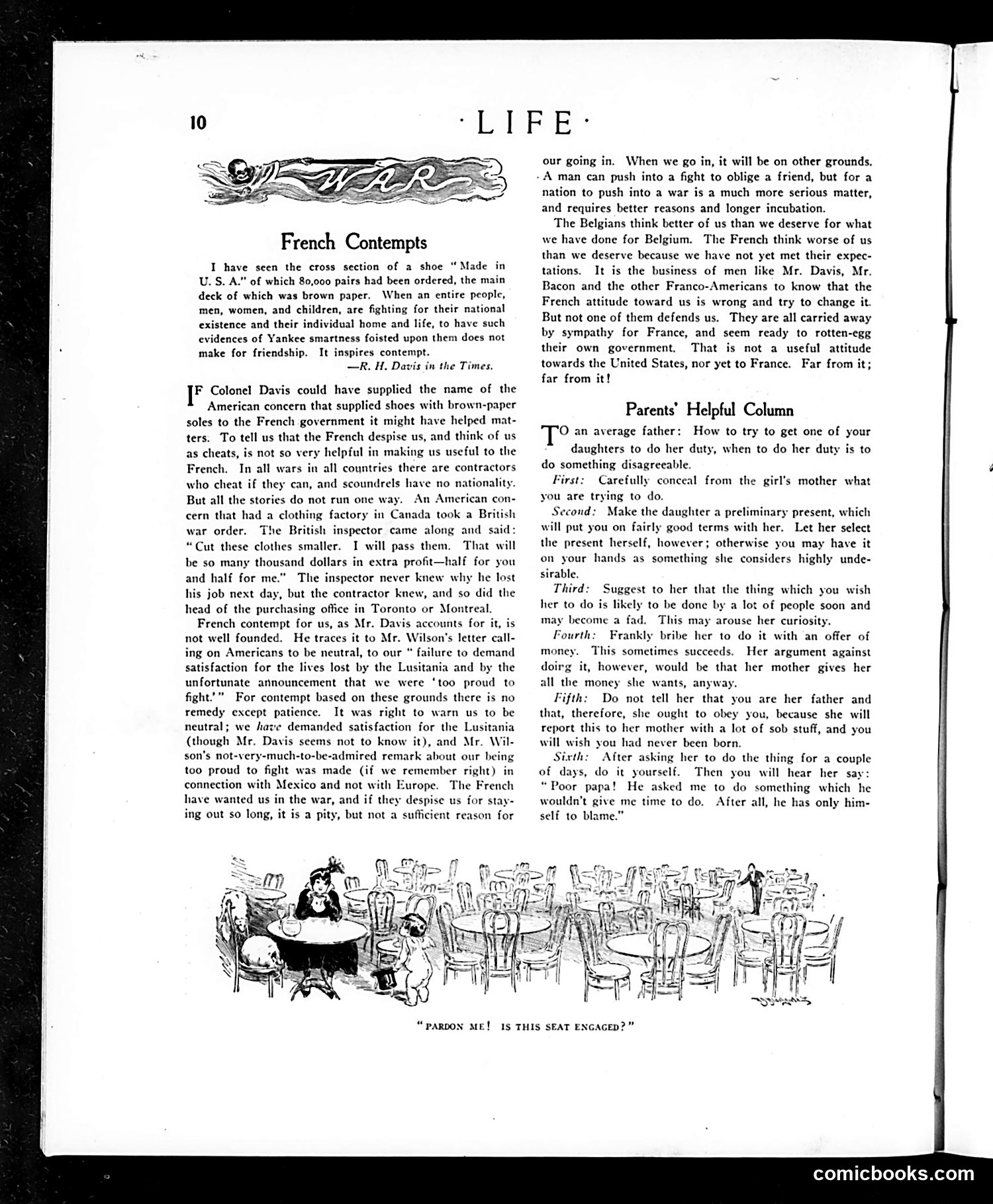
**"French Contempts" article**: R.H. Davis criticizes French attitudes toward Americans during WWI. Davis argues the French resent American soldiers' presence and view Americans as profiteers rather than allies. He references specific grievances: French contempt stems from America's initial neutrality, reluctance to enter the war, and perceived pride about fighting Mexico instead of Europe. Davis defends against accusations that American soldiers are cheaters and profiteers, attributing such behavior to universal wartime corruption rather than American character. **"Parents' Helpful Column"**: A satirical advice column offering six increasingly absurd methods to manipulate a daughter into performing an undesirable task—using concealment, bribery, psychology, and emotional manipulation. **Cartoon**: The illustration depicts a crowded restaurant or café scene with the caption "Pardon me! Is this seat engaged?"—likely a humorous social commentary on public etiquette or wartime social dynamics.
📄 Transcribed text from this page (OCR, searchable)
Machine-transcribed from the original scan — historical spelling and the odd misread are preserved.
A ll ea French Contempts I have seen the cross section of a shoe “Made in U.S. A.” of which 80,000 pairs had been ordered, the main deck of which was brown paper. When an entire people, men, women, and children, are fighting for their national existence and their individual home and life, to have such evidences of Yankee smartness foisted upon them does not make for friendship. It inspires contempt. —R. H, Davis in the Times. I Colonel Davis could have supplied the name of the American concern that supplied shoes with brown-paper soles to the French government it might have helped mat- ters. To tell us that the French despise us, and think of us as cheats, is not so very helpful in making us useful to the French. In all wars in all countries there are contractors who cheat if they can, and scoundrels have no nationality. But all the stories do not run one way. An American con- cern that had a clothing factory in Canada took a British war order. The British inspector came along and said: “Cut these clothes smaller. I will pass them. That will be so many thousand dollars in extra profit—half for you and half for me.” The inspector never knew why he lost his job next day, but the contractor knew, and so did the head of the purchasing office in Toronto or Montreal. French contempt for us, as Mr. Davis accounts for not well founded. He traces it to Mr. Wilson's letter call- ing on Americans to be neutral, to our “ failure to demand satisfaction for the lives lost by the Lusitania and by the unfortunate announcement that we were ‘too proud to fight’ For contempt based on these grounds there is no remedy except patience. It was right to warn us to be neutral; we have demanded satisfaction for the Lusitan (though Mr. Davis seems not to know it), and Mr. Wil- son's not-very-much-to-be-admired remark ahout our being too proud to fight was made (if we remember right) in connection with Mexico and not with Europe. The French have wanted us in the war, and if they despise us for stay- ing out so long, it is a pity, but not a sufficient reas our going in. When we go in, it will be on other grounds. A man can push into a fight to oblige a friend, but for a nation to push into a war is a much more serious matter, and requires better reasons and longer incubation. The Belgians think better of us than we deserve for what we have done for Belgium. The French think worse of us than we deserve because we have not yet met their expec- tations. It is the business of men like Mr. Davis, Mr. Bacon and the other Franco-Americans to know that the French attitude toward us is wrong and try to change it. But not one of them defends us. They are all carried away by sympathy for France, and seem ready to rotten-egg their own government. That is not a useful attitude towards the United States, nor yet to France. Far from it; far from it! Parents’ Helpful Column 'O an average father: How to try to get one of your daughters to do her duty, when to do her duty is to do something disagreeable. First: Carefully conceal from the girl’s mother what you are trying to do. Second: Make the daughter a preliminary present, which will put you on fairly good terms with her. Let her select the present herself, however; otherwise you may have it on your hands as something she considers highly unde- sirable. Third: Suggest to her that the thing which you wish her to do is likely to be done by a lot of people soon and may become a fad. This may arouse her curiosity. Fourth: Frankly bribe her to do it with an offer of money. This sometimes succeeds. Her argument against doirg it, however, would be that her mother gives her all the money she wants, anyway. Fifth: Do not tell her that you are her father and that, therefore, she ought to obey you, because she will report this to her mother with a lot of sob stuff, and you will wish you had never been born. rth: After asking her to do the thing for a couple of days, do it yourself. Then you will hear her say: “Poor papa! He asked me to do something which he wouldn't give me time to do. After all, he has only him- self to blame.” “PARDON ME! 1S THIS SEAT ENGAGED?” comicbooks.com