
Life, 1916-01-06 · page 30 of 48
Life — January 6, 1916 — page 30: what you’re looking at
What you’re looking at
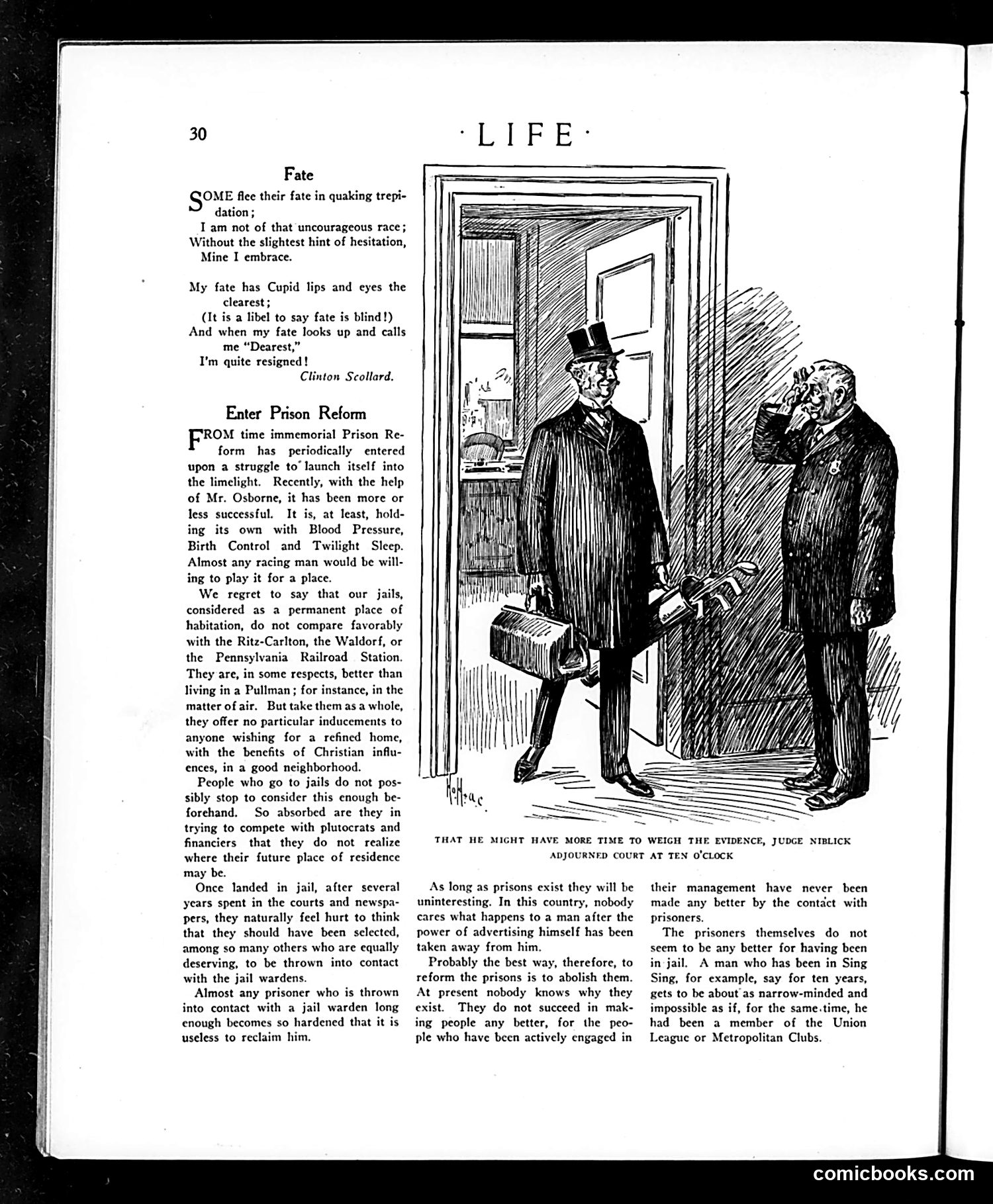
The page contains two distinct sections: **"Fate" Poem**: A light romantic verse by Clinton Scollard about accepting one's romantic destiny with good humor. **"Enter Prison Reform" Section**: A satirical essay critiquing American prison reform efforts and the justice system. The accompanying illustration shows Judge Niblick adjourning court to weigh evidence—the caption's irony suggesting judicial laziness. The essay's satire operates through exaggeration: it compares jails unfavorably to luxury hotels (Ritz-Carlton, Waldorf) and railroad Pullman cars, then absurdly suggests abolishing prisons entirely as the "best way" to reform them. The piece mocks prisoners for not considering jail consequences while competing with "plutocrats and financiers," and claims that contact with jail wardens and even jail time itself hardens rather than reforms inmates. The final jab suggests imprisoned criminals become no worse morally than respectable club members—attacking both the criminal justice system's effectiveness and upper-class hypocrisy simultaneously.
📄 Transcribed text from this page (OCR, searchable)
Machine-transcribed from the original scan — historical spelling and the odd misread are preserved.
30 Fate SOME flee their fate in quaking trepi- dation ; I am not of that uncourageous race; Without the slightest hint of hesitation, Mine I embrace. My fate has Cupid lips and eyes the clearest ; (It is a libel to say fate is blind!) And when my fate looks up and calls me “Dearest,” I'm quite resigned! Clinton Scollard. Enter Prison Reform ‘ROM time immemorial Prison Re- form has periodically entered upon a struggle to’ launch itself into the limelight. Recently, with the help of Mr. Osborne, it has been more or less successful. It is, at least, hold- ing its own with Blood Pressure, Birth Control and Twilight Sleep. Almost any racing man would be will- ing to play it for a place. We regret to say that our jails, considered as a permanent place of habitation, do not compare favorably with the Ritz-Carlton, the Waldorf, or the Pennsylvania Railroad Station. They are, in some respects, better than living in a Pullman ; for instance, in the matter of air. But take them as a whole, they offer no particular inducements to anyone wishing for a refined home, with the benefits of Christian influ- ences, in a good neighborhood. People who go to jails do not pos- sibly stop to consider this enough be- forehand, So absorbed are they in trying to compete with plutocrats and financiers that they do not realize where their future place of residence may be. Once landed in jail, after several years spent in the courts and newspa- pers, they naturally feel hurt to think that they should have been selected, among so many others who are equally deserving, to be thrown into contact with the jail wardens. Almost any prisoner who is thrown into contact with a jail warden long enough becomes so hardened that it is useless to reclaim him. SS SSSx“s5cs WSS SSS SN SS SS SS SSS SSS SASST SOS S THAT HE MIGHT HAVE MORE TIME TO WEIGH THE EVIDENCE, JUDGE NIBLICK ADJOURNED COURT AT TEN O'CLOCK As long as prisons exist they will be uninteresting. In this country, nobody cares what happens to a man after the power of advertising himself has been taken away from him, Probably the best way, therefore, to reform the prisons is to abolish them. At present nobody knows why they exist. They do not succeed in mak- ing people any better, for the peo- ple who have been actively engaged in their management have never been made any better by the contact with prisoners. The prisoners themselves do not seem to be any better for having been in jail, A man who has been in Sing Sing, for example, say for ten years, gets to be about as narrow-minded and impossible as if, for the same.time, he had been a member of the Union League or Metropolitan Clubs. comicbooks.com