
Life, 1916-01-06 · page 16 of 48
Life — January 6, 1916 — page 16: what you’re looking at
What you’re looking at
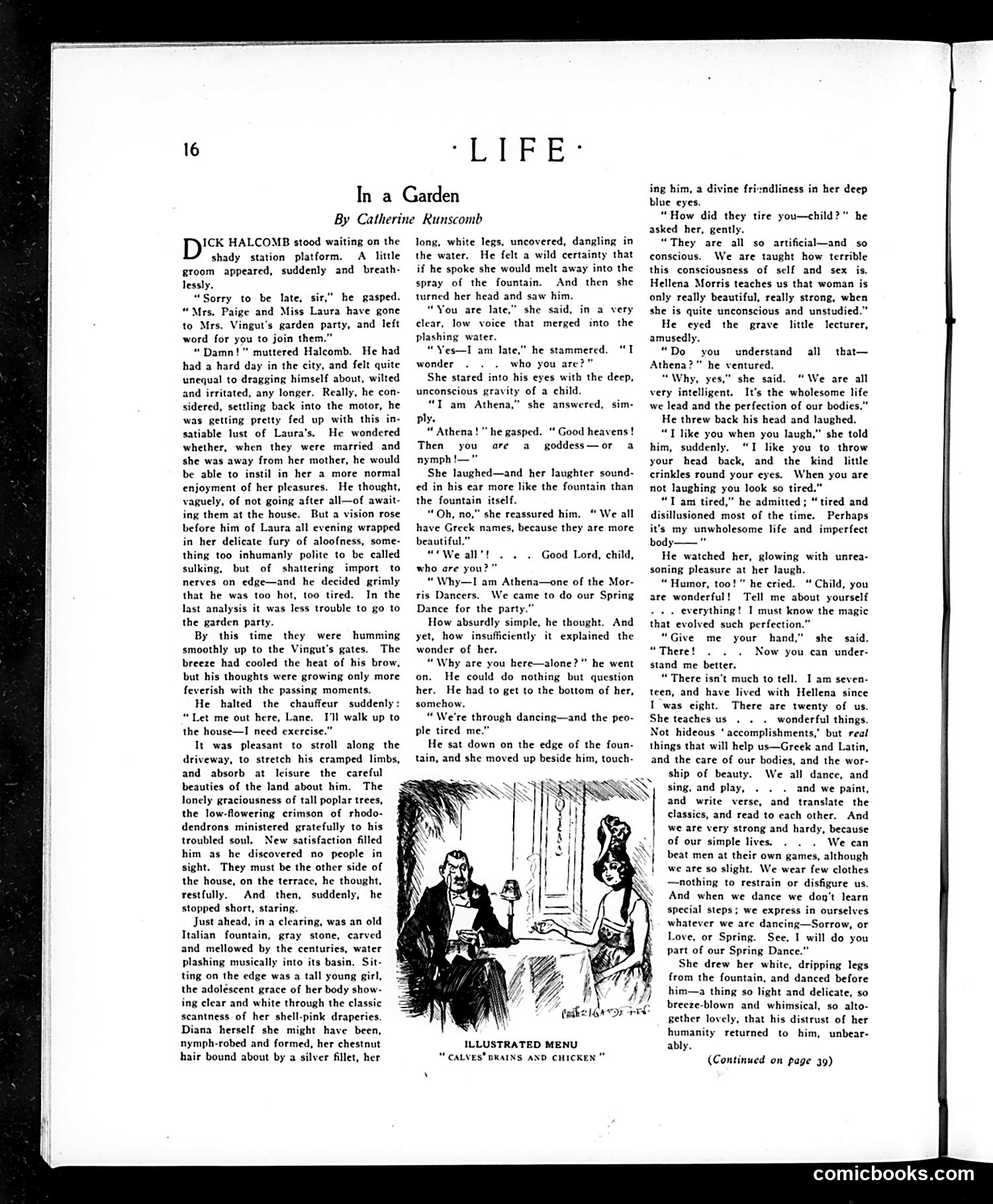
This page contains a short story by Catherine Runscomb titled "In a Garden," not political cartoon or satire. It depicts a romantic narrative: a man named Dick Halcomb reluctantly attends a garden party and encounters a young woman named Athena by a fountain. She's one of the "Morris Dancers" (a traditional English folk-dancing group) hired to perform at the party. The story explores class and attraction—Halcomb is initially enchanted by her ethereal, goddess-like appearance, only to learn she's simply a performer. The illustration shows them by the fountain in conversation. This is **literary fiction**, typical of Life magazine's content alongside satire and humor pieces. It contains no political references or social commentary beyond subtle class dynamics.
📄 Transcribed text from this page (OCR, searchable)
Machine-transcribed from the original scan — historical spelling and the odd misread are preserved.
1CK HALCOMB stood waiting on the shady station platform. A little groom appeared, suddenly and breath- lessly. “Sorry to be late, sir,” he gasped. “Mrs. Paige and Miss Laura have gone to Mrs. Vingut’s garden party, and left word for you to join them.” “Damn!” muttered Halcomb, He had had a hard day in the city, and felt quite unequal to dragging himself about, wilted and irritated, any longer. Really, he con- sidered, settling back into the motor, he was getting pretty fed up with this in- satiable lust of Laura's. He wondered whether, when they were married and she was away from her mother, he would be able to instil in her a more normal enjoyment of her pleasures. He thought, vaguely, of not going after all—of await- ing them at the house. But a vision rose before him of Laura all evening wrapped in her delicate fury of aloofness, some- thing too inhumanly polite to be called sulking, but of shattering import to nerves on edge—and he decided grimly that he was too hot, too tired. In the last analysis it was less trouble to go to the garden party. By this time they were humming smoothly up to the Vingut's gates. The breeze had cooled the heat of his brow, but his thoughts were growing only more feverish with the passing moments. He halted the chauffeur suddenly: “Let me out here, Lane. I'll walk up to the house—I need exercise.” It was pleasant to stroll along the driveway, to stretch his cramped limbs, and absorb at leisure the careful beauties of the land about him. The lonely graciousness of tall poplar trees, the low-flowering crimson of rhodo- dendrons ministered gratefully to his troubled soul. New satisfaction filled him as he discovered no people in sight. They must be the other side of the house, on the terrace, he thought, restfully. And then, suddenly, he stopped short, staring. Just ahead, in a clearing, was an old Italian fountain, gray stone, carved and mellowed by the centuries, water plashing musically into its basin. Sit- ting on the edge was a tall young girl, the adoléscent grace of her body show- ing clear and white through the classic scantness of her shell-pink draperies. Diana herself she might have been, nymph-robed and formed, her chestnut hair bound about by a silver fillet, her 7 RNE In a Garden By Catherine Runscomb long, white legs, uncovered, dangling in the water. He felt a wild certainty that if he spoke she would melt away into the spray of the fountain. And then she turned her head and saw him. “You are late,” she said, in a very clear, low voice that merged into the plashing water. “Yes—I am late,” he stammered. “T wonder who you are?” She stared into his eyes with the deep, unconscious gravity of a child. “Tam Athena,” she answered, sim- ply. “ Athena!" he gasped. “ Good heavens! Then you are a goddess—or a nymph !—"" She laughed—and her laughter sound- ed in his ear more like the fountain than the fountain itself. “Oh, no,” she reassured him. “ We all have Greek names, because they are more beautiful.” “*We all’! . . who are you? “ Why—I am Athena—one of the Mor- ris Dancers. We came to do our Spring Dance for the party.” How absurdly simple, he thought. And yet, how insufficiently it explained the wonder of her. “Why are you here—alone?" he went on. He could do nothing but question her. He had to get to the bottom of her, somehow. “We're through dancing—and the peo- ple tired me.” He sat down on the edge of the foun- tain, and she moved up beside him, touch- Good Lord, child, ILLUSTRATED MENU “ CALVES’ BRAINS AND CHICKEN ” ing him, a divine friendliness in her deep blue eyes. “How did they tire you—child?” he asked her, gently. “They are all so artificial—and so conscious. We are taught how terrible this consciousness of self and sex is. Hellena Morris teaches us that woman is only really beautiful, really strong, when she is quite unconscious and unstudied.” He eyed the grave little lecturer, amusedly. “Do you understand all Athena?” he ventured. “Why, yes,” she said. “We are all very intelligent. It’s the wholesome life we lead and the perfection of our bodies.” He threw back his head and laughed. “T like you when you laugh,” she told him, suddenly. “I like you to throw your head back, and the kind little crinkles round your eyes. When you are not laughing you look so tired.’ “Tam tired,” he admitted ; “tired and disillusioned most of the time. Perhaps it's my unwholesome life and imperfect body——"” He watched her, glowing with unrea- soning pleasure at her laugh. “Humor, too!" he cried. “Child, you are wonderful! Tell me about yourself «+. everything! I must know the magic that evolved such perfection.” “Give me your hand,” she said. “There! Now you can under- stand me better. “ There isn't much to tell. I am seven- teen, and have lived with Hellena since I was eight. There are twenty of us. She teaches us . . wonderful things. Not hideous ‘accomplishments,’ but real things that will help us—Greek and Latin, and the care of our bodies, and the wor- ship of beauty. We all dance, and sing, and play, and we paint, and write verse, and translate the classics, and read to each other. And we are very strong and hardy, because of our simple lives. We can beat men at their own games, although we are so slight. We wear few clothes —nothing to restrain or disfigure us. And when we dance we don't learn special steps; we express in ourselves whatever we are dancing—Sorrow, or Love, or Spring. See, I will do you part of our Spring Dance.” She drew her white, dripping legs from the fountain, and danced before him—a thing so light and delicate, so breeze-blown and whimsical, so alto- gether lovely, that his distrust of her humanity returned to him, unbear- ably. that— (Continued on page 39) comicbooks.com