
Life, 1916-01-06 · page 28 of 48
Life — January 6, 1916 — page 28: what you’re looking at
What you’re looking at
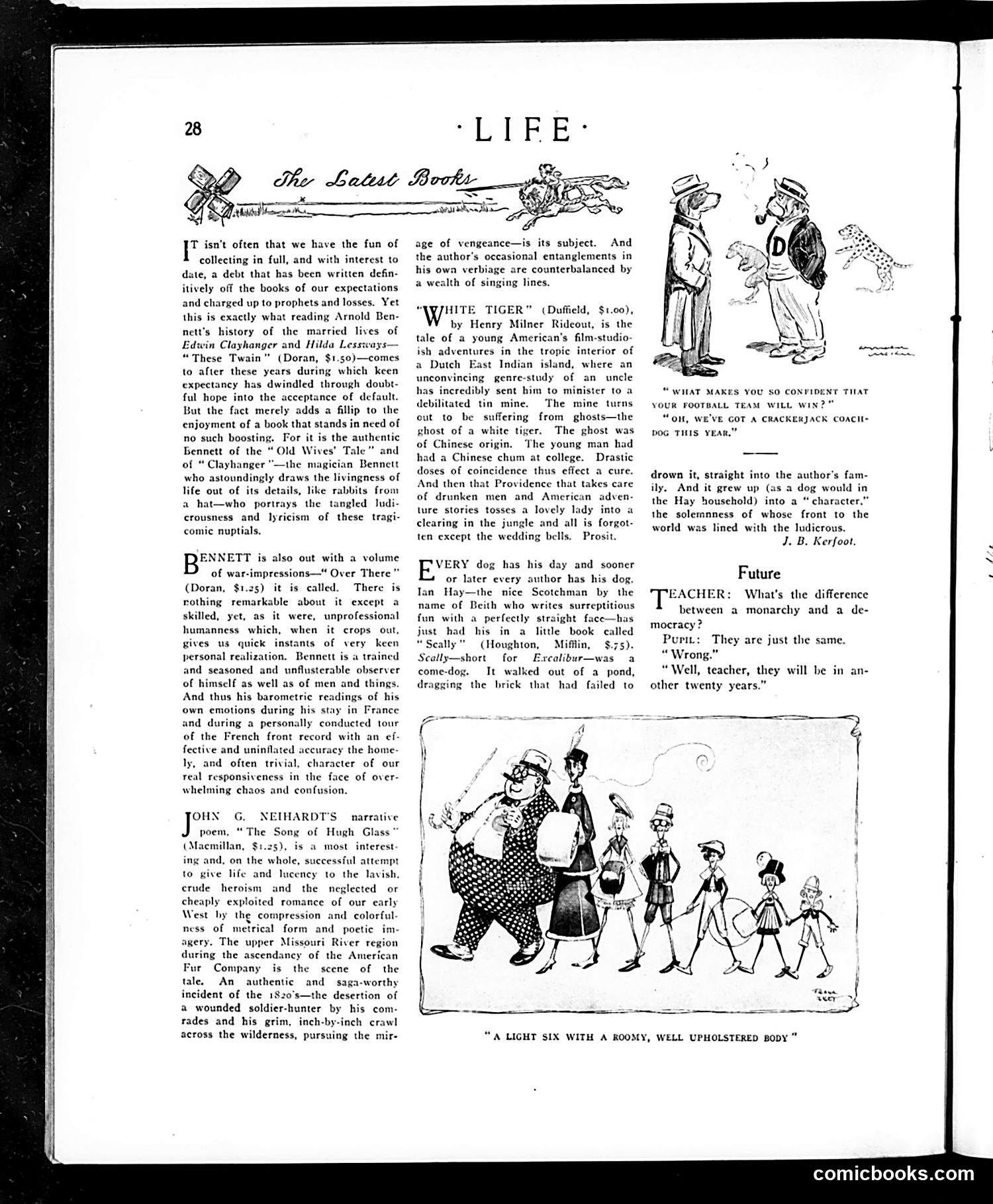
This page from *Life* magazine presents book reviews rather than political cartoons. The content discusses four recent publications: **Arnold Bennett's "These Twain"** — praised as authentic character work depicting married life with emotional depth. **Bennett's war memoir "Over There"** — critiqued as humanistic but unprofessional, capturing ordinary emotional responses to WWI's chaos. **John Neihardt's "The Song of Hugh Glass"** — a narrative poem about an 1820s frontier incident where a wounded fur-trapper crawls across wilderness for vengeance. **Henry Milner Rideout's "White Tiger"** and **Ian Hay's "Seally"** — adventure and animal stories reviewed with light mockery of their contrived plots. The cartoon below shows a coach confidently claiming his football team will win because "we've got a crackerjack dog this year"—a humorous visual reinforcing Hay's story about a dog that became central to the team's success. The joke satirizes how absurdly arbitrary sporting success can seem.
📄 Transcribed text from this page (OCR, searchable)
Machine-transcribed from the original scan — historical spelling and the odd misread are preserved.
Pn ea T isn’t often that we have the fun of collecting in full, and with interest to date, a debt that has been written defin- itively off the books of our expectations and charged up to prophets and losses. Yet this is exactly what reading Arnold Ben- nett’s history of the married lives of Edwin Clayhanger and Hilda Lessways— “These Twain” (Doran, $1.50)—comes to after these years during which keen expectancy has dwindled through doubt- ful hope into the acceptance of default. But the fact merely adds a fillip to the enjoyment of a book that stands in need of no such boosting. For it is the authentic Bennett of the “Old Wives’ Tale” and of “ Clayhanger "—the magician Bennett who astoundingly draws the livingness of life out of its details, like rabbits from a hat—who portrays the tangled lndi- crousness and lyricism of these tragi- comic nuptials. B®? of war-impressions—“ Over There" (Doran, $1.25) it is called. There is nothing remarkable about it except a skilled, yet, as it were, unprofessional humanness which, when it crops out, gives us quick instants of very keen personal realization, Bennett is a trained and seasoned and unflusterable observer of himself as well as of men and things. And thus his barometric readings of his own emotions during his stay in France and during a personally conducted tour of the French front record with an ef- fective and uninflated accuracy the home- ly, and often trivial, character of our real responsiveness in the face of over- whelming chaos and confusion. ETT is also out with a volume OHN G. NEIHARDT’S narrative poem, “The Song of Hugh Glass” (Macmillan, $1.25), is a most interest ing and, on the whole, successful attempt to give life and lucency to the lavish, and the neglected or cheaply exploited romance of our early West by the compression and colorful- ness of metrical form and poetic im- agery. The upper Missouri River region during the ascendancy of the Ameri Fur Company is the scene of the tale. An authentic and saga-worthy incident of the 1820's—the desertion of a wounded soldier-hunter by his com- rades and his grim, inch-by-inch crawl across the wilderness, pursuing the mi crude heroism aa ie. age of vengeance—is its subject. And the author's occasional entanglements in his own verbiage are counterbalanced by a wealth of singing lines. “YYW/HITE TIGER” (Duffield, $1.00), by Henry Milner Rideout, is the tale of a young American's film-studio- ish adventures in the tropic interior of a Dutch East Indian island, where an unconvincing genre-study of an uncle has incredibly sent him to minister to a debilitated tin mine. The mine turns out to be suffering from ghosts—the ghost of a white tiger. The ghost was of Chinese origin. The young man had had a Chinese chum at college. Drastic doses of coincidence thus effect a cure. And then that Providence that takes care of drunken men and American adven- ture stories tosses a lovely lady into a clearing in the jungle and all is forgot- ten except the wedding bells. Prosit. EVERY dog has his day and sooner or later every author has his dog. Ian Hay—the nice Scotchman by the name of Beith who writes surreptitious fun with a perfectly straight face—has just had his in a little book called “Seally" (Houghton, Mifflin, $.75). Scally—short for Excalibur—was a come-dog. It walked out of a pond, dragging the brick that had failed to “ WHAT MAKES YOU SO CONFIDENT THAT YOUR FOOTBALL TEAM WILL WIN?” “OM, WE'VE GOT A CRACKERJACK DOG THIS YEAR,” coacit- drown it, straight into the author's fam- ily, And it grew up (as a dog would in the Hay household) into a “ character,” the solemnness of whose front to the world was lined with the ludicrous. J.B. Kerfoot. Future EACHER: What's the difference between a monarchy and a de- mocracy ? Purit: They are just the same. “Wrong.” “Well, teacher, they will be in an- other twenty years.” “A LIGHT SIX WITH A ROOMY, WELL UPHOLSTERED BODY ” comicbooks.com