
Life, 1916-01-06 · page 26 of 48
Life — January 6, 1916 — page 26: what you’re looking at
What you’re looking at
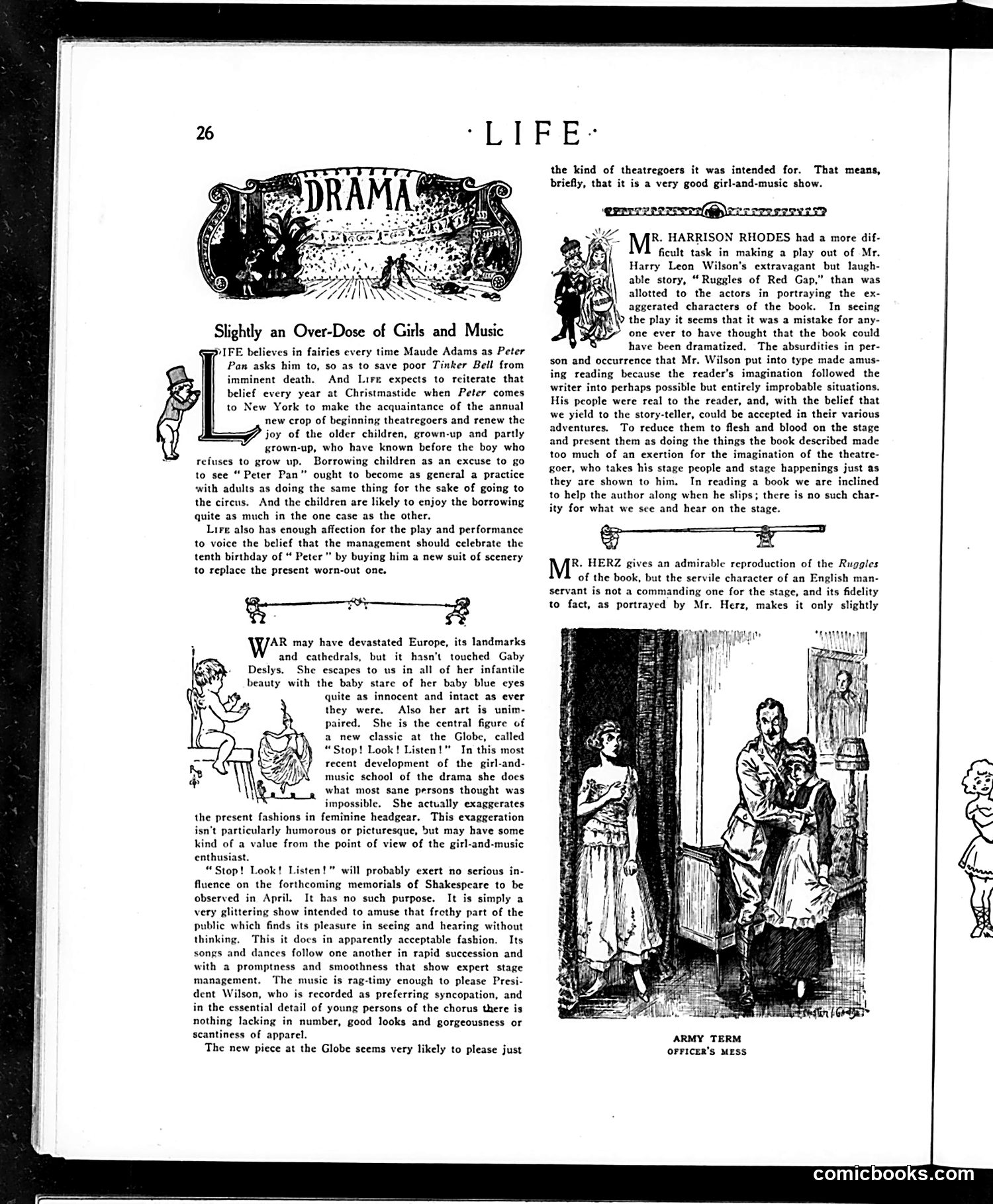
This page reviews three theatrical productions from the early 1910s: **"Peter Pan"**: Life celebrates the annual New York production starring Maude Adams, endorsing it as wholesome entertainment for both children and nostalgic adults. The magazine advocates that the theater replace its worn scenery for the play's tenth anniversary. **"Stop! Look! Listen!"**: A musical revue starring French entertainer Gaby Deslys. Life dismisses it as frivolous "girl-and-music" entertainment—deliberately vapid spectacle designed for audiences "which finds its pleasure in seeing and hearing without thinking." The satire mocks Deslys's exaggerated fashions and the show's reliance on scantily-clad chorus girls and ragtime music (President Wilson's alleged preference is mentioned sarcastically). **"Ruggles of Red Gap"**: An adaptation of Harry Leon Wilson's novel that Life judges a failed dramatization—the absurdities that worked humorously on the page become unconvincing when physically performed on stage. The overall tone critiques lowbrow theatrical entertainment while praising intellectually respectable drama.
📄 Transcribed text from this page (OCR, searchable)
Machine-transcribed from the original scan — historical spelling and the odd misread are preserved.
Slightly an Over-Dose of Girls and Music YIFE believes in fairies every time Maude Adams as Peter Pan asks him to, so as to save poor Tinker Bell from imminent death. And Lire expects to reiterate that belief every year at Christmastide when Peter comes to New York to make the acquaintance of the annual new crop of beginning theatregoers and renew the joy of the older children, grown-up and partly grown-up, who have known before the boy who refuses to grow up. Borrowing children as an excuse to go to see “ Peter Pan” ought to become as general a practice with adults as doing the same thing for the sake of going to the circus. And the children are likely to enjoy the borrowing ite as much in the one case as the other. e also has enough affection for the play and performance to voice the belief that the management should celebrate the tenth birthday of “ Peter” by buying him a new suit of scenery to replace the present worn-out one. 1 @ ay 2 TAR may have devastated Europe, its landmarks and cathedrals, but it hasn't touched Gaby Deslys. She escapes to us in all of her infantile beauty with the baby stare of her baby blue cyes quite as innocent and intact as ever they were, Also her art is unim- paired, She is the central figure of a new classic at the Globe, called “Stop! Look! Listen!” In this most recent development of the girl-and- music school of the drama she docs what most sane persons thought was impossible. She actually exaggerates the present fashions in feminine headgear. This exaggeration isn’t particularly humorous or picturesque, but may have some kind of a value from the point of view of the girl-and-music enthusiast “Stop! Look! Listen!” will probably exert no serious in- fluence on the forthcoming memorials of Shakespeare to be observed in April. It has no such purpose. It is simply a very glittering show intended to amuse that frothy part of the public which finds its pleasure in seeing and hearing without thinking, This it docs in apparently acceptable fashion. Its songs and dances follow one another in rapid succession and with a promptness and smoothness that show expert stage management. The music is rag-timy enough to please Presi- dent Wilson, who is recorded as preferring syncopation, and in the essential detail of young persons of the chorus there is nothing lacking in number, good looks and gorgeousness or scantiness of apparel. The new piece at the Globe seems very likely to please just *LIPE- the kind of theatregoers it was intended for. briefly, that it is a very good girl-and-music show. That means, ‘ 2: here rd R. HARRISON RHODES had a more dif- ficult task in making a play out of Mr. Harry Leon Wilson's extravagant but laugh- able story, “Ruggles of Red Gap,” than was allotted to the actors in portraying the ex- | aggerated characters of the book. In seeing the play it seems that it was a mistake for any- one ever to have thought that the book could have been dramatized. The absurdities in per- son and occurrence that Mr. Wilson put into type made amus- ing reading because the reader's imagination followed the writer into perhaps possible but entirely improbable situations. His people were real to the reader, and, with the belief that we yield to the story-teller, could be accepted in their various adventures. To reduce them to flesh and blood on the stage and present them as doing the things the book described made too much of an exertion for the imagination of the theatre- goer, who takes his stage people and stage happenings just as they are shown to him. In reading a book we are inclined to help the author along when he slips; there is no such char- ity for what we sce and hear on the stage. rr: a R. HERZ gives an admirable reproduction of the Ruggles of the book, but the servile character of an English man- servant is not a commanding one for the stage, and its fidelity to fact, as portrayed by Mr. Herz, makes it only slightly ARMY TERM OFFICER'S MESS comicbooks.com