
A complete issue · 48 pages · 1915
Life — December 9, 1915
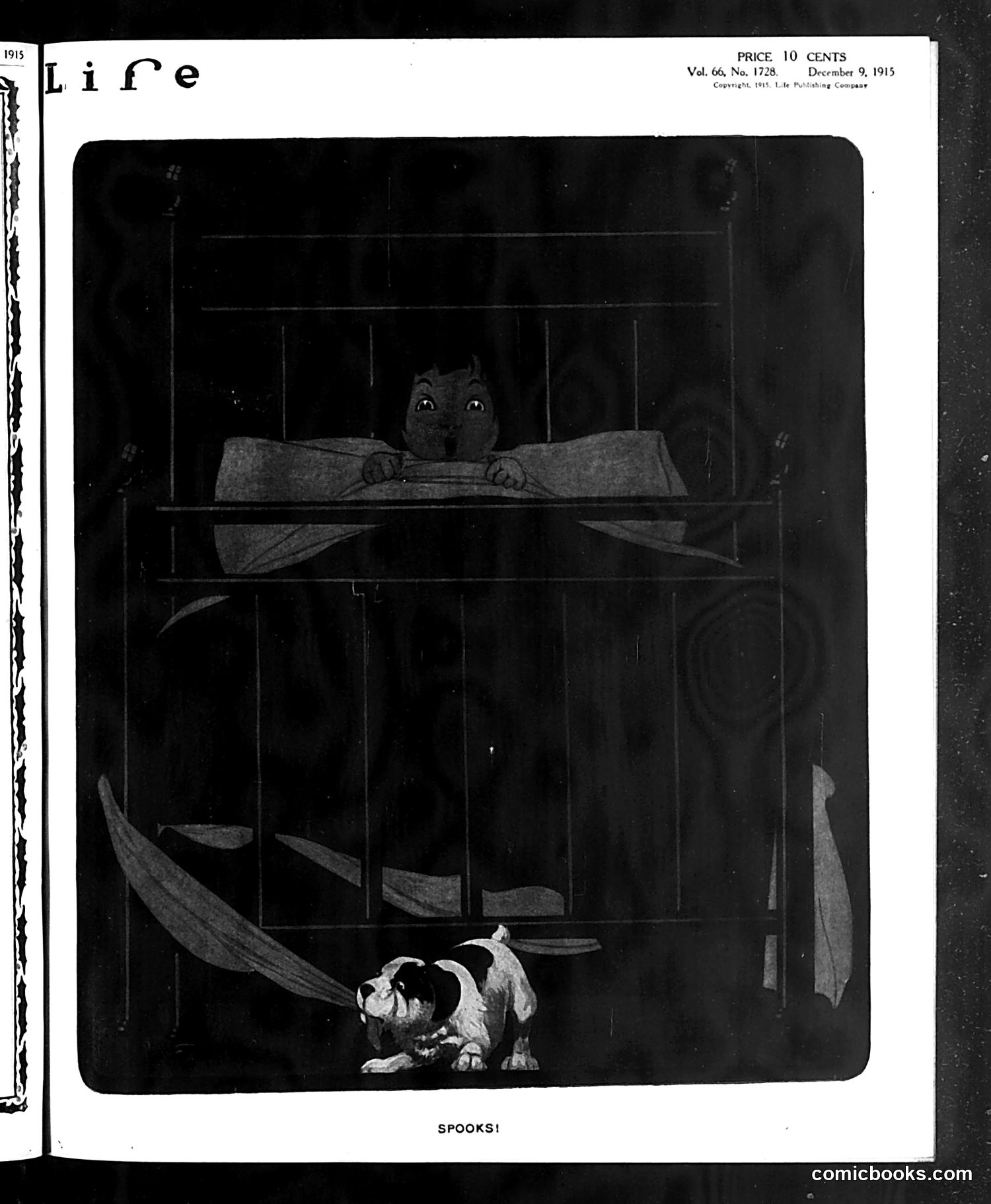
This is a humorous domestic scene playing on the word "spooks"—both ghosts and, potentially, a reference to German spies (timely given America's proximity to World War I entry in 1915). The cartoon shows a dog confronting what appears to be a ghostly or suspicious figure peering through a barred window at night, with fabric or cloth draped around. The figure's wide, startled eyes and the dog's alert stance create comedic tension. The joke likely operates on two levels: either a straightforward "ghost scare" narrative, or contemporary commentary on wartime paranoia about foreign agents. The dog serves as the household guardian detecting an intruder—whether supernatural or espionage-related—at the window.
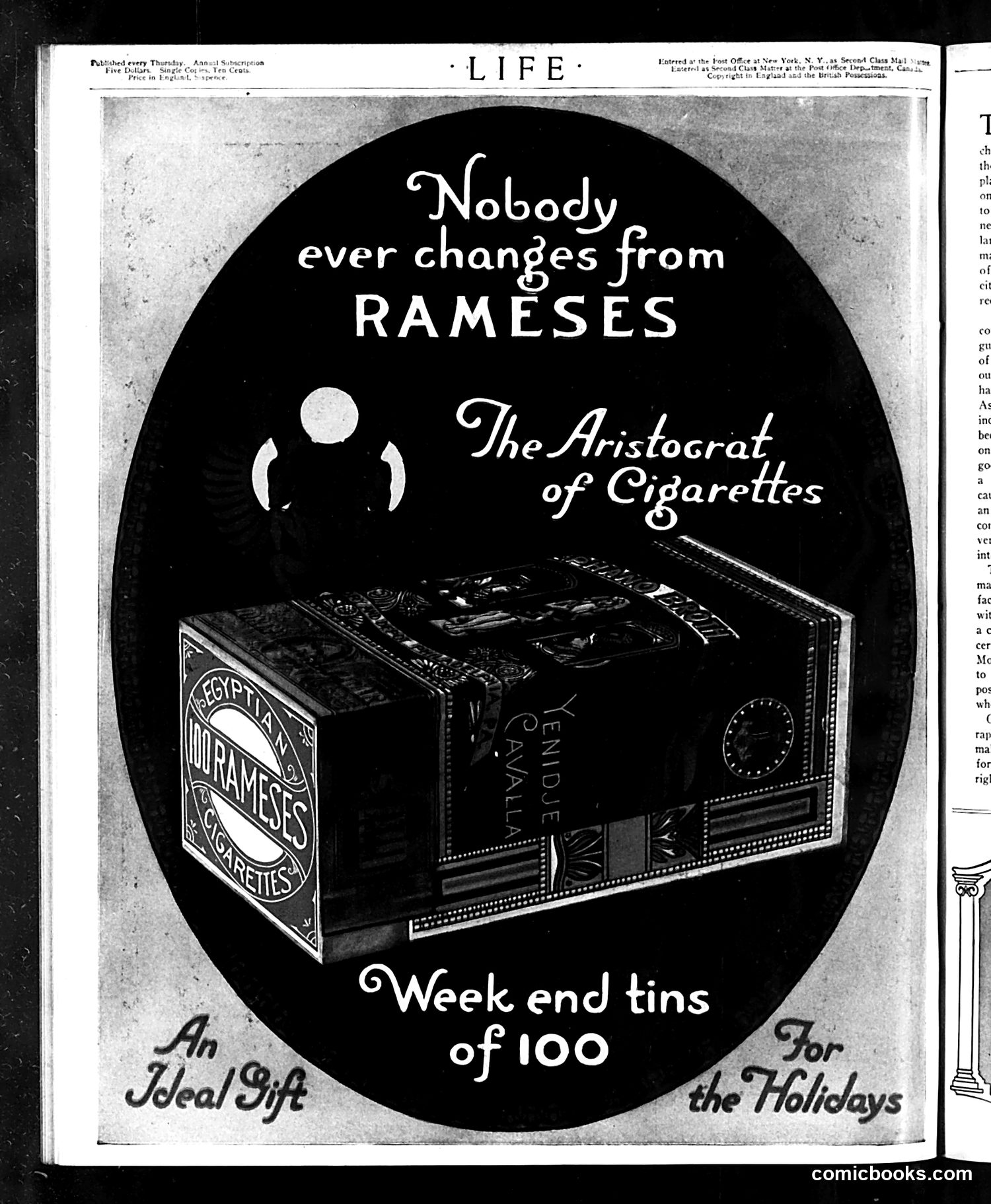
This is a **cigarette advertisement**, not political satire. The ad promotes Rameses cigarettes with the slogan "Nobody ever changes from RAMESES—The Aristocrat of Cigarettes." The design features an ornate tin box of Egyptian-themed cigarettes displayed centrally within a black oval. The "Egyptian" branding and imagery (visible on the left side of the tin) references the popular early 20th-century fascination with Egyptian design and luxury goods. The marketing pitch emphasizes product loyalty and positioning Rameses as a premium, sophisticated choice. "Week end tins of 100" and "An Ideal Gift for the Holidays" are sales appeals targeting gift-givers. This represents vintage tobacco advertising before health warnings, when cigarettes were marketed as refined consumer goods without irony or controversy.
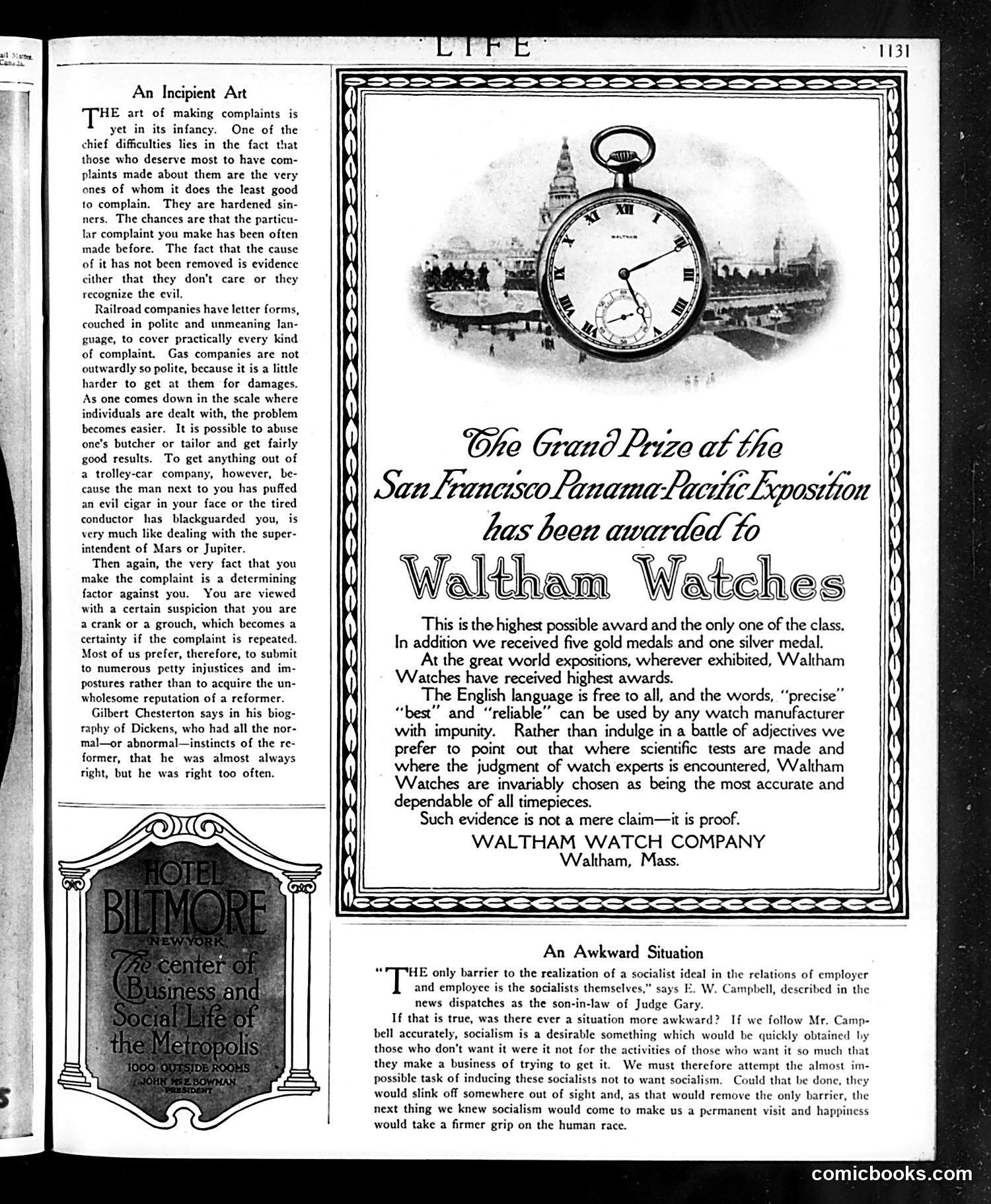
This page contains two distinct elements: 1. **Left column**: An essay titled "An Incipient Art" discussing the difficulty of making complaints effectively, with a Gilbert Chesterton quote about reformers being right too often. Below is an advertisement for Hotel Biltmore in New York. 2. **Right column**: A full-page advertisement for Waltham Watches, featuring a pocket watch image and text announcing that Waltham won the Grand Prize at the San Francisco Panama-Pacific Exposition. The ad emphasizes the watch's accuracy and reliability, claiming Waltham watches are "invariably chosen as being the most accurate and dependable of all timepieces." 3. **Bottom**: A brief article titled "An Awkward Situation" discussing socialism and employer-employee relations, quoting E.W. Campbell on the contradictions inherent in socialist ideology. The page is primarily commercial rather than satirical.
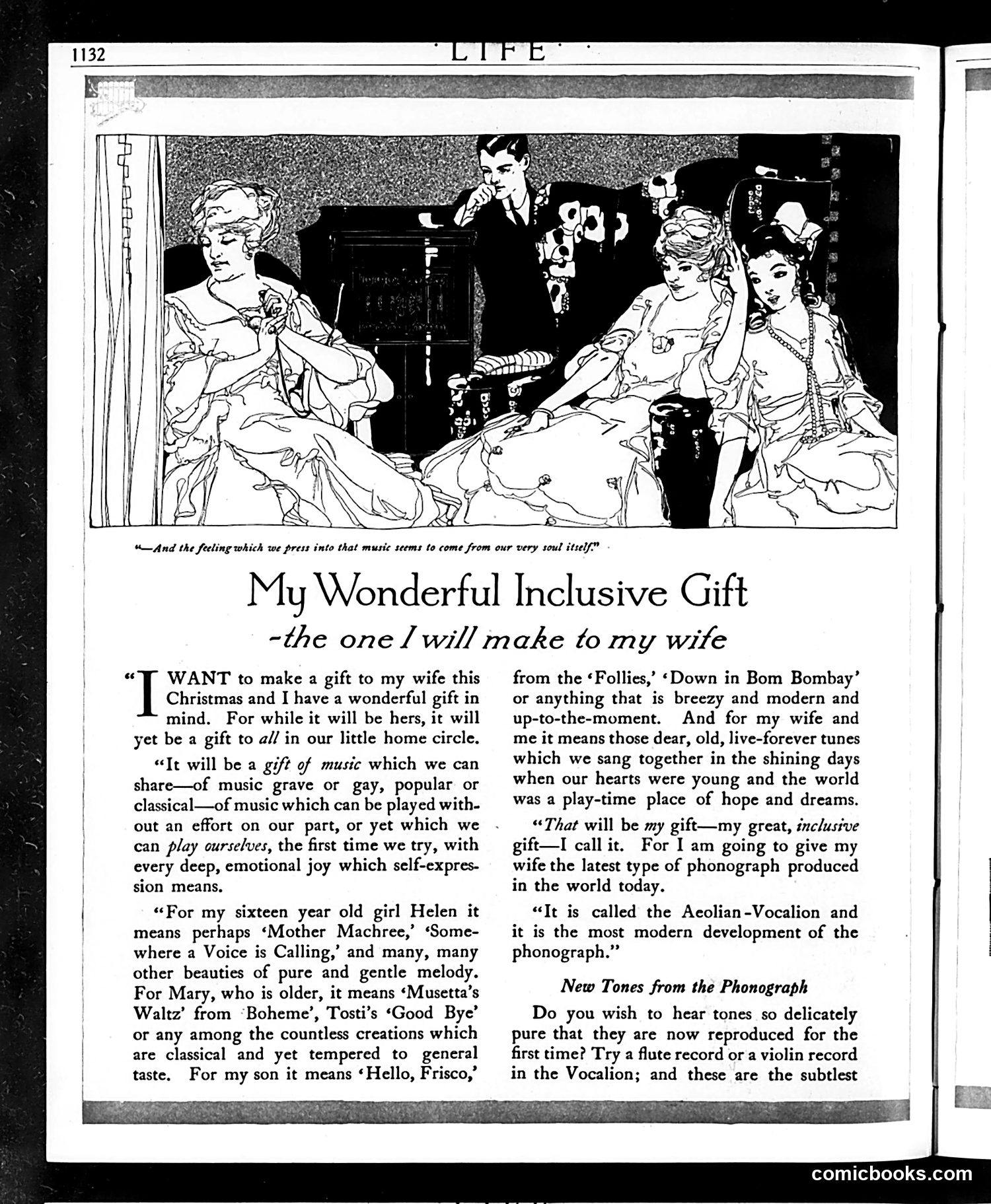
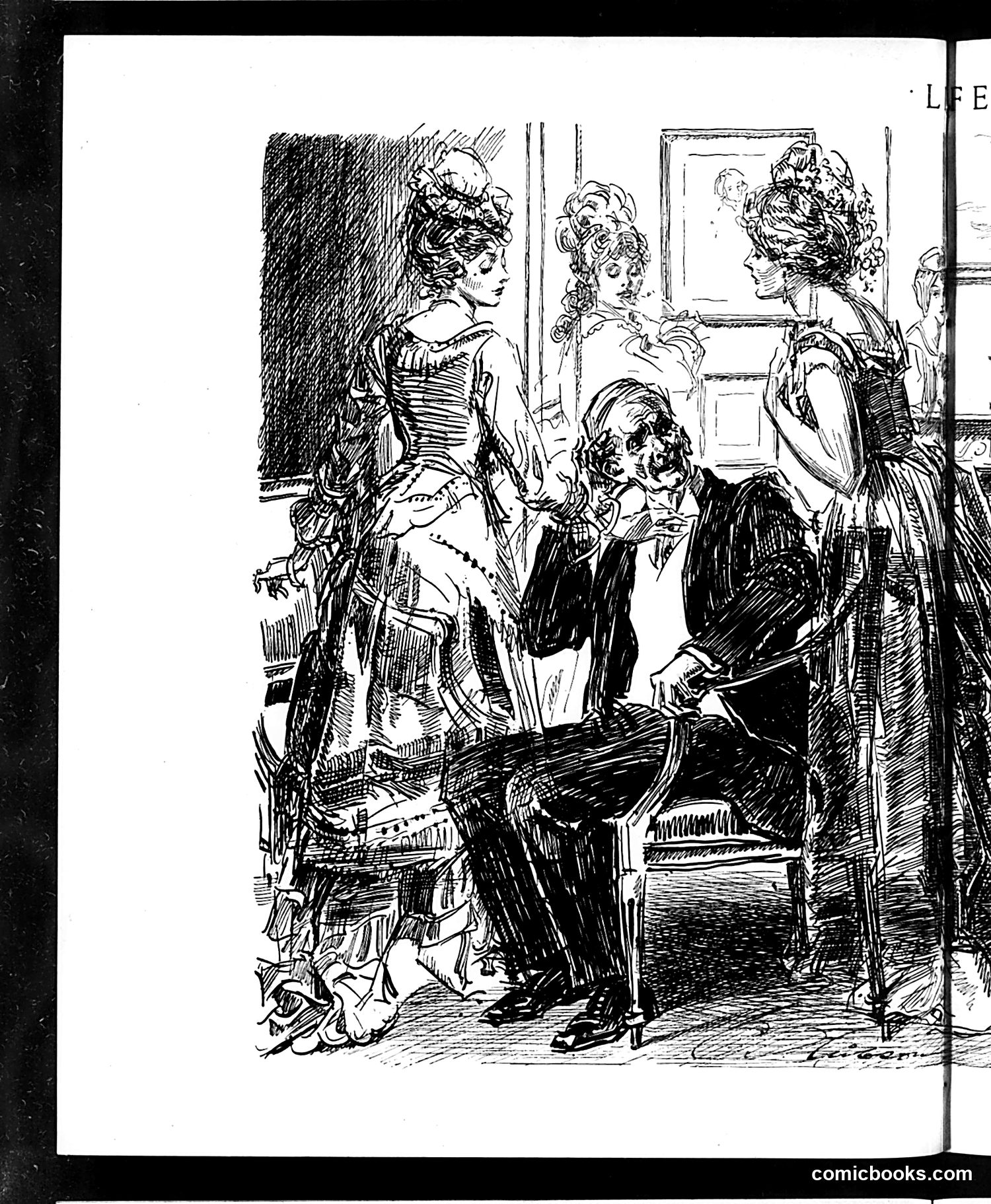
This page is primarily **advertising content**, not satire or political commentary. It advertises the "Aeolian-Vocalion" phonograph as a Christmas gift. The illustration shows a domestic scene with well-dressed women and a man in formal attire, establishing an aspirational, upper-class setting. The accompanying text presents a husband's rationale for buying this "wonderful inclusive gift" for his wife—framing the phonograph as enabling shared musical enjoyment without effort. The pitch emphasizes the phonograph's modern sophistication and emotional appeal: it promises access to both classical and popular music ("breezy and modern"), positioning the device as a gateway to shared family memories and romantic moments ("shining days when our hearts were young"). This reflects early 20th-century consumer culture targeting affluent households, using sentiment and modernity as marketing strategies.
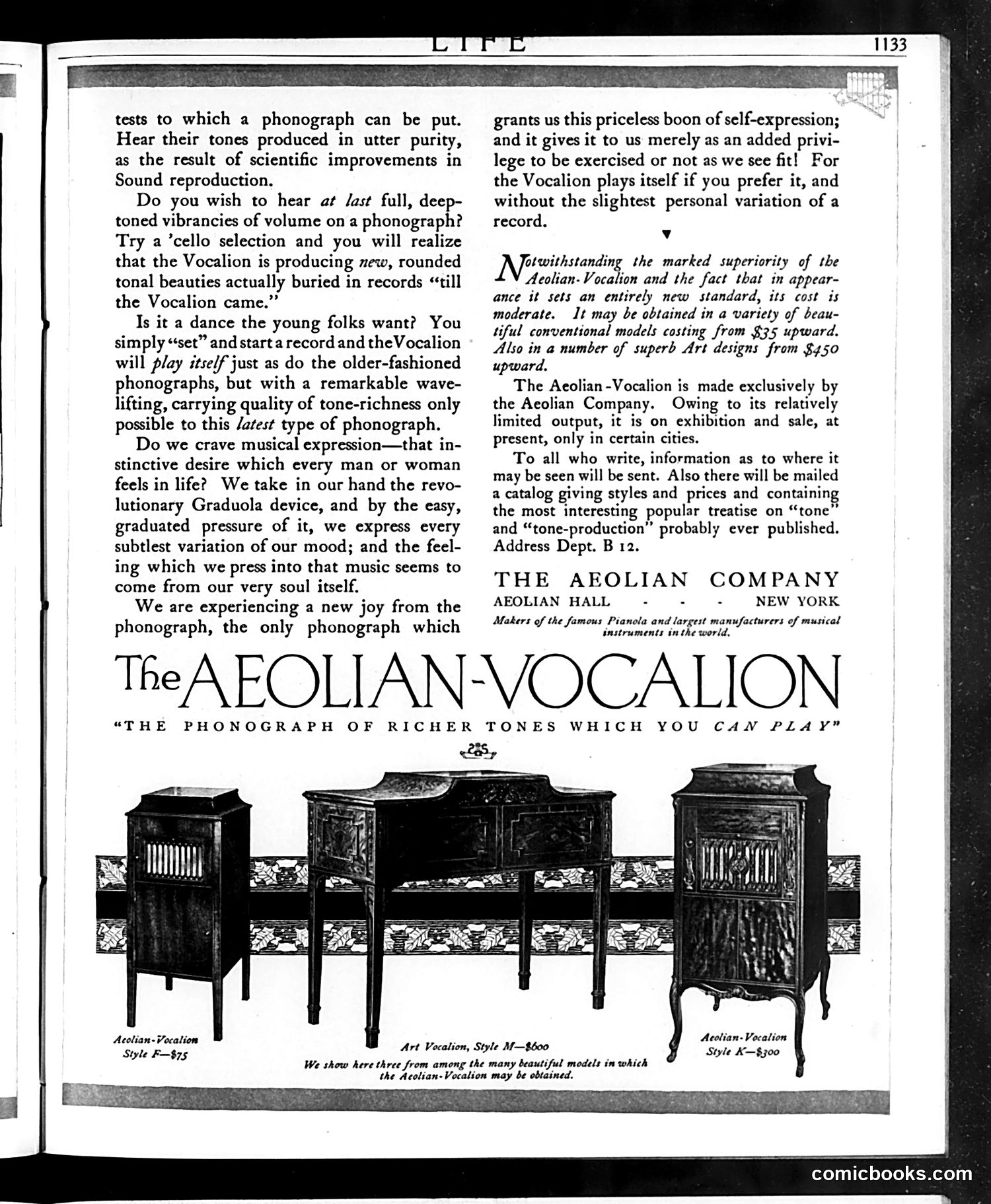
This page is **primarily an advertisement**, not satire or political commentary. It promotes the Aeolian-Vocalion phonograph, manufactured by The Aeolian Company of New York. The ad emphasizes the phonograph's superior sound quality and its innovative "Graduela device," which allows users to control musical expression and emotional nuance—claims positioning it against competitors. The text highlights features like "full, deep-toned vibrancies" and suggests the device enables personal artistic interpretation during playback. Three phonograph cabinet models are illustrated with prices ranging from $75 to $300, showcasing different decorative styles. The "Vocalion plays itself" tagline promises ease of use. This reflects early-20th-century consumer marketing during the phonograph era, before radio dominance, targeting middle and upper-class households seeking high-quality home entertainment.
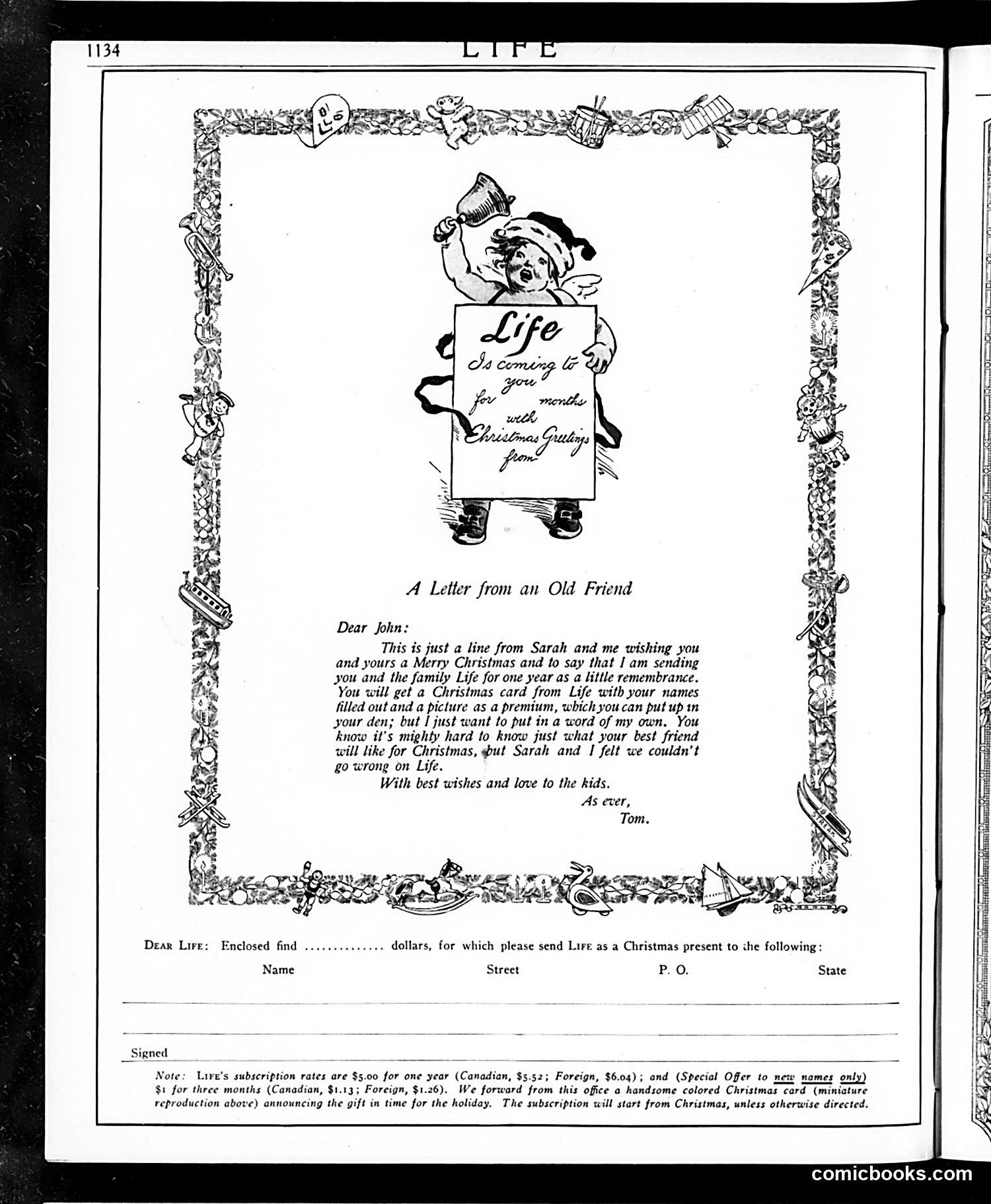
This is primarily a **subscription advertisement** for *Life* magazine, not a political cartoon. The central image shows a cheerful character (appears to be a elf or gnome) holding a sign advertising Life magazine subscriptions as Christmas gifts. The decorative border features holiday imagery—toys, bells, wreaths, and festive items—establishing a Christmas theme. The accompanying letter from "Tom" to "John" is a personal endorsement encouraging gift subscriptions to Life. Tom mentions sending a Christmas card and picture as premiums with the subscription. **The "satire" here is gentle commercial messaging**: positioning a magazine subscription as an ideal gift. The note about it being "mighty hard to know just what your best friend will like for Christmas" humorously frames the magazine as a foolproof present. This represents early 20th-century magazine marketing, blending personal recommendation with holiday sentiment.
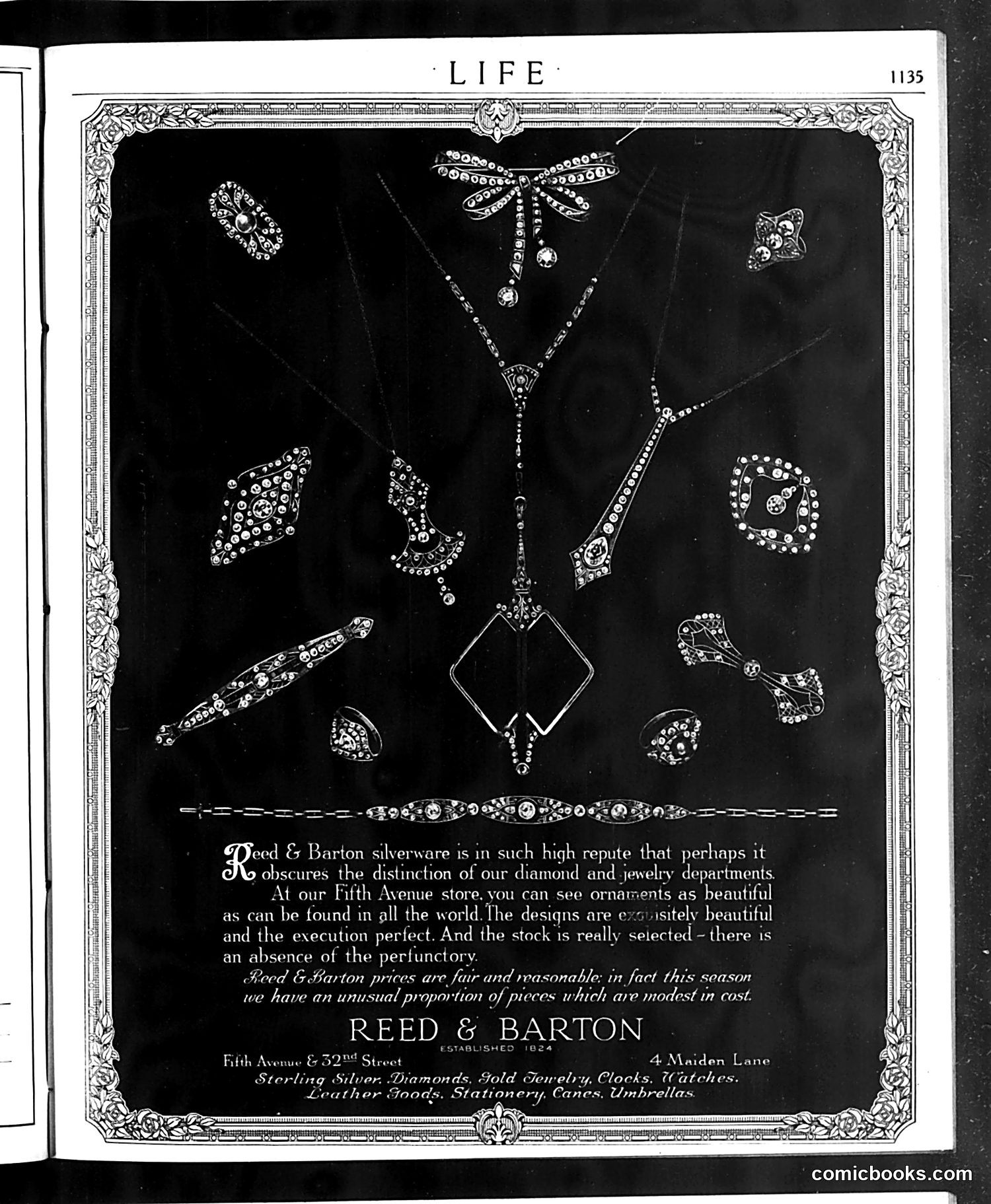
This is primarily an **advertisement page**, not a political cartoon. It's a full-page ad for Reed & Barton, a jewelry and silverware company, published in *Life* magazine (page 1135). The image displays luxury items—jewelry, decorative brooches, ornamental pieces, and accessories—arranged artfully against a black background. The text emphasizes that Reed & Barton's renowned silverware reputation sometimes overshadows their equally impressive diamond and jewelry departments. The ad highlights the quality and design of their pieces, available at their Fifth Avenue and 52nd Street location in New York. The page represents early 20th-century luxury marketing aimed at affluent *Life* readers, featuring high-end consumer goods rather than satire or political commentary.
This page is **advertising, not satire or editorial content**. It's an announcement by the White Company promoting their participation in the sixth Annual Automobile Salon at Hotel Astor in New York (January 3-8, dates unclear from context). The ad emphasizes that White Cars will be displayed in refined, leisurely surroundings at the Automobile Salon—superior to the crowded conditions at the Grand Central Palace. It highlights the cars' custom design and high quality. The only visual element besides decorative borders is the White Company's logo at bottom. This represents early 1900s automotive marketing targeting wealthy consumers seeking luxury vehicles. No political or satirical content is present—it's straightforward commercial advertising in a magazine known for humor elsewhere.
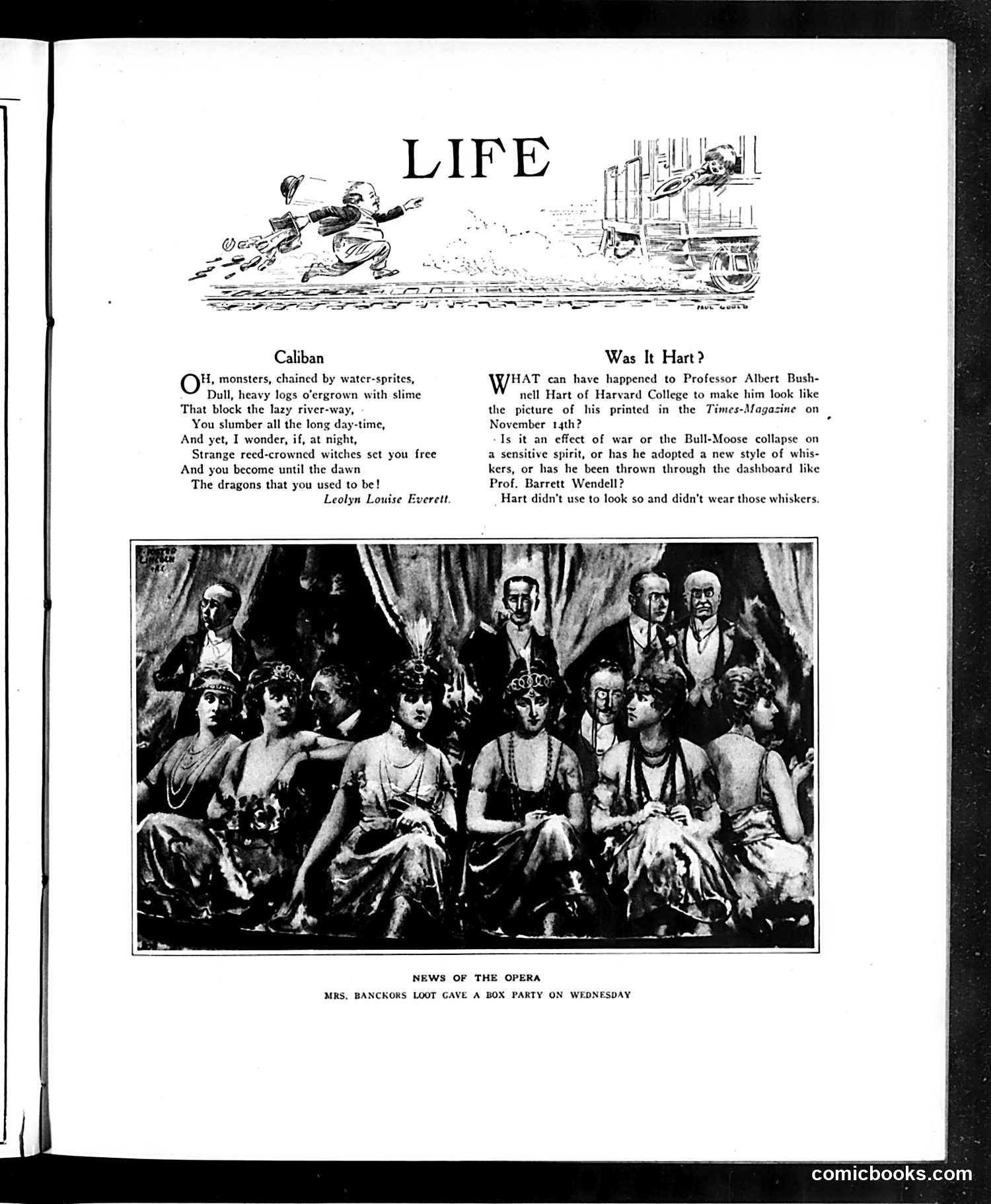
This page contains two satirical pieces: **"Caliban"** — A poem by Evelyn Louie Everett mocking what appears to be a political or social figure who has abandoned their former principles. The reference to "dragons" and "witches" suggests critiquing someone's previous radical or unconventional positions. **"Was It Hart?"** — A brief satirical piece questioning what happened to Professor Albert Bushnell Hart of Harvard College, whose appearance in *Time Magazine* (November 14th) showed him with new whiskers. The humor mocks his changed appearance, joking whether this is due to war stress, mental breakdown, or simply adopted affectation—suggesting he's now imitating Prof. Barrett Wendell's style. The photograph below captioned "News of the Opera: Mrs. Banckers Gave a Box Party on Wednesday" appears unrelated society coverage. The satire targets intellectual/academic figures and their perceived inconsistencies.
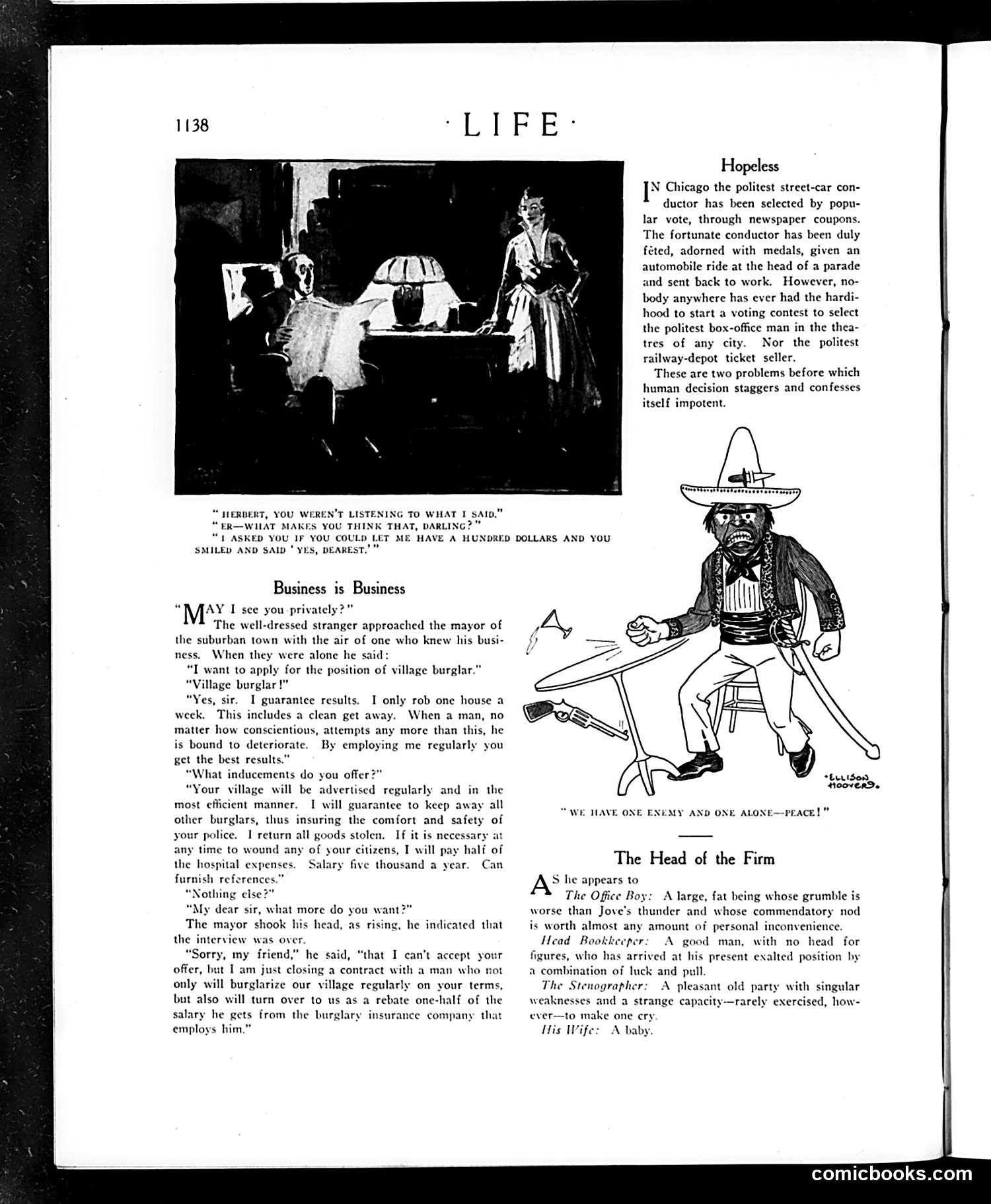
This page contains two satirical pieces: 1. **"Hopeless"** (top): A brief commentary on the absurdity of selecting Chicago's "politest street-car conductor" and "politest railroad-depot ticket seller" through public voting. The satire suggests these selections are impossible decisions—acknowledging the rarity of politeness in such positions. 2. **"Business is Business"** (middle): A humorous anecdote where a well-dressed stranger applies to be a village burglar, offering professional theft services with guarantees. The mayor rejects him, saying he's already contracted with a burglar's insurance company. 3. **"The Head of the Firm"** (bottom): Character sketches of office types, including descriptions of "The Office Boy," "Head Bookkeeper," "The Stenographer," and "His Wife." The humor targets municipal incompetence, corporate absurdity, and workplace stereotypes typical of early 20th-century American satire.
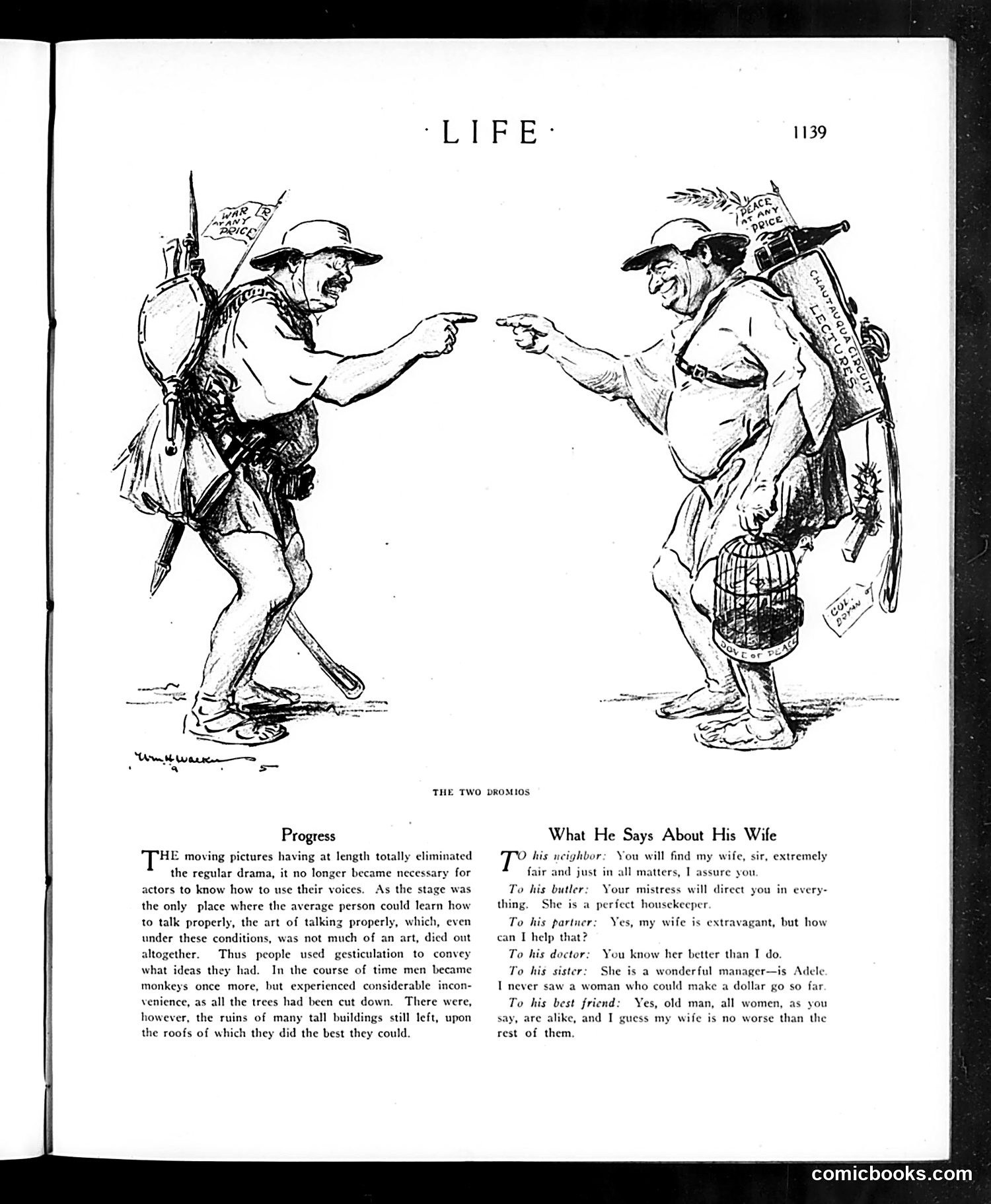
This cartoon satirizes the transition from silent film to talking pictures. The illustration shows two vaudeville-style performers pointing at each other in exaggerated poses, laden with theatrical props and equipment—representing the old stage traditions. The accompanying text explains that moving pictures eliminated the need for trained actors who could use their voices properly. As stages closed, performers lost their primary training ground for proper diction and speech. The joke critiques how silent film actors never learned to *talk* professionally, creating a problem once sound arrived in cinema. The figure labeled "What He Says About His Wife" provides comic relief through boastful claims about his spouse—a stock comedic device of the era. The cartoon mocks the unpreparedness of silent-era performers for the sound revolution.
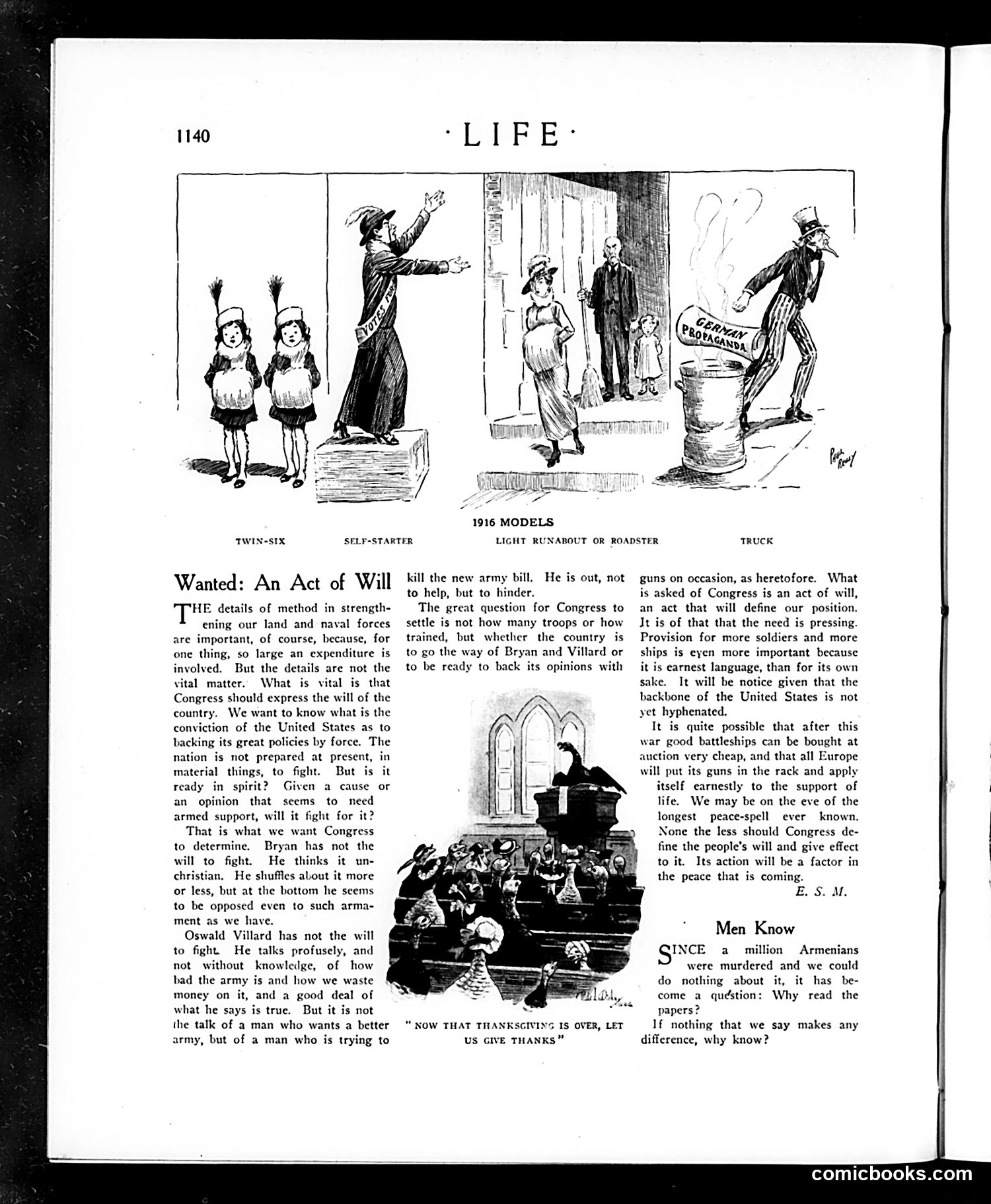
**The Cartoons:** Four 1916 automobile models are shown as satirical commentary, labeled "Twin-Six," "Self-Starter," "Light Runabout or Roadster," and "Truck." **Main Article - "Wanted: An Act of Will":** This discusses military preparedness and Congressional debate. The text critiques figures (appears to reference Bryan and Villard) for opposing military spending. The central illustration shows a Thanksgiving scene with the caption "NOW THAT THANKSGIVING IS OVER, LET US GIVE THANKS," suggesting ironic commentary on national priorities regarding military armament versus civilian concerns. **Secondary Article - "Men Know":** References the Armenian genocide ("a million Armenians were murdered"), questioning why Americans remain uninformed and asking whether news coverage matters. **Context:** This reflects pre-WWI American debates over military preparedness and isolationism, alongside awareness of overseas atrocities.
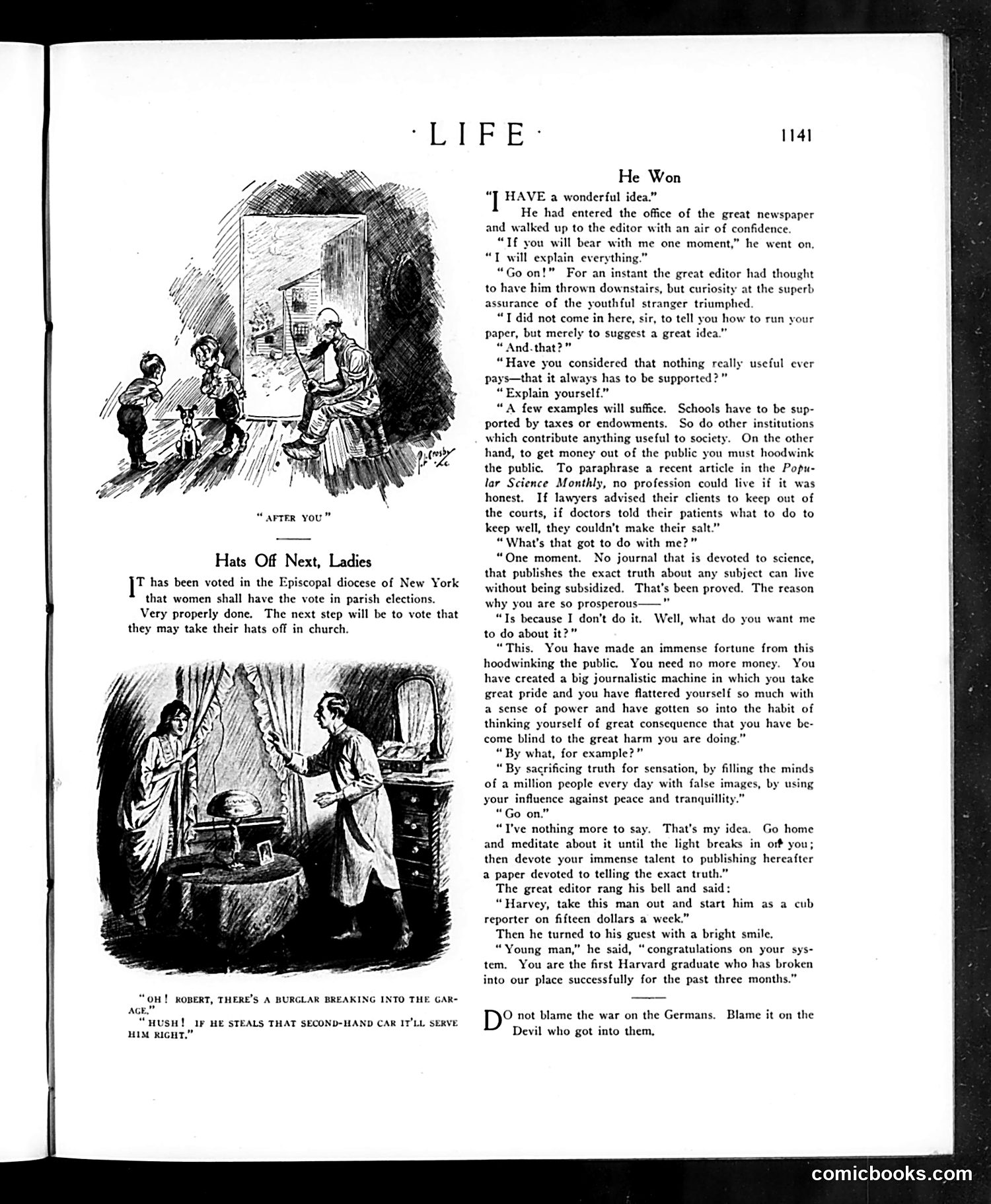
This page contains two separate satirical pieces: **"He Won"** depicts a young man pitching an idea to a newspaper editor. The young man proposes that newspapers should stop subsidizing various institutions (schools, churches, courts, medicine) and instead use their influence "to hoodwink the public." The editor's sharp response critiques this corrupt approach, ultimately praising the young man's confidence while actually dismissing him as a cub reporter—a satirical comedown. **"Hats Off Next, Ladies"** references Episcopal women gaining voting rights in parish elections, presenting it as a progressive step toward fuller participation. Both pieces satirize media manipulation, institutional corruption, and the tension between journalistic integrity and sensationalism—showing Life magazine's skepticism toward press ethics in early 20th-century America.
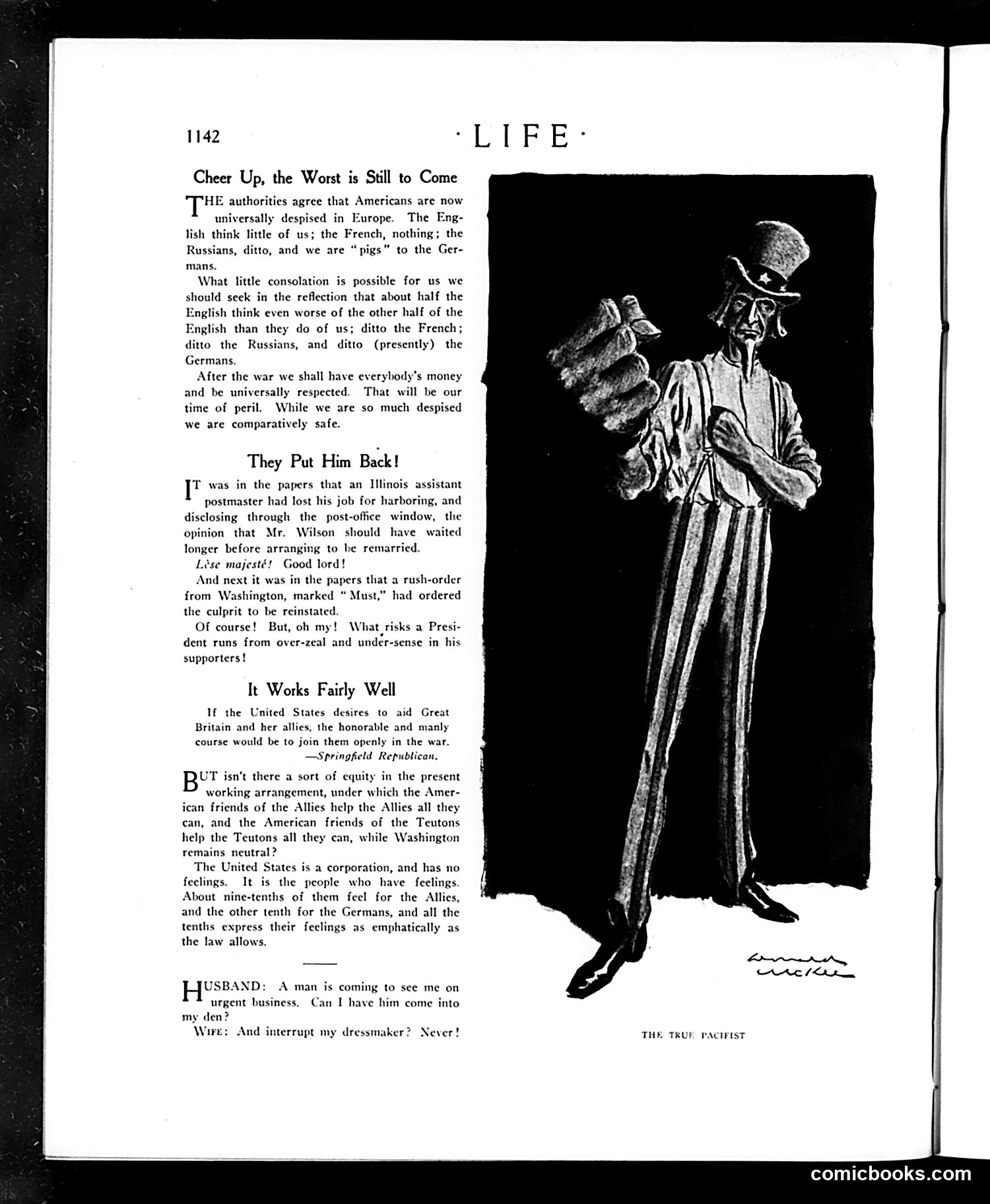
The page contains three satirical pieces about American standing during World War I (the text references post-war respect and wartime alliances). **"Cheer Up, the Worst is Still to Come"** mocks European contempt for Americans, noting that England, France, Russia, and Germany all despise the U.S., but predicts America will gain respect and money after the war. **"They Put Him Back!"** jokes about an Illinois postmaster fired for harboring a culprit, then reinstated by presidential order—satirizing political patronage and presidential overreach. **"It Works Fairly Well"** critiques America's supposed neutrality while actually aiding the Allies, arguing this arrangement allows Americans supporting different sides to help their preferred nations while Washington claims neutrality. The illustration titled **"The True Pacifist"** (right) appears to depict a skeletal or death-like figure, likely satirizing pacifism during wartime.
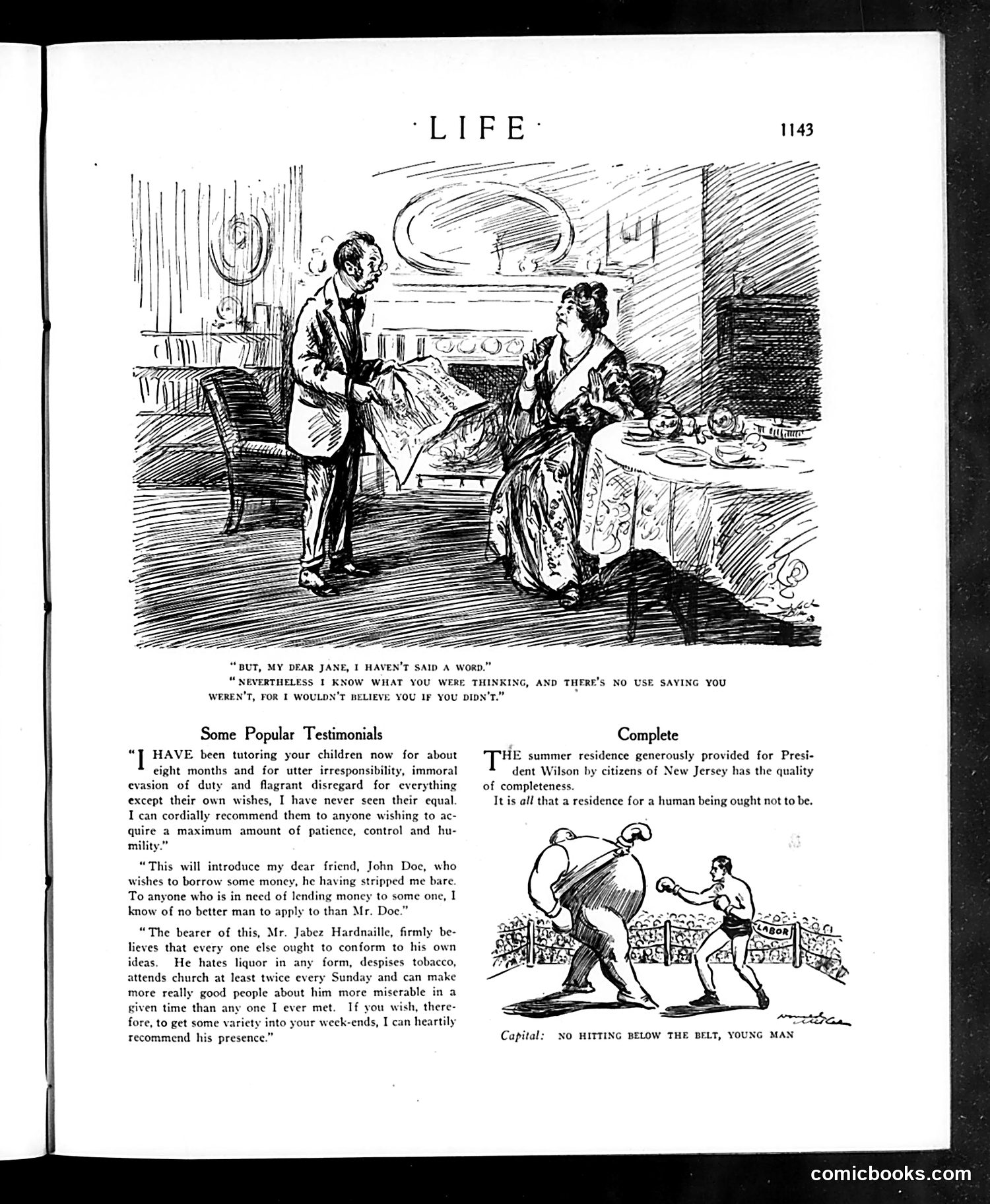
**Main Cartoon:** Shows a man confronting a woman about her thoughts, claiming he can read her mind without her speaking. The satire targets male presumption—the joke is that men assume they understand women's unstated feelings, when they likely don't. **"Some Popular Testimonials":** These are mock character references praising individuals (John Doe, Mr. Jaber Hardnaille). The satire mocks formal recommendation letters and testimonials as often insincere or exaggerated praise. Each describes someone as virtuous but hints at darker undertones (duty-shirking, borrowing money, hatred of liquor suggesting excess drinking). **Boxing Illustration:** Labeled "NO HITTING BELOW THE BELT, YOUNG MAN"—appears to be humorous sporting advice about boxing rules and propriety. The page satirizes social hypocrisy, male presumption, and false character witnesses.
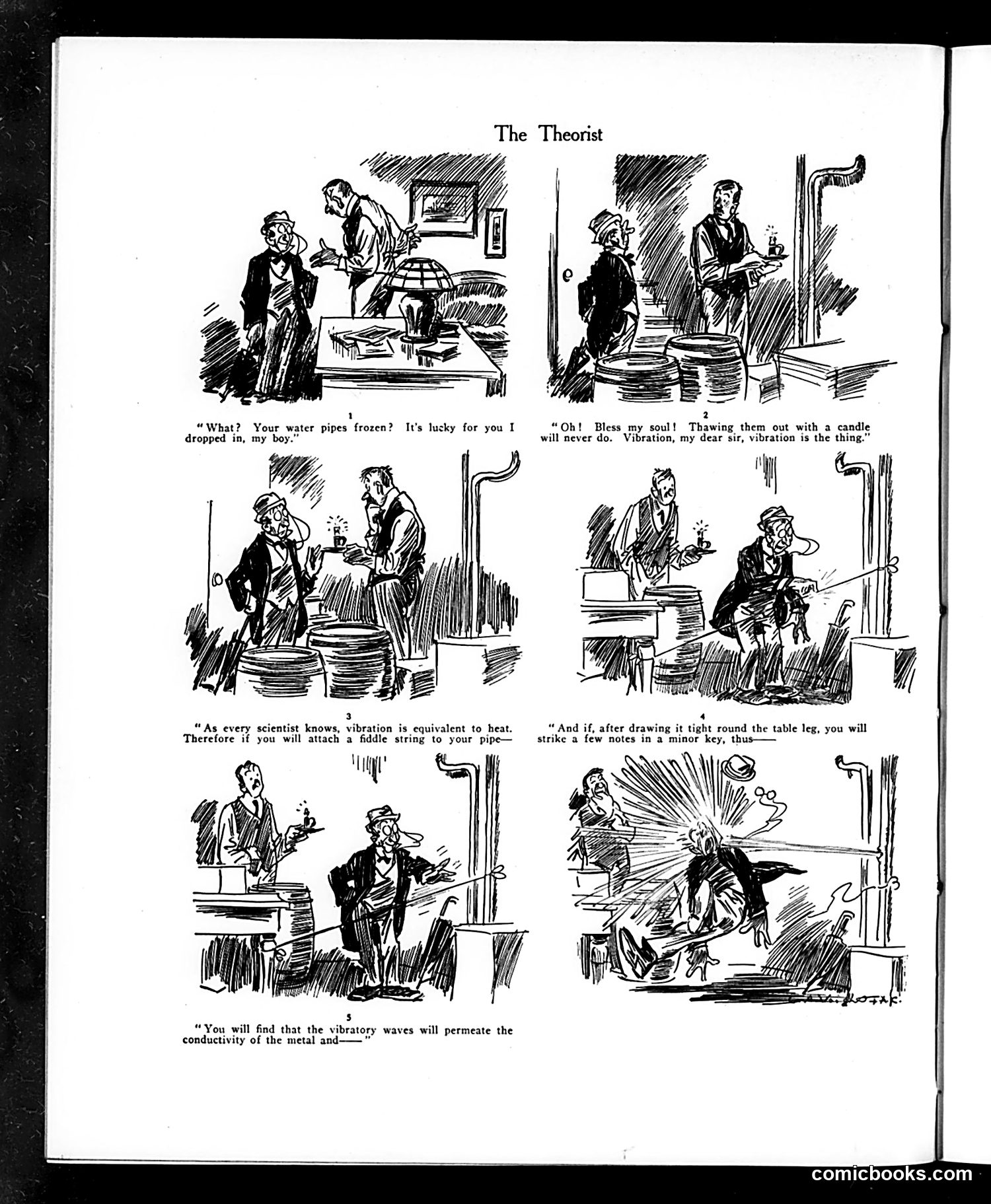
This six-panel comic satirizes pseudo-scientific "theorists" who overcomplicate simple problems with elaborate pseudoscientific explanations. **The setup**: A man's water pipes are frozen. A self-proclaimed expert dismisses the practical solution (a candle) and instead proposes increasingly absurd theories—attaching a fiddle string to pipes and playing musical notes to create "vibrations" that allegedly generate heat and thaw the ice. **The joke**: The theorist delivers each ridiculous idea with complete confidence, citing scientific principles ("vibration is equivalent to heat," "vibratory waves will permeate the conductivity") that sound plausible but are being applied nonsensically. The final panel shows the inevitable result: the man is knocked backward by the chaos of his own creation. **Social satire**: This mocks intellectuals and "armchair scientists" of the era who valued clever theories over practical problem-solving, substituting elaborate explanations for common sense. It's also humor about male vanity and the willingness to accept bad advice from authority figures.
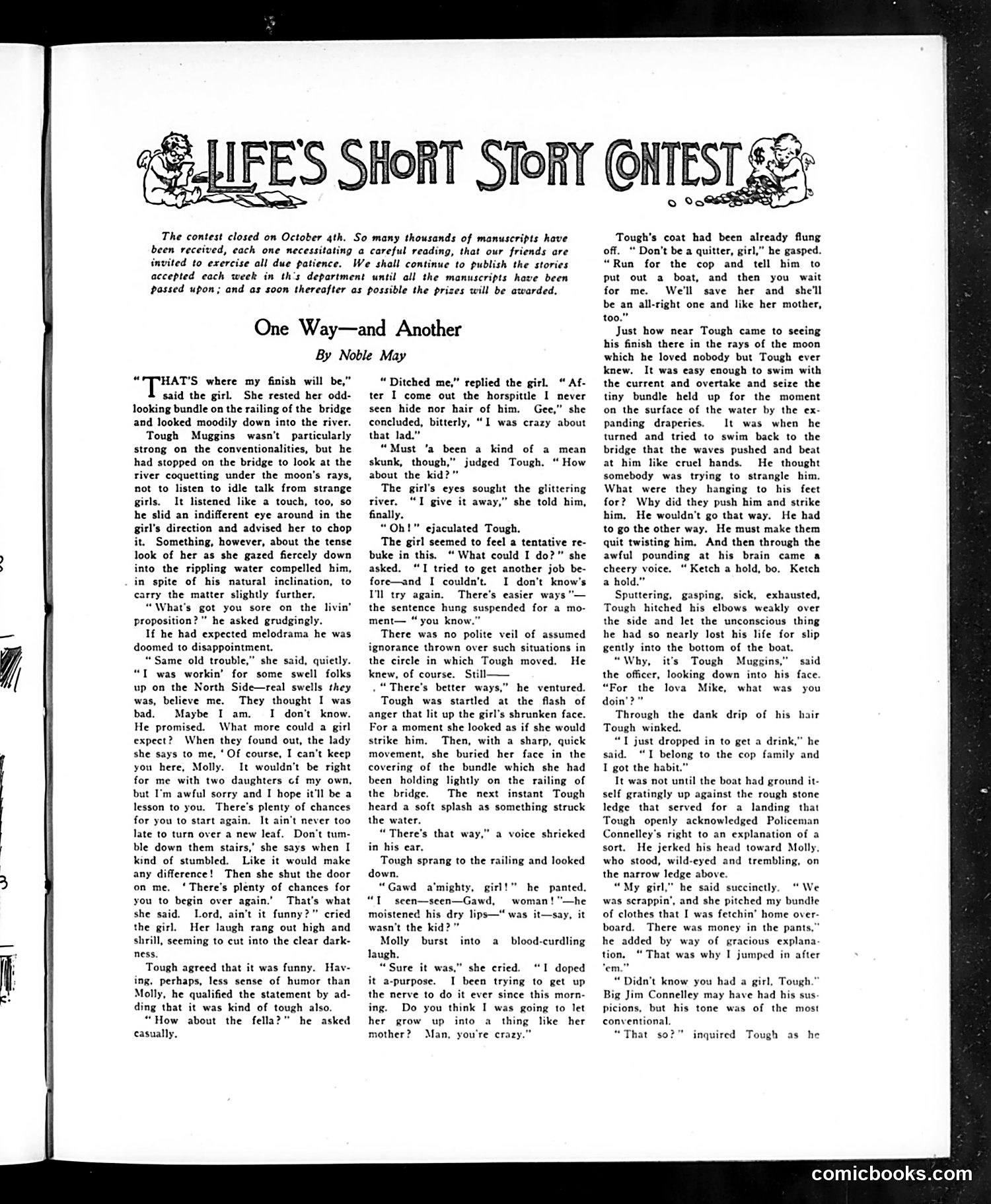
This page presents "One Way—and Another," a short story from Life magazine's contest. The narrative depicts a tragic encounter between Tough Muggins, a street-tough character, and Molly, a desperate young woman on a bridge. The story reflects early 20th-century social attitudes: Molly, pregnant and unmarried, was fired from her respectable employer's household. Her employer's dismissal—"plenty of chances for you to start again"—represents sanctimonious hypocrisy masking class cruelty. Molly gave away her baby and now contemplates suicide. Tough represents the working-class vernacular character common in period fiction ("livin' proposition," "swell folks"). The story's moral weight comes from depicting how social stigma and economic desperation drove women toward self-destruction, with the implication that Molly has thrown herself (or her baby) into the river. The ending—abrupt and ambiguous—serves the contest's apparent goal: publishing emotionally affecting stories about life's hardships. The tale critiques both the callousness of the wealthy and the limited options available to women in poverty.
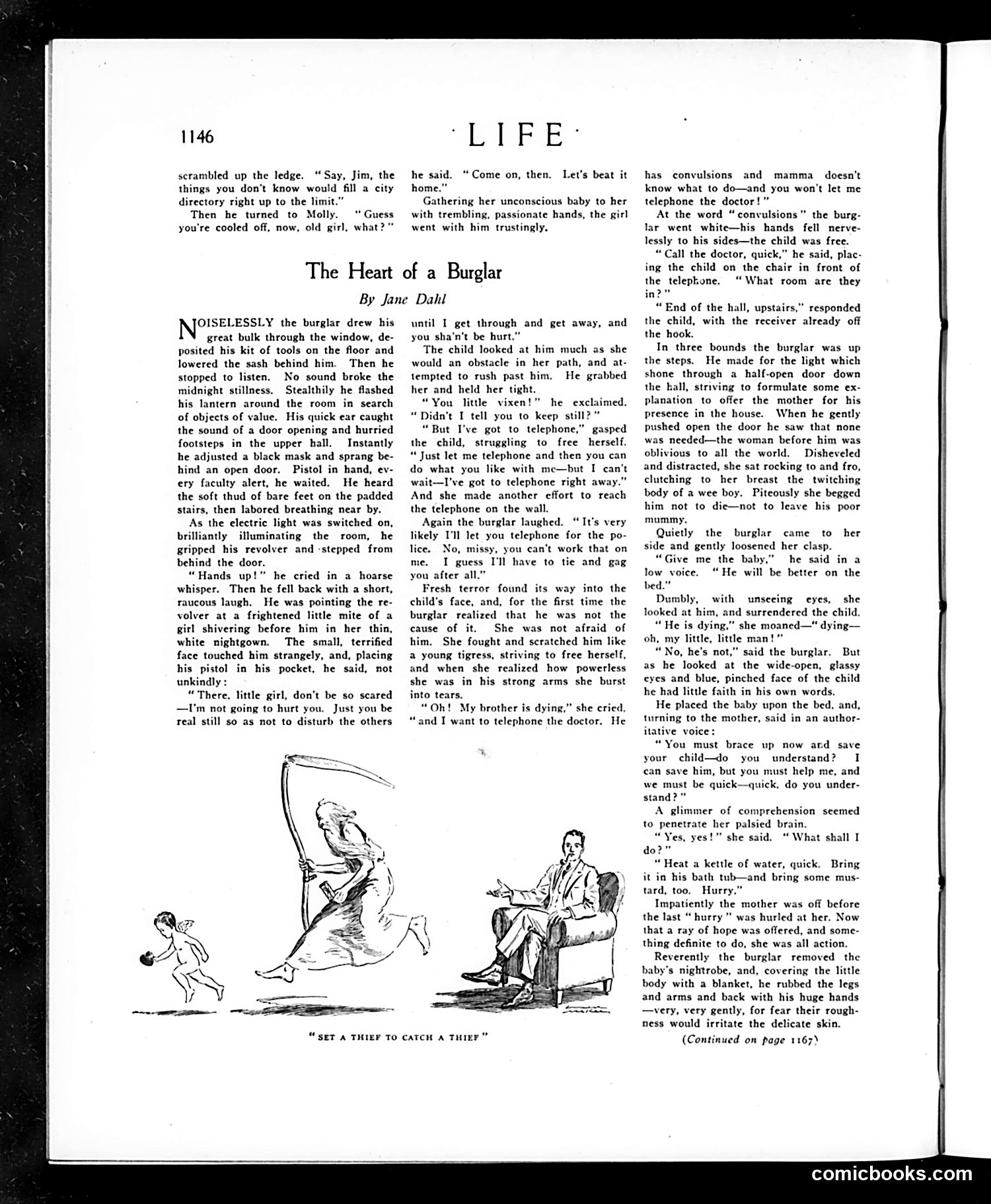
This is a sentimental short story by Jane Dahl, not political satire. It depicts a burglar breaking into a home who encounters a desperate young girl trying to call a doctor for her dying brother. The story's moral point is ironic: a hardened criminal—someone society deems irredeemable—is moved by the child's plight and sets aside his crimes to help. The accompanying illustration (captioned "Set a Thief to Catch a Thief") shows the burglar confronting the girl. The narrative explores a popular early-20th-century theme: that even criminals possess human compassion when confronted with genuine suffering, particularly involving children. The burglar's sudden emotional transformation—going "white" at the mention of convulsions—suggests an unexpected capacity for decency hidden beneath his criminal exterior. This reflects period sentimentality about human nature's fundamental goodness.
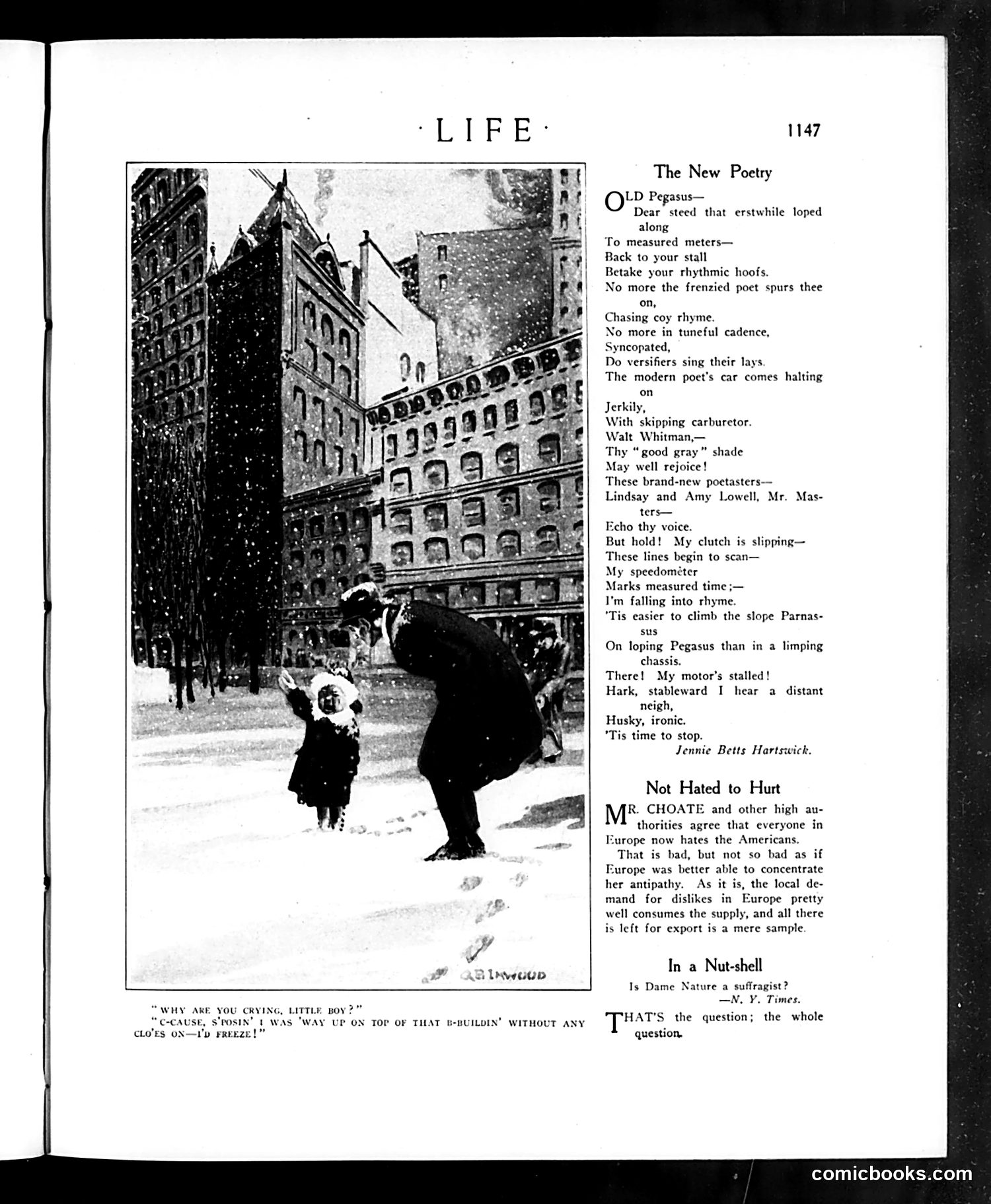
This page satirizes early 20th-century modernist poetry movements. The main poem mocks the shift from traditional verse (represented by the old horse "Pegasus" and measured meters) to free verse and experimental forms championed by contemporary poets like **Walt Whitman, Amy Lowell, and Edgar Lee Masters** (referenced by name). The satire uses an extended metaphor: traditional poetry is a reliable horse; modern poetry is a sputtering automobile with a "skipping carburetor" and stalled motor—unreliable and undignified. The poet ironically admits that despite rejecting rhyme and meter, he keeps "falling into rhyme," suggesting modernism cannot fully escape its poetic roots. A secondary item jokes that Europeans hate Americans but lack sufficient antipathy to concentrate it all on export—dark humor about post-WWI transatlantic tension.
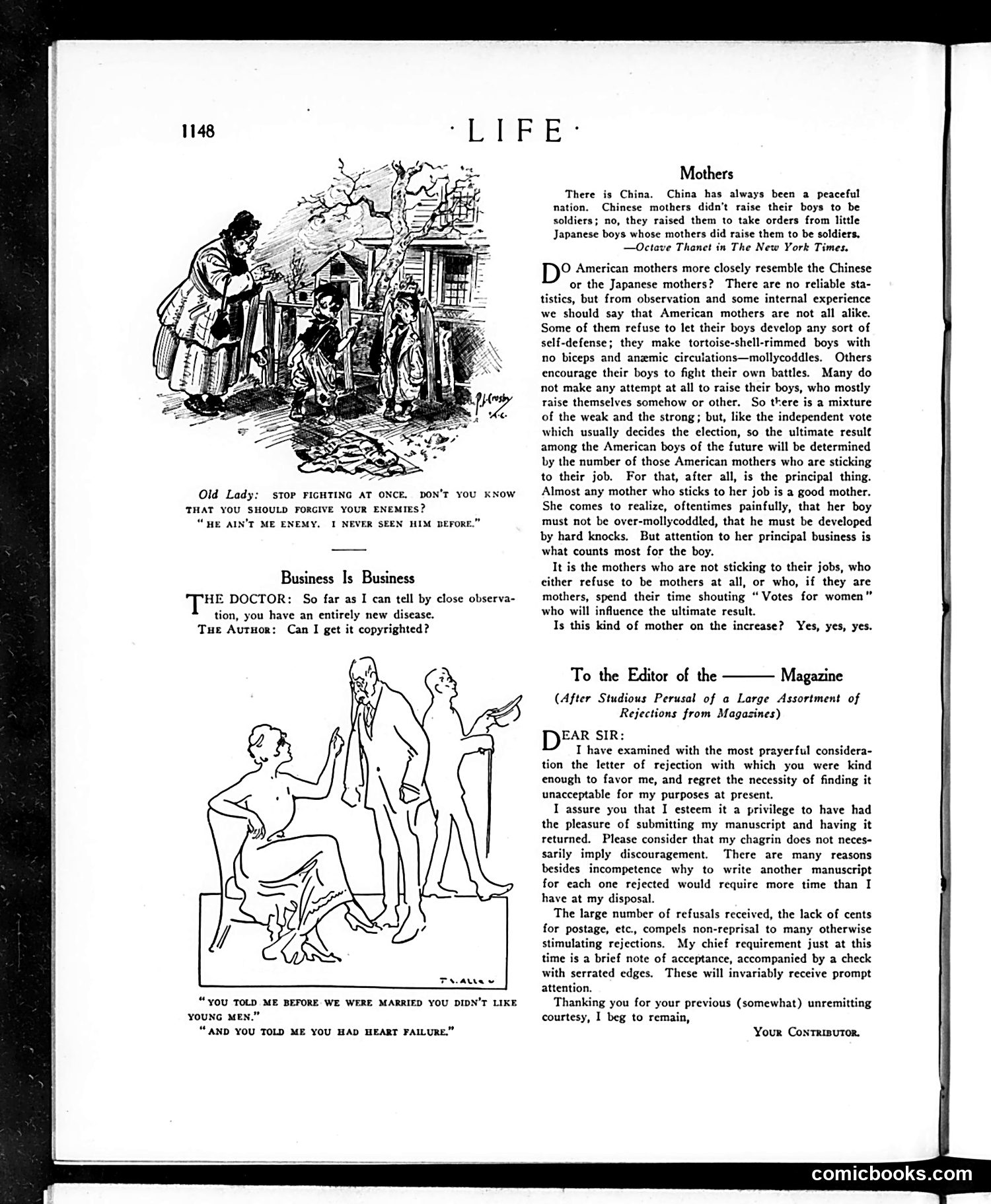
This page contains three satirical pieces typical of Life's humor: **"Business Is Business"**: A doctor-author joke mocking intellectual property obsession. The author asks if he can copyright a "new disease," satirizing writers' desperation to profit from any idea. **The fighting scene**: An old lady tries to make two men stop fighting by invoking forgiveness. Their response—"He ain't me enemy. I never seen him before"—jokes that they're fighting as a business transaction or obligation, not from genuine enmity. **"Mothers" essay**: A commentary on American motherhood referencing Chinese and Japanese mothers (likely alluding to militarism), debating whether American mothers coddle sons or properly raise them. The piece sarcastically criticizes mothers prioritizing "Votes for women" (suffrage activism) over child-rearing, suggesting feminist activism neglects maternal duties. **"To the Editor"**: A humorous rejection letter from a perpetually-rejected writer, politely inverting critique—thanking editors for rejections while subtly mocking magazine gatekeeping and his own poverty.
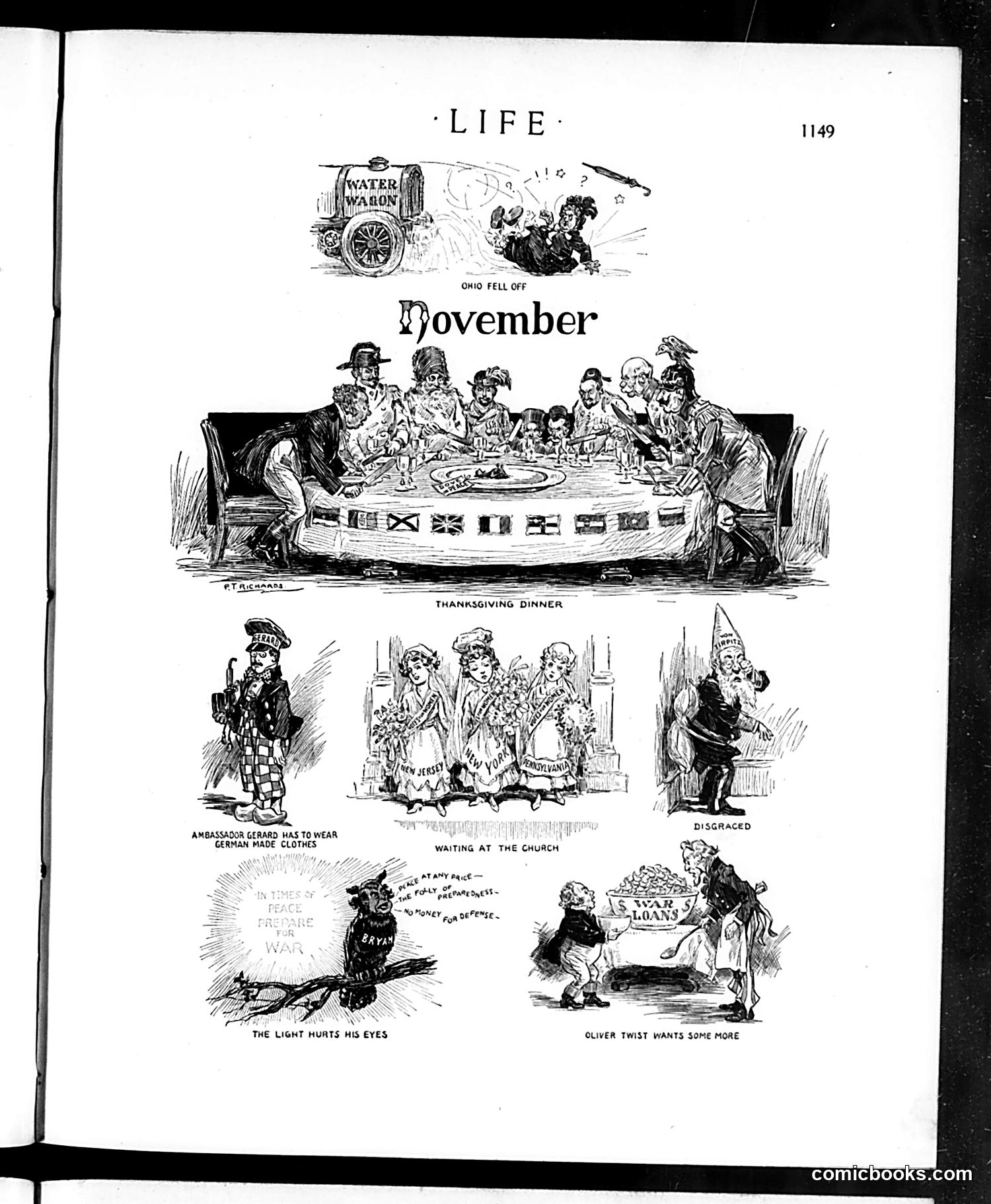
This *Life* magazine page uses November themes to satirize American involvement in World War I. The top panel depicts a grotesque "Thanksgiving Dinner" with caricatured national figures, likely representing Allied nations gathered in an uncomfortable alliance. Lower cartoons reference Ambassador Gerard (U.S. envoy to Germany), forced to wear German clothes—suggesting diplomatic humiliation or compromised neutrality. "Waiting at the Church" implies broken promises or delayed commitments. "The Light Hurts His Eyes" shows a figure recoiling from peace proposals, suggesting blindness to peace opportunities. "Oliver Twist Wants Some More" references the Dickens character begging for food, implying America's seemingly insatiable appetite for war participation or military spending. The overall message critiques American wavering on war involvement and the uncomfortable position of diplomacy during this period.
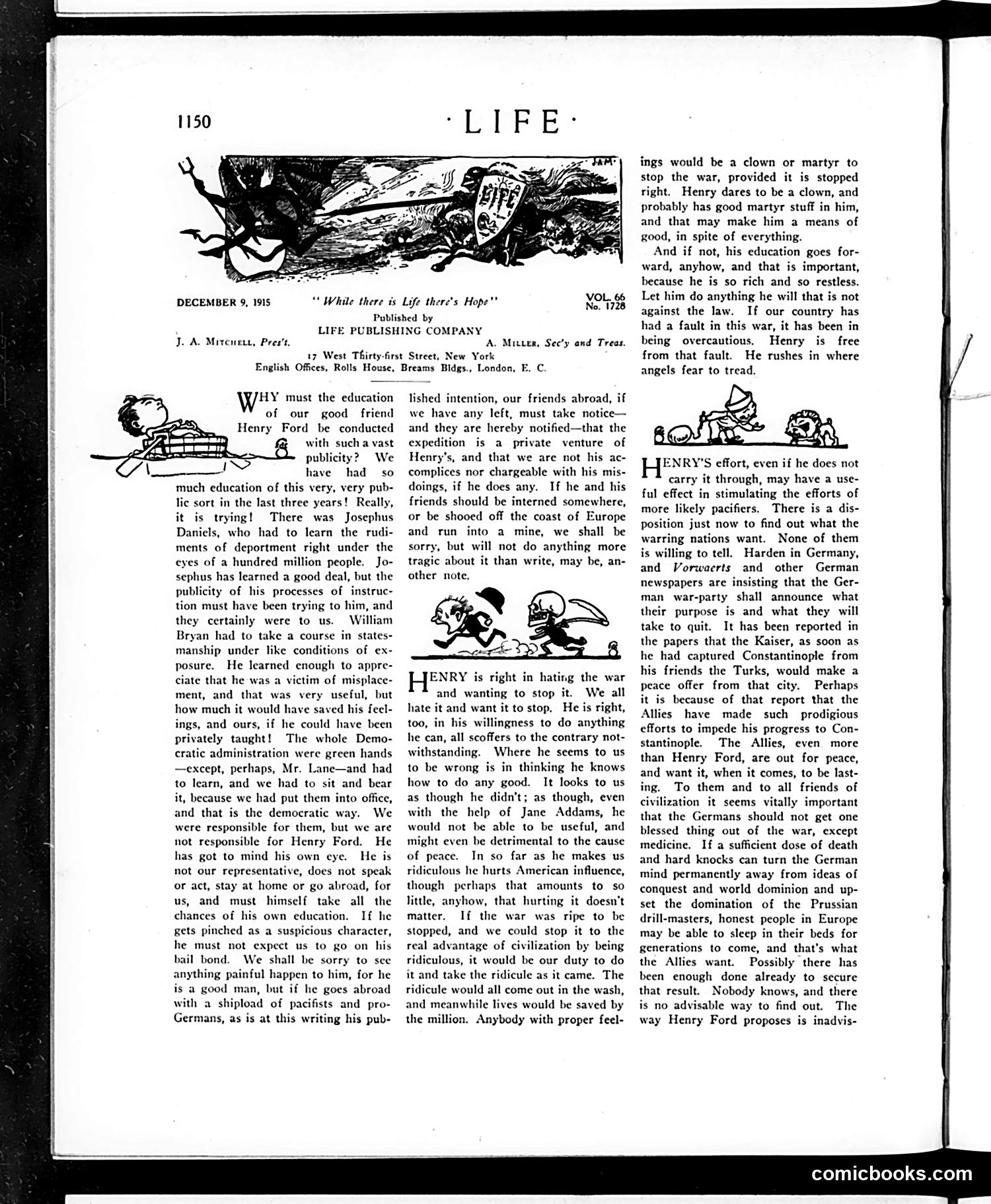
This editorial satirizes **Henry Ford's famous "Peace Ship"** — his announced plan to sail to Europe with pacifists to end World War I. The cartoons show Ford being educated/instructed, mocking his naïveté. The text criticizes Ford's public self-education process, comparing it unfavorably to earlier embarrassing displays by government figures like Secretary Josephus Daniels and William Jennings Bryan. Life's editors acknowledge Ford is *right* to hate war, but argue he's **wrong thinking he knows how to stop it** — his peace mission will only make America look ridiculous internationally and harm American influence. The key point: Life defends Ford's *right* to attempt this foolish venture (democratic freedom), but distances the publication and nation from responsibility for his probable failure. The satire suggests Ford's earnest pacifism, however well-intentioned, is naive and counterproductive diplomacy.
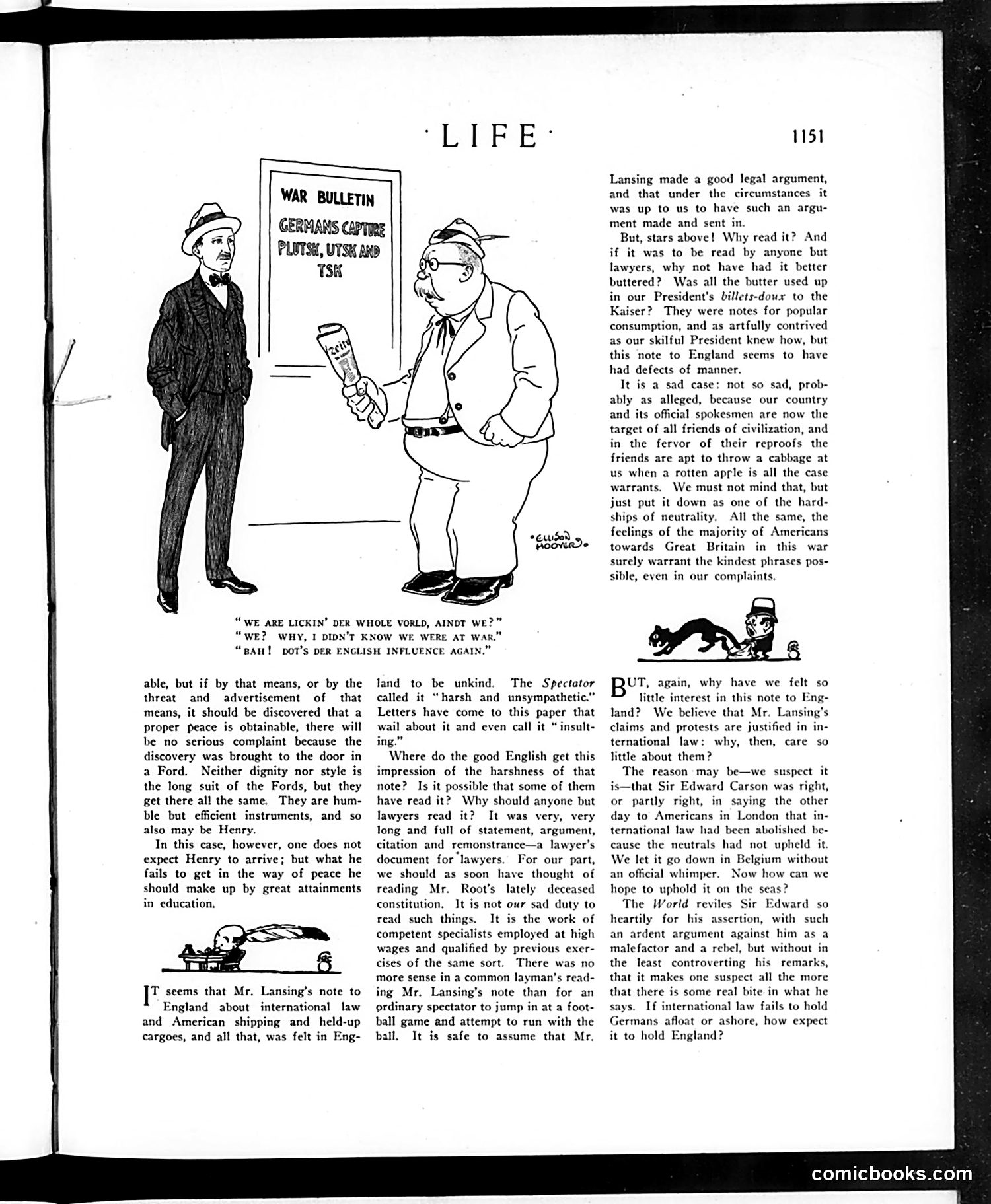
## The Cartoon The main cartoon depicts two figures discussing a war bulletin. The German-accented character (left) boasts "We are lickin' der whole world, aindt we?" to which an American responds "We? Why, I didn't know we were at war"—followed by "Bah! Dot's der English influence again." ## Meaning This satirizes American neutrality during World War I. The joke mocks how Germans and their American sympathizers claimed America was already fighting alongside the Allies, while officially the U.S. remained neutral. The punchline blames "English influence" for this perception—a dig at pro-British American sentiment. ## Context The page's text discusses Secretary of State Lansing's formal legal note to England regarding shipping and cargo seizures. Life argues Americans shouldn't complain about England's wartime actions, given American reluctance to enforce international law (referencing Belgium's occupation). The piece suggests Americans tacitly support the Allied cause despite official neutrality. This reflects pre-1917 American debate over neutrality versus intervention.
I can see this is a black and white sketch from *Life* magazine depicting a social scene with well-dressed figures in what appears to be a formal interior setting. The drawing shows several women in elaborate Edwardian-era clothing with elaborate hairstyles, and at least one man in formal attire seated among them. However, without visible text, captions, or a title on this page excerpt, I cannot definitively identify the specific individuals being satirized or the particular social/political commentary being made. The style and clothing suggest early 1900s high society, but I cannot determine which social issue or public figures are being lampooned. The OCR text only shows "comicbooks.com," which appears to be a website attribution rather than original magazine text. To properly explain the satire, I would need visible captions or context text.
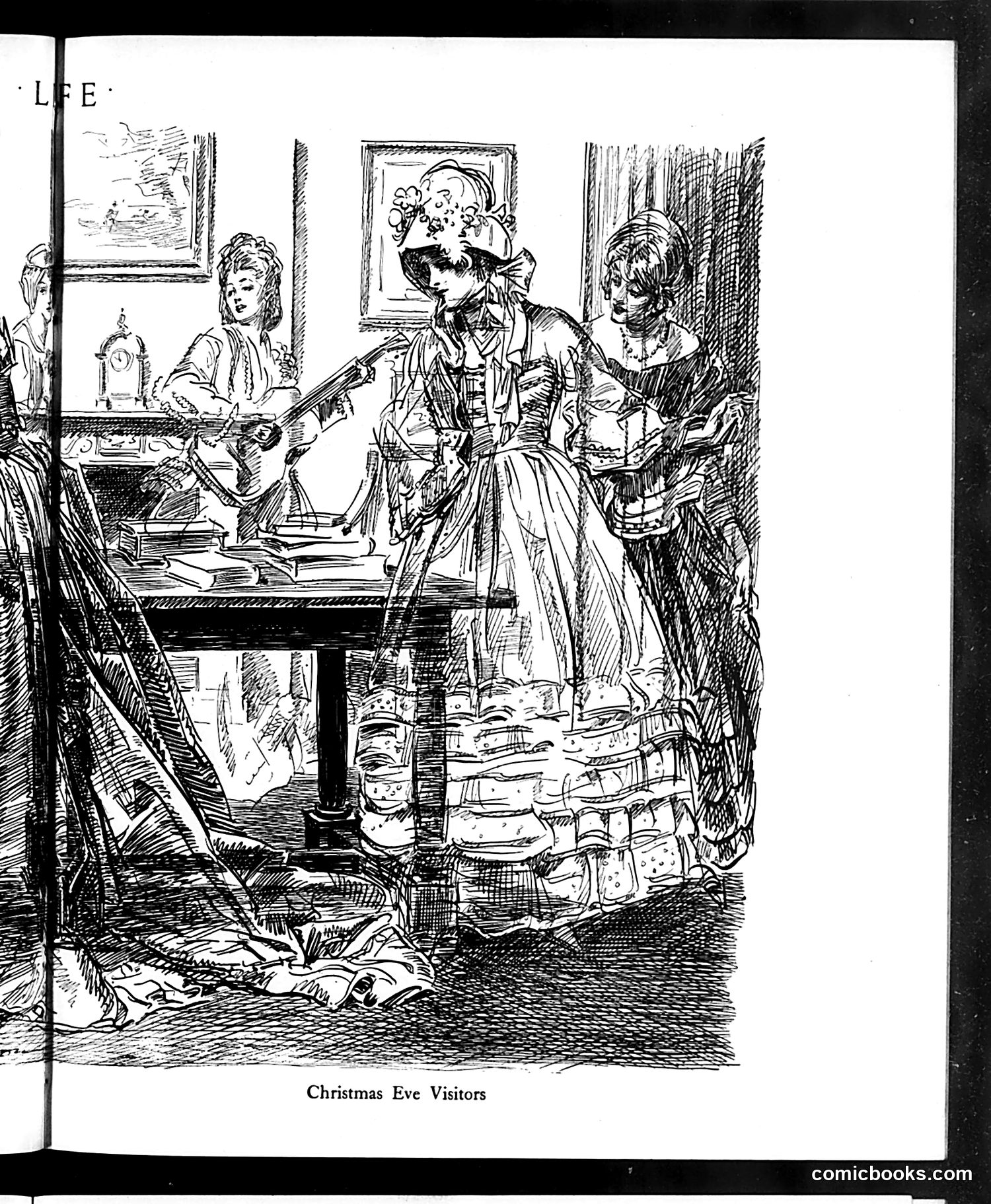
This illustration depicts three well-dressed women visiting what appears to be a modest home on Christmas Eve. The scene shows domestic life with period furnishings and a fireplace. The visitors are rendered in formal attire typical of early-to-mid 20th century fashion, suggesting they represent a higher social class than the inhabitants. The satire likely comments on **Christmas charity customs**—specifically the performative nature of wealthy individuals visiting the poor during the holidays. The illustration suggests a social commentary on class divisions and the somewhat condescending character of seasonal "good works" by the privileged classes. The specific identities of the figures are unclear from the image alone, but the scene captures a common theme in Life magazine: satirizing upper-class hypocrisy and social pretension during the holiday season.
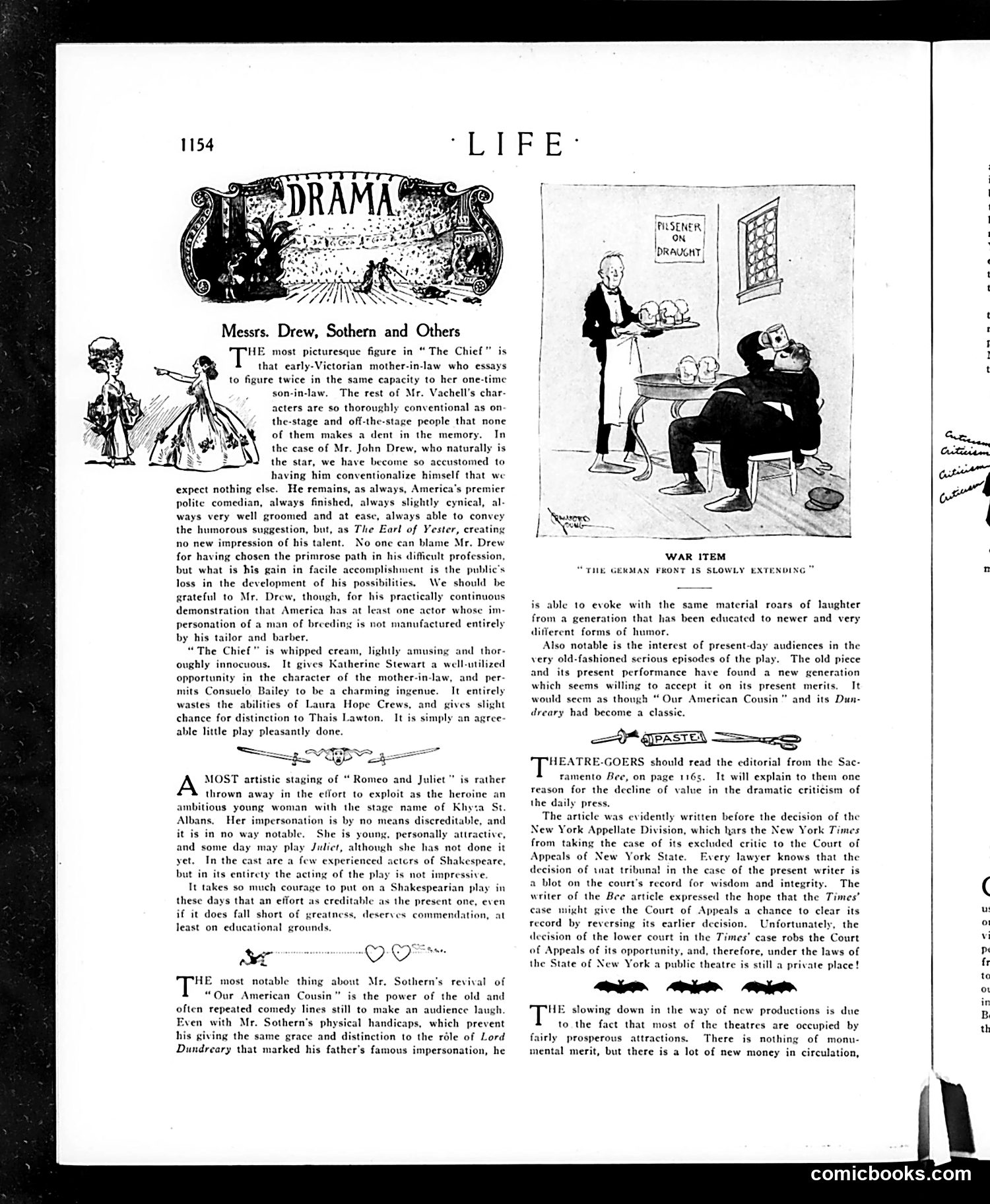
This page reviews three theatrical productions. The main cartoon (labeled "War Item") appears to be a satirical comment on WWI's expanding German front, showing what looks like military officers in a casual domestic setting—a common Life magazine tactic of juxtaposing serious war news with absurd everyday scenarios for dark comic effect. The drama reviews discuss John Drew in "The Chief" (criticizing his polished but uninspired performances), a young actress named Khyra St. Albans in "Romeo and Juliet" (deemed competent but unremarkable), and E.H. Sothern's revival of "Our American Cousin" (noting audiences still laugh at old comedy despite changing humor tastes). The editorial note at bottom references a Sacramento *Bee* piece explaining declining theatrical criticism quality, mentioning a New York *Times* legal dispute over critic access—apparently a contemporary press controversy about journalistic independence.
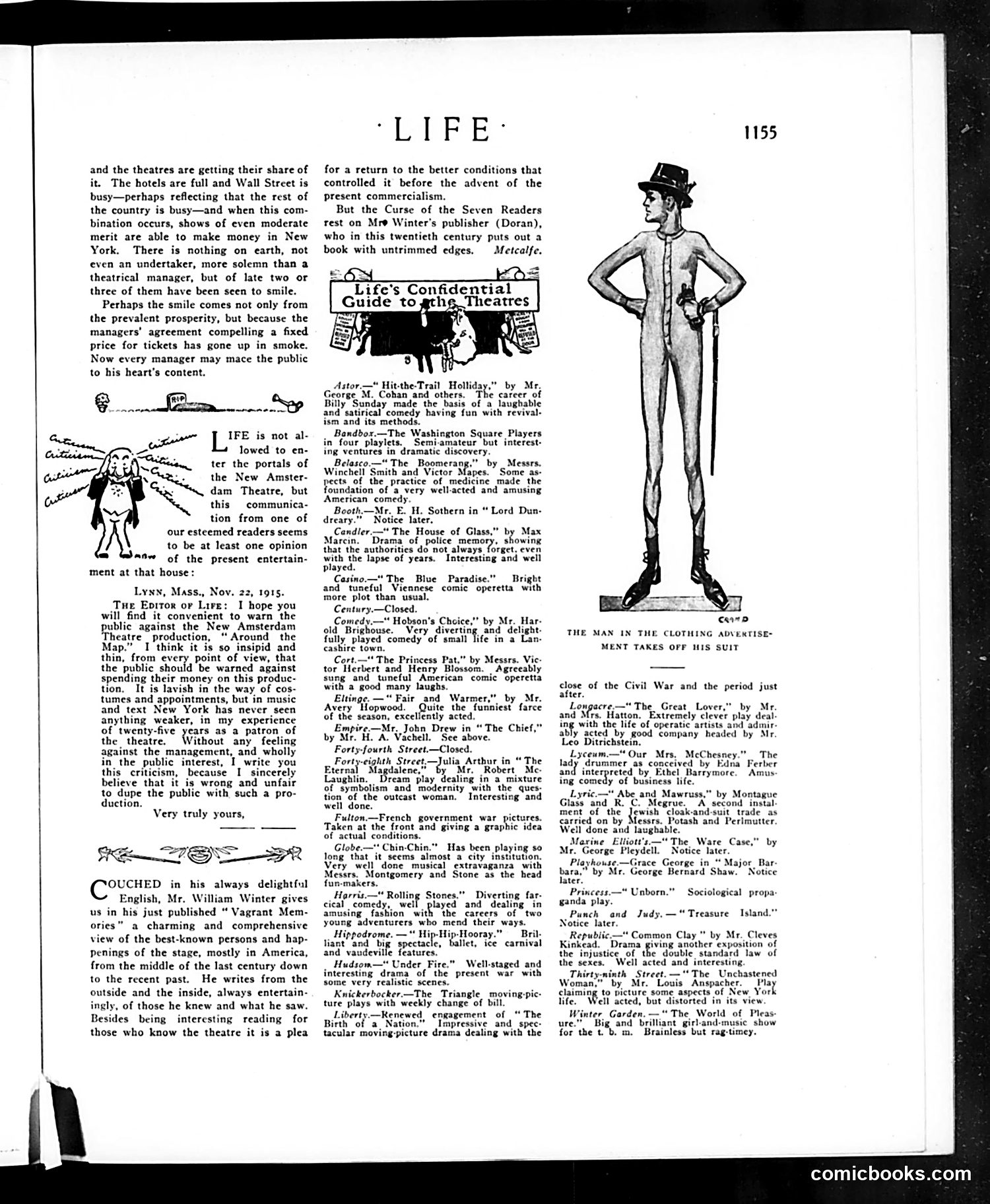
This page from *Life* magazine (November 1915) contains **theatrical criticism and commentary**, not political cartoons per se. The main visual element is an illustration of a man in a one-piece suit with his hands on his hips—labeled "THE MAN IN THE CLOTHING ADVERTISEMENT TAKES OFF HIS SUIT." This appears to be satirical commentary on advertising imagery rather than political content. The text discusses New York theater prosperity and includes a scathing reader letter criticizing the New Amsterdam Theatre's production "Around the Map" as insipid and weak despite lavish costumes. Editor William Winter's book on theater history is praised but criticized for having untrimmed page edges—an absurd complaint that seems intentionally humorous. The bulk of the page comprises brief reviews of various Broadway productions (comedies, operettas, dramas), suggesting this is primarily a **theater review section** aimed at *Life*'s entertainment-focused readership rather than political satire.
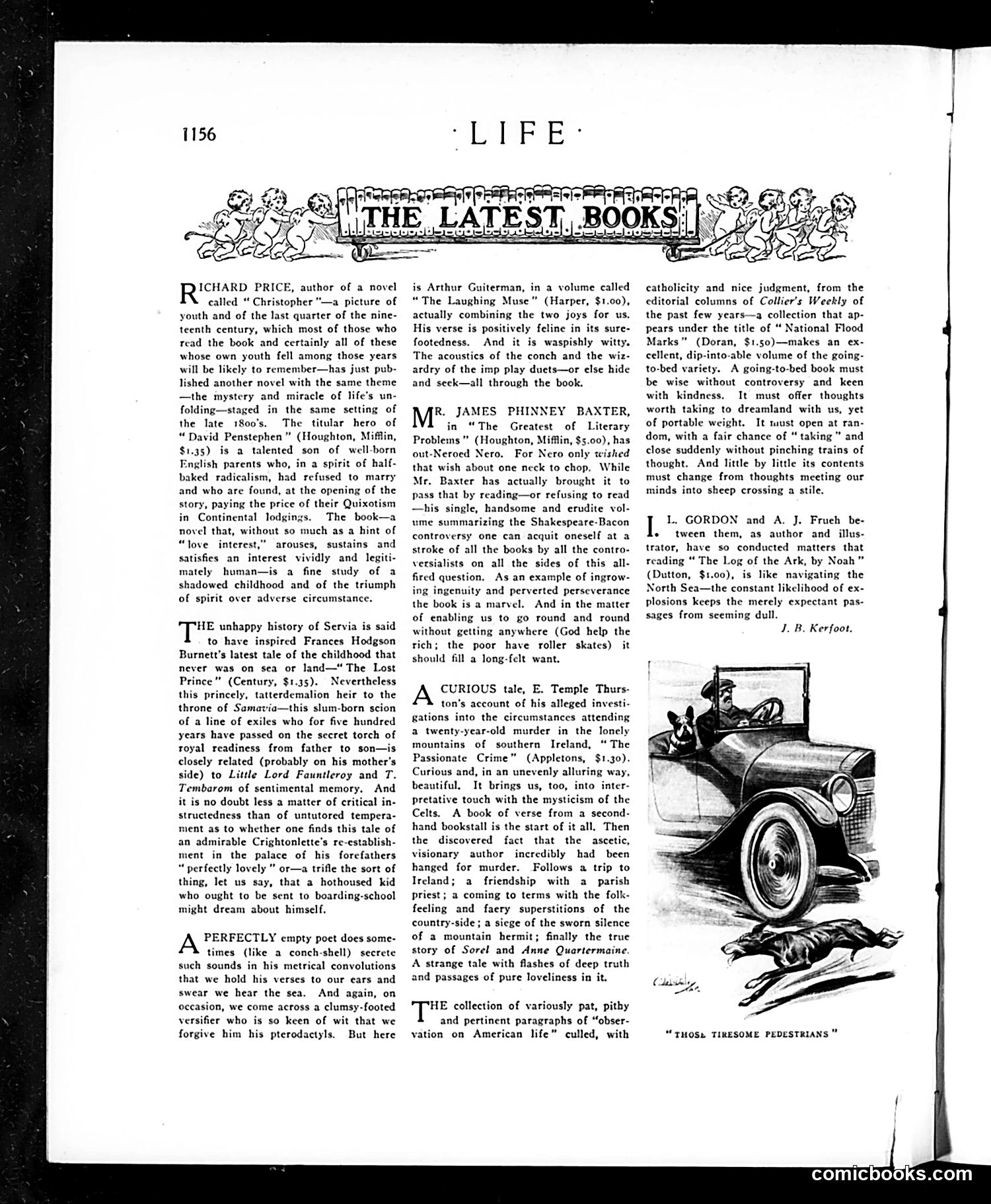
This is a **book review section** from Life magazine's "Latest Books" feature, not primarily a political cartoon page. The single illustration—captioned "Those Tiresome Pedestrians"—shows a wealthy motorist in an expensive car nearly hitting pedestrians, satirizing the emerging social problem of reckless automobile drivers endangering foot traffic. The reviews discuss contemporary 1910s fiction and literary works, including novels about childhood (Price's "David Penstephen"), a fairy-tale about exiled royalty (Burnett's "The Lost Prince"), and poetry by Guiterman. One review humorously skewers James Phinney Baxter's exhaustive scholarly tome on the Shakespeare-Bacon authorship debate as simultaneously authoritative yet circular—an example of academic over-elaboration. The cartoon's satirical point: newly wealthy car owners represent a dangerous social menace to ordinary pedestrians, reflecting contemporary anxieties about automobiles disrupting urban life.
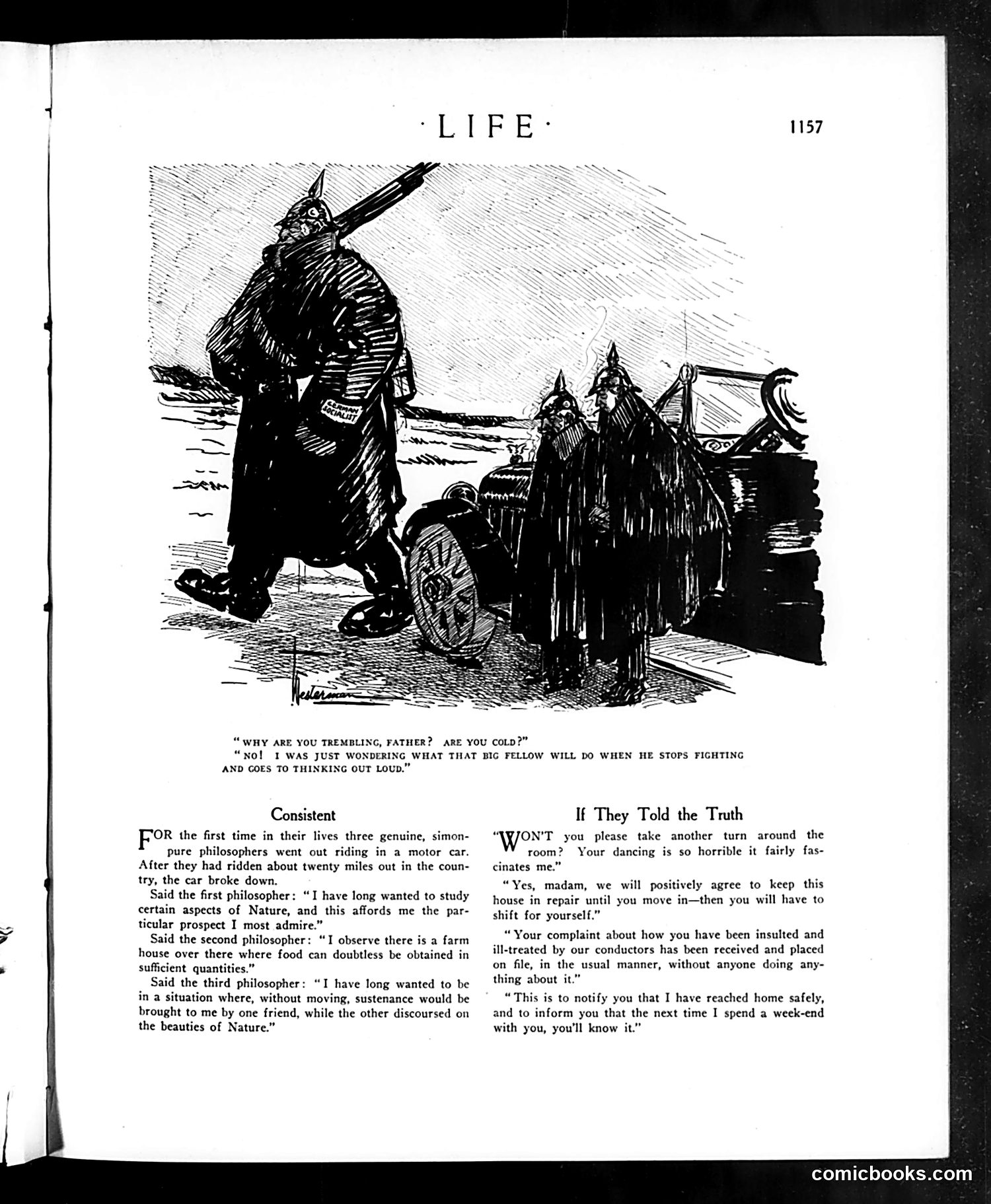
The page contains three separate satirical pieces from *Life* magazine: **Top cartoon**: Shows a soldier with a bayonet towering over civilians. The caption suggests a father is trembling, not from cold, but from anxious speculation about what the aggressive military figure will do "when he stops fighting"—likely commentary on post-WWI fears about demobilized soldiers and social upheaval. **"Consistent"**: Mocks philosophers as impractical idealists. Three philosophers' car breaks down; each spins the mishap as fortunate—studying Nature, finding food, getting service without effort. The joke: their abstract reasoning makes them oblivious to actual problems. **"If They Told the Truth"**: Satirizes social hypocrisy by presenting what people *actually* mean versus what they say. Examples: insulting a dance partner but calling it "fascinating," promising home repairs then abandoning tenants, ignoring complaints, and threatening a spouse with retaliation for poor hospitality. The satire exposes the polite lies underlying everyday interactions.
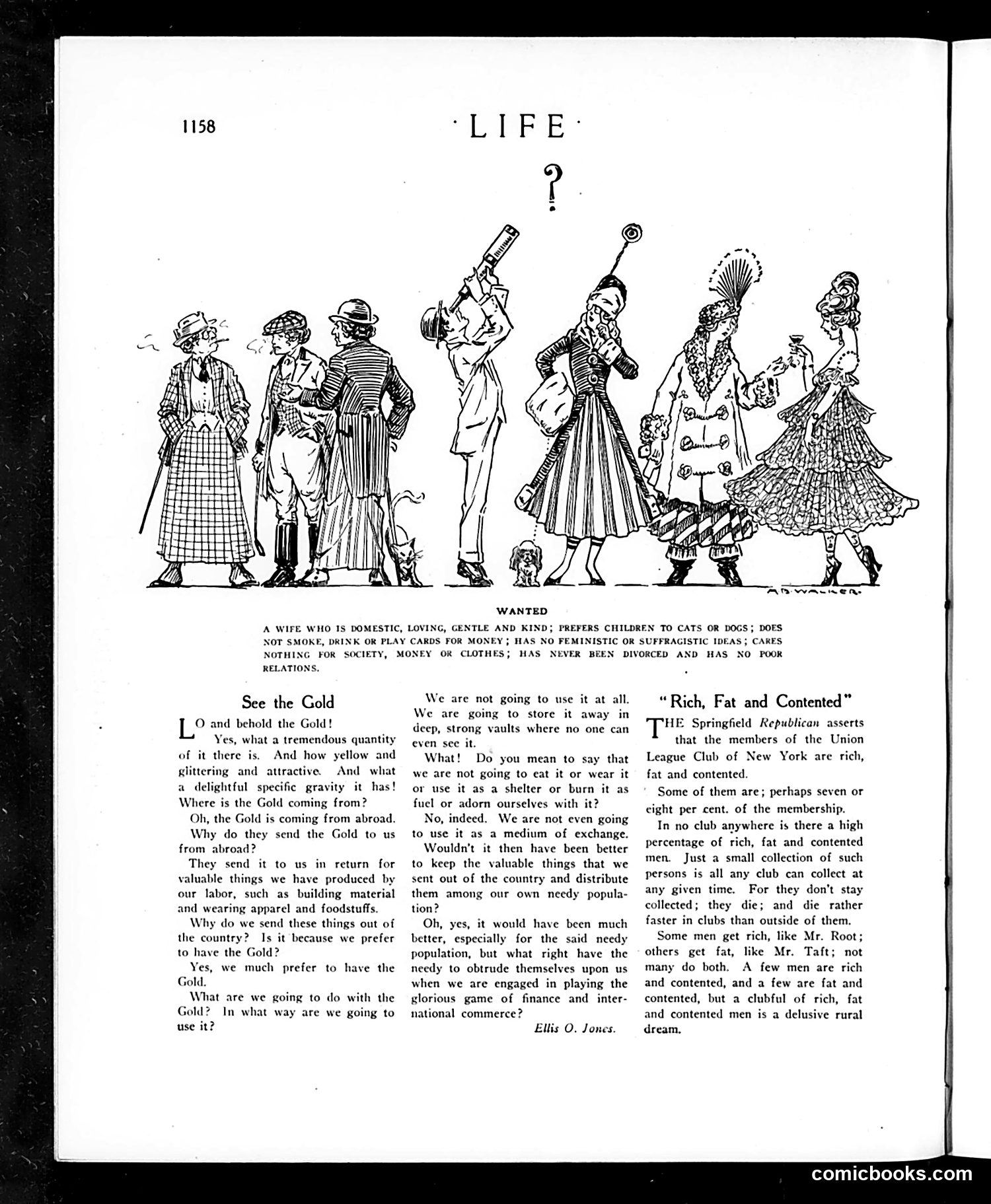
This page contains three distinct satirical pieces: **"Wanted" (top cartoon):** A mock "personal ad" ridiculing impossible female ideals. The illustration shows various fashionable women representing different social types. The text demands a wife who is domestic, kind, prefers children to pets, doesn't gamble or smoke, yet paradoxically cares nothing for society or money—an unrealistic, contradictory fantasy of the "perfect woman." **"See the Gold" (left column):** Satirizes American economic policy during what appears to be gold-standard era debates. The piece uses absurdist dialogue to mock the logic of exporting valuable domestic goods (materials, clothing, food) abroad in exchange for gold that's then locked away unused—serving no practical purpose for citizens or the poor. The satire highlights the disconnect between nationalist finance and actual human welfare. **"Rich, Fat and Contented" (right column):** Responds to a newspaper claim that Union League Club members are wealthy and satisfied. The author argues this is a rural fantasy—most wealthy clubs contain only a small percentage of truly rich, contented members, since people die, lose fortunes, or gain only one attribute (wealth OR contentment, rarely both).
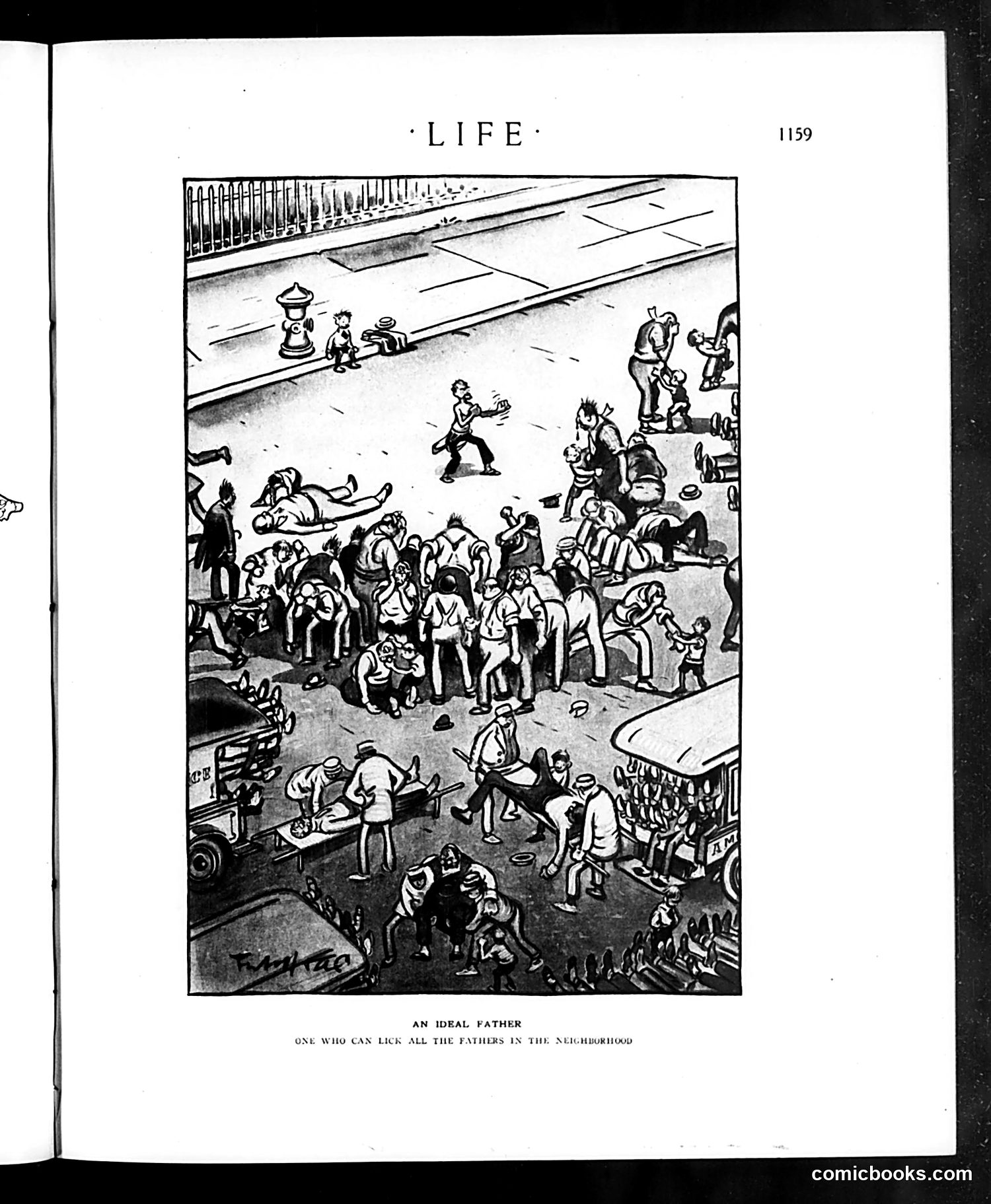
This is a satirical cartoon titled "An Ideal Father: One Who Can Lick All the Fathers in the Neighborhood." The image depicts a street scene with numerous children playing and adults supervising. The joke appears to be a commentary on mid-20th century masculinity and parenting ideals. The caption suggests that the "ideal father" is defined by his physical dominance—his ability to physically overpower other neighborhood fathers. This satirizes a particular masculine standard of the era: the notion that a man's worth as a father was measured by his toughness and willingness to fight. The crowded, chaotic neighborhood scene emphasizes the social competition implied by this standard. The satire mocks how superficial and aggressive this definition of ideal fatherhood was, contrasting physical prowess with actual parenting responsibilities visible in the busy street scene.
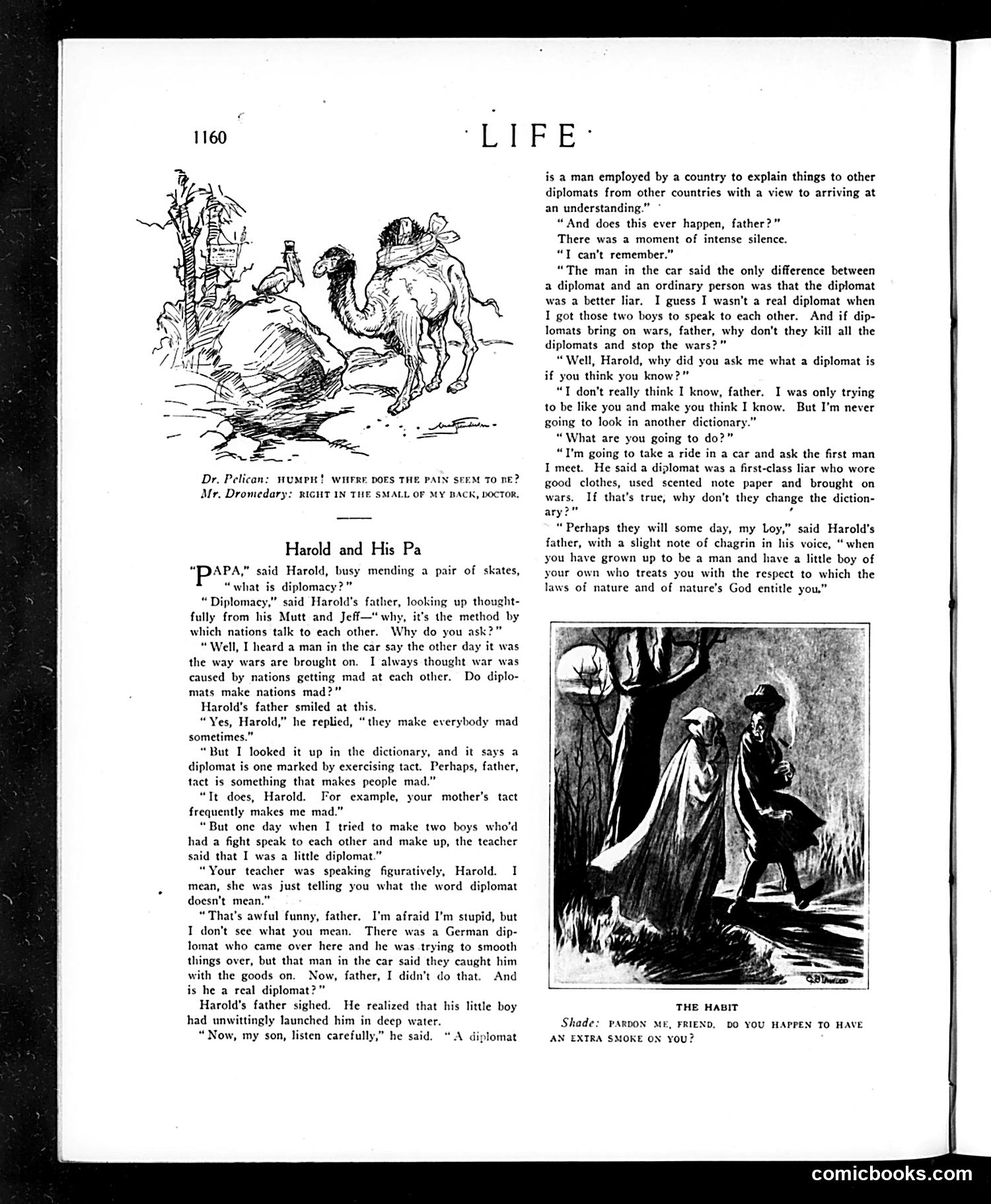
This page contains a humorous dialogue satirizing diplomacy and international relations, likely from the early 20th century. Harold innocently interrogates his father about diplomacy after overhearing a stranger claim diplomats cause wars through deception. The satire operates on multiple levels: Harold's childlike logic exposes the absurdity of diplomatic pretense—if diplomats are merely "better liars" who wear fine clothes and cause conflict, why not eliminate them? His father, unable to articulate a meaningful defense of diplomacy, eventually admits he "can't remember" diplomacy ever successfully preventing war. The joke targets both professional diplomats (portrayed as sophisticated fraudsters) and the father's inability to defend an institution he presumably respects. The cartoons above and below—a pelican and dromedary discussing pain, and "The Habit" about bumming cigarettes—are unrelated satirical sketches typical of Life magazine's format. The piece reflects post-WWI skepticism about whether diplomacy genuinely prevents conflict or merely masks national self-interest.
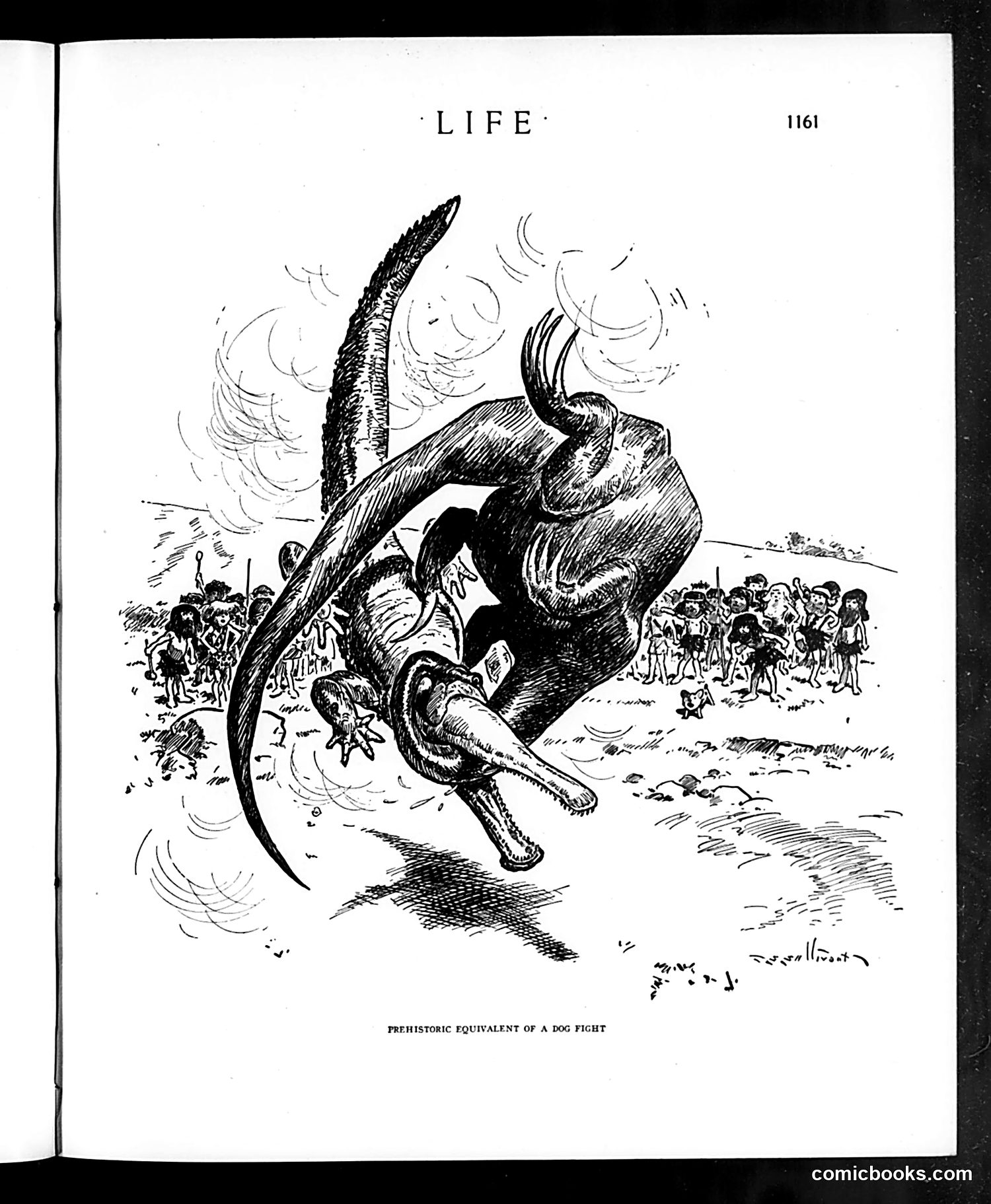
This satirical cartoon from *Life* magazine depicts two prehistoric creatures engaged in combat, labeled "Prehistoric Equivalent of a Dog Fight." The illustration shows what appear to be early humanoid or ape-like beings with exaggerated features—large horns or tusks and muscular builds—grappling violently while a crowd of primitive figures watches in the background. The satire works by drawing a parallel between ancient, "primitive" human behavior and modern entertainment. The term "dog fight" refers to organized fighting matches (illegal and cruel), suggesting that humans haven't evolved morally or intellectually from their prehistoric ancestors. The joke implies that contemporary audiences who enjoy violent spectacles are fundamentally no different from prehistoric peoples watching brutal combat—the same base instinct for violence entertainment persists across millennia, despite civilization's veneer of progress.
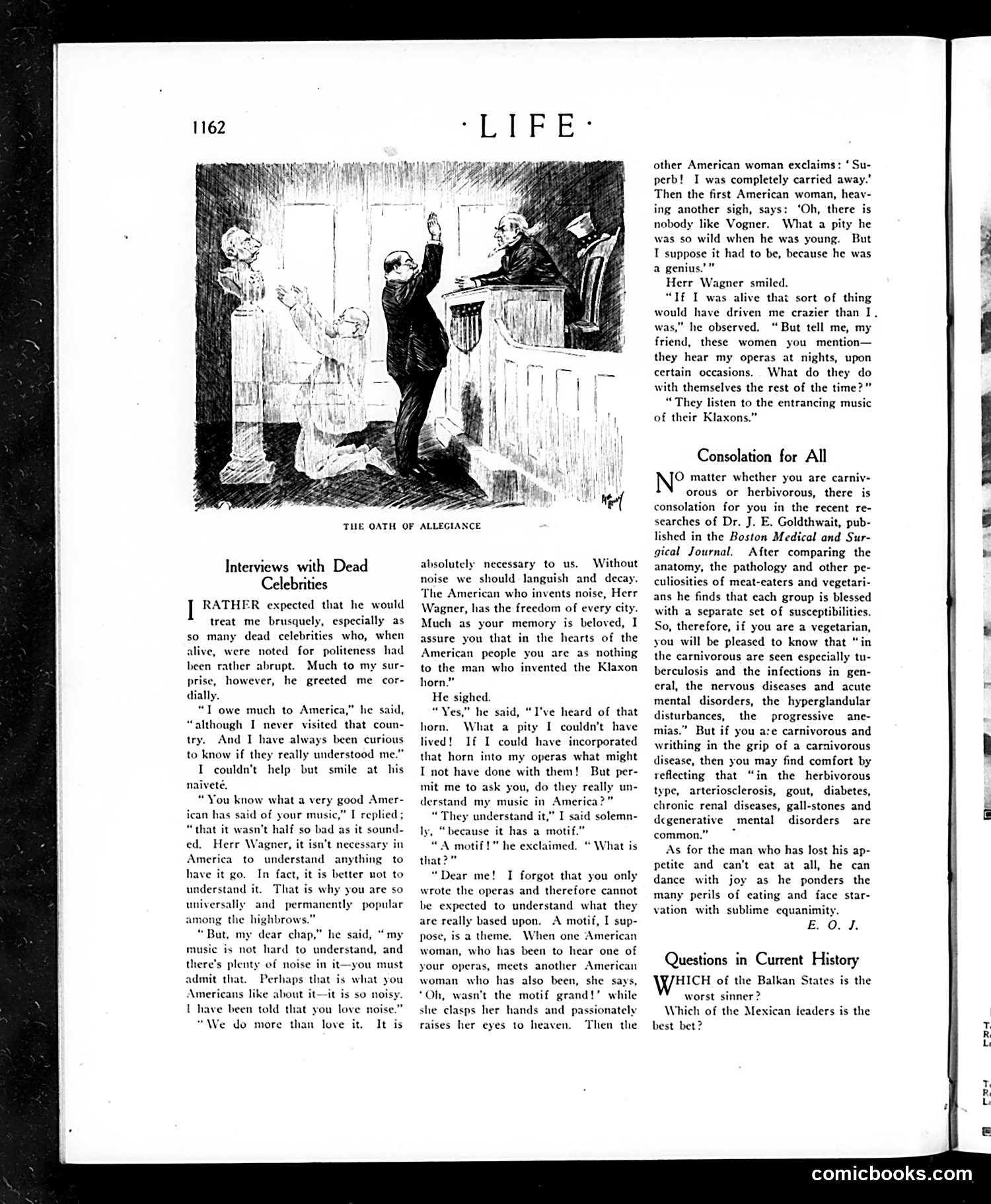
This satirical piece features an imagined interview with the dead composer Richard Wagner. The cartoon depicts Wagner greeting an American interviewer cordially at what appears to be a customs or border checkpoint (hence "Oath of Allegiance"). **The satire's targets:** 1. **American noise and materialism**: The piece mocks Americans' alleged love of noise, elevating the inventor of the Klaxon horn above Wagner himself in American esteem. 2. **Superficial cultural consumption**: American women who attend Wagner operas don't genuinely understand them—they simply repeat the word "motif" as pretentious jargon to impress each other, having absorbed nothing meaningful. 3. **Wagner's reputation**: The joke implies Americans respect Wagner's name while remaining completely indifferent to his actual artistic achievement. The humor relies on Wagner's bemused realization that his operas matter far less to Americans than automobile horns, and that his music serves merely as background to social posturing rather than genuine aesthetic appreciation.
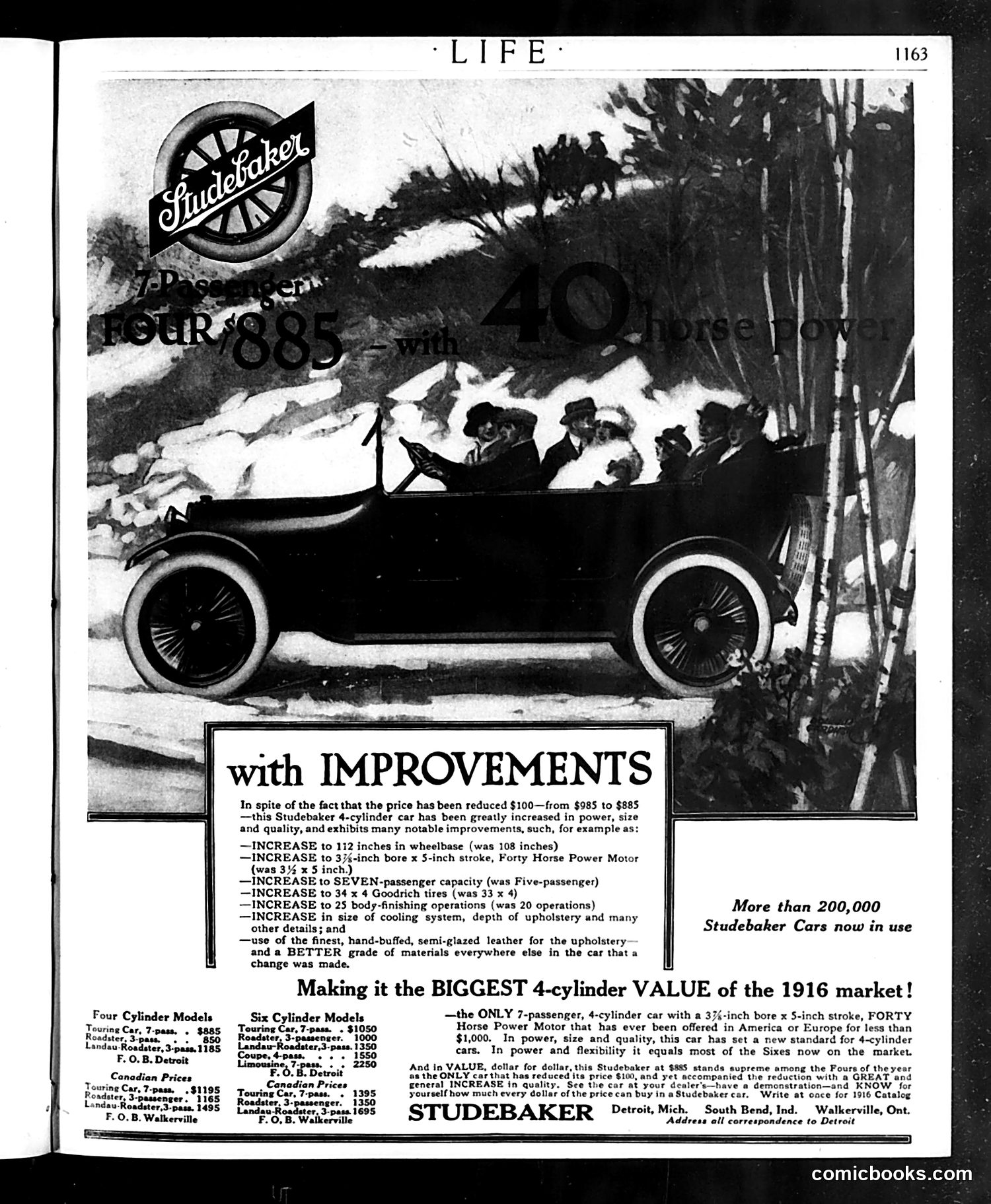
This is **not a political cartoon or satire**, but rather a **full-page advertisement** for the 1916 Studebaker automobile, published in *Life* magazine. The image shows a side-profile illustration of a Studebaker 4-cylinder touring car with passengers, positioned in an idyllic outdoor landscape. The advertisement's rhetorical strategy is to emphasize value: despite a $100 price reduction (from $985 to $885), the car features numerous upgrades—increased wheelbase, engine power, passenger capacity, tire size, and interior refinements. The central claim is that this represents "the BIGGEST 4-cylinder VALUE of the 1916 market." The ad lists specific technical improvements and boasts that over 200,000 Studebaker cars are "now in use," lending social proof to the product. This reflects early automotive advertising's emphasis on technical specifications and competitive positioning during a period when automobiles were becoming more accessible consumer goods for middle-class Americans.
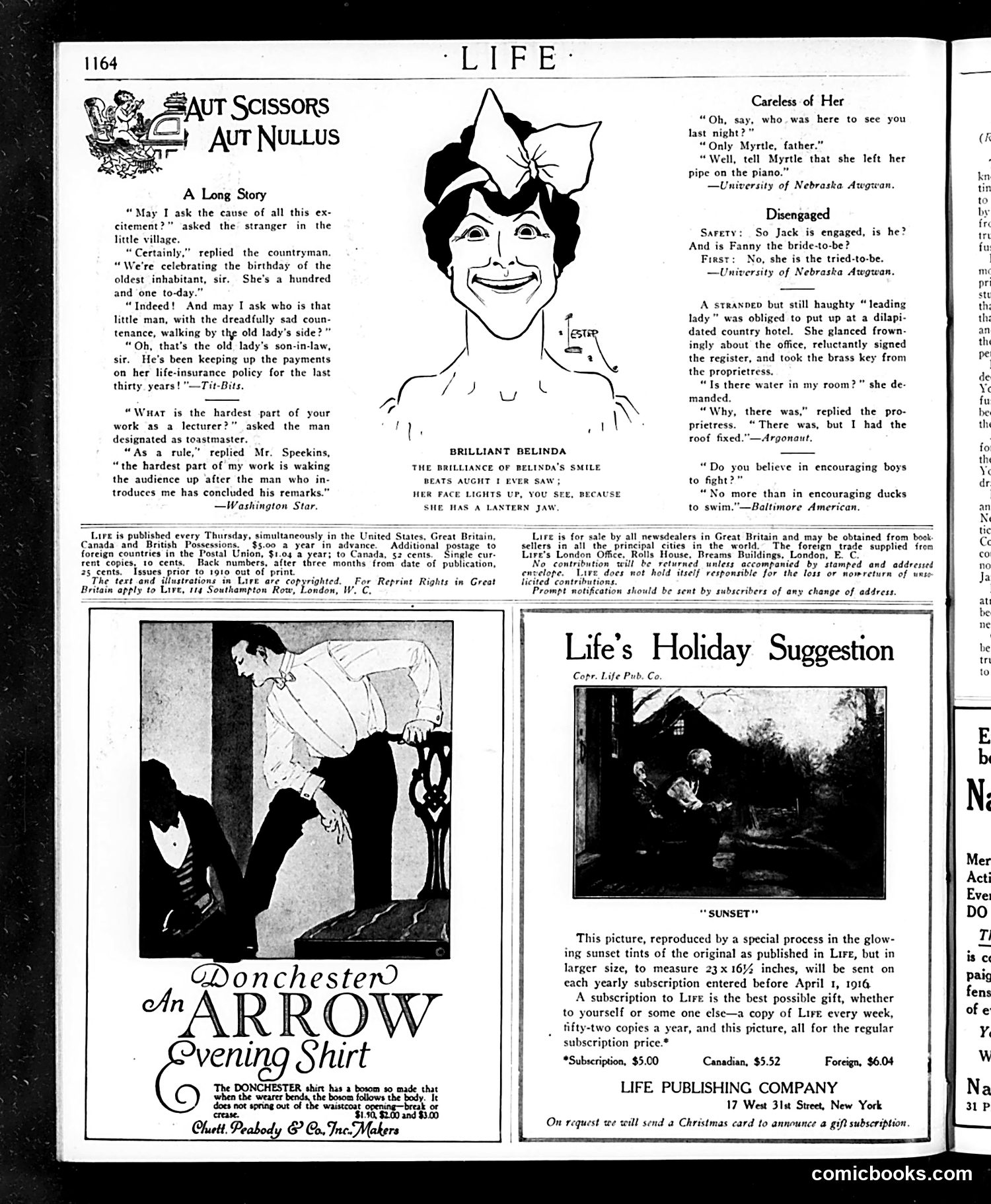
This page from *Life* magazine (circa 1915) contains several short humorous anecdotes and advertisements typical of the era's satirical humor. The jokes rely on irony and social commentary: One mock-celebrates a centenarian's birthday while highlighting her son-in-law's misery—he's profited from keeping her alive through insurance payments. Another mocks the tedium of public speaking. A third jokes about a woman's "lantern jaw" (protruding lower jaw)—a dated physical insult common in early 20th-century humor. The cartoons and quips satirize middle-class anxieties: insurance practices, marital disappointment, and social pretension (the haughty actress at a shabby hotel). The Donchester shirt advertisement uses humor to sell menswear. **Key context for modern readers:** These jokes assume audiences understood period-specific humor about physical appearance and family dynamics. The insurance joke's dark humor reflects contemporary anxieties about financial dependency and aging. The overall tone is genteel rather than biting—typical of *Life*'s target audience of educated, affluent readers.
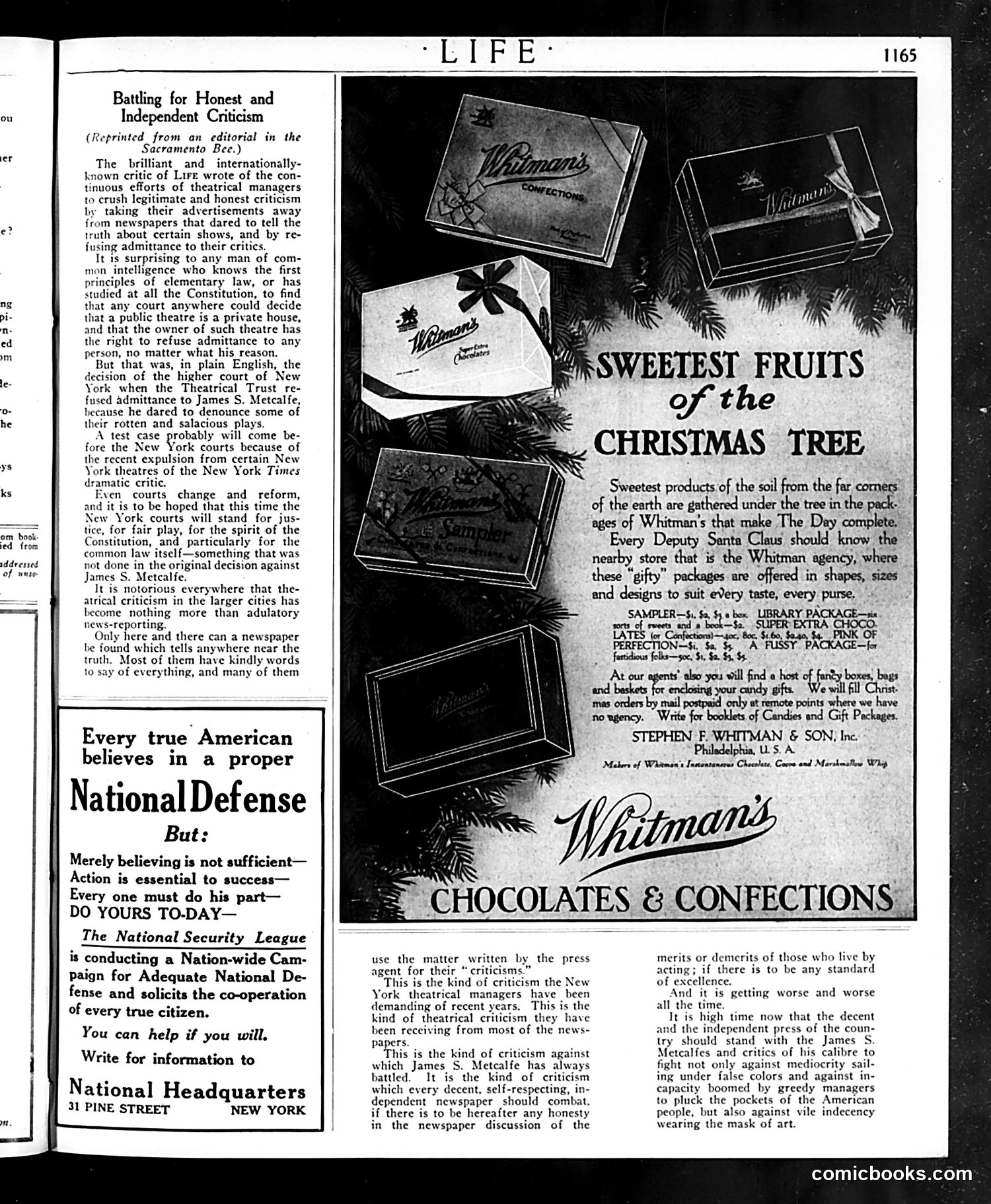
This page contains editorial commentary on theatrical criticism alongside period advertising. The main text criticizes theatrical managers' suppression of honest drama critics. It references **James S. Metcalfe**, a Life critic, who was denied theatre admission for negative reviews. The editorial notes a court decision upheld theatre owners' right to exclude critics, and predicts similar cases will follow (mentioning a New York Times drama critic's recent expulsion). The piece argues that most theatrical criticism has become merely promotional "news-reporting" rather than honest evaluation, because managers punish critical papers by withdrawing advertisements. The editorial calls for courts and newspapers to defend independent criticism as a matter of constitutional principle and professional integrity. The left sidebar is a National Defense League advertisement (likely WWI-era, given the patriotic framing), while the right features a Whitman's Chocolates Christmas advertisement—typical period magazine content unrelated to the editorial matter.
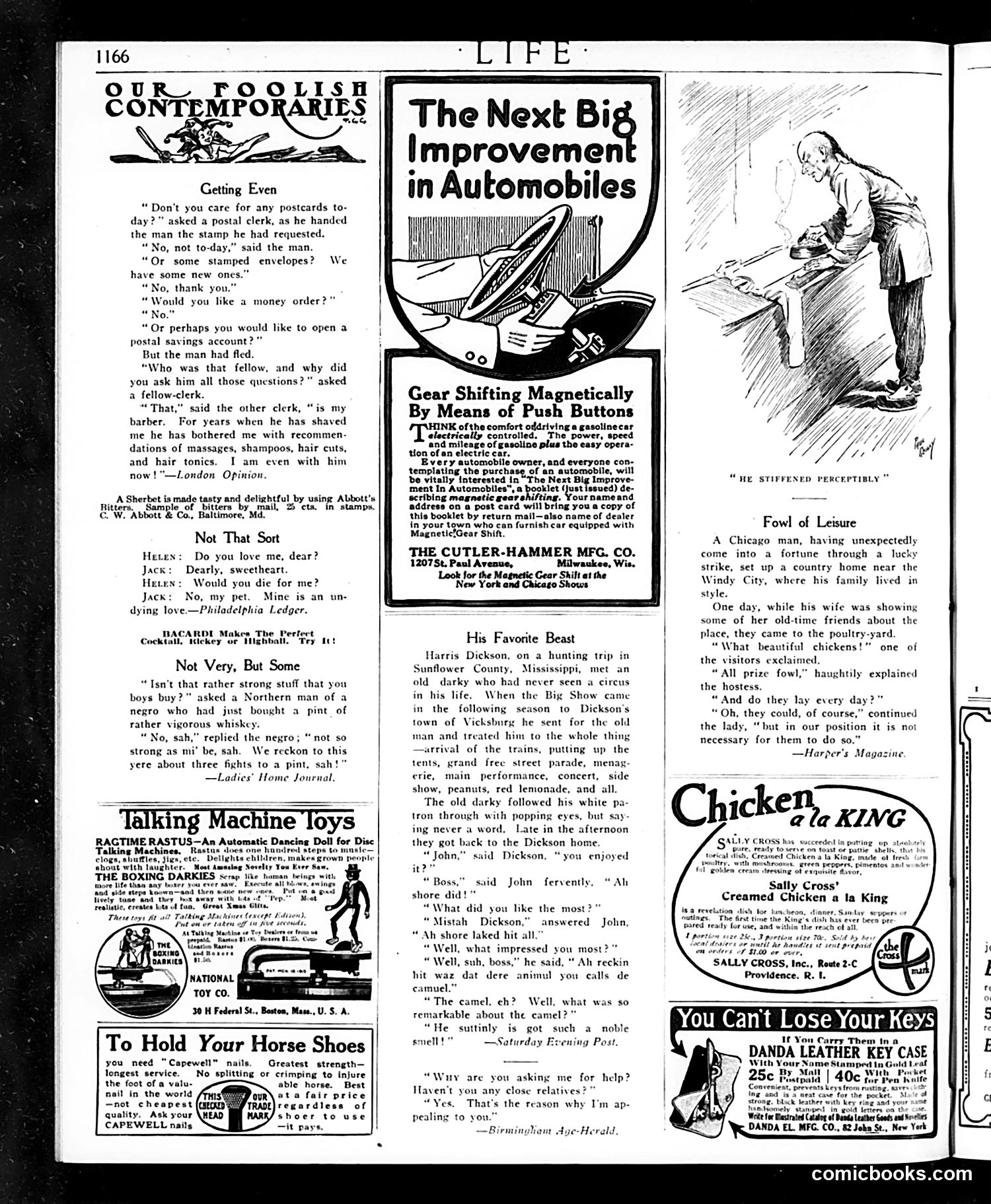
This page from *Life* magazine (a satirical publication, not the photo magazine) contains several short humor pieces typical of early 20th-century American comic writing: **"Getting Even"** mocks a postal clerk who annoyingly upsells services to customers. The joke: the clerk's barber has done the same thing for years, so now the clerk retaliates by pestering the barber with unwanted offers. **"Not That Sort"** and **"Not Very, But Some"** are brief romantic/ethnic humor pieces using wordplay and dialect stereotypes common to the era. **The main advertisement** promotes "magnetic gear shifting" for automobiles—a technological innovation being marketed as "the next big improvement." **"His Favorite Beast"** is a dialect humor piece featuring a Black character who attends a circus. The "joke" relies on stereotypical speech patterns and the premise that the character is most impressed by the camel, framed as unexpected or amusing. The page also advertises toy automata, horseshoe nails, and food products. The overall tone reflects early-20th-century publishing conventions, including casual use of racial caricatures now recognized as offensive.
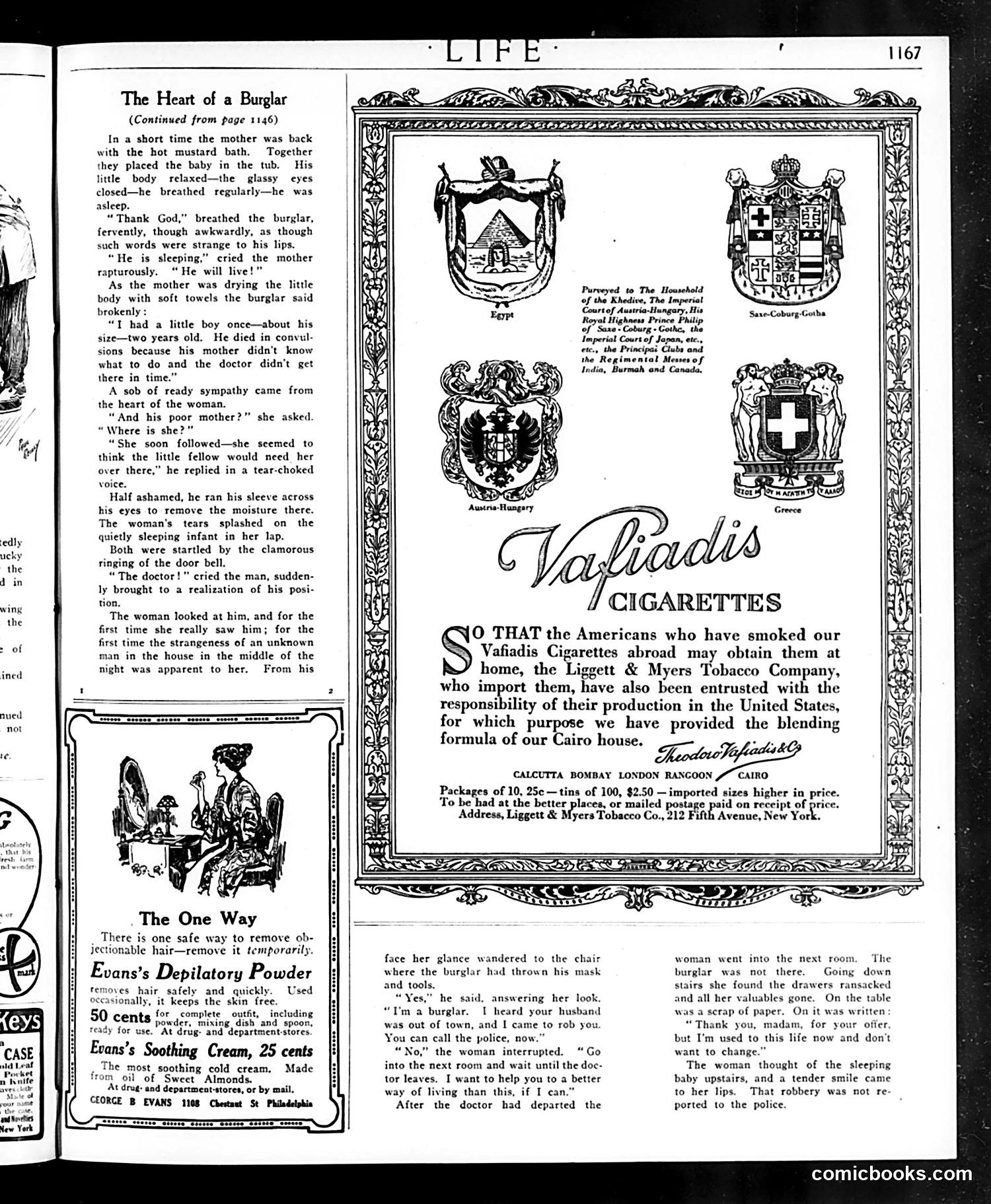
This is a serialized short story (continued from page 1146) about a burglar who breaks into a home and discovers a critically ill infant. Despite his criminal nature, he helps the mother save the baby's life using a mustard bath treatment. The burglar reveals he lost his own young child years ago under similar circumstances—a tragedy that humanizes him. When the doctor arrives, the burglar's true identity is exposed. Rather than turn him in, the grateful mother offers him a chance at redemption. However, the burglar cannot abandon his criminal life and steals from the house anyway—though his note suggests her kindness has moved him. The story's message is sentimental: even hardened criminals possess human hearts capable of compassion, yet are trapped by circumstance or habit. It reflects early 20th-century interest in redemption narratives and the notion that criminality stems from tragedy or desperation rather than pure evil.
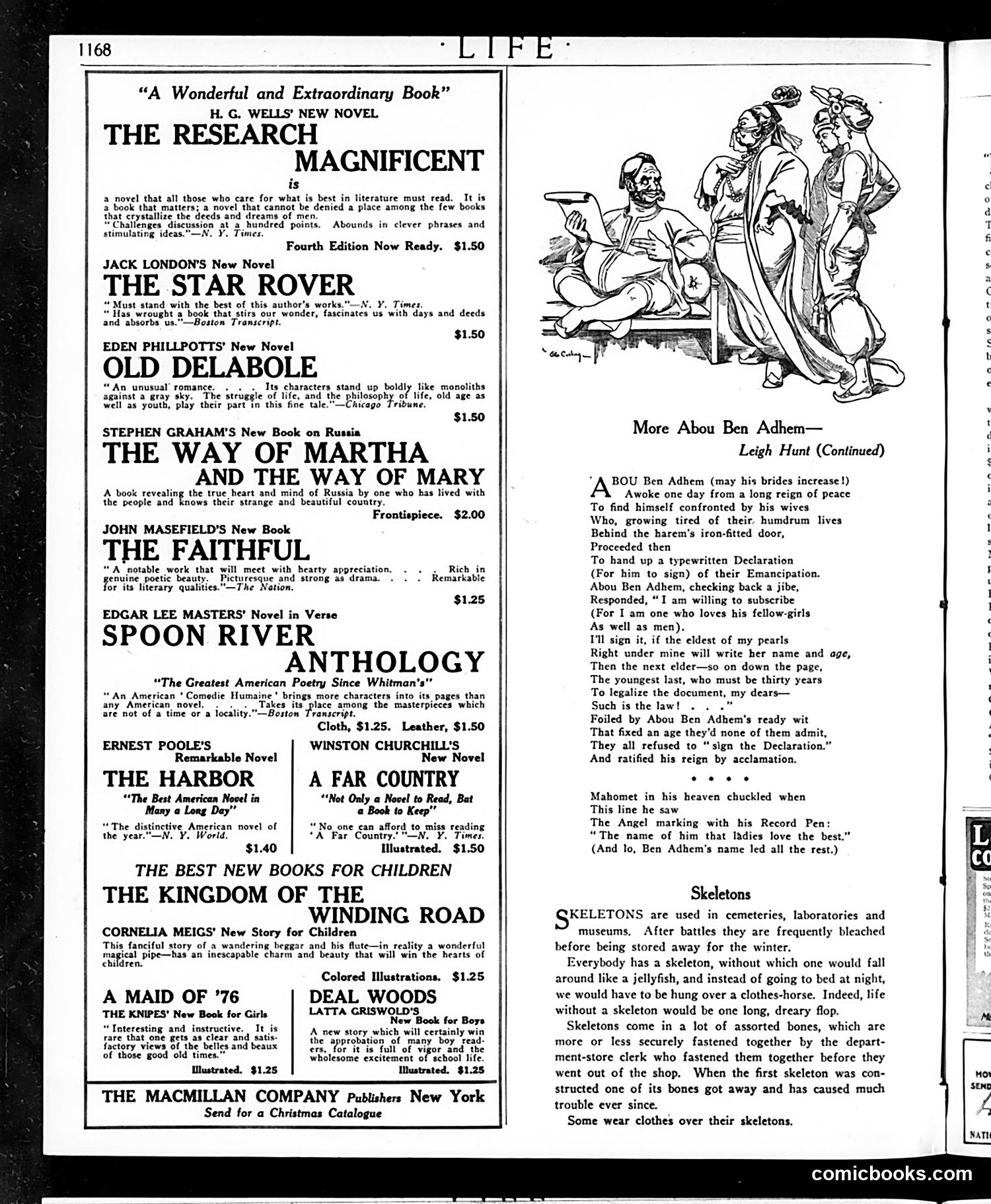
This page is primarily **book advertisements** from circa 1915, with two distinct content areas: ## Left Side: New Literary Releases Publishers advertise novels by major authors (H.G. Wells, Jack London, Eden Phillpotts, Edgar Lee Masters, Ernest Poole) at $1.25-$2.00, positioning literature as culturally significant. The quoted reviews emphasize "great American" works and masterpieces, reflecting Progressive-era confidence in literature's importance. ## Right Side: Poetry & Humor The illustrated section presents "More About Ben Adhem," a satirical poem continuation by Leigh Hunt. The cartoon depicts **harem wives demanding women's emancipation**—a contemporary feminist joke. Ben Adhem cleverly requires wives to sign with their actual ages to prove eligibility, which no woman will do. The humor relies on age-related vanity defeating women's rights activism—a *anti-suffrage* joke mocking early 1900s feminism as vain and self-defeating. The "Skeletons" section (bottom) is mundane educational content about anatomical specimens. **Context: This reflects pre-1920 American attitudes toward women's suffrage through satirical dismissal.**
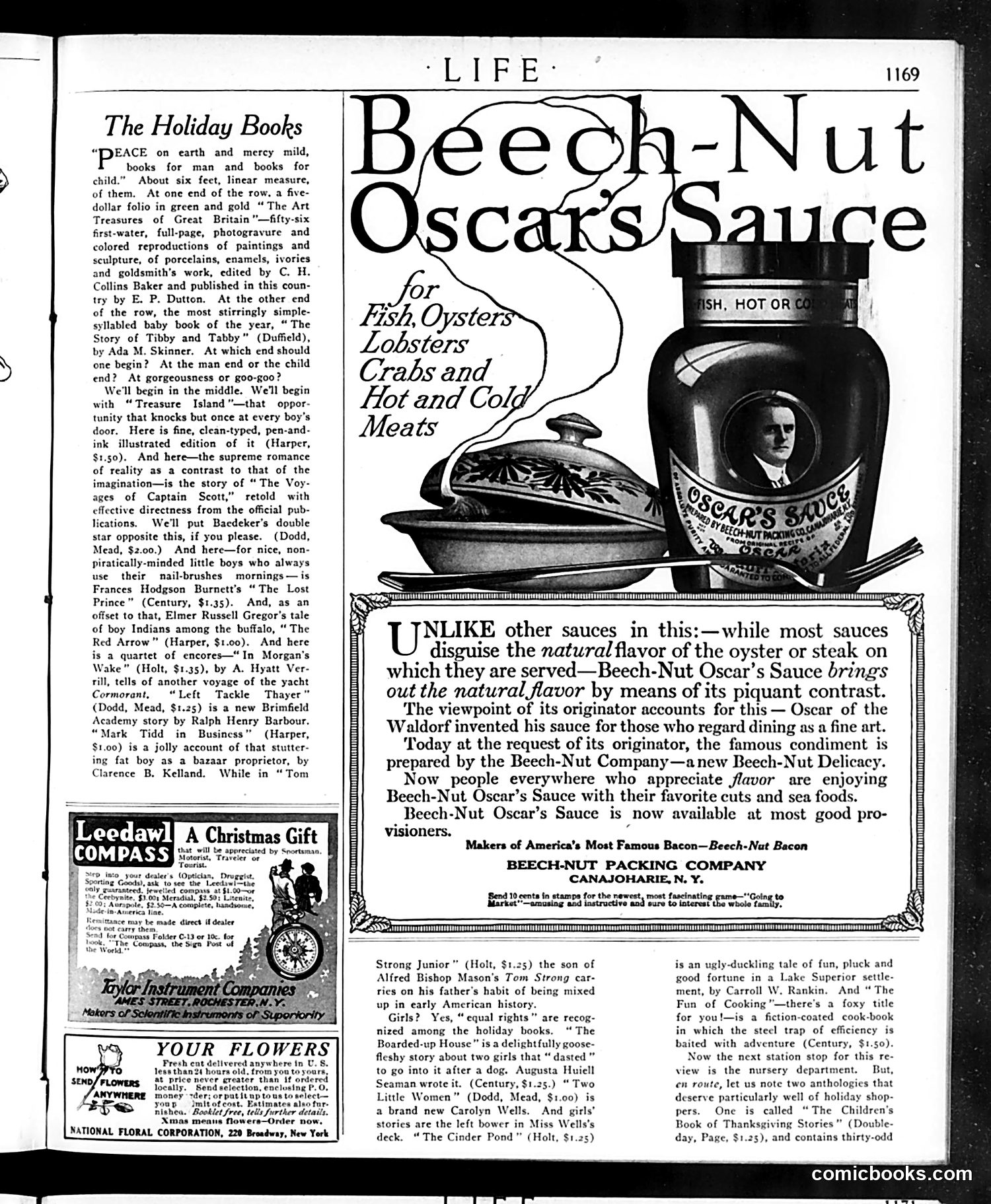
This is primarily a **book review column** titled "The Holiday Books," not a political cartoon. The author recommends Christmas gift books for both adults and children, ranging from an expensive art book ($5) to simple children's stories. The selections span adventure tales (*Treasure Island*), historical narratives (*Voyages of Captain Scott*), and stories about boys (*The Lost Prince*, *Mark Tidd in Business*). The page also contains **period advertisements**: a Leedawl compass (navigation instrument), National Floral Corporation (flower delivery), and prominently, **Beech-Nut Oscar's Sauce**—a commercial condiment allegedly invented by "Oscar of the Waldorf" (the famous chef), now mass-produced by Beech-Nut Company. There is **no political satire** on this page. It reflects early 20th-century consumer culture and gift-giving conventions, with advertising integrated throughout the editorial content—typical of *Life* magazine's business model.
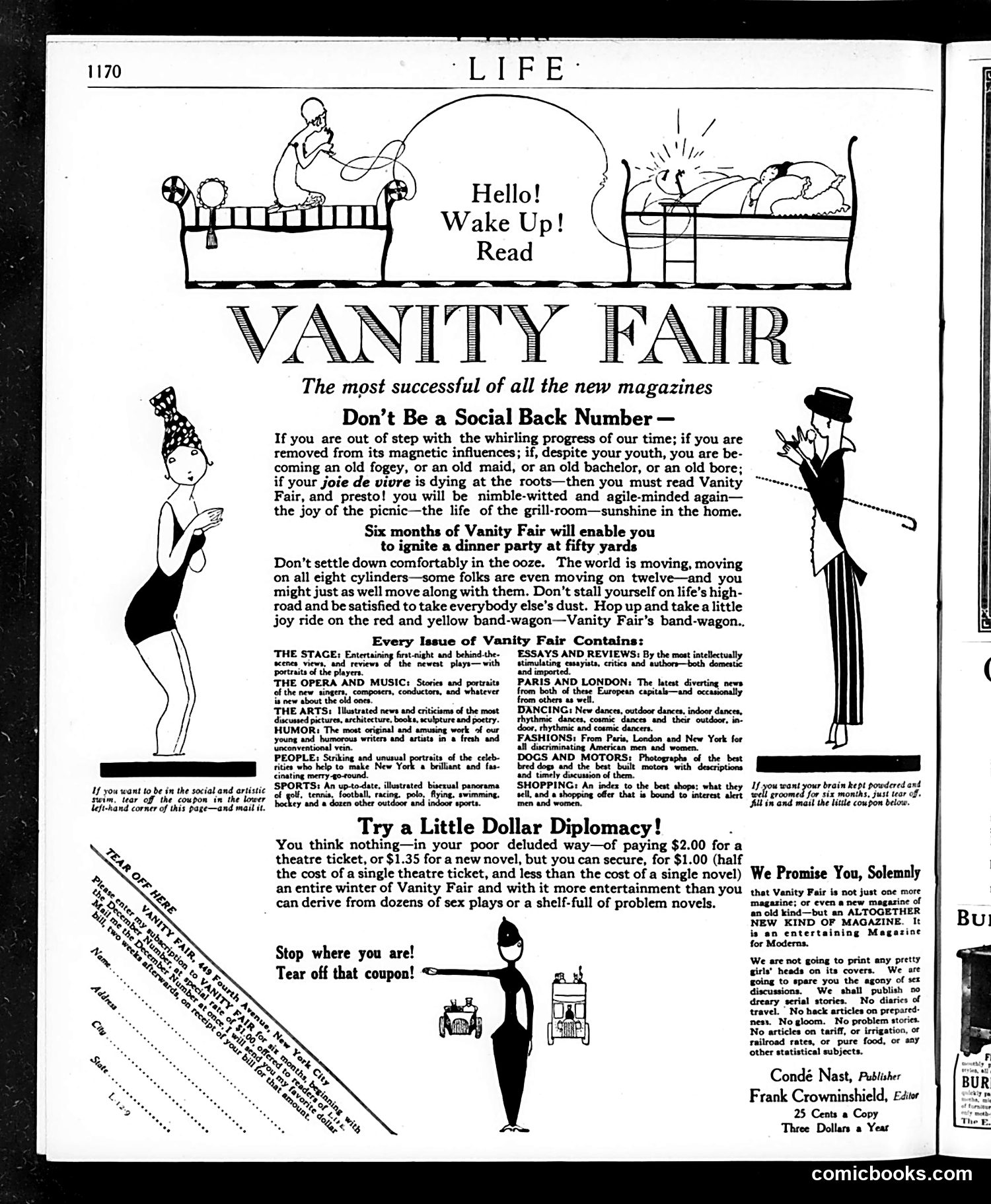
This is primarily a **magazine advertisement**, not political satire. It promotes Vanity Fair, positioned as a modern, sophisticated publication for culturally engaged readers. The cartoon figures flanking the text represent **fashionable urbanites**—a woman on the left reading, a well-dressed man on the right. They embody the magazine's target audience: socially ambitious people wanting to stay current with modern culture. The ad mocks **social obsolescence**, warning readers not to become "old fogeys" or "social back numbers" left behind by modern progress ("moving on all eight cylinders"). It promises that Vanity Fair covers cutting-edge topics: theater, opera, art, fashion, Paris gossip, and motor cars—all markers of sophistication and worldliness. The phrase **"Dollar Diplomacy"** plays on Theodore Roosevelt-era foreign policy but here means getting premium entertainment cheaply ($1 versus $2 for theater tickets). The underlying message: reading Vanity Fair signals you're modern, witty, and culturally aware—not dull or provincial.
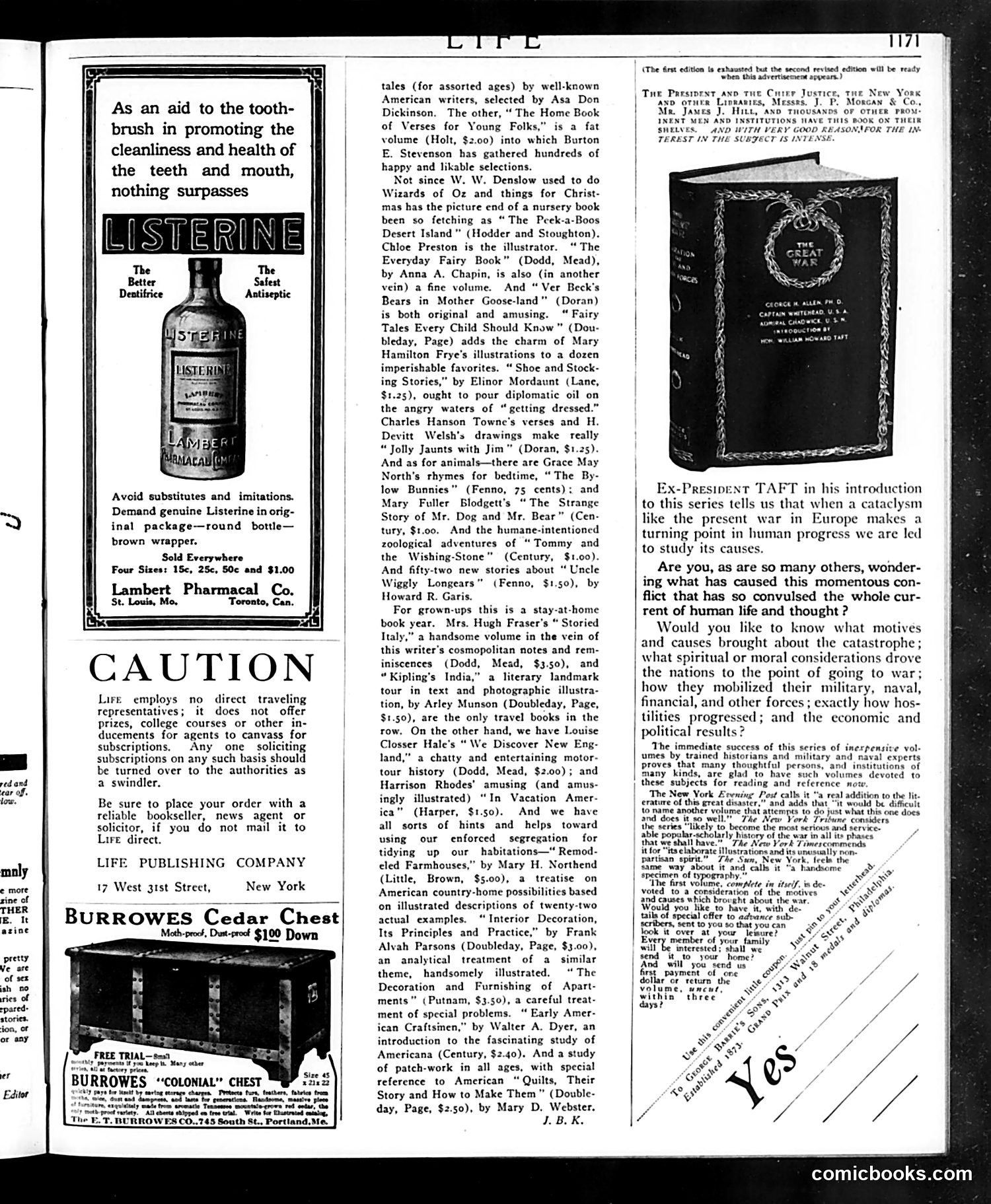
This page is primarily **advertising and book reviews**, not political satire. The main elements are: **Advertisements:** Listerine mouthwash, Burrowes Cedar Chest furniture, and a cautionary notice warning readers against fraudulent subscription solicitors posing as Life magazine representatives. **Book Reviews:** The bulk of the page reviews children's and adult books suitable for wartime "stay-at-home" reading. The context—references to "enforced segregation" and staying home—suggests this was published during **World War I**, when travel restrictions and social disruptions affected leisure activities. The review emphasizes books by established American authors (Kipling, Denslow, Towne) and promotes domestic activities like home decoration and interior design as alternatives to travel. **No political cartoon or satire is present** on this page. The content reflects early-20th-century consumer culture and wartime domestic life.
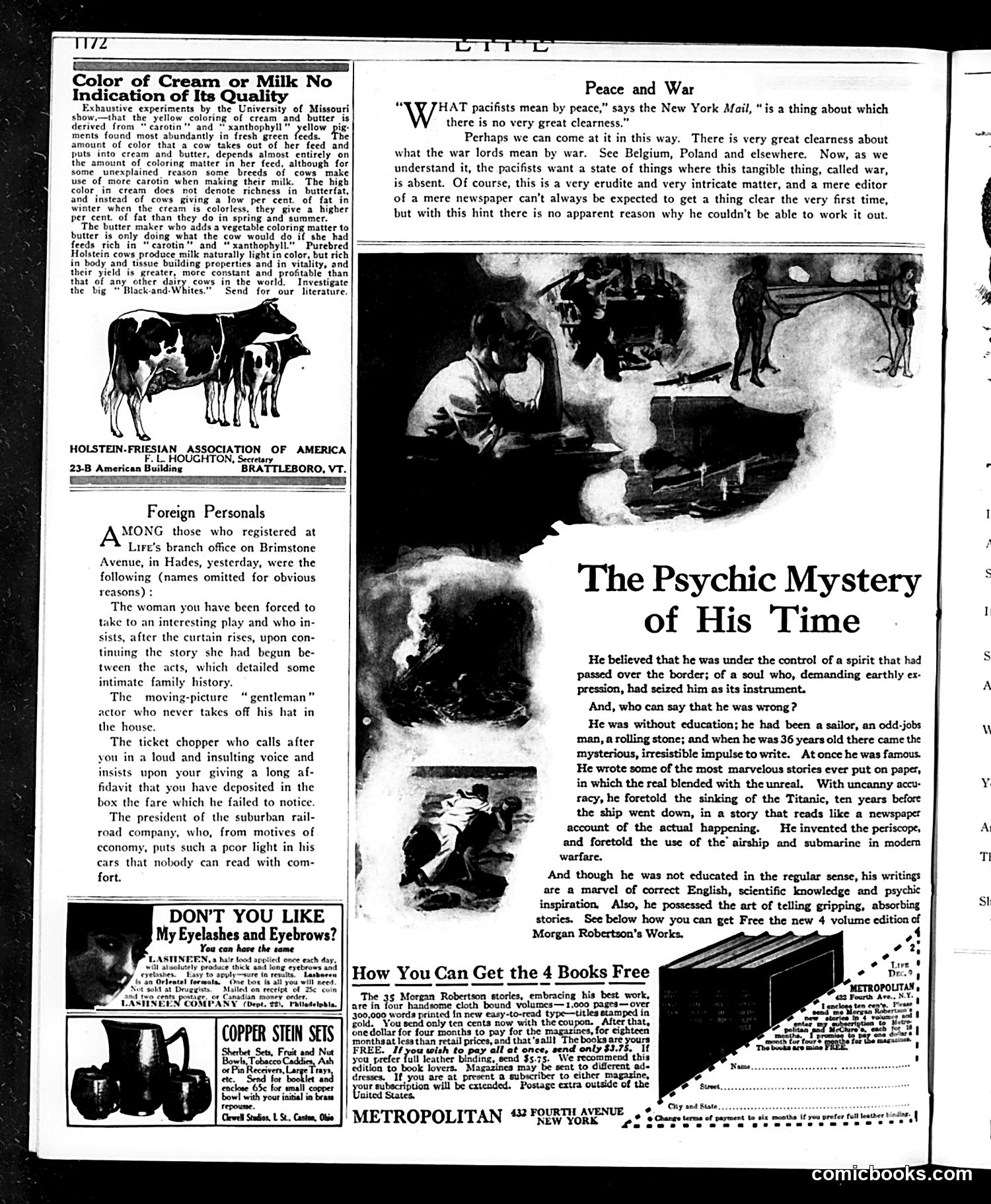
This page mixes advertisements and editorial content typical of early 20th-century Life magazine. **Left side** contains an ad for Holstein-Friesian cattle (promoting dairy quality) and humor pieces under "Foreign Personals"—satirical one-liners about annoying theater-goers (the woman who won't stop talking, the man who won't remove his hat, the rude ticket-taker). These are light social satire about common public annoyances. **Center/right** features an editorial on "Peace and War" mocking pacifists. It sarcastically suggests pacifists are vague about what peace means, while war's effects (referencing Belgium and Poland—likely WWI atrocities) are brutally clear. The author implies pacifists are naive or unclear thinkers. **Lower right** advertises books about a mysterious writer (appears to reference Morgan Robertson) who allegedly predicted major events like the Titanic sinking and military innovations. The page reflects pre- or early-WWI concerns about pacifism versus militarism, with satirical dismissal of peace advocates as impractical idealists.
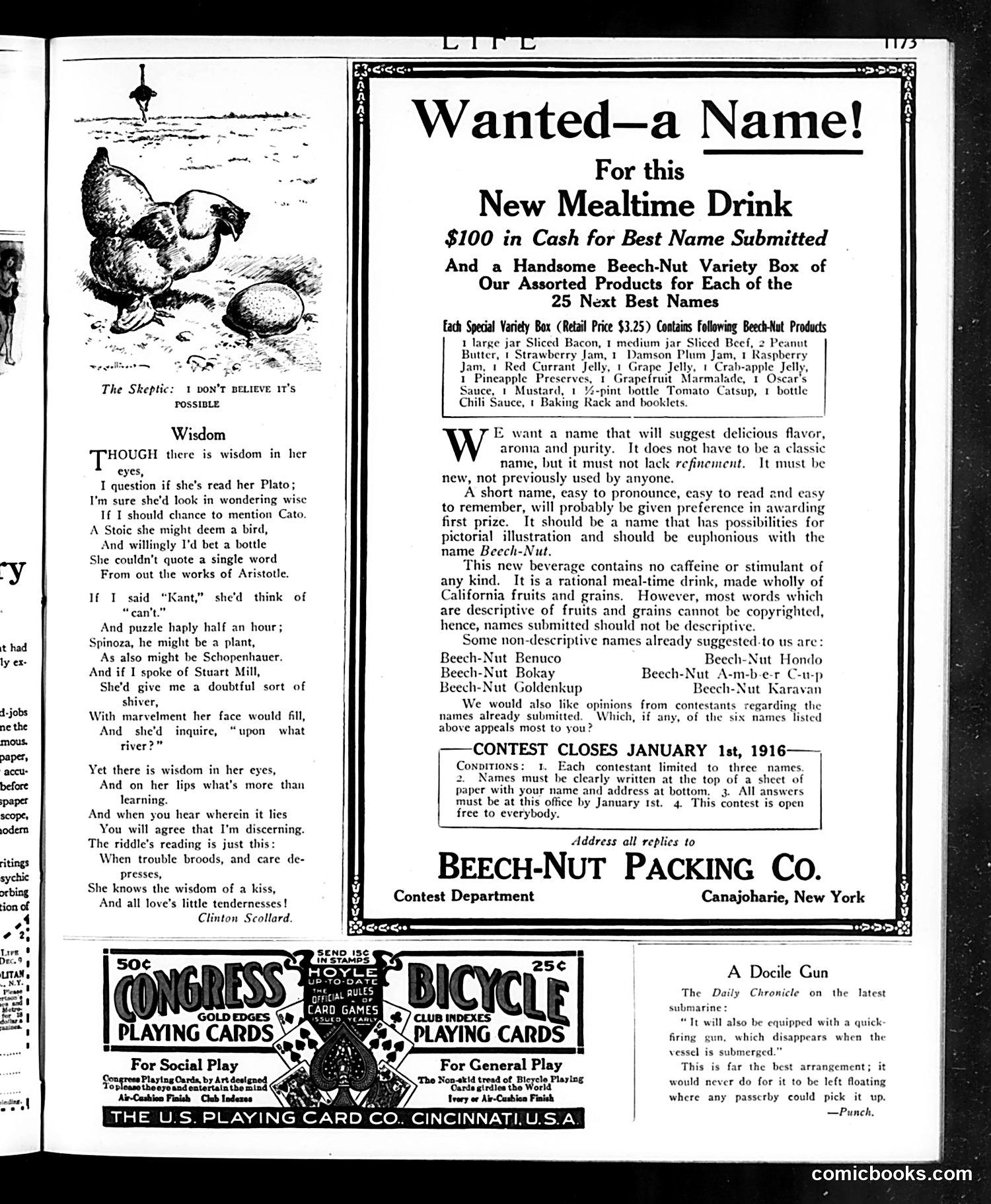
This page contains two distinct elements: **Left side - Poetry titled "Wisdom" by Clinton Scollard:** A romantic poem that plays on conventional expectations. The speaker initially suggests a woman lacks classical education (can't discuss Plato, Aristotle, Kant), but then reveals the real "wisdom" lies in her ability to comfort through affection and tenderness—a gentle satire on male intellectual pretension and a celebration of emotional intelligence over academic knowledge. **Right side - Advertisement:** Beech-Nut Packing Company runs a naming contest for a new mealtime drink, offering $100 cash plus product boxes. The beverage contains no caffeine and is made from California fruits and grains. Entrants must suggest original, non-descriptive names (examples given: "Benuco," "Bokay," "Karavan"). The contest closes January 1, 1916. **Bottom:** Unrelated advertisements for playing cards and a humorous excerpt from *Punch* magazine about submarine guns. The page reflects early 20th-century consumer marketing and commercial naming contests, common in this era.
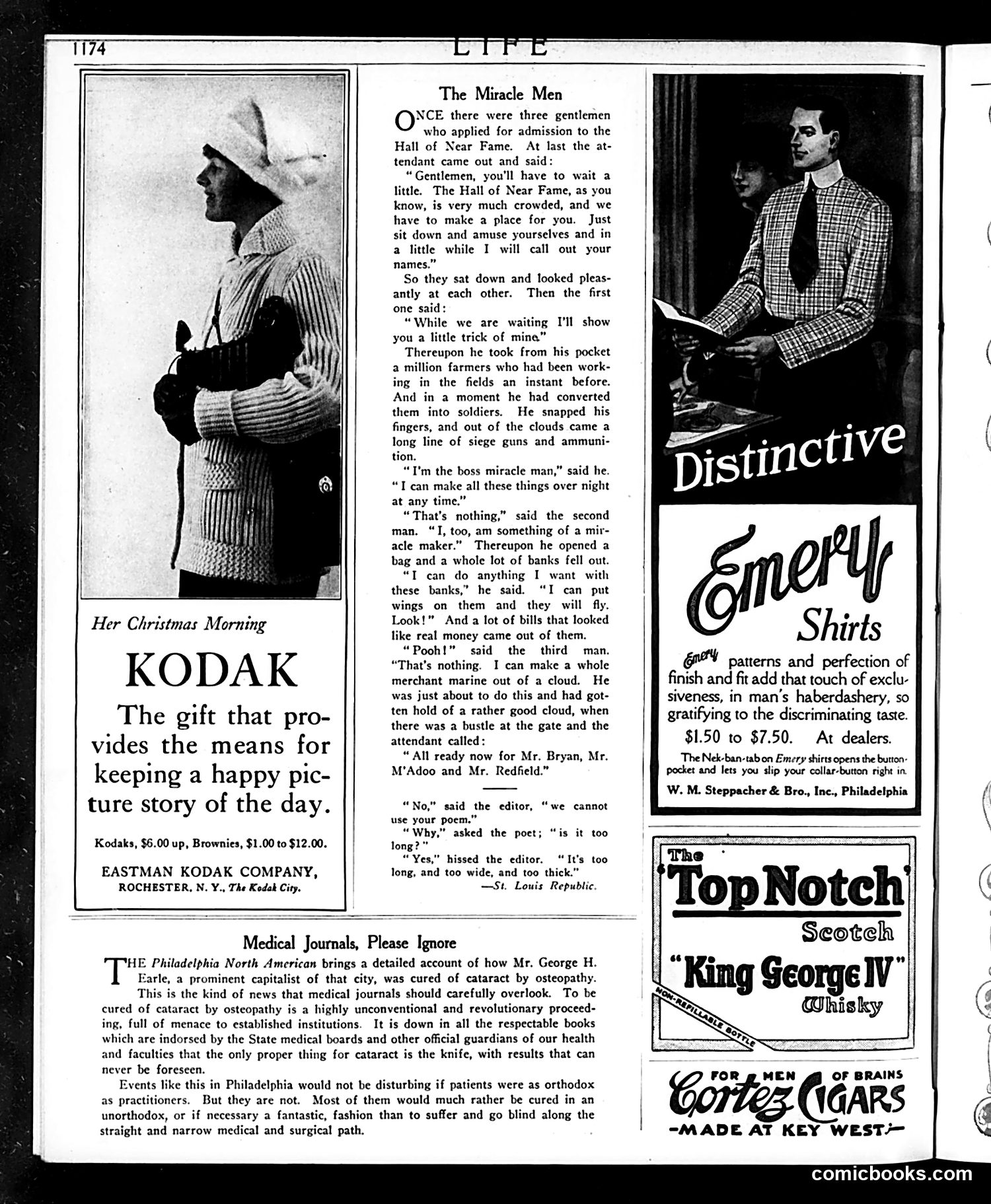
This cartoon satirizes three powerful figures who each claim miraculous economic/political powers. The first conjures soldiers from farmers (likely referring to military mobilization or wartime industrialization). The second performs banking "miracles," manipulating financial institutions and currency. The third attempts to create a merchant marine from clouds. The punchline reveals the satire's target: when summoned, the attendant calls for "Mr. Bryan, Mr. M'Adoo and Mr. Redfield"—likely referring to William Jennings Bryan (politician), William McAdoo (Wilson administration official), and William Redfield (Commerce Secretary). The "Hall of Near Fame" suggests these men's grandiose claims don't quite match reality. The joke mocks progressive-era politicians who promised miraculous economic and military solutions, presenting their rhetoric as mere sleight-of-hand rather than genuine capability. The editor's rejection of the poet's work adds a meta-commentary on censorship or editorial standards.
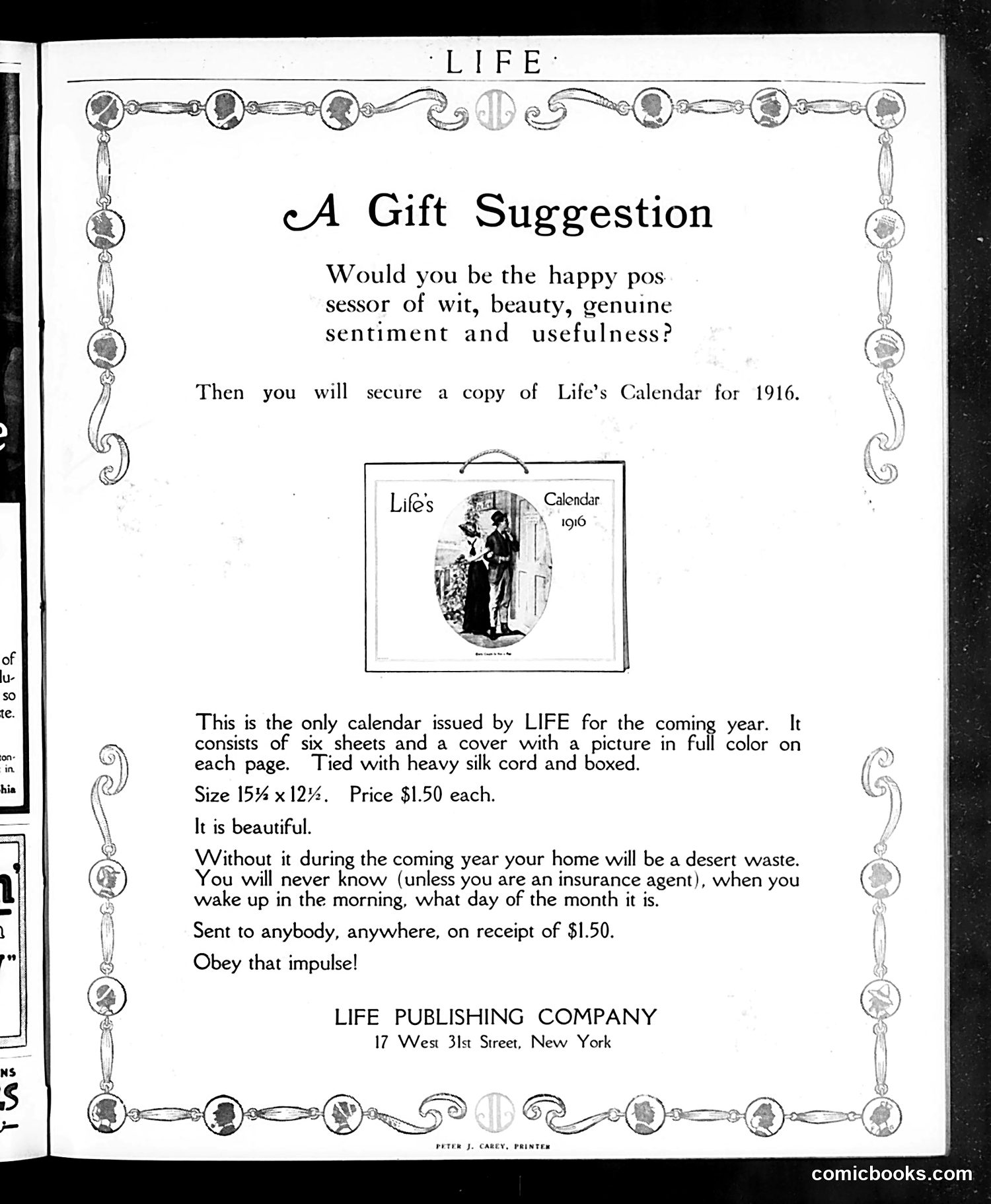
This is a product advertisement, not a political cartoon. Life Publishing Company promotes their 1916 calendar through humorous, exaggerated copy typical of early 20th-century advertising. The satire operates through absurdist hyperbole: the ad claims that without this calendar, one's home becomes "a desert waste" and you won't know what day it is upon waking (with a jab at insurance agents, who supposedly track dates meticulously). The breathless language—"Obey that impulse!"—mocks both the product's supposed indispensability and advertising's manipulative urgency. The calendar itself featured six illustrated pages in full color, tied with silk cord and boxed, priced at $1.50. This was positioned as Life's sole official calendar offering. The humor lies in treating a mundane calendar as a luxury item essential to civilized life, reflecting contemporary advertising conventions that used exaggeration and mock-seriousness to drive consumer purchases.
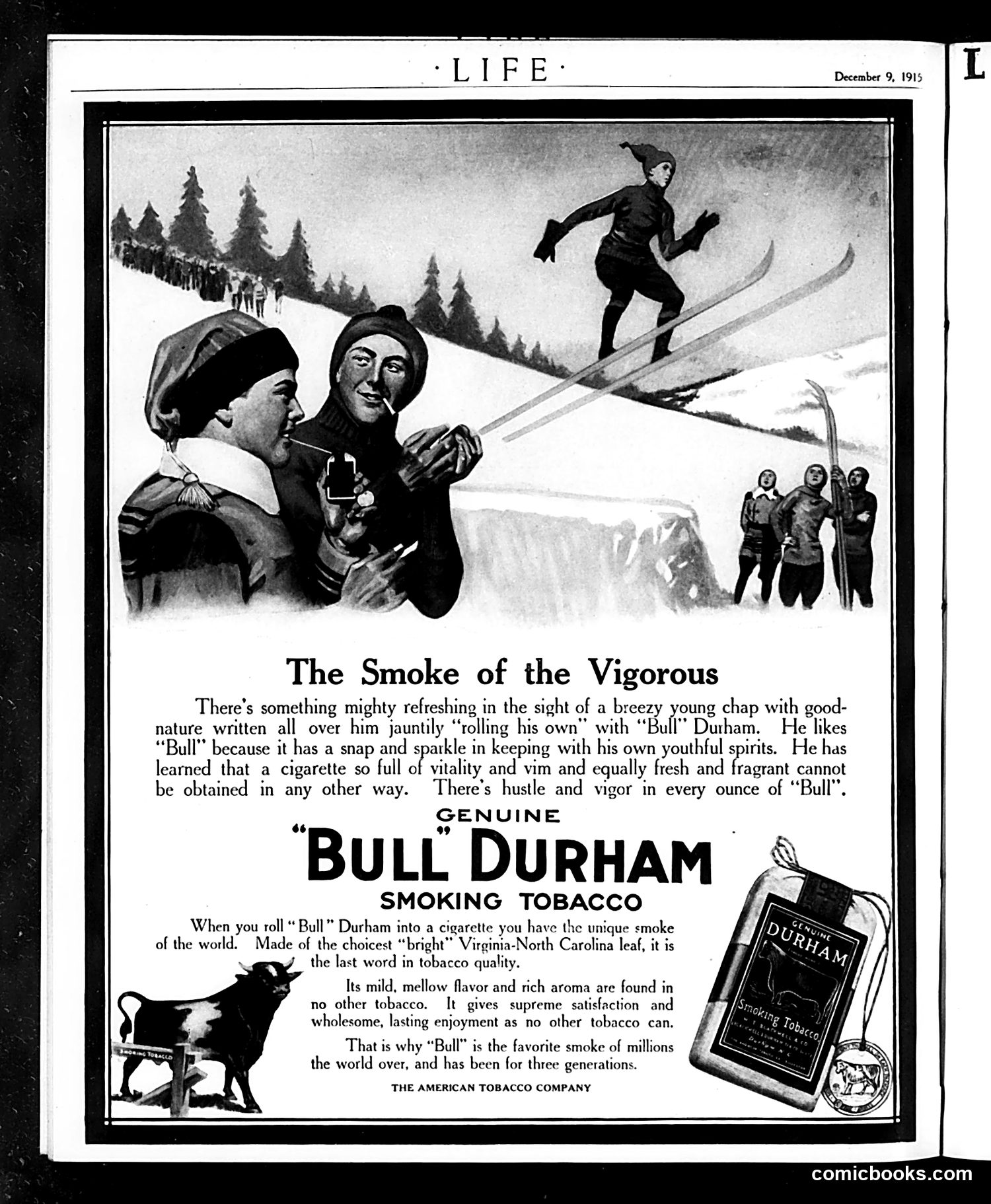
This is primarily a **tobacco advertisement**, not political satire. It depicts vigorous young men skiing and rolling their own cigarettes with Bull Durham tobacco, a popular rolling-tobacco brand of the era. The ad's appeal is to **masculine vitality and youth**: the "breezy young chap" exemplifies energy, good nature, and self-reliance ("rolling his own"). The copy emphasizes the product's association with "hustle and vigor"—qualities the advertiser links to manly character. The ski scene and casual poses suggest outdoor recreation and rugged independence, cultural markers of desirable masculinity in 1915. The American Tobacco Company uses this imagery to market smoking not merely as a habit, but as an expression of youthful vigor and American strength. By modern standards, the advertisement is notable for its **open promotion of cigarettes without health warnings** and its explicit targeting of youth through idealized masculine imagery.