
Life, 1915-12-09 · page 22 of 48
Life — December 9, 1915 — page 22: what you’re looking at
What you’re looking at
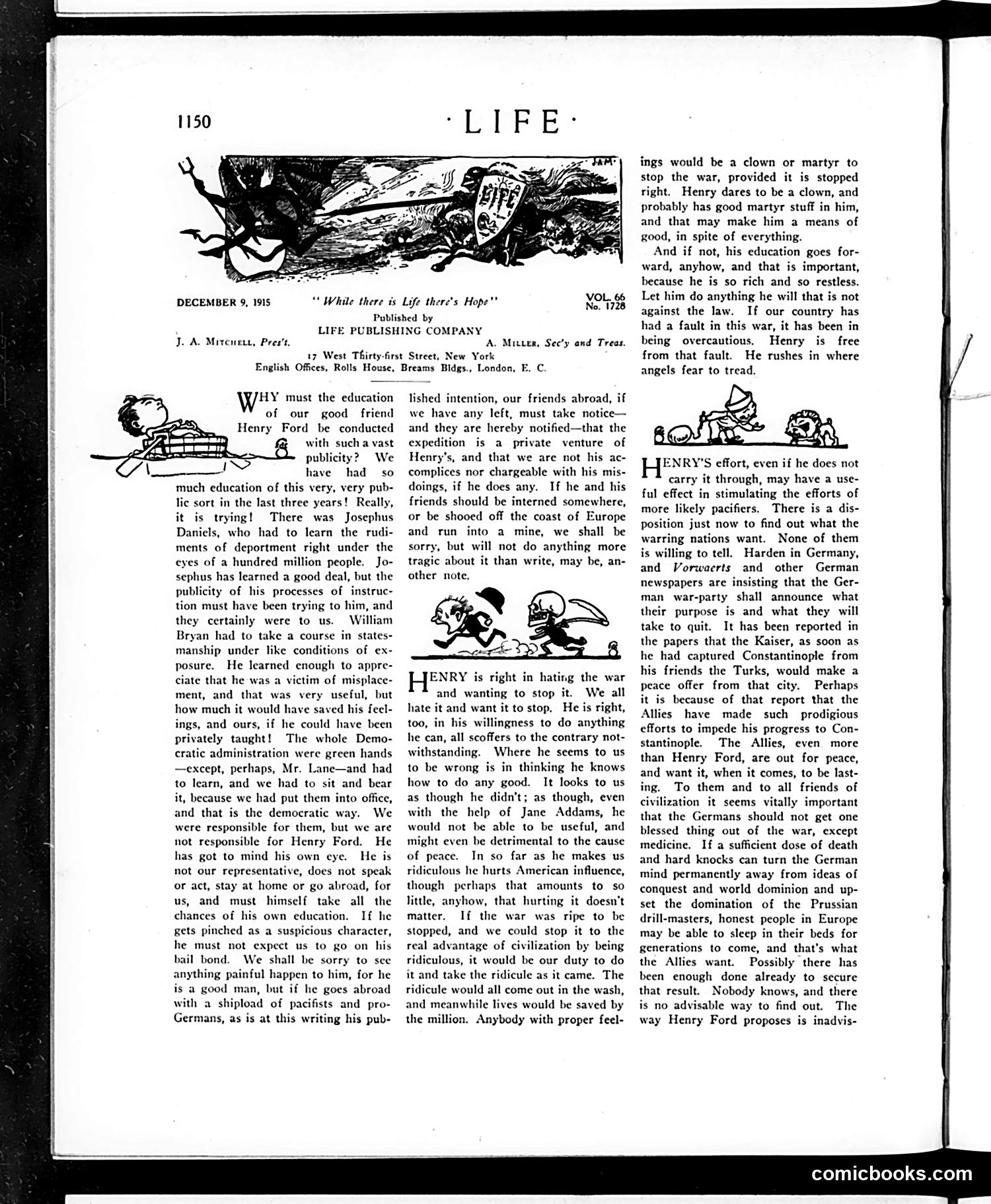
This editorial satirizes **Henry Ford's famous "Peace Ship"** — his announced plan to sail to Europe with pacifists to end World War I. The cartoons show Ford being educated/instructed, mocking his naïveté. The text criticizes Ford's public self-education process, comparing it unfavorably to earlier embarrassing displays by government figures like Secretary Josephus Daniels and William Jennings Bryan. Life's editors acknowledge Ford is *right* to hate war, but argue he's **wrong thinking he knows how to stop it** — his peace mission will only make America look ridiculous internationally and harm American influence. The key point: Life defends Ford's *right* to attempt this foolish venture (democratic freedom), but distances the publication and nation from responsibility for his probable failure. The satire suggests Ford's earnest pacifism, however well-intentioned, is naive and counterproductive diplomacy.
📄 Transcribed text from this page (OCR, searchable)
Machine-transcribed from the original scan — historical spelling and the odd misread are preserved.
DECEMBER 9, 1915 “While there is Life there's Hope"’ Published by LIFE PUBLISHING COMPANY J. A. Mircunut, Pres't, A. Miter, Sec’y and Treas. 17 West Thirty-first Street, New York English Offices, Rolls House, Breams Bldgs., London, E. C. HY must the education of our good friend Henry Ford be conducted with such a vast publicity? We have had so much education of this very, very pub- lic sort in the last three years! Really, it is trying! There was Josephus Daniels, who had to learn the rudi- ments of deportment right under the eyes of a hundred million people. Jo- sephus has learned a good deal, but the publicity of his processes of instruc- tion must have been trying to him, and they certainly were to us. William Bryan had to take a course in states- manship under like conditions of ex- posure. He learned enough to appre- ciate that he was a victim of misplace- ment, and that was very useful, but how much it would have saved his feel- ings, and ours, if he could have been privately taught! The whole Demo- cratic administration were green hands —except, perhaps, Mr. Lane—and had to learn, and we had to sit and bear it, because we had put them into office, and that is the democratic wa We were responsible for them, but we are not responsible for Henry Ford. He has got to mind his own eye. He is not our representative, does not speak or act, stay at home or go abroad, for us, and must himself take all the chances of his own education. If he gets pinched as a suspicious character, he must not expect us to go on his bail bond. We shall be sorry to see anything painful happen to him, for he is a good man, but if he goes abroad with a shipload of pacifists and pro- Germans, as is at this writing his pub- lished intention, our friends abroad, if we have any left, must take notice— and they are hereby notified—that the expedition is a private venture of Henry's, and that we are not his ac- complices nor chargeable with his mis- doings, if he does any. If he and his friends should be interned somewhere, or be shooed off the coast of Europe and run into a mine, we shall be sorry, but will not do anything more tragic about it than write, may be, an- other note, H NRY is right in hating the war and wanting to stop it. We all hate it and want it to stop. He is right, too, in his willingness to do anything he can, all scoffers to the contrary not- withstanding. Where he seems to us to be wrong is in thinking he knows how to do any good. It looks to us as though he didn’t; as though, even with the help of Jane Addams, he would not be able to be useful, and might even be detrimental to the cause of peace. In so far as he makes us ridiculous he hurts American influence, though perhaps that amounts to so little, anyhow, that hurting it doesn’t matter. If the war was ripe to be stopped, and we could stop it to the real advantage of civilization by being ridiculous, it would be our duty to do it and take the ridicule as it came. The ridicule would all come out in the wash, and meanwhile lives would be saved by the million. Anybody with proper feel- ings would be a clown or martyr to stop the war, provided it is stopped right. Henry dares to be a clown, and probably has good martyr stuff in him, and that may make him a means of good, in spite of everything. And if not, his education goes for- ward, anyhow, and that is important, because he is so rich and so restless. Let him do anything he will that is not against the law. If our country has had a fault in this war, it has been in being overcautious. Henry is free from that fault. He rushes in where angels fear to tread. ENRY’S effort, even if he does not carry it through, may have a use- ful effect in stimulating the efforts of more likely pacifiers. There is a dis- position just now to find out what the warring nations want. None of them is willing to tell. Harden in Germany, and Vorwaerts and other German newspapers are insisting that the Ger- man war-party shall announce what their purpose is and what they will take to quit. It has been reported in the papers that the Kaiser, as soon as he had captured Constantinople from his friends the Turks, would make a peace offer from that city. Perhaps it is because of that report that the Allies have made such prodigious efforts to impede his progress to Con- stantinople. The Allies, even more than Henry Ford, are out for peace, and want it, when it comes, to be last- To them and to all friends of zation it seems vitally important that the Germans should not get one blessed thing out of the war, except medicine. If a sufficient dose of death and hard knocks can turn the German mind permanently away from ideas of conquest and world dominion and up- set the domination of the Prussian drill-masters, honest people in Europe may be able to sleep in their beds for generations to come, and that’s what the Allies want. Possibly there has been enough done already to secure that result. Nobody knows, and there is no advisable way to find out. The way Henry Ford proposes is inadvis- comicbooks.com