
Life, 1915-12-09 · page 32 of 48
Life — December 9, 1915 — page 32: what you’re looking at
What you’re looking at
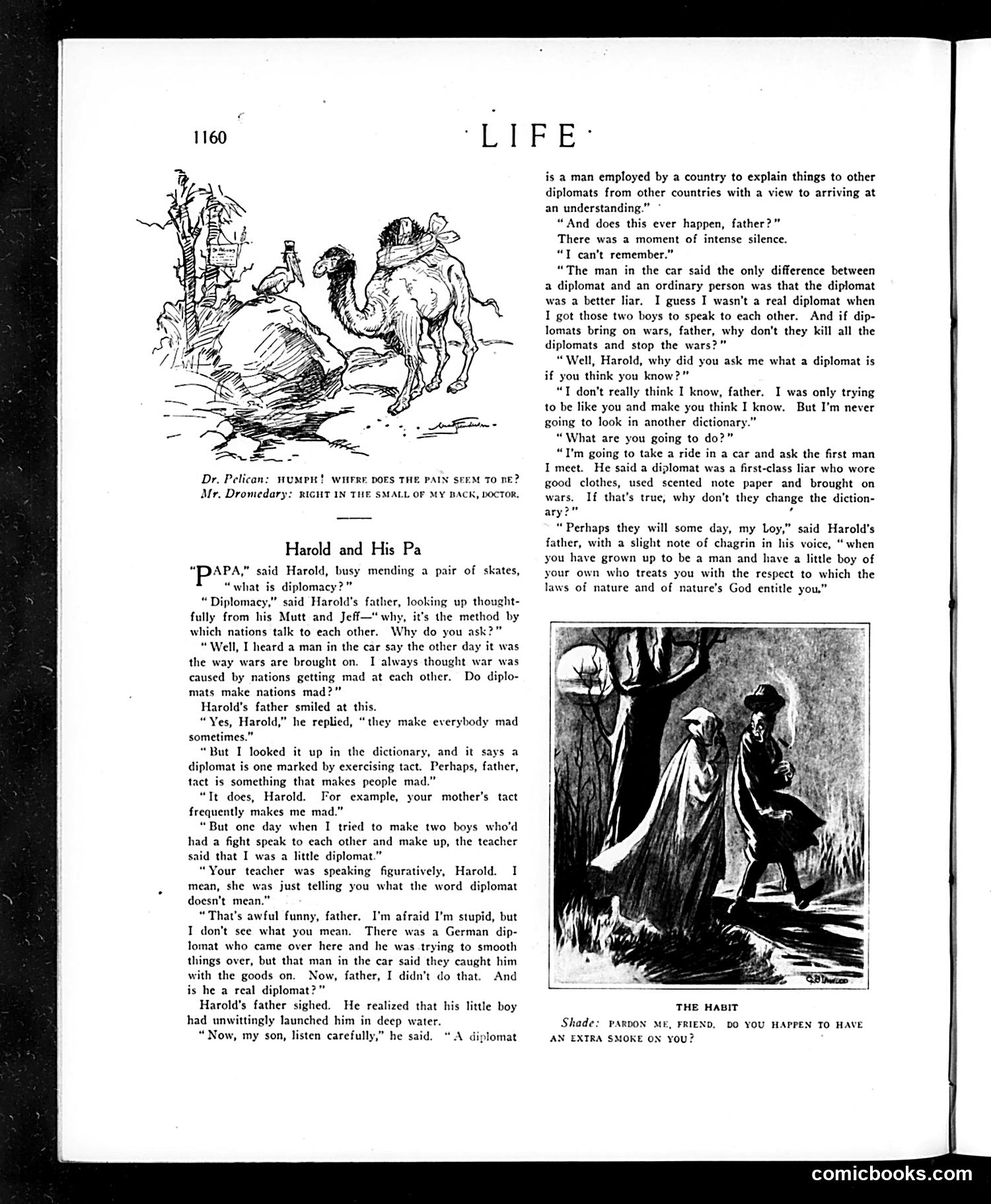
This page contains a humorous dialogue satirizing diplomacy and international relations, likely from the early 20th century. Harold innocently interrogates his father about diplomacy after overhearing a stranger claim diplomats cause wars through deception. The satire operates on multiple levels: Harold's childlike logic exposes the absurdity of diplomatic pretense—if diplomats are merely "better liars" who wear fine clothes and cause conflict, why not eliminate them? His father, unable to articulate a meaningful defense of diplomacy, eventually admits he "can't remember" diplomacy ever successfully preventing war. The joke targets both professional diplomats (portrayed as sophisticated fraudsters) and the father's inability to defend an institution he presumably respects. The cartoons above and below—a pelican and dromedary discussing pain, and "The Habit" about bumming cigarettes—are unrelated satirical sketches typical of Life magazine's format. The piece reflects post-WWI skepticism about whether diplomacy genuinely prevents conflict or merely masks national self-interest.
📄 Transcribed text from this page (OCR, searchable)
Machine-transcribed from the original scan — historical spelling and the odd misread are preserved.
‘LYPE: Dr, Pelican: WuMPH! WHFRE DOES THE PAIN SEEM 70 TE? Mr, Dromedary: RIGHT IN THE SMALL OF MY BACK, DOCTOR, Harold and His Pa “papa” said Harold, busy mending a pair of skates, “what is diplomacy?” “ Diplomacy,” said Harold's father, looking up thought- fully from his Mutt and Jeff—‘ why, it’s the method by which nations talk to each other. Why do you ask?” “Well, I heard a man in the car say the other day it was the way wars are brought on. I always thought war was caused by nations getting mad at each other. Do diplo- mats make nations mad?” Harold’s father smiled at this. “Yes, Harold,” he replied, “they make everybody mad sometimes.” “But I looked it up in the dictionary, and it says a diplomat is one marked by exercising tact. Perhaps, father, tact is something that makes people mad.” “Tt does, Harold. For example, your mother’s tact frequently makes me mad.” “But one day when I tried to make two boys who'd had a fight speak to each other and make up, the teacher said that I was a little diplomat.” “Your teacher was speaking figuratively, Harold. I mean, she was just telling you what the word diplomat doesn’t mean. “That's awful funny, father, I’m afraid I’m stupid, but I don’t see what you mean. There was a German dip- lomat who came over here and he was trying to smooth things over, but that man in the car said they caught him with the goods on. Now, father, I didn’t do that. And he a real diplomat?” Harold's father sighed. He realized that his little boy had unwittingly launched him in deep water. “Now, my son, listen carefully,” he said. “A diplomat is a man employed by a country to explain things to other diplomats from other countries with a view to arriving at an understanding.” “And does this ever happen, father?” There was a moment of intense silence. “T can't remember.” “The man in the car said the only difference between a diplomat and an ordinary person was that the diplomat was a better liar. I guess I wasn’t a real diplomat when I got those two boys to speak to each other. And if dip- lomats bring on wars, father, why don’t they kill all the diplomats and stop the wars?” “Well, Harold, why did you ask me what a diplomat is if you think you know?” “T don't really think I know, father. I was only trying to be like you and make you think I know. But I’m never going to look in another dictionary.” “What are you going to do?” “I'm going to take a ride in a car and ask the first man I meet. He said a diplomat was a first-class liar who wore good clothes, used scented note paper and brought on wars. If that’s true, why don’t they change the diction- ary?” ’ “Perhaps they will some day, my Loy,” said Harold's father, with a slight note of chagrin in his voice, “when you have grown up to be a man and have a little boy of your own who treats you with the respect to which the laws of nature and of nature’s God entitle you.” THE HABIT Shade: PARDON ME, FRIEND, DO YOU HAPPEN TO HAVE AN EXTRA SMOKE ON YOU? comicbooks.com