
Life, 1915-12-09 · page 23 of 48
Life — December 9, 1915 — page 23: what you’re looking at
What you’re looking at
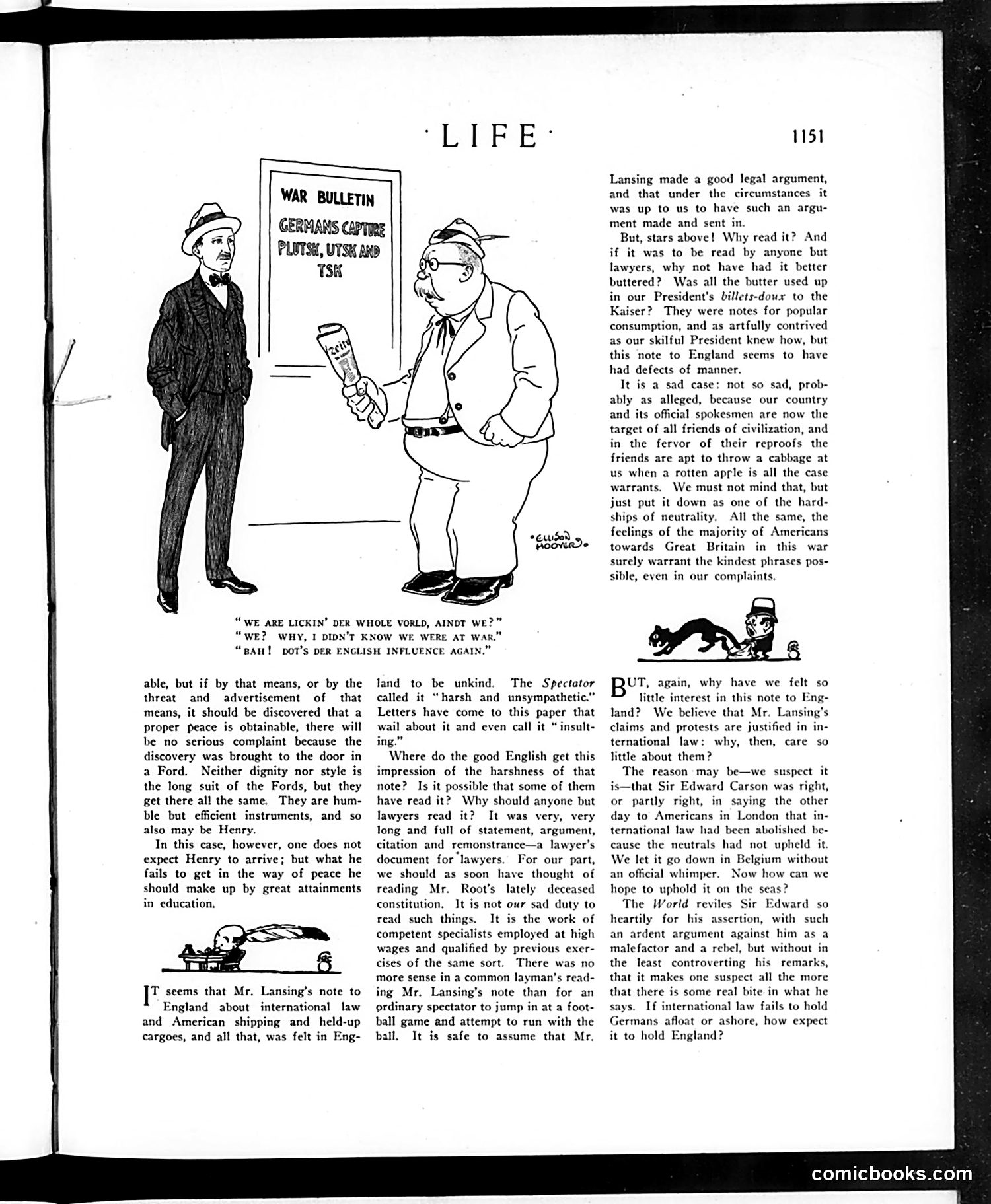
## The Cartoon The main cartoon depicts two figures discussing a war bulletin. The German-accented character (left) boasts "We are lickin' der whole world, aindt we?" to which an American responds "We? Why, I didn't know we were at war"—followed by "Bah! Dot's der English influence again." ## Meaning This satirizes American neutrality during World War I. The joke mocks how Germans and their American sympathizers claimed America was already fighting alongside the Allies, while officially the U.S. remained neutral. The punchline blames "English influence" for this perception—a dig at pro-British American sentiment. ## Context The page's text discusses Secretary of State Lansing's formal legal note to England regarding shipping and cargo seizures. Life argues Americans shouldn't complain about England's wartime actions, given American reluctance to enforce international law (referencing Belgium's occupation). The piece suggests Americans tacitly support the Allied cause despite official neutrality. This reflects pre-1917 American debate over neutrality versus intervention.
📄 Transcribed text from this page (OCR, searchable)
Machine-transcribed from the original scan — historical spelling and the odd misread are preserved.
“WE ARE LICKIN’ DER WHOLE VORLD, AINDT WE?” “WE? WHY, I DIDN'T KNOW WE WERE AT WAR.” “pan! pot’s DER EN! able, but if by that means, or by the threat and advertisement of that means, it should be discovered that a proper peace is obtainable, there will be no serious complaint because the discovery was brought to the door in a Ford. Neither dignity nor style is the long suit of the Fords, but they get there all the same. They are hum- ble but efficient instruments, and so also may be Henry. In this case, however, one does not expect Henry to arrive; but what he fails to get in the way of peace he should make up by great attainments in education. T seems that Mr. Lansing’s note to England about international law and American shipping and held-up cargoes, and all that, was felt in Eng- LISH INFLUENCE AGAIN.” land to be unkind. called it “harsh and unsympathetic.’ Letters have come to this paper that wail about it and even call it “ insult- ing.” Where do the good English get this impression of the harshness of that note? Is it possible that some of them have read it? Why should anyone but lawyers read it? It was very, very long and full of statement, argument, citation and remonstrance—a lawyer's document for “lawyers. For our part, we should as soon have thought of reading Mr. Root’s lately deceased constitution, It is not our sad duty to read such things. It is the work of competent specialists employed at high wages and qualified by previous exer- cises of the same sort. There was no more sense in a common layman's read- ing Mr. Lansing’s note than for an ordinary spectator to jump in at a foot- ball game and attempt to run with the ball. It is safe to assume that Mr. The Spectator 1151 Lansing made a good legal argument, and that under the circumstances it was up to us to have such an argu- ment made and sent in. But, stars above! Why read it? And if it was to be read by anyone but lawyers, why not have had it better buttered? Was all the butter used up in our President's billets-dowx to the Kaiser? They were notes for popular consumption, and as artfully contrived as our skilful President knew how, but this note to England seems to have had defects of manner. It is a sad case: not so sad, prob- s alleged, because our country official spokesmen are now the target of all friends of civilization, and in the fervor of their reproofs the friends are apt to throw a cabbage at us when a rotten apple is all the case warrants. We must not mind that, but just put it down as one of the hard- ships of neutrality. All the same, the feelings of the majority of Americans towards Great Britain in this war surely warrant the kindest phrases pos- sible, even in our complaints. UT, again, why have we felt so little interest in this note to Eng- land? We believe that Mr. Lansing’s claims and protests are justified in in- ternational law: why, then, care so little about them? The reason may be—we suspect it is—that Sir Edward Carson was right, or partly right, in saying the other day to Americans in London that in- ternational law had been abolished be- cause the neutrals had not upheld it. We let it go down in Belgium without an official whimper. Now how can we hope to uphold it on the seas? The World reviles Sir Edward so heartily for his assertion, with such an ardent argument against him as a malefactor and a rebel, but without in the least controverting his remarks, that it makes one suspect all the more that there is some real bite in what he says. If international law fails to hold Germans afloat or ashore, how expect it to hold England? comicbooks.com