
Life, 1915-12-09 · page 13 of 48
Life — December 9, 1915 — page 13: what you’re looking at
What you’re looking at
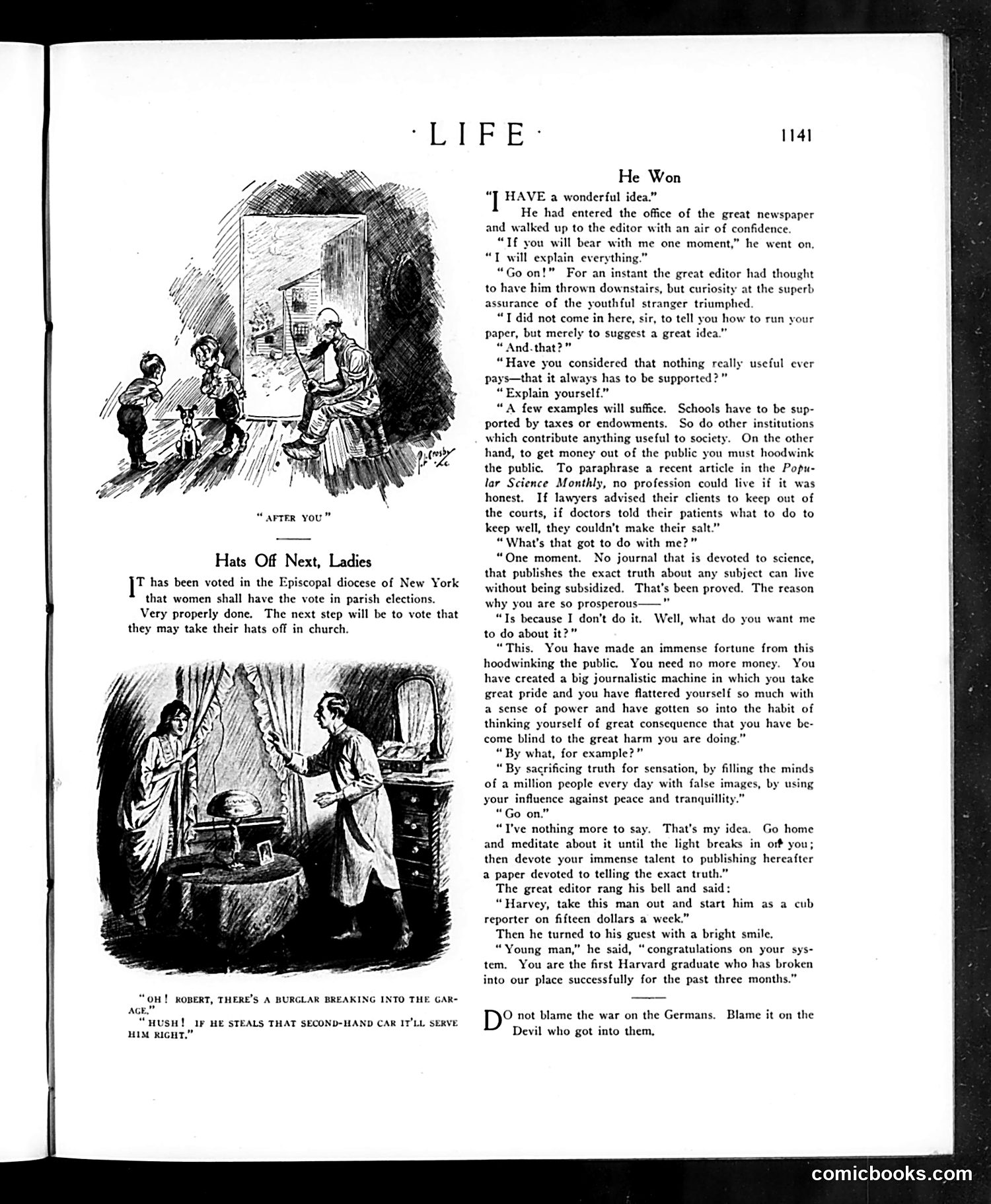
This page contains two separate satirical pieces: **"He Won"** depicts a young man pitching an idea to a newspaper editor. The young man proposes that newspapers should stop subsidizing various institutions (schools, churches, courts, medicine) and instead use their influence "to hoodwink the public." The editor's sharp response critiques this corrupt approach, ultimately praising the young man's confidence while actually dismissing him as a cub reporter—a satirical comedown. **"Hats Off Next, Ladies"** references Episcopal women gaining voting rights in parish elections, presenting it as a progressive step toward fuller participation. Both pieces satirize media manipulation, institutional corruption, and the tension between journalistic integrity and sensationalism—showing Life magazine's skepticism toward press ethics in early 20th-century America.
📄 Transcribed text from this page (OCR, searchable)
Machine-transcribed from the original scan — historical spelling and the odd misread are preserved.
‘LIFE: “APTER you” Hats Off Next, Ladies T has been voted in the Episcopal diocese of New York that women shall have the vote in parish elections. Very properly done. The next step will be to vote that they may take their hats off in church. “OH! ROBERT, THERE’S A BURGLAR BREAKING INTO THE GAR- HUSH! IF HE STEALS THAT SECOND-HAND CAR IT'LL SERVE HIM RIGHT,” He Won “] HAVE a wonderful idea.” He had entered the office of the great newspaper and walked up to the editor with an air of confidence. “Tf you will bear with me one moment,” he went on, “T will explain everything.” “Go on!” For an instant the great editor had thought to have him thrown downstairs, but curiosity at the superb assurance of the youthful stranger triumphed. “T did not come in here, sir, to tell you how to run your paper, but merely to suggest a great idea.” “ And.that?” “Have you considered that nothing really useful ever pays—that it always has to be supported?” “Explain yourself.” “A few examples will suffice. Schools have to be sup- ported by taxes or endowments. So do other institutions which contribute anything useful to society. On the other hand, to get money out of the public you must hoodwink the public. To paraphrase a recent article in the Popu- lar Science Monthly, no profession could live if it was honest. If lawyers advised their clients to keep out of the courts, if doctors told their patients what to do to keep well, they couldn't make their salt.” “What's that got to do with me?” “One moment. No journal that is devoted to science, that publishes the exact truth about any subject can live without being subsidized, That's been proved. The reason why you are so prosperous——" “Is because I don’t do it. Well, what do you want me to do about it?” “This. You have made an immense fortune from this hoodwinking the public. You need no more money. You have created a big journalistic machine in which you take great pride and you have flattered yourself so much with a sense of power and have gotten so into the habit of thinking yourself of great consequence that you have be- come blind to the great harm you are doing.” “ By what, for example?” “ By sacrificing truth for sensation, by filling the minds of a million people every day with false images, by using your influence against peace and tranquillity. “Go on.” “T've nothing more to say. That's my idea. Go home and meditate about it until the light breaks in of you; then devote your immense talent to publishing hereafter a paper devoted to telling the exact truth. The great editor rang his bell and sai “Harvey, take this man out and start him as a cub reporter on fifteen dollars a week.” Then he turned to his guest with a bright smile. “Young man,” he said, “congratulations on your sys- tem. You are the first Harvard graduate who has broken into our place successfully for the past three months.” O not blame the war on the Germans. Blame it on the Devil who got into them, comicbooks.com