
Life, 1915-12-09 · page 26 of 48
Life — December 9, 1915 — page 26: what you’re looking at
What you’re looking at
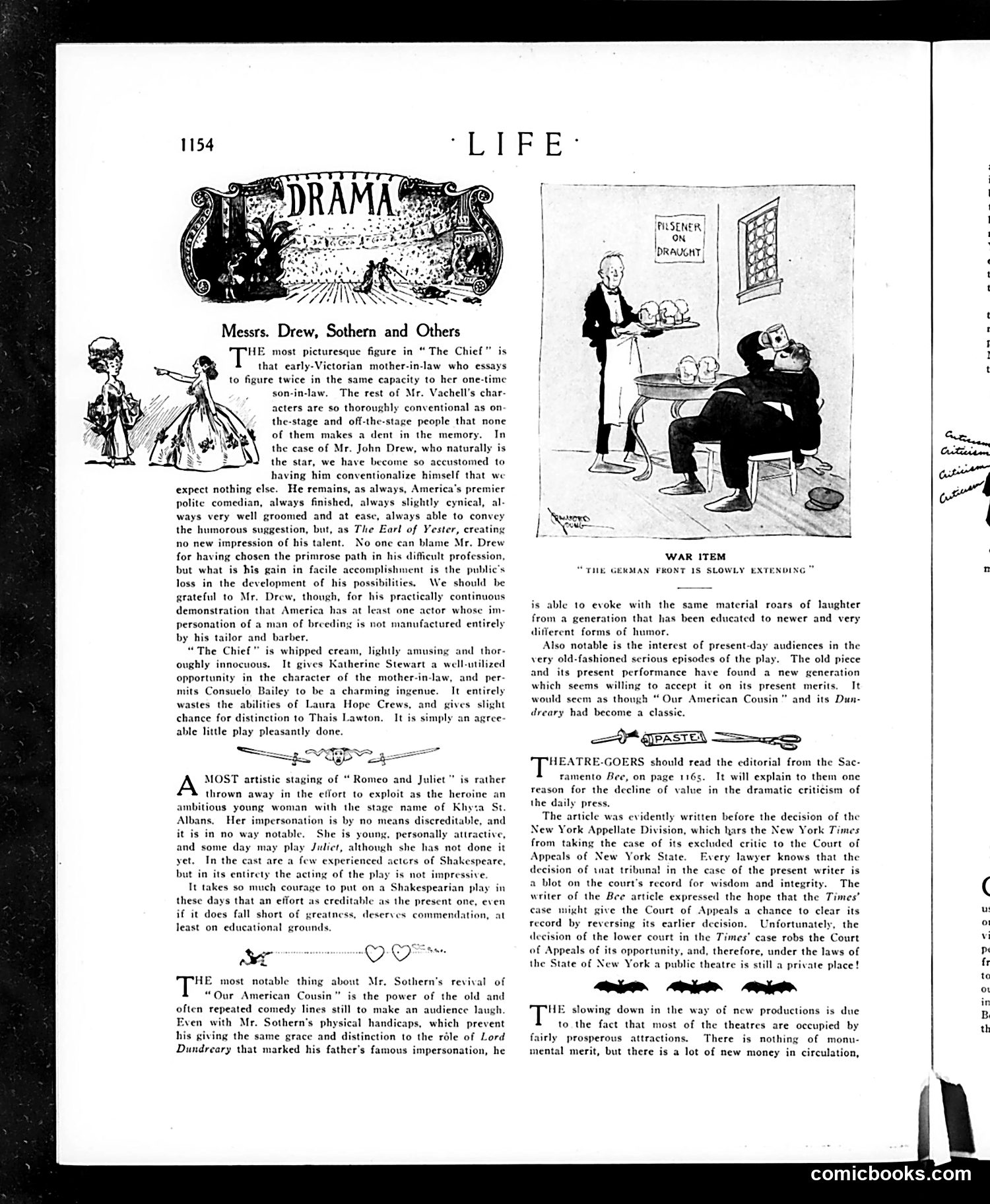
This page reviews three theatrical productions. The main cartoon (labeled "War Item") appears to be a satirical comment on WWI's expanding German front, showing what looks like military officers in a casual domestic setting—a common Life magazine tactic of juxtaposing serious war news with absurd everyday scenarios for dark comic effect. The drama reviews discuss John Drew in "The Chief" (criticizing his polished but uninspired performances), a young actress named Khyra St. Albans in "Romeo and Juliet" (deemed competent but unremarkable), and E.H. Sothern's revival of "Our American Cousin" (noting audiences still laugh at old comedy despite changing humor tastes). The editorial note at bottom references a Sacramento *Bee* piece explaining declining theatrical criticism quality, mentioning a New York *Times* legal dispute over critic access—apparently a contemporary press controversy about journalistic independence.
📄 Transcribed text from this page (OCR, searchable)
Machine-transcribed from the original scan — historical spelling and the odd misread are preserved.
Messrs. Drew, Sothern and Others HE most picturesque figure in “ The Chief" is that early-Victorian mother-in-law who essays to figure twice in the same capacity to her one-time son-in-law. The rest of Mr. Vachell’s char- acters are so thoroughly conventional as on: the-stage and off-the-stage people that none of them makes a dent in the memory. In *\ the case of Mr. John Drew, who naturally is the star, we have become so accustomed to having him conventionalize himself that we expect nothing clse. He remains, as always, America’s premier polite comedian, always finished, always slightly cynical, al- ways very well groomed and at ease, always able to convey the humorous suggestion, but, as The Eart of Yester, creating no new impression of his talent. No one can blame Mr. Drew for having chosen the primrose path in his difficult profession, but what is his gain in facile accomplishment is the public's loss in the development of his possibilities, We should be grateful to Mr. Drew, though, for his practically continuous demonstration that America has at least one actor whose personation of a man of breeding is not manufactured entirely by his tailor and barber. “The Chief” is whipped cream, lightly ai oughly innocuous. It gives Katherine Stewart opportunity in the character of the mother-in-law, and per- mits Consuelo Bailey to be a charming ingenue. It entirely wastes the abilities of Laura Hope Crews, and gives slight chance for distinction to Thais Lawton. It is simply an agree- able little play pleasantly done. sing and thor- well-utilized MOST artistic staging of “Romeo and Juliet” is rather thrown away in the effort to exploit as the heroine an ambitious young woman with the stage name of Khy:a St Albans. Her impersonation is by no means discreditable, and it is in no way notable. She is young, personally attractive, and some day may play Julict, although she has not done it yet. In the cast are a few experienced acters of Shakespeare, but in its entirety the acting of the play is not impressive It takes so much courage to put on a Shakespearian 7 these days that an eifort as creditable as the present one, even if it doe: ort of greatness, deserves commendation, at least on educational grounds. Senn ck i HE most notable thing abe in wt Mr. Sothern’s revival of “Our American Cousin” is the power of the old and often repeated comedy lines still to make an audience laugh Even with Mr. Sothern’s physical handicaps, which prevent his giving the same grace and distinction to the réle of Lord Dundreary that marked his father’s famous impersonation, he lrascner| | j oN | DRAUGHT WAR ITEM “THE GERMAN FRONT IS SLOWLY EXTENDING ” is able 10 evoke with the same material roars of laughter from a generation that has been educated to newer and very different forms of humor. Also notable is the interest of present-day audiences in the very old-fashioned serious episodes of the play. The old piece and its present performance have found a new generation which seems willing to accept it on its present merits. It would seem as though “Our American Cousin” and its Dun- dreary had become a classic. =* GA Se HEATRE-GOERS should read the editorial from the Sac- ramento Bee, on page 1165. Tt will explain to them one reason for the decline of value in the dramatic criticism of the daily press. The article was evidently written before the decision of the New York Appellate Division, which hars the New York Times from taking the case of its excluded critic to the Court of Appeals of New York State. Every lawyer knows that the decision of inat tribunal in the case of the present writer is a blot on the court's record for wisdom and integrity. The writer of the Bee article expressed the hope that the Times’ case might give the Court of Appeals a chance to clear its record by reversing its earlier decision. Unfortunately, the ion of the lower court in the Times’ case robs the Court of Appeals of its opportunity, and, therefore, under the laws of the State of New York a public theatre is still a private place! Bn A wie HE slowing down in the way of new productions is due to the fact that most of the theatres are occupied by fairly prosperous attractions, There is nothing of monu- mental merit, but there is a lot of new money in circulation, dee comicbooks.com