
Life, 1915-12-09 · page 18 of 48
Life — December 9, 1915 — page 18: what you’re looking at
What you’re looking at
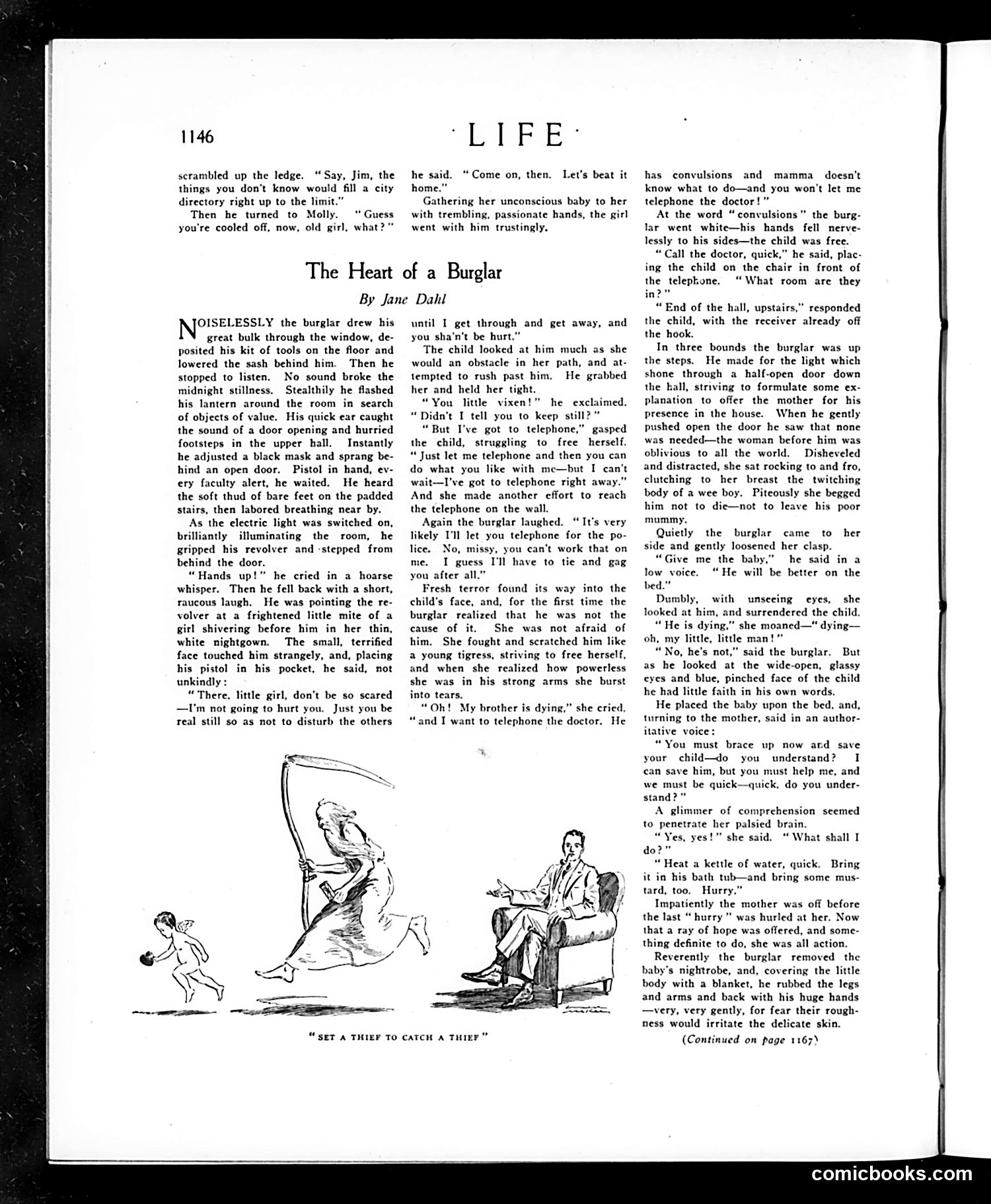
This is a sentimental short story by Jane Dahl, not political satire. It depicts a burglar breaking into a home who encounters a desperate young girl trying to call a doctor for her dying brother. The story's moral point is ironic: a hardened criminal—someone society deems irredeemable—is moved by the child's plight and sets aside his crimes to help. The accompanying illustration (captioned "Set a Thief to Catch a Thief") shows the burglar confronting the girl. The narrative explores a popular early-20th-century theme: that even criminals possess human compassion when confronted with genuine suffering, particularly involving children. The burglar's sudden emotional transformation—going "white" at the mention of convulsions—suggests an unexpected capacity for decency hidden beneath his criminal exterior. This reflects period sentimentality about human nature's fundamental goodness.
📄 Transcribed text from this page (OCR, searchable)
Machine-transcribed from the original scan — historical spelling and the odd misread are preserved.
1146 scrambled up the ledge. “Say, Jim, the things you don’t know would fill a city directory right up to the lim Then he turned to Molly. “Guess you're cooled off, now, old girl, what?” “TEE” “Come on, then. Let's beat it Gathering her unconscious baby to her with trembling, passionate hands, the girl went with him trustingly, The Heart of a Burglar By Jane Dahl IOISELESSLY the burglar drew his great bulk through the window, de- posited his kit of tools on the floor and lowered the sash behind him. Then he stopped to listen. No sound broke the midnight stillness. Stealthily he flashed his lantern around the room in search of objects of value. His quick ear caught the sound of a door opening and hurried footsteps in the upper hall. Instantly he adjusted a black mask and sprang be- hind an open door. Pistol in hand, ev- ery faculty alert, he waited. He heard the soft thud of bare feet on the padded stairs, then labored breathing near by. As the electric light was switched on, brilliantly illuminating the room, he gripped his revolver and «stepped from behind the door. “Hands up!" he cried in a hoarse whisper. Then he fell back with a short, raucous laugh. He was pointing the re- volver at a frightened little mite of a girl shivering before him in her thin, white nightgown. The small, terrified face touched him strangely, and, placing his pistol in his pocket, he said, not unkindly : “There. little girl, don’t be so scared —I'm not going to hurt you. Just you be real still so as not to disturb the others until I get through and get away, and you sha’n't be hurt.” The child looked at him much as she would an obstacle in her path, and at- tempted to rush past him. He grabbed her and held her tight. “You little vixen!” he exclaimed. “Didn't [ tell you to keep still? “But I've got to telephone,” gasped the child, struggling to free herself. “ Just let me telephone and then you can do what you like with mc—but I can't wait—I’ve got to telephone right away.” And she made another effort to reach the telephone on the wall. Again the burglar laughed. “It’s very likely I'll let you telephone for the po- lice. No, missy, you can't work that on me. I guess I'll have to tie and gag you after all.” Fresh terror found its way into the child’s face, and, for the first time the burglar realized that he was not the cause of it. She was not afraid of him, She fought and scratched him like a young tigress, striving to free herself, and when she realized how powerless she was in his strong arms she burst into tears. “Oh! My brother is dying,” she cried, “and I want to telephone the doctor. He “SET A THIEF TO CATCH A THIEF” has convulsions and mamma doesn't know what to do—and you won't let me telephone the doctor!” At the word “convulsions” the burg- lar went white—his hands fell nerve- lessly to his sides—the child was free. “Call the doctor, quick,” he said, plac- ing the child on the chair in front of the telephone. ‘What room are they in?” “End of the hall, upstairs,” responded the child, with the receiver already off the hook. In three bounds the burglar was up the steps. He made for the light which shone through a half-open door down the hall, striving to formulate some ex- planation to offer the mother for his presence in the house. When he gently pushed open the door he saw that none was needed—the woman before him was oblivious to all the world. Disheveled and distracted, she sat rocking to and fro, clutching to her breast the twitching body of a wee boy. Piteously she begged him not to die—not to leave his poor mummy. Quietly the burglar came to her side and gently loosened her clasp. “Give me the baby,” he said in a low voice. “He will be better on the bed.” Dumbly, with unseeing eyes, she looked at him, and surrendered the child. “He is dying,” she moaned—“ dying— oh, my little, little man!" “No, he's not,” said the burglar. But as he looked at the wide-open, glassy eyes and blue, ched face of the child he had little faith in his own words. He placed the baby upon the bed, and, turning to the mother, said in an author- itative voice: “You must brace up now and save your child—do you understand? I can save him, but you must help me, and we must be quick—quick, do you under- stand?” A glimmer of comprehension seemed to penetrate her palsied brain. “Yes, yes!" she said. “ What shall I do? “ Heat a kettle of water, quick. Bring it in his bath tub—and bring some mus- tard, too, Hurry,” Impatiently the mother was off before the last “ hurry" was hurled at her. Now that a ray of hope was offered, and some- thing definite to do, she was all action. Reverently the burglar removed the baby’s nightrobe, and, covering the little body with a blanket, he rubbed the legs and arms and back with his huge hands —very, very gently, for fear their rough- ness would irritate the delicate skin. (Continued on page 1167. comicbooks.com