
Life, 1915-12-09 · page 27 of 48
Life — December 9, 1915 — page 27: what you’re looking at
What you’re looking at
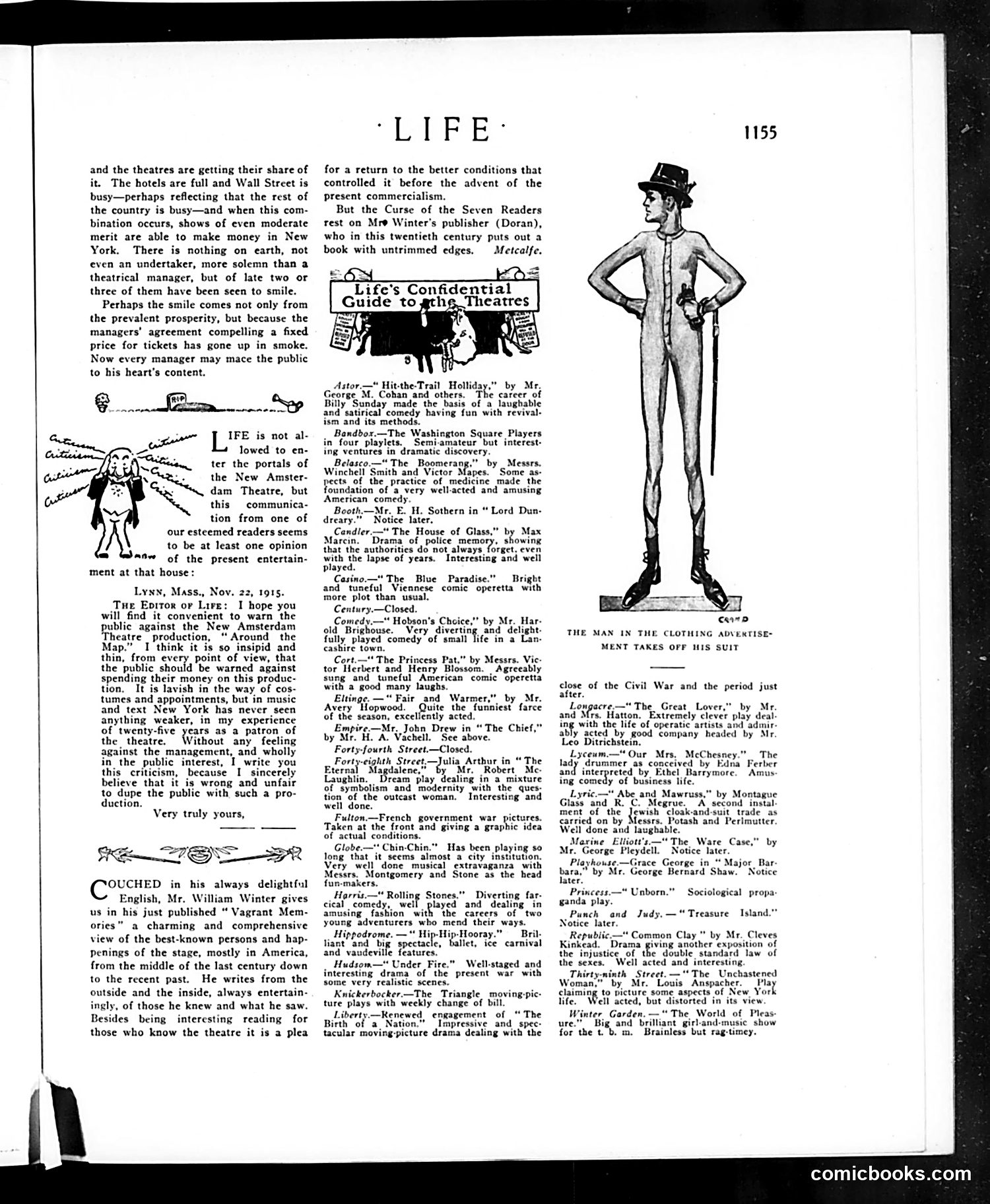
This page from *Life* magazine (November 1915) contains **theatrical criticism and commentary**, not political cartoons per se. The main visual element is an illustration of a man in a one-piece suit with his hands on his hips—labeled "THE MAN IN THE CLOTHING ADVERTISEMENT TAKES OFF HIS SUIT." This appears to be satirical commentary on advertising imagery rather than political content. The text discusses New York theater prosperity and includes a scathing reader letter criticizing the New Amsterdam Theatre's production "Around the Map" as insipid and weak despite lavish costumes. Editor William Winter's book on theater history is praised but criticized for having untrimmed page edges—an absurd complaint that seems intentionally humorous. The bulk of the page comprises brief reviews of various Broadway productions (comedies, operettas, dramas), suggesting this is primarily a **theater review section** aimed at *Life*'s entertainment-focused readership rather than political satire.
📄 Transcribed text from this page (OCR, searchable)
Machine-transcribed from the original scan — historical spelling and the odd misread are preserved.
and the theatres are getting their share of it. The hotels are full and Wall Street is busy—perhaps reflecting that the rest of the country is busy—and when this com- bination occurs, shows of even moderate merit are able to make money in New York, There is nothing on earth, not even an undertaker, more solemn than a theatrical manager, but of late two or three of them have been seen to smile. Perhaps the smile comes not only from the prevalent prosperity, but because the managers’ agreement compelling a fixed price for tickets has gone up in smoke. Now every manager may mace the public to his heart's content. g ee | IFE is not al- lowed to en- yeaa ter the portals of a the New Amster- ae dam Theatre, but this communica- tion from one of our esteemed readers seems to be at least one opinion mov of the present entertain- ment at that house: Lyxx, Mass., Nov. 22, 1915. Tue Evitor or Lire: I hope you will find it convenient to warn the public against the New Amsterdam Theatre production, “Around the Map.” I think it is so insipid and thin, from every point of view, that the public should be warned against spending their money on this produc- tion. It is lavish in the way of cos- tumes and appointments, but in music and text New York has never seen anything weaker, in my experience of twenty-five years as a patron of the theatre. Without any. feeling against the management, and wholly in the public interest, I write you this criticism, because cerely believe that it is wrong and unfair to dupe the public with such a pro- duction. Very truly yours, OUCHED in his always delightful English, Mr. William Winter gives us in his just published “ Vagrant Mem- sa charming and comprehensive view of the best-known persons and hap- Penings of the stage, mostly in America, from the middle of the last century down to the recent past. He writes from the outside and the inside, always entertain- ingly, of those he knew and what he saw. Besides being interesting reading for those who know the theatre it is a plea ‘LF E* for a return to the better conditions that controlled it before the advent of the Present commercialism. But the Curse of the Seven Readers rest on Mre Winter's publisher (Doran), who in this twentieth century puts out a Metcalfe, book with untrimmed edges, Hit-the-Trail Holliday,” by Mr, George M. Cohan and others. The career of Billy Sunday made the basis of a laughable and satirical comedy having fun with revival- ism and its methods. _ Bondbox.—The Washington Square Players in four playlets. Semi-amateur but interest- ing ventures in dramatic discovery. Belasco.—" The Boomerang.” by Messrs. Winchell Smith and Victor Mapes. Some a pects of the practice of medicine made the foundation of a very well-acted and amusing American comedy. Mr. E. H. Sothern in “Lord Dun- Notice later. Candler —" The House of Glass," by Max Marcin. Drama of police memory, showing that the authorities do not always forget. even with the lapse of years. Interesting and well played. Casino The Blue Paradise.” Bright and tuneful Viennese comic operetta with more plot than usual. Century.—Closed. Comedy,—" Hobson's Choice," by Mr. Har- old Brighouse. Very fiverting and delight: fully played comedy of small life in a Lan- casbire town. Cort.—* The Princess Pat,” by Messrs. Vic tor Herbert and Henry Blossom. Agreeably sung and tuneful American comic operetta with a good many laughs. Eltinge. —“ Fair and Warmer," by Mr. Avery Hopwood. Quite the funniest farce of the season, excellently acted, Empire-—Mr. John Drew in “The Chief,” by Mr. H. A. Vachell. See above. Forty-fourth Street.—Closed. Forty-eighth Street—Julia Arthur in “The Eternal Magualene” ty Mr. Robert Me: Laughlin. Dream play dealing in a mixture of symbolism and modernity with the ques- tion of the outcast woman. Interesting and well done. Fulton.—French government war pictures. Taken at the front and giving a graphic idea of actual condition Globe.—"' Chin-Chin.” Has been playing so long that it seems almost a city institution, Very well done musical extravaganza with Messrs. Montgomery and Stone as the head funmakers. Horris.—" Rolling Stones.” Diverting far- cical_comedy, well played and dealing in amusing fashion with the careers of two young adventurers who mend their ways. Hippodrome. —" Hip Hip Hoora Brit. liant and big spectacle, ballet, ice carnival and vaudeville features. Hudsom—" Under Fire.” Well-staged and interesting drama of the present war with some very realistic scenes. Knickerbocker—The Triangle moving-pic- ture plays with weekly change of bill. Liberty.—Kenewed, engagement of“ The Birth of a Nation.” Impressive and_ spec- tacular moving-picture drama dealing with the THE MAN IN THE CLOTHING ADVERTISE MENT TAKES OFF 11S SUIT close of the Civil War and the period just after. Longacre —“ The Great Lover,” by Mr and Mrs. Hatton. Extremely clever play deal: ing with the life of operatic artists and adinir- ably acted by good company headed by Mr. Leo Ditrichstein. Lyceum.—“ Our Mrs. McChesney." The lady drummer jas conceived by Edna Ferber and interpreted by. Ethel Barrymore, Amus ing comedy of business life. Lyric.—" Abe and Mawruss,” by Montague Glass and R. C. Megrue. A second instal ment of the Jewish cloak-and-suit trade as carried on by Messrs. Potash and Perlmutter. Well done and laughable. Marine Etiiott's—“ The Ware Case,” by Mr. George Pleydell. Notice later. Playhouse.—Grace George in“ Major Bar bara,” by Mr. George Bernard Shaw. Notice later. Princess.—" Unborn.” Sociological propa. ganda play. Punch and Judy.—“ Treasure Island.” Notice later. Republic.—" Common Clay " by Mr. Cleves Kinkead. Drama giving another exposition of the injustice of the double standard law of the sexes. Well acted and interesting. Thirty-ninth Street. —‘The Unchastened Woman,” by Mr. Louis Anspacher. Pla claiming to picture some aspects of New Yor life. Well acted, but distorted in its view Winter Garden. —“ The World of Pleas: ure.” Big and brilliant girl-and-music show for the tb. m. Brainless but rag-timey. comicbooks.com