
Life, 1915-12-09 · page 20 of 48
Life — December 9, 1915 — page 20: what you’re looking at
What you’re looking at
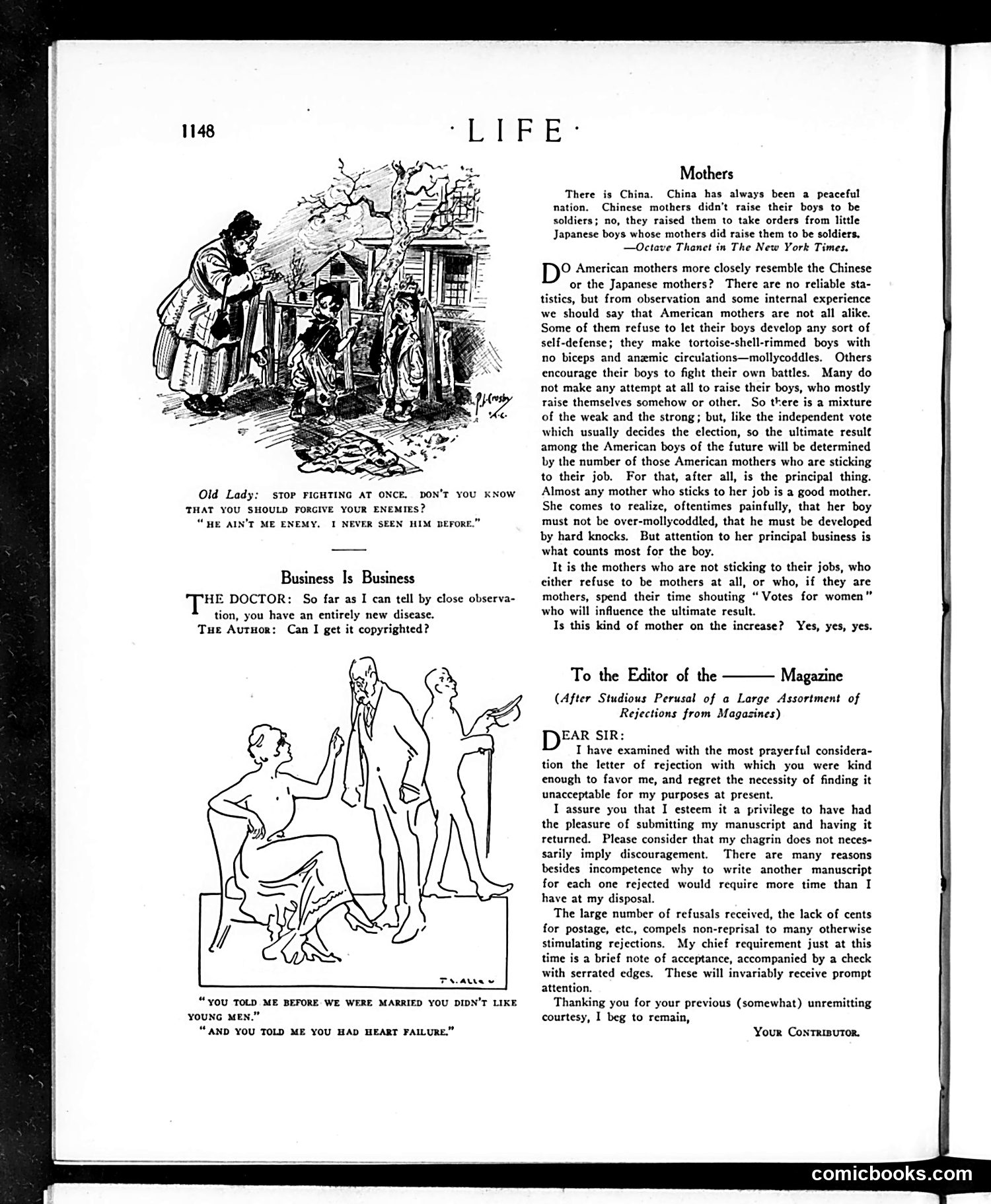
This page contains three satirical pieces typical of Life's humor: **"Business Is Business"**: A doctor-author joke mocking intellectual property obsession. The author asks if he can copyright a "new disease," satirizing writers' desperation to profit from any idea. **The fighting scene**: An old lady tries to make two men stop fighting by invoking forgiveness. Their response—"He ain't me enemy. I never seen him before"—jokes that they're fighting as a business transaction or obligation, not from genuine enmity. **"Mothers" essay**: A commentary on American motherhood referencing Chinese and Japanese mothers (likely alluding to militarism), debating whether American mothers coddle sons or properly raise them. The piece sarcastically criticizes mothers prioritizing "Votes for women" (suffrage activism) over child-rearing, suggesting feminist activism neglects maternal duties. **"To the Editor"**: A humorous rejection letter from a perpetually-rejected writer, politely inverting critique—thanking editors for rejections while subtly mocking magazine gatekeeping and his own poverty.
📄 Transcribed text from this page (OCR, searchable)
Machine-transcribed from the original scan — historical spelling and the odd misread are preserved.
Old Lady: stop FIGHTING AT ONCE. DON’T YOU KNOW THAT YOU SHOULD FORGIVE YOUR ENEMIES? “HE AIN'T ME ENEMY. I NEVER SEEN HIM BEFORE.” Business Is Business HE DOCTOR: So far as I can tell by close observa- tion, you have an entirely new disease. Tue Autuor: Can I get it copyrighted? “YOU TOLD ME BEFORE WE WERE MARRIED YOU DIDN'T LIKE YOUNG MEN.” “AND YOU TOLD ME YOU HAD HEART FAILURE.” Mothers There is China. China has always been a peaceful nation. Chinese mothers didn’t raise their boys to be soldiers; no, they raised them to take orders from little Japanese boys whose mothers did raise them to be soldiers. —Octave Thanet in The New York Times. D° American mothers more closely resemble the Chinese or the Japanese mothers? There are no reliable sta- tistics, but from observation and some internal experience we should say that American mothers are not all alike. Some of them refuse to let their boys develop any sort of self-defense; they make tortoise-shell-rimmed boys with no biceps and anzmic circulations—mollycoddles. Others encourage their boys to fight their own battles. Many do not make any attempt at all to raise their boys, who mostly raise themselves somehow or other. So there is a mixture of the weak and the strong; but, like the independent vote which usually decides the election, so the ultimate result among the American boys of the future will be determined by the number of those American mothers who are sticking to their job. For that, after all, is the principal thing. Almost any mother who sticks to her job is a good mother. She comes to realize, oftentimes painfully, that her boy must not be over-mollycoddled, that he must be developed by hard knocks, But attention to her principal business is what counts most for the boy. It is the mothers who are not sticking to their jobs, who either refuse to be mothers at all, or who, if they are mothers, spend their time shouting “ Votes for women” who will influence the ultimate result. Is this kind of mother on the increase? Yes, yes, yes. To the Editor of the ——— Magazine (After Studious Perusal of a Large Assortment of Rejections from Magazines) EAR SIR: I have examined with the most prayerful considera- tion the letter of rejection with which you were kind enough to favor me, and regret the necessity of finding it unacceptable for my purposes at present. I assure you that I esteem it a privilege to have had the pleasure of submitting my manuscript and having it returned. Please consider that my chagrin does not neces- sarily imply discouragement. There are many reasons besides incompetence why to write another manuscript for each one rejected would require more time than I have at my disposal. The large number of refusals received, the lack of cents for postage, etc., compels non-reprisal to many otherwise stimulating rejections. My chief requirement just at this time is a brief note of acceptance, accompanied by a check with serrated edges. These will invariably receive prompt attention. Thanking you for your previous (somewhat) unremitting courtesy, I beg to remain, Your Conrriputor. comicbooks.com