
Life, 1915-12-09 · page 10 of 48
Life — December 9, 1915 — page 10: what you’re looking at
What you’re looking at
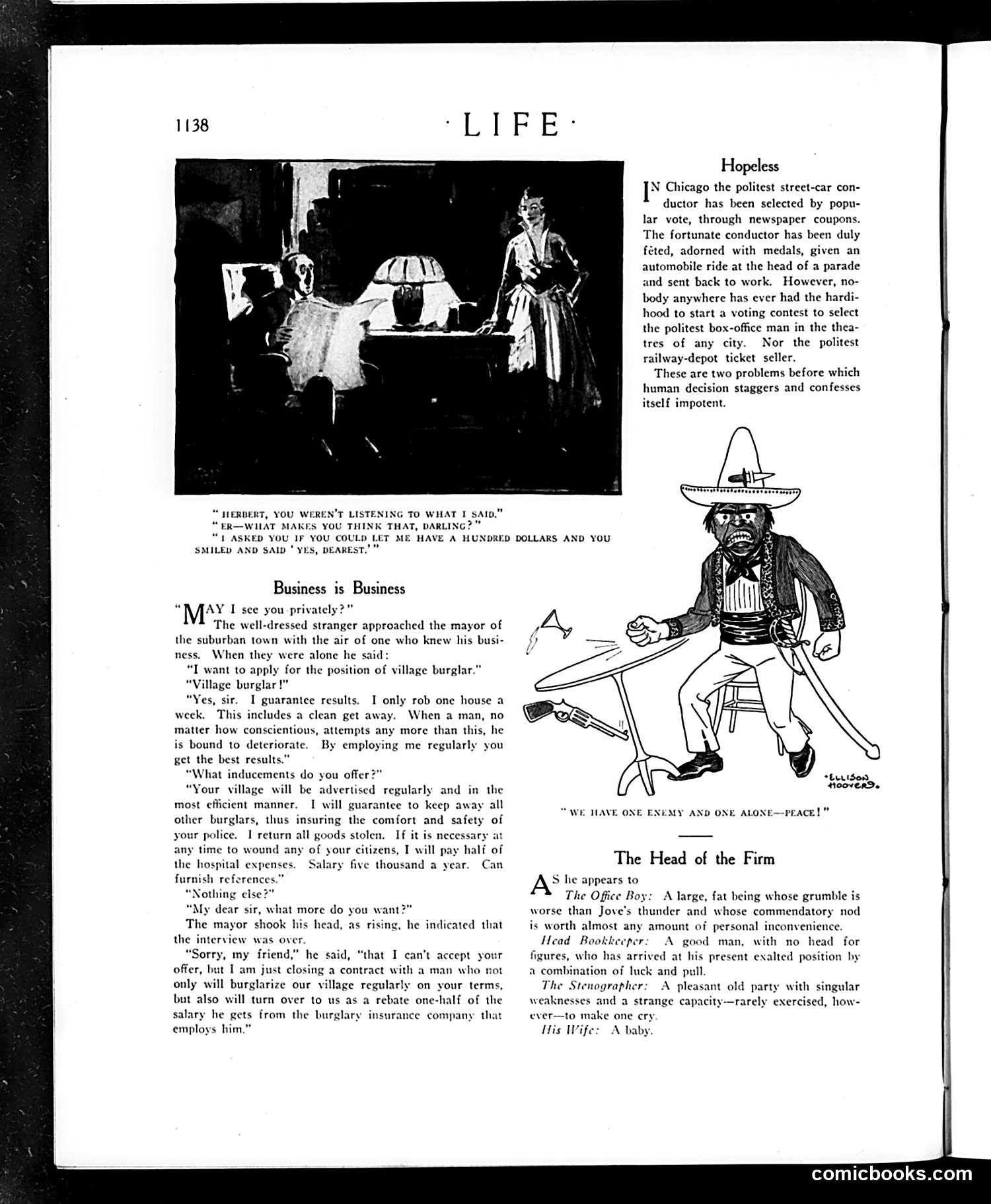
This page contains two satirical pieces: 1. **"Hopeless"** (top): A brief commentary on the absurdity of selecting Chicago's "politest street-car conductor" and "politest railroad-depot ticket seller" through public voting. The satire suggests these selections are impossible decisions—acknowledging the rarity of politeness in such positions. 2. **"Business is Business"** (middle): A humorous anecdote where a well-dressed stranger applies to be a village burglar, offering professional theft services with guarantees. The mayor rejects him, saying he's already contracted with a burglar's insurance company. 3. **"The Head of the Firm"** (bottom): Character sketches of office types, including descriptions of "The Office Boy," "Head Bookkeeper," "The Stenographer," and "His Wife." The humor targets municipal incompetence, corporate absurdity, and workplace stereotypes typical of early 20th-century American satire.
📄 Transcribed text from this page (OCR, searchable)
Machine-transcribed from the original scan — historical spelling and the odd misread are preserved.
“HERBERT, YOU WEREN'T LISTENING TO WHAT “ER—WHAT MAKES YOU THINK THAT, DARLING?” “1 ASKED YOU IF YOU COULD LET ME HAVE A HUNDRED DOLLARS AND YOU SMILED AND SAID ‘ YES, DEAREST.” Business is Business AY I see you privately?” he well-dressed stranger approached the mayor of the suburban town with the air of one who knew his busi- ness. When they were alone he said: “I want to apply for the position of village burglar.” “Village burglar!” “Yes, sir. I guarantee results. I only rob one house a week. This includes a clean get away. When a man, no matter how conscientious, attempts any more than this, he is bound to deteriorate. By employing me regularly you get the best results.’ “What inducements do you offer?” “Your village will be advertised regularly and in the most efficient manner. I will guarantee to keep away all other burglars, thus insuring the comfort and safety of your police. I return all goods stolen. If it is necessary at any time to wound any of your citizens, I will pay half of the hospital expenses. Salary five thousand a year. Can furnish references.’ “Nothing else? “My dear sir, what more do you want?" The mayor shook his head, as rising, he indicated that the interview was over, “Sorry, my friend,” he said, “that I can’t accept your offer, but I am just closing a contract with a man who not only will burglarize our village regularly on your terms, but also will turn over to us as a rebate one-half of the salary he gets from the burglary insurance comp: employs him.” Hopeless I‘ Chicago the politest street-car con- ductor has been selected by popu- lar vote, through newspaper coupons. The fortunate conductor has been duly féted, adorned with medals, given an automobile ride at the head of a parade and sent back to work. However, no- body anywhere has ever had the hardi- hood to start a voting contest to select the politest box-office man in the thea- tres of any city. Nor the politest railway-depot ticket seller. These are two problems before which human decision staggers and confesses itself impotent. “WE HAVE ONE ENEMY AND ONE ALONE—PEACE!” The Head of the Firm A he appears to The Office Boy: A large, fat being whose grumble is worse than Jove’s thunder and whose commendatory nod is worth almost any amount of personal inconvenience Head Bookkeeper: A good man, with no head for figures, who has arrived at his present exalted position by a combination of luck and pull The Stenographer: A pleasant old party with singular weaknesses and a strange capacity-—rarely exercised, how- ever—to make one ery His A baby. comicbooks.com