
Life, 1915-12-09 · page 34 of 48
Life — December 9, 1915 — page 34: what you’re looking at
What you’re looking at
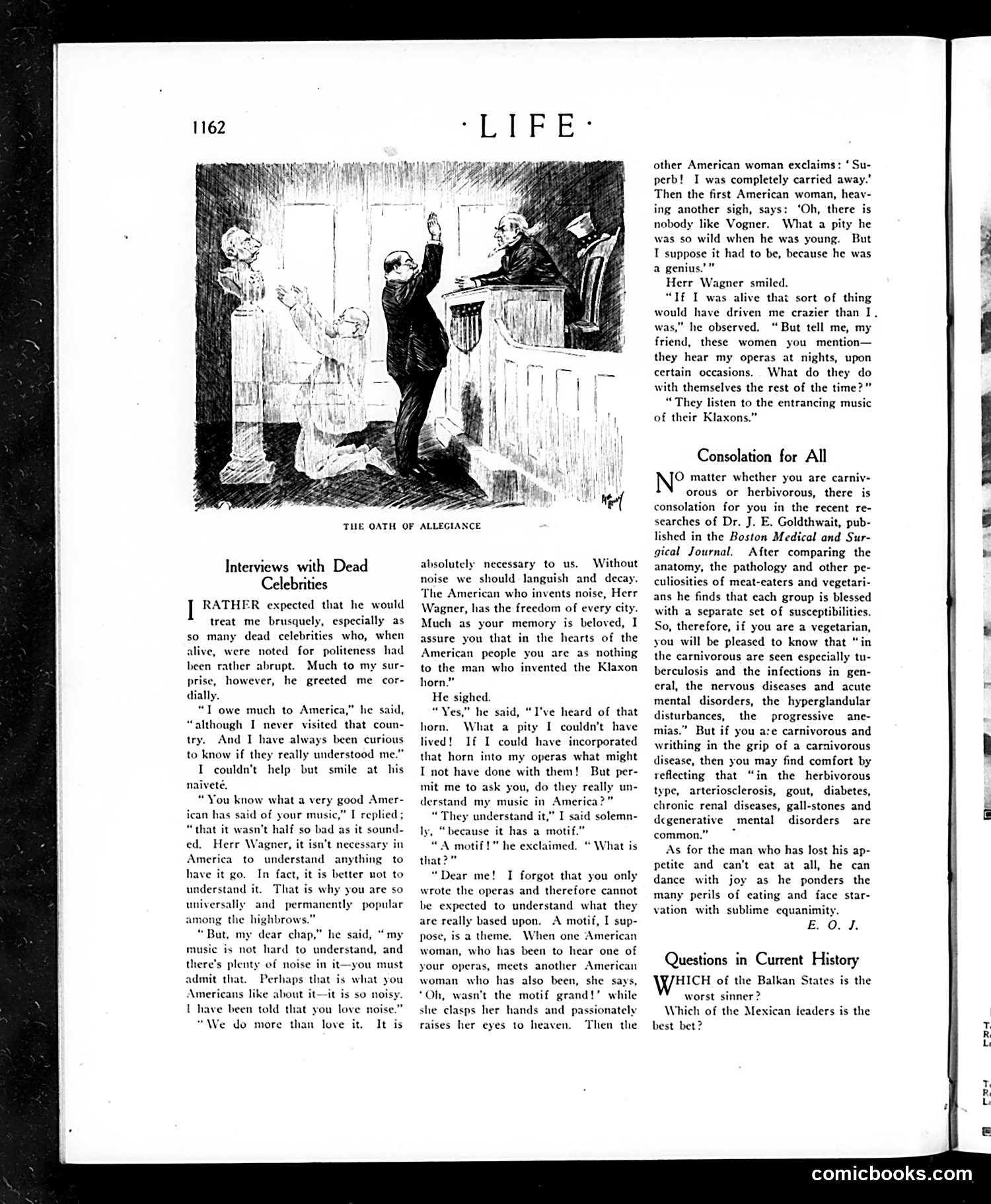
This satirical piece features an imagined interview with the dead composer Richard Wagner. The cartoon depicts Wagner greeting an American interviewer cordially at what appears to be a customs or border checkpoint (hence "Oath of Allegiance"). **The satire's targets:** 1. **American noise and materialism**: The piece mocks Americans' alleged love of noise, elevating the inventor of the Klaxon horn above Wagner himself in American esteem. 2. **Superficial cultural consumption**: American women who attend Wagner operas don't genuinely understand them—they simply repeat the word "motif" as pretentious jargon to impress each other, having absorbed nothing meaningful. 3. **Wagner's reputation**: The joke implies Americans respect Wagner's name while remaining completely indifferent to his actual artistic achievement. The humor relies on Wagner's bemused realization that his operas matter far less to Americans than automobile horns, and that his music serves merely as background to social posturing rather than genuine aesthetic appreciation.
📄 Transcribed text from this page (OCR, searchable)
Machine-transcribed from the original scan — historical spelling and the odd misread are preserved.
THE OATH OF ALLEGIANCE Interviews with Dead Celebrities RATHER expected that he would treat me brusquely, especially as so many dead celebrities who, when alive, were noted for politeness had been rather abrupt. Much to my sur- prise, however, he greeted me cor- dially. “IT owe much to America,” he said, “although I never visited that coun- try. And I have always been curious to know if they really understood me.” I couldn't help but smile at his naiveté. “You know what a very good Amer- ican has said of your music,” I replied; “that it wasn't half so bad as it sound- ed. Herr Wagner, it isn't necessary in America to understand anything to have it go. In fact, it is better not to understand it. That is why you are so universally and permanently popular among the highbrow “But, my dear chap,” he said, “my music is not hard to understand, and there’s plenty of noise in it—you must admit that. Perhaps that is what you Americans like about it—it is so noisy. U have been told that you love noise.” “We do more than love it. It is absolutely necessary to us. Without noise we should languish and decay. The American who invents noise, Herr Wagner, has the freedom of every city. Much as your memory is beloved, I assure you that in the hearts of the American people you are as nothing to the man who invented the Klaxon horn.” He sighed. "Yes," he's: “T've heard of that horn. What a pity I couldn't have ived! If I could have incorporated that horn into my operas what might I not have done with them! But per- mit me to ask you, do they really un- derstand my music in America?” “They understand it,” I said solemn- ly, “because it has a motif.” “A motif!” he exclaimed. that?” “Dear me! I forgot that you only wrote the operas and therefore cannot be expected to understand what they are really based upon. A motif, I sup- pose, is a theme. When one American woman, who has been to hear one of your operas, meets another American woman who has also been, she says, “Oh, wasn’t the motif grand!’ while she clasps her hands and passionately raises her eyes to heaven, Then the What is other American woman exclaims: ‘ Su- perb! I was completely carried away.’ Then the first American woman, heav- ing another sigh, says: ‘Oh, there is nobody like Vogner. What a pity he was so wild when he was young. But I suppose it had to be, because he was a genius.” Herr Wagner smiled. “If I was alive that sort of thing would have driven me crazier than I was,” he observed. “ But tell me, my friend, these women you mention— they hear my operas at nights, upon certain occasions. What do they do with themselves the rest of the time?” They listen to the entrancing music of their Klaxons.” Consolation for All ‘O matter whether you are carniv- orous or herbivorous, there is consolation for you in the recent re- searches of Dr. J. E. Goldthwait, pub- lished in the Boston Medical and Sur- gical Journal. After comparing the anatomy, the pathology and other pe- culiosities of meat-eaters and vegetari- ans he finds that each group is blessed with a separate set of susceptibilities. So, therefore, if you are a vegetarian, you will be pleased to know that “in the carnivorous are seen especially tu- berculosis and the infections in gen- eral, the nervous diseases and acute mental disorders, the hyperglandular disturbances, the progressive ane- mias.” But if you aze carnivorous and writhing in the grip of a carnivorous disease, then you may find comfort by reflecting that “in the herbivorous type, arteriosclerosis, gout, diabetes, chronic renal diseases, gall-stones and degenerative mental disorders are common.” . As for the man who has lost his ap- petite and can’t eat at all, he can dance with joy as he ponders the many perils of eating and face star- vation with sublime equanimity. E. 0. J. Questions in Current History HICH of the Balkan States is the worst sinner? Which of the Mexican leaders is the best bet? comicbooks.com fe