
Life, 1915-12-09 · page 28 of 48
Life — December 9, 1915 — page 28: what you’re looking at
What you’re looking at
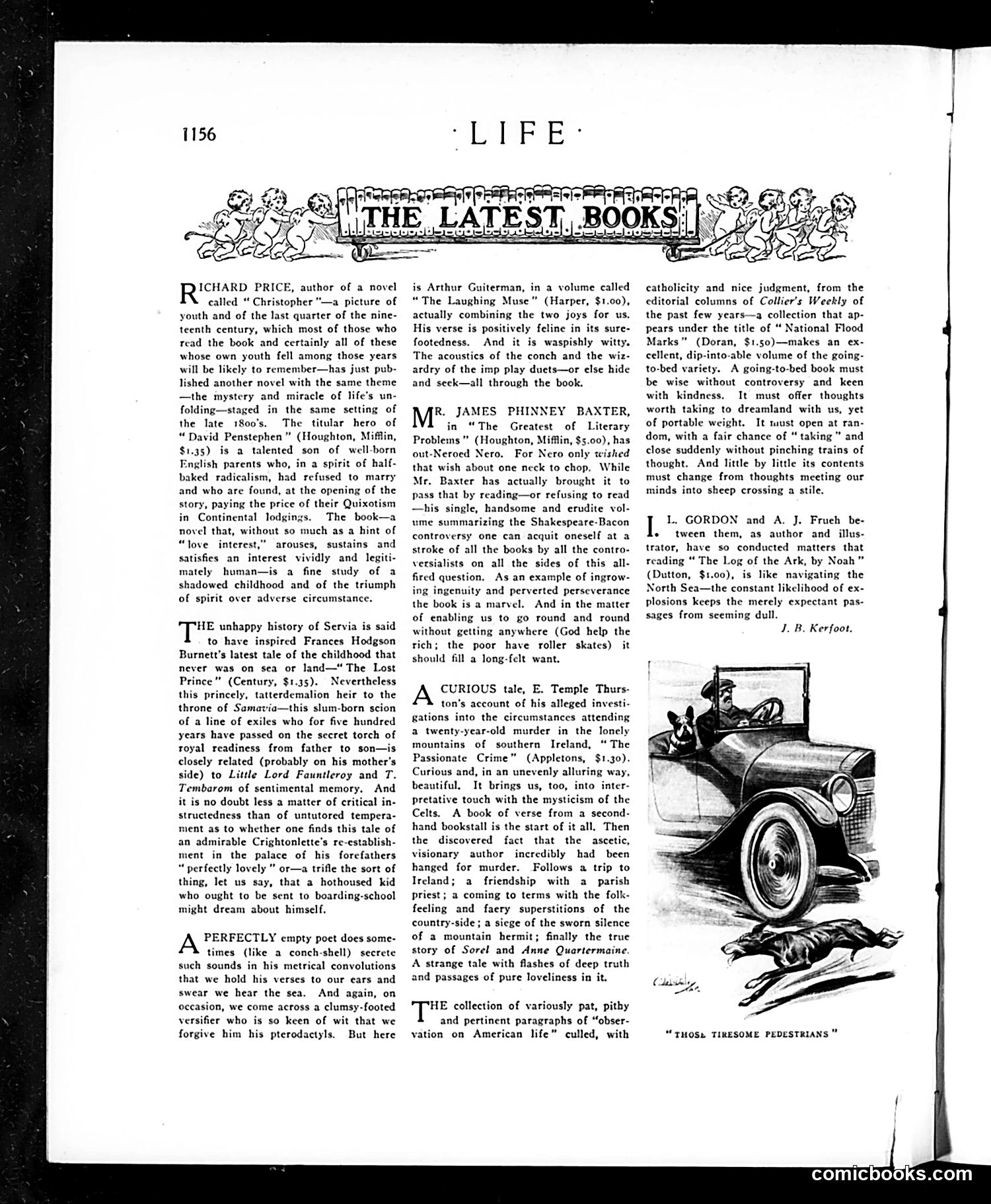
This is a **book review section** from Life magazine's "Latest Books" feature, not primarily a political cartoon page. The single illustration—captioned "Those Tiresome Pedestrians"—shows a wealthy motorist in an expensive car nearly hitting pedestrians, satirizing the emerging social problem of reckless automobile drivers endangering foot traffic. The reviews discuss contemporary 1910s fiction and literary works, including novels about childhood (Price's "David Penstephen"), a fairy-tale about exiled royalty (Burnett's "The Lost Prince"), and poetry by Guiterman. One review humorously skewers James Phinney Baxter's exhaustive scholarly tome on the Shakespeare-Bacon authorship debate as simultaneously authoritative yet circular—an example of academic over-elaboration. The cartoon's satirical point: newly wealthy car owners represent a dangerous social menace to ordinary pedestrians, reflecting contemporary anxieties about automobiles disrupting urban life.
📄 Transcribed text from this page (OCR, searchable)
Machine-transcribed from the original scan — historical spelling and the odd misread are preserved.
ICHARD PRICE, author of a novel called “ Christopher "—a picture of youth and of the last quarter of the nine- teenth century, which most of those who read the book and certainly all of these whose own youth fell among those years will be likely to remember—has just pub- lished another novel with the same theme —the mystery and miracle of life's un- folding—staged in the same setting of the late 1800's. The titular hero of “David Penstephen” (Houghton, Mifflin, $1.35) is a talented son of well-born glish parents who, in a spirit of half- baked radicalism, had refused to marry and who are found, at the opening of the story, paying the price of their Quixotism in Continental lodgings. The book—a novel that, without so much as a hint of “love intere: arouses, sustains and satisfies an interest vividly and legiti- mately human—is a fine study of a shadowed childhood and of the triumph of spirit over adverse circumstance. HE unhappy history of Servia is said to have inspired Frances Hodgson Burnett's latest tale of the childhood that never on sea or land— The Lost Prince” (Century, $1.35). Nevertheless this princely, tatterdemalion heir to the throne of Samavia—this slum-born scion of a line of exiles who for five hundred years have passed on the secret torch of royal readiness from father to son—is closely related (probably on his mother’s side) to Little Lord Fauntleroy and T. Tembarom of sentimental memory, And it is no doubt less a matter of cr 1 in- structedness than of untutored tempera- ment as to whether one finds this tale of an admirable Crightonlette’s re-establish- ment in the palace of his forefathers “ perfectly lovely ” or—a trifle the sort of thing, let us say, that a hothoused kid who ought to be sent to boarding-school might dream about himself. PERFECTLY empty poet does some- times (like a conch-shell) secrete such sounds in his metrical convolutions that we hold his verses to our ears and swear we hear the sea. And again, on occasion, we come across a clumsy-footed versifier who is so keen of wit that we forgive him his pterodactyls. But here is Arthur Guiterman, in a volume called “The Laughing Muse” (Harper, $1.00), actually combining the two joys for us. His verse is positively feline in its sure- footedness. And it is waspishly witty. The acoustics of the conch and the wiz- ardry of the imp play duets—or else hide and seck—all through the book. M*® JAMES PHINNEY BAXTER, in “The Greatest of Literary Problems" (Houghton, Miffiin, $5.00), has out-Neroed Nero. For Nero only wished that wish about one neck to chop. While Mr. Baxter has actually brought it to pass that by reading—or refusing to read —his single, handsome and erudite vol- ume summarizing the Shakespeare-Bacon controversy one can acquit oneself at a stroke of all the books by all the contro- versialists on all the sides of this all- fired question, As an example of ingrow- ing ingenuity and perverted perseverance the book is a marvel. And in the matter of enabling us to go round and round without getting anywhere (God help the rich; the poor have roller skates) it should fill a long-felt want. CURIOUS tale, E. Temple Thurs- ton's account of his alleged inves gations into the circumstances attending a twenty-year-old murder in the lonely mountains of southern Ireland, “ The Passionate Crime” (Appletons, $1.30). Curious and, in an unevenly alluring wa beautiful, It brings us, too, into inte pretative touch with the mysticism of the Celts. A book of verse from a second- hand bookstall is the start of it all. Then the discovered fact that the ascetic, visionary author incredibly had been hanged for murder. Follows a trip to Ireland; a friendship with a parish priest; a coming to terms with the folk- feeling and faery superstitions of the country-side ; a siege of the sworn silence of a mountain hermit; finally the true story of Sorel and Anne Quartermaine. A strange tale with flashes of deep truth and passages of pure loveliness in it. HE collection of variously pat, pithy and pertinent paragraphs of “obser- vation on American life” culled, with catholicity and nice judgment, from the editorial columns of Collier's Weekly of the past few years—a collection that ap- pears under the title of “ National Flood Marks” (Doran, $1.50)—makes an ex- cellent, dip-into-able volume of the going- to-bed variety. A going-to-bed book must be wise without controversy and keen with kindness. It must offer thoughts worth taking to dreamland with us, yet of portable weight. It must open at ran- dom, with a fair chance of “ taking” and close suddenly without pinching trains of thought. And little by little its contents must change from thoughts meeting our minds into sheep crossing a stile. I L. GORDON and A. J. Frueh be- © tween them, as author and illus- trator, have so conducted matters that reading “ The Log of the Ark, by Noah” (Dutton, $1.00), is like navigating the North Sea—the constant likelihood of ex- plosions keeps the merely expectant pas- sages from seeming dull. J. B. Kerfoot, “THOSE TIRESOME PEDESTRIANS " comicbooks.com