
A complete issue · 52 pages · 1915
Life — November 18, 1915
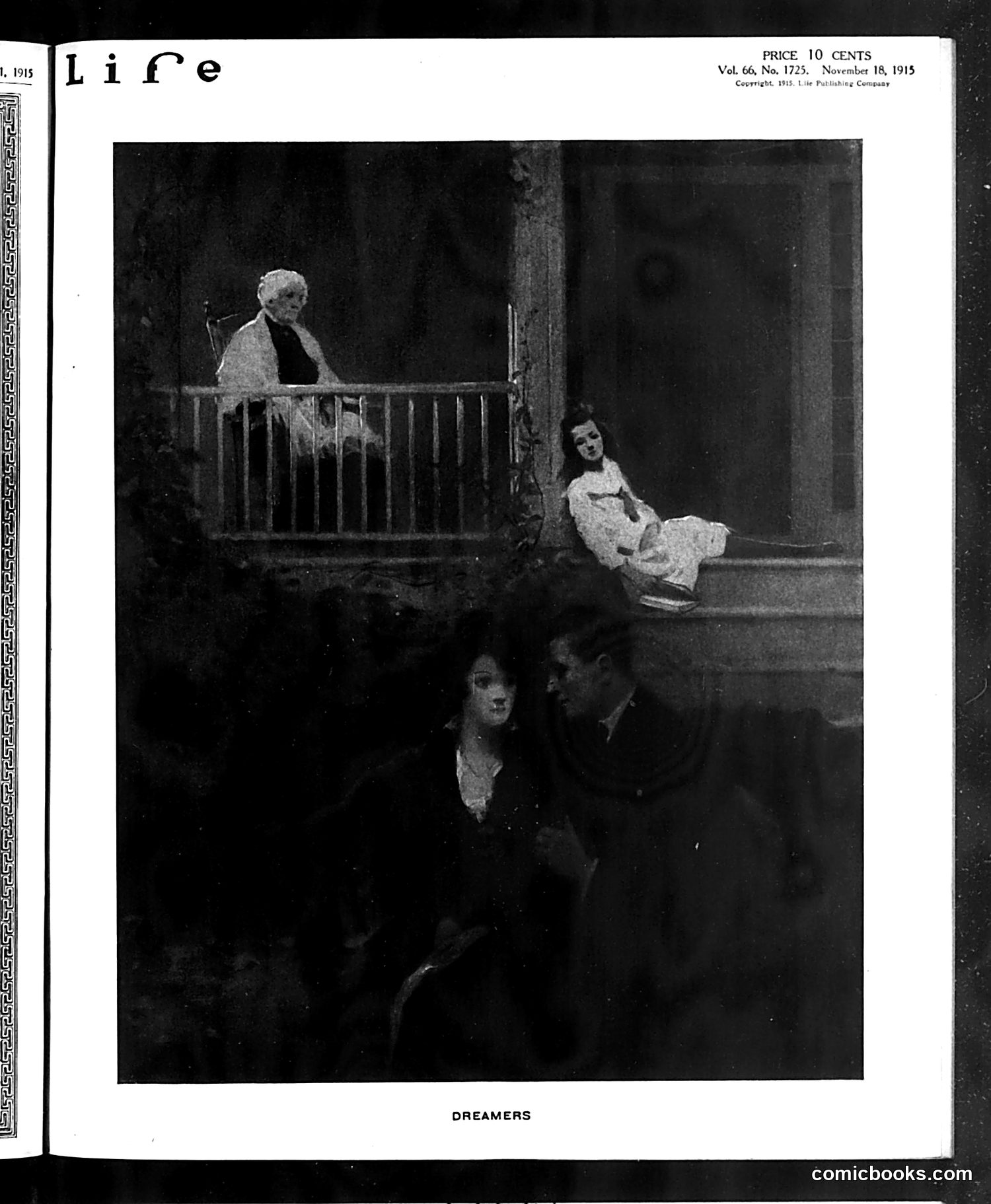
This appears to be a theatrical or film still rather than a political cartoon. The image shows four figures in what seems to be a dramatic scene: an elderly man at an upper railing, a woman in light clothing on stairs, and two figures in dark clothing in the foreground appearing to converse or conspire. The caption "Dreamers" suggests this depicts a narrative about idealistic or delusional characters. Without additional context about which play or film this represents, the specific satire remains unclear. It may comment on romantic idealism, social aspiration, or theatrical melodrama common to 1915 entertainment—themes Life magazine frequently mocked. The composition emphasizes the dramatic contrast between the upper and lower figures.
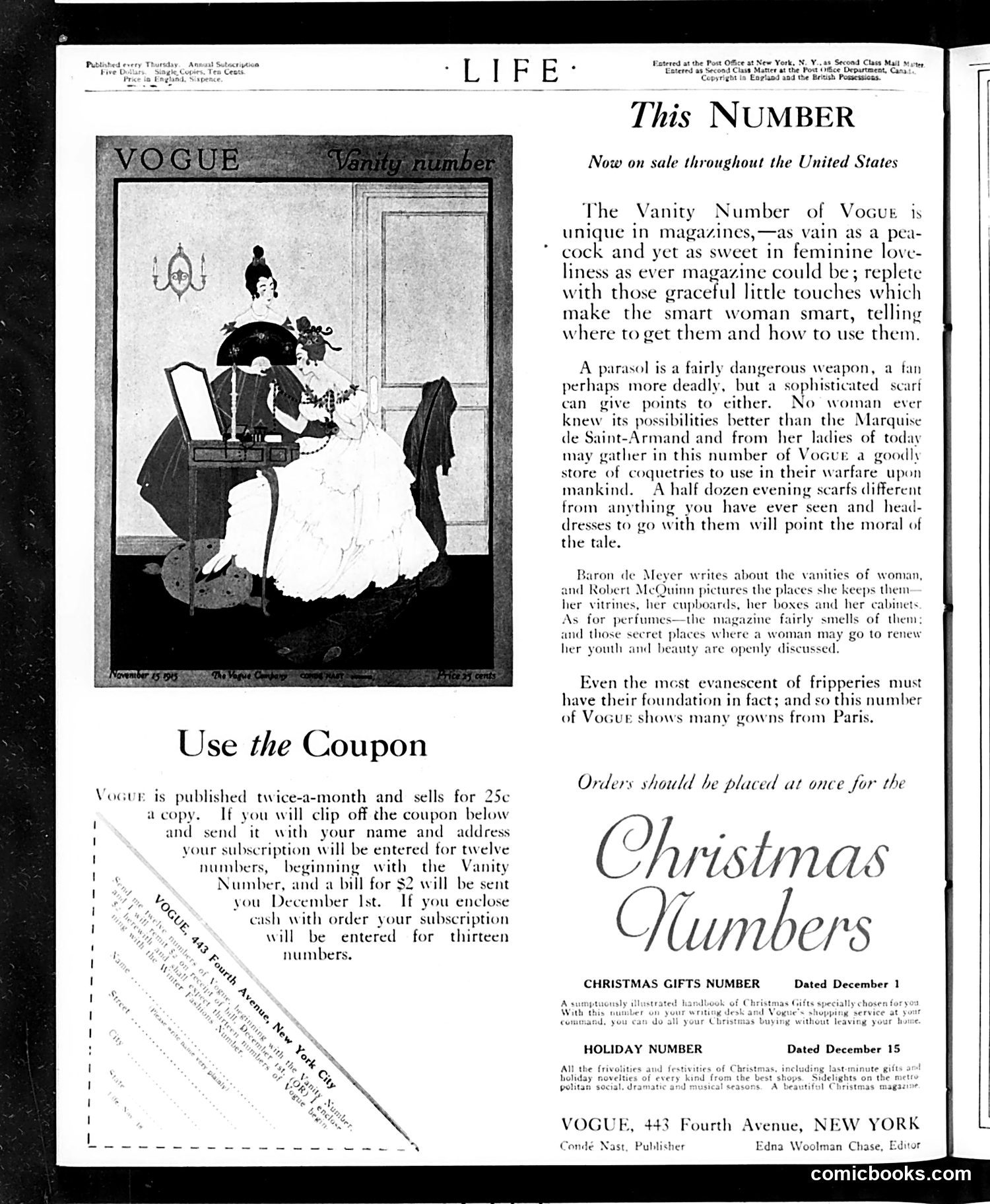
This page is primarily **advertising for Vogue magazine**, not political satire. The illustration shows a stylized woman at her vanity, demonstrating the magazine's focus on fashion, beauty, and feminine lifestyle. The accompanying text promotes Vogue's "Vanity Number," emphasizing fashion advice and beauty tips. References to the "Marquise de Saint-Armand" and discussions of parasols, perfumes, and evening wear reflect early 20th-century upper-class concerns. The "Use the Coupon" section encourages subscriptions, promoting Christmas and Holiday special issues. This is **lifestyle advertising** rather than political commentary—it reflects contemporary attitudes about women's magazines catering to wealthy, fashion-conscious female readers interested in luxury goods and social refinement.
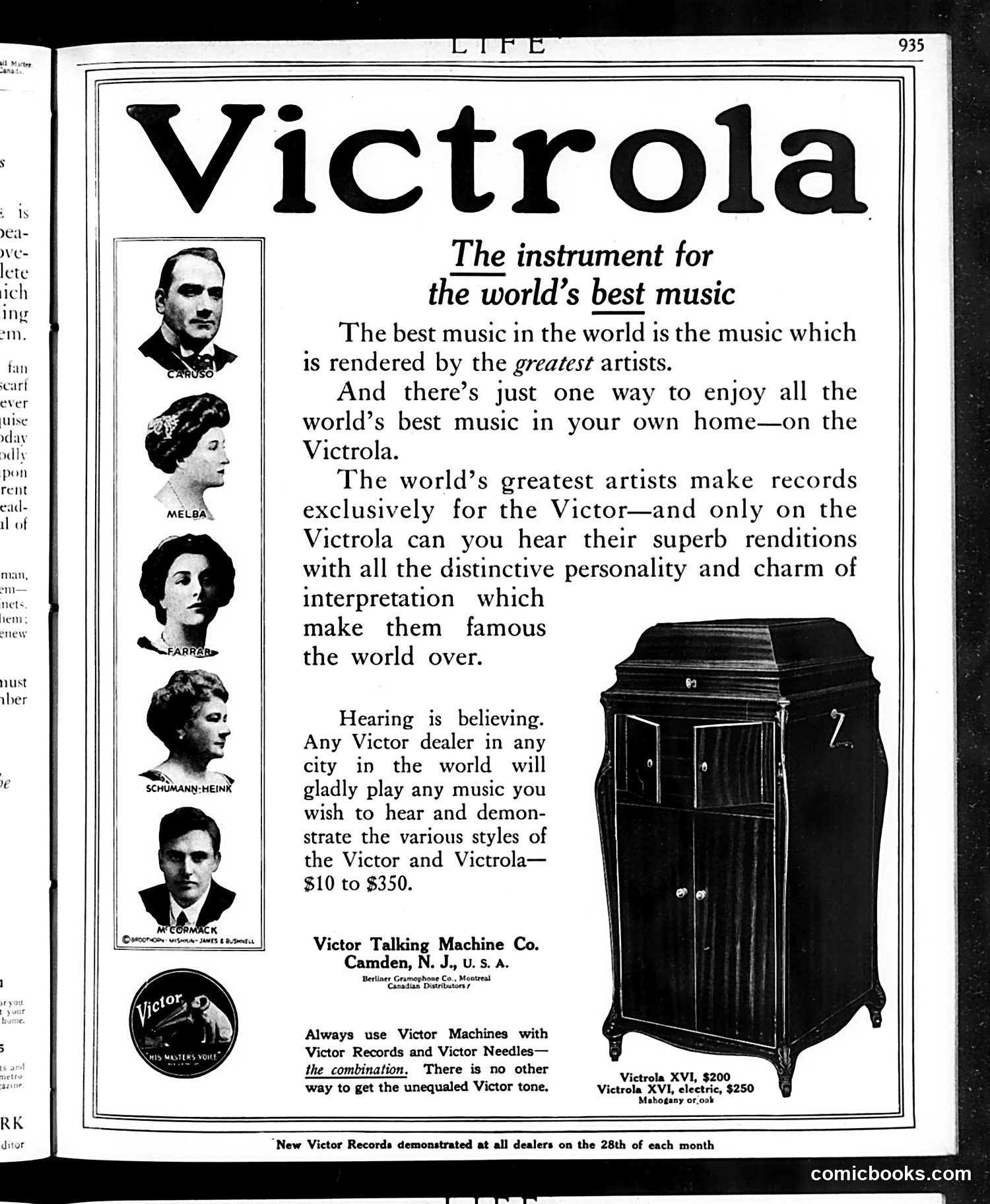
This is a **Victrola phonograph advertisement**, not political satire. The page features portraits of famous classical musicians and opera singers (labeled names include Melba, Farrar, Schumann-Heinck, and McCormack) who recorded exclusively for Victor Records. The ad's pitch: owning a Victrola allows middle-class homes to experience world-class music performances. It emphasizes that these renowned artists' "personality and charm" can only be heard through Victor machines—a marketing strategy claiming exclusivity and authenticity. Pricing ranges from $10 to $350, making the technology accessible to prosperous households. The manufacturer encourages potential customers to visit dealers for demonstrations. This represents early-20th-century consumer culture marketing premium entertainment technology to aspirational audiences.
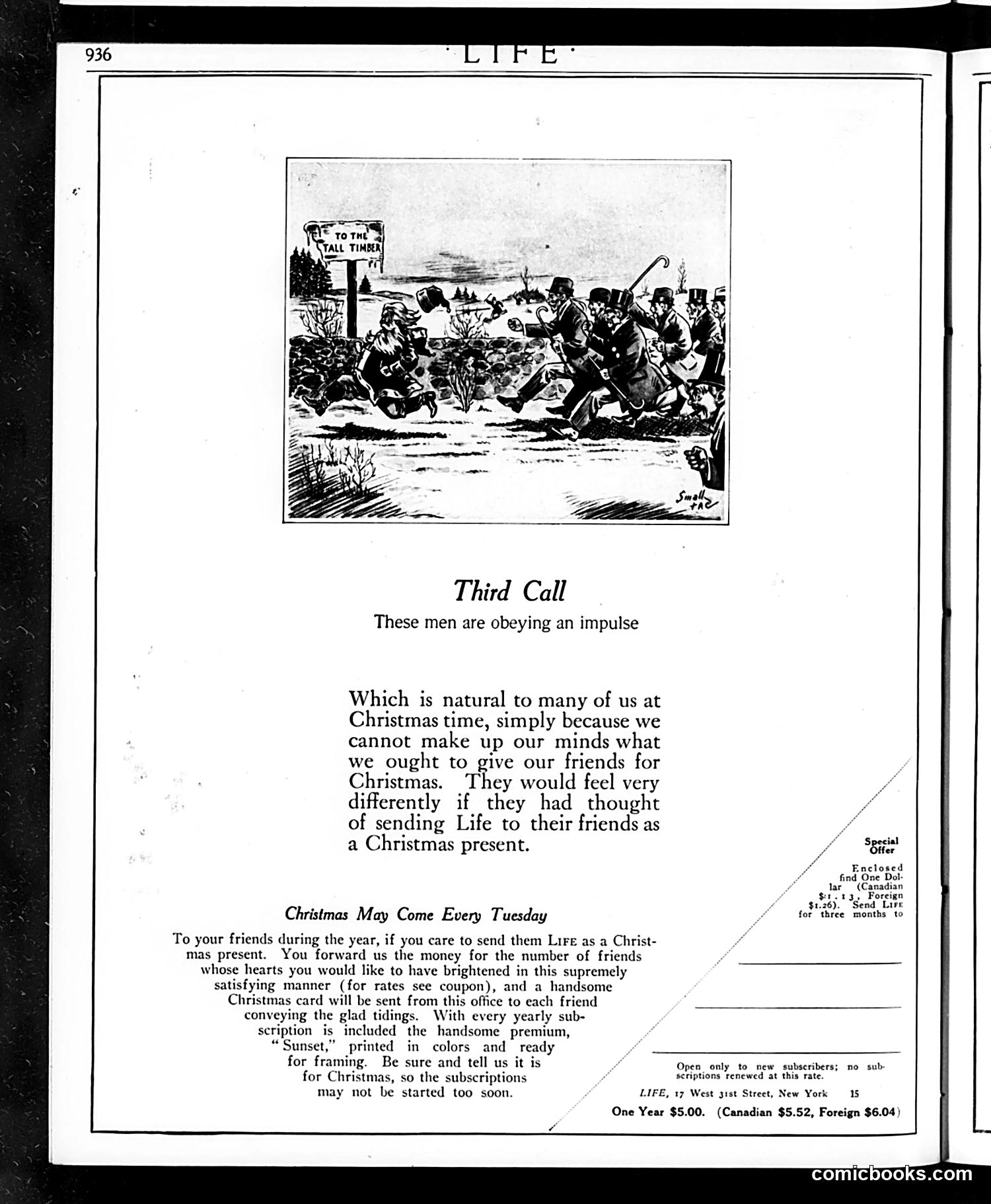
This page is primarily a **Christmas gift subscription advertisement** for Life magazine, not political satire. The cartoon titled "Third Call" depicts a group of men gathered around a signpost reading "TO THE TALL TIMBER," seemingly heeding an impulse. The accompanying text suggests this is a humorous visual metaphor—the "impulse" being the natural difficulty people face deciding what Christmas gifts to give friends. The advertisement proposes a solution: subscribers can send Life magazine as a Christmas present to friends throughout the year. Each recipient would receive a handsome Christmas card with holiday greetings. The copy emphasizes this as a "supremely satisfying" gift option. The pricing information indicates one-year subscriptions cost $5.00 (US), $5.52 (Canadian), or $6.04 (Foreign).
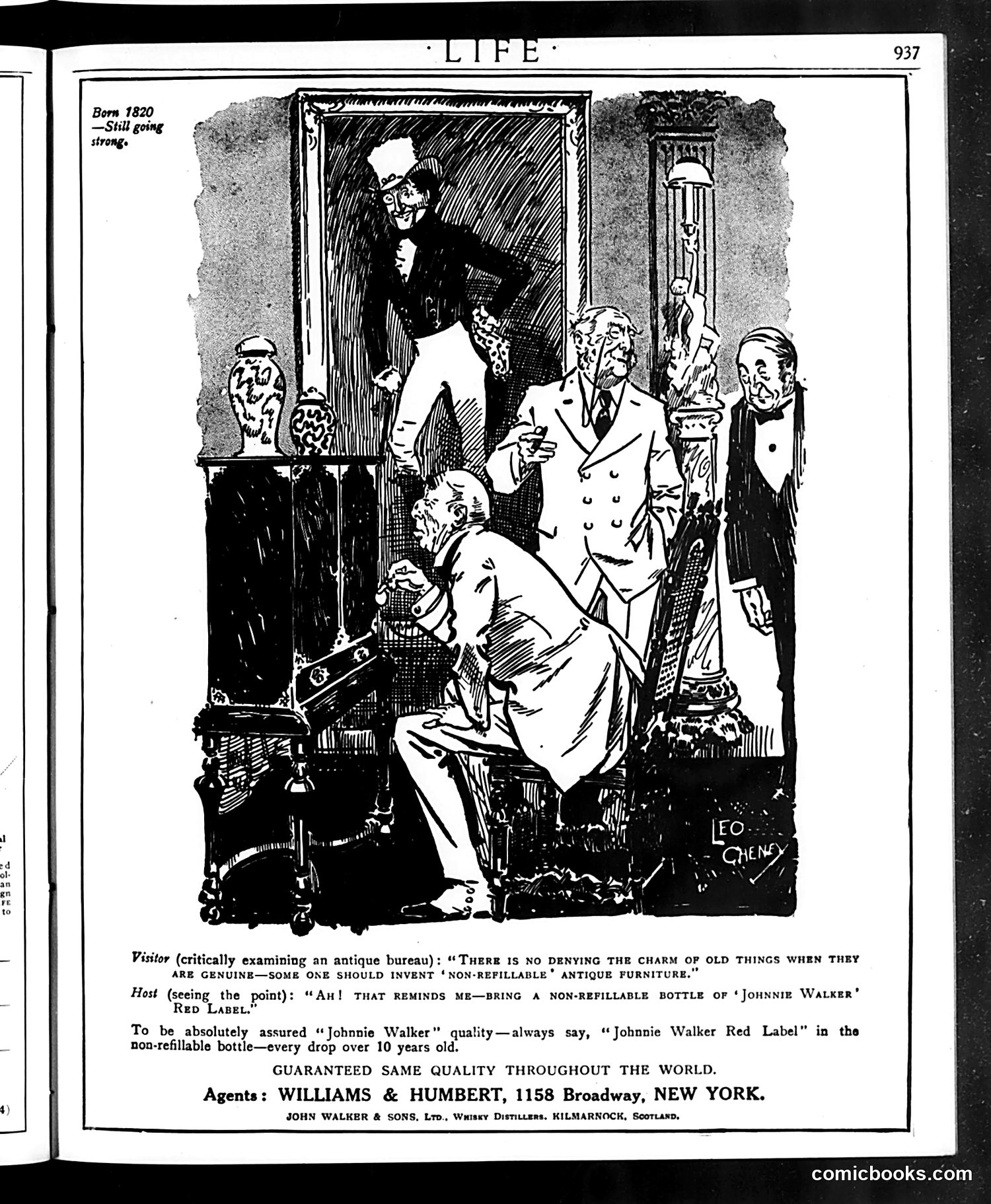
This is primarily an **advertisement for Johnnie Walker Red Label whisky**, not political satire. The illustrated scene depicts an antique dealer's shop where a visitor examines an old bureau. The "joke" is a sales pitch: the visitor notes that old things have charm, prompting the host to recommend Johnnie Walker Red Label as a "non-refillable" antique—implying the whisky improves with age like fine furniture, with "every drop over 10 years old." The cartoon uses the genteel setting of wealthy collectors discussing fine antiques to position the whisky as a quality product that, like aged pieces, maintains consistent excellence. The advertisement emphasizes the product's reliability and global availability through Williams & Humbert agents in New York. This reflects early 20th-century advertising strategy linking consumer goods to sophistication and tradition.
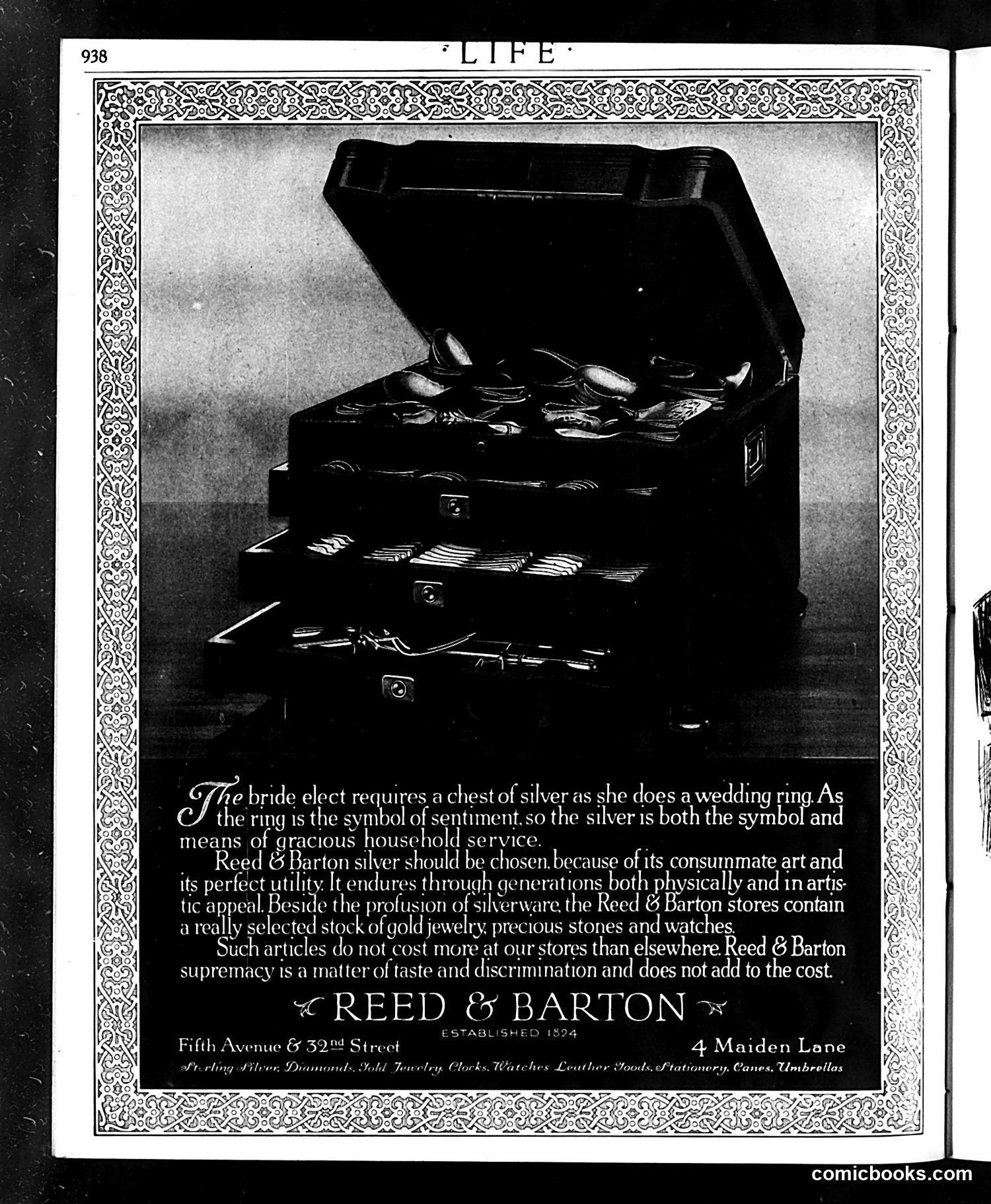
This page is **not a cartoon or satire** — it's a straightforward advertisement for Reed & Barton, a silverware and jewelry retailer established in 1824. The image shows an open jewelry chest displaying silver items and goods across multiple drawers. The ad targets brides-to-be, arguing that a silver chest is as essential as a wedding ring. It emphasizes that silver serves dual purposes: as a sentimental symbol and as functional tableware that will endure "through generations both physically and in artistic appeal." The copy also notes Reed & Barton's competitive pricing on luxury goods (gold jewelry, precious stones, watches), positioning the store as offering superior taste without premium costs. This represents typical early-20th-century marketing aimed at affluent women contemplating marriage and household management.
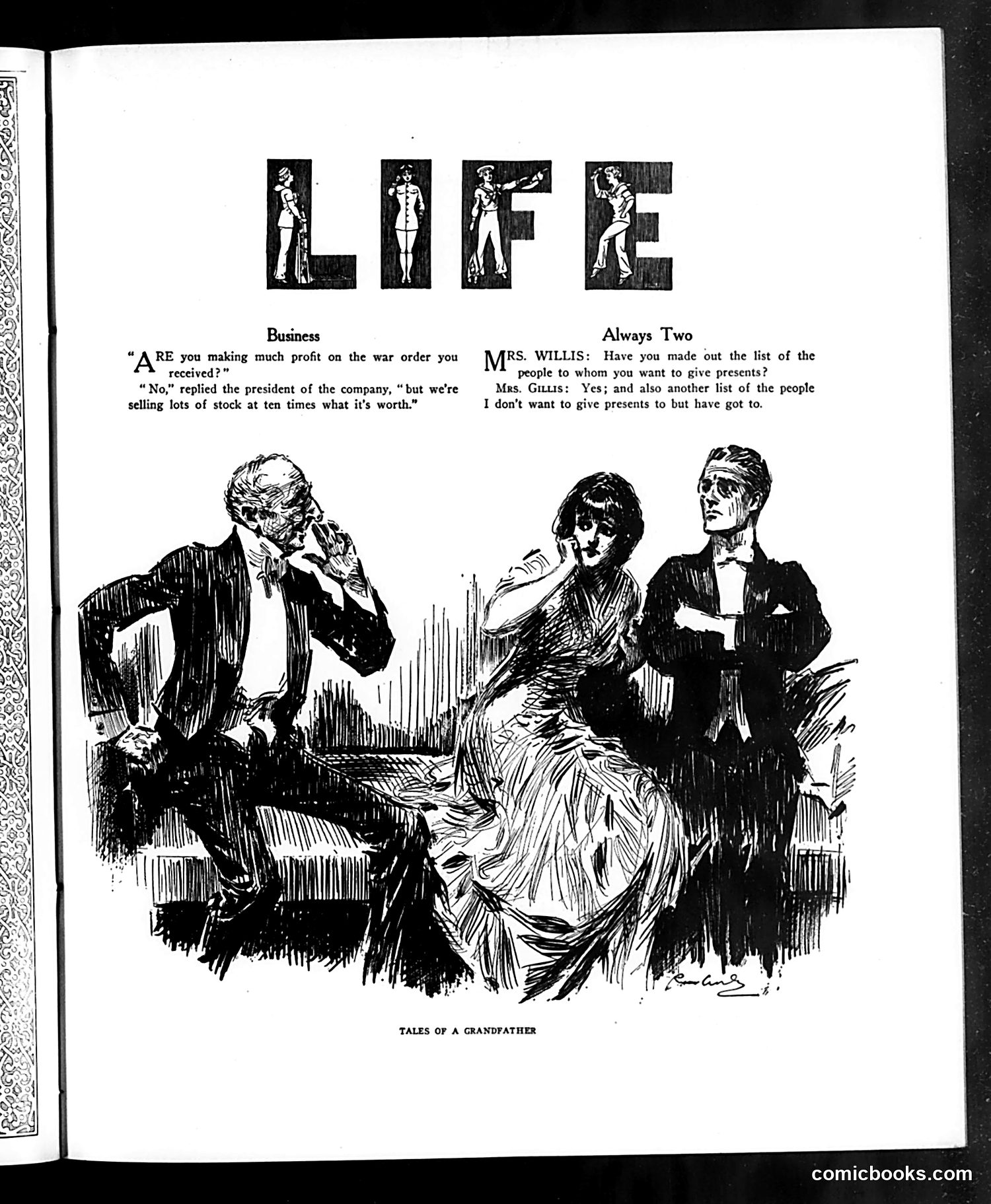
This page contains two brief satirical dialogues labeled "Business" and "Always Two." **"Business"** depicts a company president defending inflated profits on war orders, claiming they're "selling lots of stock at ten times what it's worth." The satire targets wartime profiteering—corporations exploiting government military contracts to artificially inflate stock prices and enrich shareholders while claiming patriotic service. **"Always Two"** shows Mrs. Willis struggling with gift-giving etiquette, wanting to give presents only to people she likes while avoiding obligatory gifts to those she dislikes. The joke satirizes social hypocrisy and the burden of maintaining appearances through unwanted gift obligations. Both vignettes mock dishonesty in business and social conventions—one economic, one social.
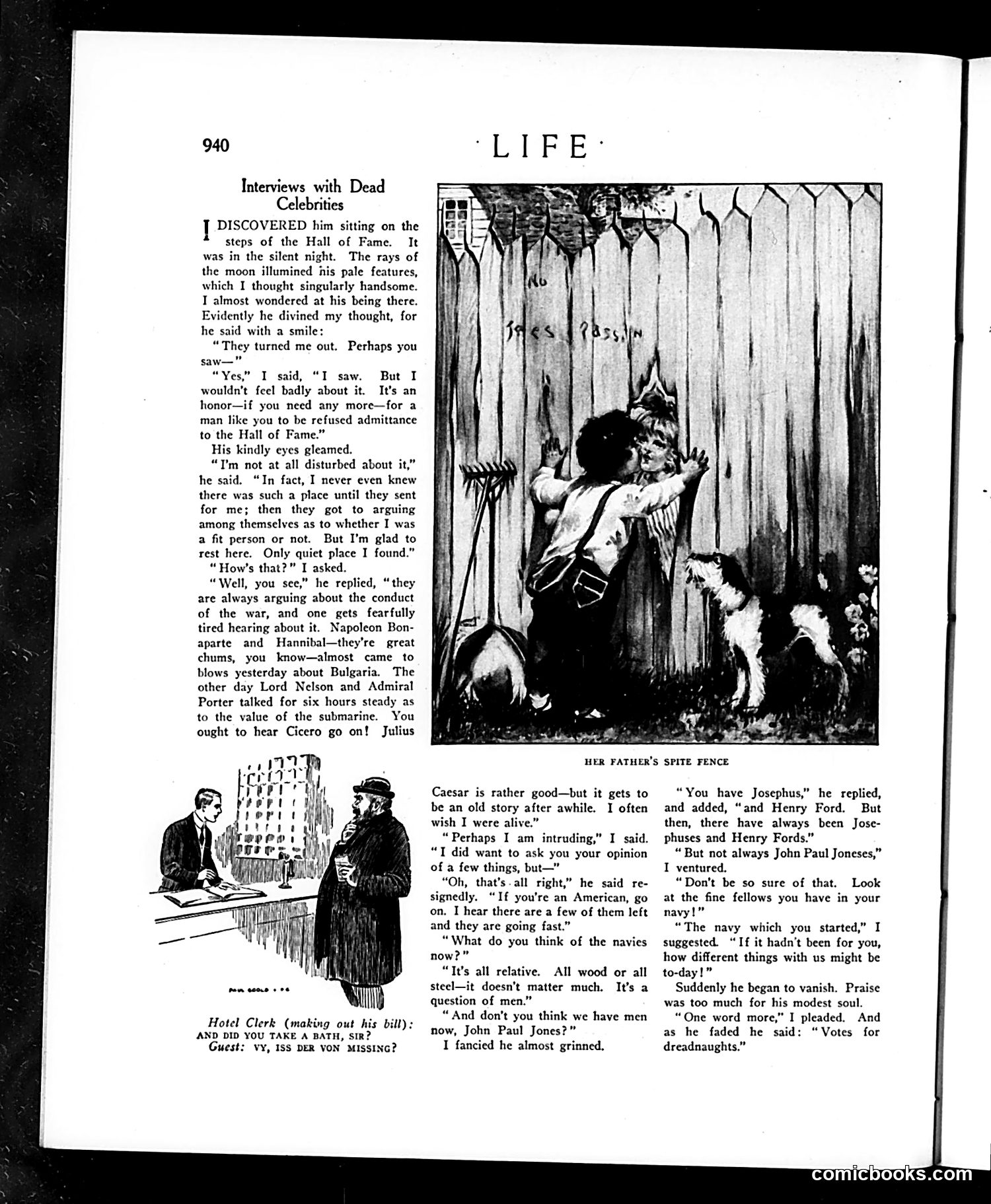
This satirical piece imagines a conversation with a deceased historical figure in the Hall of Fame. The main narrative discusses arguments among dead military leaders—Napoleon Bonaparte and Hannibal are mentioned as "great chums" endlessly debating war strategy, while Lord Nelson and Admiral Porter also feature in these posthumous disputes. The cartoon critiques how historical figures are mythologized and debated by the living. The small illustration shows a hotel clerk collecting payment, with dialogue mocking bureaucratic indifference. The satire suggests that even in death, famous military men remain contentious and argumentative rather than peaceful. The piece gently mocks both the reverence we grant historical figures and their apparent inability to move beyond earthly disputes.
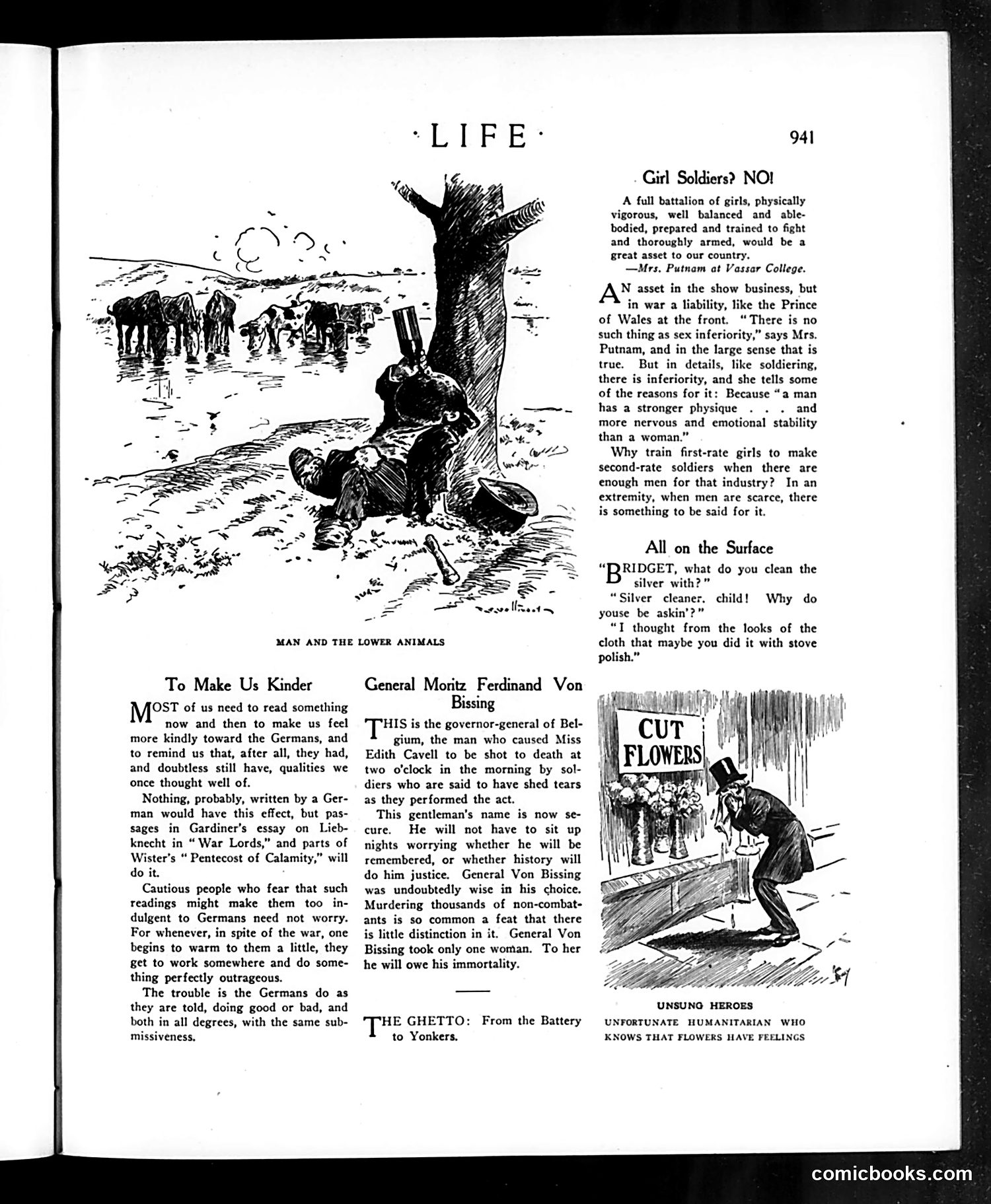
This page contains several WWI-era satirical pieces. The main cartoon "Man and the Lower Animals" depicts a soldier sheltering against a tree during combat, contrasting human and animal behavior in war. Below, "To Make Us Kinder" argues Germans shouldn't be demonized despite the war, citing a German essay suggesting mutual understanding. The piece "General Moritz Ferdinand Von Bissing" references the German governor-general of occupied Belgium, notorious for executing Belgian civilians including Edith Cavell (a British nurse shot in 1915). The satire notes his name is now "secure"—history will remember him infamously. "The Ghetto" and "Unsung Heroes" appear to be additional satirical sections. The page reflects 1915-1916 attitudes toward Germany and WWI conduct.
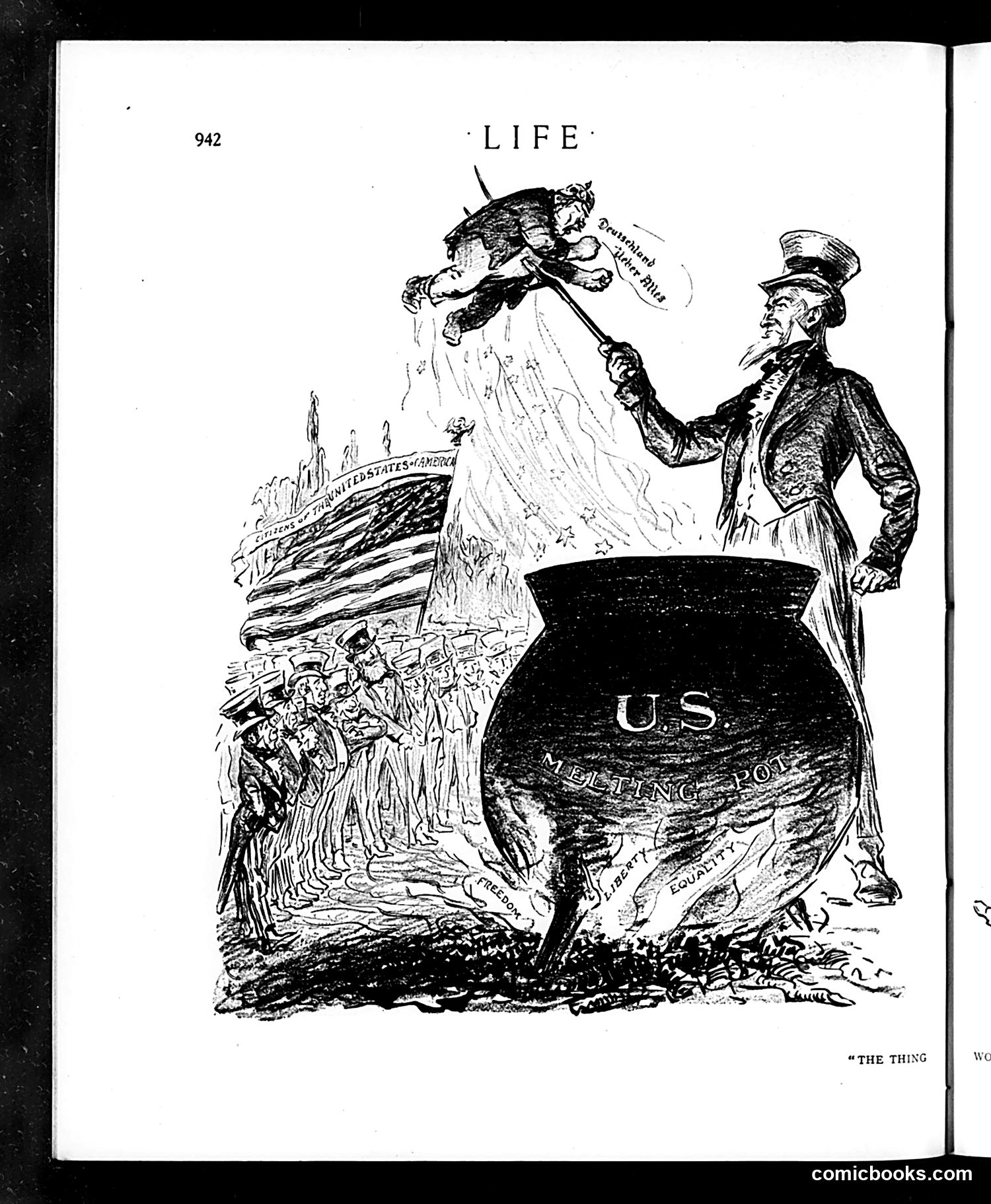
This is a satirical cartoon from Life magazine (page 942) depicting a figure in formal 19th-century dress using a long stick to hold up a rat or rodent above a large cauldron labeled "U.S. Melting Pot." The pot displays text referencing "Liberty" and "Equality." The cartoon appears to critique immigration policy or assimilation debates of the era. The "melting pot" metaphor was popular rhetoric about America blending different peoples into one unified nation. However, the cartoonist seems skeptical—showing the figure actively controlling or rejecting what goes into this supposedly inclusive crucible, suggesting selective rather than genuine integration. The rat likely represents an unwanted immigrant group, though without additional context, the specific target remains unclear.
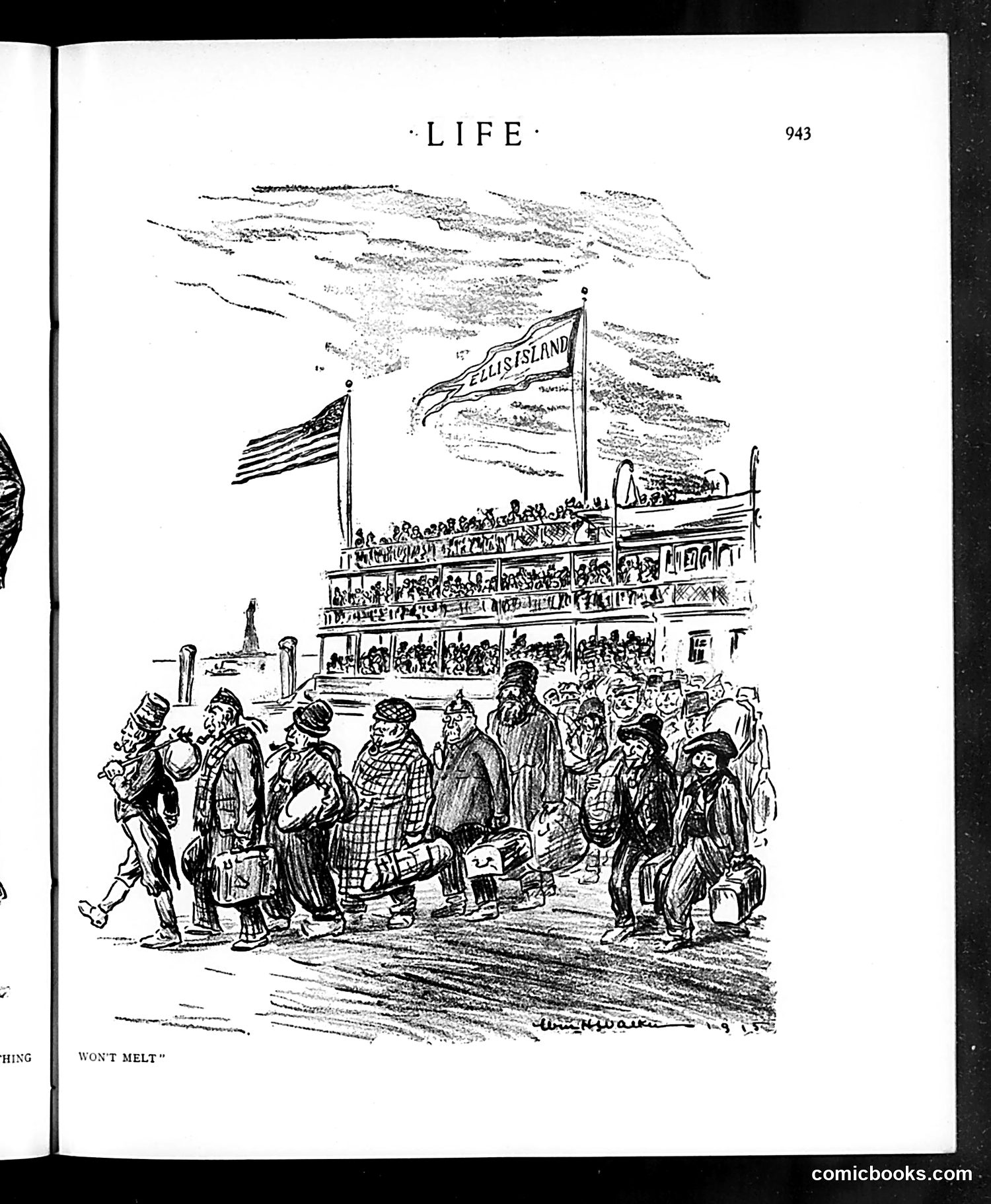
This is page 943 from Life magazine showing a satirical cartoon about immigration to Ellis Island. The drawing depicts a crowded scene at Ellis Island's immigration station, with a large American flag and an "Ellis Island" banner visible on the building above. A diverse group of immigrants—rendered in period clothing and carrying belongings—stands before immigration officials. The cartoon satirizes the massive influx of immigrants arriving in America during the early 20th century. The cramped, chaotic composition and the portrayal of the varied immigrant population appears to critique either the overwhelming numbers of arrivals or the bureaucratic processing system itself. The sketch style is characteristic of early Life magazine's political humor addressing contemporary American social issues.
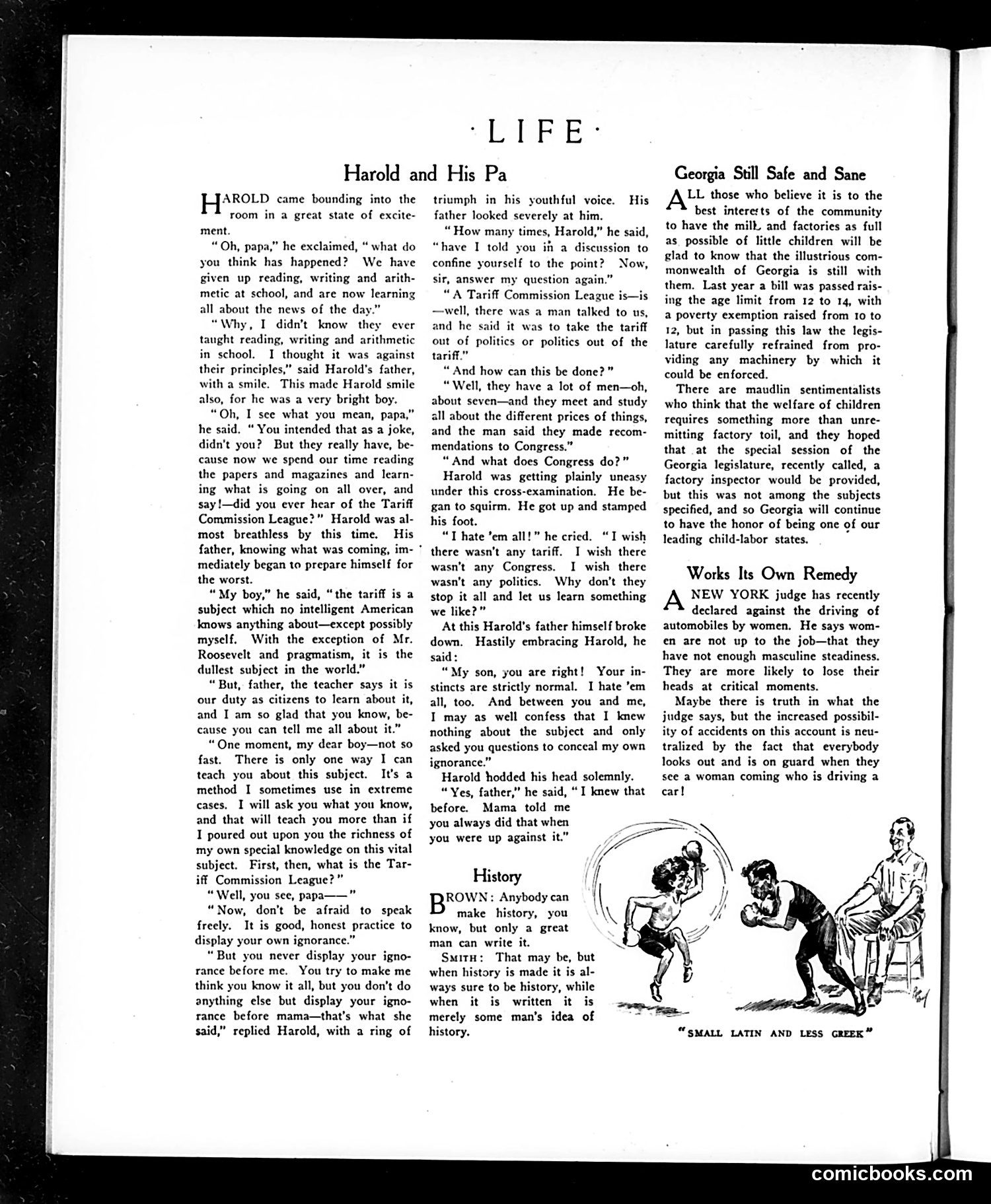
This page contains three separate pieces of satirical content: **"Harold and His Pa"** (left column): A dialogue between a father and son about the Tariff Commission League. Harold excitedly discusses tariffs and politics, while his father gently mocks his earnestness, suggesting the boy is displaying youthful ignorance by pretending to understand complex economic policy. **"Georgia Still Safe and Sane"** (right column): Commentary defending Georgia's child labor practices against reform efforts, arguing the state should resist factory inspection laws—representing opposition to Progressive-era child labor protections. **"Works Its Own Remedy"** (bottom right): A brief item mocking a judge's ruling against women drivers, portraying female drivers as dangerous and suggesting accidents will naturally discourage them. The cartoon below depicts children at play, captioned "Small Latin and Less Greek"—likely referencing limited educational access.
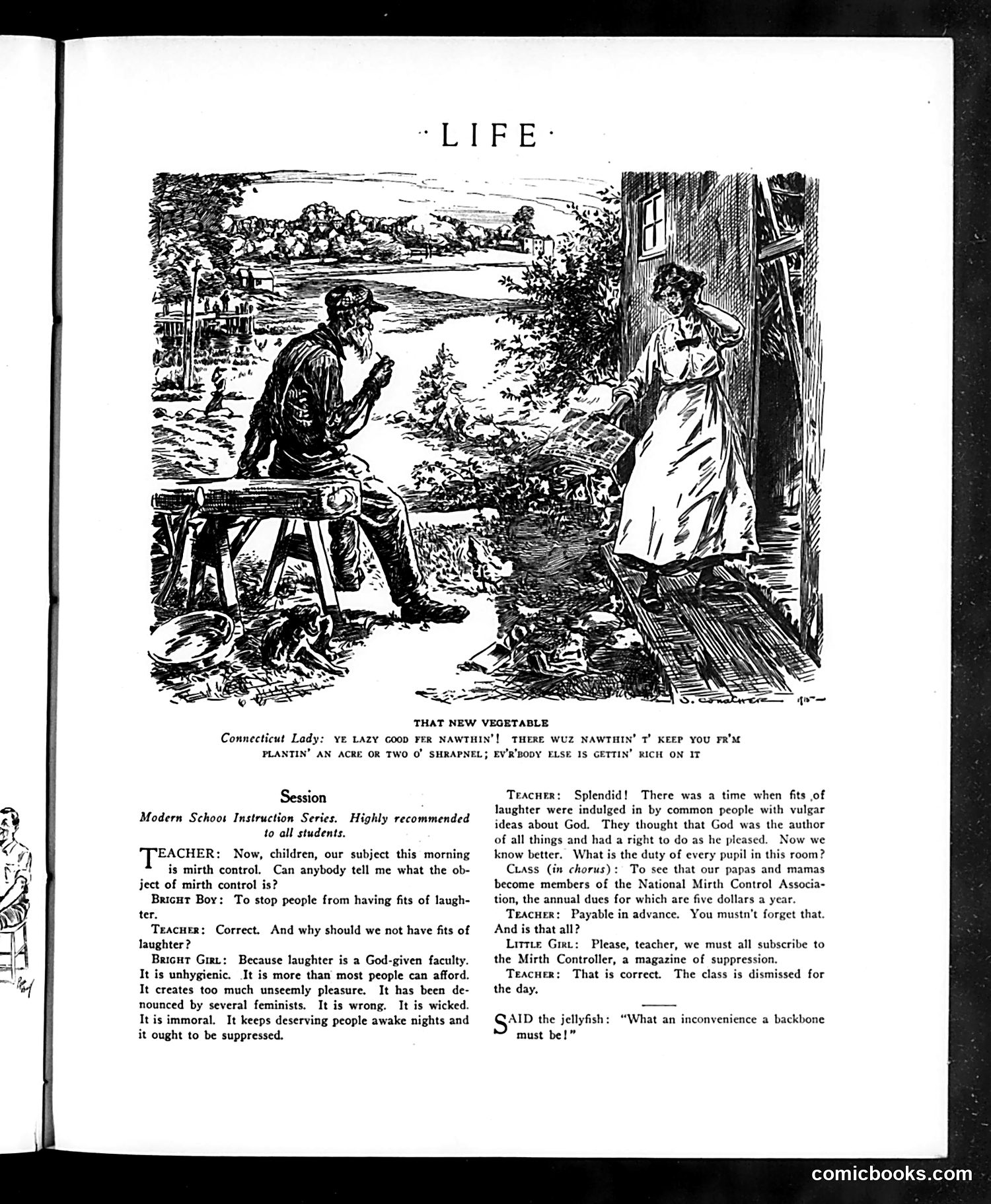
This page satirizes progressive "Modern School Instruction" on birth control. The cartoon depicts a teacher lecturing children about "mirth control"—suppressing laughter—while the dialogue reveals the absurdity: the teacher argues laughter is "unwigged" (uncivilized), "immoral," and "wicked," promoting a puritanical ideology. The accompanying text mocks this repressive approach, with a student character then describing subscribing to "The Birth Controller, a magazine of suppression." The final joke about the jellyfish's "inconvenience" as a "backbone" suggests the magazine itself (and its ideology) lacks spine. The page satirizes both prudish Victorian attitudes and emerging 1920s movements for sexual education reform, using absurdist humor to mock excessive censorship and moral prohibition.
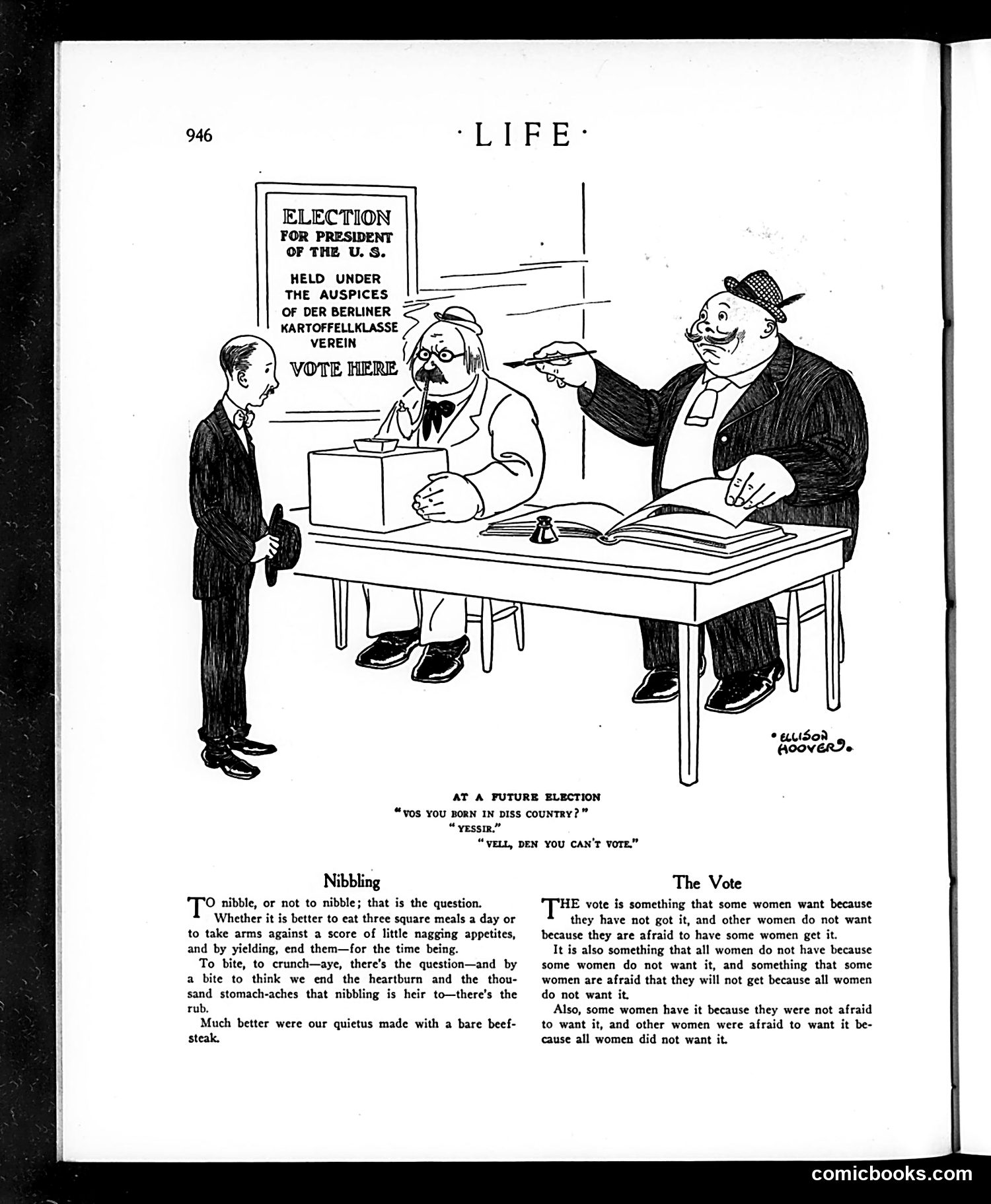
This Life magazine page contains a political cartoon mocking early 20th-century immigrant voting practices in America, specifically German immigrants ("Der Berliner Kartoffelklasse Verein"). **The cartoon** depicts a voting scenario where a young boy approaches an election table staffed by two men conducting a fraudulent or manipulated vote. The sign references a German organization, suggesting the satire targets German-American voting bloc influence or corruption. **The caption** presents a darkly humorous future scenario where a child asks if he can vote, but is told "you can't vote"—likely because he wasn't born in the country, satirizing restrictive voting rights and nativist concerns about immigrant participation. **Below are two separate columns** on "Nibbling" and "The Vote"—the latter discussing women's suffrage ambivalently, reflecting pre-19th Amendment attitudes toward female voting rights.
This page presents three literary contest entries from Life magazine's short story competition (closed October 4th). The page contains no political cartoons or caricatures—it's purely textual content featuring three stories: 1. **"The Recoil of the Gun"** by Marion Parker—a domestic drama where a woman shoots her husband in self-defense 2. **"Two Letters, a Telegram and a Finale"** by H.S. Haskins—correspondence depicting a revenge narrative involving an automobile accident and implied murder 3. A brief editorial note about another entry These appear to be dramatized, sensational stories typical of early-20th-century magazine fiction. There is no political satire present; this is a straightforward literary competition showcase page.
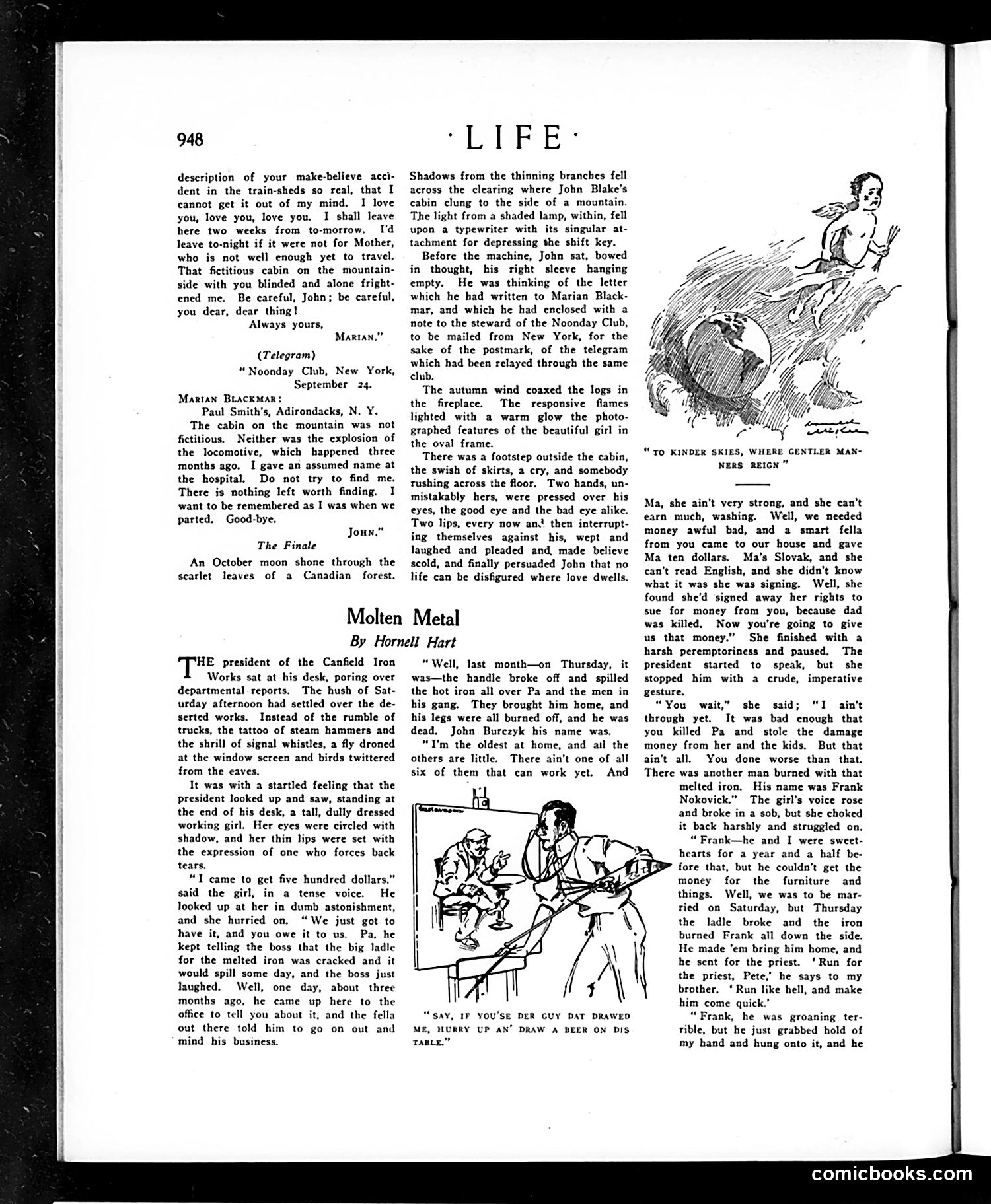
This page presents two distinct stories. **"The Finale"** is a sentimental romance about John Blake, a man with a missing arm (indicated by his "empty" right sleeve), who had faked his death to spare his beloved Marian from his disfigurement. The narrative climaxes when she finds him anyway, declaring that love transcends physical injury. The accompanying sketch shows a cherub-like figure, likely representing romantic idealization. **"Molten Metal"** by Hornell Hart shifts to social commentary. A working-class girl confronts an iron works president, demanding $500 in compensation for her father's death. Her father, John Burezyk, died when a cracked ladle of molten metal spilled on him—a hazard he'd repeatedly warned management about, which they ignored. The stark contrast between these stories appears intentional: the first romanticizes suffering and self-sacrifice; the second exposes industrial negligence and workers' vulnerability. The juxtaposition critiques how society sentimentalizes personal tragedy while ignoring systemic worker exploitation and preventable deaths caused by corporate indifference.
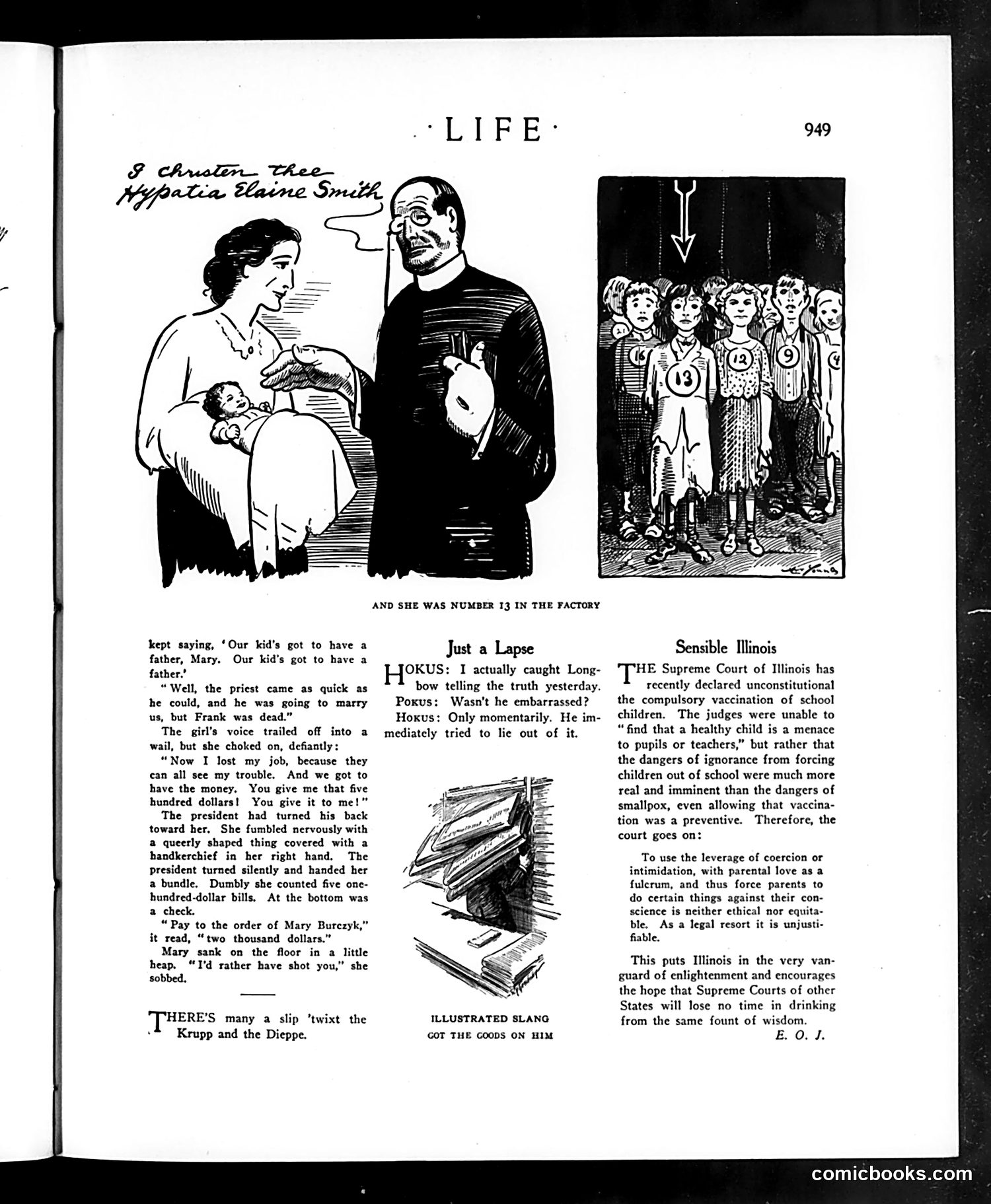
The page contains three distinct satirical pieces: **Left cartoon:** "I Christen Thee Hypocritia Elaine Smith" depicts a priest baptizing a child born out of wedlock. The accompanying story describes a desperate unwed mother confronting a powerful man (implied to be a political or business leader) who impregnated her boyfriend Frank, who died. She demands money; he pays her off. The satire targets wealthy men's exploitation of working-class women and the hypocrisy of religious institutions that shame illegitimate children while powerful men escape consequences. **Right cartoon:** Shows numbered children (one marked "13") in what appears to be a factory or work setting, satirizing child labor practices. **"Just a Lapse":** A brief joke about someone habitually lying. **"Sensible Illinois":** Praises Illinois's Supreme Court for striking down compulsory school vaccination requirements, arguing education's benefits outweigh disease risks—an early anti-vaccination stance. The page critiques class exploitation, religious hypocrisy, child labor, and supports medical freedom over public health mandates.
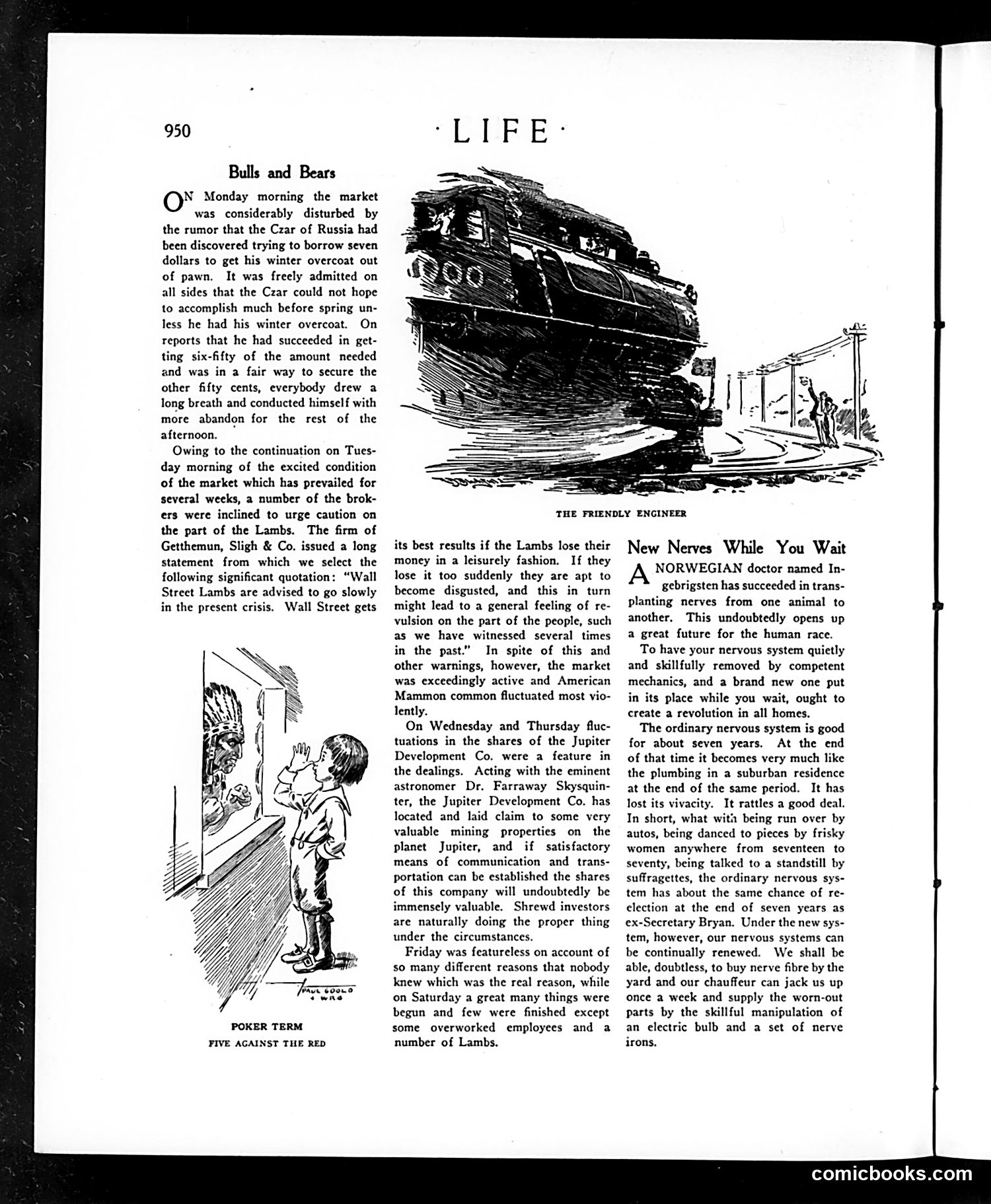
This page contains two distinct satirical pieces from Life magazine's "Bulls and Bears" financial humor section: **"Bulls and Bears"** mocks stock market speculation and investor psychology. It uses absurdist humor—like a rumor about the Russian Czar pawning his winter coat—to ridicule how easily markets respond to trivial news. The term "Lambs" refers to naive investors who are easily fleeced. The piece satirizes brokers encouraging cautious losses over sudden ones (to prevent public disgust) and the Jupiter Development Company scheme, which appears to be a fictional scam promising mining wealth from the planet Jupiter—mocking investors' gullibility toward obviously fraudulent ventures. **"New Nerves While You Wait"** is a humorous advertisement-style piece predicting that Norwegian nerve-transplant technology will revolutionize society. It satirizes both the obsession with medical "progress" and modern life's toll on nerves, mentioning automobiles, frisky women, and "suffragettes" (mocking women's rights activists) as sources of nervous exhaustion. The joke is that people will replace worn-out nerves like worn plumbing.
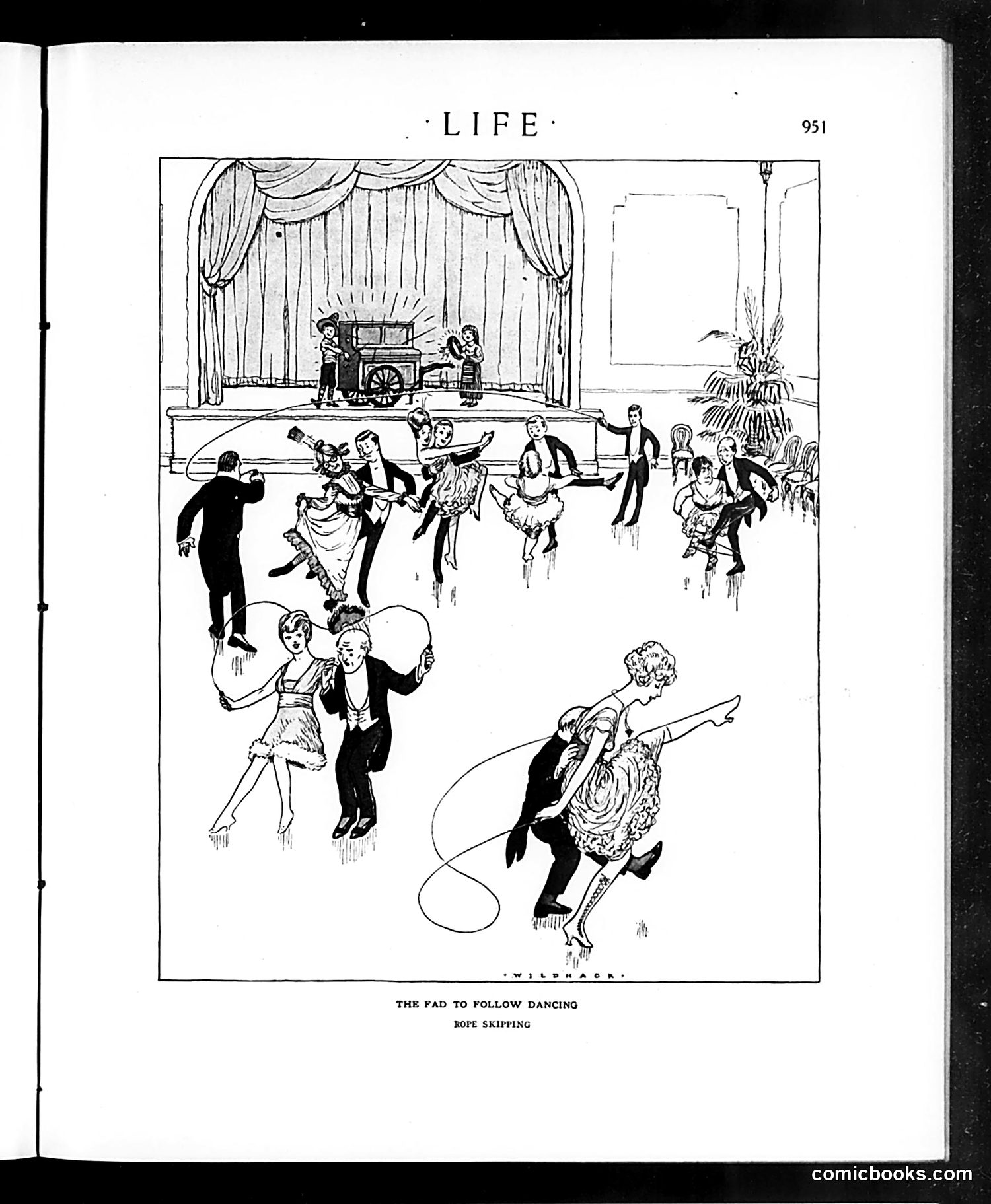
This illustration depicts a fashionable ballroom scene where well-dressed couples are engaged in rope-skipping rather than traditional dancing. The satire mocks a contemporary fad—apparently rope-skipping had become a trendy dance-floor activity among the social elite. The cartoon ridicules the absurdity of substituting children's playground games for conventional ballroom dancing at formal events. A stage with orchestra and curtains frames the scene, emphasizing the incongruity of this "fad." The elegantly dressed participants jumping rope, while musicians perform above, highlights how fashion-conscious society blindly adopts whatever novelty becomes popular, regardless of how silly or inappropriate it may be. The satire targets upper-class conformity and the fickleness of social trends.
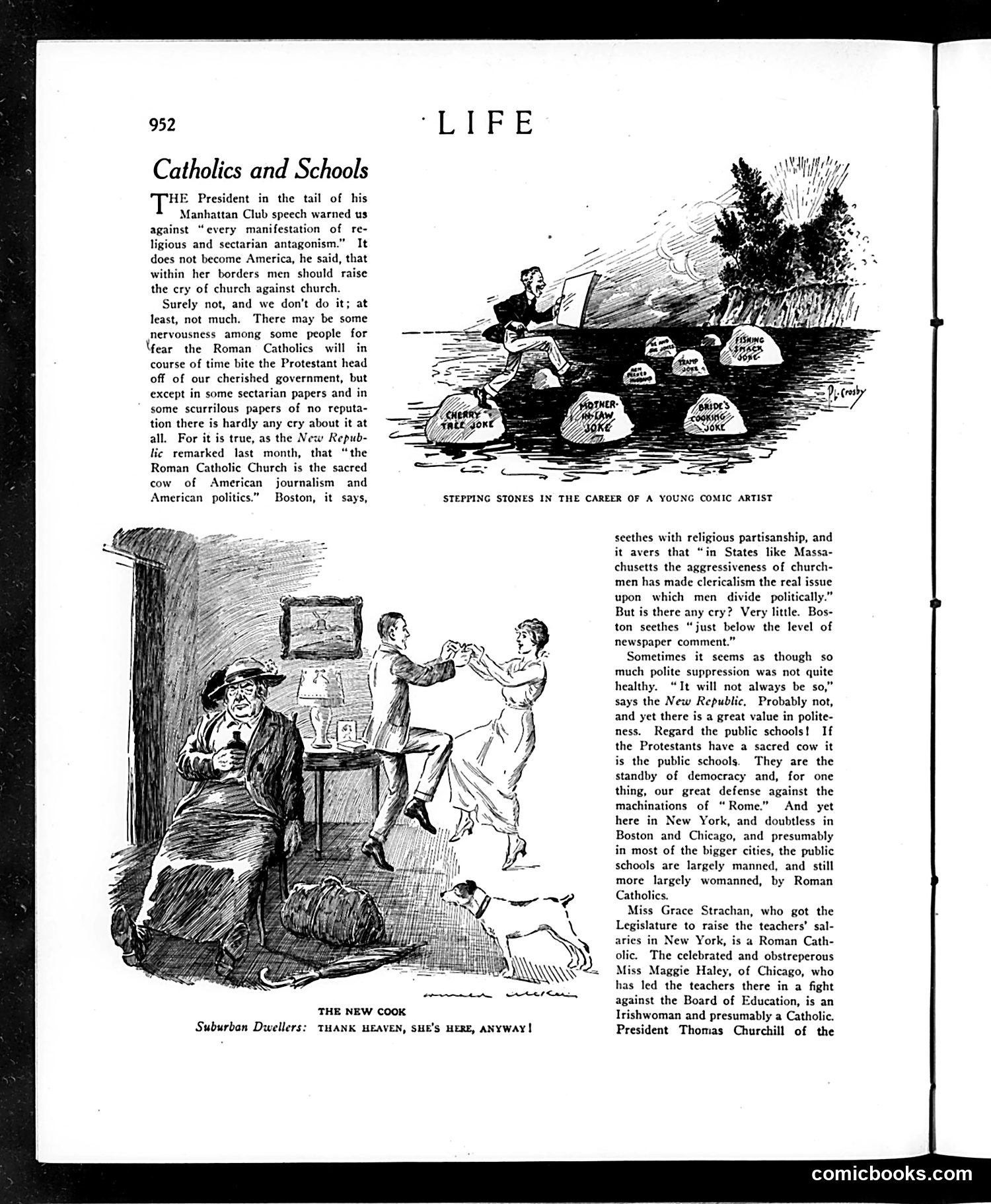
This 1920s *Life* magazine article satirizes American religious tensions, particularly Catholic-Protestant anxieties about public institutions. **The cartoons illustrate the article's ironic argument:** The top cartoon ("Stepping Stones") shows a young artist navigating obstacles labeled "Cherry Tree Joke," "Mother-in-Law Joke," "Bride's Bedroom Joke," etc.—depicting conventional comic material as career hurdles. The bottom cartoon ("The New Cook") shows suburban dwellers relieved to hire a cook, with the caption "Thank Heaven, she's here, anyway!" This likely references anxiety about Catholic immigrants (often Irish) entering traditionally Protestant-dominated American households and institutions. **The article's point:** Despite a President's warning against religious antagonism, Americans largely suppress discussion of real Catholic-Protestant divisions. Ironically, while Protestants fear Catholic influence on democracy through public schools, those very schools are staffed by Catholics like Grace Strachan and Maggie Haley—revealing the hypocrisy of polite silence about genuine sectarian tensions. The satire critiques both suppressed anxiety and institutional reality.
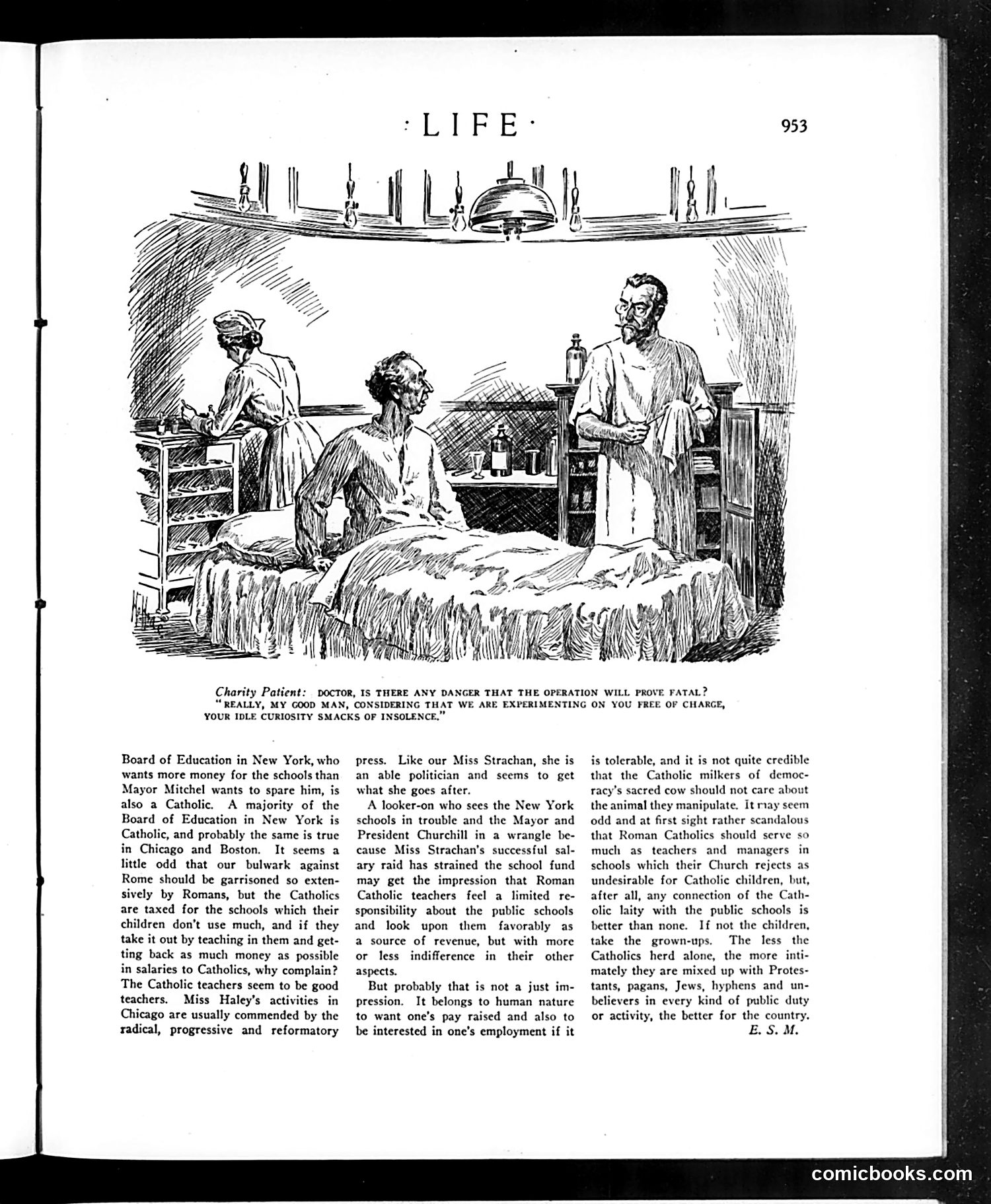
The cartoon depicts a doctor dismissing a charity patient's legitimate medical concern about experimental surgery with arrogant condescension—the joke being that the patient should be grateful for free (if dangerous) treatment rather than asking reasonable questions. The accompanying article addresses New York's Board of Education conflicts, specifically mentioning salary disputes led by Catholic educators (likely referencing activist teachers like Miss Haley and Miss Strachan). The text expresses ambivalence about Catholic dominance in public school administration, framing it as paradoxical: Catholics reject public schools for their own children yet aggressively advocate for teacher salaries within them. The article ultimately argues this is acceptable because Catholic involvement in public institutions promotes religious and ethnic integration ("mixed up with Protestants, pagans, Jews...") rather than Catholic isolation. The rhetoric reflects early 20th-century anxieties about Catholic institutional power and assimilation into American public life.
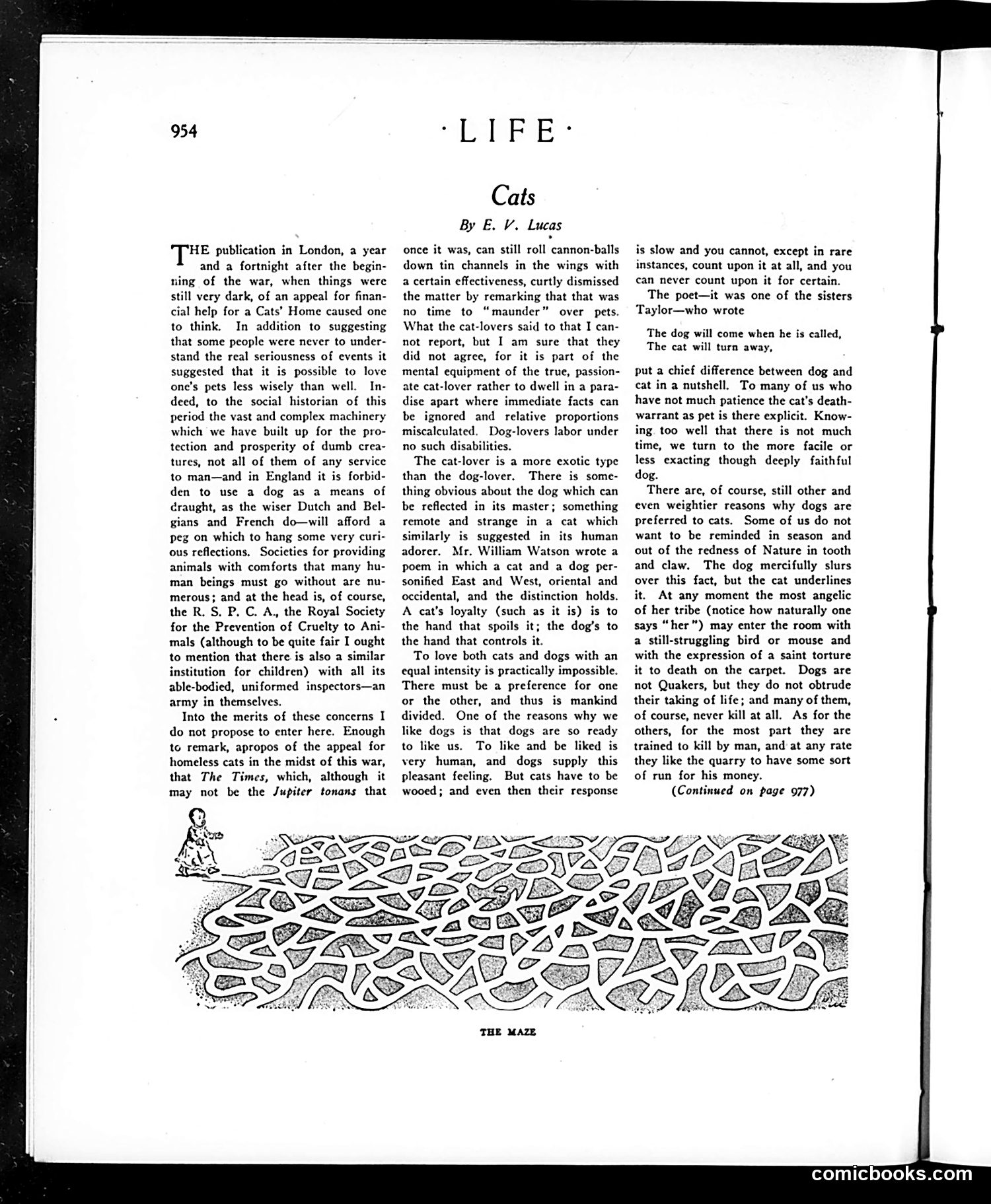
This is a literary essay, not a political cartoon. The illustration titled "The Maze" at the bottom appears decorative rather than satirical. Lucas discusses the British publication of a wartime appeal for a Cats' Home shelter during World War I. He uses this seemingly frivolous request (during serious wartime) to reflect on society's elaborate animal welfare systems—particularly the RSPCA (Royal Society for Prevention of Cruelty to Animals). The essay contrasts cat-lovers with dog-lovers: cats demand wooing and offer uncertain loyalty, while dogs provide reassuring, human-like affection. Lucas suggests cat-lovers inhabit a separate reality where they ignore practical concerns. He references a poem by a "sister Taylor" distinguishing dogs' responsiveness from cats' indifference. The underlying point satirizes how British society prioritizes animal comfort even amid war's darkness—a commentary on misplaced values rather than the animals themselves.
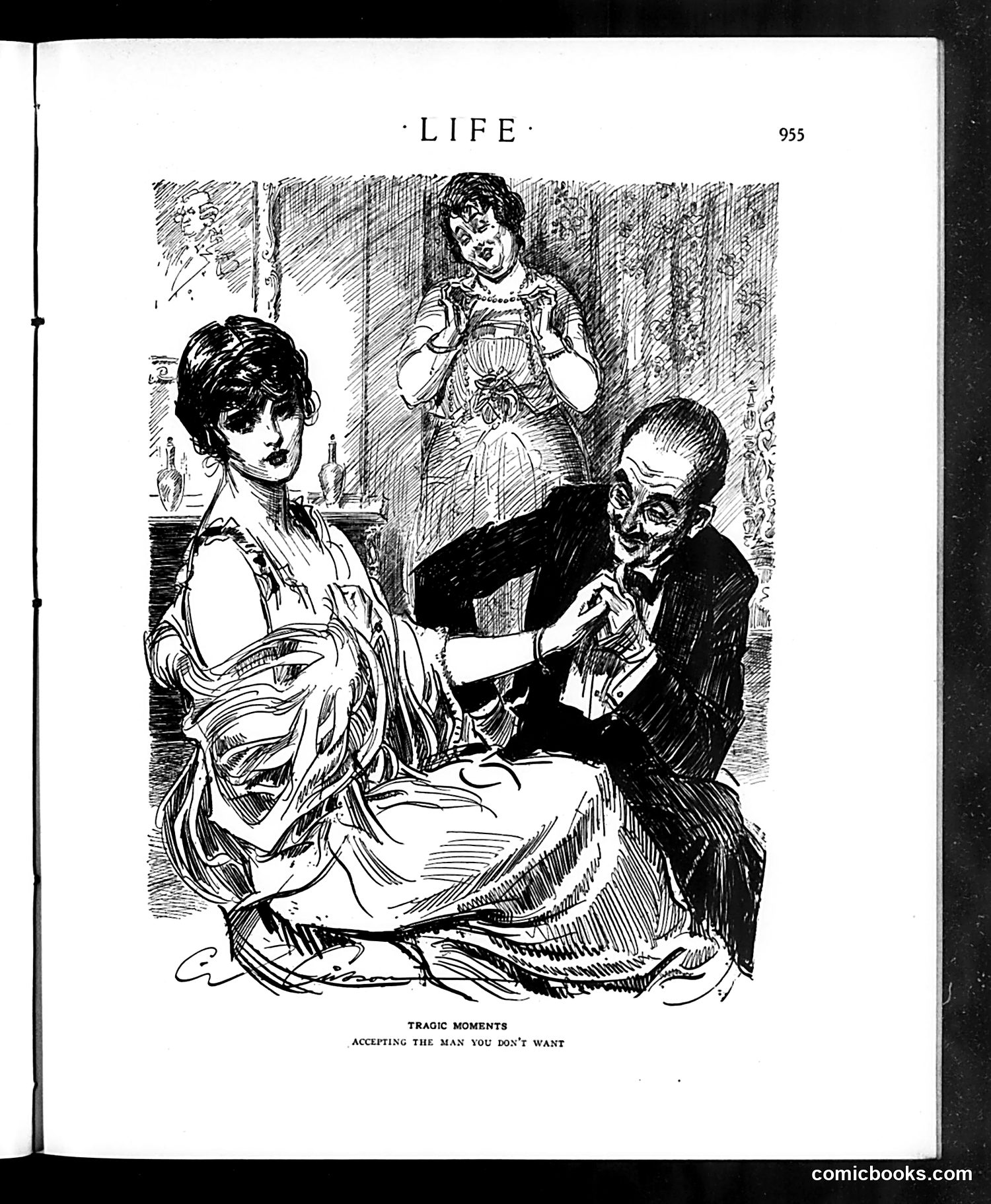
This is a satirical illustration from *Life* magazine depicting a social comedy about romantic acceptance. The cartoon shows three figures: a woman in elegant dress turning away (appearing uninterested), a poorly dressed or shabby man in dark clothing gesturing toward her, and a young girl in the background observing the scene. The caption "Tragic Moments: Accepting the Man You Don't Want" suggests commentary on women's limited romantic choices or social pressure to accept unsuitable suitors. The satire likely mocks either the desperation of rejected men or the social expectations forcing women into unwanted relationships—a common *Life* magazine theme addressing gender dynamics and courtship conventions of the early 20th century. The specific historical context remains unclear without additional dating information.
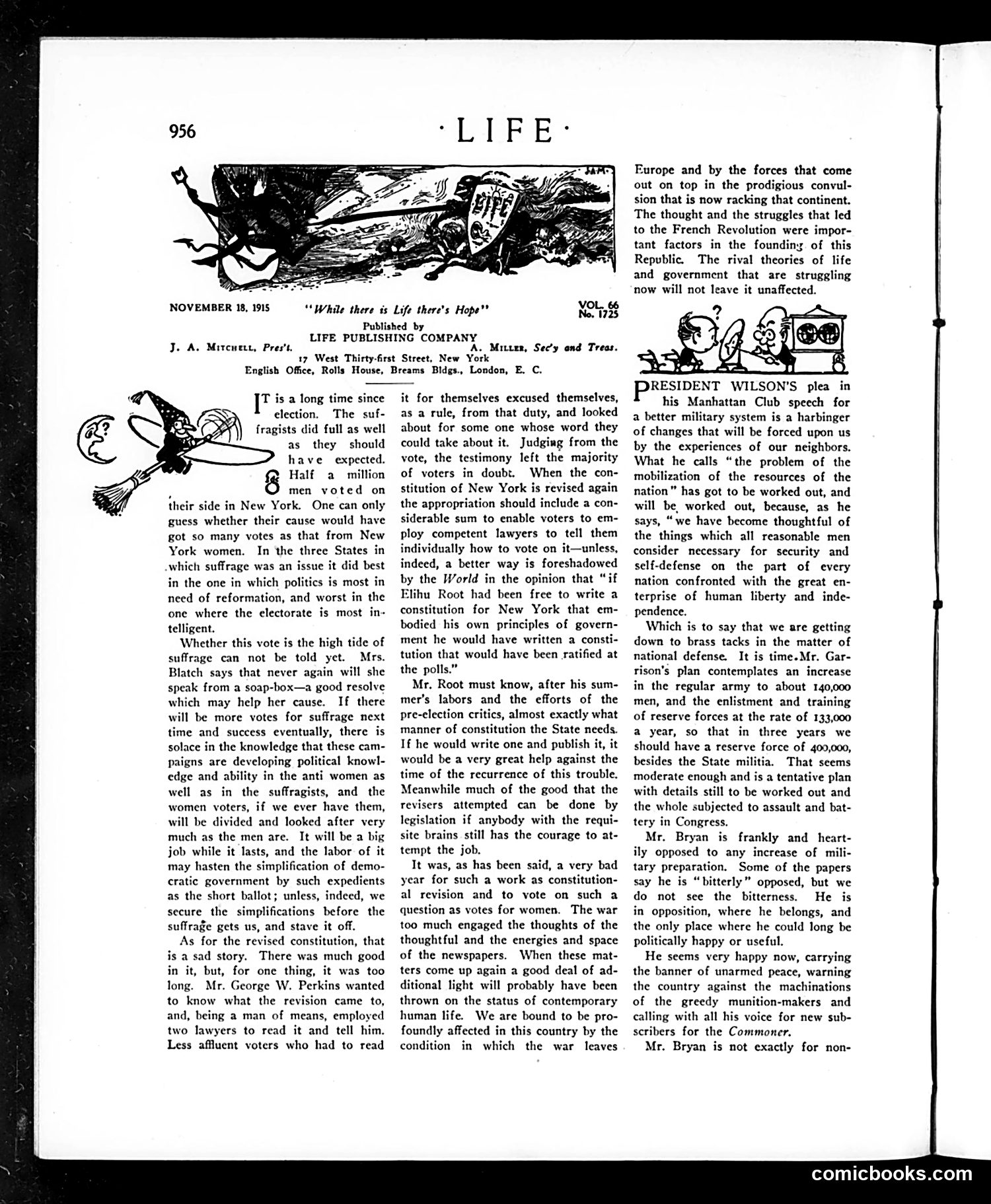
This page discusses recent voting results on women's suffrage and New York's revised state constitution. The left cartoon (artist unclear) depicts the suffrage debate with satirical imagery. **Key points:** The article notes that suffrage measures passed in three states, though the results were mixed. It criticizes voters' lack of engagement with the lengthy revised constitution—so complex that wealthy businessman George W. Perkins had to hire lawyers to explain it to him. Poorer voters simply guessed. The piece sarcastically suggests that future constitutional revisions should budget funds so ordinary citizens can afford lawyers to tell them how to vote, since the document was incomprehensible to the electorate. **Context:** This reflects 1915 debates over women's voting rights (suffrage was granted nationally in 1920) and public frustration with overly complex legal documents. The satire targets both voter apathy and the gap between rich and poor in accessing political information.
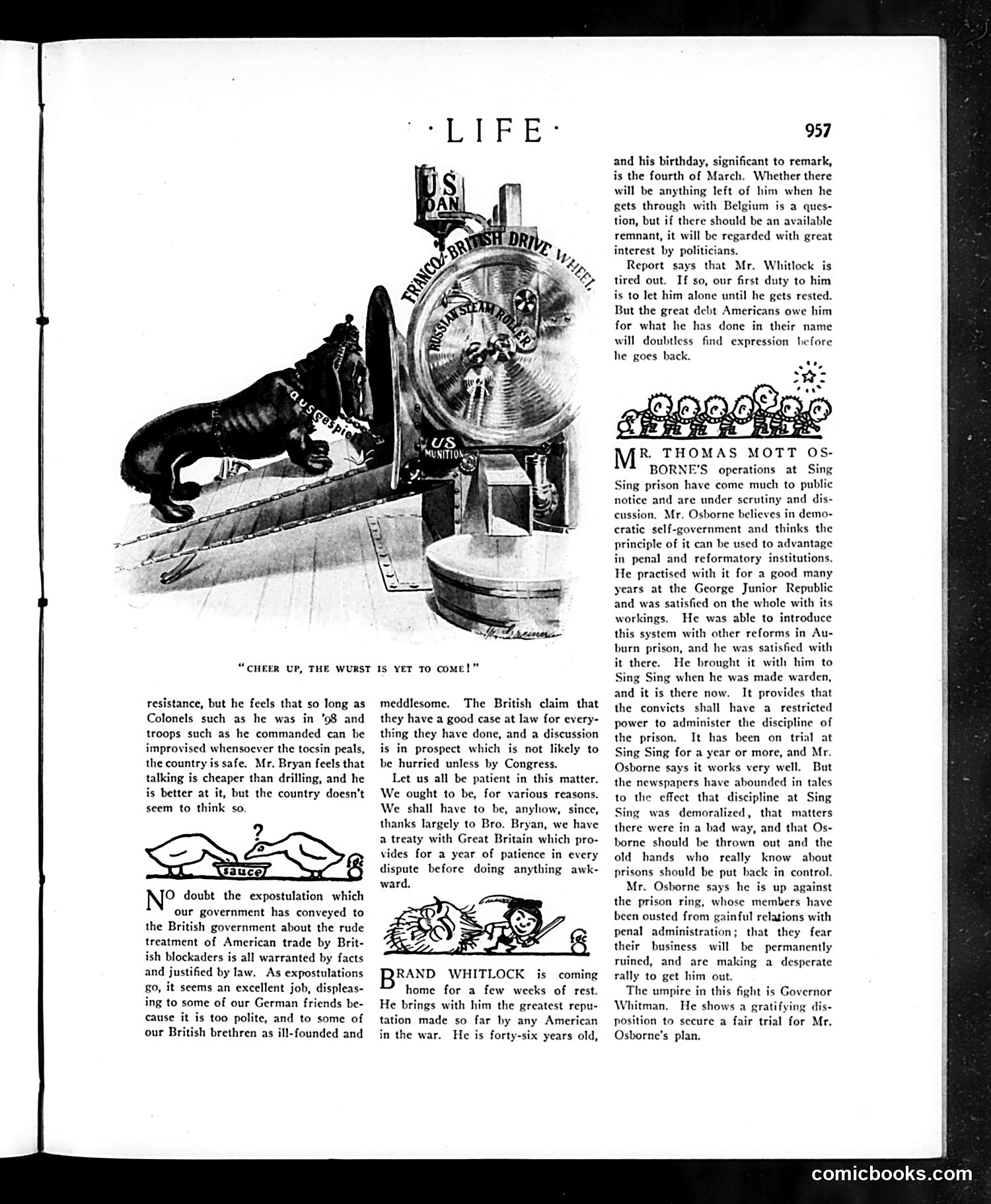
The main cartoon depicts a German sausage (labeled "WURST") being ground through a Franco-British drive wheel, with the caption "CHEER UP, THE WURST IS YET TO COME!" This is WWI-era satire celebrating Allied military pressure on Germany—suggesting German defeat is inevitable. The text discusses three figures: **William Jennings Bryan** (criticized for preferring talk over military preparedness), **Brand Whitlock** (U.S. minister to Belgium, praised for humanitarian work during the war), and **Thomas Mott Osborne** (prison reformer at Sing Sing who introduced democratic self-governance principles to inmates, now facing opposition from entrenched prison officials). The satire mocks Bryan's pacifist rhetoric while praising Whitlock's sacrifice and Osborne's progressive reforms. The overall tone reflects American WWI-era politics: preparedness advocates versus pacifists, and progressive reform versus institutional resistance.
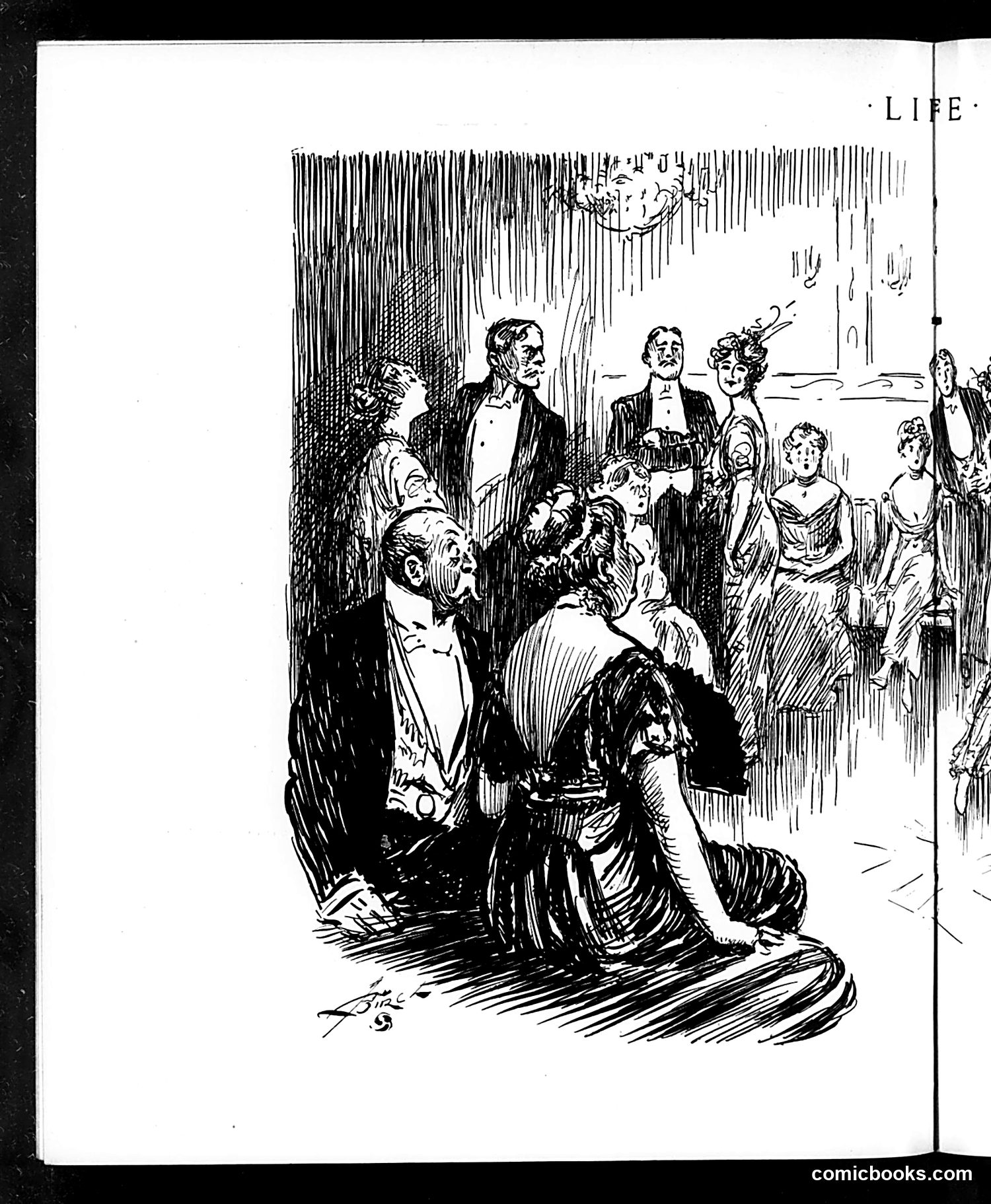
I can see this is a black ink sketch from *Life* magazine showing what appears to be a formal social gathering or ball scene. The drawing depicts elegantly dressed men in tuxedos and women in gowns at what seems to be an upper-class event, with detailed period clothing suggesting late 19th or early 20th century. However, without visible caption text or clearer identifying details in the image itself, I cannot definitively identify the specific figures being caricatured or determine what particular social or political situation this cartoon satirizes. The scene appears to mock high society or formal gatherings, but the specific satirical point remains unclear from the image alone. Additional context or caption text would be needed to accurately explain the intended satire to a modern reader.
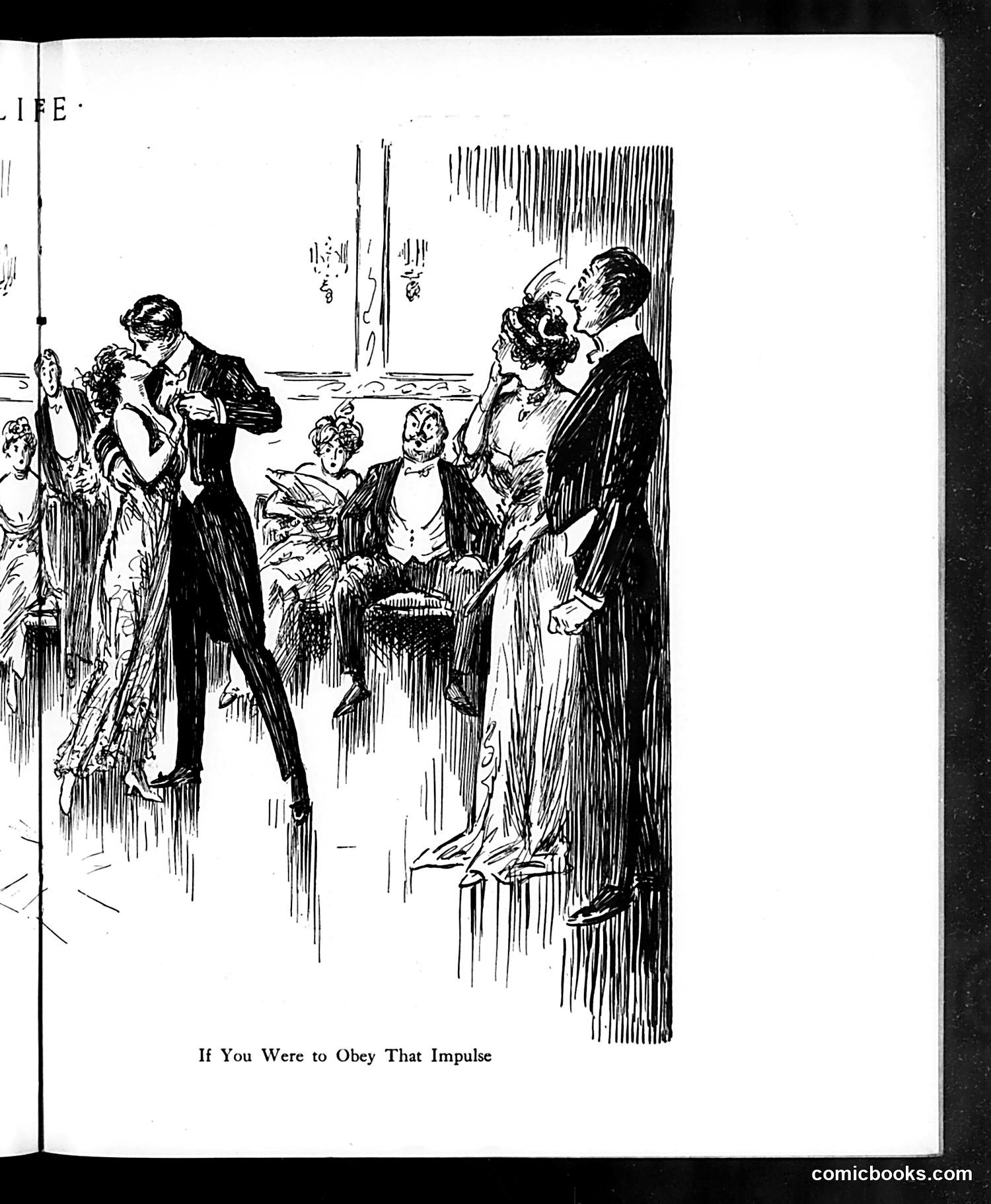
This cartoon depicts an elegant social gathering—a formal party with well-dressed men in tuxedos and women in evening gowns. The caption suggests a moment of temptation or improper desire. The satire appears to comment on social restraint versus impulse in high society. Without additional context, the specific "impulse" referenced is unclear from the image alone, though the formal setting suggests it involves either romantic/flirtation impropriety or some breach of social etiquette expected at such gatherings. The cartoon's humor lies in the contrast between proper Victorian/early-20th-century social conventions and the human desires lurking beneath formal dress and polite company. The exact social commentary—whether satirizing morality, class behavior, or something else—remains ambiguous without knowing Life magazine's date and editorial stance.
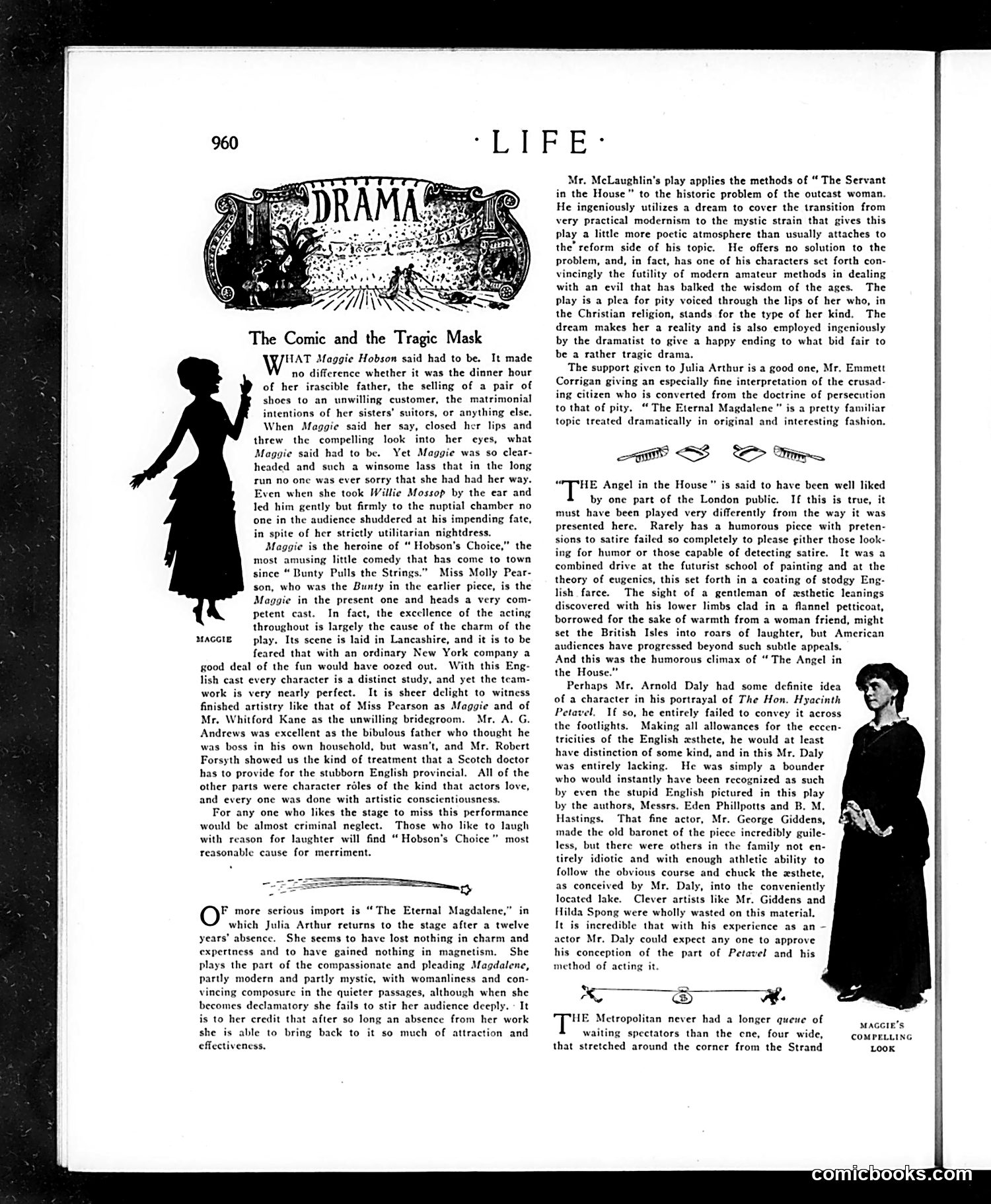
This page reviews two theatrical productions. The main illustration depicts **Maggie from "Hobson's Choice,"** a British comedy about a strong-willed Lancashire woman who dominates her household. The silhouette captures her "compelling look" mentioned in the text—her defining characteristic. The reviewer praises the English cast's excellence, particularly Molly Pearson's performance as Maggie and Whitford Kane as the reluctant bridegroom Willie Mossop, arguing the play's charm depends entirely on skillful acting. The second review concerns **"The Eternal Magdalene,"** starring Julia Arthur after a twelve-year absence. It addresses the "social problem" play genre—serious drama tackling moral issues like fallen women and redemption. The reviewer notes the play uses dream sequences to bridge modern realism with mystical elements, offering pity rather than solutions to social "evil." Both reviews emphasize *acting quality* and *theatrical craftsmanship* as paramount to successful drama, whether comic or tragic.
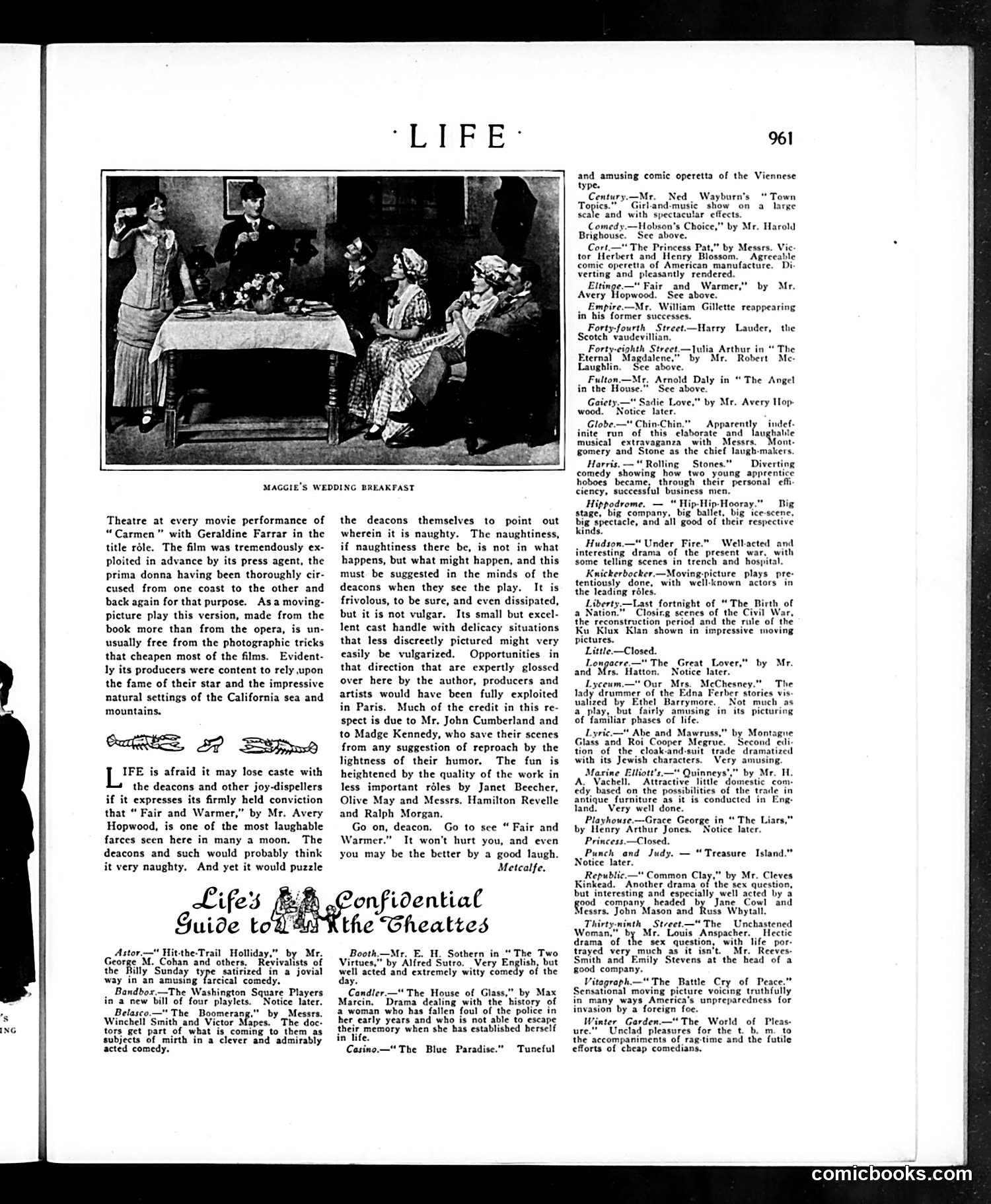
This page is primarily a **theatre review column** ("Life's Confidential Guide to the Theatres"), not a political cartoon. The photograph shows a scene from "Maggie's Wedding Breakfast," likely from a film or stage production. The main satirical content targets **moral hypocrisy**. Life's critic defends the farce "Fair and Warmer" as wholesome entertainment, despite expecting religious "deacons" to condemn it as immoral. The joke: the play's naughtiness exists only in viewers' *imaginations*—nothing explicitly vulgar occurs on stage. Life sarcastically suggests deacons themselves couldn't identify what makes it "naughty," implying their prudishness is baseless. The piece mocks **censorious moral guardians** of the era who objected to theatrical content, suggesting their objections reveal more about their own suspicious minds than the material's actual content. The critic invites disapproving clergy to attend, confident they'll actually enjoy it.
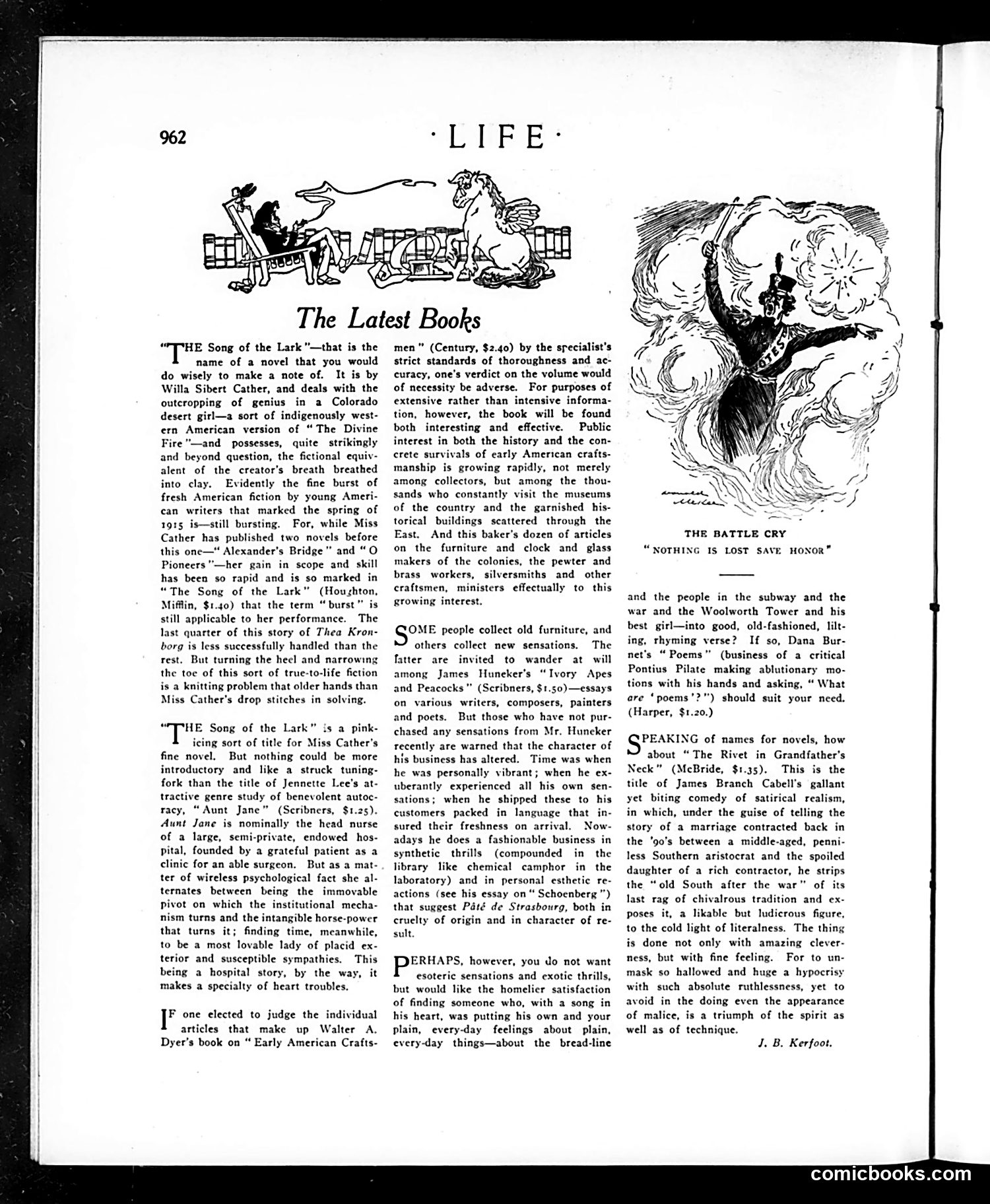
This is a book review section from *Life* magazine (page 962), featuring four novel and nonfiction recommendations from what appears to be 1915. The main illustrated cartoons at top and side are decorative vignettes typical of *Life*'s satirical style—showing figures in leisure activities—rather than political commentary. The reviews themselves discuss: 1. **"The Song of the Lark"** by Willa Cather—praised as exemplifying a "fine burst of fresh American fiction" about a talented Colorado girl 2. **"Aunt Jane"** by Jennette Lee—a hospital story examining an influential nurse's quiet power 3. **"Early American Craftsmen"** by Walter A. Dyer—a survey of colonial artisans and craftwork, noted as broad rather than deeply specialized 4. **"Ivory Apes and Peacocks"** by James Huneker—essays on writers and artists, with the reviewer noting Huneker's critical style has shifted from personal vivacity to manufactured "synthetic thrills" The page reflects *Life*'s role as an arbiter of contemporary literary taste for educated readers.
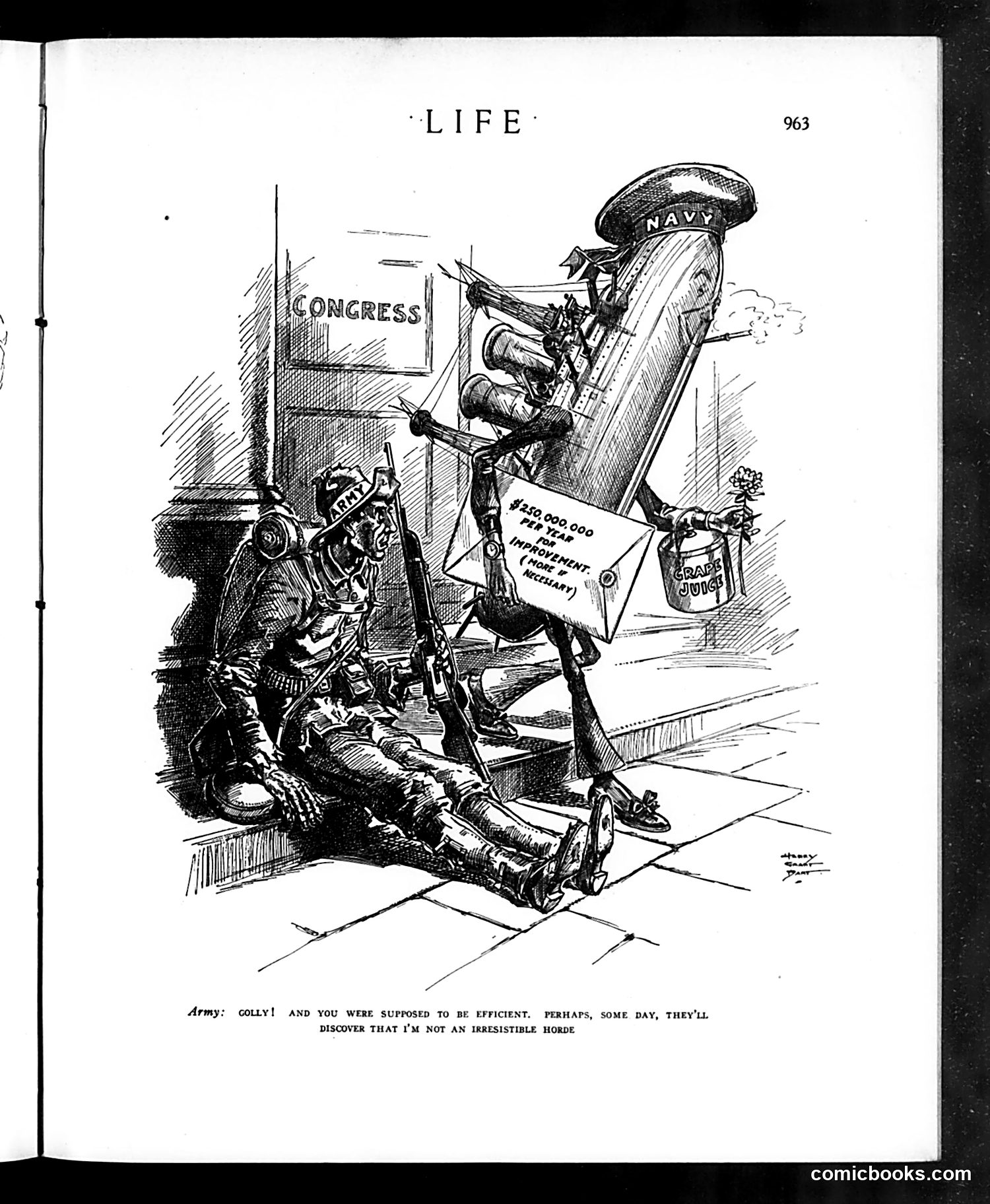
This political cartoon satirizes military inefficiency and bureaucratic dysfunction. A naval officer stands atop an overturned vessel labeled "Navy," while an Army figure lies defeated below. The scene includes a Congressional building in the background and documents referencing "$250,000,000 for [something] IMPROVEMENT (Most Necessary)." The satire critiques inter-service rivalry and waste: despite massive Congressional military appropriations, the armed forces remain inefficient and unable to coordinate. The Army character's complaint about not being an "irresistible horde" suggests the cartoon mocks both services for failing to live up to their supposed strength despite enormous taxpayer investment. The overall message: Congress keeps funding military expansion, yet institutional dysfunction prevents effectiveness—a commentary on wasteful defense spending and bureaucratic incompetence during what appears to be a pre-World War II period.
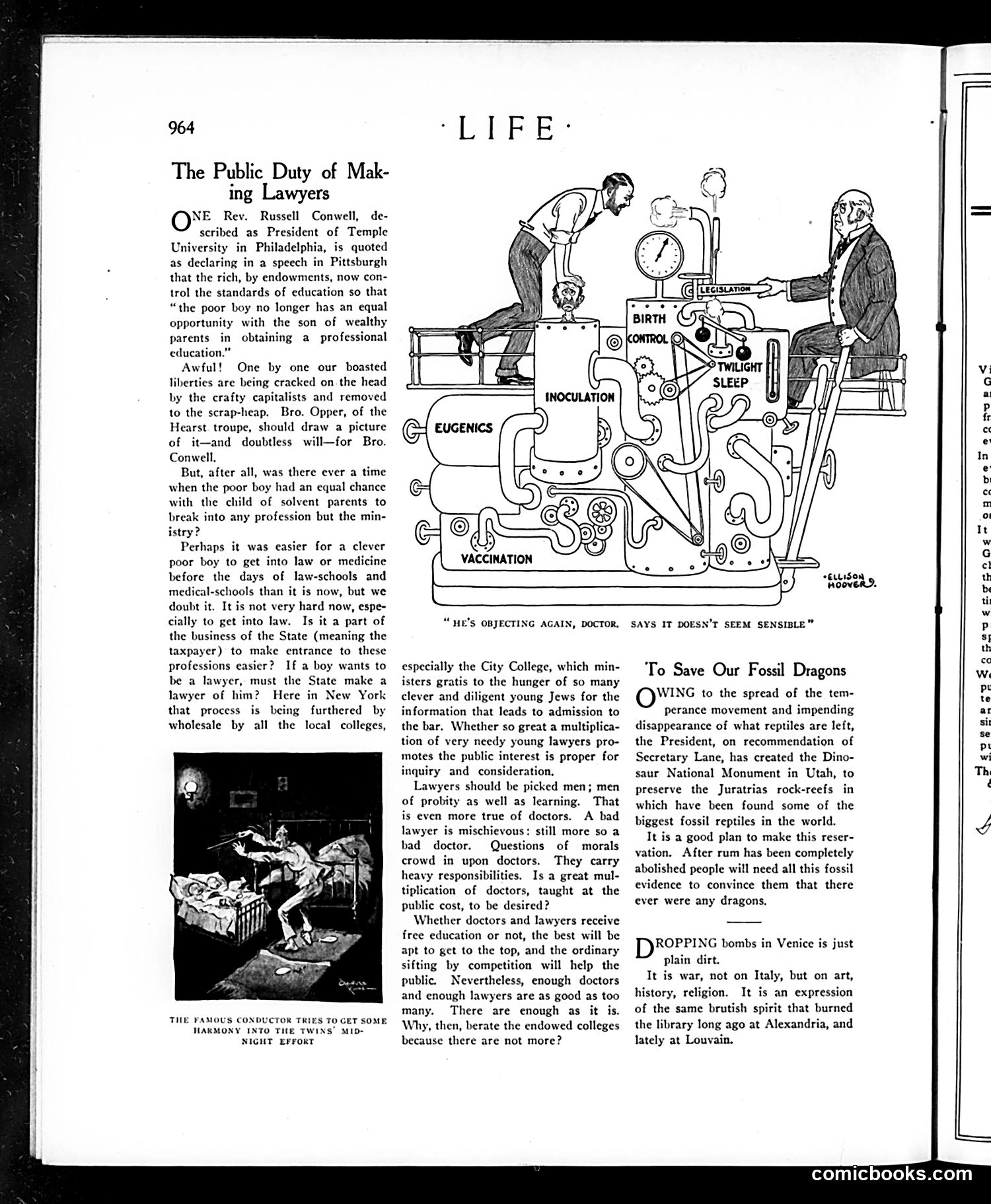
This page contains three distinct pieces of social commentary: ## "The Public Duty of Making Lawyers" A debate about whether the State should subsidize professional education. Rev. Russell Conwell (Temple University president) claims the rich control education standards, disadvantaging poor students. The editorial counters that poor boys never had equal access to professions anyway, and questions whether taxpayer-funded lawyer and doctor training serves the public interest. It specifically references New York City College providing free education to "clever and diligent young Jews" seeking bar admission—revealing period antisemitic anxieties about Jewish professional advancement. ## "The Famous Conductor" Cartoon Shows a conductor trying to impose harmony on quarreling twins during a "midnight effort"—likely satirizing domestic discord or conflicting policy goals. ## "Fossil Dragons" and "Venice Bombing" Brief items: one defends a dinosaur fossil preservation effort in Utah (humorously suggesting future generations will need proof dinosaurs existed after Prohibition ends); another condemns bombing of Venice as cultural destruction, comparing it to historical library burnings.
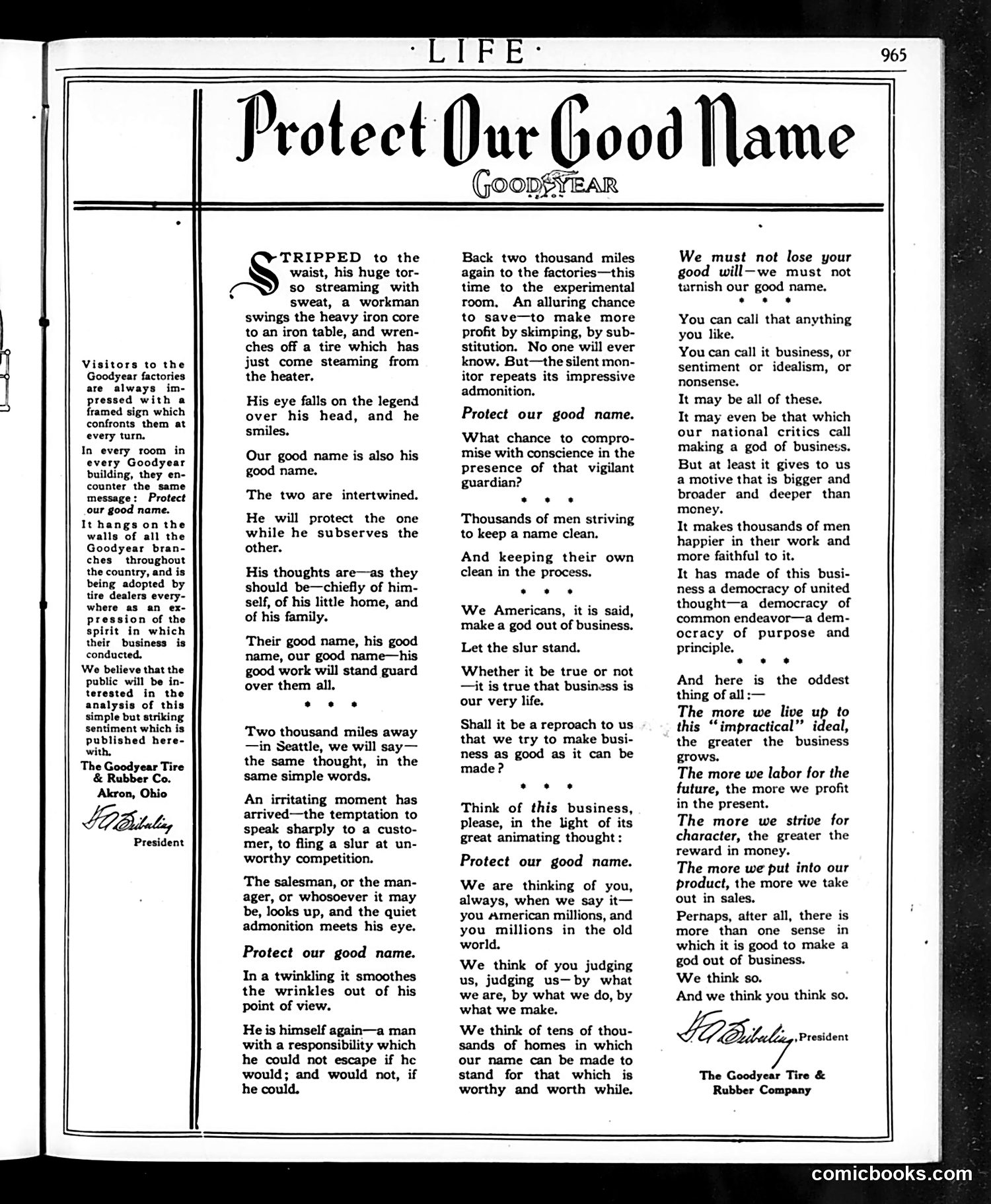
This is a **corporate advertisement**, not satire. The Goodyear Tire & Rubber Company uses this Life magazine page to promote its internal corporate philosophy: "Protect Our Good Name." The piece describes how Goodyear displays this slogan throughout its factories and offices to guide employee behavior—from factory workers resisting shortcuts to salesmen avoiding harsh language toward competitors. The company argues this isn't purely idealistic but pragmatically profitable: workers stay motivated, quality improves, and the brand strengthens. The rhetoric presents business as a quasi-moral enterprise where profit and principle align. Notably, the company frames this as distinctly American, appealing to readers' sense of national character and suggesting that ethical business practices are compatible with—even essential to—capitalist success. This reflects early 20th-century "corporate paternalism," where companies positioned themselves as moral communities, not merely profit-seeking entities.
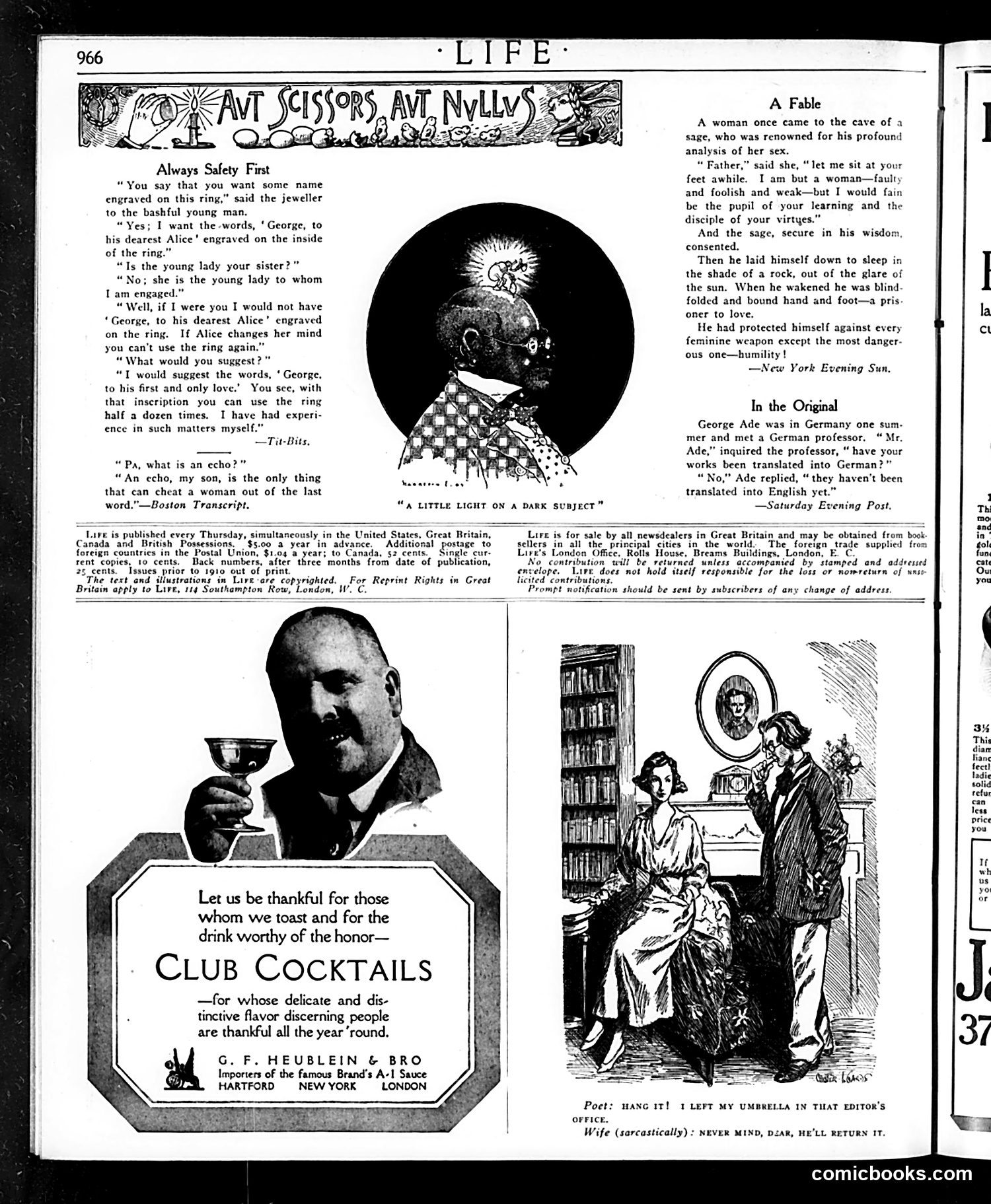
This page collects brief satirical pieces and jokes typical of Life's humor format: **"Always Safety First"** mocks romantic naiveté. A jeweler advises against engraving "George, to his dearest Alice" on an engagement ring, cynically suggesting "to his first and only love" instead—implying men commonly reuse rings across multiple engagements. The joke targets both male fickleness and the jeweler's mercenary worldview. **"A Fable"** presents misogynistic humor: a woman seeks wisdom from a sage but instead blindfolds and binds him, proving women's "most dangerous weapon" is false humility. It reinforces period stereotypes about feminine deception. **"In the Original"** is a self-deprecating joke attributed to writer George Ade, suggesting his work hasn't even been translated into English yet—implying its poor quality or obscurity. The **Club Cocktails advertisement** appears unrelated to the humor content. The bottom cartoon shows a wife sarcastically telling her husband he'll retrieve his umbrella from an editor's office—likely mocking the absent-minded intellectual or suggesting the editor will keep it.
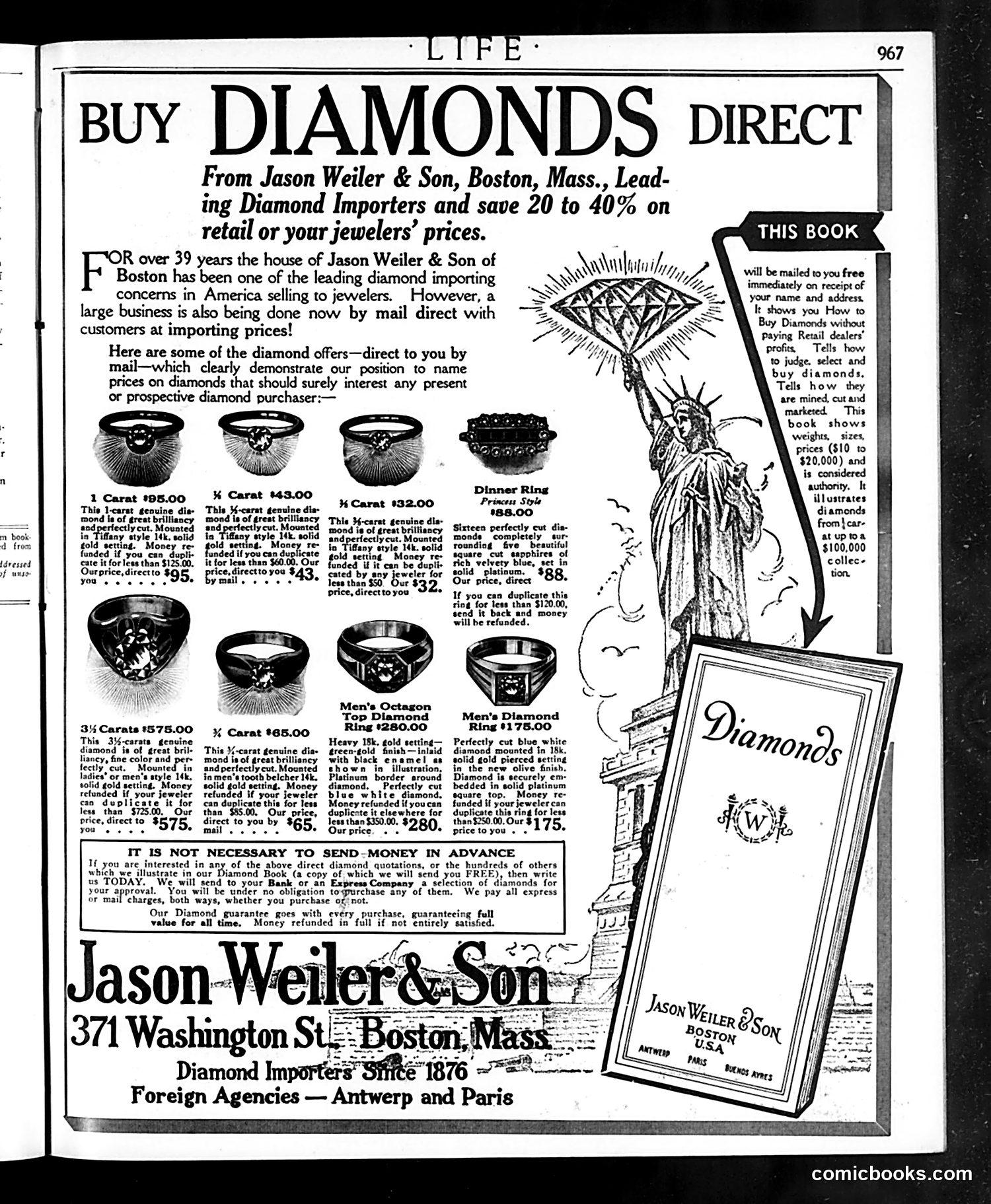
This is **primarily a diamond sales advertisement**, not political satire. Jason Weiler & Son, a Boston diamond importer established in 1876, is marketing direct-to-consumer diamond sales via mail order. The "joke" or sales pitch is the claim to undercut retail jewelers by 20-40% by eliminating middlemen. The illustrated diamonds show various cuts and settings (1-carat through 3½-carat stones, men's rings, dinner rings). The accompanying book offer promises to educate buyers on diamond grading and pricing ($10-$20,000 range), positioning the company as a trustworthy "authority." **Context for modern readers:** This represents early mail-order commerce and direct-to-consumer marketing—somewhat revolutionary for the 1920s-30s era. The ad's reassurance ("no money in advance," "money refunded if not satisfied") suggests customers were skeptical about buying expensive goods by mail from strangers, a significant sales barrier before internet commerce normalized such transactions.
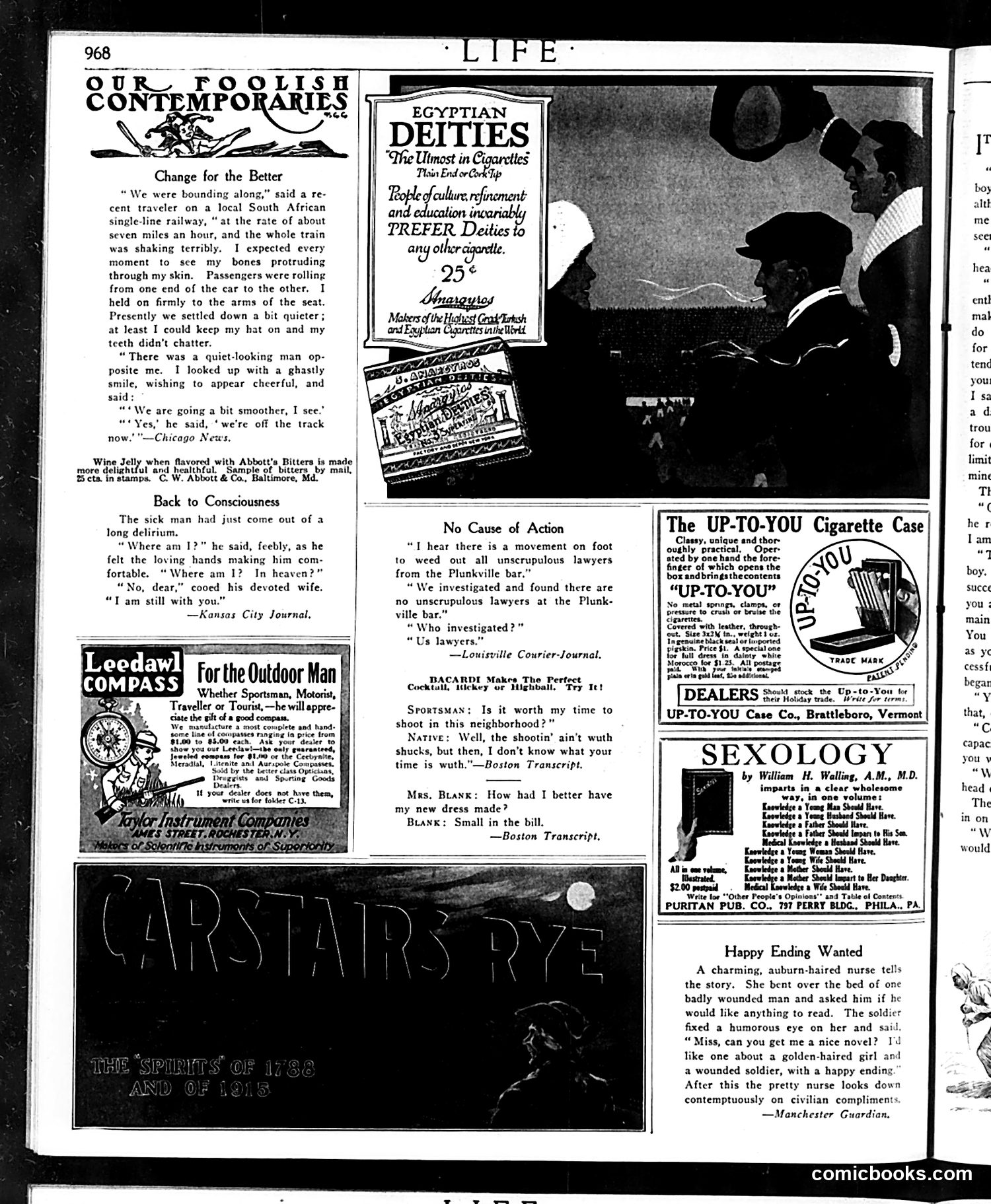
This page is primarily **advertising and humor columns** rather than political satire. The content includes: **Humor Pieces:** - "Change for the Better": A joke about a South African train so poorly maintained that passengers only feel relief when it derails - "Back to Consciousness": A sick man's wife jokes that his delirium made him think he was in heaven, but he's still with her - "No Cause of Action": Lawyers investigate removing corrupt lawyers from their bar, finding none exist—because the lawyers investigating are themselves corrupt - Several other brief jokes about sports, fashion, and romance **Advertisements:** Multiple product ads for cigarettes (Egyptian Deities, UP-TO-YOU Case), compasses (Leedaw), liquor (Bacardi), and books (Sexology). **The Satirical Point:** The humor relies on irony and wordplay rather than political commentary. The lawyer joke is the closest to social satire—mocking the legal profession's self-regulation. The "happy ending" piece gently satirizes readers' romance preferences. This appears to be a typical 1920s Life magazine page mixing light entertainment with commercial content.
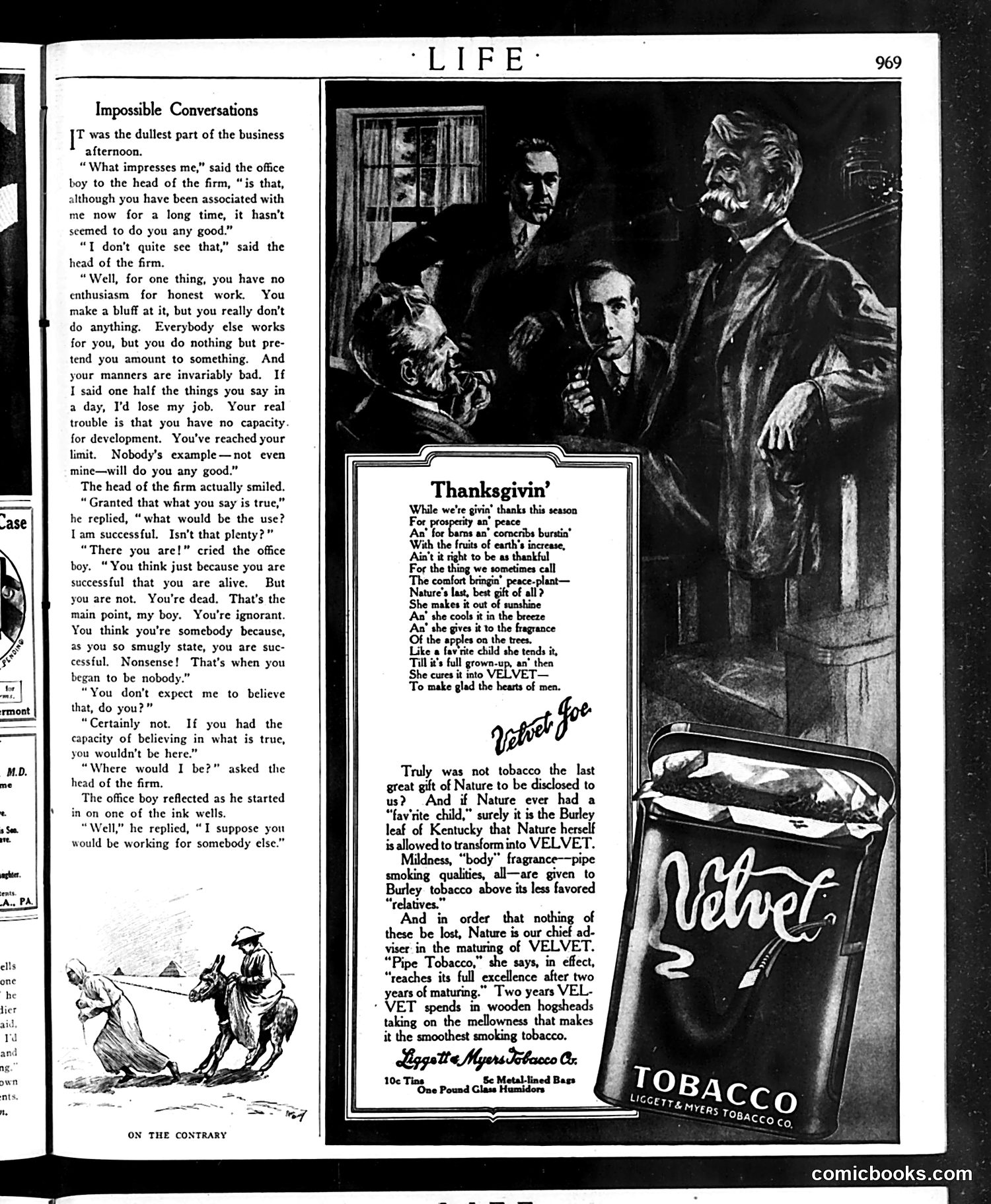
**The Satire ("Impossible Conversations"):** An office boy audaciously lectures his employer, the head of the firm, on his worthlessness. The boy claims the boss is "dead"—successful financially but spiritually and intellectually defunct, incapable of growth, and only pretending to matter while others do the real work. The humor lies in the role reversal: a subordinate speaks with brutal honesty that would cost him his job, yet the boss listens. The "impossible conversation" is one where truth-telling destroys social hierarchy. **The Advertisement:** Velvet Tobacco dominates the right side, featuring a Thanksgiving poem celebrating tobacco as "Nature's last, best gift." It emphasizes the Burley leaf's superiority and aging process (two years in wooden hogsheads for smoothness). **Context for Modern Readers:** The juxtaposition is ironic: the satire mocks empty success and pretense while advertising sells tobacco through appeals to natural wholesomeness and family values—itself a form of pretense. Both pieces reflect 1920s attitudes about work, authenticity, and consumerism.
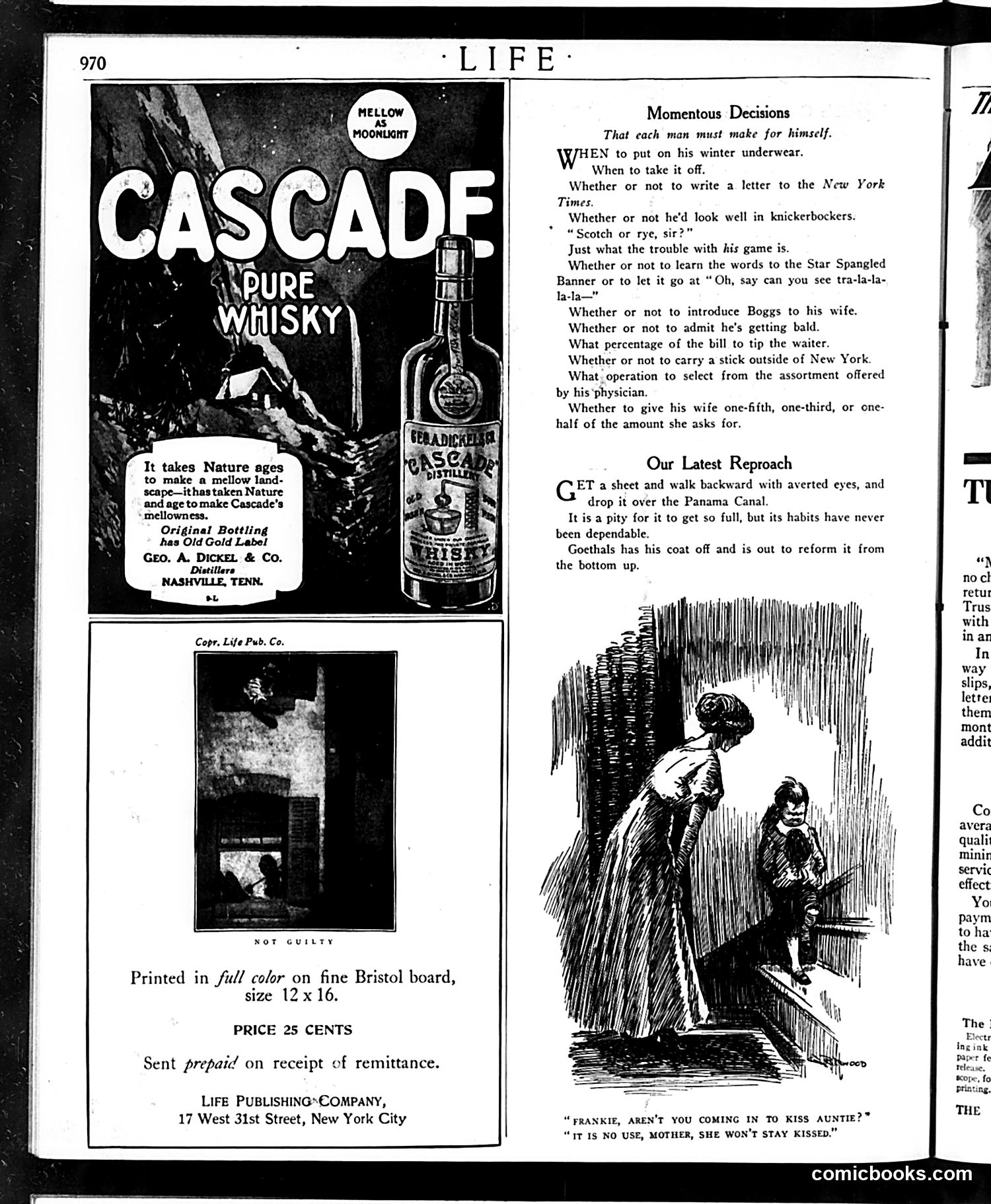
This page contains two distinct pieces of satire: **Left side:** A Cascade whisky advertisement with a humorous accompanying illustration labeled "Not Guilty." The ad uses an evocative landscape image to sell the product's "mellowness." **Right side:** Two satirical pieces: 1. **"Momentous Decisions"** lists trivial, mundane choices men face daily—from underwear timing to how much to tip waiters to marital financial negotiations. The satire mocks how men agonize over petty matters. 2. **"Our Latest Reproach"** sarcastically critiques the Panama Canal's poor condition, suggesting it's so filthy it should be covered with a sheet. It references Goethals (the canal's chief engineer) attempting reforms "from the bottom up"—implying systemic corruption or mismanagement. The joke suggests the canal project, despite being a modern engineering marvel, had become a source of embarrassment for American competence and management. The bottom cartoon depicts a child refusing to kiss an aunt, satirizing stubborn childhood behavior.

This is **not a cartoon or satire** — it's a straightforward advertisement for office equipment, specifically the Multigraph copying/printing machine. The page showcases how the American Security and Trust Company of Washington used Multigraph equipment to reduce costs by over $915 in ten months. The accompanying table demonstrates monthly savings across different printing metrics (letterheads, deposit slips, etc.). The "point" is purely commercial: the ad argues that businesses of any size can profitably use this compact, operator-friendly machine. It emphasizes low risk (20% down payment, easy terms) and high quality output for routine office forms — letterheads, checks, reports, and circular letters. The silhouetted figure at the left is simply an **operator using the equipment**; there are no political figures or satirical caricatures present. This is a standard early 20th-century trade advertisement designed to convince business managers that the Multigraph would pay for itself through increased efficiency.
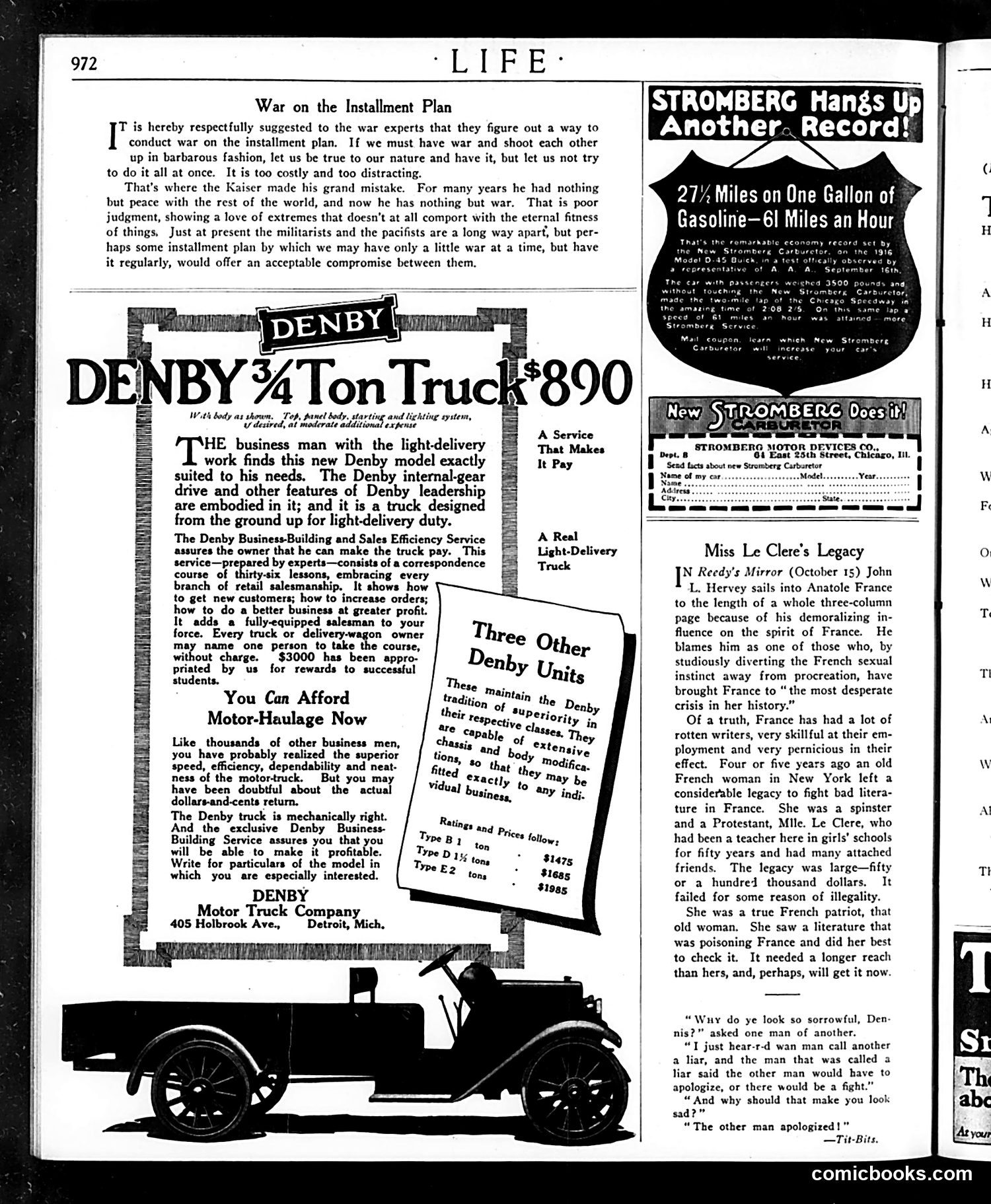
This page contains a political satire and period advertisements from Life magazine (circa WWI era). **The Satire:** The opening essay "War on the Installment Plan" mocks the escalating costs and disruption of World War I. The author suggests ironically that nations should wage "installment war"—small, regular conflicts rather than total war—as a compromise between militarists and pacifists. This is absurdist satire criticizing the war's scale and expense while ridiculing both warmongers and peace advocates for their extremism. **The Advertisements:** The page is dominated by truck and automobile ads typical of the period, including Denby Motor Trucks and Stromberg Carburetors. **The Essay "Miss Le Clere's Legacy":** This piece critiques French writer Anatole France for allegedly corrupting French morality, then ironically notes that a wealthy American spinster actually left money to fight "bad literature in France"—underscoring the perceived cultural threat of French influence on American values. Overall: period-specific commercial content mixed with contemporary cultural anxiety about war, literature, and moral influence.
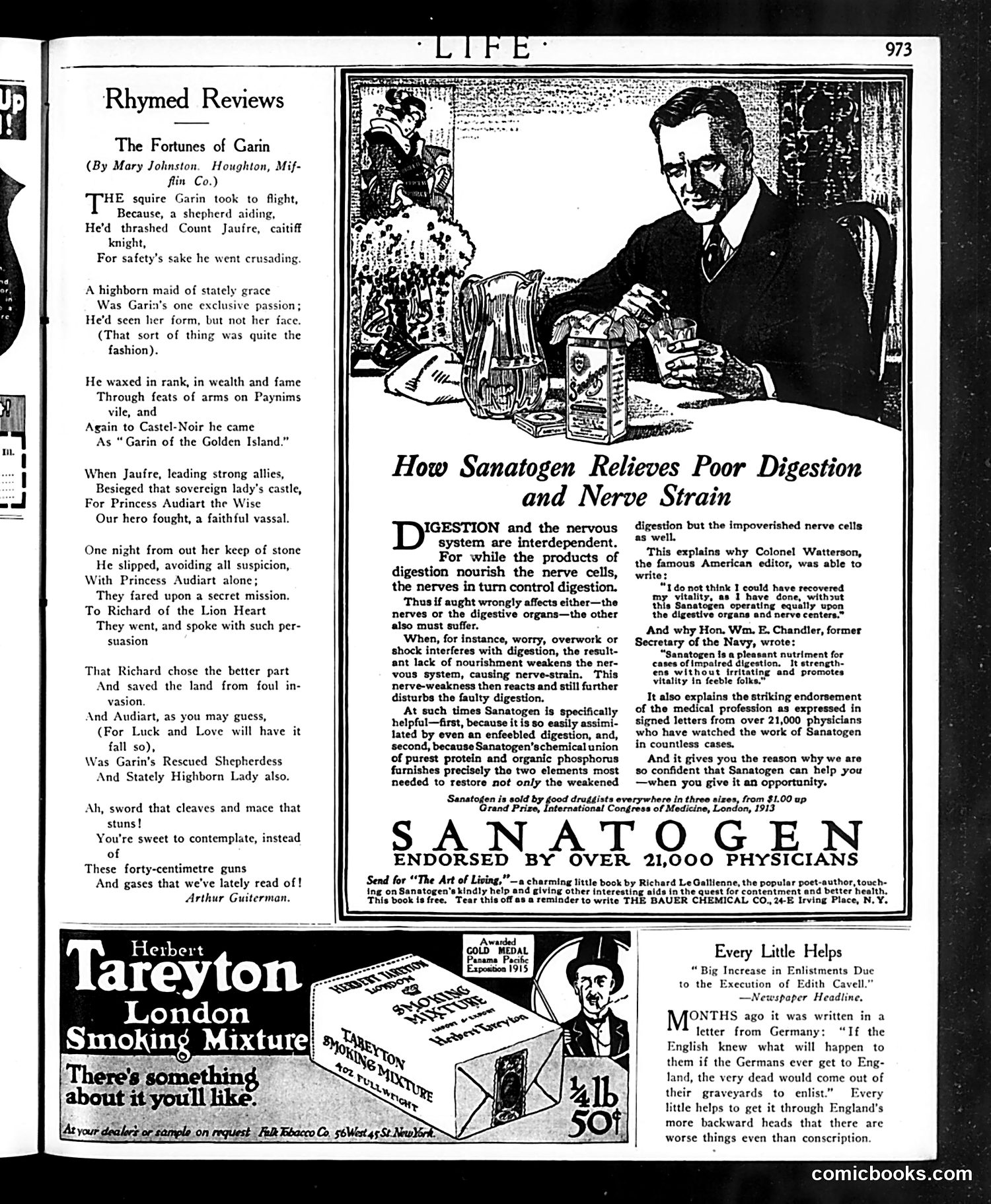
This page contains three distinct elements: **Left side:** A humorous rhymed book review of "The Fortunes of Garin" by Mary Johnston, summarizing a medieval romance plot involving crusades, knights, and a rescued noblewoman. It's lighthearted literary satire. **Center:** A large advertisement for Sanatogen, a patent medicine claiming to cure digestive problems and "nerve strain" through protein and phosphorus. It includes endorsements from Colonel Watterson (editor) and other notable figures—typical early-20th-century medical advertising making dubious health claims. **Right side:** A brief item titled "Every Little Helps," referencing a newspaper headline claiming that executions (specifically mentioning Edith Cavell, the British nurse executed by Germany in 1915) increased military enlistments. This appears to be satirical commentary on wartime propaganda. The page reflects WWI-era concerns: militarism, questionable medical products marketed to stressed populations, and propaganda effectiveness—all presented within Life's satirical framework.
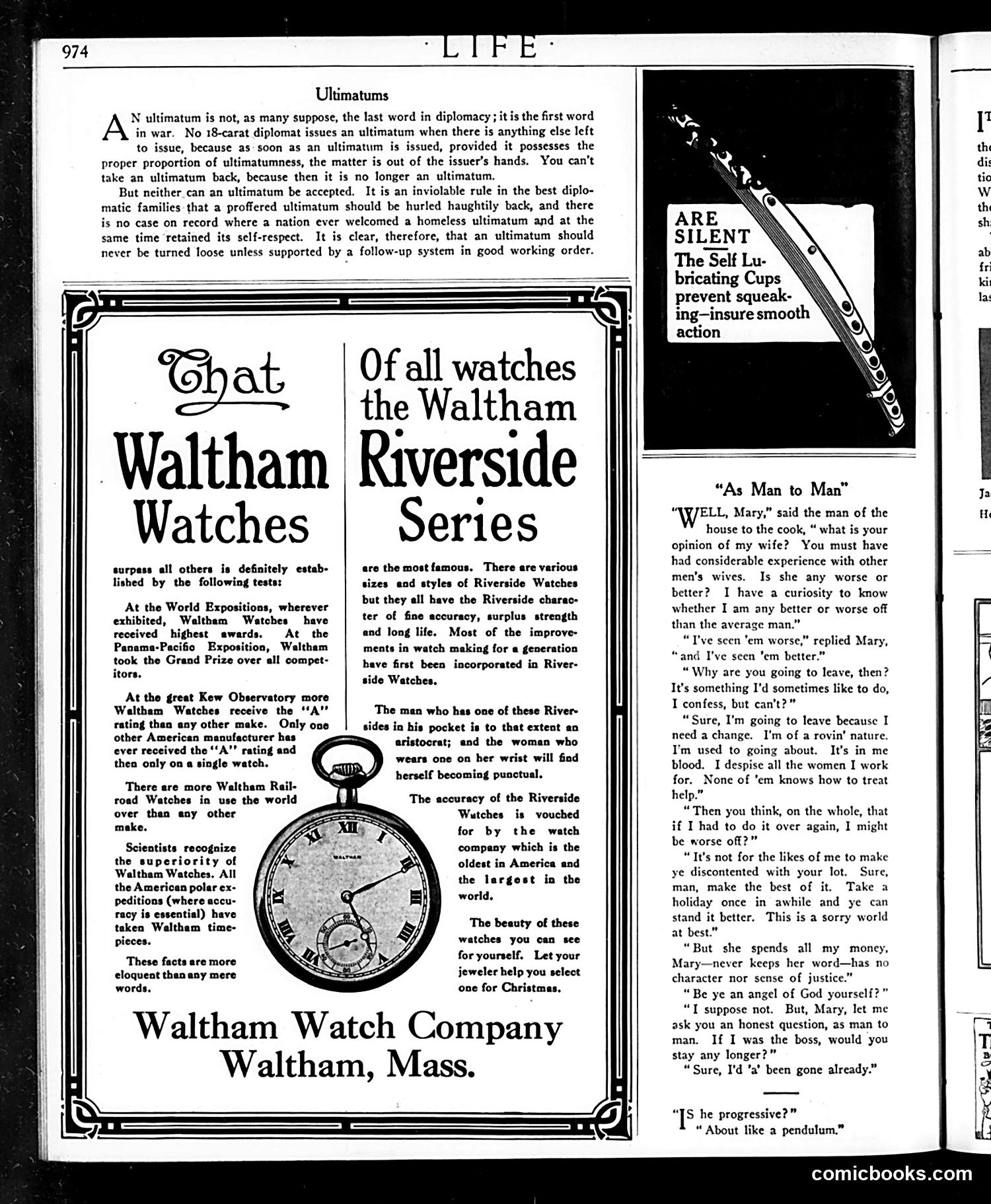
This page contains two unrelated sections: a political editorial on diplomacy and period advertisements. **"Ultimatums" Editorial**: The text argues that in warfare, an ultimatum is paradoxically both the *first* word (not the last) in diplomacy. Once issued, it cannot be retracted or accepted without loss of face. The author asserts nations should never issue ultimatums without a "follow-up system"—essentially, military backing. This reflects early 20th-century thinking about international relations and the binding nature of formal diplomatic demands. **Advertisements**: The page features two ads—one for Waltham Watches emphasizing precision and awards, and a lubricating cups product. These are straightforward commercial appeals, not satirical content. **"As Man to Man" Dialogue**: A humorous exchange between a householder and his cook (Mary) about his wife. The cook delivers blunt, working-class wisdom: his wife isn't uniquely bad, life is "a sorry world at best," but taking occasional holidays helps. The satire targets bourgeois marital complaints through the cook's practical philosophy.
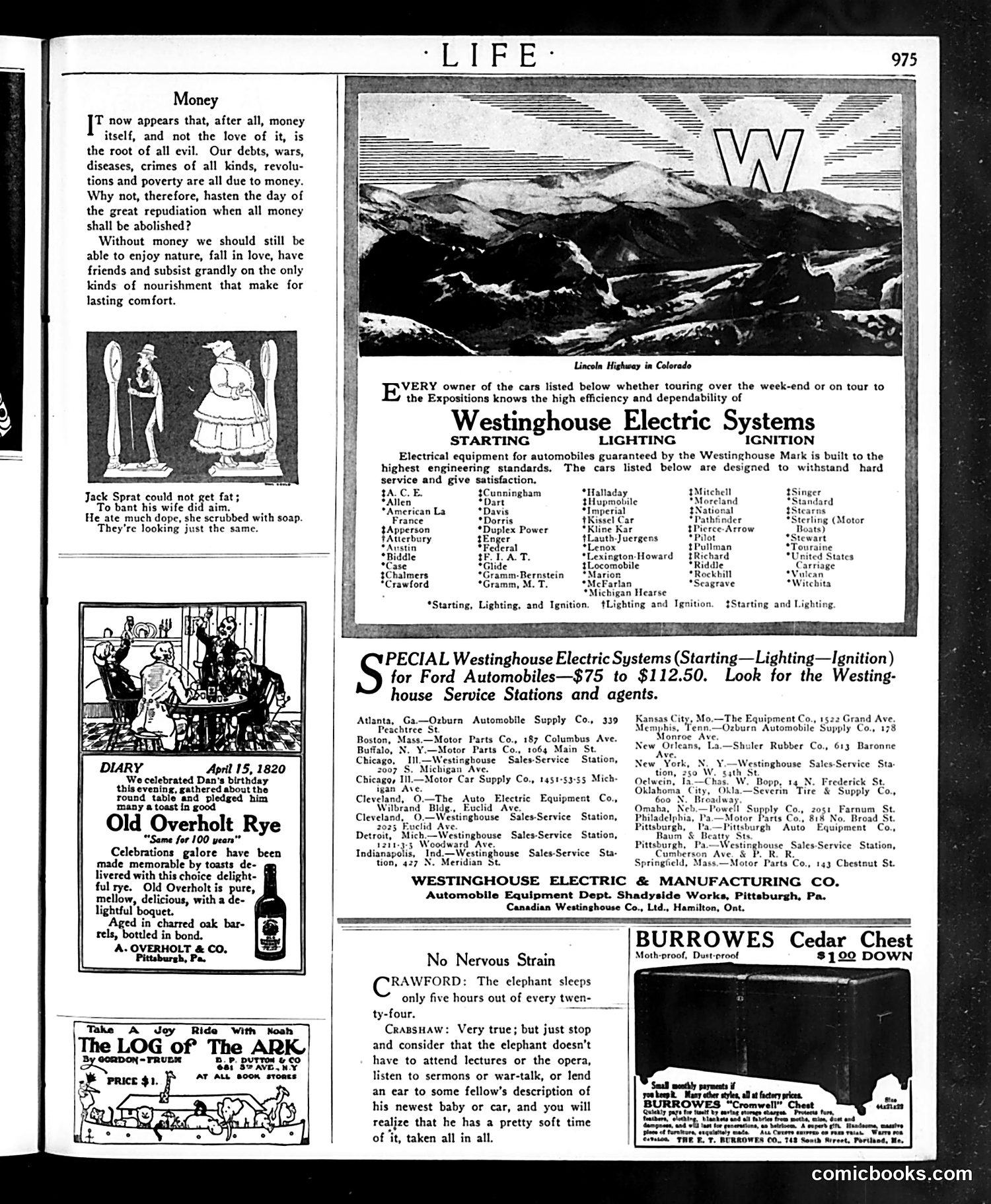
This page mixes editorial satire with period advertising. The main "Money" essay presents a tongue-in-cheek argument that money—not love of money—is "the root of all evil," causing wars, disease, and crime. It satirizes those advocating money's abolition by noting we'd still need sustenance and comfort without it. The Jack Sprat cartoon illustrates marital domesticity humorously. The "Diary" entry celebrating "Old Overholt Rye" whiskey appears ironic given Prohibition (enacted 1920), advertising alcohol as a "choice delightful rye" despite legal restrictions—likely commentary on widespread bootlegging. The bulk of the page features genuine advertising: Westinghouse Electric automobile systems (starting, lighting, ignition) and Burrowes Cedar Chests. These represent the era's emerging consumer culture and automobile industry expansion, with extensive dealer listings nationwide. The "Crawford/Crabshaw" dialogue about an elephant's sleep habits appears to be filler humor without satirical intent.
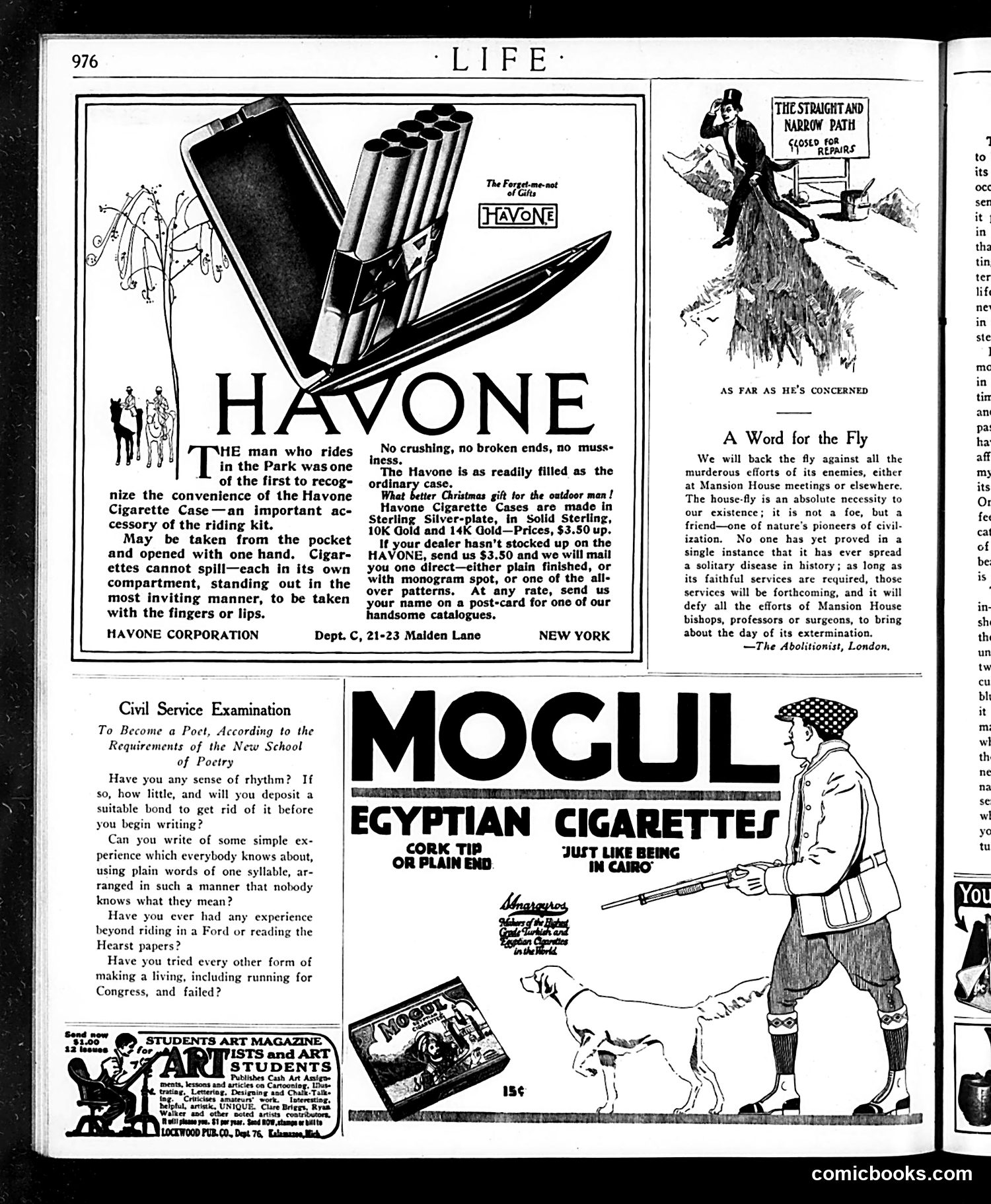
This page contains satirical advertisements and commentary typical of Life's early 20th-century humor: **Havone Cigarette Case ad**: A straightforward luxury product advertisement targeting wealthy riders, emphasizing convenience and elegance—cigarette cases were status symbols for the affluent. **"Civil Service Examination" satire**: Life mocks the modernist poetry movement (likely Imagism), which emphasized simple language and unclear meaning. The joke: aspiring poets must prove they have *no* sense of rhythm, write incomprehensibly despite plain words, and have failed at everything else. This reflects contemporary intellectual debates about whether "new poetry" was genuine art or pretentious nonsense. **Mogul Egyptian Cigarettes ad**: Features an orientalist caricature of a man in Egyptian dress with a dog. The copy plays on exotic appeal—positioning Egyptian cigarettes as sophisticated and foreign. **"A Word for the Fly"**: A tongue-in-cheek defense of houseflies against public health campaigns, absurdly claiming flies spread no diseases and are "pioneers of civilization." This likely satirizes both overzealous sanitarians and anti-pest movements of the era. The page is primarily advertising with embedded satire targeting contemporary cultural trends.
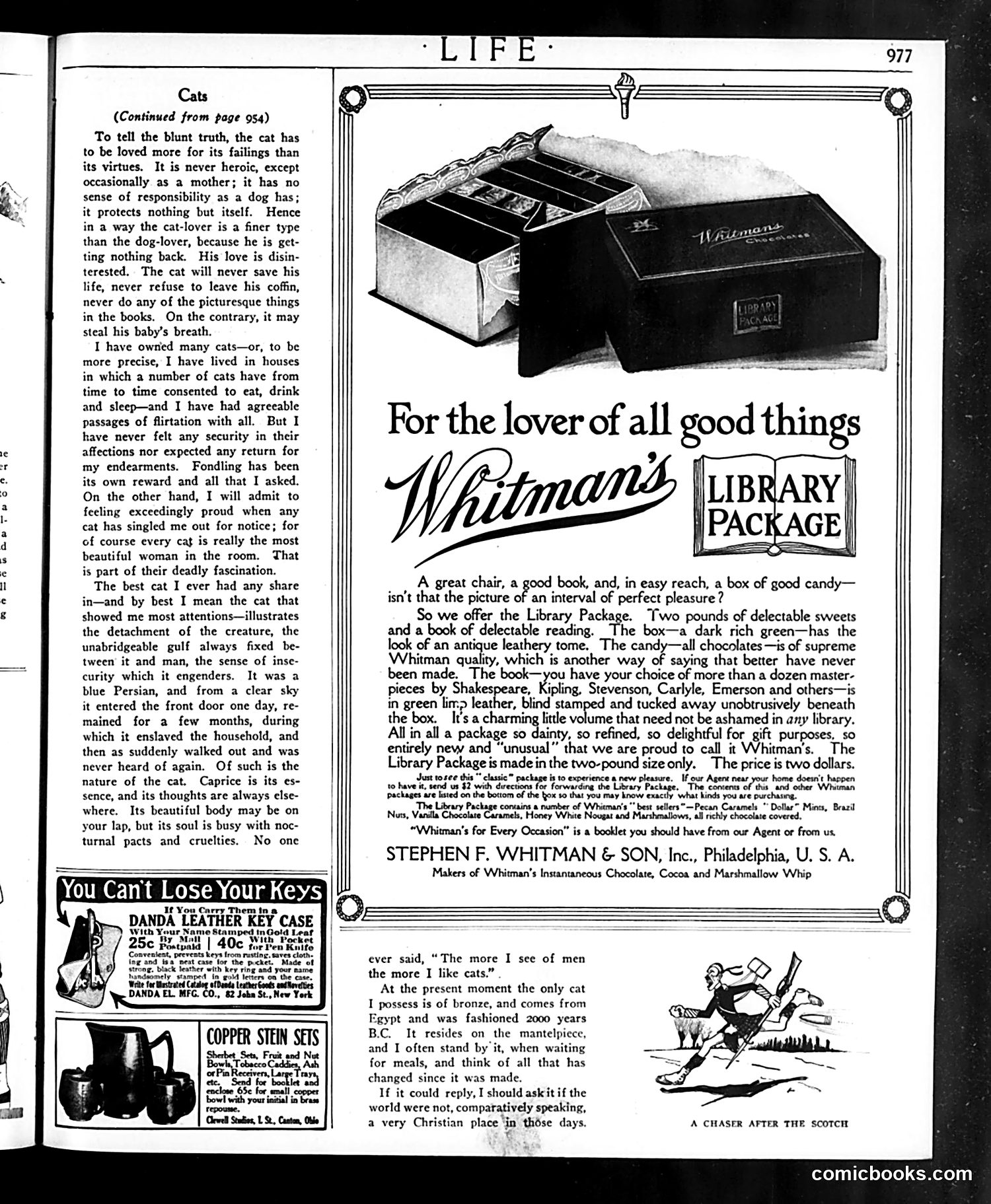
This page contains primarily **advertising and editorial content**, not political satire. The main feature is an essay on **cats** that contrasts them unfavorably with dogs—cats are selfish, disloyal, and emotionally unavailable compared to dogs' devotion. The author argues paradoxically that cat-lovers are "finer" precisely because they receive nothing in return, making their affection "disinterested." The essay uses a personal anecdote about a blue Persian cat that mysteriously abandoned the household, illustrating feline caprice and inscrutability. The advertisements include: - **Whitman's "Library Package"** (two pounds of chocolates plus a classic book for $2) - **Danda Leather Key Case** with monogramming - **Copper Stein Sets** The bottom illustration labeled "A Chaser After the Scotch" appears to be a humorous cartoon (content unclear from description alone). There is no political satire on this page—it reflects early 20th-century consumer culture and genteel attitudes toward pets and gift-giving.
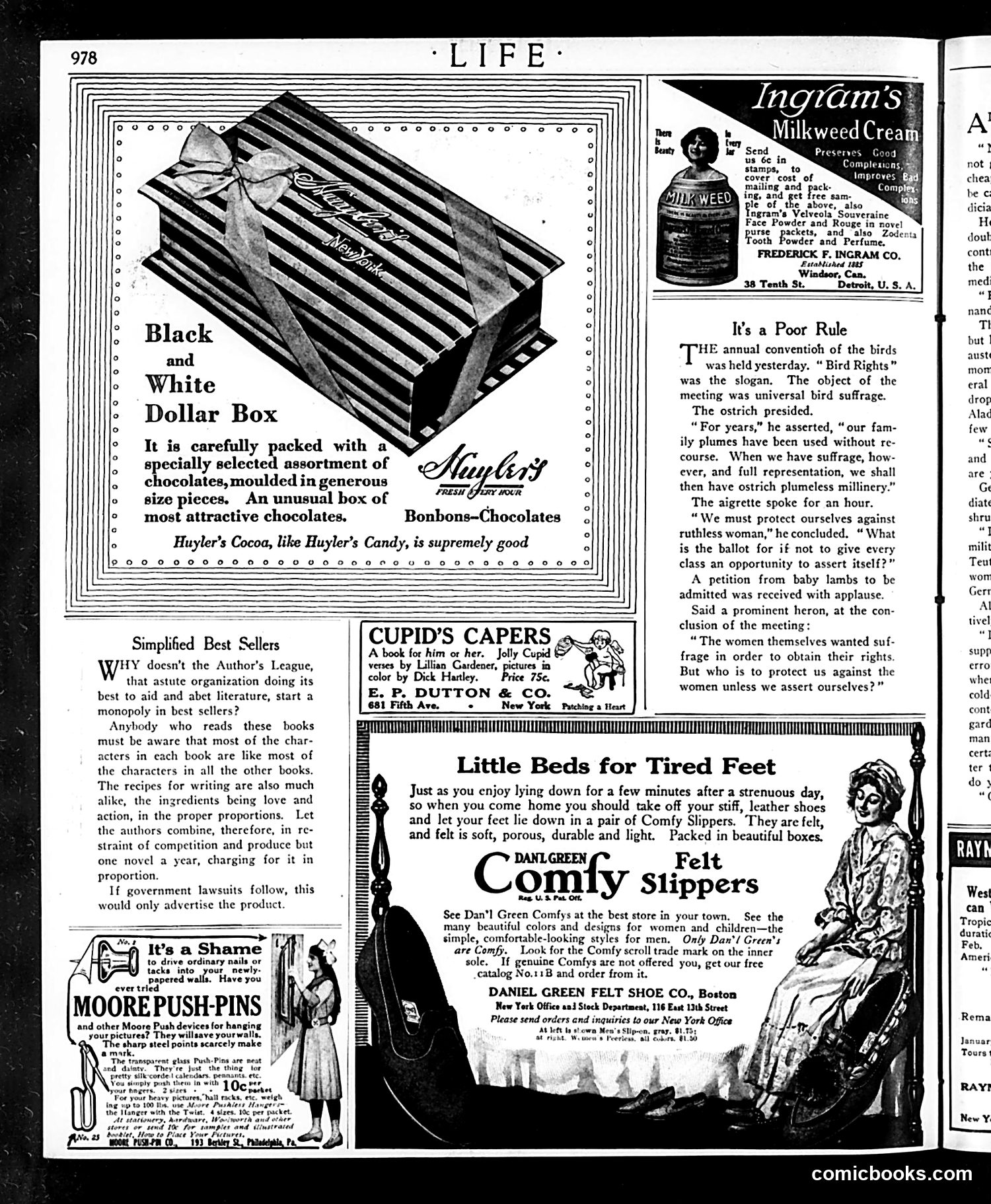
This brief satirical piece mocks the women's suffrage movement through animal allegory. At a "birds' convention" on "Bird Rights," various birds debate universal suffrage for their species. An ostrich presides while an aigrette (a plumed bird) argues eloquently for voting rights. The satire's point: birds worry that if women gain voting power, they'll ban the plume trade that decimates bird populations for fashionable millinery. A heron concludes by sardonically asking who will protect birds from "ruthless woman" if they don't vote—inverting the suffrage argument to suggest women voters pose a threat rather than deserve representation. The joke relies on the contemporary controversy over feathered hats depleting bird species, positioning suffragists as a danger to wildlife rather than advocates for equality. It's anti-suffrage satire dressed in whimsy.
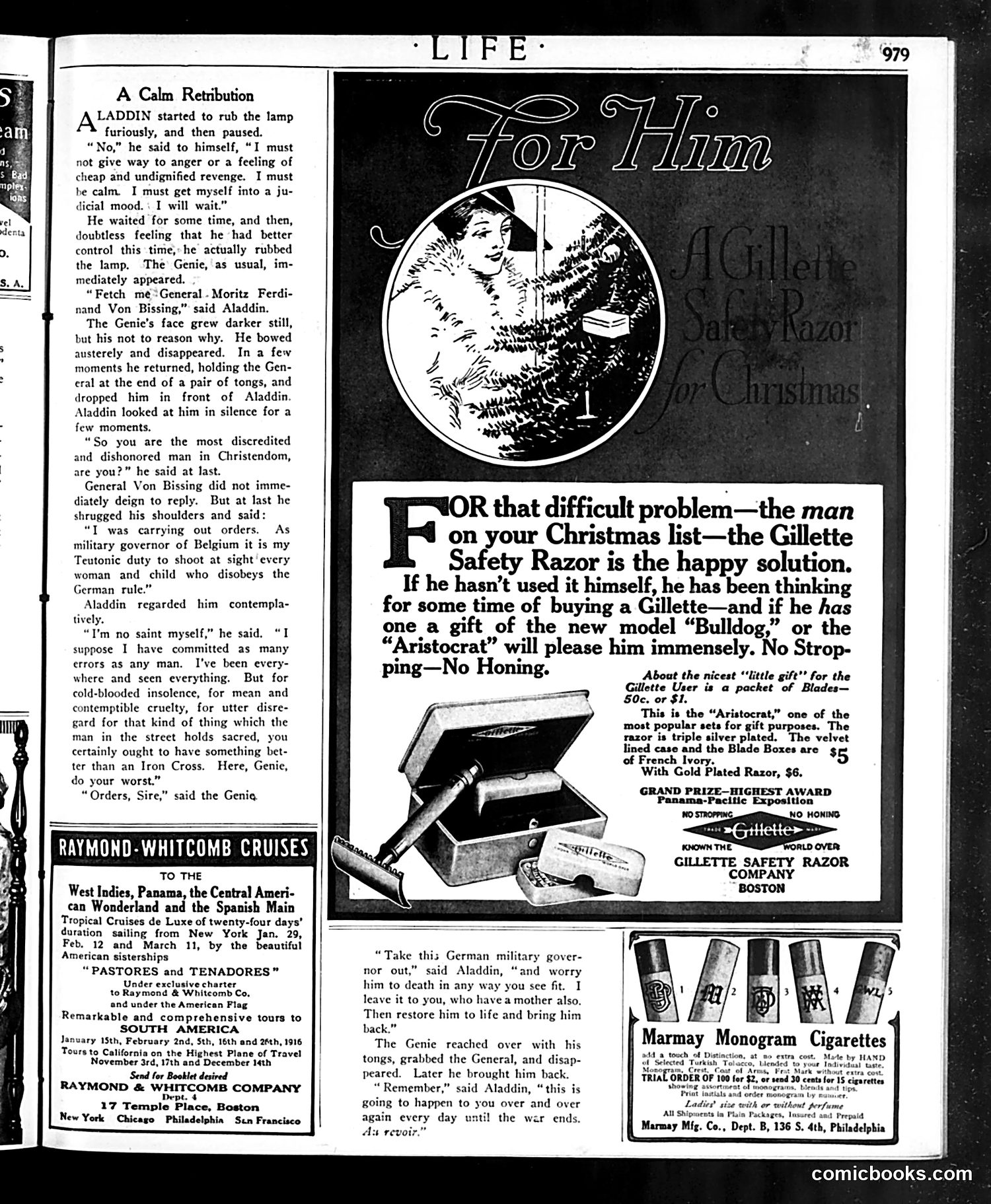
This is a satirical fantasy story about Aladdin summoning a genie to punish **General Moritz Ferdinand Von Bissing**, the real German military governor of occupied Belgium during World War I. The satire targets Von Bissing's brutal rule: he openly defends executing Belgian civilians who disobeyed German orders as mere "Teutonic duty." Aladdin—representing justice—condemns this as "cold-blooded insolence" and "contemptible cruelty," then orders the genie to torment him eternally as punishment that will repeat "every day until the war ends." The piece uses the Aladdin fantasy framework to express American/Allied outrage at German atrocities in Belgium, a major propaganda point during WWI. By having Aladdin call Von Bissing "the most discredited and dishonored man in Christendom," *Life* magazine frames German conduct as violating basic human civilization. The page also contains period advertisements (Gillette razors, cruises, cigarettes).
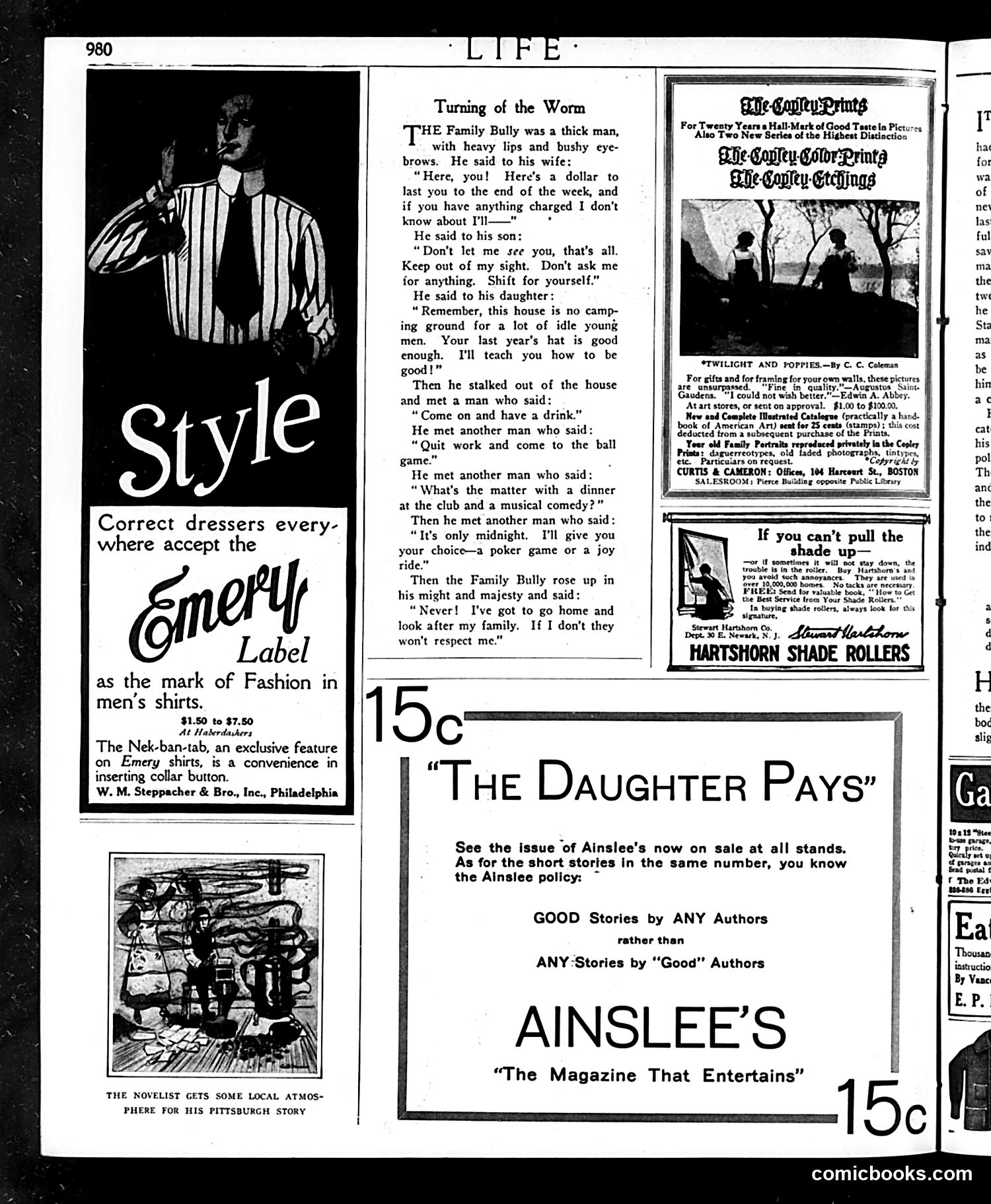
This short story excerpt satirizes a common social hypocrisy of the era: the "Family Bully"—a man who tyrannizes his wife and children at home with stinginess and cruelty ("Don't let me see you," "Keep out of my sight"), then becomes a different person in public. The joke is the reversal: when tempted by male acquaintances to drink, gamble, and carouse late into the night, he suddenly invokes family duty and respectability. He refuses their invitations by claiming he must "go home and look after my family. If I don't they won't respect me." The irony is sharp: this man who shows his family no respect demands theirs through control and deprivation. The "worm turning" refers to his sudden assertion of domestic responsibility—but only to justify leaving his companions, not from genuine principle. It mocks men who abuse their authority at home while posturing as respectable family men in public.
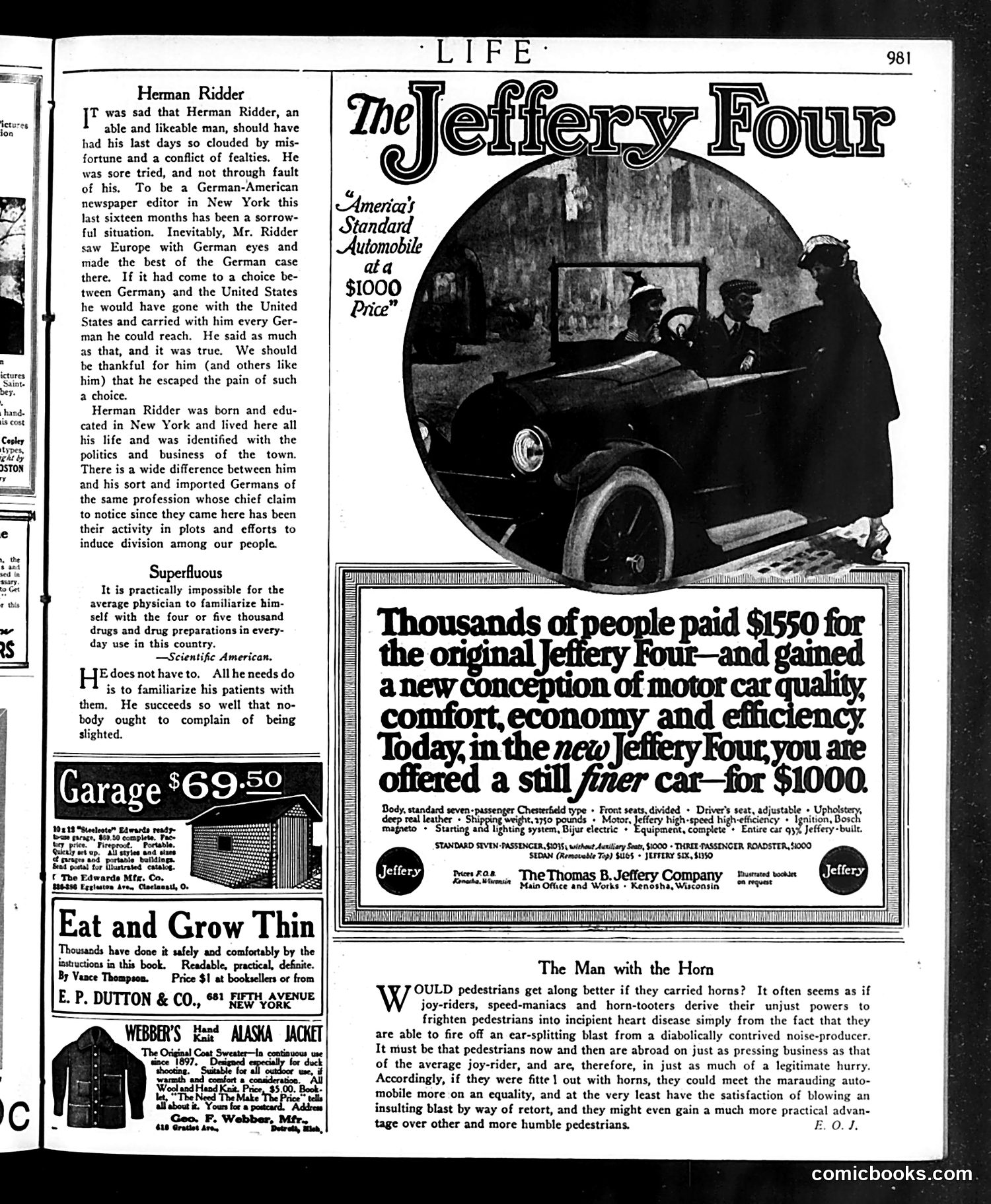
**Main Editorial**: A tribute to Herman Ridder, a German-American newspaper editor in New York who died during WWI. The piece acknowledges his difficult position—sympathetic to Germany but ultimately loyal to America. Life praises him for avoiding the "plots" attributed to other German immigrants seeking to divide American opinion. This reflects WWI-era tensions around German-American loyalty and espionage concerns. **Advertisements**: The page features ads for a Jeffery automobile ($1000), a garage ($69.50), and a diet book—typical period marketing. **Satirical Piece - "The Man with the Horn"**: A brief commentary suggesting pedestrians should carry horns to compete with aggressive motorists. It's a humorous critique of reckless drivers who use horns to intimidate slower pedestrians, proposing equal footing through mutual noise-making. This reflects early automotive-age tensions between vehicles and foot traffic.
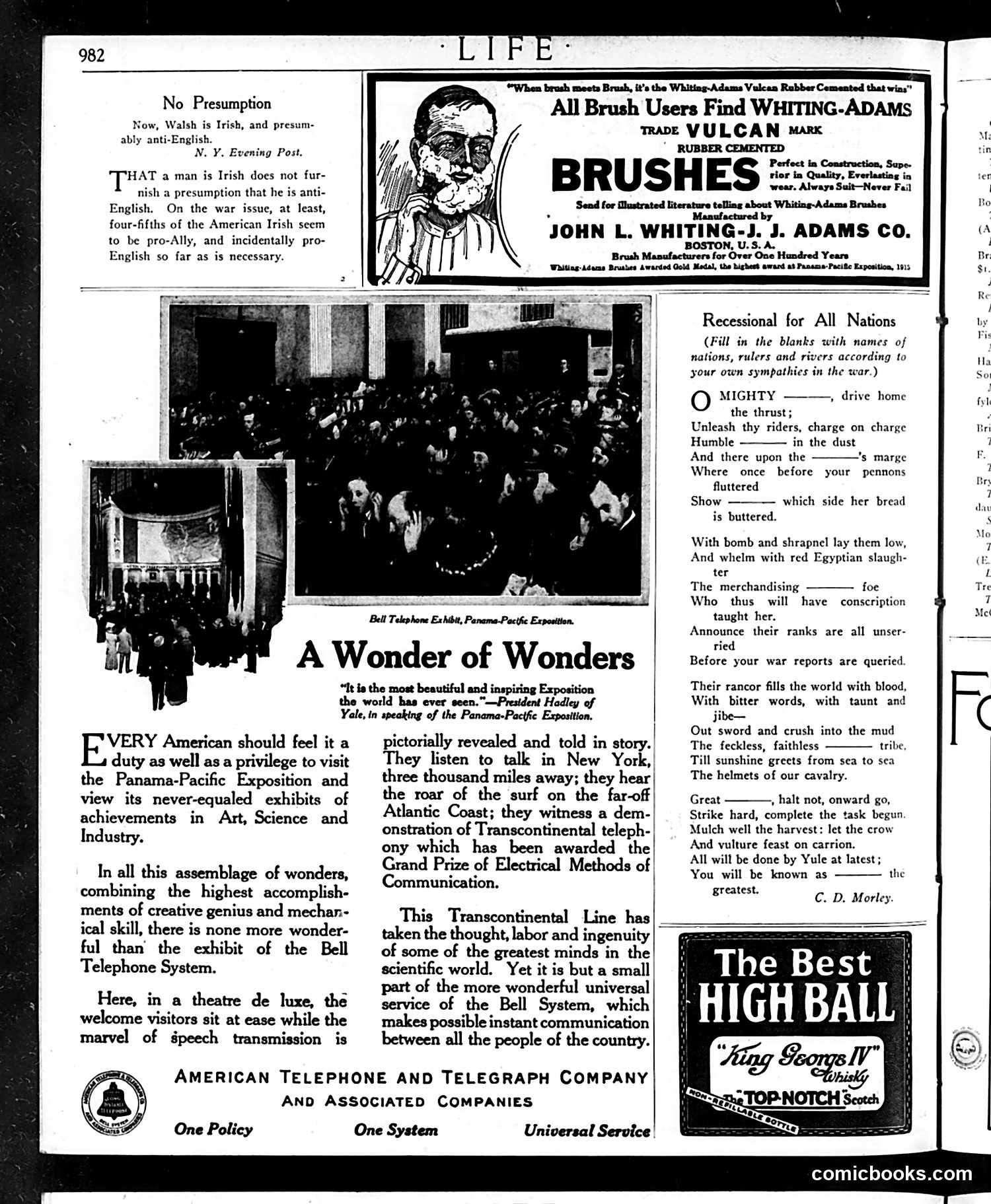
This page mixes advertising with wartime satire during World War I. **The "No Presumption" section** addresses Irish-American attitudes toward the war. It disputes the assumption that Irish Americans automatically opposed Britain, noting that four-fifths actually supported the Allies—a counterargument to anti-Irish stereotyping. **"Recessional for All Nations"** is a fill-in-the-blank poem satirizing jingoistic war rhetoric. Readers are invited to insert their preferred nations and rivers to create nationalistic battle hymns. The poem mockingly celebrates violence, slaughter, and economic exploitation ("merchandising foe"), satirizing how different nations rationalize their own wars while condemning others'. The title references Kipling's "Recessional," inverting its cautious imperialism into hollow patriotic fervor. **The Bell Telephone exhibit section** is straightforward promotional content celebrating American technological achievement at the Panama-Pacific Exposition, emphasizing transcontinental communication capabilities. The page juxtaposes genuine wartime anxiety (the poem) with American commercial confidence (Bell advertising), reflecting 1915 American ambivalence about the European conflict.
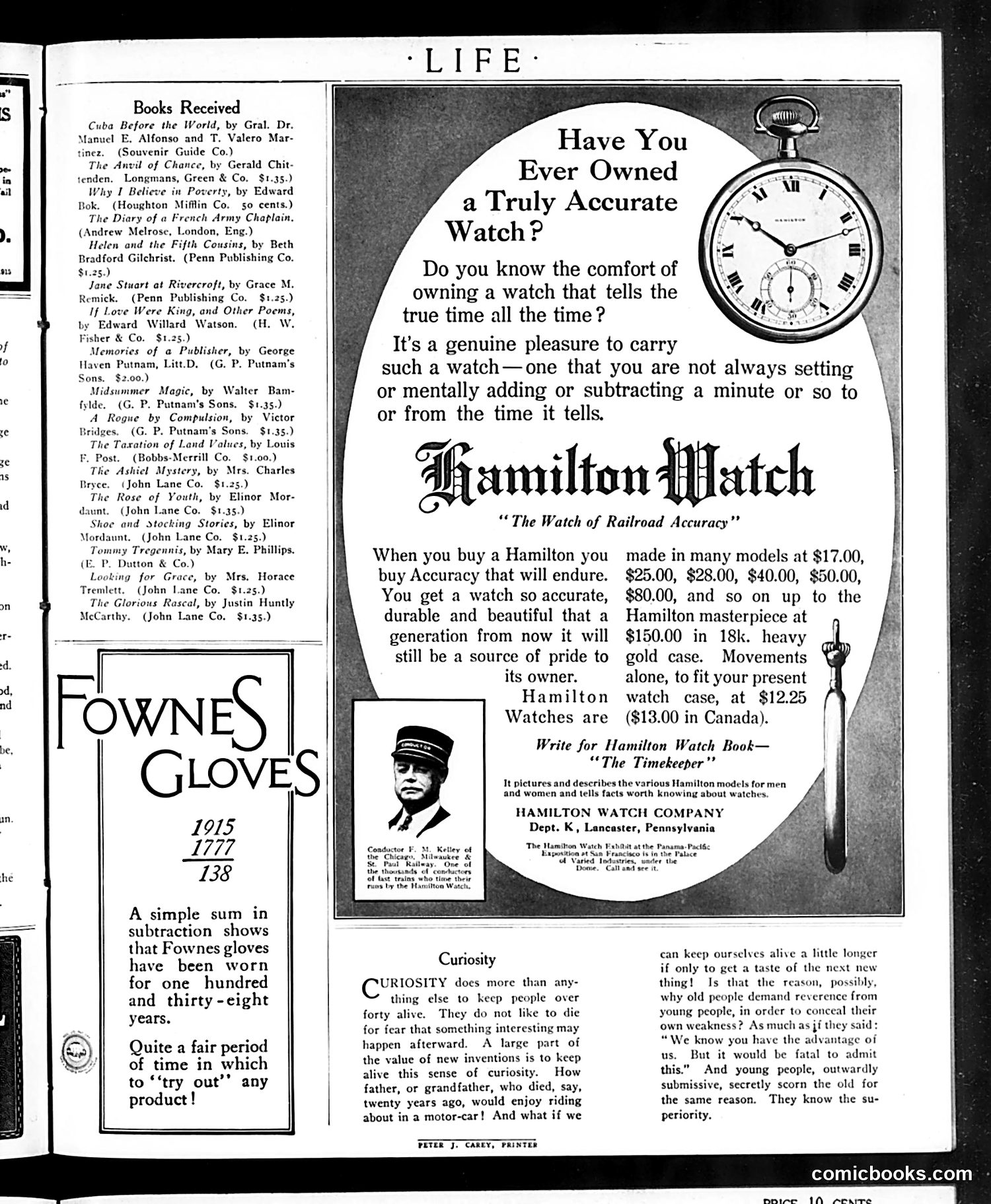
This page is primarily **advertising and book reviews**, not political satire. The main content includes: **Left side:** A list of newly published books and a Fownes Gloves advertisement emphasizing the brand's 138-year history (1777-1915) as proof of durability. **Right side:** A large Hamilton Watch Company advertisement featuring a pocket watch, claiming "Railroad Accuracy" and positioning the watch as a luxury item ($17-$150) for reliability-conscious consumers. **Bottom:** A brief essay titled "Curiosity" philosophizing about why curiosity keeps people alive and engaged with life, possibly hinting at generational tensions between elderly and young people over vitality and relevance. There are **no political cartoons** on this page. The "Curiosity" section contains mild social commentary about aging and generational attitudes, but it's reflective rather than satirical. The page's primary purpose is commercial advertising dressed in editorial content.
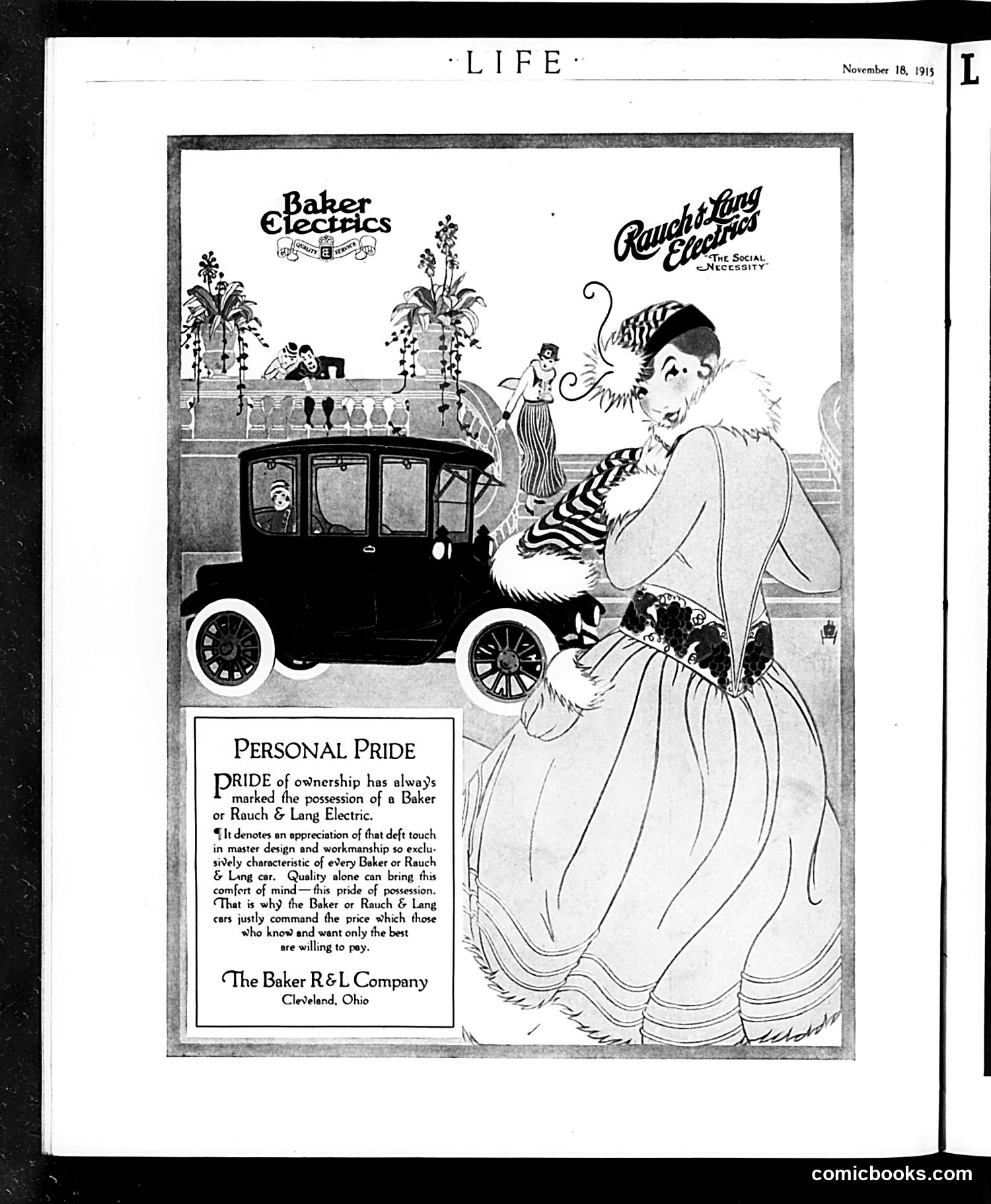
This is primarily a **product advertisement**, not political satire. It promotes Baker and Rauch & Lang electric automobiles through aspirational imagery rather than humor or social commentary. The illustration depicts a wealthy, fashionably-dressed woman in elaborate fur-trimmed clothing admiring a Baker or Rauch & Lang electric car. The opulent setting (classical architecture, decorative planters, servant figures) emphasizes luxury and social status. The ad's message centers on "Personal Pride"—appealing to upper-class consumers' desire for exclusivity and quality craftsmanship. Electric cars were expensive, prestigious vehicles in 1915, and this advertisement targets affluent buyers by suggesting ownership demonstrates refined taste and discernment. The satire (if present) is subtle: the ad conflates material consumption with personal virtue, suggesting that buying an expensive car reflects one's character and values—a common early 20th-century advertising technique that modern readers might recognize as manipulative.