
Life, 1915-11-18 · page 16 of 52
Life — November 18, 1915 — page 16: what you’re looking at
What you’re looking at
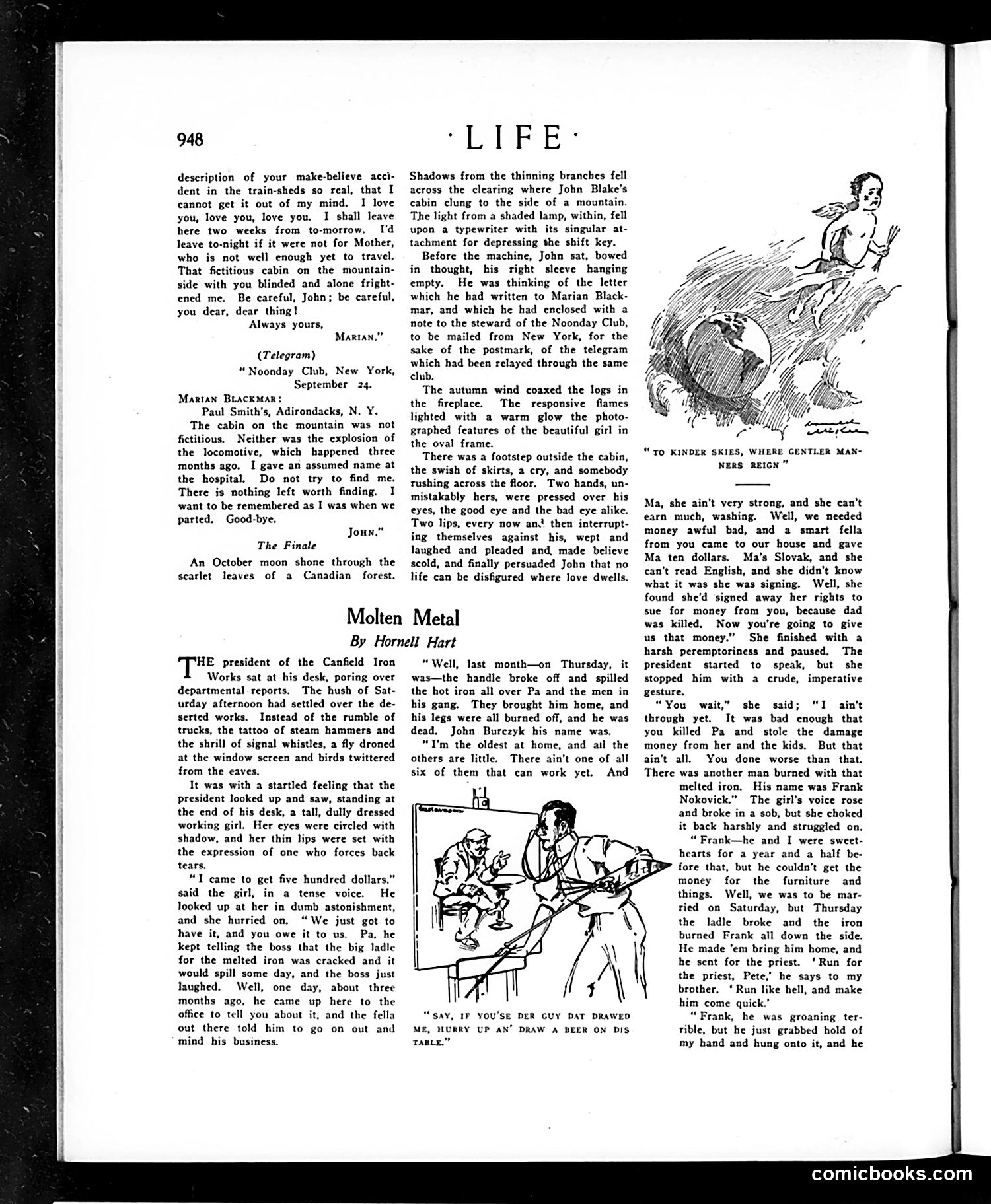
This page presents two distinct stories. **"The Finale"** is a sentimental romance about John Blake, a man with a missing arm (indicated by his "empty" right sleeve), who had faked his death to spare his beloved Marian from his disfigurement. The narrative climaxes when she finds him anyway, declaring that love transcends physical injury. The accompanying sketch shows a cherub-like figure, likely representing romantic idealization. **"Molten Metal"** by Hornell Hart shifts to social commentary. A working-class girl confronts an iron works president, demanding $500 in compensation for her father's death. Her father, John Burezyk, died when a cracked ladle of molten metal spilled on him—a hazard he'd repeatedly warned management about, which they ignored. The stark contrast between these stories appears intentional: the first romanticizes suffering and self-sacrifice; the second exposes industrial negligence and workers' vulnerability. The juxtaposition critiques how society sentimentalizes personal tragedy while ignoring systemic worker exploitation and preventable deaths caused by corporate indifference.
📄 Transcribed text from this page (OCR, searchable)
Machine-transcribed from the original scan — historical spelling and the odd misread are preserved.
948 description of your make-believe acci- dent in the train-sheds so real, that I cannot get it out of my mind. I love you, love you, love you. I shall leave here two weeks from to-morrow. I'd leave to-night if it were not for Mother, who is not well enough yet to travel. That fictitious cabin on the mountain- side with you blinded and alone fright- ened me. Be careful, John; be careful, you dear, dear thing! Always yours, Marian.” (Telegram) “Noonday Club, New York, September 24. Marian BLackMar: Paul Smith's, Adirondacks, N. Y. The cabin on the mountain was not fictitious. Neither was the explosion of the locomotive, which happened three months ago. I gave an assumed name at the hospital. Do not try to find me. There is nothing left worth finding. I want to be remembered as I was when we parted. Good-bye. Joun.” The Finale An October moon shone through the scarlet leaves of a Canadian forest. “LIFE Shadows from the thinning branches fell across the clearing where John Blake's cabin clung to the side of a mountain. The light from a shaded lamp, within, fell upon a typewriter with its singular at- tachment for depressing the shift key. Before the machine, John sat, bowed in thought, his right sleeve hanging empty. He was thinking of the letter which he had written to Marian Black- mar, and which he had enclosed with a note to the steward of the Noonday Club, to be mailed from New York, for the sake of the postmark, of the telegram which had been relayed through the same club. The autumn wind coaxed the logs in the fireplace. The responsive flames lighted with a warm glow the photo- graphed features of the beautiful girl in the oval frame. There was a footstep outside the cabin, the swish of skirts, a cry, and somebody tushing across the floor. Two hands, un- mistakably hers, were pressed over his eyes, the good eye and the bad eye alike. Two lips, every now an! then interrupt- ing themselves against his, wept and laughed and pleaded and, made believe scold, and finally persuaded John that no life can be disfigured where love dwells. Molten Metal By Hornell Hart 'HE president of the Canfield Iron Works sat at his desk, poring over departmental reports. The hush of Sat- urday afternoon had settled over the de- serted works, Instead of the rumble of trucks, the tattoo of steam hammers and the shrill of signal whistles, a fly droned at the window screen and birds twittered from the eaves. It was with a startled feeling that the president looked up and saw, standing at the end of his desk, a tall, dully dressed working girl. Her eyes were circled with shadow, and her thin lips were set with the expression of one who forces back tears. “TI came to get five hundred dollars,” said the girl, in a tense voice. He looked up at her in dumb astonishment, and she hurried on. “We just got to have it, and you owe it to us. Pa, he kept telling the boss that the big ladle for the melted iron was cracked and it would spill some day, and the boss just laughed. Well, one day, about three months ago, he came up here to the office to tell you about it, and the fella out there told him to go on out and mind his business. “Well, last month—on Thursday, it was—the handle broke off and spilled the hot iron all over Pa and the men in his gang. They brought him home, and his legs were all burned off, and he was dead. John Burezyk his name was. “T'm the oldest at home, and ail the others are little. There ain't one of all six of them that can work yet. And “SAY, IP YOU'SE DER GUY DAT DRAWED ME, HURRY UP AN’ DRAW A BEER ON DIS TABLE.” “70 KINDER SKIES, WHERE GENTLER MAN- NERS REIGN” Mi Y je Coe e Ma, she ain't very strong, and she can’t earn much, washing. Well, we needed money awful bad, and a smart fella from you came to our house and gave Ma ten dollars, Ma's Slovak, and she can't read English, and she didn’t know what it was she was signing. Well, she found she'd signed away her rights to sue for money from you, because dad was killed. Now you're going to give us that money.” She finished with a harsh peremptoriness and paused. The President started to speak, but she stopped him with a crude, imperative gesture. “You wait,” she said; “I ain't through yet. It was bad enough that you killed Pa and stole the damage money from her and the kids. But that ain't all. You done worse than that. There was another man burned with that melted iron. His name was Frank Nokovick.” The girl's voice rose and broke in a sob, but she choked it back harshly and struggled on. “Frank—he and I were sweet- hearts for a year and a half be- fore that, but he couldn’t get the money for the furniture and things. Well, we was to be mar- ried on Saturday, but Thursday the ladle broke and the iron burned Frank all down the side. He made ‘em bring him home, and he sent for the priest. ‘Run for the priest, Pete,’ he says to my brother. ‘Run like hell, and make him come quick.’ “Frank, he was groaning ter- rible, but he just grabbed hold of my hand and hung onto it, and he comicbooks.com