
Life, 1915-11-18 · page 30 of 52
Life — November 18, 1915 — page 30: what you’re looking at
What you’re looking at
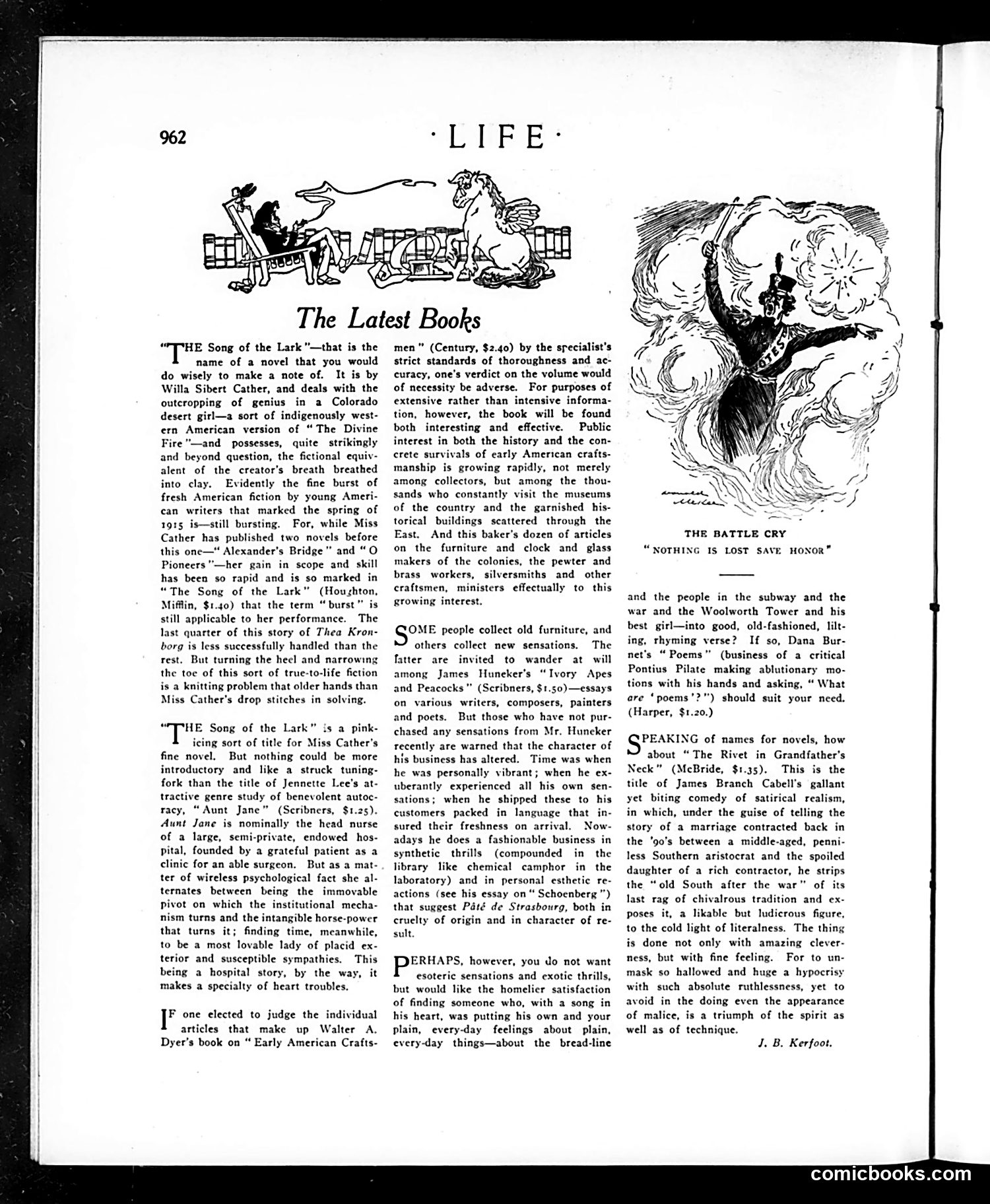
This is a book review section from *Life* magazine (page 962), featuring four novel and nonfiction recommendations from what appears to be 1915. The main illustrated cartoons at top and side are decorative vignettes typical of *Life*'s satirical style—showing figures in leisure activities—rather than political commentary. The reviews themselves discuss: 1. **"The Song of the Lark"** by Willa Cather—praised as exemplifying a "fine burst of fresh American fiction" about a talented Colorado girl 2. **"Aunt Jane"** by Jennette Lee—a hospital story examining an influential nurse's quiet power 3. **"Early American Craftsmen"** by Walter A. Dyer—a survey of colonial artisans and craftwork, noted as broad rather than deeply specialized 4. **"Ivory Apes and Peacocks"** by James Huneker—essays on writers and artists, with the reviewer noting Huneker's critical style has shifted from personal vivacity to manufactured "synthetic thrills" The page reflects *Life*'s role as an arbiter of contemporary literary taste for educated readers.
📄 Transcribed text from this page (OCR, searchable)
Machine-transcribed from the original scan — historical spelling and the odd misread are preserved.
The Latest Books “THE Song of the Lark "—that is the name of a novel that you would do wisely to make a note of. It is by Willa Sibert Cather, and deals with the outcropping of genius in a Colorado desert girl—a sort of indigenously west- ern American version of “ The Divine Fire "—and possesses, quite strikingly and beyond question, the fictional eqi alent of the creator's breath breathed into clay. Evidently the fine burst of fresh American fiction by young Ameri- can writers that marked the spring of 1915 is—still bursting. For, while Miss Cather has published two novels before this one— Alexander's Bridge" and “O Pioneers ""—her gain in scope and skill has been so rapid and is so marked in “The Song of the Lark" (Houghton, Mifflin, $1.40) that the term “ burst” is still applicable to her performance. The last quarter of this story of Thea Kron- borg is less successfully handled than the rest, But turning the heel and narrowing the toe of this sort of true-to-life fiction is a knitting problem that older hands than Miss Cather's drop stitches in solving. “THE Song of the Lark” is a pink- icing sort of title for Miss Cather's fine novel. But nothing could be more introductory and like a struck tuning- fork than the title of Jennette Lee's at- tractive genre study of benevolent autoc- racy, “Aunt Jane” (Scribners, $1.25). Aunt Jane is nominally the head nurse of a large, semi-private, endowed hos- pital, founded by a grateful patient as a clinic for an able surgeon. But as a mat- ter of wireless psychological fact she al- ternates between being the immovable pivot on which the institutional mecha- nism turns and the intangible horse-pow that turns it; finding time, meanwhile, to be a most lovable lady of placid ex- terior and susceptible sympathies. This being a hospital story, by the way, it makes a specialty of heart troubles. F one elected to judge the individual articles that make up Walter A. Dyer’s book on “ Early American Crafts- men” (Century, $2.40) by the specialist's strict standards of thoroughness and ac- curacy, one’s verdict on the volume would of necessity be adverse. For purposes of extensive rather than intensive informa- tion, however, the book will be found both interesting and effective. Public interest in both the history and the con- crete survivals of early American crafts- manship is growing rapidly, not merely among collectors, but among the thou- sands who constantly visit the museums of the country and the garnished his- torical buildings scattered through the East, And this baker's dozen of articles on the furniture and clock and glass makers of the colonies, the pewter and brass workers, silversmiths and other craftsmen, ministers effectually to this growing interest. OME people collect old furniture, and others collect new sensations. The fatter invited to wander at will among James Huneker’s “Ivory Apes and Peacocks" (Scribners, $1.50)—essays on various writers, composers, painters and poets. But those who have not pur- chased any sensations from Mr. Huneker recently are warned that the character of his business has altered. Time was when he was personally vibrant; when he ex- uberantly experienced all his own sen- sations; when he shipped these to his customers packed in language that in- sured their freshness on arrival. Now- adays he does a fashionable business in synthetic thrills (compounded in the library like chemical camphor in the laboratory) and in personal esthetic re- actions (see his essay on“ Schoenberg”) that suggest Pété de Strasbourg, both in cruelty of origin and in character of re- sult are ERHAPS, however, you do not want esoteric sensations and exotic thrills, but would like the homelier satisfaction of finding someone who, with a song in his heart, was putting his own and your plain, every-day feelings about plain, every-day things—about the bread-line THE BATTLE CRY “NOTHING IS LOST SAVE HONOR” and the people in the subway and the war and the Woolworth Tower and his best girl—into good, old-fashioned, lilt- ing, rhyming verse? If so, Dana Bur- net's “Poems” (business of a critical Pontius Pilate making ablutionary mo- tions with his hands and asking, “ What are ‘poems'?") should suit your need. (Harper, $1.20.) PEAKING of names for novels, how about “The Rivet in Grandfather's Neck” (McBride, $1.35). This is the tide of James Branch Cabell's gallant yet biting comedy of satirical realism, in which, under the guise of telling the story of a marriage contracted back in the ‘90's between a middle-aged, penni- less Southern aristocrat and the spoiled daughter of a rich contractor, he strips the “old South after the war” of its last rag of chivalrous tradition and ex- poses it, a likable but ludicrous figure, to the cold light of literalness. The thing is done not only with amazing clever- ness, but with fine feeling. For to un- mask so hallowed and huge a hypocrisy with such absolute ruthlessness, yet to avoid in the doing even the appearance of malice, is a triumph of the spirit as well as of technique. J. B. Kerfoot, comicbooks.com