
Life, 1915-11-18 · page 22 of 52
Life — November 18, 1915 — page 22: what you’re looking at
What you’re looking at
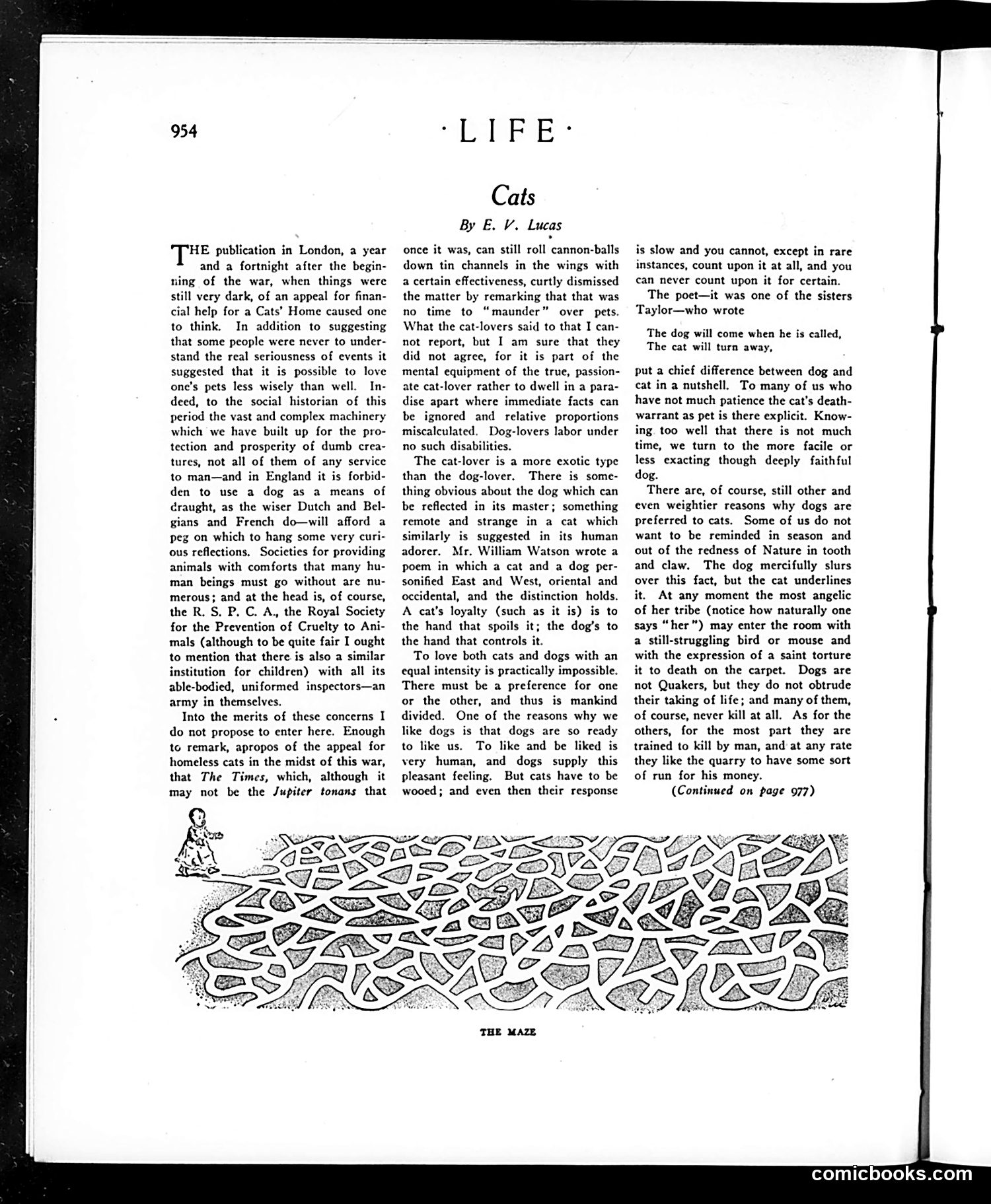
This is a literary essay, not a political cartoon. The illustration titled "The Maze" at the bottom appears decorative rather than satirical. Lucas discusses the British publication of a wartime appeal for a Cats' Home shelter during World War I. He uses this seemingly frivolous request (during serious wartime) to reflect on society's elaborate animal welfare systems—particularly the RSPCA (Royal Society for Prevention of Cruelty to Animals). The essay contrasts cat-lovers with dog-lovers: cats demand wooing and offer uncertain loyalty, while dogs provide reassuring, human-like affection. Lucas suggests cat-lovers inhabit a separate reality where they ignore practical concerns. He references a poem by a "sister Taylor" distinguishing dogs' responsiveness from cats' indifference. The underlying point satirizes how British society prioritizes animal comfort even amid war's darkness—a commentary on misplaced values rather than the animals themselves.
📄 Transcribed text from this page (OCR, searchable)
Machine-transcribed from the original scan — historical spelling and the odd misread are preserved.
TH publication in London, a year and a fortnight after the begin- ning of the war, when things were still very dark, of an appeal for finan- cial help for a Cats’ Home caused one to think. In addition to suggesting that some people were never to under- stand the real seriousness of events it suggested that it is possible to love one’s pets less wisely than well. In- deed, to the social historian of this period the vast and complex machinery which we have built up for the pro- tection and prosperity of dumb crea- tures, not all of them of any service to man—and in England it is forbid- den to use a dog as a means of draught, as the wiser Dutch and Bel- gians and French do—will afford a peg on which to hang some very curi- ous reflections. Societies for providing animals with comforts that many hu- man beings must go without are nu- merous; and at the head is, of course, the R. S. P. C. A, the Royal Society for the Prevention of Cruelty to Ani- mals (although to be quite fair I ought to mention that there is also a similar institution for children) with all its able-bodied, uniformed inspectors—an army in themselves. Into the merits of these concerns I do not propose to enter here. Enough to remark, apropos of the appeal for homeless cats in the midst of this war, that The Times, which, although it may not be the Jupiter tonans that © SaVees eon Cats By E. V. Lucas once it was, can still roll cannon-balls down tin channels in the wings with a certain effectiveness, curtly dismissed the matter by remarking that that was no time to “maunder” over pets. What the cat-lovers said to that I can- not report, but I am sure that they did not agree, for it is part of the mental equipment of the true, passion- ate cat-lover rather to dwell in a para- dise apart where immediate facts can be ignored and relative proportions miscalculated. Dog-lovers labor under no such disabilities. The cat-lover is a more exotic type than the dog-lover. There is some- thing obvious about the dog which can be reflected in its master; something remote and strange in a cat which similarly is suggested in its human adorer. Mr. William Watson wrote a poem in which a cat and a dog per- sonified East and West, oriental and occidental, and the distinction holds. A cat's loyalty (such as it is) is to the hand that spoils it; the dog’s to the hand that controls it. To love both cats and dogs with an equal intensity is practically impossible. There must be a preference for one or the other, and thus is mankind divided. One of the reasons why we like dogs is that dogs are so ready to like us. To like and be liked is very human, and dogs supply this pleasant feeling. But cats have to be wooed; and even then their response is slow and you cannot, except in rare instances, count upon it at all, and you can never count upon it for certain. The poet—it was one of the sisters Taylor—who wrote The dog will come when he is called, The cat will turn away, put a chief difference between dog and cat in a nutshell, To many of us who have not much patience the cat's death- warrant as pet is there explicit. Know- ing. too well that there is not much time, we turn to the more facile or less exacting though deeply faithful dog. There are, of course, still other and even weightier reasons why dogs are preferred to cats. Some of us do not want to be reminded in season and out of the redness of Nature in tooth and claw. The dog mercifully slurs over this fact, but the cat underlines it. At any moment the most angelic of her tribe (notice how naturally one says “her”) may enter the room with a still-struggling bird or mouse and with the expression of a saint torture it to death on the carpet. Dogs are not Quakers, but they do not obtrude their taking of life; and many of them, of course, never kill at all. As for the others, for the most part they are trained to kill by man, and at any rate they like the quarry to have some sort of run for his money, (Continued on page 977) comicbooks.com