
Life, 1915-11-18 · page 25 of 52
Life — November 18, 1915 — page 25: what you’re looking at
What you’re looking at
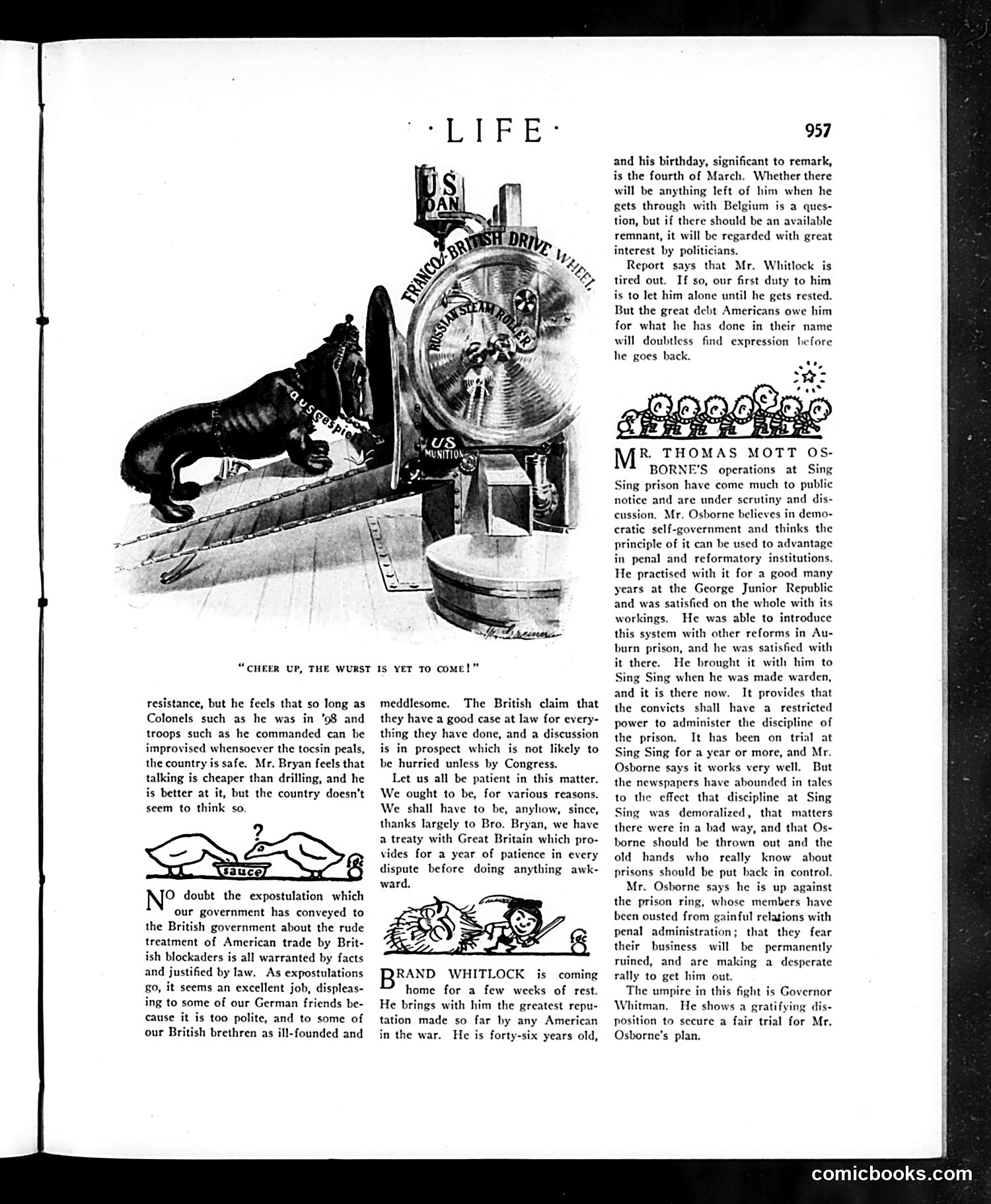
The main cartoon depicts a German sausage (labeled "WURST") being ground through a Franco-British drive wheel, with the caption "CHEER UP, THE WURST IS YET TO COME!" This is WWI-era satire celebrating Allied military pressure on Germany—suggesting German defeat is inevitable. The text discusses three figures: **William Jennings Bryan** (criticized for preferring talk over military preparedness), **Brand Whitlock** (U.S. minister to Belgium, praised for humanitarian work during the war), and **Thomas Mott Osborne** (prison reformer at Sing Sing who introduced democratic self-governance principles to inmates, now facing opposition from entrenched prison officials). The satire mocks Bryan's pacifist rhetoric while praising Whitlock's sacrifice and Osborne's progressive reforms. The overall tone reflects American WWI-era politics: preparedness advocates versus pacifists, and progressive reform versus institutional resistance.
📄 Transcribed text from this page (OCR, searchable)
Machine-transcribed from the original scan — historical spelling and the odd misread are preserved.
“CHEER UP, THE WURST IS YET TO come!” resistance, but he feels that so long as Colonels such as he was in '98 and troops such as he commanded can be improvised whensoever the tocsin peals, the country is safe. Mr. Bryan feels that talking is cheaper than drilling, and he is better at it, but the country doesn’t seem to think so, N° doubt the expostulation which our government has conveyed to the British government about the rude treatment of American trade by Brit- ish blockaders is all warranted by facts and justified by law. As expostulations go, it seems an excellent job, displeas- ing to some of our German friends be- cause it is too polite, and to some of our British brethren as ill-founded and meddlesome. The British claim that they have a good case at law for every- thing they have done, and a discussion is in prospect which is not likely to be hurried unless by Congress. Let us all be patient in this matter. We ought to be, for various reasons. We shall have to be, anyhow, since, thanks largely to Bro. Bryan, we have a treaty with Great Britain which pro- vides for a year of patience in every dispute before doing anything awk- RAND WHITLOCK is coming home for a few weeks of rest. He brings with him the greatest repu- tation made so far by any American in the war. He is forty-six years old, 957 and his birthday, significant to remark, is the fourth of March. Whether there will be anything left of him when he gets through with Belgium is a ques- tion, but if there should be an available remnant, it will be regarded with great interest by politicians. Report says that Mr. Whitlock is tired out. If so, our first duty to him is to let him alone until he gets rested. But the great debt Americans owe him for what he has done in their name will doubtless find expression before he goes back. BORNE’S operations at Sing ing prison have come much to public notice and are under scrutiny and dis- cussion, Mr. Osborne believes in demo- cratic self-government and thinks the principle of it can be used to advantage in penal and reformatory institutions. He practised with it for a good many years at the George Junior Republic and was satisfied on the whole with its workings. He was able to introduce this system with other reforms in Au- burn prison, and he was satisfied with it there. He brought it with him to Sing Sing when he was made warden, and it is there now. It provides that the convicts shall have a restricted power to administer the discipline of the prison, It has been on trial at Sing Sing for a year or more, and Mr. Osborne says it works very well. But the newspapers have abounded in tales to the effect that discipline at Sing Sing was demoralized, that matters there were in a bad way, and that Os- borne should be thrown out and the old hands who really know about prisons should be put back in control. Mr. Osborne says he is up against the prison ring, whose members have been ousted from gainful relations with penal administration; that they fear their business will be permanently ruined, and are making a desperate rally to get him out. The umpire in this fight is Governor Whitman. He shows a gratifying dis- position to secure a fair trial for Mr. Osborne's plan. comicbooks.com