
Life, 1915-11-18 · page 33 of 52
Life — November 18, 1915 — page 33: what you’re looking at
What you’re looking at
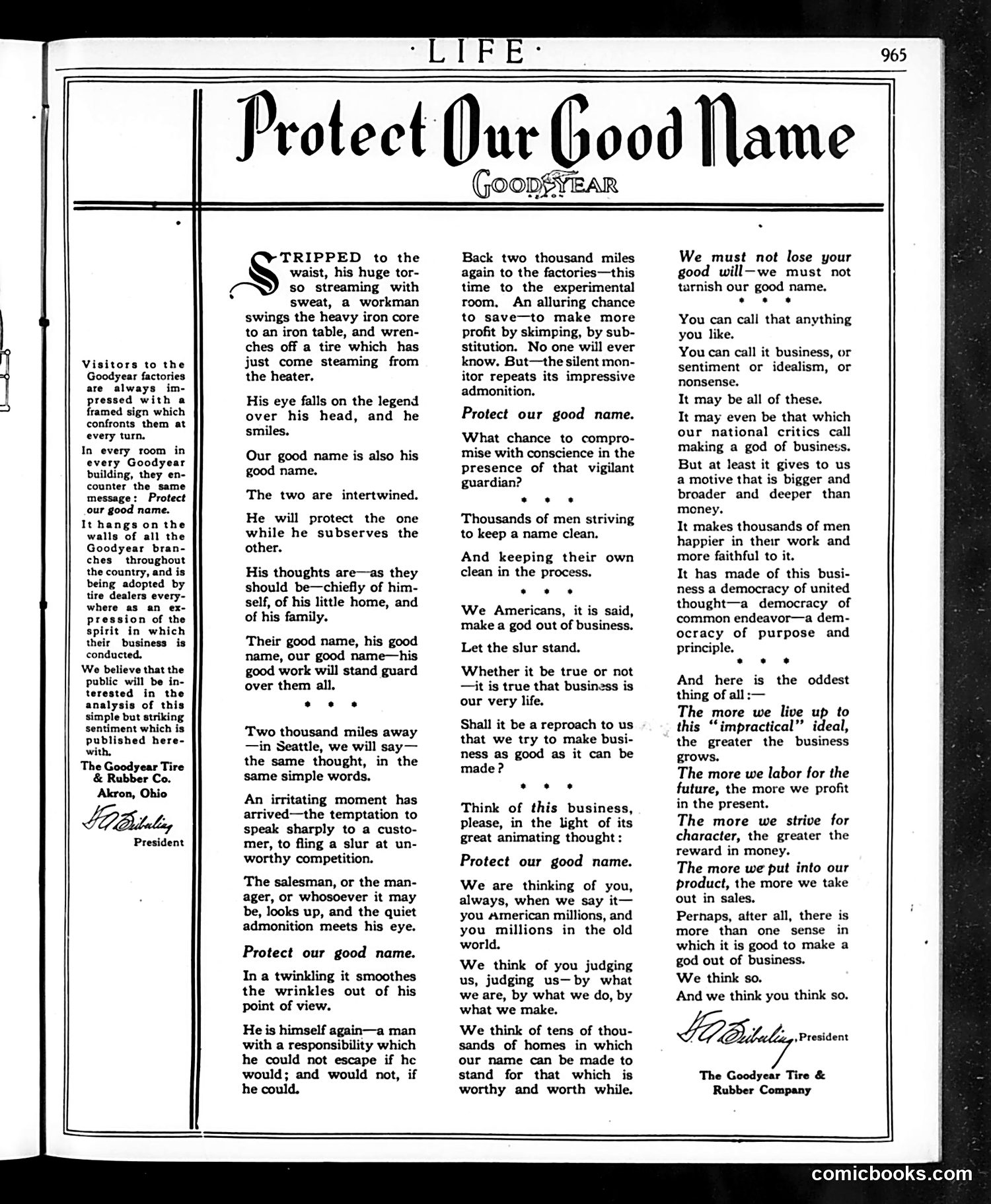
This is a **corporate advertisement**, not satire. The Goodyear Tire & Rubber Company uses this Life magazine page to promote its internal corporate philosophy: "Protect Our Good Name." The piece describes how Goodyear displays this slogan throughout its factories and offices to guide employee behavior—from factory workers resisting shortcuts to salesmen avoiding harsh language toward competitors. The company argues this isn't purely idealistic but pragmatically profitable: workers stay motivated, quality improves, and the brand strengthens. The rhetoric presents business as a quasi-moral enterprise where profit and principle align. Notably, the company frames this as distinctly American, appealing to readers' sense of national character and suggesting that ethical business practices are compatible with—even essential to—capitalist success. This reflects early 20th-century "corporate paternalism," where companies positioned themselves as moral communities, not merely profit-seeking entities.
📄 Transcribed text from this page (OCR, searchable)
Machine-transcribed from the original scan — historical spelling and the odd misread are preserved.
Visitors to the Goodyear factories are always im- pressed with a framed sign which confronts them at every turn, In every room in every Goodyear building, they en- counter the same message: Protect our good name. It hangs onthe walls of all the Goodyear bran- ches throughout the country, and is being adopted by tire dealers every- their business is conducted, We believe that the public will be in- terested in the analysis of this simple but striking sentiment which is published here- with, The Goodyear Tire & Rubber Co. President Protect Dur Good Name GoopsvEAR TRIPPED to the waist, his huge tor- so streaming with sweat, a workman swings the heavy iron core to an iron table, and wren- ches off a tire which has just come steaming from the heater. His eye falls on the legend over his head, and he smiles. Our good name is also his good name. The two are intertwined. He will protect the one while he subserves the other. His thoughts are—as they should be—chiefly of him- self, of his little home, and of his family. Their good name, his good name, our good name—his good work will stand guard over them all. oe 8 Two thousand miles away —in Seattle, we will say— the same thought, in the same simple words. An irritating moment has arrived—the temptation to speak sharply to a custo- mer, to fling a slur at un- worthy competition. The salesman, or the man- ager, or whosoever it may be, looks up, and the quiet admonition meets his eye. Protect our good name. In a twinkling it smoothes the wrinkles out of his point of view. He is himself again—a man with a responsibility which he could not escape if he would; and would not, if he could. Back two thousand miles again to the factories—this time to the experimental toom, An alluring chance to save—to make more profit by skimping, by sub- stitution. No one will ever know. But—the silent mon- itor repeats its impressive admonition. Protect our good name. ‘What chance to compro- mise with conscience in the presence of that vigilant guardian? eee Thousands of men striving to keep a name clean. And keeping their own clean in the process. es 8 6 We Americans, it is said, make a god out of business. Let the slur stand. Whether it be true or not —it is true that business is our very life. Shall it be a reproach to us that we try to make busi- ness as good as it can be made? ee 6 Think of this business, please, in the light of its great animating thought: Protect our good name. We are thinking of you, always, when we say it— you American millions, and you millions in the old world. We think of you judging us, judging us— by what we are, by what we do, by what we make. We think of tens of thou- sands of homes in which our name can be made to stand for that which is worthy and worth while. We must not lose your good will—we must not tarnish our good name. o 8 8 You can call that anything you like. You can call it business, or sentiment or idealism, or nonsense. It may be all of these. It may even be that which our national critics call making a god of business. But at least it gives to us a motive that is bigger and broader and deeper than money. It makes thousands of men happier in their work and more faithful to it. It has made of this busi- ness a democracy of united thought—a democracy of common endeavor—a dem- ocracy of purpose and principle. oe 6 And here is the oddest thing of all :— The more we live up to this “impractical” ideal, the greater the business grows. The more we labor for the future, the more we profit in the present. The more we strive for character, the greater the reward in money. The more we put into our product, the more we take out in sales. Pernaps, after all, there is more than one sense in which it is good to make a god out of business. We think so. And we think you think so. The Goodyear Tire & Rubber Company President comicbooks.com