
Life, 1915-11-18 · page 28 of 52
Life — November 18, 1915 — page 28: what you’re looking at
What you’re looking at
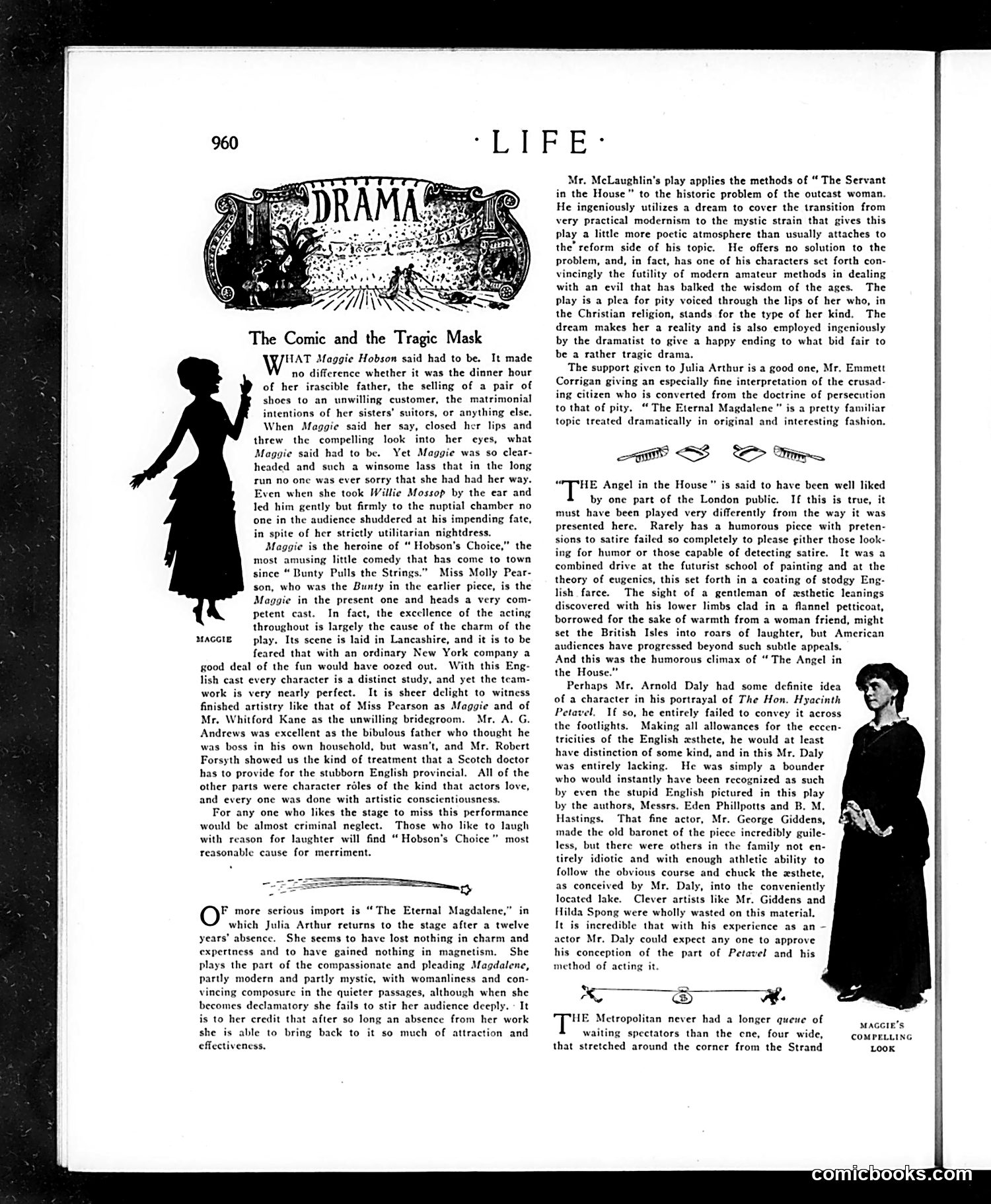
This page reviews two theatrical productions. The main illustration depicts **Maggie from "Hobson's Choice,"** a British comedy about a strong-willed Lancashire woman who dominates her household. The silhouette captures her "compelling look" mentioned in the text—her defining characteristic. The reviewer praises the English cast's excellence, particularly Molly Pearson's performance as Maggie and Whitford Kane as the reluctant bridegroom Willie Mossop, arguing the play's charm depends entirely on skillful acting. The second review concerns **"The Eternal Magdalene,"** starring Julia Arthur after a twelve-year absence. It addresses the "social problem" play genre—serious drama tackling moral issues like fallen women and redemption. The reviewer notes the play uses dream sequences to bridge modern realism with mystical elements, offering pity rather than solutions to social "evil." Both reviews emphasize *acting quality* and *theatrical craftsmanship* as paramount to successful drama, whether comic or tragic.
📄 Transcribed text from this page (OCR, searchable)
Machine-transcribed from the original scan — historical spelling and the odd misread are preserved.
"LIFE- The Comic and the Tragic Mask HAT Maggie Hobson said had to be. It made no difference whether it was the dinner hour of her irascible father, the selling of a pair of shoes to an unwilling customer, the matrimonial intentions of her sisters’ suitors, or anything else. When Maggie said her say, closed her lips and threw the compelling look into her eyes, what Maggie said had to be. Yet Maggie was so clear- headed and such a winsome lass that in the long run no one was ever sorry that she had had her way. Even when she took Willie Mossop by the ear and led him gently but firmly to the nuptial chamber no one in the audience shuddered at his impending fate, in spite of her strictly utilitarian nightdress. Maggie is the heroine of “ Hobson's Choice,” the most amusing little comedy that has come to town since “ Bunty Pulls the Strings.” Miss Molly Pear- son, who was the Bunty in the earlier piece, is the Maggie in the present one and heads a very com- petent cast. In fact, the excellence of the acting throughout is largely the cause of the charm of the play. Its scene is laid in Lancashire, and it is to be feared that with an ordinary New York company a good deal of the fun would have oozed out. With this Eng- lish cast every character is a distinct study, and yet the team- work is very nearly perfect. It is sheer delight to witness finished artistry like that of Miss Pearson as Maggie and of Mr. Whitford Kane as the unwilling bridegroom. Mr. A. G. Andrews was excellent as the bibulous father who thought he was boss in his own houschold, but wasn't, and Mr. Robert Forsyth showed us the kind of treatment that a Scotch doctor has to provide for the stubborn English provincial. All of the other parts were character réles of the kind that actors love, and every one was done with artistic conscientiousness. For any one who likes the stage to miss this performance would be almost criminal neglect. Those who 1 to laugh with reason for laughter will find “Hobson's Choice” most reasonable cause for merriment. SSS F more serious import is “The Eternal Magdalene,” which Julia Arthur returns to the stage after a twelve years’ absence. She seems to have lost nothing in charm and expertness and to have gained nothing in magnetism. She plays the part of the compassionate and pleading Magdalene, partly modern and partly mystic, with womanliness and con- vincing composure in the quieter passages, although when she becomes declamatory she fails to stir her audience deeply. « It is to her credit that after so long an absence from her work she is able to bring back to it so much of attraction and effectiveness. MAGGIE Mr. McLaughlin's play applies the methods of “ The Servant in the House” to the historic problem of the outcast woman. He ingeniously utilizes a dream to cover the transition from very practical modernism to the mystic strain that gives this play a little more poctic atmosphere than usually attaches to the’ reform side of his topic. He offers no solution to the problem, and, in fact, has one of his characters set forth con- vincingly the futility of modern amateur methods in dealing with an evil that has balked the wisdom of the ages. The play is a plea for pity voiced through the lips of her who, in the Christian religion, stands for the type of her kind. The dream makes her a reality and is also employed ingeniously by the dramatist to give a happy ending to what bid fair to be a rather tragic drama. The support given to Julia Arthur is a good one, Mr. Emmett Corrigan giving an especially fine interpretation of the crusad- ing citizen who is converted from the doctrine of persecution to that of pity. “ The Eternal Magdalene " is a pretty familiar topic treated dramatically in original and interesting fashion. HE Angel in the House” is said to have been well liked by one part of the London public. If this is true, it must have been played very differently from the way it was presented here. Rarely has a humorous picce with preten- sions to satire failed so completely to please gither those look- ing for humor or those capable of detecting satire. It was a combined drive at the futurist school of painting and at the theory of eugenics, this set forth in a coating of stodgy Eng- lish farce. The sight of a gentleman of xsthetic leanings discovered with his lower limbs clad in a flannel petticoat, borrowed for the sake of warmth from a woman friend, might set the British Isles into roars of laughter, but American audiences have progressed beyond such subtle appeals. And this was the humorous climax of “The Angel in the House.” Perhaps Mr. Arnold Daly had some definite idea of a character in his portrayal of The Hon. Hyacinth Petavel. If so, he entirely failed to convey it across the footlights. Making all allowances for the eccen- tricities of the English xsthete, he would at least have distinction of some kind, and in this Mr. Daly was entirely lacking. He was simply a bounder who would instantly have been recognized as such by even the stupid English pictured in this play by the authors, Messrs. Eden Phillpotts and B. M. Hastings. That fine actor, Mr. George Giddens, made the old baronet of the piece incredibly guile- less, but there were others in the family not en- tirely idiotic and with enough athletic ability to follow the obvious course and chuck the xsthete, as conceived by Mr. Daly, into the conveniently located lake. Clever artists like Mr. Giddens and Hilda Spong were wholly wasted on this material. It is incredible that with his experience as an — actor Mr. Daly could expect any one to approve his conception of the part of Petavel and his method of acting it. HE Metropolitan never had a longer queue of waiting spectators than the cne, four wide, that stretched around the corner from the Strand MAGGIE’S COMPELLING