
Life, 1915-11-18 · page 24 of 52
Life — November 18, 1915 — page 24: what you’re looking at
What you’re looking at
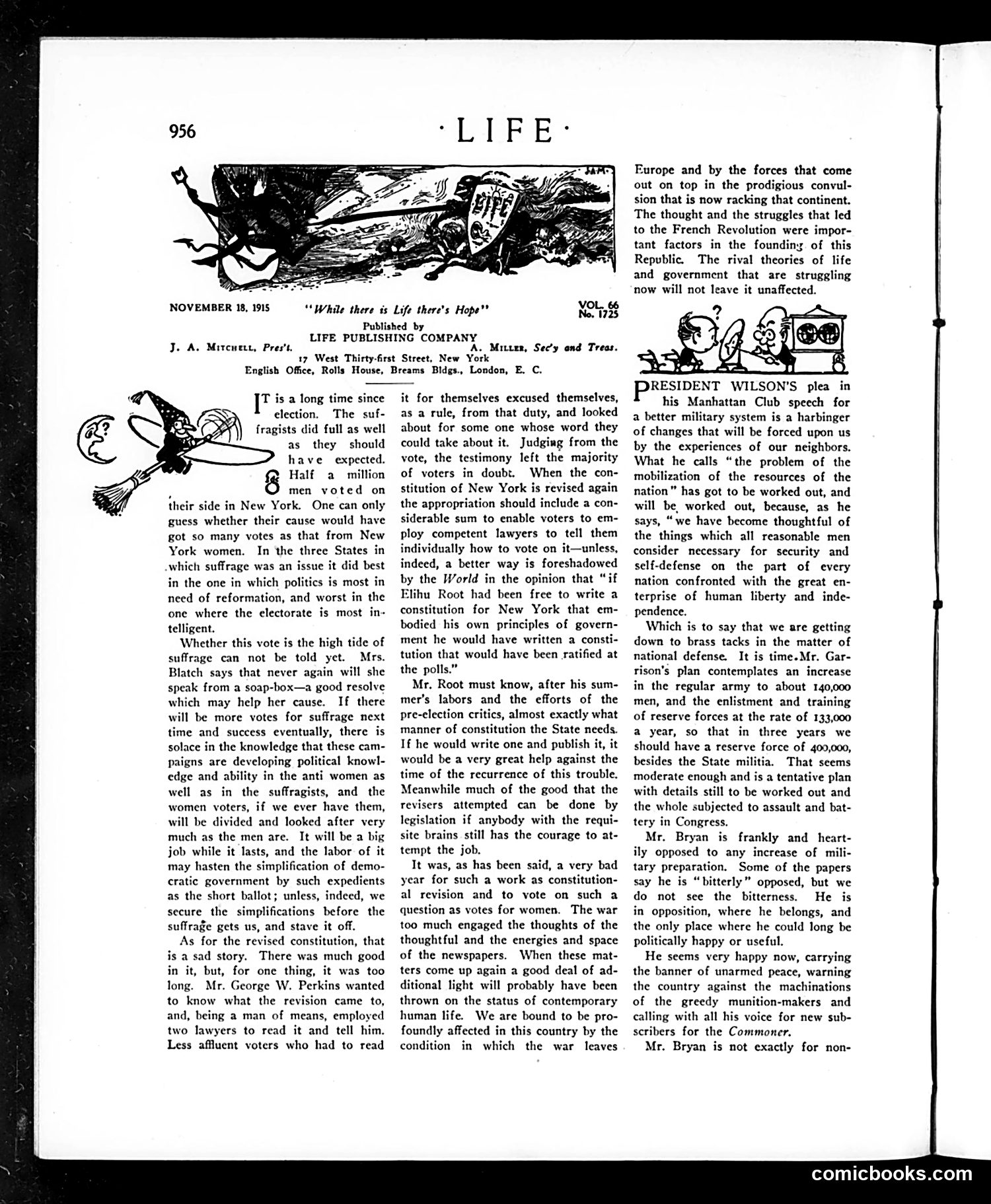
This page discusses recent voting results on women's suffrage and New York's revised state constitution. The left cartoon (artist unclear) depicts the suffrage debate with satirical imagery. **Key points:** The article notes that suffrage measures passed in three states, though the results were mixed. It criticizes voters' lack of engagement with the lengthy revised constitution—so complex that wealthy businessman George W. Perkins had to hire lawyers to explain it to him. Poorer voters simply guessed. The piece sarcastically suggests that future constitutional revisions should budget funds so ordinary citizens can afford lawyers to tell them how to vote, since the document was incomprehensible to the electorate. **Context:** This reflects 1915 debates over women's voting rights (suffrage was granted nationally in 1920) and public frustration with overly complex legal documents. The satire targets both voter apathy and the gap between rich and poor in accessing political information.
📄 Transcribed text from this page (OCR, searchable)
Machine-transcribed from the original scan — historical spelling and the odd misread are preserved.
NOVEMBER 18, 1915 “While there ts Life there's Hope" No, 1725 Published by LIFE PUBLISHING COMPANY A. Mittzr, Sec’y ond Treas. 17 West Thirty-first Street, New York English Office, Rolls House, Breams Bldgs. J. A. Mircuett, Pres't, T is a long time since election. The suf- fragists did full as well as they should have expected. @ Half a_ million z men voted on their side in New York. One can only guess whether their cause would have got so many votes as that from New York women. In the three States in which suffrage was an issue it did best in the one in which politics is most in need of reformation, and worst in the one where the electorate is most in- telligent. Whether this vote is the high tide of suffrage can not be told yet. Mrs. Blatch says that never again will she speak from a soap-box—a good resolve which may help her cause. If there will be more votes for suffrage next time and success eventually, there is solace in the knowledge that these cam- paigns are developing political knowl- edge and ability in the anti women as well as in the suffragists, and the women voters, we ever have them, will be divided and looked after very much as the men are. It will be a big job while it lasts, and the labor of it may hasten the simplification of demo- cratic government by such expedients as the short ballot; unless, indeed, we secure the simplifications before the suffrage gets us, and stave it off. As for the revised constitution, that is a sad story. There was much good in it, but, for one thing, it was too long. Mr. George W. Perkins wanted to know what the revision came to, and, being a man of means, employed two lawyers to read it and tell him. Less affluent voters who had to read London, E. C. it for themselves excused themselves, as a rule, from that duty, and looked about for some one whose word they could take about it, Judging from the vote, the testimony left the majority of voters in doubt. When the con- stitution of New York is revised again the appropriation should include a con- siderable sum to enable voters to em- ploy competent lawyers to tell them individually how to vote on it—unless, indeed, a better way is foreshadowed by the World in the opinion that “if hu Root had been free to write a constitution for New York that em- bodied his own principles of govern- ment he would have written a consti- tution that would have been ratified at the polls.” Mr. Root must know, after his sum- mer’s labors and the efforts of the pre-election critics, almost exactly what manner of constitution the State needs. If he would write one and publish it, it would be a very great help against the time of the recurrence of this trouble, Meanwhile much of the good that the revisers attempted can be done by legislation if anybody with the requi- site brains still has the courage to at- tempt the job. It was, as has been said, a very bad year for such a work as constitution- al revision and to vote on such a question as votes for women. The war too much engaged the thoughts of the thoughtful and the energies and space of the newspapers. When these mat- ters come up again a good deal of ad- ditional light will probably have been thrown on the status of contemporary human life. We are bound to be pro- foundly affected in this country by the condition in which the war leaves Europe and by the forces that come out on top in the prodigious convul- sion that is now racking that continent. The thought and the struggles that led to the French Revolution were impor- tant factors in the founding of this Republic. The rival theories of life and government that are struggling now will not leave it unaffected. RESIDENT WILSON'S plea in his Manhattan Club speech for a better military system is a harbinger of changes that will be forced upon us by the experiences of our neighbors. What he calls “the problem of the mobilization of the resources of the nation” has got to be worked out, and will be, worked out, because, as he says, “we have become thoughtful of the things which all reasonable men consider necessary for security and self-defense on the part of every nation confronted with the great en- terprise of human liberty and inde- pendence. Which is to say that we are getting down to brass tacks in the matter of national defense. It is time.Mr. Gar- rison’s plan contemplates an increase in the regular army to about 140,000 men, and the enlistment and training of reserve forces at the rate of 133,000 a year, so that in three years we should have a reserve force of 400,000, besides the State militia. That seems moderate enough and is a tentative plan with details still to be worked out and the whole subjected to assault and bat- tery in Congress. Mr. Bryan is frankly and hea ily opposed to any increase of mi tary preparation. Some of the papers say he is “bitterly” opposed, but we do not see the bitterness. He is in opposition, where he belongs, and the only place where he could long be politically happy or useful. He seems very happy now, carrying the banner of unarmed peace, warning the country against the machinations of the greedy munition-makers and calling with all his voice for new sub- scribers for the Commoner. Mr. Bryan is not exactly for non- comicbooks.com