
Life, 1915-11-18 · page 29 of 52
Life — November 18, 1915 — page 29: what you’re looking at
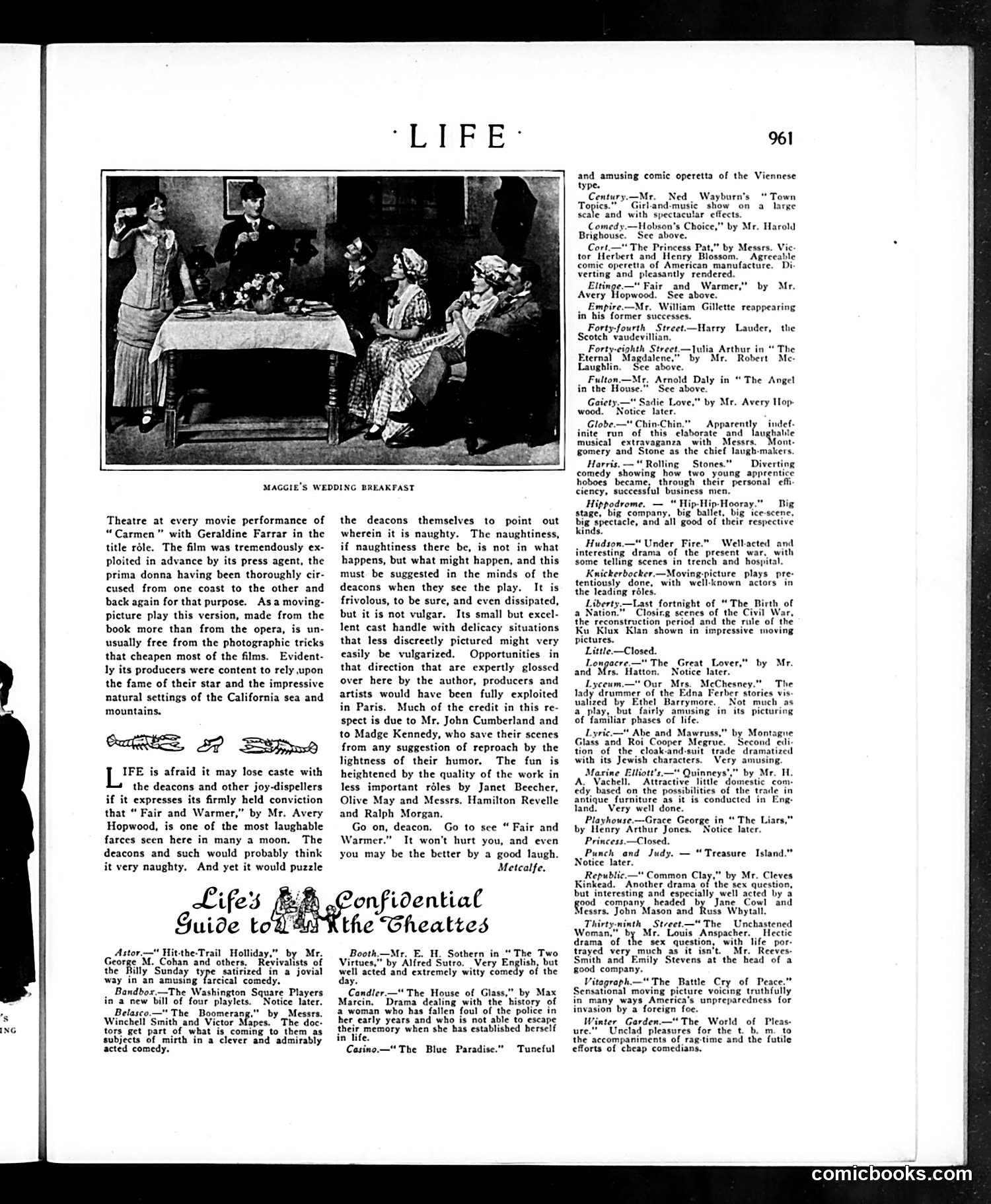
What you’re looking at
This page is primarily a **theatre review column** ("Life's Confidential Guide to the Theatres"), not a political cartoon. The photograph shows a scene from "Maggie's Wedding Breakfast," likely from a film or stage production. The main satirical content targets **moral hypocrisy**. Life's critic defends the farce "Fair and Warmer" as wholesome entertainment, despite expecting religious "deacons" to condemn it as immoral. The joke: the play's naughtiness exists only in viewers' *imaginations*—nothing explicitly vulgar occurs on stage. Life sarcastically suggests deacons themselves couldn't identify what makes it "naughty," implying their prudishness is baseless. The piece mocks **censorious moral guardians** of the era who objected to theatrical content, suggesting their objections reveal more about their own suspicious minds than the material's actual content. The critic invites disapproving clergy to attend, confident they'll actually enjoy it.
📄 Transcribed text from this page (OCR, searchable)
Machine-transcribed from the original scan — historical spelling and the odd misread are preserved.
MAGGIE’S WEDDING BREAKFAST Theatre at every movie performance of “Carmen” with Geraldine Farrar in the title réle. The film was tremendously ex- ploited in advance by its press agent, the prima donna having been thoroughly cir- cused from one coast to the other and back again for that purpose. Asa moving- picture play this version, made from the book more than from the opera, is un- usually free from the photographic tricks that cheapen most of the films. Evident- ly its producers were content to rely upon the fame of their star and the impressive natural settings of the California sea and mountains. OES FF Bs IFE is afraid it may lose caste with the deacons and other joy-dispellers if it expresses its firmly held conviction that “ Fair and Warmer,” by Mr. Avery Hopwood, is one of the most laughable farces seen here in many a moon. The deacons and such would probably think it very naughty. And yet it would puzzle Lifer Guide to “ Hitthe-Trail Holliday,” by Mr, . Cohan and others. Revivalists of the Billy ‘Sunday type satirized in a jovial way in an amusing farcical comedy. _ Bandbox.—The Washington Square Players in a new bill of four playlets. Notice later. Belasco.—" The Boomerang," by _ Messrs. Winchell Smith and Victor Mapes. The doc: tors get part of what is coming to them as subjects of mirth in a clever and admirably acted comedy. the deacons themselves to point out wherein it is naughty. The naughtiness, if naughtiness there be, is not in what happens, but what might happen, and this must be suggested in the minds of the deacons when they see the play. It is frivolous, to be sure, and even dissipated, but it is not vulgar. Its small but excel- lent cast handle with delicacy situations that less discreetly pictured might very easily be vulgarized. Opportunities in that direction that are expertly glossed over here by the author, producers and artists would have been fully exploited in Paris. Much of the credit in this re- spect is due to Mr. John Cumberland and to Madge Kennedy, who save their scenes from any suggestion of reproach by the lightness of their humor. The fun is heightened by the quality of the work in less important réles by Janet Beecher, Olive May and Messrs, Hamilton Revelle and Ralph Morgan. Go on, deacon. Go to sce “ Fair and Warmer.” It won't hurt you, and even you may be the better by a good laugh. Metcalfe. onfidential the Gheattes Booth.—Mr. E. H. Sothern in “The Two Virtues,” by Alfred Sutro. Very English, but ell acted and extremely witty comedy of the lay. Candler.— The House of Glass,” by Max Marcin, Drama dealing with the history of a woman who has fallen foul of the police in her early years and who is not able to escape their memory when she has established herself in life. Casino.. The Blue Paradise.” Tuneful 961 and amusing comic operetta of the Viennese type. Century.—Mr. Ned Wayburn’s “Town Topics.” Girl-and-music show on a large scale and with spectacular effects. Comedy.—Hobson’s Choice,” by Mr. Harold Brighouse. See above. Cort.—" The Princess Pat,” by Messrs. Vic tor Herbert and Henry Blossom. Agreeable comic operetta of American manufacture. Di verting and pleasantly rendered. Eltinge—" Fair and Warmer,’ Avery Hopwood. See above. _ Empire.—Mr. William Gillette reappearing in his former successes. Forty-fourth Street.—Harry Lauder, the Scotch’ vaudevillian, Forty-eighth Street—Julia Arthur in “ The Eternal Magdalene,” by Mr. Robert Me: Laughlin. above. _ Fulton.—Mr, Arnold Daly in “The Angel in the House. “See above. Gaiety —" Sadie Love,” by Mr. Avery Hop- wood. Notice later. Globe.—" Chin-Chin.” inite run of this elaborate and faughal musical extravaganza with Messrs. Mor gomery and Stone as the chief laugh-makers. Harris. —“ Rolling Stones." __Diverting comedy showing how two young apprentice hoboes became, through their personal effi ciency, successful business men. Hippodrome. — “ Hip-Hip-Hooray.” Big stage, big company, big ballet, big ice-scene, big spectacle, and all good of their respective kinds. Hudson.—" Under Fire.” Well-acted and interesting drama of the present war. with some telling scenes in trench and hospital. Knickerbocker.—Moving-picture plays pre: tentiously done, with well-known actors in the leading réles. Liberty.—Last fortnight of “The Birth, of a Nation.” ig scenes of the Civil War, the reconstruction period and the rule of the Ku Klux Klan shown in impressive moving pictures. Little—Closed. Longacre.—" The and Mrs. Hatton, Notice later. Lyceum.—" Our Mrs. McChesney." The lady drummer of the Edna Ferber stories vis. ualized by Ethel Barrymore. Not much as a play, but fairly amusing in its picturing of familiar phases of life. Lyric—" Abe and Mawruss,” by Montagne Glass and Roi Cooper Megrue. Second edi tion of the cloak-and-suit trade dramatized with its Jewish characters. Very amusing Marine Eltiott’s:— Quinneys’.” by Mr. H. A. Vachell, “Attractive little domestic ¢ edy based on the possibilities of the trade in antique furniture as it is conducted in Eng- land. Very well done. Playhouse.—Grace George in “ The Liars,” by Henry Arthur Jones, Notice later. Princess.—Closed. Punch and Judy. — “Treasure Island.” Notice later. Republic.—" Common Clay," by Mr. Cleves Kinkead. Another drama of the sex question, but interesting and especially well acted by a Read company headed by. Jane Cowl and Messrs. John Mason and Russ Whytall, Thirty-ninth | Street.—“ The _Unchastened Woman,” by Mr. Louis Anspacher. Hectic drama of the sex question, with life por- trayed very much as it isn't. Mr. Reeves- Smith and Emily Stevens at the head of a good company. Vitagraph.—" The Battle Cry of Peace.” Sensational moving picture voicing truthfully in many ways America’s unpreparedness for invasion by a foreign foe. ter Garden.—"The World of Pleas- Unclad pleasures for the t. b. m. to the accompaniments of rag-time and the futile efforts of cheap comedians. by Mr. Apparently | indef- au Great Lover," by Mr, comicbooks.com