
Life, 1915-11-18 · page 21 of 52
Life — November 18, 1915 — page 21: what you’re looking at
What you’re looking at
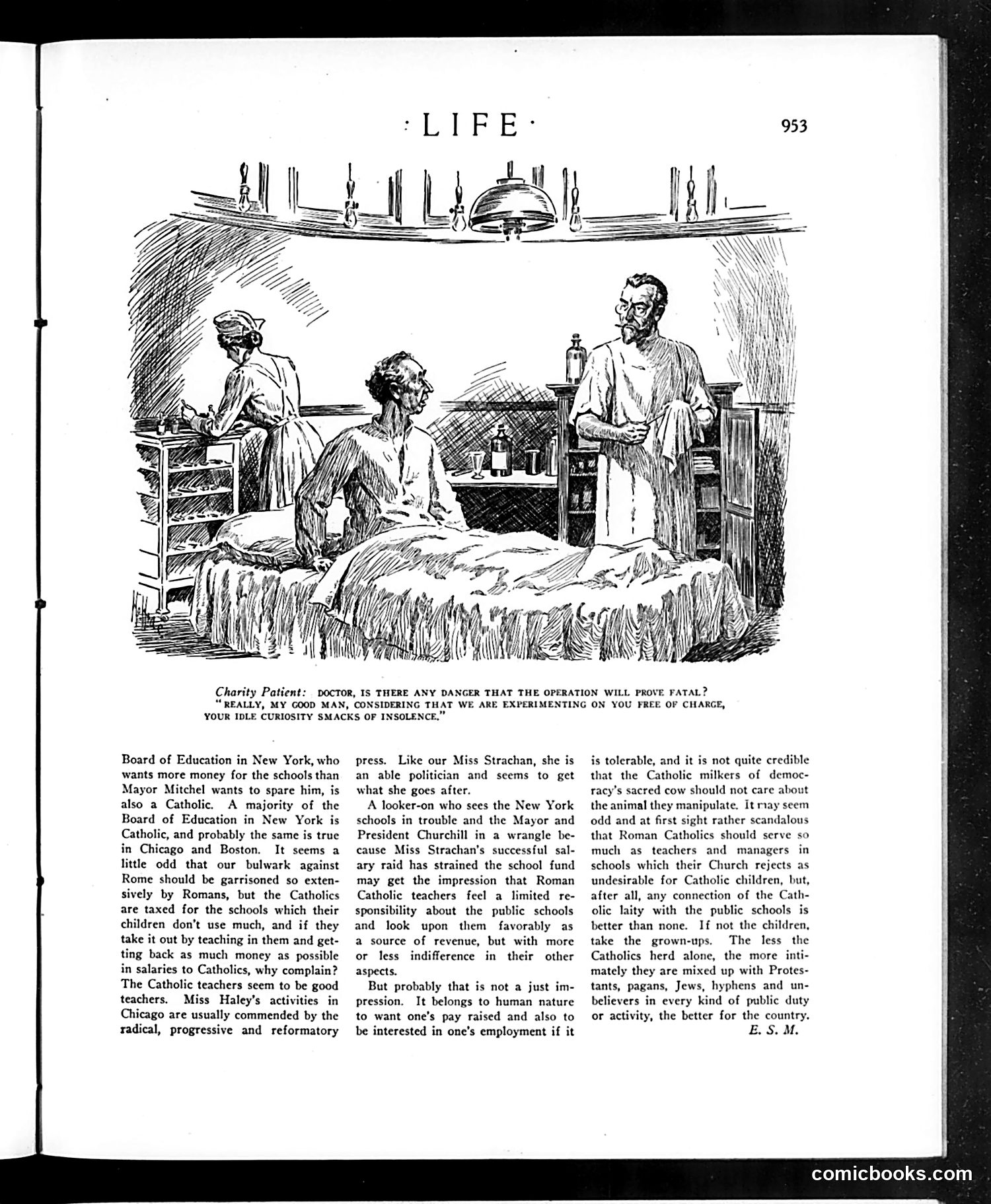
The cartoon depicts a doctor dismissing a charity patient's legitimate medical concern about experimental surgery with arrogant condescension—the joke being that the patient should be grateful for free (if dangerous) treatment rather than asking reasonable questions. The accompanying article addresses New York's Board of Education conflicts, specifically mentioning salary disputes led by Catholic educators (likely referencing activist teachers like Miss Haley and Miss Strachan). The text expresses ambivalence about Catholic dominance in public school administration, framing it as paradoxical: Catholics reject public schools for their own children yet aggressively advocate for teacher salaries within them. The article ultimately argues this is acceptable because Catholic involvement in public institutions promotes religious and ethnic integration ("mixed up with Protestants, pagans, Jews...") rather than Catholic isolation. The rhetoric reflects early 20th-century anxieties about Catholic institutional power and assimilation into American public life.
📄 Transcribed text from this page (OCR, searchable)
Machine-transcribed from the original scan — historical spelling and the odd misread are preserved.
Charity Patient: DOCTOR, IS THERE ANY DANGER THAT THE OPERATION WILL PROVE FATAL? “REALLY, MY GOOD MAN, CONSIDERING THAT WE ARE EXPERIMENTING ON YOU FREE OF CHARGE, YOUR IDLE CURIOSITY SMACKS OF INSOLENCE.” Board of Education in New York, who wants more money for the schools than Mayor Mitchel wants to spare him, is also a Catholic. A majority of the Board of Education in New York is Catholic, and probably the same is true in Chicago and Boston. It seems a little odd that our bulwark against Rome should be garrisoned so exten- sively by Romans, but the Catholics are taxed for the schools which their children don’t use much, and if they take it out by teaching in them and get- ting back as much money as possible in salaries to Catholics, why complain? The Catholic teachers seem to be good teachers. Miss Haley’s activities in Chicago are usually commended by the radical, progressive and reformatory press. Like our Miss Strachan, she is an able politician and seems to get what she goes after. A looker-on who sees the New York schools in trouble and the Mayor and President Churchill in a wrangle be- cause Miss Strachan's successful sal- ary raid has strained the school fund may get the impression that Roman Catholic teachers feel a limited re- sponsibility about the public schools and look upon them favorably as a source of revenue, but with more or less indifference in their other aspects. But probably that is not a just im- pression. It belongs to human nature to want one’s pay raised and also to be interested in one’s employment if it is tolerable, and it is not quite credible that the Catholic milkers of democ- racy’s sacred cow should not care about the animal they manipulate. It may seem odd and at first sight rather scandalous that Roman Catholics should serve so much as teachers and managers in schools which their Church rejects as undesirable for Catholic children, but, after all, any connection of the Cath- olic laity with the public schools is better than none. If not the children, take the grown-ups. The less the Catholics herd alone, the more inti- mately they are mixed up with Protes- tants, pagans, Jews, hyphens and un- believers in every kind of public duty or activity, the better for the country. E.S. M. comicbooks.com