
Life, 1915-11-18 · page 20 of 52
Life — November 18, 1915 — page 20: what you’re looking at
What you’re looking at
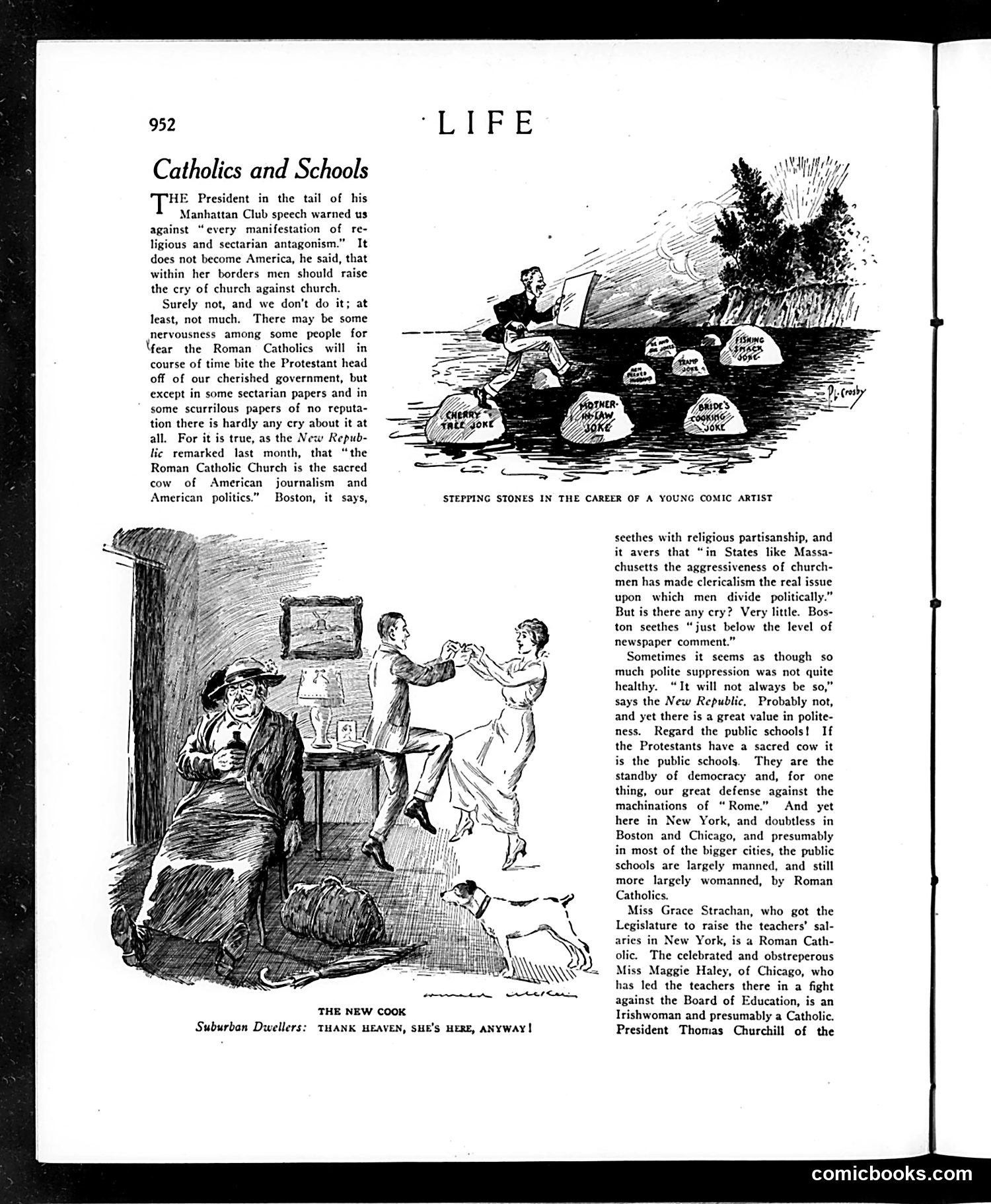
This 1920s *Life* magazine article satirizes American religious tensions, particularly Catholic-Protestant anxieties about public institutions. **The cartoons illustrate the article's ironic argument:** The top cartoon ("Stepping Stones") shows a young artist navigating obstacles labeled "Cherry Tree Joke," "Mother-in-Law Joke," "Bride's Bedroom Joke," etc.—depicting conventional comic material as career hurdles. The bottom cartoon ("The New Cook") shows suburban dwellers relieved to hire a cook, with the caption "Thank Heaven, she's here, anyway!" This likely references anxiety about Catholic immigrants (often Irish) entering traditionally Protestant-dominated American households and institutions. **The article's point:** Despite a President's warning against religious antagonism, Americans largely suppress discussion of real Catholic-Protestant divisions. Ironically, while Protestants fear Catholic influence on democracy through public schools, those very schools are staffed by Catholics like Grace Strachan and Maggie Haley—revealing the hypocrisy of polite silence about genuine sectarian tensions. The satire critiques both suppressed anxiety and institutional reality.
📄 Transcribed text from this page (OCR, searchable)
Machine-transcribed from the original scan — historical spelling and the odd misread are preserved.
952 Catholics and Schools 'HE President in the tail of his Manhattan Club speech warned us against “every manifestation of re- ligious and sectarian antagonism.” It does not become America, he said, that within her borders men should raise the cry of church against church. Surely not, and we don’t do it; at least, not much. There may be some Mervousness among some people for Year the Roman Catholics will in course of time bite the Protestant head off of our cherished government, but except in some sectarian papers and in some scurrilous papers of no reputa- tion there is hardly any cry about it at all. For it is true, as the New Repub- lic remarked last month, that “the Roman Catholic Church is the sacred cow of American journalism and American politics.” Boston, it says, STEPPING STONES IN THE CAREER OF A YOUNG COMIC ARTIST seethes with religious partisanship, and it avers that “in States like Massa- chusetts the aggressiveness of church- men has made clericalism the real issue upon which men divide politically.” But is there any cry? Very little. Bos- ton seethes “just below the level of newspaper comment.” Sometimes it seems as though so much polite suppression was not quite healthy. “It will not always be so,” says the New Republic, Probably not, and yet there is a great value in polite- ness. Regard the public schools! If the Protestants have a sacred cow it is the public schools. They are the standby of democracy and, for one thing, our great defense against the machinations of “Rome.” And yet here in New York, and doubtless in Boston and Chicago, and presumably in most of the bigger cities, the public schools are largely manned, and still more largely womanned, by Roman Catholics. Miss Grace Strachan, who got the Legislature to raise the teachers’ sal- aries in New York, is a Roman Cath- olic. The celebrated and obstreperous Miss Maggie Haley, of Chicago, who has led the teachers there in a fight against the Board of Education, is an THE NEW COOK Irishwoman and presumably a Catholic. Suburban Dwellers: THANK HEAVEN, SHE'S HERE, ANYWAY! President Thomas Churchill of the comicbooks.com