
A complete issue · 56 pages · 1915
Life — November 4, 1915
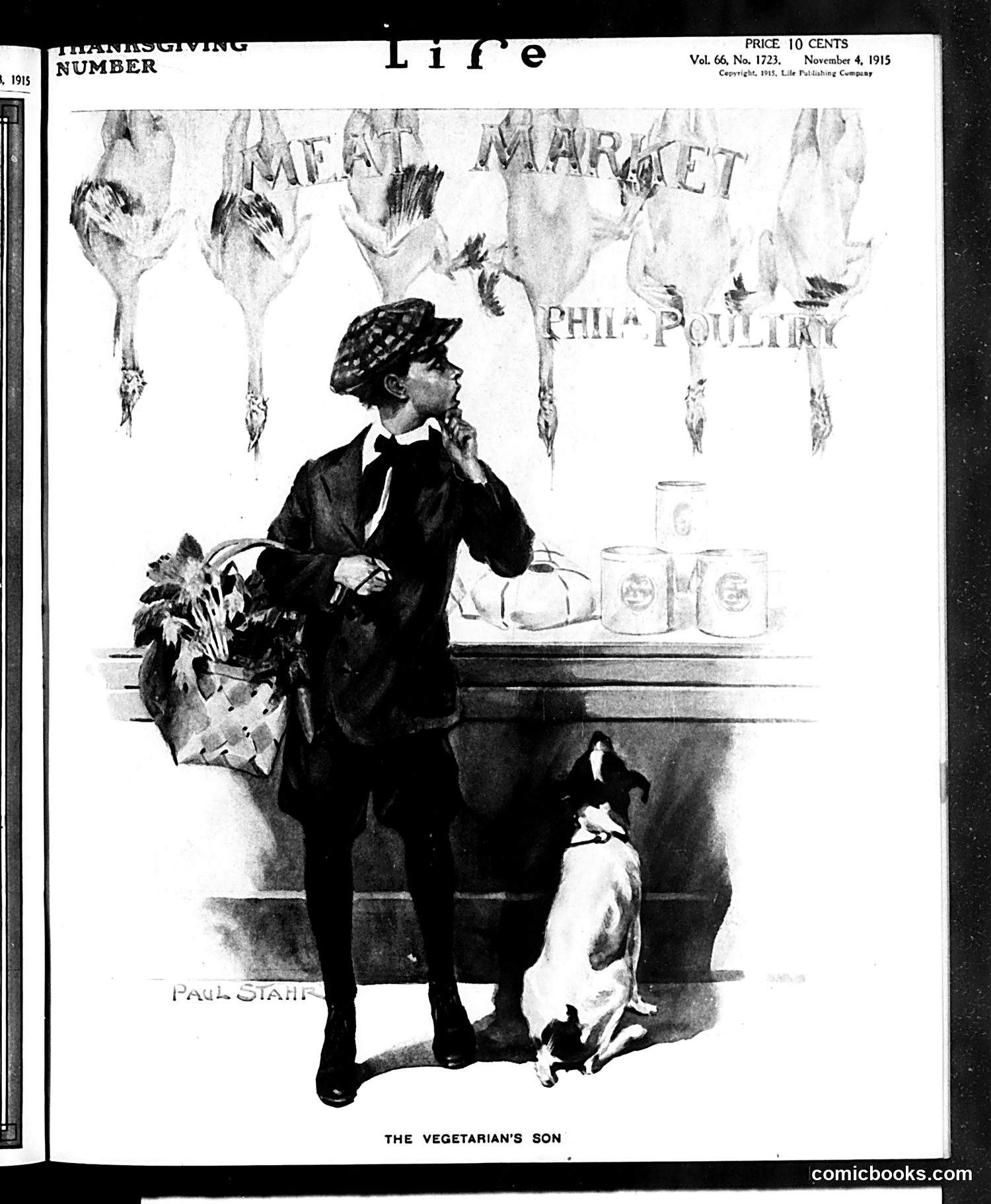
This Thanksgiving issue cartoon by Paul Stahl satirizes vegetarianism through a humorous domestic scene. A well-dressed man at a meat market counter (labeled "MEAT MARKET" and "PHILA POULTRY") appears conflicted, looking away from hanging poultry and dressed meats while holding vegetables. A small dog at his feet also looks away from the meat display. The joke targets the contradiction between vegetarian ideology and practical reality—the man is apparently a vegetarian whose principles are tested at an actual meat market during Thanksgiving season, traditionally centered on turkey or poultry. The dog's similar avoidance suggests even animals find the abstinence amusing. The cartoon mocks vegetarianism as pretentious or difficult to maintain, particularly during holiday season.
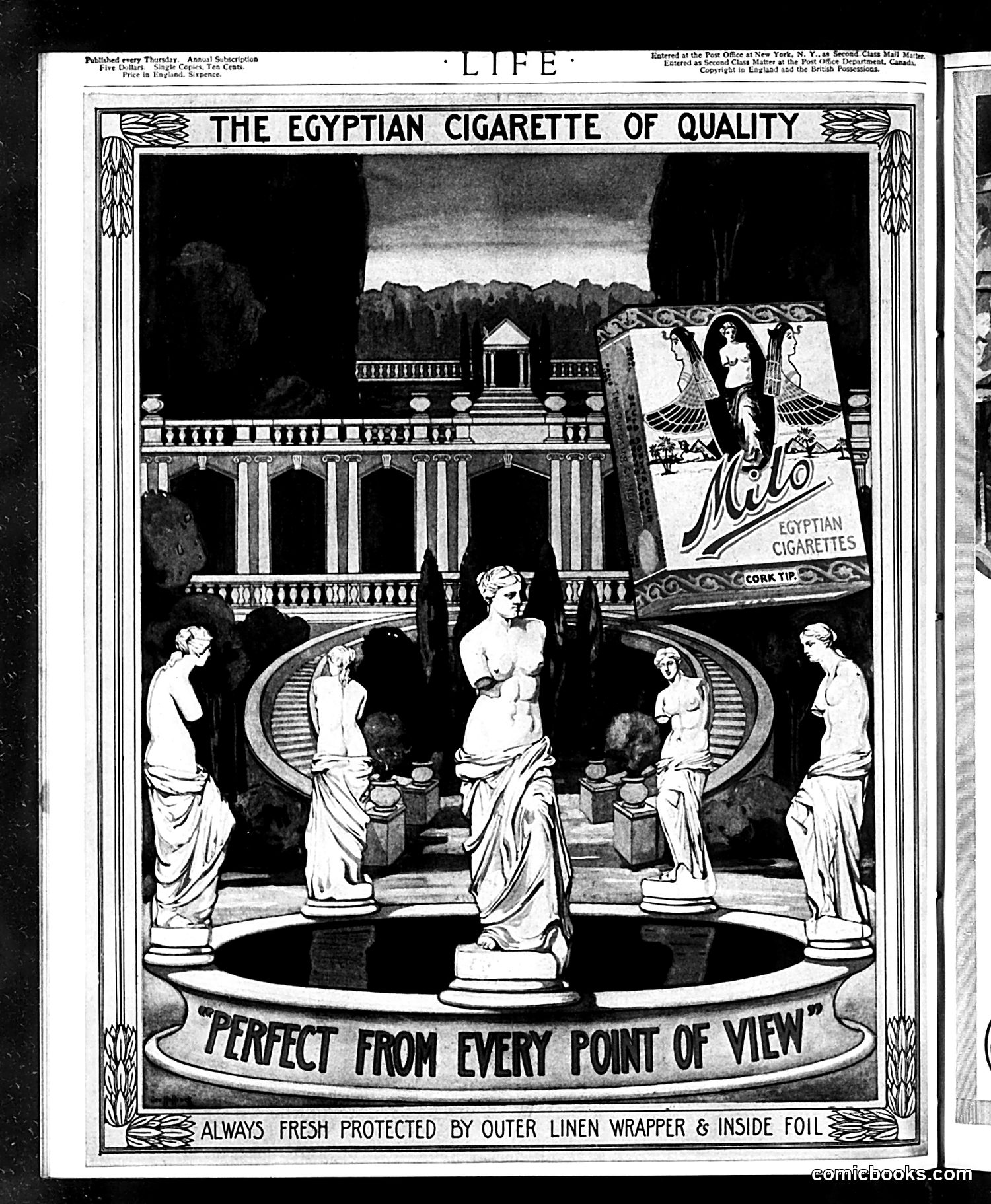
This is primarily a **cigarette advertisement**, not political satire. It's an advertisement for Milo brand Egyptian cigarettes, appearing in Life magazine. The ad depicts classical statuary and architecture—nude female figures posed around a decorative pool in an ornate palatial setting—creating an association between the product and luxury, refinement, and timeless elegance. The "Egyptian" branding references the tobacco's origin. The tagline "Perfect From Every Point of View" emphasizes product quality. Text at bottom notes the cigarettes are "Always Fresh Protected by Outer Linen Wrapper & Inside Foil." This represents typical early-20th-century advertising strategy: using classical aesthetics and suggestive imagery to market luxury consumer goods. By modern standards, the semi-nude imagery would be considered inappropriate for mainstream advertising.
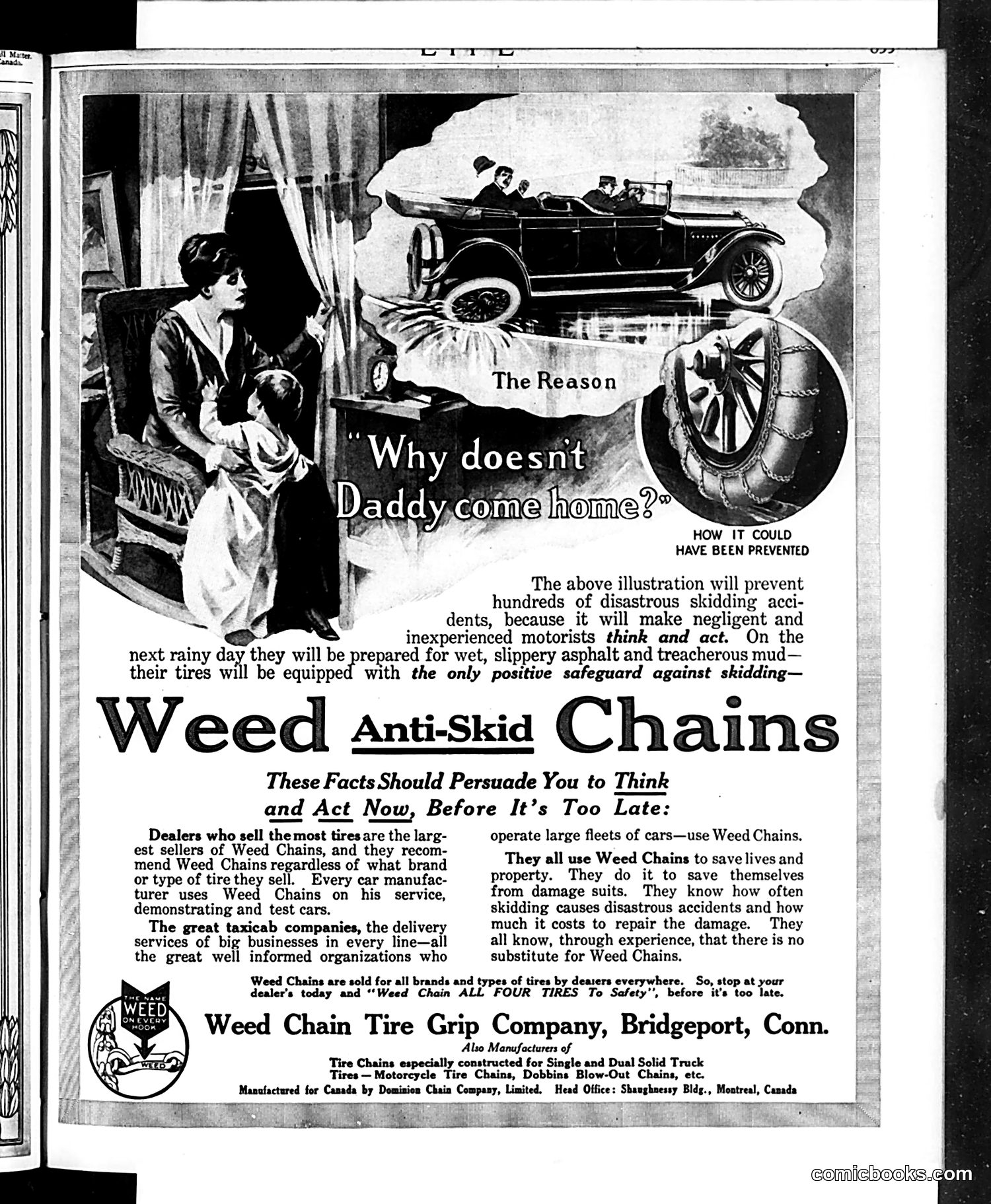
This is primarily a **product advertisement**, not satire or political commentary. It promotes Weed Anti-Skid Chains, tire safety devices. The advertisement uses emotional appeal rather than humor: it depicts a mother and child asking "Why doesn't Daddy come home?"—implying the father died in a car accident caused by skidding. The illustration shows a car accident scene. The ad's argument is straightforward: winter driving on wet roads causes skidding accidents; tire chains prevent this. It appeals to family safety concerns, suggesting chains are "the only positive safeguard against skidding." The ad emphasizes that taxi companies, delivery services, and large fleet operators use Weed Chains because they understand accident costs and liability. This represents early automotive safety advertising using fear-based messaging common in the 1910s-1920s.
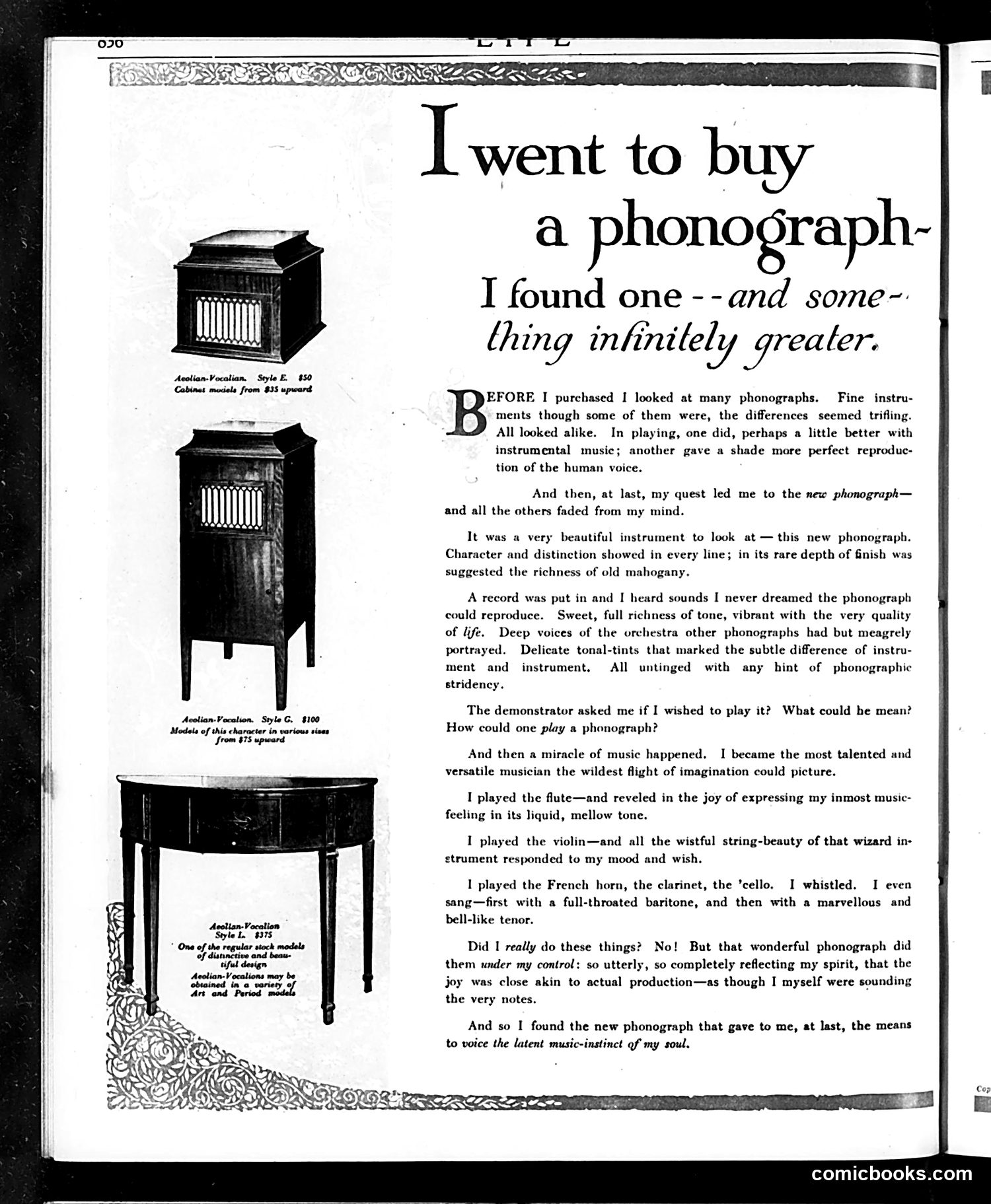
This is **not a political cartoon**, but rather a **phonograph advertisement** disguised as editorial content—a common early 20th-century marketing technique. The piece describes someone who went shopping for a phonograph and discovered one model so superior it made all others irrelevant. The narrative emphasizes the phonograph's ability to reproduce music with such fidelity that the owner could play various instruments (flute, violin, French horn, clarinet, cello) and even sing through it, as if they themselves were performing. The three product images on the left show different **Aeolian-Vocalion phonograph models** at various price points ($150-$175). The advertisement's emotional appeal—claiming the machine "gave voice to the latent music-instinct of my soul"—was typical promotional hyperbole for early audio technology, positioning the phonograph as almost miraculous in capability.
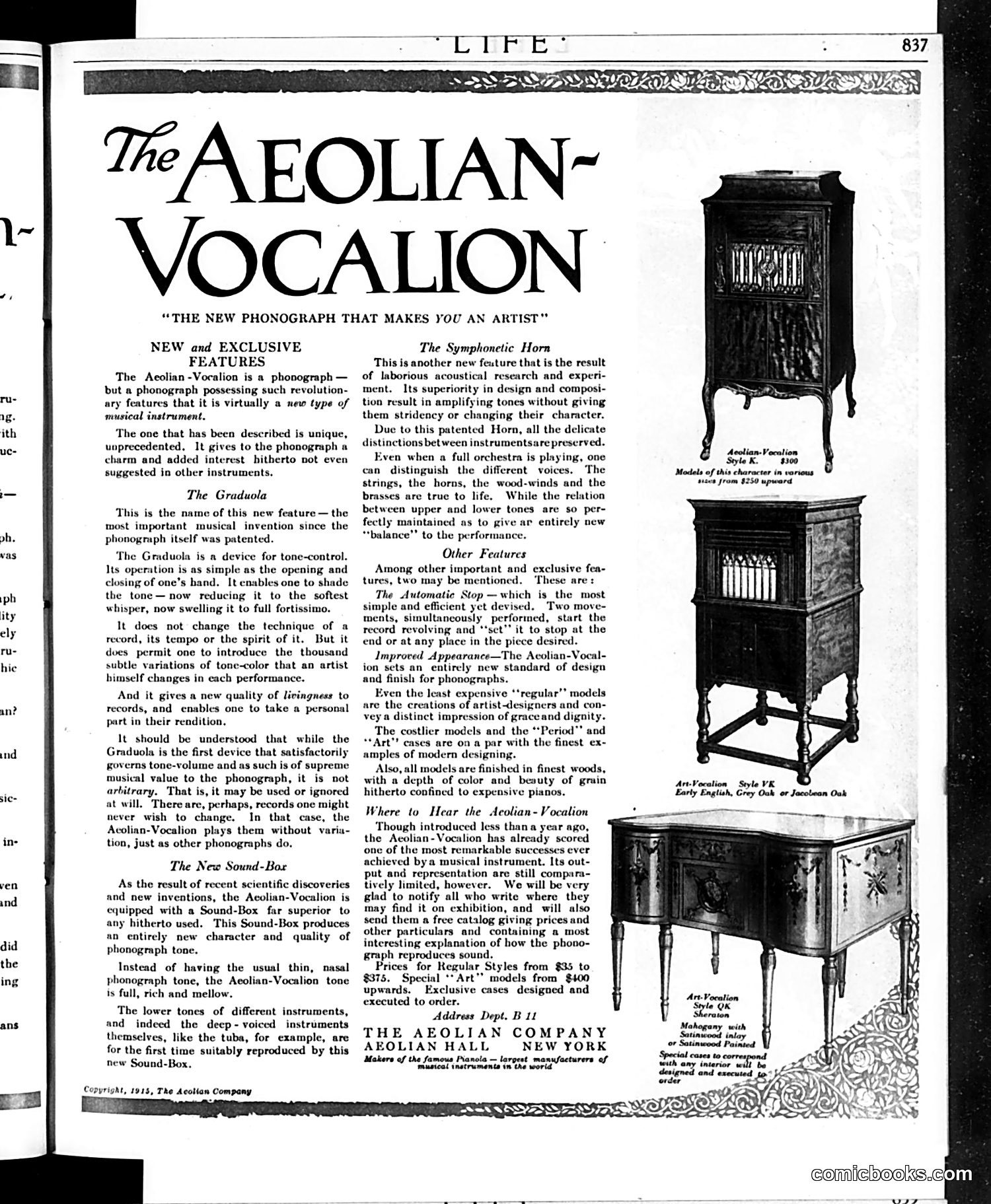
This page is **primarily advertising**, not political satire or cartoon content. It's a full-page advertisement for the Aeolian-Vocalion phonograph, published in *Life* magazine (page 837). The ad promotes the phonograph as revolutionary ("makes YOU an artist"), highlighting technical features like the "Graduela" tone control and "Sympathetic Horn." It emphasizes superior sound quality and elegant cabinet designs finished in fine woods. The copy targets affluent consumers, with "Regular" models priced from $35 to $200 and exclusive "Period" and "Art" cases reaching $400+. The ad includes product images and directs readers to Aeolian Hall in New York for demonstrations. This represents early 20th-century consumer marketing rather than editorial satire or political commentary.
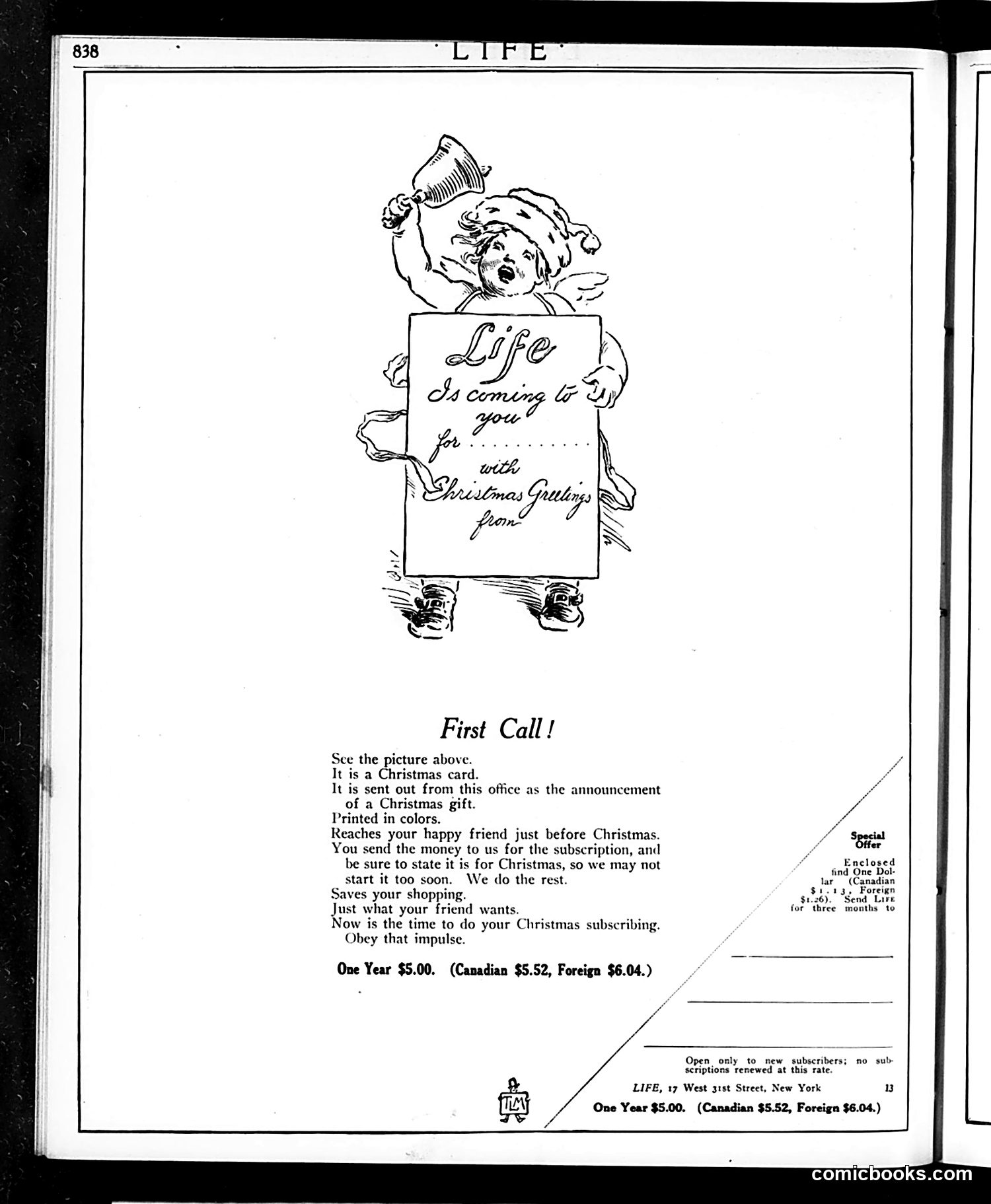
This is primarily a **Christmas subscription advertisement** for Life magazine, not a political cartoon. The image shows a cheerful cherub or angel figure holding a sign that reads "Life is coming to you for you with Christmas Greetings from" — essentially advertising Life as a gift subscription. The "First Call!" headline announces this as an early Christmas shopping opportunity. The copy emphasizes convenience: subscribers send money to the Life office, which mails the magazine to recipients as a surprise gift, arriving before Christmas. The pricing ($5.00 for one year; $5.52 Canadian; $6.04 Foreign) and the special offer details appear in the right margin. This is straightforward commercial messaging dressed in festive imagery, typical of early-20th-century magazine promotion.
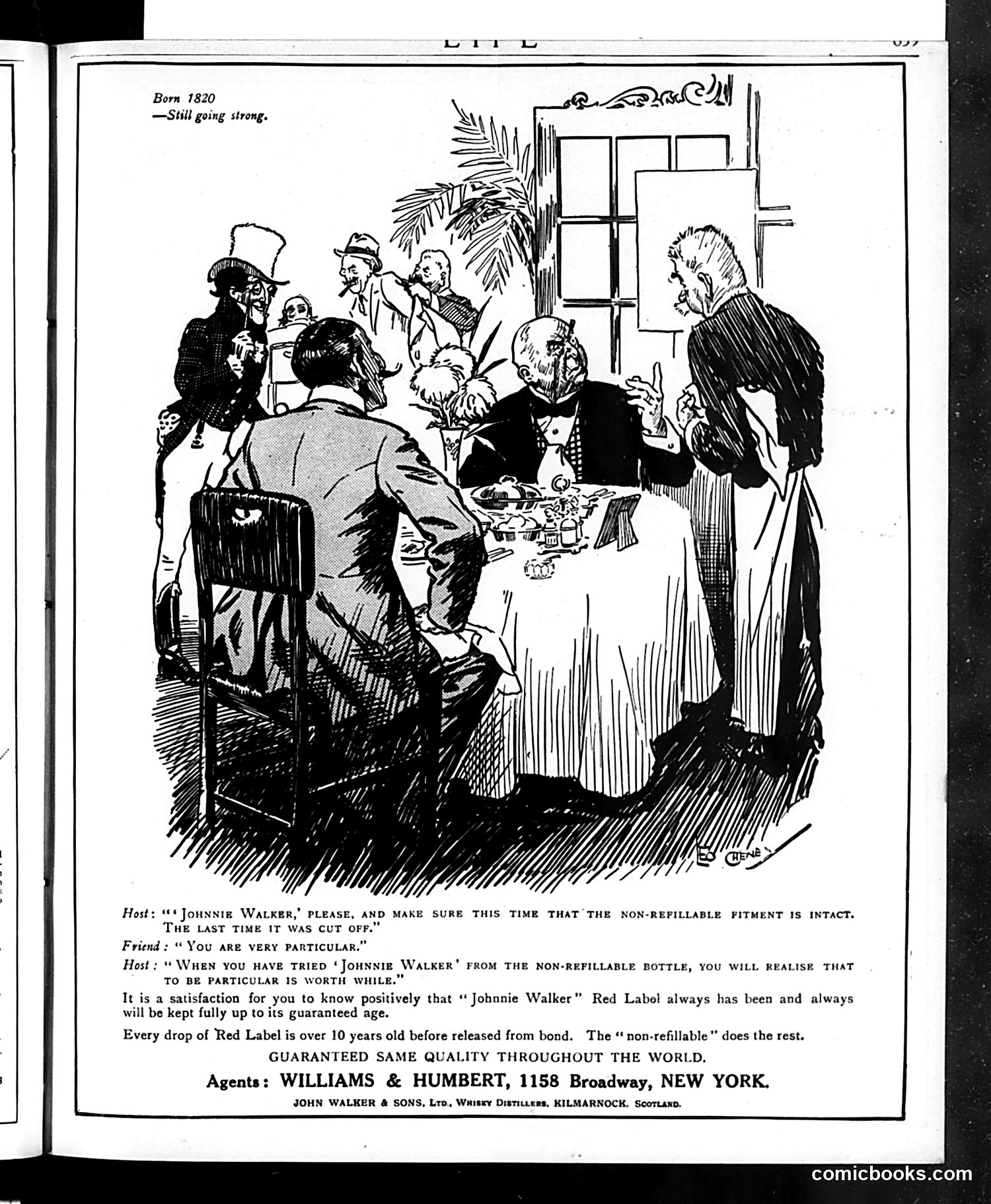
This page is primarily **advertising**, not political satire. It's a Johnnie Walker Red Label whisky advertisement disguised as an editorial cartoon. The illustration shows a social gathering where a host instructs a servant to ensure a bottle of Johnnie Walker has an "intact" non-refillable seal—implying that counterfeit or refilled bottles were a known consumer concern in this era. The dialogue plays on this anxiety: the host boasts about the whisky's guaranteed age (over 10 years old) and quality, while his friend responds that being "particular" about authenticity "is worth while." The advertisement emphasizes brand integrity and authenticity as selling points, suggesting that product counterfeiting was a real marketplace problem when this ad ran.
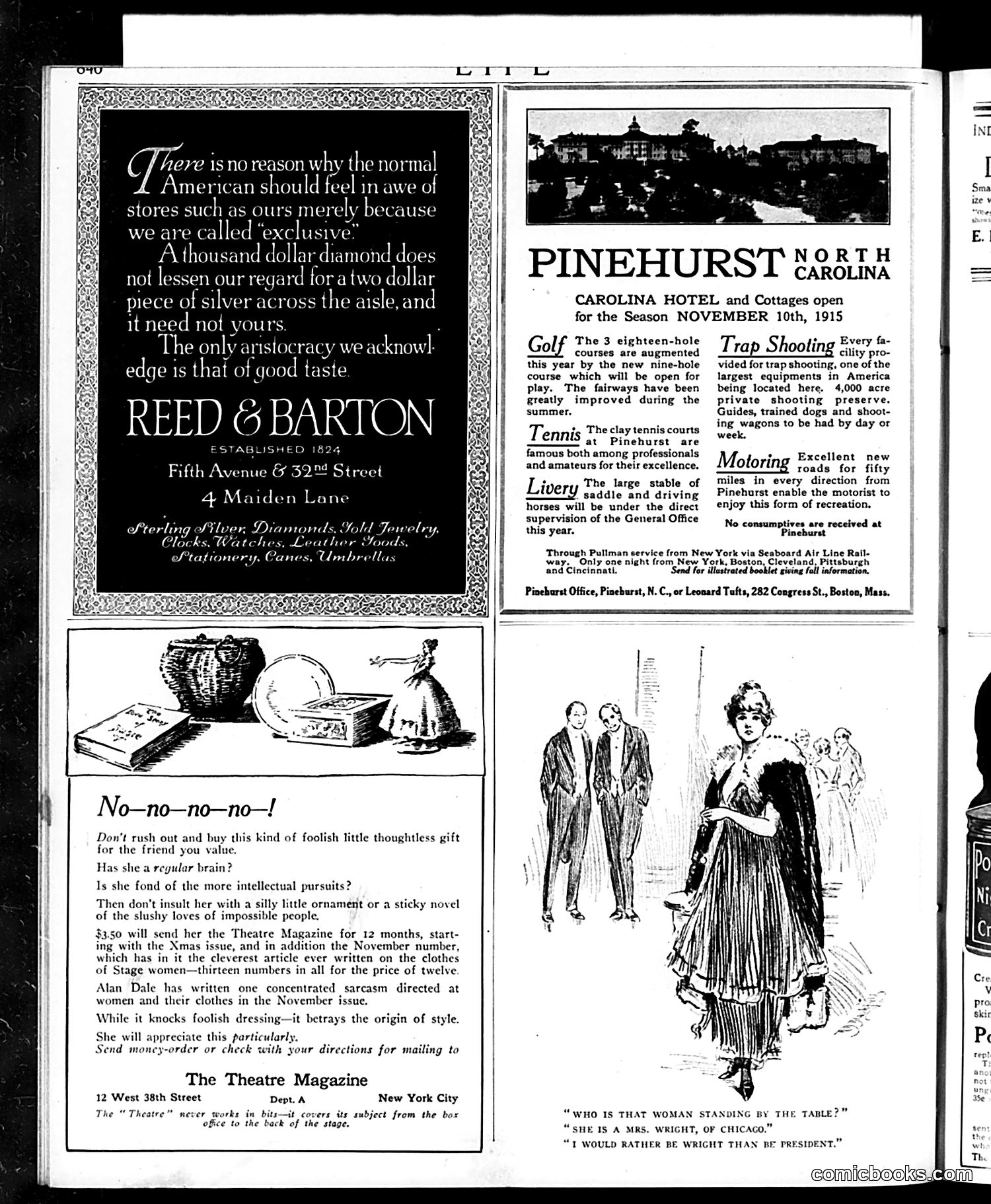
This page is primarily **advertisements** (Reed & Barton jewelry, Pinehurst resort) with one satirical cartoon about gift-giving. The cartoon mocks giving women intellectually insulting gifts. It warns against buying "foolish little thoughtless gift[s]" like ornaments or cheap novels for intelligent women. The satire suggests that such gifts insult female recipients by implying they lack serious interests. The solution offered is *Theatre Magazine*—positioned as proof of respect for women's intellectual pursuits. The sarcasm is subtle: Life sarcastically endorses Theatre Magazine as the sophisticated alternative to trinkets, implying that even magazine subscriptions beat treating women as decorative objects rather than thinking people. The cartoon reflects early 20th-century debates about women's intellectual capacity and appropriate gender roles.
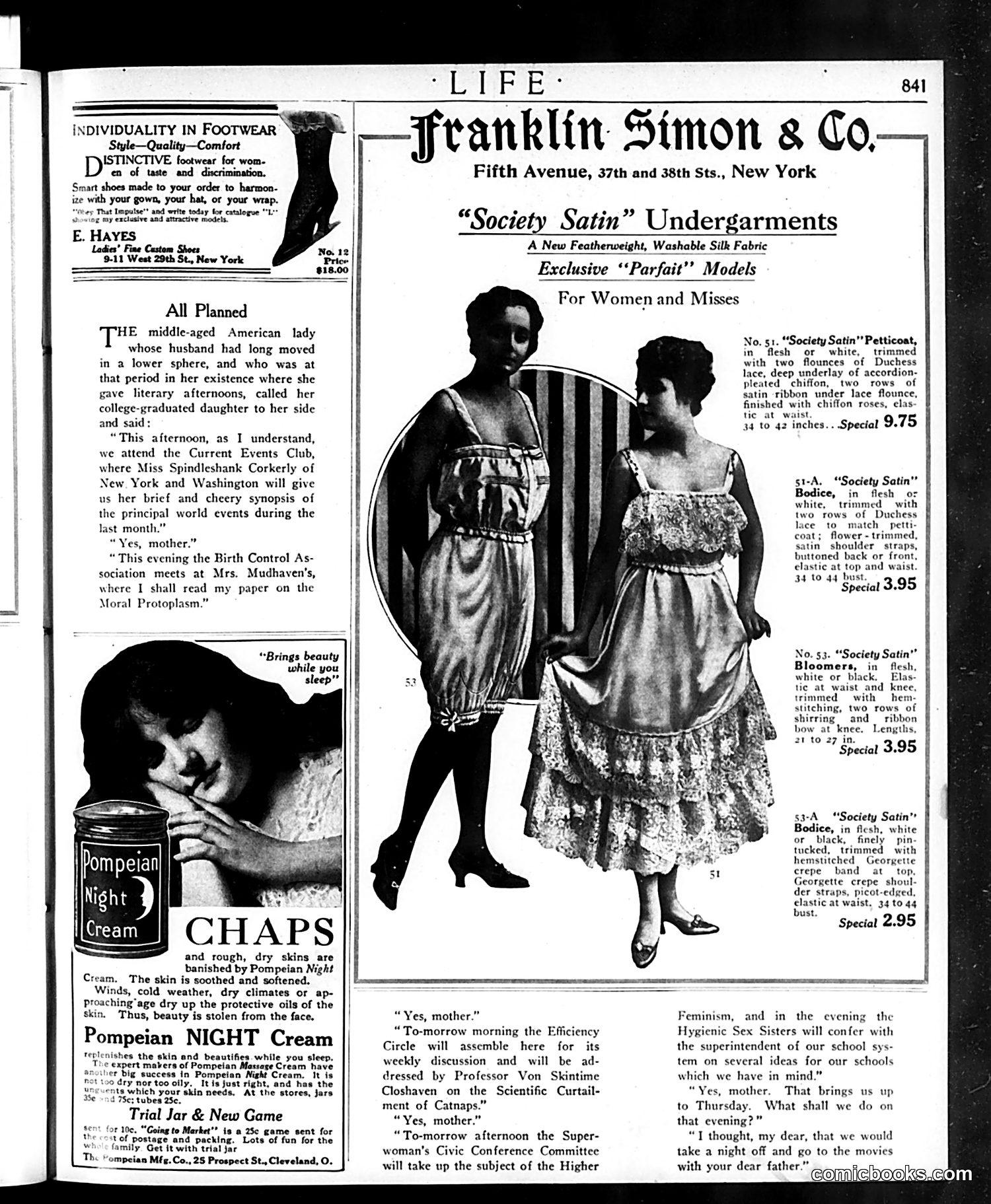
This page is primarily **advertising**, not political satire. It contains four distinct ads: 1. **E. Hayes Footwear** — promoting custom shoes for women 2. **Franklin Simon & Co.** — advertising "Society Satin" undergarments (petticoats, bodices, bloomers) with prices ranging from $2.95-$9.75 3. **Pompeian Night Cream** — a skincare product addressing chapped, dry skin 4. A narrative snippet titled **"All Planned"** — a satirical domestic dialogue where a middle-class wife describes attending various women's clubs and meetings (Current Events Club, Birth Control Association, Efficiency Circle, Superwoman's Civic Conference), to her bemused husband The "All Planned" section gently satirizes the proliferation of women's social and activist organizations in this era, poking fun at the busy social calendar of modern women. The humor lies in the husband's confused acceptance of his wife's numerous commitments.
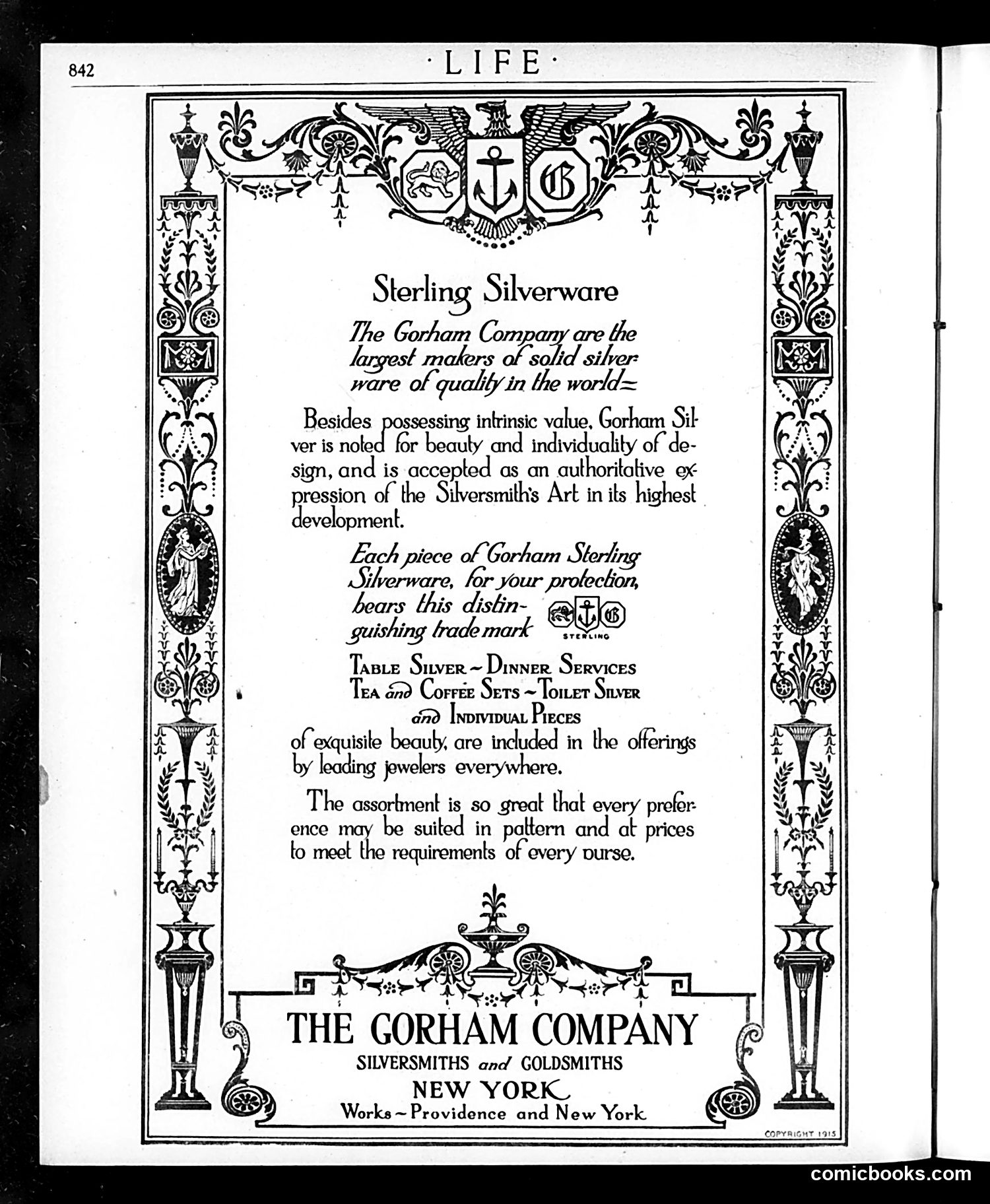
This is an **advertisement**, not a cartoon or satirical content. The page promotes The Gorham Company, a silversmith and goldsmith business based in New York with works in Providence and New York. The ad emphasizes that Gorham produces "the largest makers of solid silver ware of quality in the world." It highlights their sterling silverware's "beauty and individuality of design" and claims it represents "the Silversmith's Art in its highest development." The advertisement lists product categories (table silver, dinner services, tea and coffee sets, toilet silver, and individual pieces) and promises an assortment large enough to suit "every preference...in pattern and at prices to meet the requirements of every purse." The ornate decorative border is typical of early 20th-century luxury goods advertising.
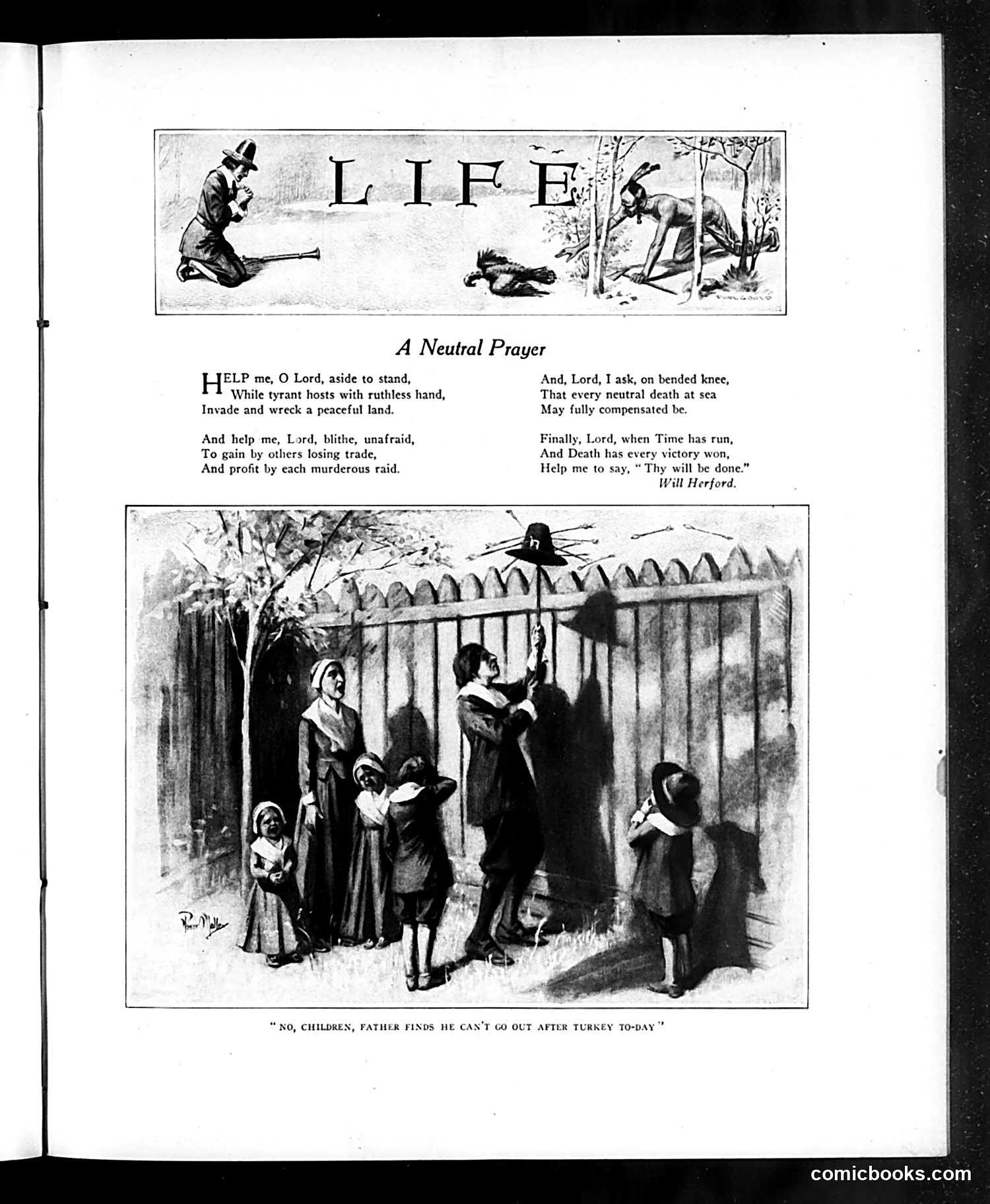
This page satirizes American neutrality during World War I. The poem "A Neutral Prayer" by Will Herford mocks those seeking to profit from the war while remaining officially neutral—praying to "gain by others losing trade" and "profit by each murderous raid." The lower cartoon depicts a mother telling her children that "Father finds he can't go out after turkey to-day," likely referencing food rationing or shortages affecting American civilians during wartime. Together, these pieces critique the hypocrisy of American neutrality: wealthy individuals profiting from European conflict while ordinary families face domestic hardship. The satire targets both greedy profiteers and the inadequacy of official neutrality as a moral position during global crisis.
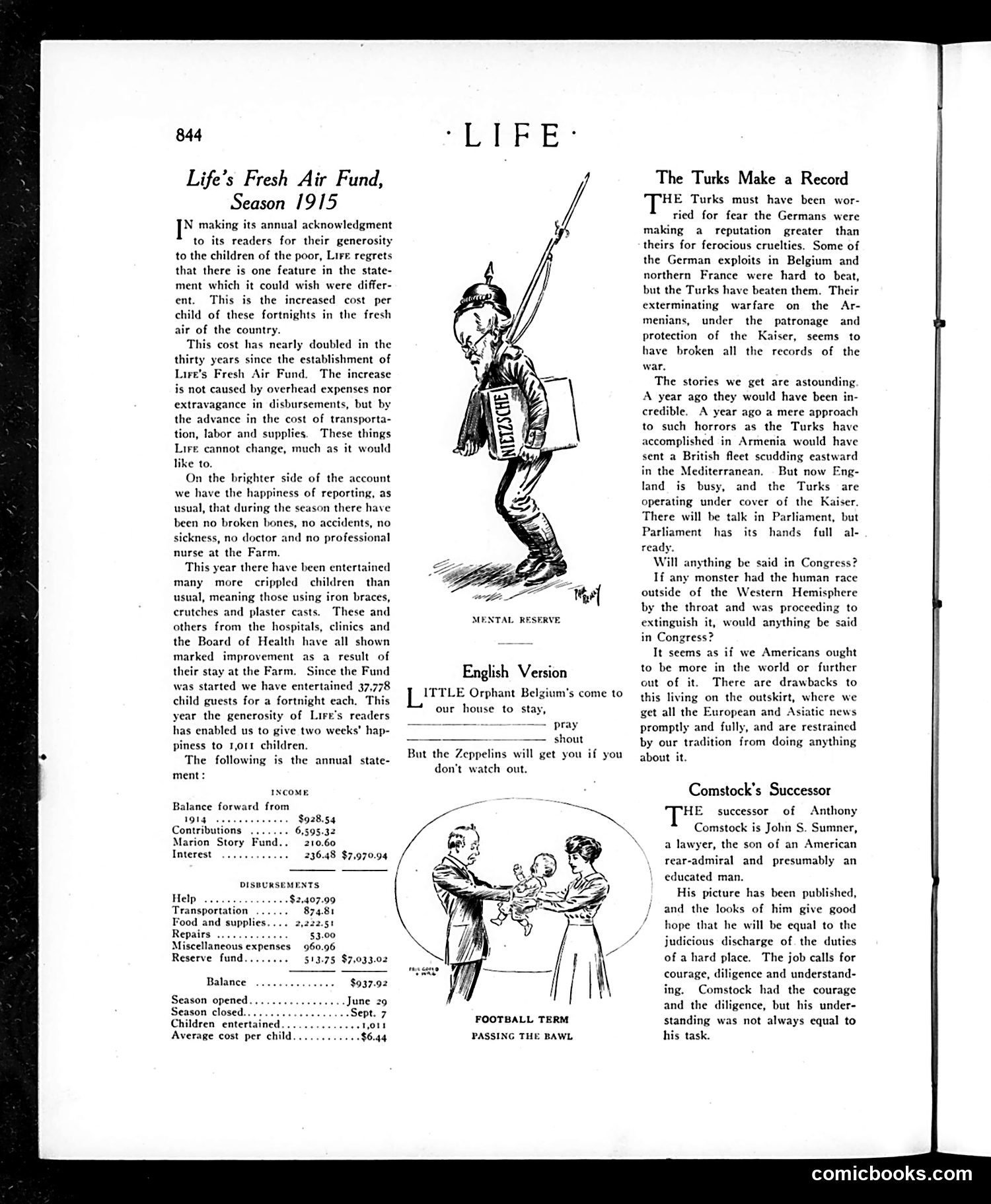
This page contains three distinct sections: **"Mental Reserve"** (top left): A satirical illustration of a German soldier in a spiked helmet labeled "Mental Reserve," depicted as gaunt and hollow—likely mocking German military morale or resources during World War I. **"English Version"** (center): A poem mocking potential German attacks, warning that "Zeppelins will get you if you don't watch out"—referencing German airships used in WWI bombing raids on Britain. **"Football Term: Passing the Bawl"** (bottom): A cartoon showing two women passing a baby to a man, using sports terminology as innuendo—typical of Life's irreverent humor. The page also includes financial reports for "Life's Fresh Air Fund" (a children's charity) and an article about John S. Sumner as Anthony Comstock's successor.
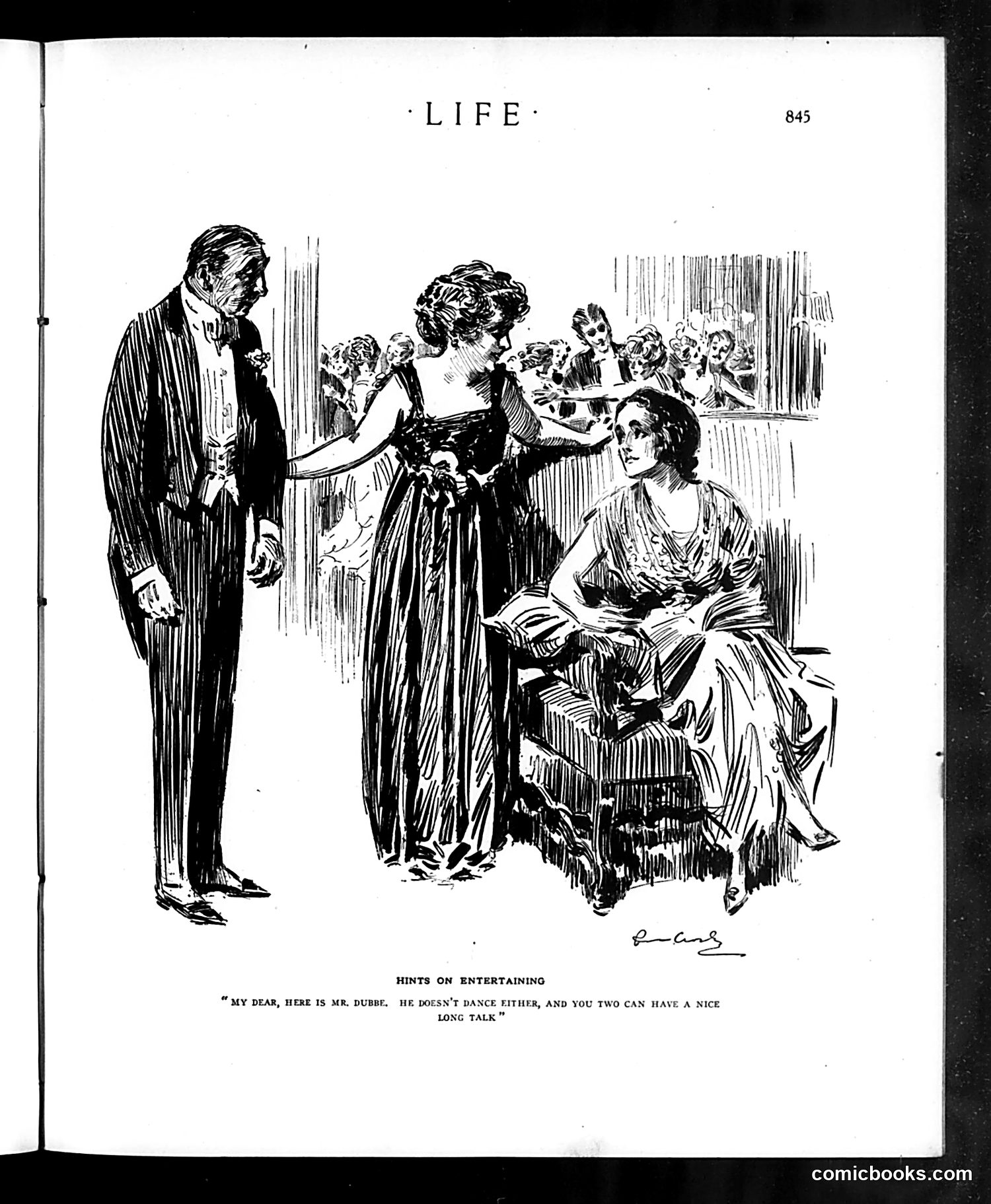
This single-panel cartoon satirizes social etiquette among the upper classes. A gentleman introduces "Mr. Dubbe" to a seated woman at what appears to be a formal social gathering, suggesting she converse with him since "he doesn't dance either." The humor targets social anxiety and awkwardness: the cartoon mocks the situation where an undesirable guest—apparently a poor dancer—is foisted upon an equally reluctant woman. The joke relies on the implication that both parties are socially inept or undesirable, making them "perfect" matches by default. The drawing style and setting suggest early 20th-century high society. The caption functions as satirical "advice" about managing uncomfortable social introductions among the wealthy elite.
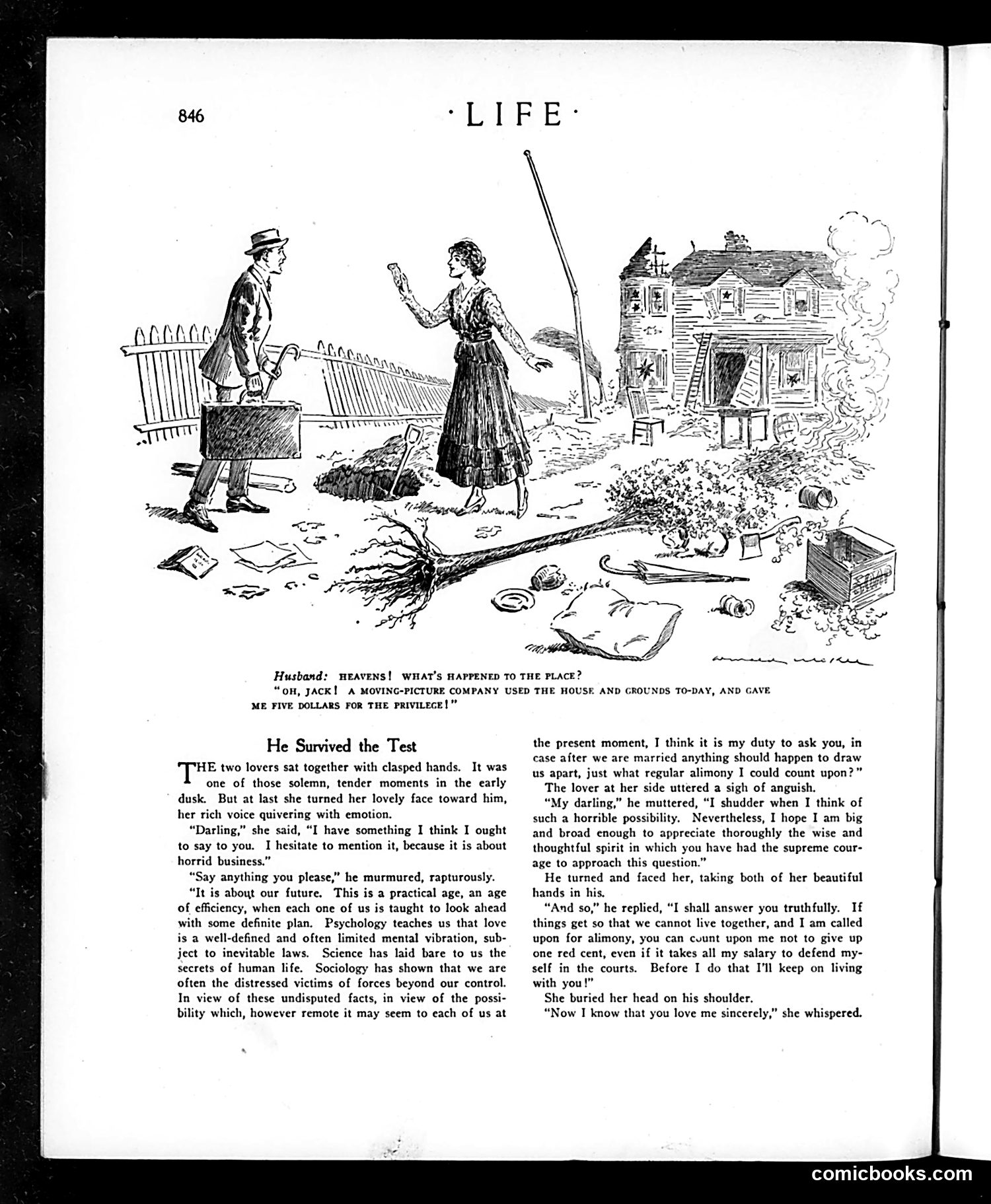
This page contains a cartoon and short story titled "He Survived the Test." The cartoon depicts a domestic scene where a husband confronts his wife about property damage—a house and grounds destroyed, with debris scattered about. The caption indicates a film company paid them five dollars to use their property for a movie. The humor targets early 20th-century commercial exploitation: homeowners allowing studios to wreck their houses for minimal compensation. The "test" in the story title refers to whether the couple's love can survive financial hardship and practical disagreements about their future. The accompanying text explores whether relationships can withstand material loss and necessity, positioning love as something that must prove resilient against real-world pressures—a common theme in period romance writing.
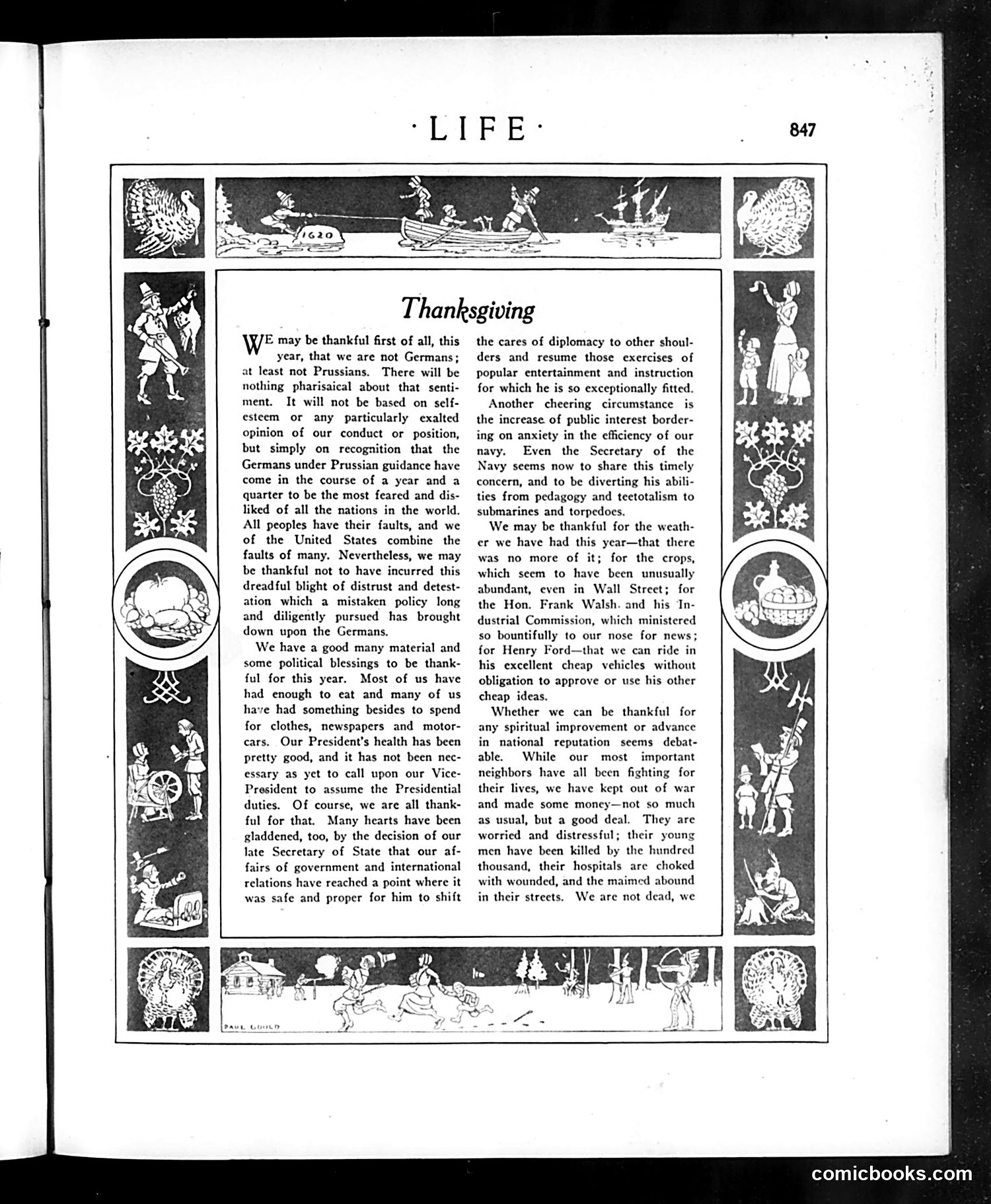
This is an editorial essay titled "Thanksgiving," not a political cartoon. The piece reflects on 1917 America's gratitude despite World War I's ongoing carnage. The text expresses relief that Americans are not Germans or Prussians, praised U.S. leadership (mentioning President Wilson and Secretary of State), and celebrated domestic achievements—notably Henry Ford's affordable automobiles and Frank Walsh's Industrial Commission. The essay acknowledges the war's human cost ("young men have been killed by the hundred thousand") while emphasizing America's relative safety and prosperity. It references anxiety about naval efficiency, suggesting pre-WWI naval readiness concerns. The decorative borders contain period illustrations of Thanksgiving themes, harvest scenes, and domestic life—not satirical commentary, but thematic ornamentation appropriate to the holiday essay.
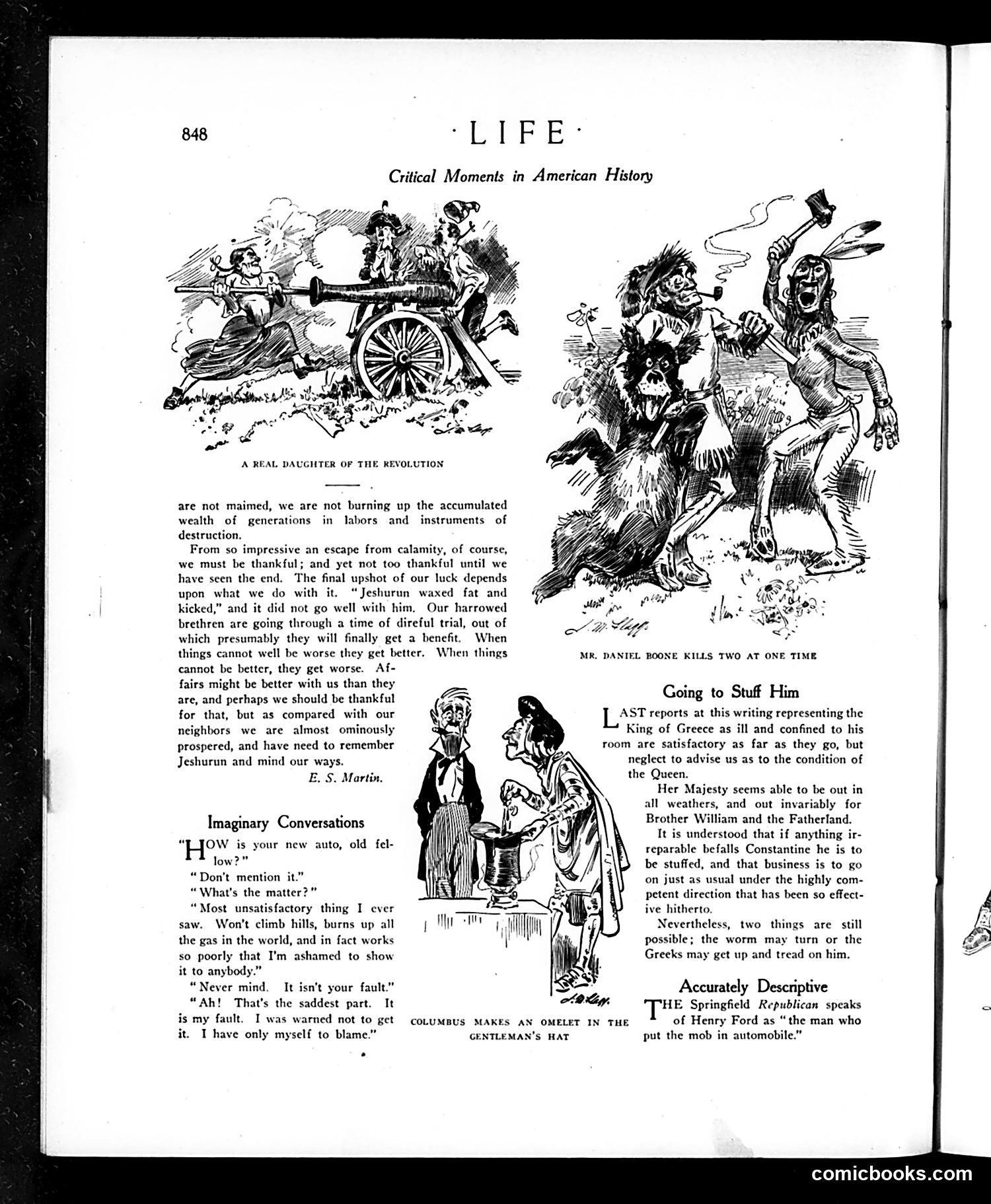
This page from *Life* magazine contains three distinct satirical pieces: **"A Real Daughter of the Revolution"** depicts a woman operating a cannon—likely satirizing female patriotism or suffragette activism by invoking Revolutionary War imagery. **"Imaginary Conversations"** mocks automobile owners' complaints. A man admits his new car is terrible but blames only himself for buying it despite warnings—satirizing consumer culture and personal responsibility, or perhaps criticizing wealthy people's self-indulgent poor choices. **"Going to Stuff Him"** comments on King Constantine I of Greece (likely WWI-era), suggesting the Queen is more active in supporting "Brother William" (Germany) and the Fatherland. The dark humor about "stuffing" the king if he dies reflects cynicism about Greek politics and German influence. **"Accurately Descriptive"** quotes a newspaper calling Henry Ford "the man who put the mob in automobile"—sarcastic praise for mass-producing cars, implying Ford democratized automobiles but also created mob culture. The overall tone is skeptical toward progress, politics, and consumer excess.
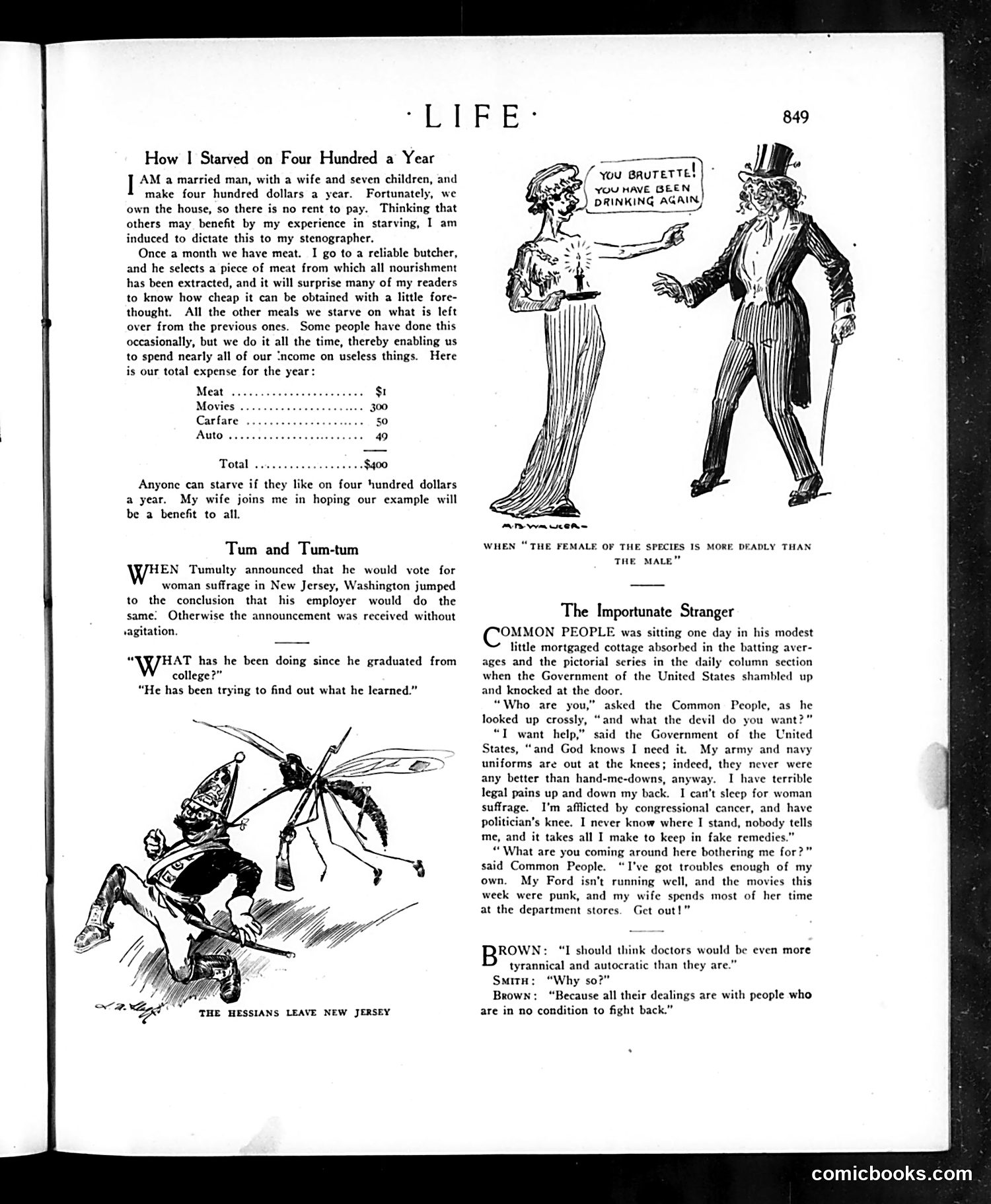
This page contains three satirical pieces targeting early 20th-century American concerns: **"How I Starved on Four Hundred a Year"** mocks both poverty wages and misplaced priorities. The narrator claims to support a family of nine on $400 annually by eating leftovers and buying cheap meat—yet spends $300 on movies and $40 on auto expenses. The satire exposes the contradiction: working families supposedly can "starve" comfortably if they just manage finances, ignoring systemic wage inadequacy. **"Tum and Tum-tum"** references Tumulty (Wilson's secretary) announcing support for women's suffrage in New Jersey, with the cartoon "The Hessians Leave New Jersey" showing a woman threatening a drunkard—likely satirizing anti-suffrage arguments that women voters would be tyrannical. **"The Importunate Stranger"** depicts the U.S. Government as a desperate beggar visiting "Common People," listing absurd complaints (uniforms worn out, "politician's knee," "congressional cancer"). This satirizes government inefficiency and its constant demands on taxpayers during a period of expanding federal programs and increasing taxes.
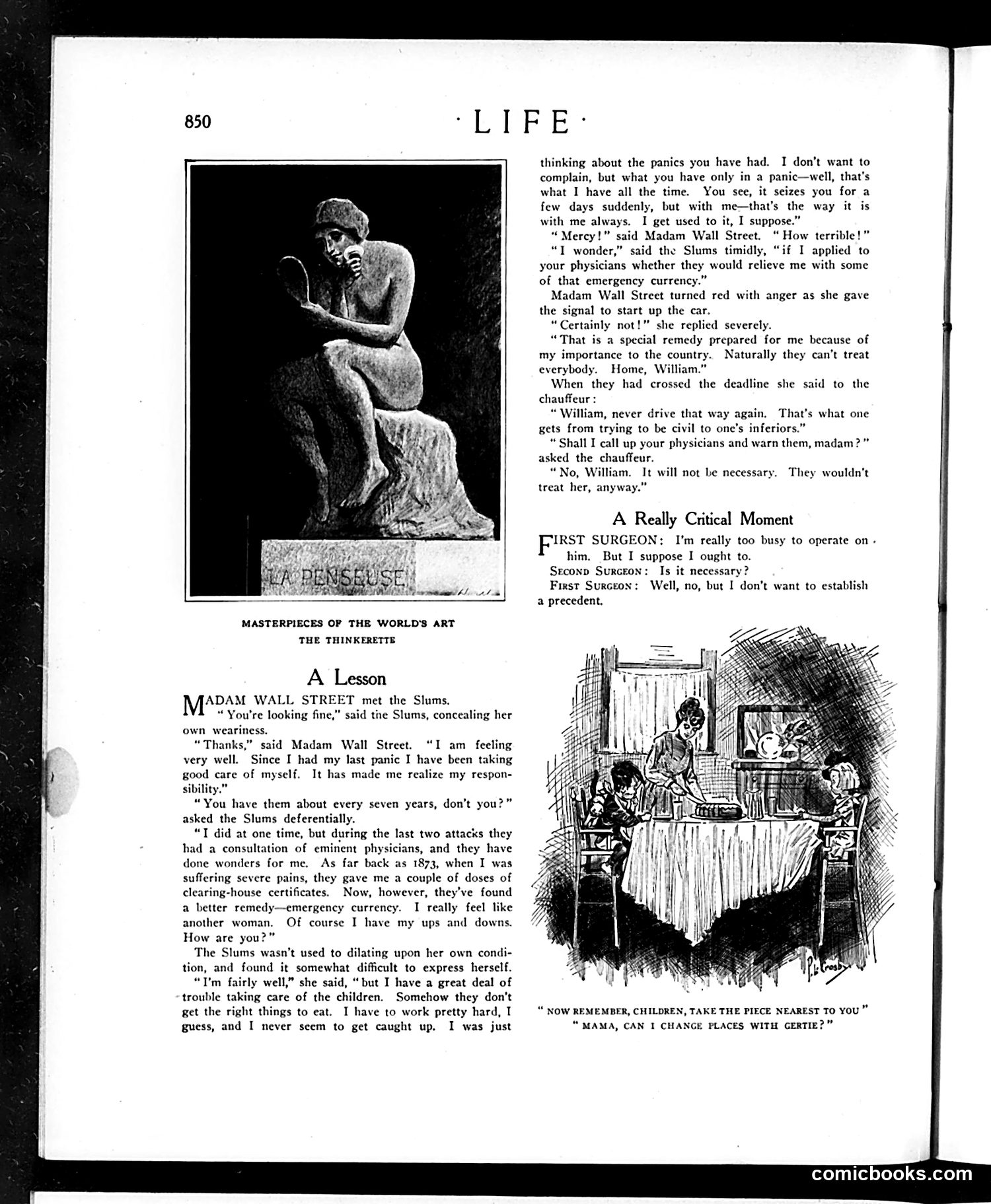
This page satirizes the stark inequality between Wall Street wealth and urban poverty during the early 1900s. "Madam Wall Street" personifies financial elites, while "the Slums" represents the poor. The main dialogue mocks how the wealthy receive special government remedies (emergency currency) during financial panics—occurring regularly since 1873—while the poor receive nothing. When the Slums asks if she might access this same relief, Madam Wall Street angrily refuses, claiming it's reserved for the "important" to the nation. She then instructs her chauffeur never to drive through poor neighborhoods again, calling the poor "inferiors." The secondary cartoon about surgeons suggests a darker parallel: the wealthy get special treatment and precedent-setting care, while others are left to die. The "Thinkerette" statue parodies Rodin's famous sculpture, implying this bitter contemplation of class injustice is the era's defining thought.
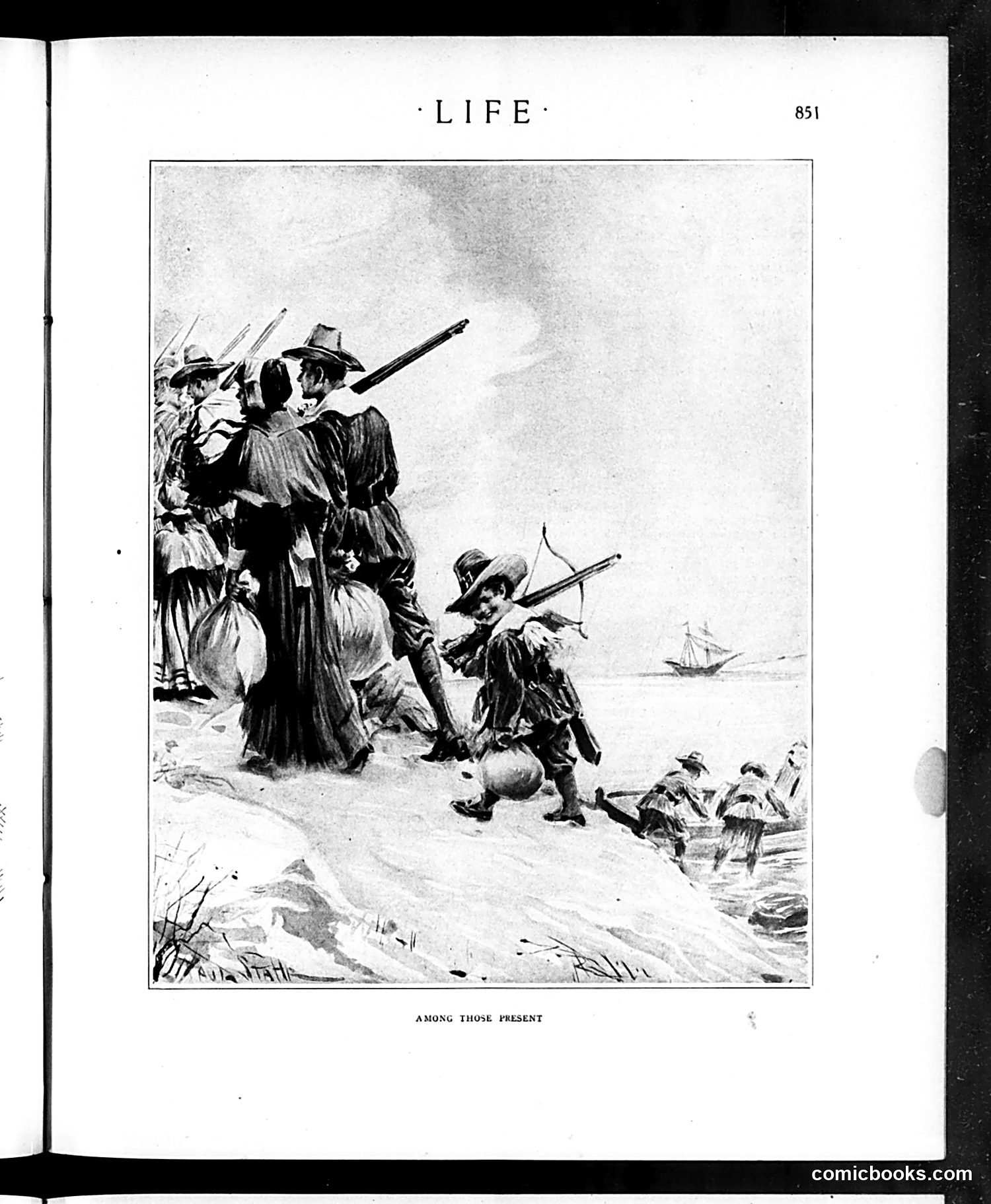
This illustration depicts a beach scene with figures in period dress (appearing to be colonial or 18th-century clothing) observing something through telescopes pointed toward the sea. A sailing ship is visible on the horizon. The caption "Among Those Present" suggests this is satirizing a specific historical event or gathering. Without additional context from the magazine's date or surrounding articles, I cannot definitively identify which historical event is being referenced. The scene appears to mock either an important historical moment being witnessed by notable figures, or perhaps satirizes the pretensions of people claiming to have been "present" at significant events. The style suggests this is likely from the early 20th century.
This is a humorous domestic story by Richard Dark, not a political cartoon. It's a satirical piece about marriage dynamics in early 20th-century England. The narrator describes acquiring a loud, checked tweed suit as part of his honeymoon outfit on his Uncle William's advice. On their fifth day of marriage, his new wife refuses to be seen with him in public while wearing it—she demands he choose between her and the suit. He complies, choosing his marriage. The satire targets masculine pride and the power dynamics of marriage. The narrator presents himself as a rational man of good judgment, yet is utterly dominated by his wife's preferences. The joke lies in his self-deception: he frames his capitulation as a deliberate "strategy" for managing wives through agreement, when he's actually entirely under her control. The wartime context (references to economizing and reduced servants) suggests this reflects post-WWI British society and changing social expectations around domestic authority and marital compromise.
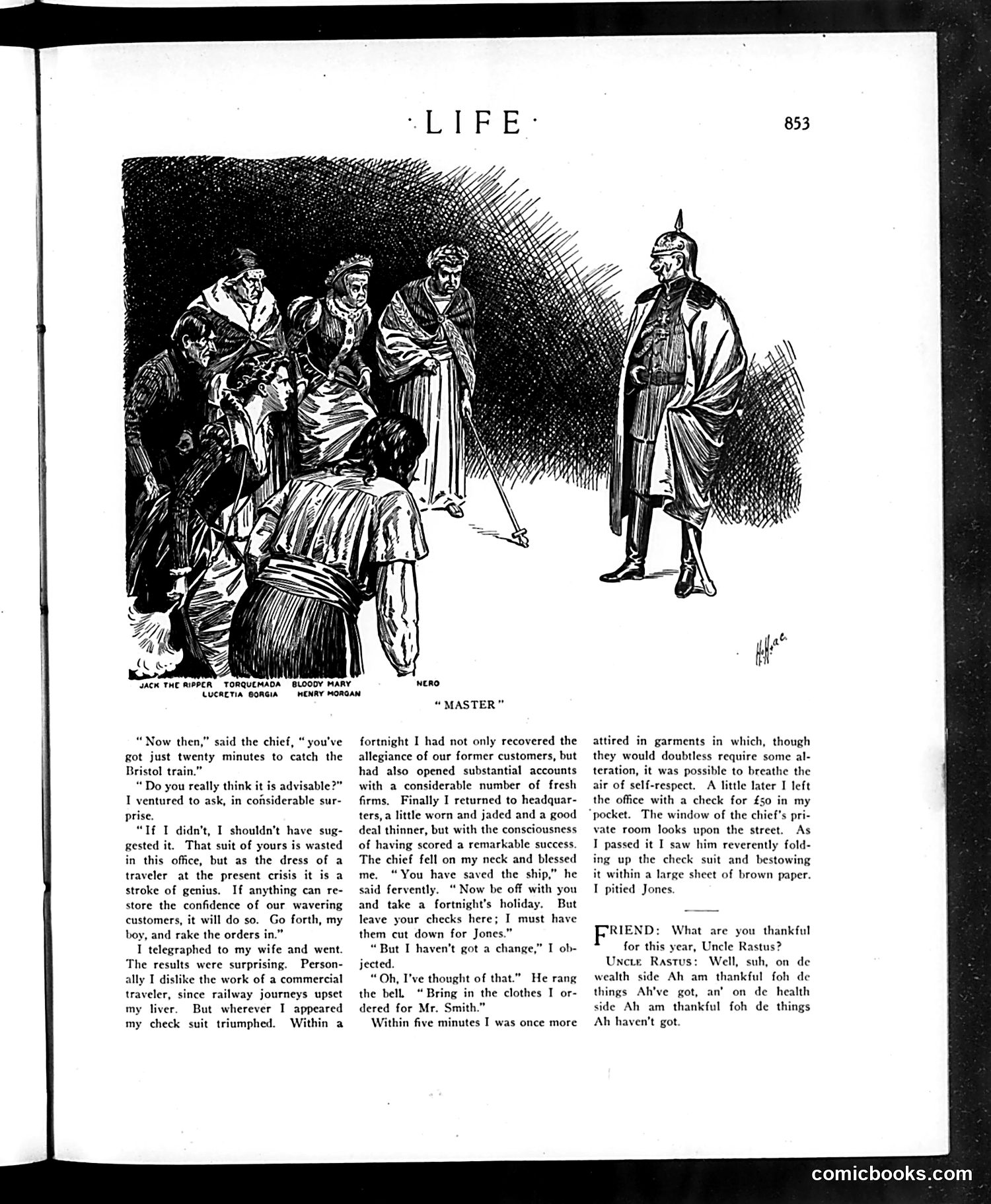
The main illustration satirizes corporate ruthlessness. A commercial traveler's shabby "check suit" mysteriously becomes his greatest asset in winning back customers during an economic crisis. The joke's dark twist: after he succeeds, his boss confiscates the suit to pass down to another employee ("Jones"), reducing the successful salesman back to poverty despite his triumph. The labeled villains—Jack the Ripper, Torquemada, Bloody Mary, Lucretia Borgia, Nero, Henry Morgan—underscore the chief's moral monstrosity: he uses people as disposable tools. The lower section is a separate brief dialogue featuring racist stereotypes common to early 20th-century American humor. "Uncle Rastus" expresses gratitude for material possessions while joking about avoiding illness—harmless by the text's intent, though reflecting deeply offensive minstrelsy conventions. The satire targets exploitative labor practices and corporate indifference to individual welfare—concerns relevant to the publication's era of industrial capitalism.
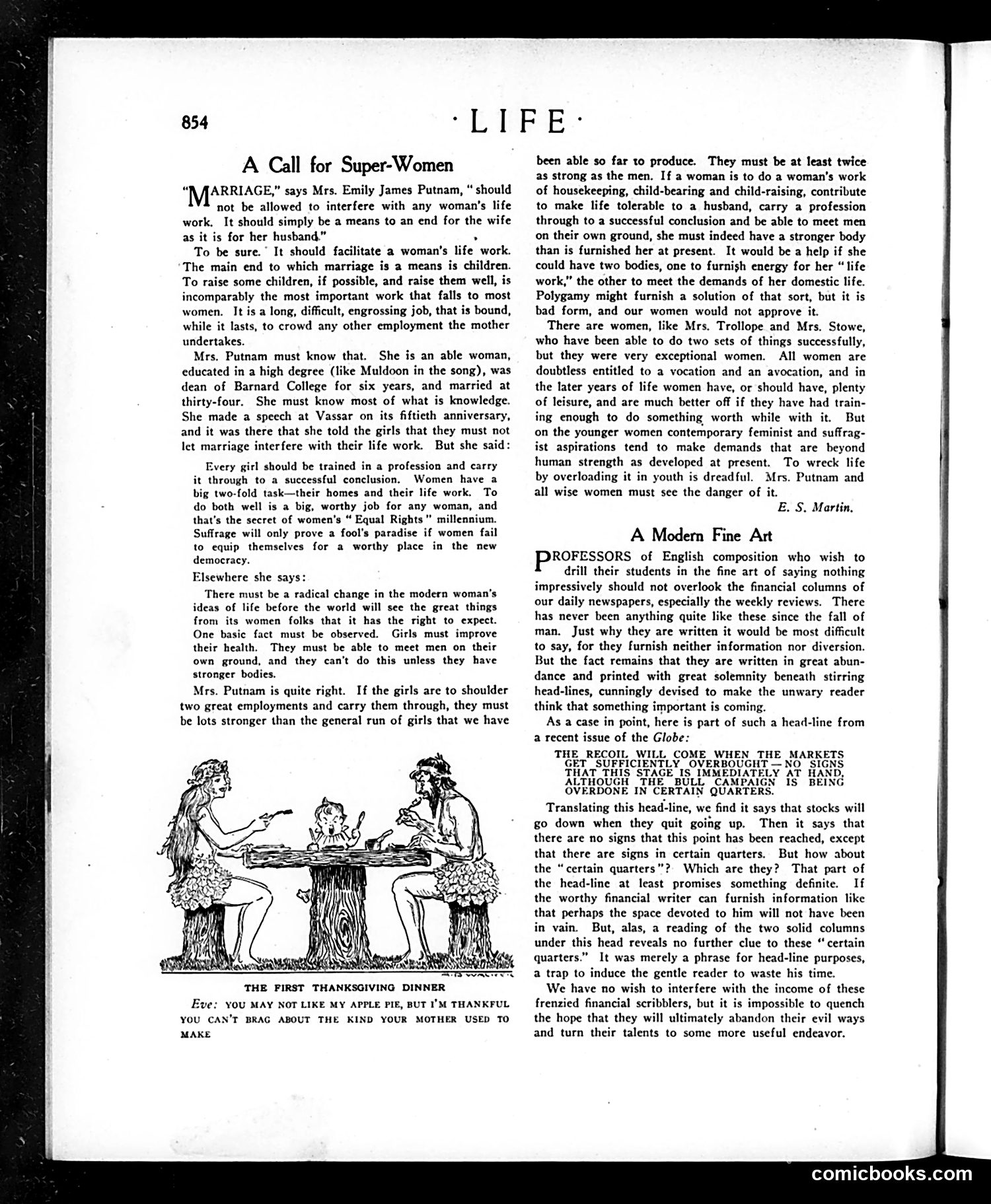
This page presents two distinct pieces of social commentary from early 20th-century America. **"A Call for Super-Women"** critiques Emily James Putnam's argument that women shouldn't let marriage interfere with their careers. The author (E.S. Martin) sarcastically supports her position while exposing its absurdity: women would need to be twice as strong as men to simultaneously manage full-time careers, housekeeping, childbearing, and spousal support. The piece argues such demands are physically impossible and dangerous, invoking examples of exceptional women (Trollope, Stowe) to prove they're rare exceptions, not achievable ideals. The satire targets both feminist aspirations and the physical limitations society placed on women. **"The First Thanksgiving Dinner"** is a cartoon joke about Eve and Adam, with Eve defending her apple pie by noting Adam can't brag about his mother's cooking—since Eve is humanity's only woman. It's a light domestic humor piece playing on the biblical creation narrative. Together, these pieces reflect period anxieties about women's expanding roles during the suffrage era.
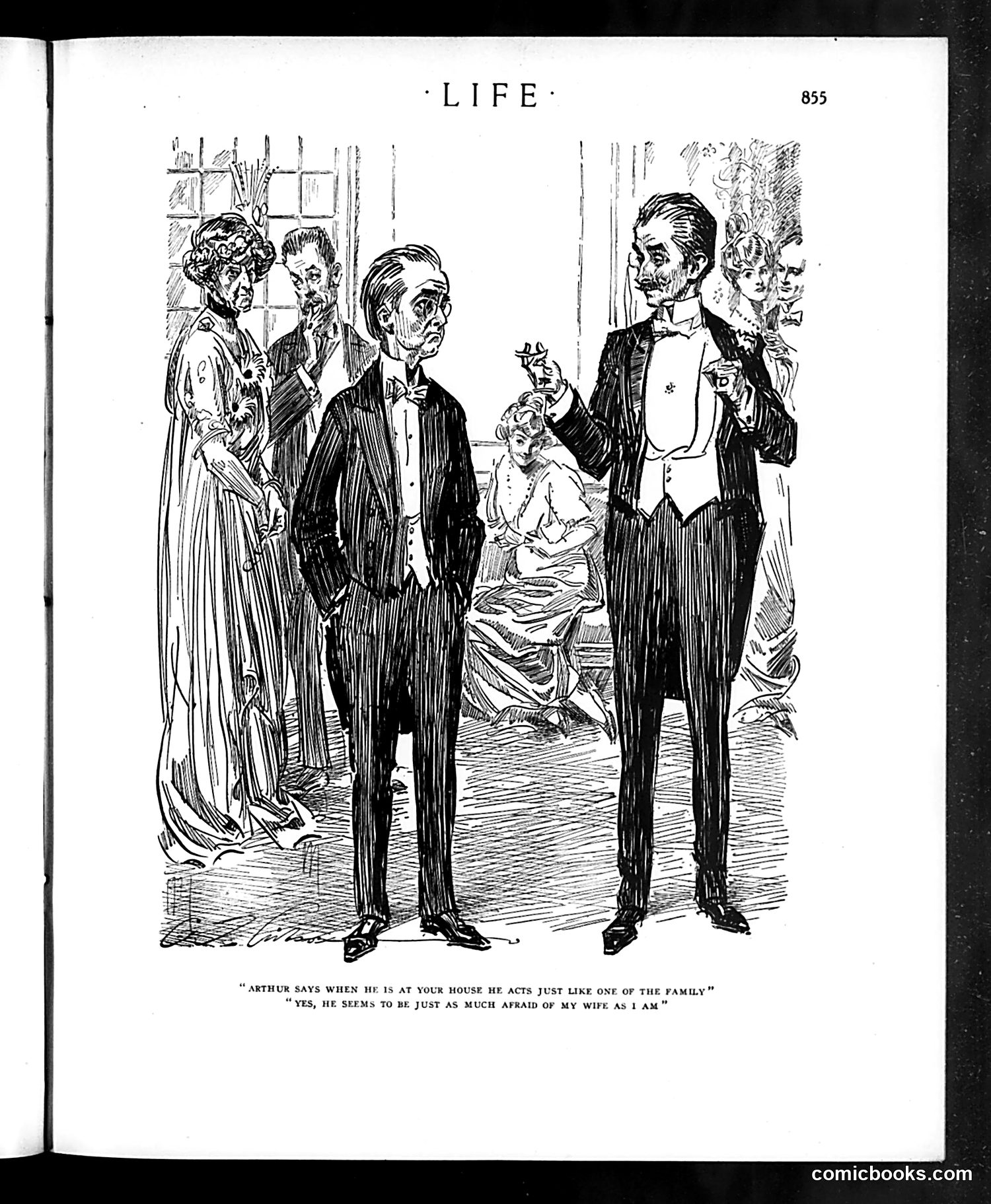
This single-panel cartoon depicts a formal social gathering—likely an evening party among the wealthy elite, based on the men's white-tie formal wear and women's elegant gowns. The caption reveals the joke's social commentary: one speaker tells another that their friend Arthur behaves "just like one of the family" when visiting, yet is "just as much afraid of my wife as I am." The humor satirizes Victorian-era marital dynamics and masculine anxiety about wives' authority within the household. The cartoon mocks both men's shared fear of their spouses and the pretense of social familiarity that masks genuine discomfort. This reflects early 20th-century anxieties about changing gender relations and domestic power structures among the upper classes.
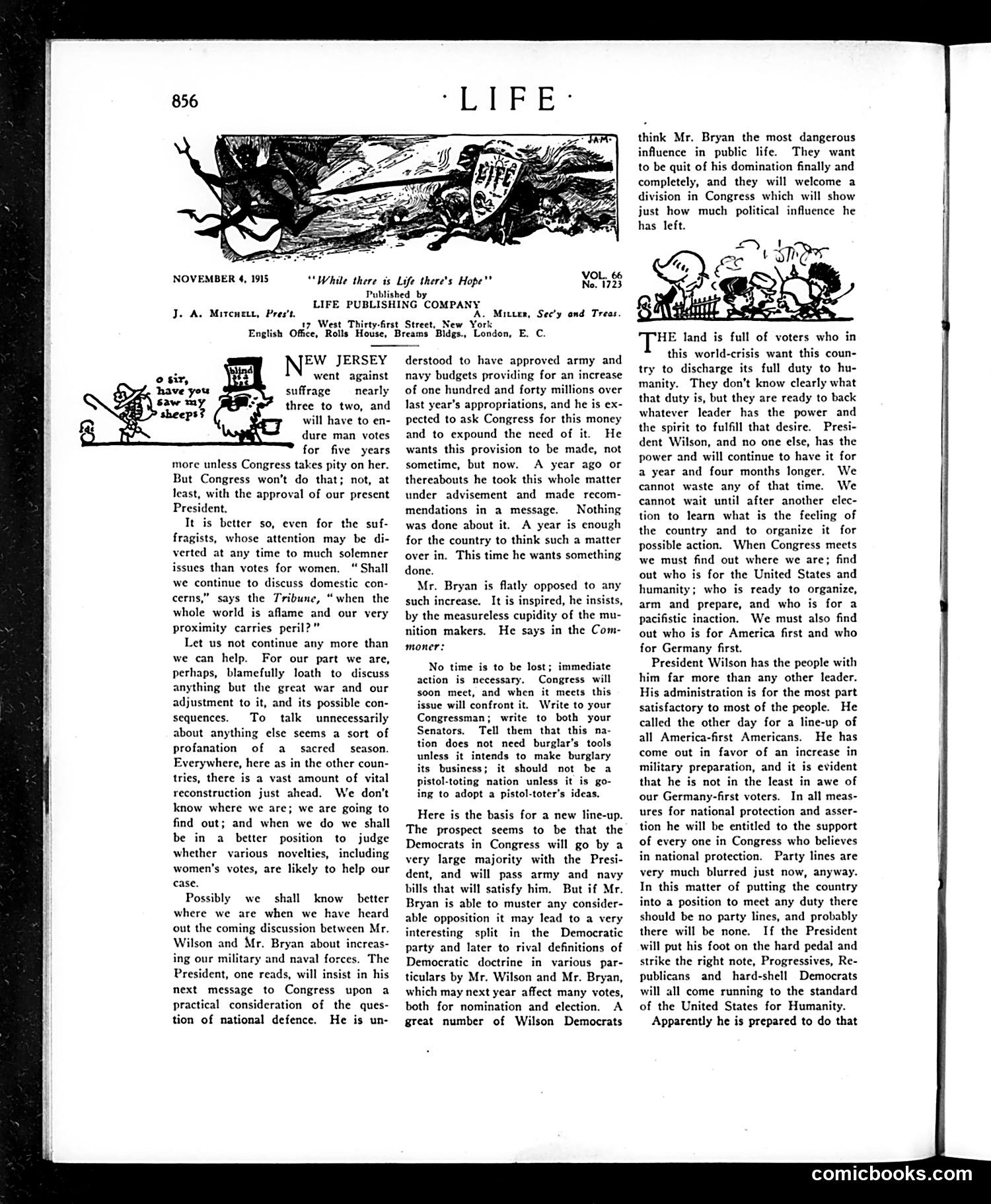
This page contains editorial commentary on a brewing political conflict between President Wilson and William Jennings Bryan over military spending. The text explains that Wilson wants Congress to approve a $140 million increase in army and navy budgets, while Bryan (writing in his publication *The Commoner*) opposes it, viewing the spending as driven by munitions manufacturers' greed. The cartoon at the top appears to depict this conflict, though specific figures are unclear from the image quality. The editorial suggests this disagreement could split the Democratic Party and weaken Bryan's political influence—something many "Wilson Democrats" actually welcomed. The page also dismisses ongoing women's suffrage efforts (New Jersey recently voted against it), arguing such domestic concerns should be postponed during wartime ("the world is aflame").
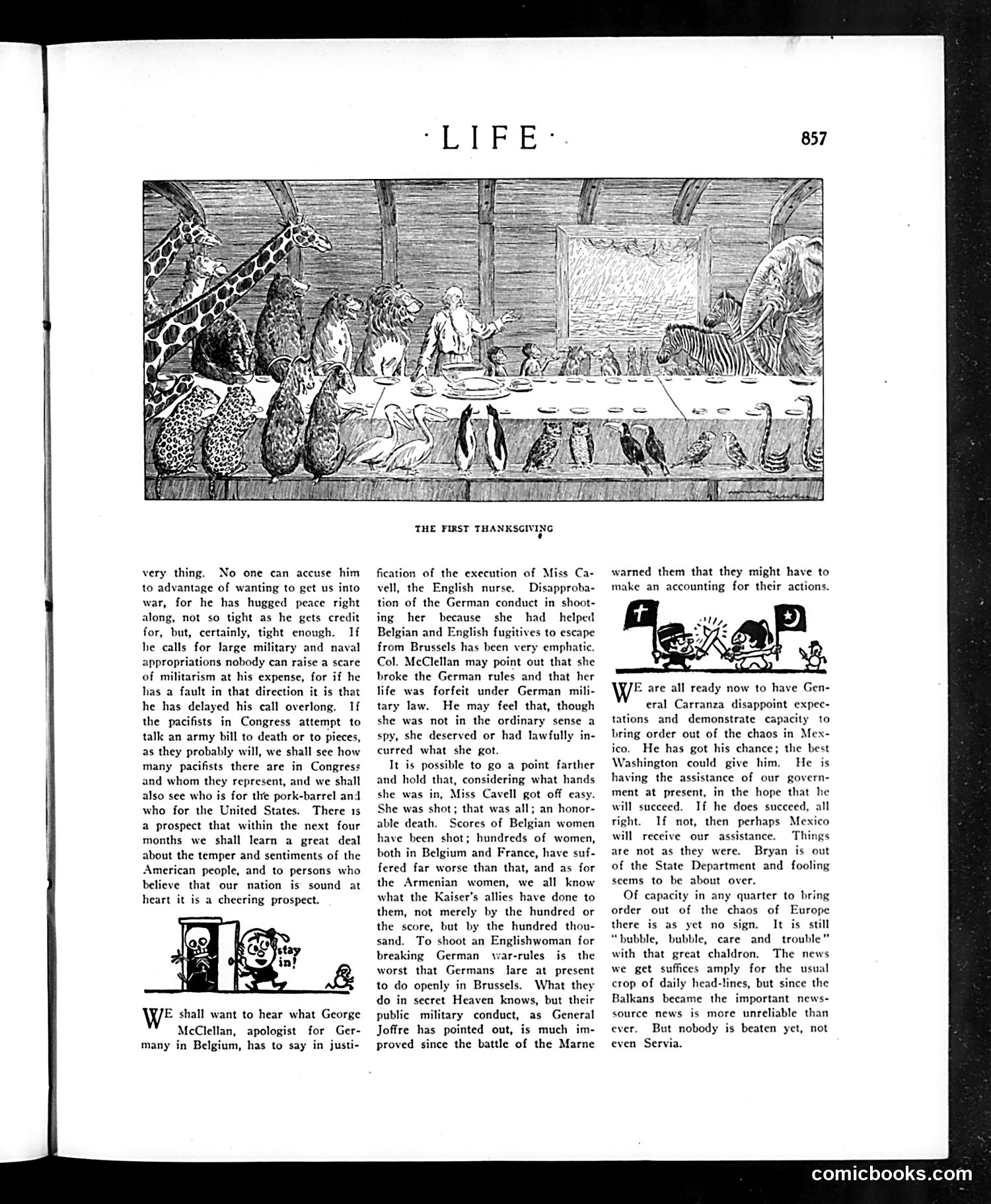
## The Main Cartoon: "The First Thanksgiving" The satirical illustration depicts animals (giraffes, leopards, penguins, zebras, and an elephant) seated at a formal dinner table with a human figure presiding. The cartoon ironically titles this scene "The First Thanksgiving." ## The Satire This appears to be dark humor about World War I and international conflict. The animals likely represent different nations or combatants in the war. By depicting them as dining together peacefully while a human oversees, the cartoonist satirizes the absurdity of hoping for diplomatic resolution or peaceful coexistence among warring powers—suggesting that getting such antagonistic parties to "give thanks together" is as fantastical as having wild animals dine civilly. ## Accompanying Text Context The prose discusses Miss Cavell (English nurse executed by Germans), General Carranza (Mexican leader), and congressional pacifists. The overall tone criticizes those defending Germany's conduct while questioning whether real peace or order is achievable in the current conflict. The cartoon's ironic title thus mocks optimistic hopes for wartime reconciliation.
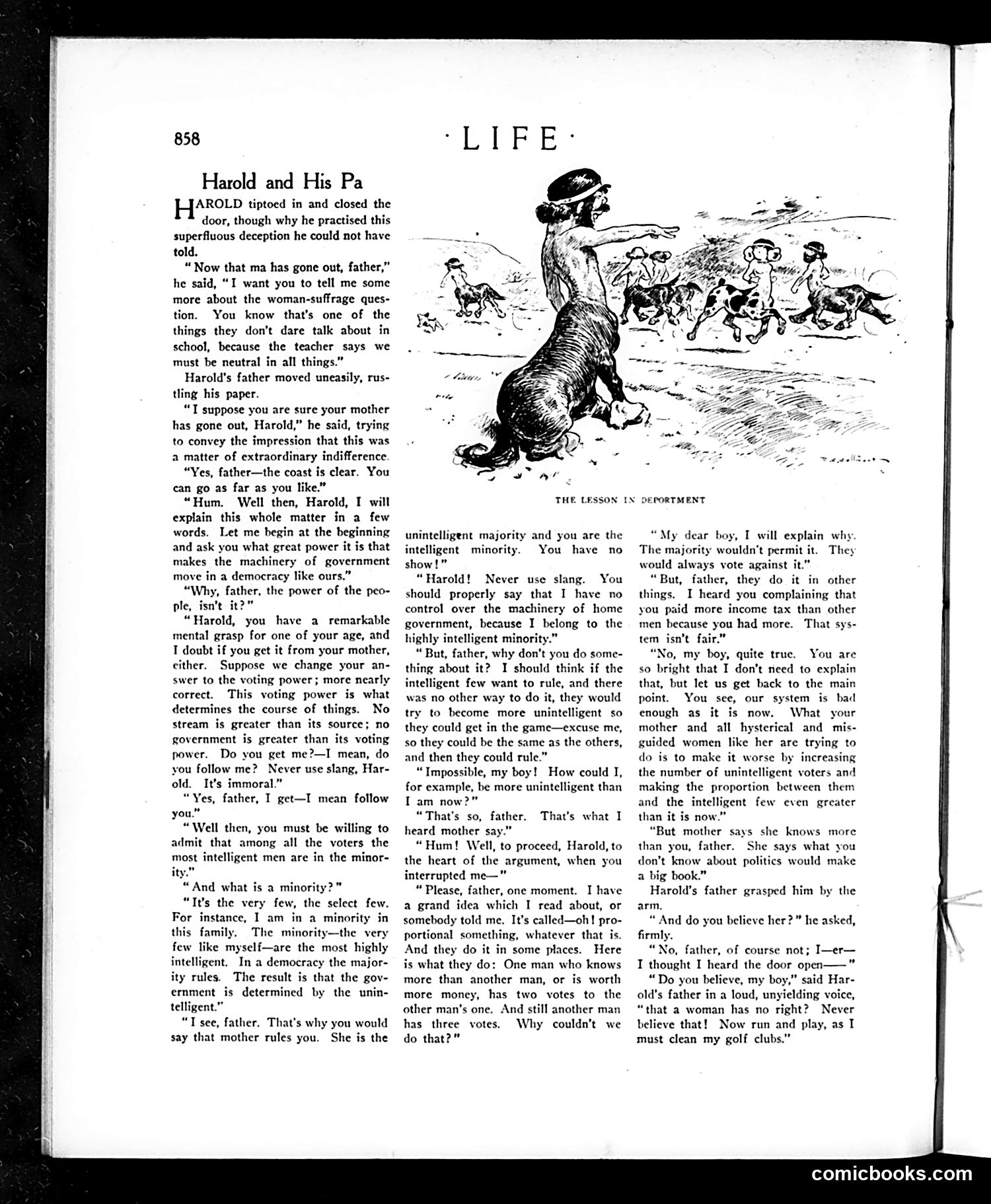
This dialogue satirizes anti-suffrage arguments by exposing their logical absurdity through a child's innocent questions. The father represents the smug male voter who claims women shouldn't vote because they're part of an "unintelligent majority," while he belongs to a superior "intelligent minority." The humor lies in Harold's simple logic: if intelligence should determine voting power, why not adopt a weighted voting system based on education or wealth? This directly undermines the father's position—he's already accepted such inequality in taxation but won't admit the principle applies to women's suffrage. The cartoon attacks the hypocrisy of men like this father who use pseudo-intellectual arguments to maintain political dominance while the illustration shows women actively engaged (supervising children, being capable). The piece ridicules how men invoke "neutrality" and "logic" to avoid discussing women's rights, revealing these as mere excuses for preserving male privilege.
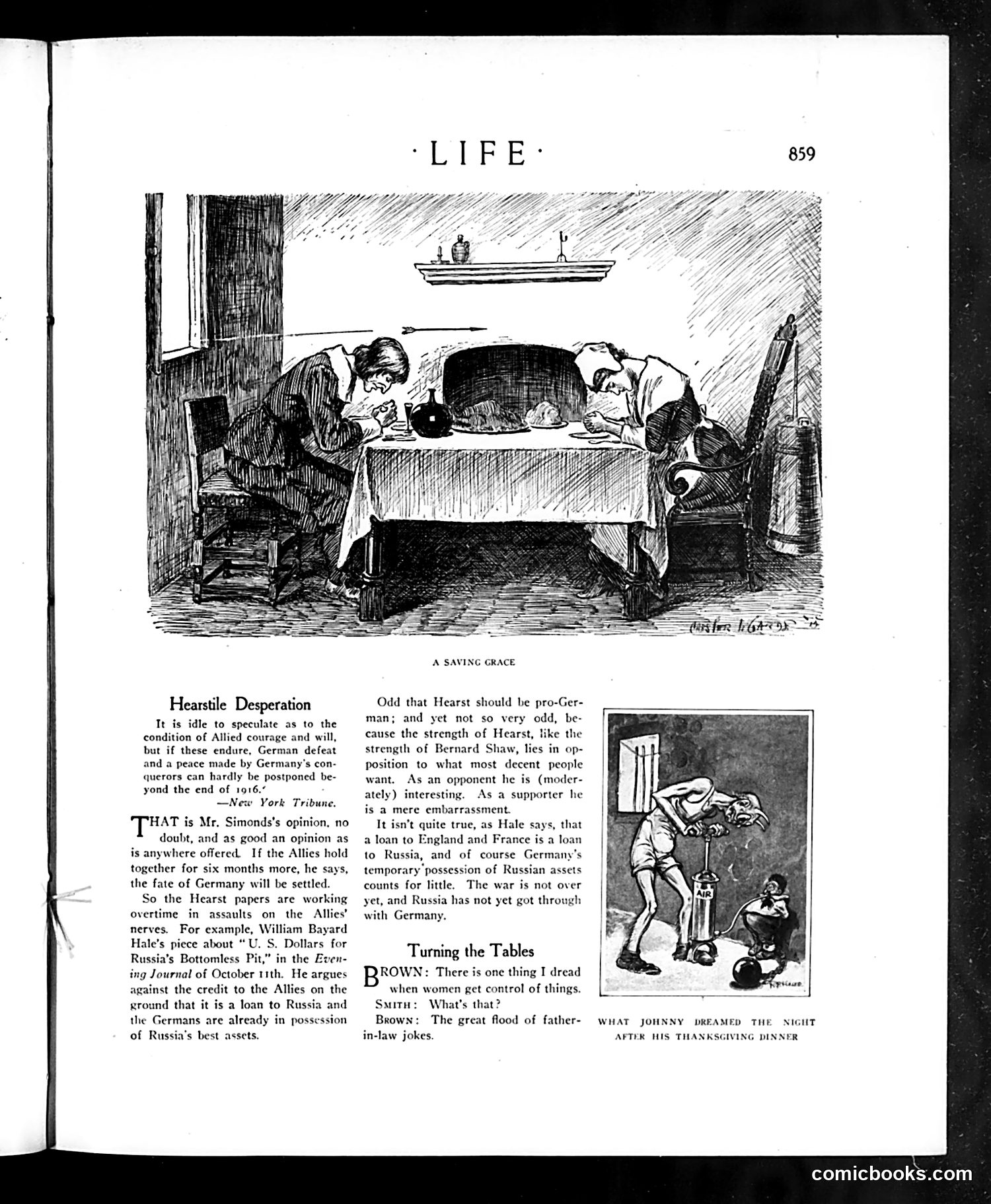
**"Hearstile Desperation"** attacks newspaper mogul William Randolph Hearst for undermining Allied (British-French-Russian) war efforts during World War I. The article accuses Hearst's papers of publishing propaganda—citing columnist William Bayard Hale's October 1916 piece arguing loans to Russia were wasteful since Germany already controlled Russian assets. Life magazine sarcastically notes Hearst's strength lies in opposition: he's "pro-German" not from conviction but from compulsive contrarianism. The piece defends the Allied loans as legitimate wartime support. **"Turning the Tables"** is a brief joke about gender roles: Brown dreads women gaining power because they'll invent "father-in-law jokes"—reversing the long tradition of men's jokes mocking mothers-in-law. The small illustration shows a man's nightmare vision. **"A Saving Grace"** illustration depicts two men saying grace before a meal, with a boat visible through a window—likely referencing wartime food scarcity or rationing concerns.
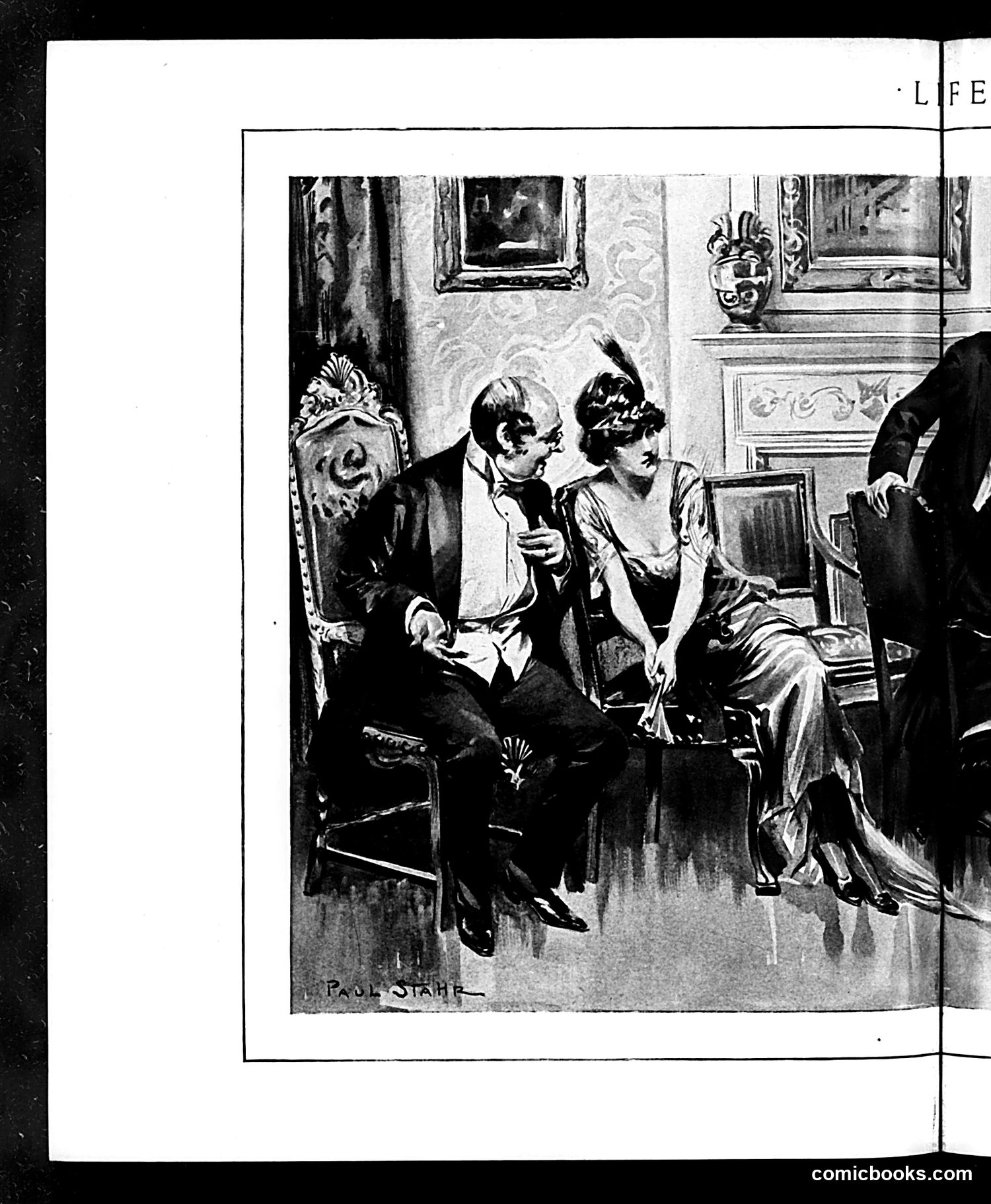
This is an illustration by Paul Starr (signed lower left) depicting an elegant interior salon scene. A man and woman sit conversing in ornate chairs, surrounded by period furnishings, framed artwork, decorative vases, and elaborate wall panels. Without additional OCR text or caption visible on the page, I cannot definitively identify the specific figures or social/political commentary intended. The scene appears to satirize **high society manners or aristocratic pretension**, suggested by the exaggerated elegance of the setting and the figures' formal poses and dress. The humor likely targets **social climbing, artificial sophistication, or romantic intrigue among the wealthy**—common themes in *Life* magazine's satirical commentary on early 20th-century American upper-class behavior. However, without a visible caption or headline text, I cannot specify the exact social reference or point of the satire with certainty.
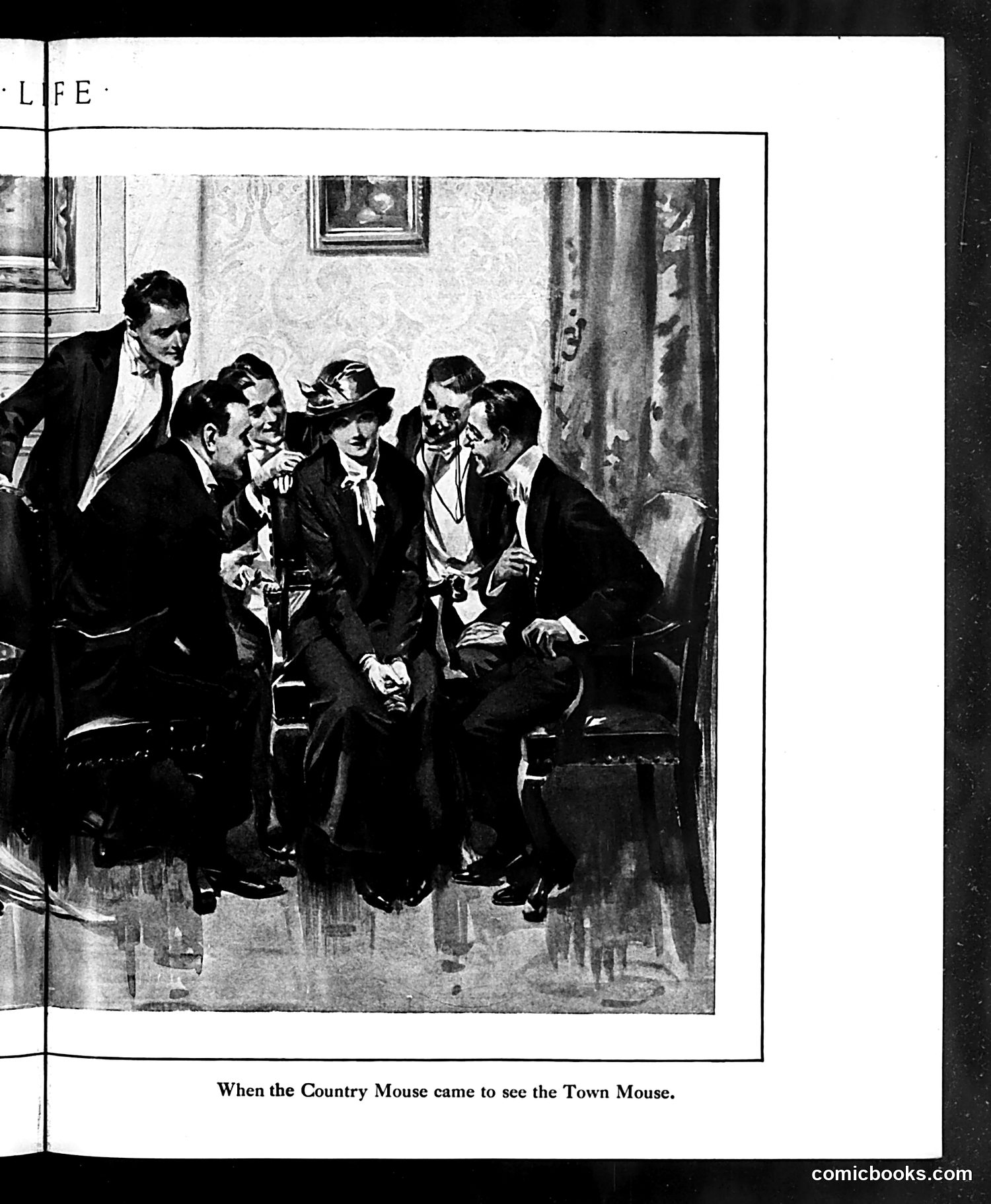
This is a satirical illustration referencing Aesop's fable "The Town Mouse and the Country Mouse." The caption suggests a social commentary on rural versus urban life and manners. The image shows six men in formal attire (suits and hats) in what appears to be an elegant interior room, engaged in animated conversation. Based on the fable reference, the cartoon likely satirizes the contrast between unsophisticated country visitors and their supposedly more refined urban hosts—a common theme in early 20th-century American satire about class and regional differences. The exact identities of the figures remain unclear from the image alone. The humor appears to stem from the social dynamics and pretensions of "town" versus "country" society, though without additional context, the specific political or social targets cannot be definitively identified.
This is a short story submission to Life magazine's 1910s-era contest, not a political cartoon. The piece explores immigrant identity and assimilation through a romantic narrative. **Key context for modern readers:** The story depicts early 20th-century Italian and Albanian immigrant communities in industrial America, specifically factory workers in New Jersey. Period-authentic ethnic slurs ("Wops," "Polacks," "Sheenies") reflect both the narrator's voice and contemporary prejudices against Southern/Eastern European immigrants. **The central conflict:** Maria's Albanian father forbids relationships with Italians ("Wops"), yet she falls for Tomaso, an Italian coworker. Her father arranges her engagement to Dimiter, a fellow Albanian, emphasizing "old country" traditions. Maria wants the "American way"—implying romantic choice and assimilation over arranged marriages and ethnic insularity. **The satire:** The story gently mocks both rigid immigrant traditions and American naiveté, using Maria's broken English and conflicted loyalties to explore how first-generation immigrants navigated competing cultural values.
This is a humorous short story about mistaken identity and marital misunderstanding. Marathon Jiggs leaves a casual note at a hotel intended for his university friend George H. Jones, inviting him to "call me up...and we will have a time to-night," signing it "Mary" (his college nickname). However, the note is mistakenly given to George K. Jones and his wife, who interprets it as evidence of her husband's infidelity with a woman named Mary. She threatens divorce immediately. Jiggs discovers his error when the clerk mentions "his wife" received the note, realizes the name confusion, and rushes to explain the innocent mix-up. The satire targets human hasty judgment and the comedy of errors—how a simple mistake, combined with a suspicious mind, nearly destroys a marriage.
This page reviews three theatrical productions for modern readers unfamiliar with early 1900s Broadway. **"Abe and Mawruss"** and **"Our Mrs. McChesney"** are "carpentered dramas"—plays constructed from existing literary sources (Montague Glass stories and Edna Ferber fiction). The critic notes they're essentially vaudeville sketches padded into full plays rather than traditionally plotted dramas, lacking narrative continuity. **The illustration** (captioned "Unsung Heroines: The Wife of a Frugal Fashion Artist") depicts a woman coordinating workers on what appears to be a fashion or design project—likely satirizing the underappreciated female support systems behind male creative success, a common Life magazine theme. The drama criticism praises actor **Barney Bernard's** performance as the Jewish merchant Abe Potash and **Ethel Barrymore's** charm in the female lead, even while acknowledging the plays' structural weaknesses. The reviewer argues stage characters should be judged independently from their literary sources.
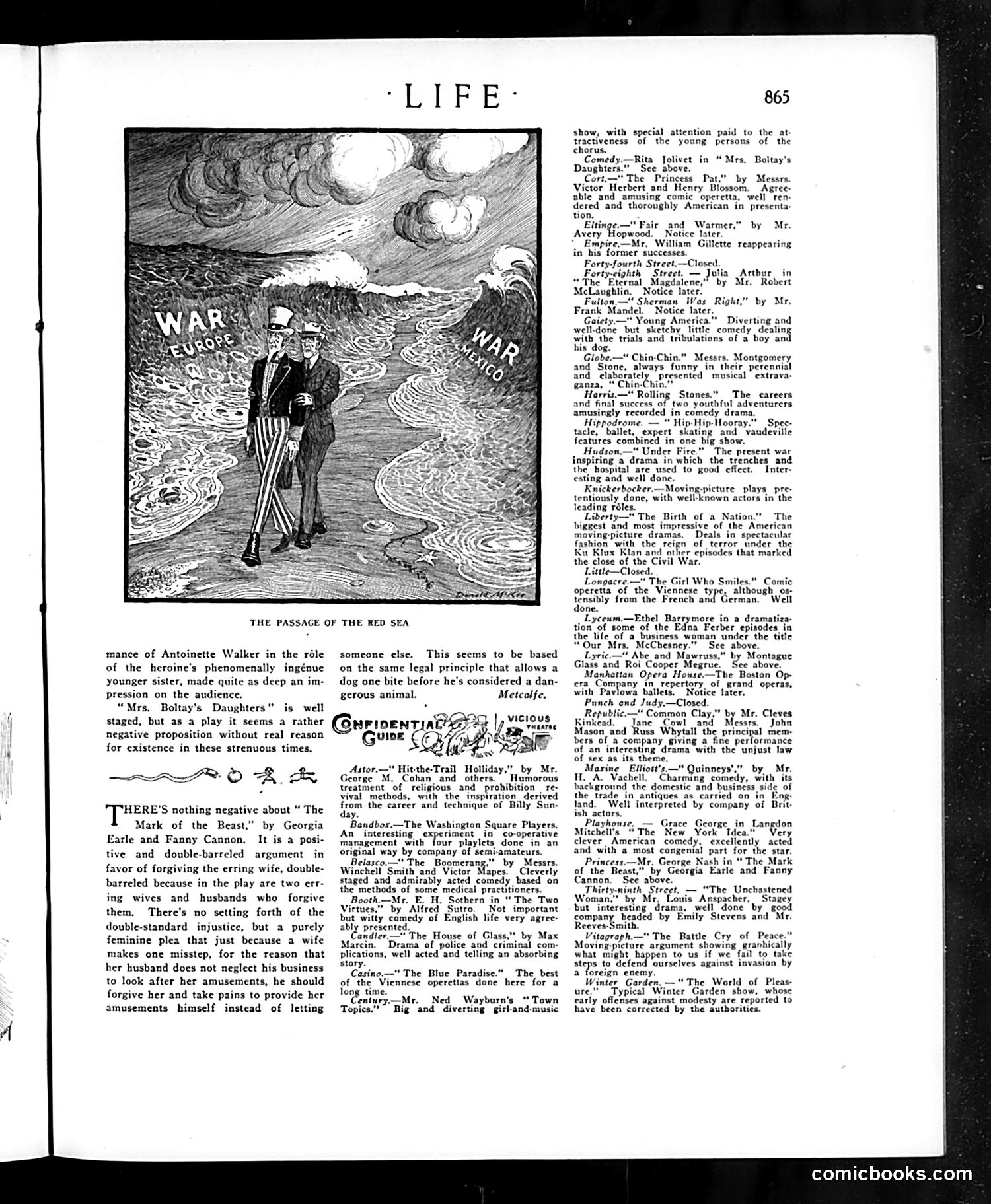
This cartoon depicts **Uncle Sam** (identifiable by his characteristic star-spangled outfit and top hat) walking between two labeled storm clouds: "WAR EUROPE" and "WAR CONGO." The swirling, turbulent sky suggests chaos and danger. The title references the Biblical Red Sea parting, implying Uncle Sam is navigating a treacherous path between two conflicts. This appears to be commentary on **American neutrality during World War I** (Europe's war) while also referencing colonial tensions in Africa ("Congo"). The satirical point: America is attempting to remain isolated and uninvolved in international conflicts, miraculously passing through without being drawn into either war—though the ominous sky suggests this precarious balance is fragile and may not hold. The image criticizes or questions America's ability to maintain neutrality amid global turmoil.
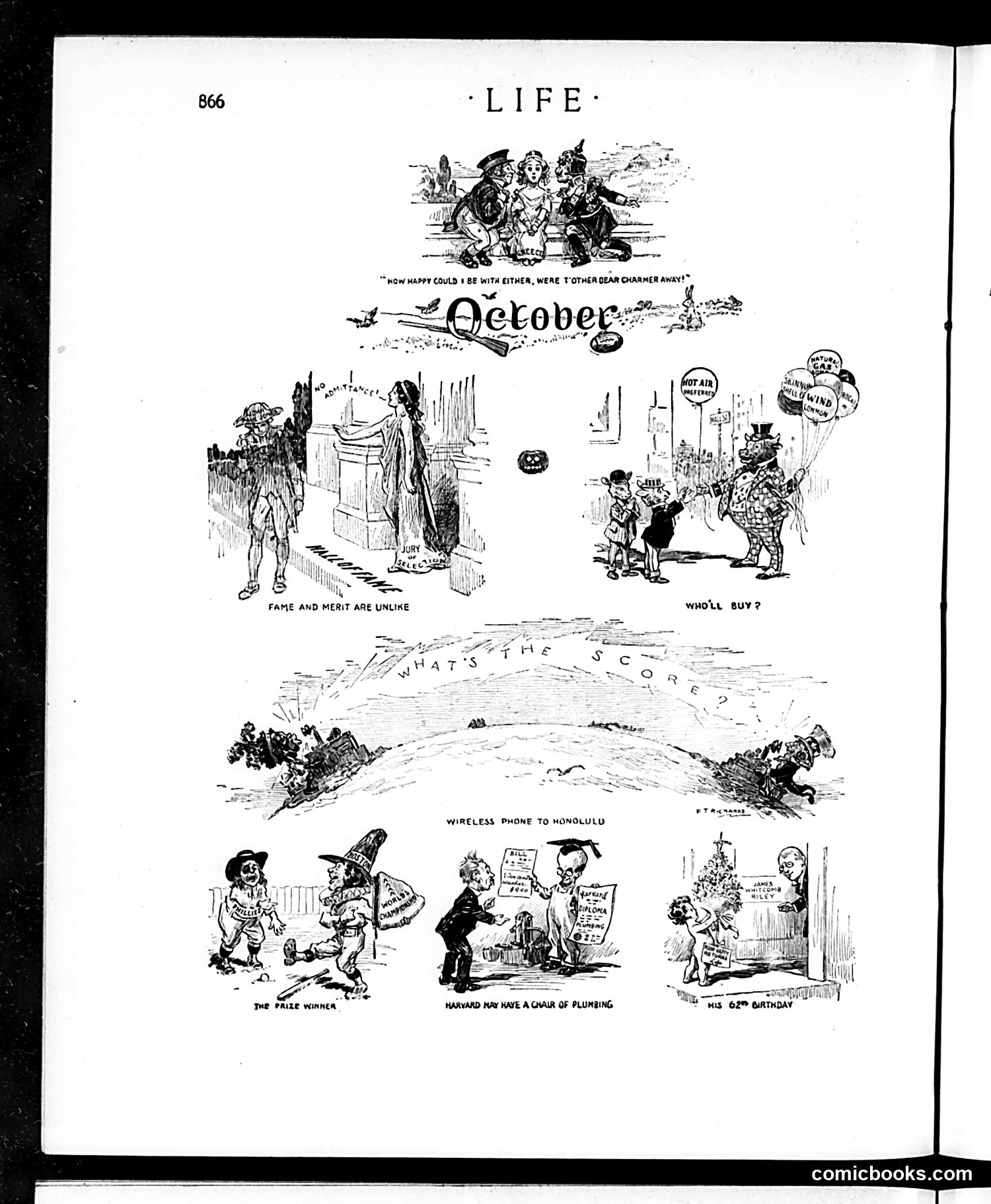
This October-themed page from *Life* magazine contains several satirical cartoons: 1. **"Fame and Merit Are Unlike"** (left): Shows a skeleton labeled "Fame" towering over a small figure labeled "Merit," satirizing how celebrity often overshadows actual accomplishment. 2. **"Who'll Buy?"** (right): Depicts a vendor hawking hot air and wind-related goods to children, likely mocking commercialization or inflated promises in advertising. 3. **"Wireless Phone to Honolulu"**: References early wireless/radio technology as a novelty or exaggerated claim. 4. **"Harvard Boy Has a Chair of Plumbing"** and **"His 62nd Birthday"**: Appear to be social satire about pretentious academic appointments and aging. The page uses October imagery (pumpkins, witches) to frame these critiques of early-20th-century American culture, commerce, and social pretension.
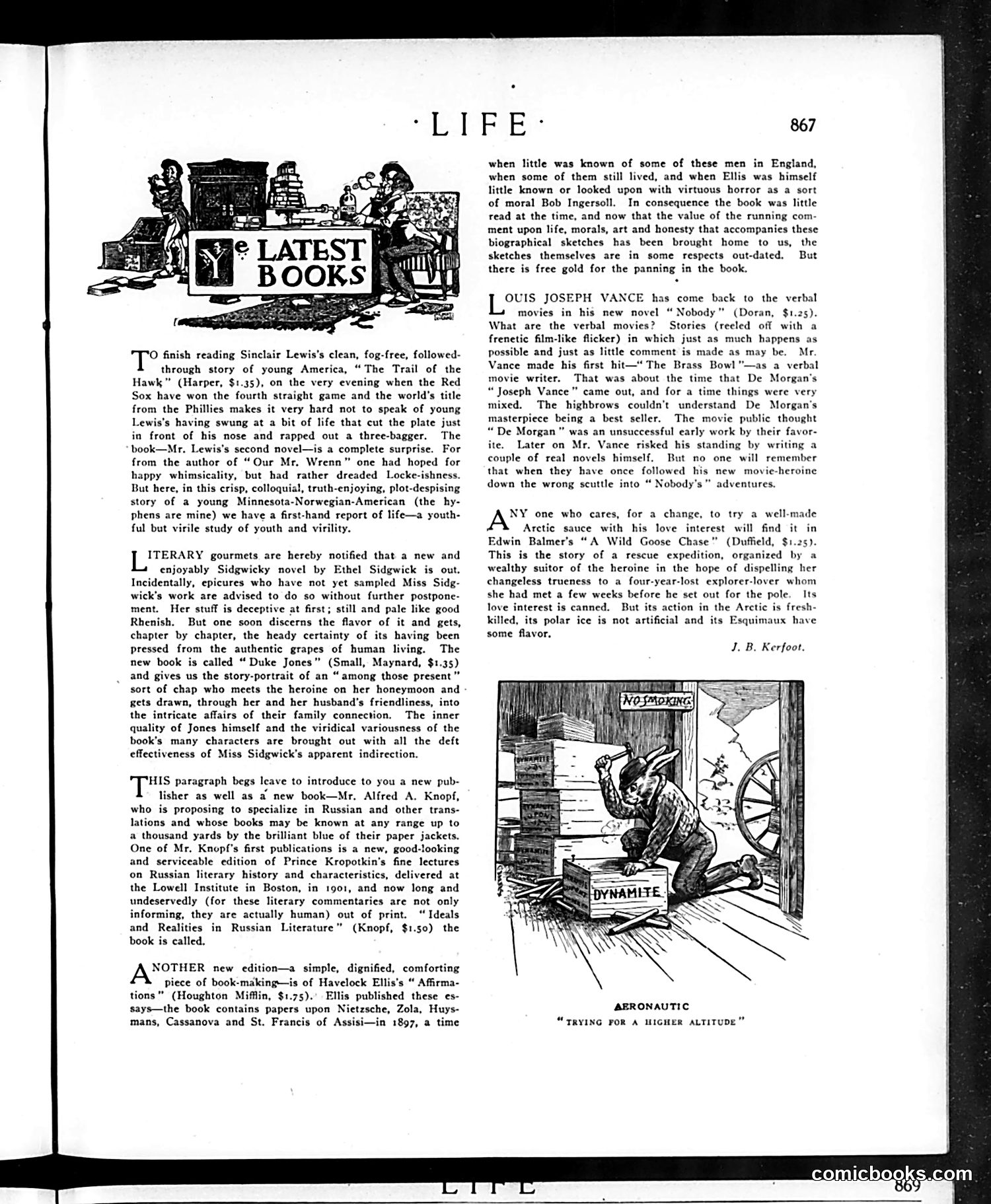
This page is a **book review section** titled "Latest Books," not primarily a political cartoon. The small illustration labeled "Aeronautic: Trying for a Higher Altitude" appears to be a humorous sketch of someone at a desk surrounded by dynamite and "No Smoking" signs—likely satirizing the explosive nature of creative work or literary ambition. The text reviews several new novels and publications, including: - Sinclair Lewis's "The Trail of the Hawk" (praised for authentic American realism) - Ethel Sidgwick's "Duke Jones" - A new publisher, Alfred A. Knopf, specializing in Russian translations - Reprinted editions of Russian literary criticism and Havelock Ellis's essays - Louis Joseph Vance's "Nobody" (described as "verbal movies"—fast-paced fiction) The reviews emphasize **literary quality and authenticity** over commercial appeal, reflecting early 20th-century intellectual tastes. The page documents emerging modernist American literature and serious publishing ventures.
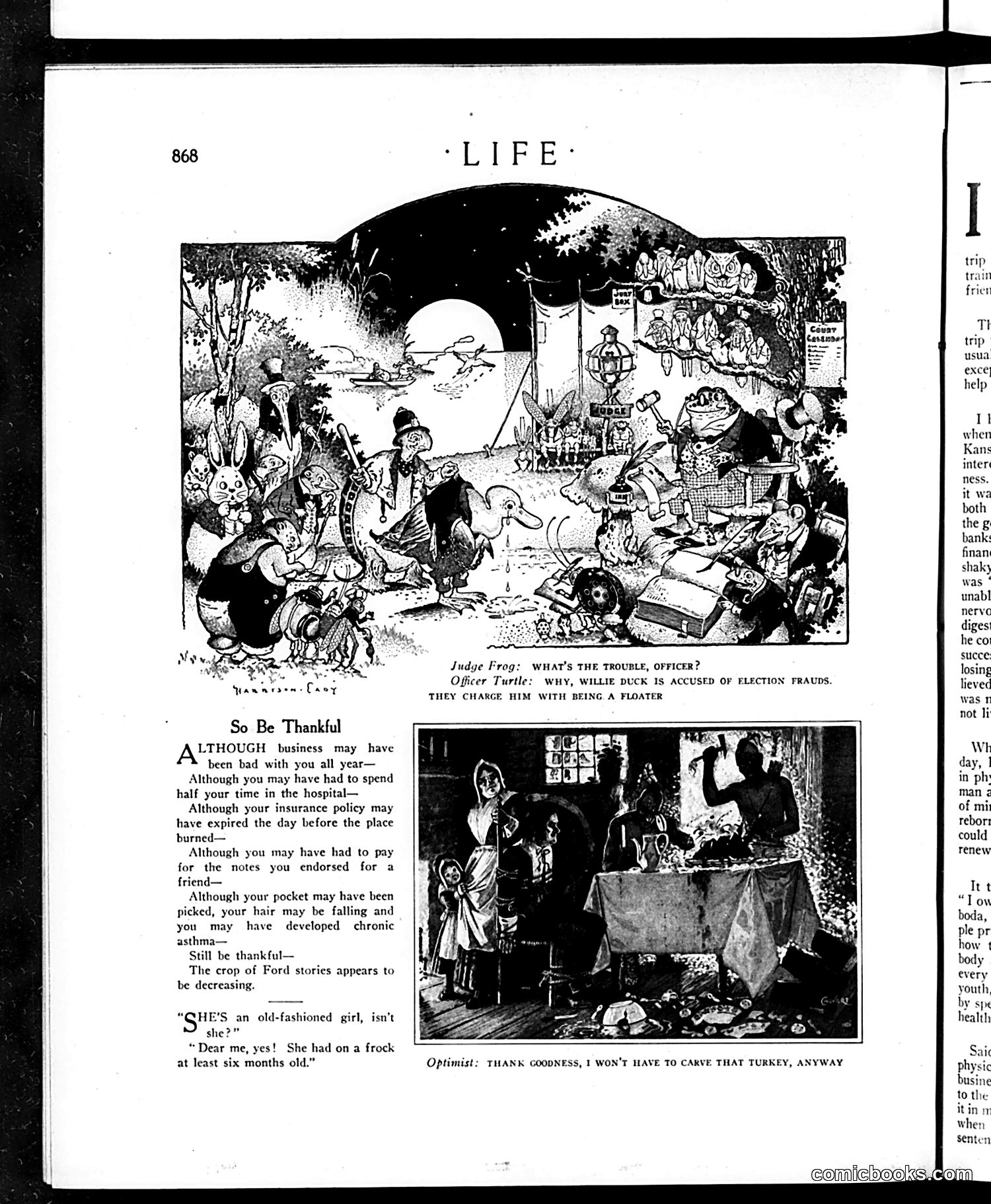
This page contains three satirical pieces typical of *Life* magazine's humor: 1. **"So Be Thankful"**: A sarcastic list mocking Americans' hardships (hospitalization, insurance failures, financial ruin, theft, hair loss, asthma) while sarcastically celebrating that "Ford stories appear to be decreasing"—referring to jokes about Ford automobiles, likely Model T reliability issues that were culturally ubiquitous at the time. 2. **The fashion joke**: Satirizes women's fashion obsession by presenting owning a six-month-old dress as hopelessly outdated, mocking rapid style changes. 3. **The animal cartoon**: Uses animal characters (Judge Frog, Officer Turtle, Willie Duck) in a pun about election fraud. "Floater" means both a vagrant voter (election fraud) and something that floats—wordplay based on the duck character. 4. **The Thanksgiving cartoon**: Shows an optimist thanking goodness he won't carve turkey—presumably because the turkey is gone (suggesting poverty or misfortune).
This is a **testimonial advertisement disguised as editorial content**, a common practice in early 20th-century magazines. The article promotes "Conscious Evolution," a health/self-improvement method taught by Alois P. Swoboda (address: 1388 Aeolian Building, New York City). The narrative structure uses a personal anecdote: the author encounters an old acquaintance, Hollister, who was supposedly dying from business stress and nervous exhaustion around 1890. Swoboda's teachings allegedly transformed Hollister into a vigorous, healthy man in his sixties. **The satire/appeal targets:** - Aging readers anxious about declining vitality - Business-stressed professionals - Skeptics of conventional medicine (Hollister's doctor advised travel/retirement, which failed) **Key persuasion tactics:** testimonial from a "real person," specific details (business failure, symptoms), dramatic before/after contrast, and the promise that anyone can recapture youth through proper technique. The piece exemplifies early-1900s wellness marketing blending pseudoscience with personal narrative—essentially a polished infomercial positioned as journalism.
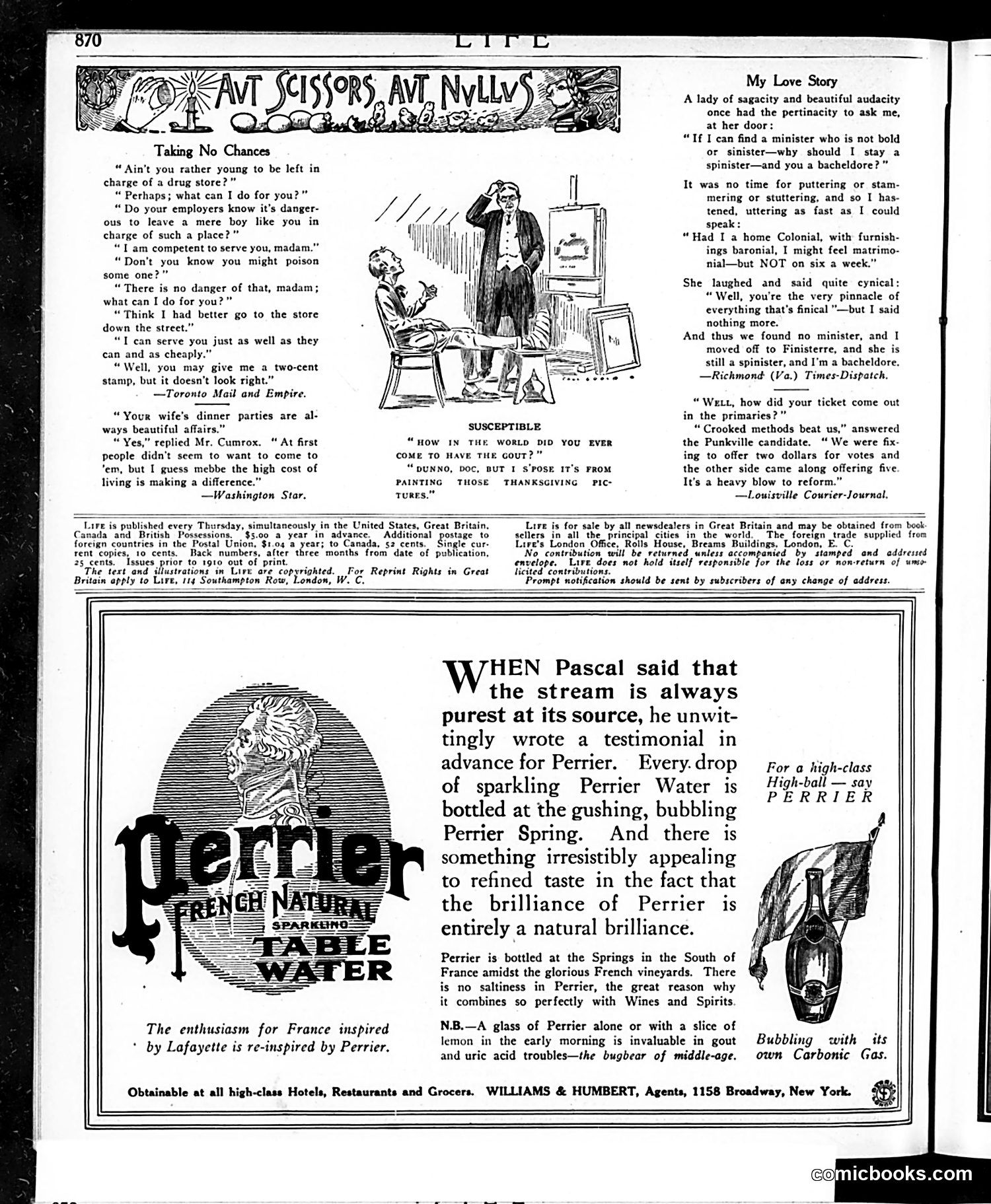
This page contains three brief humorous cartoons and one major advertisement, typical of Life's satirical format. **The Cartoons:** The first cartoon mocks a young druggist facing customer skepticism—a satire on age discrimination and consumer anxiety about competence in service roles. The second jokes about social climbing through wealth: a man's dinner parties attract guests only after he achieves financial success, implying people are motivated by free food rather than genuine friendship. The third is a visual pun: a man claims his gout came from "painting Thanksgiving pictures"—a play on words suggesting artistic work caused his condition, likely nonsensical humor. **The Advertisement:** The dominant lower half advertises Perrier Water, invoking Pascal's philosophy to suggest the product's natural purity. It emphasizes French sophistication and appeals to "refined taste," targeting upper-class consumers. The page reflects early 20th-century American attitudes: social anxiety about class mobility, skepticism of youth, and aspirational marketing toward genteel consumers.
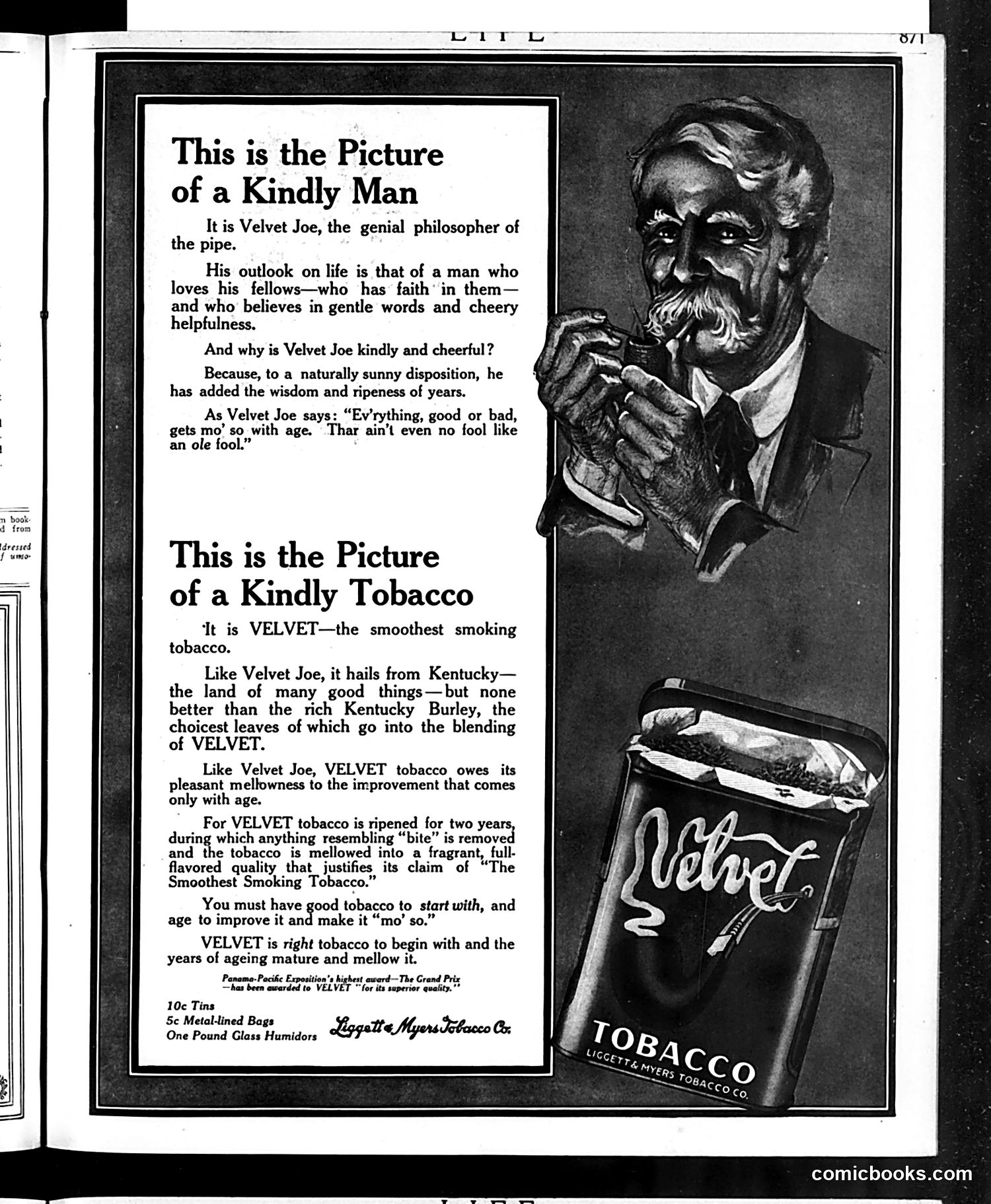
This is a **tobacco advertisement**, not satire or political commentary. The page uses a character marketing technique common in early 20th-century advertising. "Velvet Joe" is a fictional persona—a kindly, elderly Southern gentleman who speaks in dialect ("Ev'rything...gets mo' so with age"). The advertisement draws a parallel between Joe's character (improved by age and wisdom) and Velvet tobacco (improved by two years of aging). Both are presented as naturally good products that become better over time. The strategy anthropomorphizes the tobacco brand by associating it with folksy virtue and gentle Southern charm. The portrait shows a bearded older man smoking a pipe, reinforcing the "aged wisdom" metaphor. The text emphasizes Kentucky origins and careful ripening to justify premium pricing. For modern readers: this reflects an era when tobacco advertising could openly celebrate smoking without health warnings, and when such ads relied on nostalgic character-building rather than the lifestyle imagery that would dominate later campaigns.
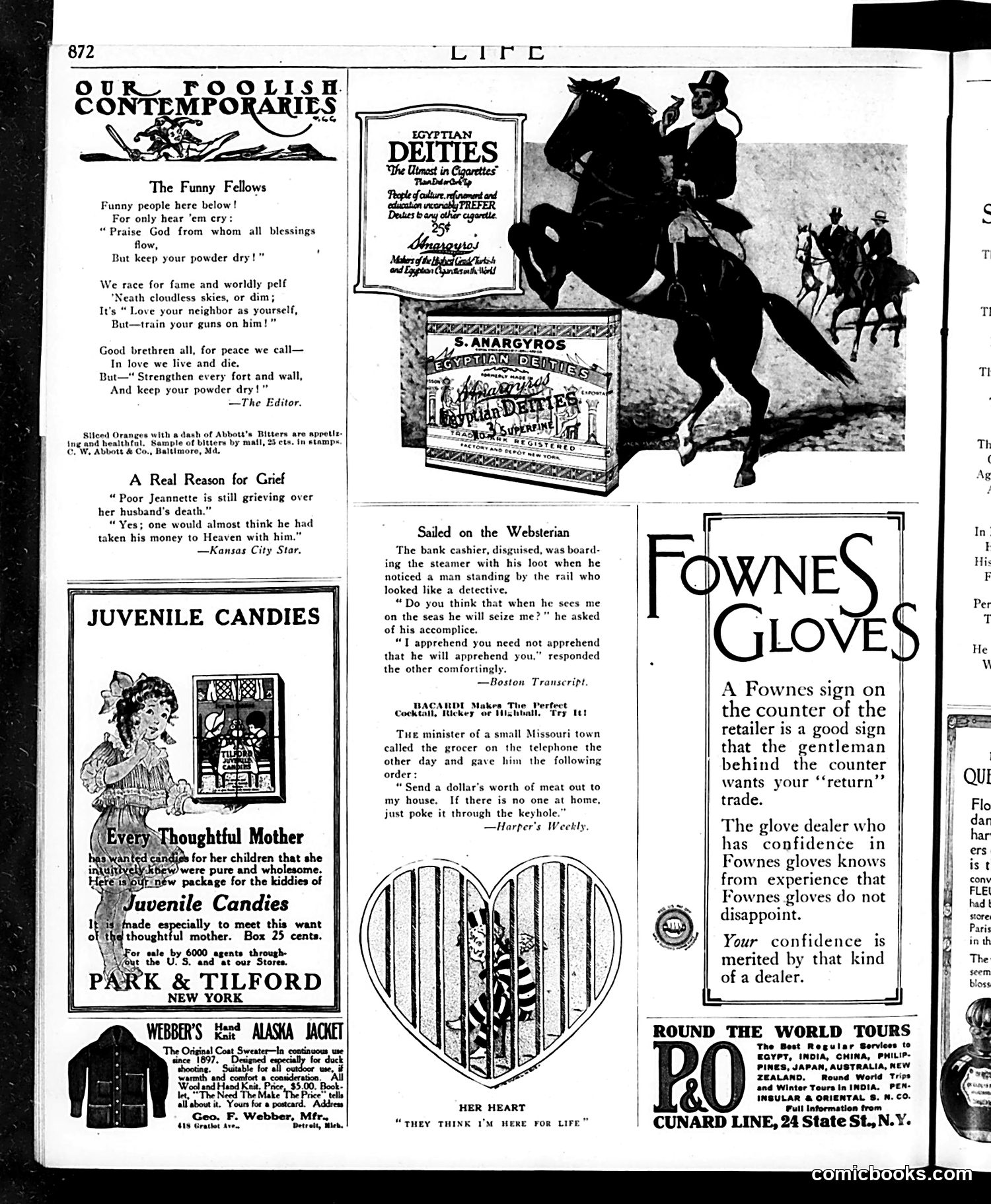
This poem, credited to "The Editor," is political satire targeting the contradiction between Christian pacifist rhetoric and militaristic preparation. The phrase "keep your powder dry" (meaning stay ready for war) is juxtaposed ironically against hymn lyrics and commandments about loving one's neighbor. The satire works by repetition: each stanza pairs peaceful religious sentiment with military language. "Love your neighbor as yourself / But—train your guns on him" exposes what the author sees as hollow piety masking aggressive nationalism. The historical context suggests this addresses pre-World War I or World War I-era American society—a time when churches and civic leaders preached peace while nations armed themselves. The satire implies that Americans (and Western civilization generally) were hypocritically combining Christian values with preparation for industrial-scale warfare. The other items on this page are advertisements unrelated to the satire's message.
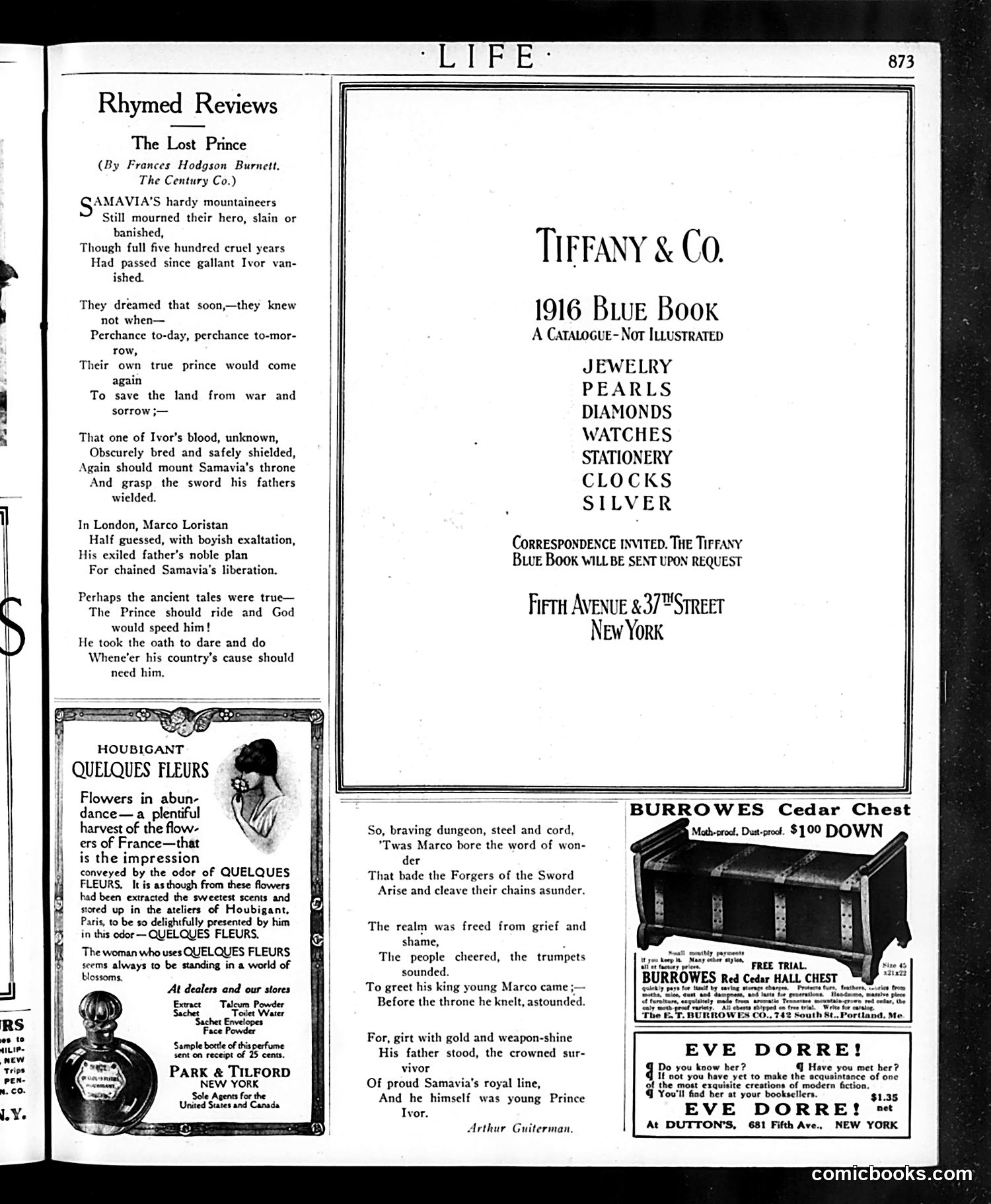
This page is primarily **advertising and book reviews**, not political satire. The "Rhymed Reviews" section critiques Frances Hodgson Burnett's novel *The Lost Prince*—a romantic fantasy about exiled Samavian mountaineers awaiting their hidden prince. The poem summarizes the plot: young Marco Loristan in London helps orchestrate his father's liberation of the fictional kingdom Samavia, only to discover his father is actually the rightful king, making Marco himself Prince Ivor. The satirical element is mild—the review gently mocks the melodramatic, wish-fulfillment nature of Burnett's tale: ancient prophecies, secret princely lineages, and triumphant liberation. This was Burnett's popular sentimental style. The rest of the page contains luxury advertisements: Tiffany & Co., Houbigant perfume, Burrowes cedar chests, and Eve Dorre novels. These reflect 1916 consumer culture targeting affluent readers.
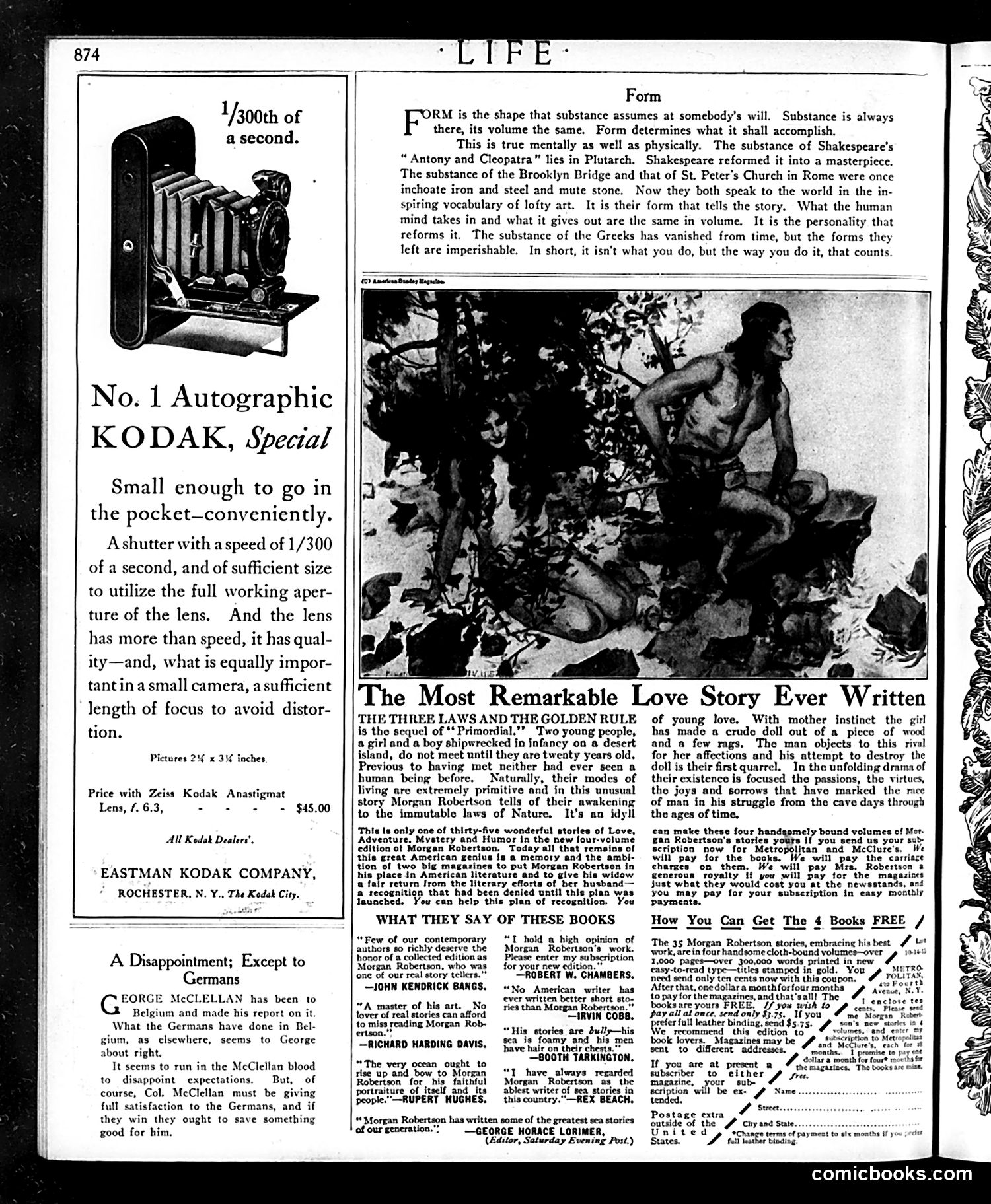
This is a political cartoon satirizing General George McClellan's visit to Belgium and his report on German conduct there during what appears to be World War I. The satire suggests McClellan found German actions acceptable or justified—disappointing to those expecting criticism. The piece plays on McClellan family history: his grandfather, General George B. McClellan (Civil War era), was known for failing to meet expectations in battle. The cartoon implies the current McClellan is similarly disappointing, but specifically to American interests rather than German ones. The closing line darkly jokes that if Germany wins the war, they should "save something good for" McClellan—implying he's become a German sympathizer or collaborator. The tone is sharply critical of both McClellan's apparent pro-German stance and his family's broader legacy of unfulfilled promises.
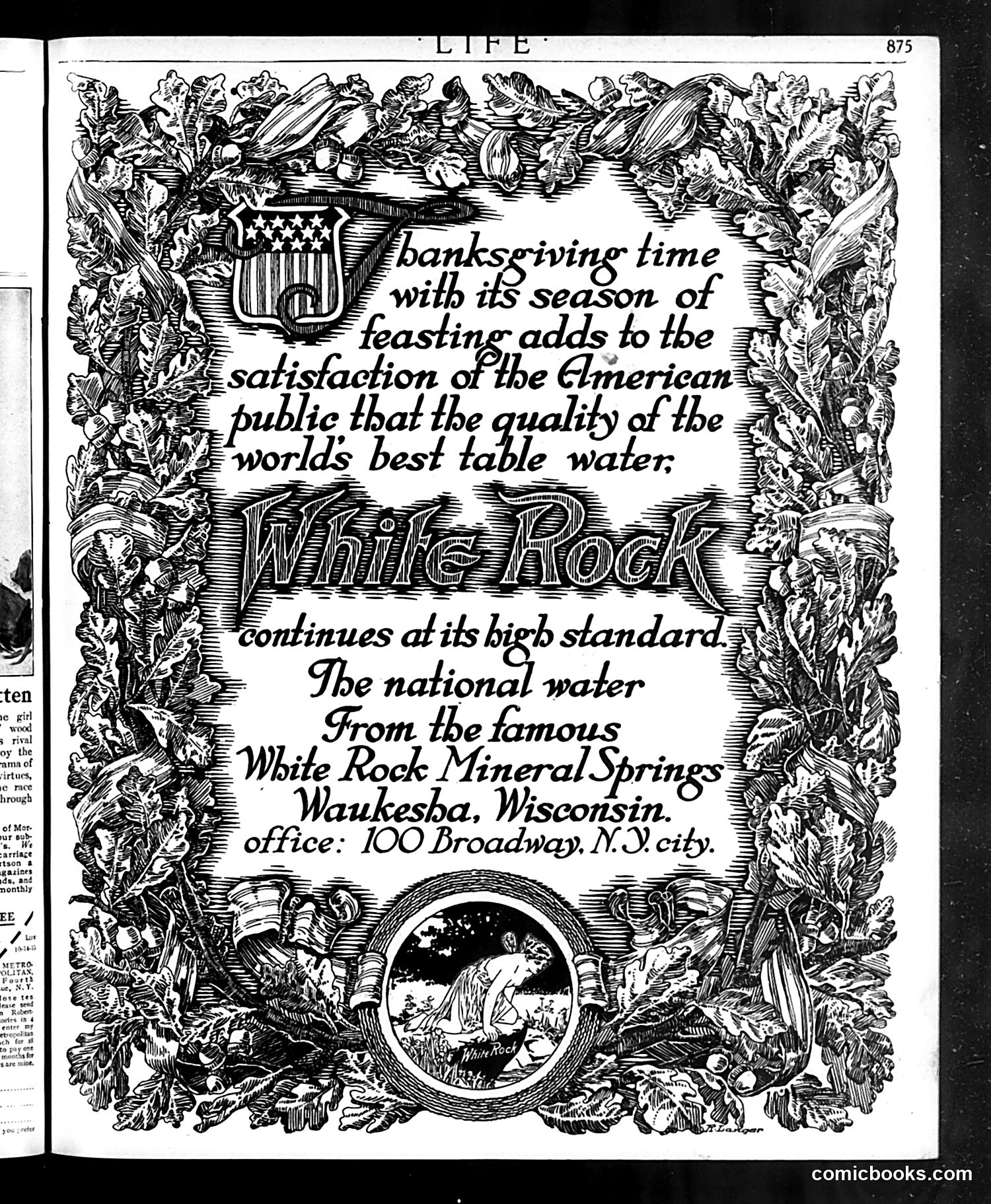
This is a full-page advertisement for White Rock mineral water, not a political cartoon. The ornate decorative border frames a message celebrating Thanksgiving season, connecting the holiday's tradition of feasting with the product's quality. The ad emphasizes that White Rock water maintains "its high standard" as "the national water" sourced from White Rock Mineral Springs in Waukesha, Wisconsin. The copy positions the product as a premium table water suitable for American holiday celebrations. A circular vignette at the bottom shows a classical figure, likely evoking purity and tradition. This represents typical early 20th-century advertising strategy: associating a consumer product with American values, seasonal occasions, and aspirational quality to appeal to middle-class readers of *Life* magazine.
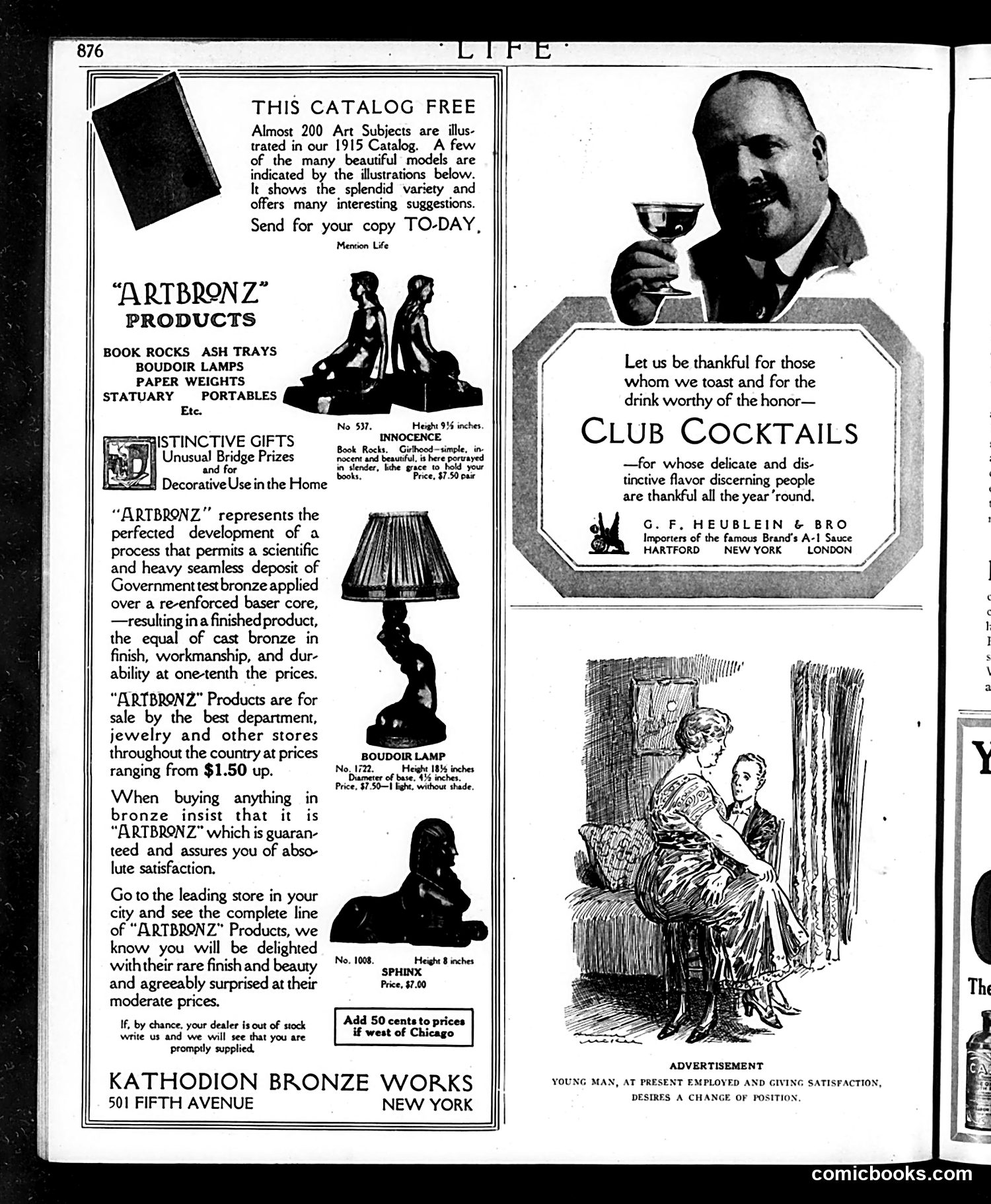
This page consists primarily of **product advertisements** rather than editorial cartoons or satire. **Left side:** Kathodion Bronze Works promotes "Artbronz" decorative products—bronze book rocks, lamps, and statuary. The copy emphasizes that these cast-bronze items equal expensive bronze at one-tenth the cost, targeting middle-class consumers seeking refined home décor. **Right side:** Two separate ads—one for Club Cocktails by G.F. Heublein & Bro (featuring a man raising a cocktail glass, likely appealing to pre-Prohibition 1915 audiences), and one small classified employment advertisement seeking a position change for a satisfactory worker. The illustrated figures are product imagery and a satisfied customer, not political caricatures. This appears to be a standard commercial page reflecting early 20th-century consumer culture and advertising practices in *Life* magazine.
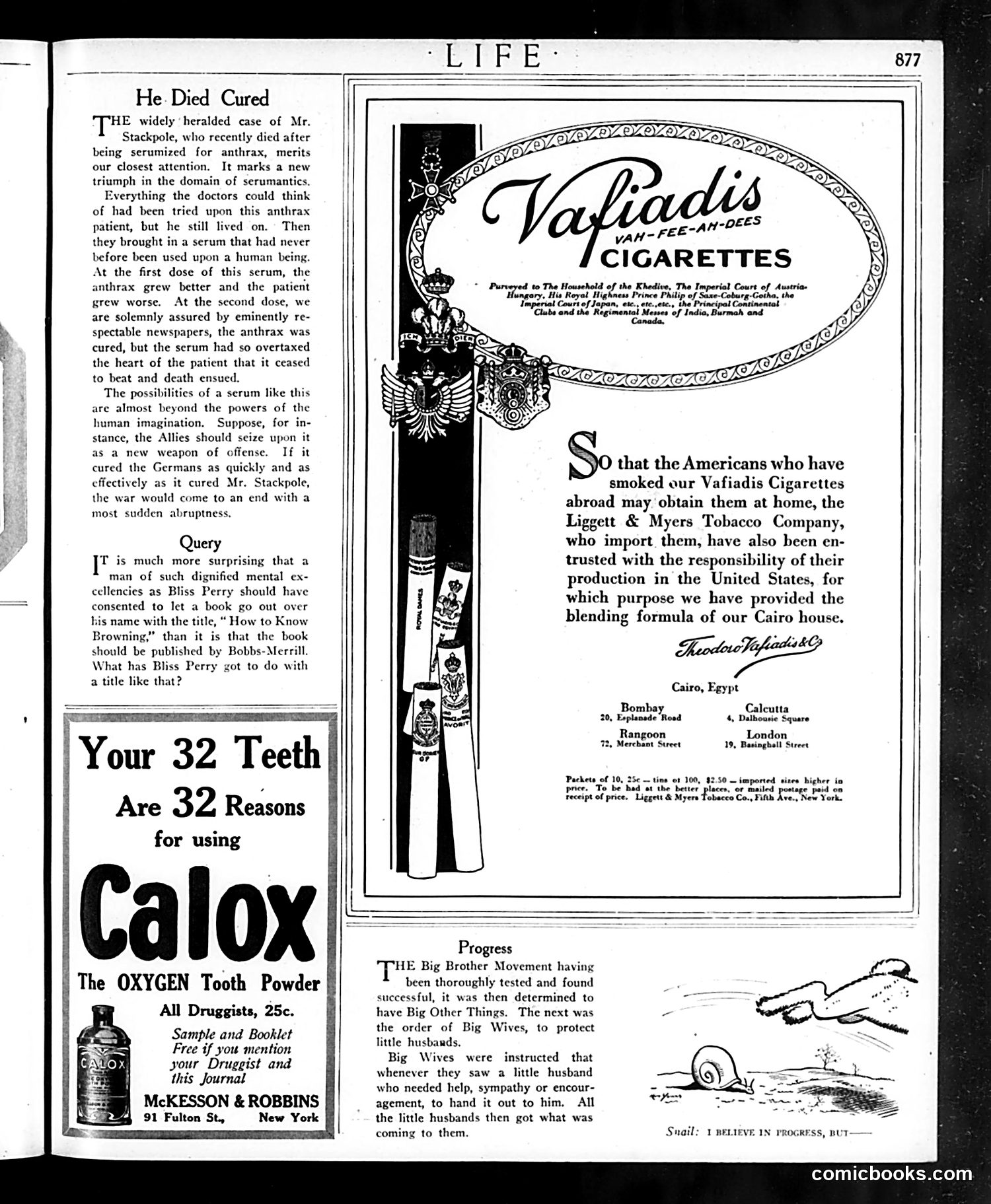
This page mixes satirical articles with period advertisements. The main satire, "He Died Cured," mocks a real case where Mr. Stackpole died after receiving an experimental anthrax serum—technically "cured" of anthrax but killed by the treatment itself. The author sarcastically suggests this could be weaponized against Germans in World War I, highlighting the absurdity of calling a treatment successful when the patient dies. A brief query criticizes literary scholar Bliss Perry for lending his name to a book about Browning. "Progress" satirizes the "Big Brother Movement" (a contemporary social initiative), then its extension to "Big Wives"—women assigned to help struggling husbands. The snail cartoon punchline suggests skepticism about such progress. The advertisements (Calox tooth powder, Vafiadis cigarettes) represent typical period marketing, with the cigarette ad emphasizing Egyptian prestige and international availability to American smokers.
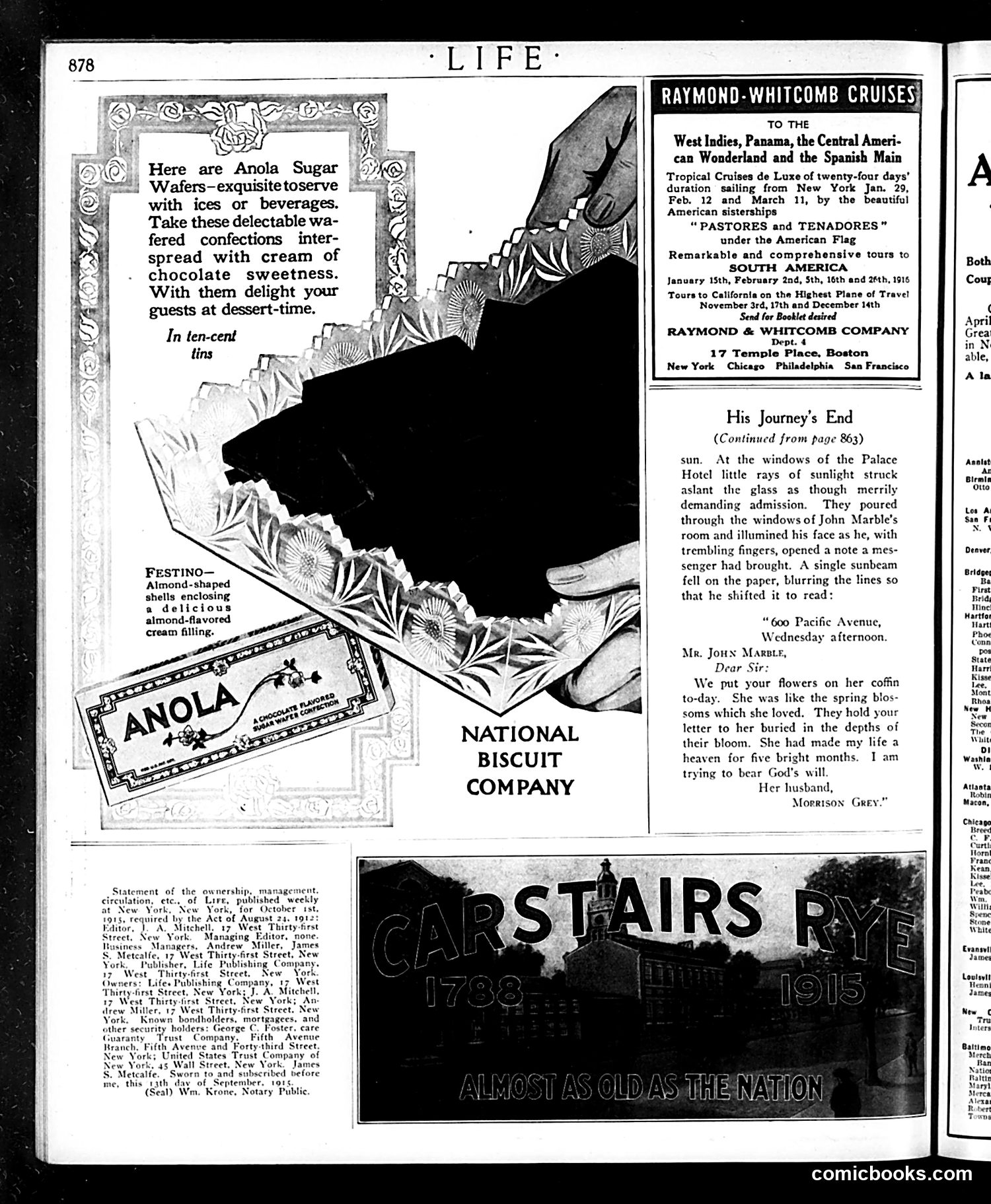
This page is primarily **advertising and serialized fiction**, not political satire. **Left side**: Two product advertisements—Anola Sugar Wafers and Festino candies by National Biscuit Company, with decorative borders featuring illustrated hands and confections. **Top right**: Raymond-Whitcomb Cruises advertisement promoting luxury voyages to the West Indies, Panama, Central America, and South America for January-March 1916. **Center**: "His Journey's End," a continued serialized story. A widower reads a letter from another man whose wife has died—the letter describes placing flowers on her coffin and the "five bright months" of marriage she gave him. The tone is sentimental Victorian melodrama. **Bottom**: Standard magazine ownership and management statement (legally required publication information). There is no political cartoon or satire on this page. It represents typical *Life* magazine content from 1915: luxury advertising targeting affluent readers and serialized domestic fiction.
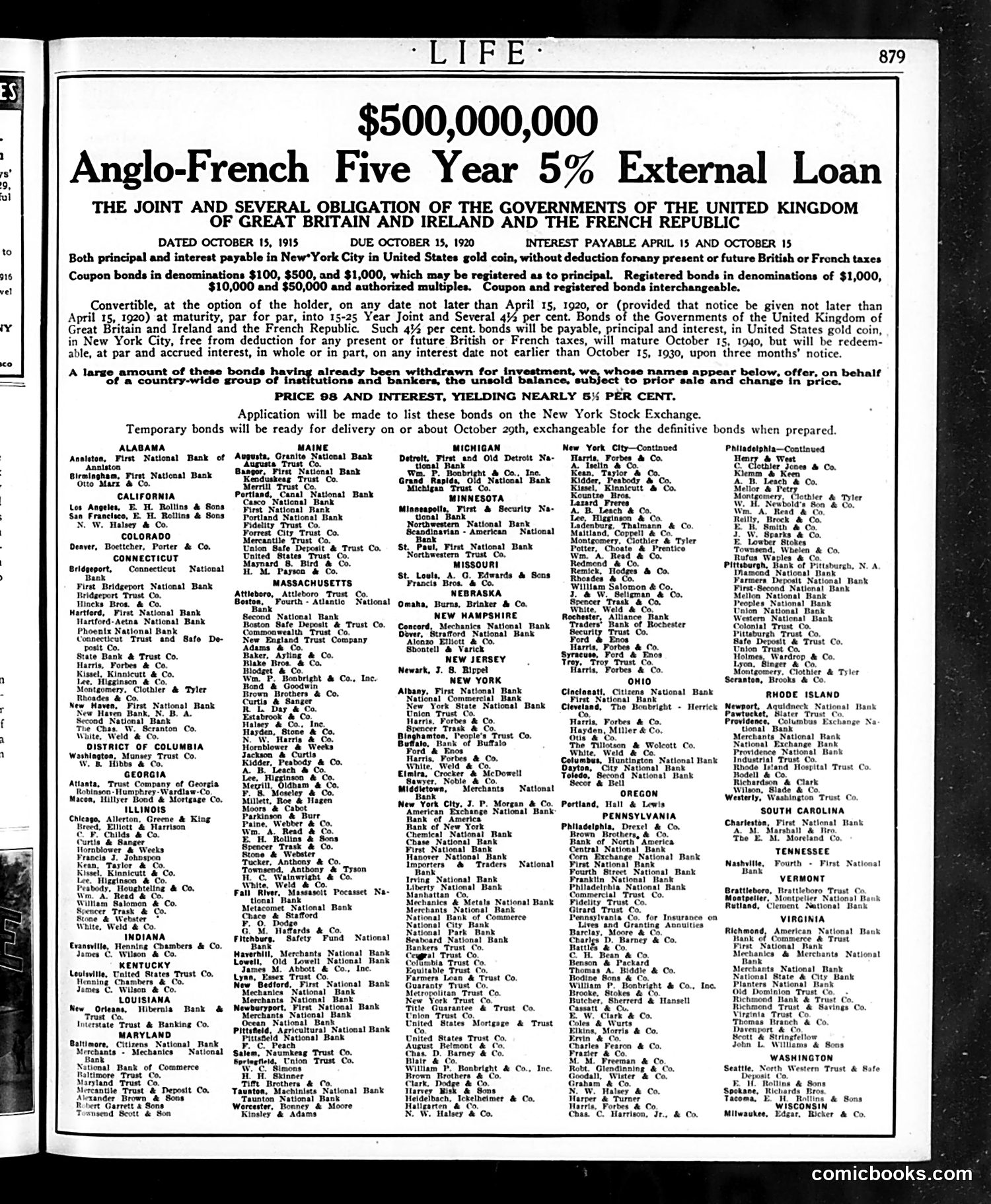
This is **not a cartoon or satirical content** — it's a financial advertisement/prospectus page from *Life* magazine (October 1915). The page announces a **$500 million joint loan from Britain and France**, issued during World War I. Both governments jointly guaranteed the bond, payable in U.S. gold in New York City. The bonds offered 5% interest, mature in 1920, and were convertible into longer-term 4% bonds. The bulk of the page lists hundreds of American banks and financial institutions authorized to sell these bonds — from major cities (New York, Boston, Chicago) to smaller towns (Anniston, Alabama; Cranwville, Indiana). This was a major wartime fundraising effort by the Allies to secure American capital. For modern readers: This shows how WWI was financed through American investments before the U.S. officially entered the war (1917). It's a historical record of American financial support for the Allies during neutrality.
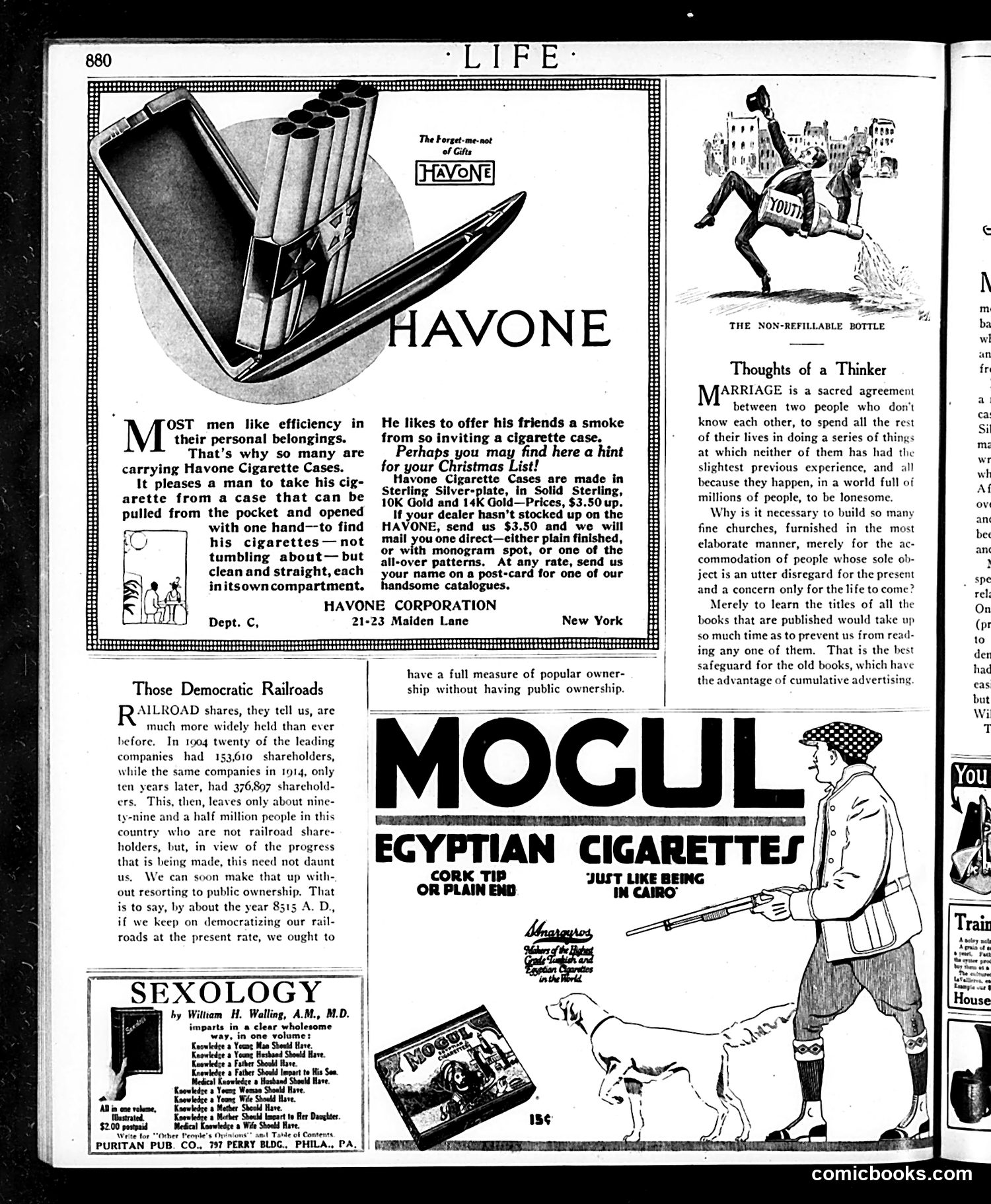
This page is primarily **advertising**, with one notable satirical piece. **The Main Satire: "Those Democratic Railroads"** A short editorial cartoon mocks the claim that railroad shareholding is becoming "democratized." The piece notes that in 1904, twenty major railroad companies had ~154,000 shareholders; by 1914, this grew to ~377,000—leaving "ninety-nine and a half million people" still without shares. The satire's punch line: at this rate of "democratization," it will take until **year 8515 A.D.** for everyone to own railroad stock. **The Point:** This is sarcastic criticism of claims that railroads were becoming more publicly owned. In reality, ownership remained heavily concentrated among the wealthy, making the "democratic" framing absurd. The joke targets both railroad companies' PR and Progressive Era rhetoric about wealth distribution. **The Advertisements** include cigarette cases, Egyptian cigarettes, and a sexology book—typical 1910s consumer goods and self-help literature.
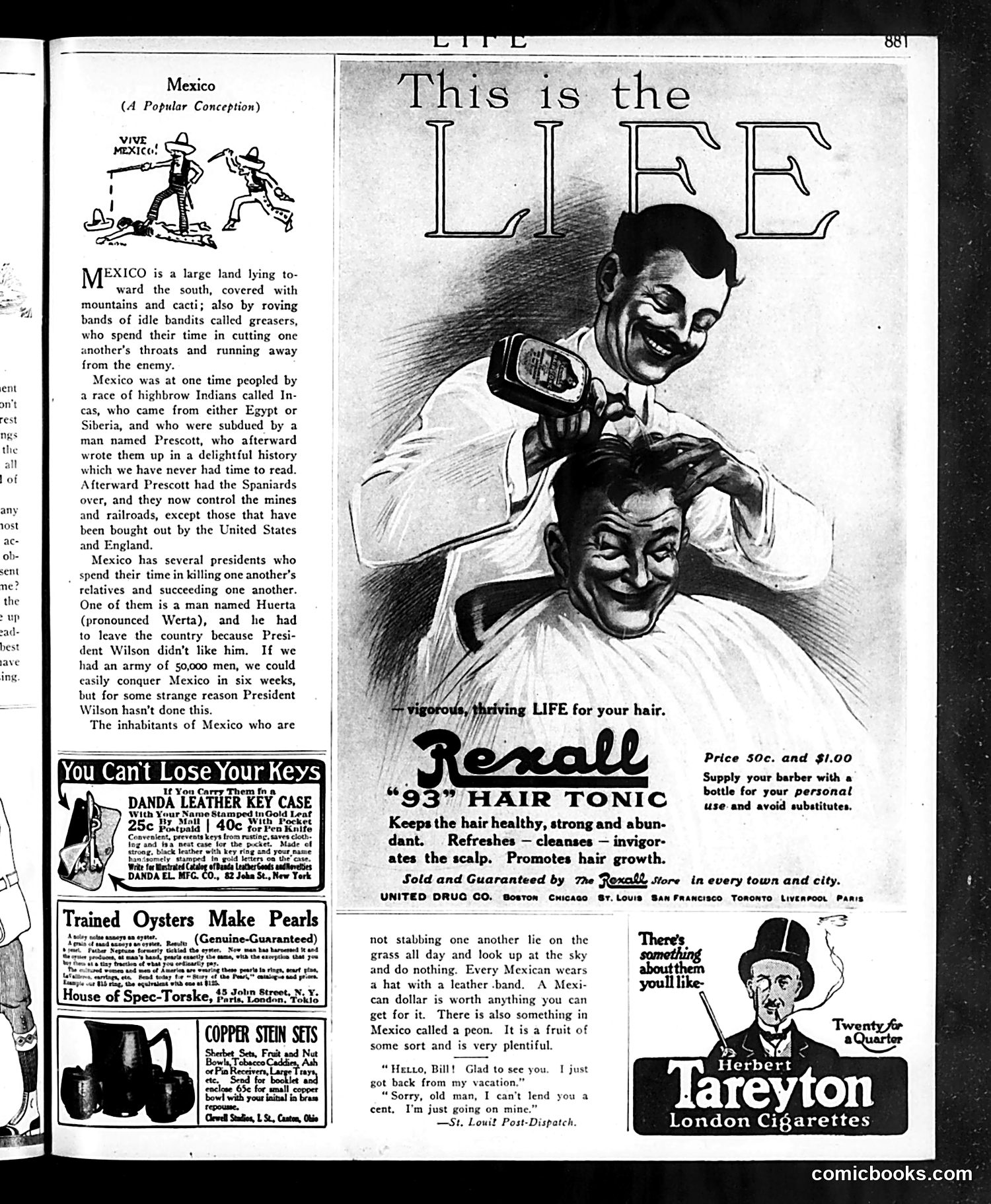
This satirical piece mocks American stereotypes and misconceptions about Mexico circa 1910s. The text presents deliberately absurd, contradictory "facts"—claiming Mexico was populated by Incas from "Egypt or Siberia," that Mexican presidents spend time "killing one another's relatives," and confusing a "peon" (laborer) with a fruit. The piece ridicules American ignorance and arrogance, particularly regarding President Wilson's Mexican policy. It sardonically notes that with 50,000 troops America could "easily conquer Mexico in six weeks" but Wilson mysteriously hasn't done so—likely referencing contemporary U.S. military interventions in Mexico (1914-1917). The satire targets both American imperial attitudes and lazy stereotyping of Mexicans as idle bandits ("greasers") and lazy peasants. The accompanying cartoon (showing exaggerated caricatured figures) reinforces how Life magazine presented these prejudiced "popular conceptions" to critique them. The page is primarily advertisements, with the satirical Mexico article as the main editorial content.
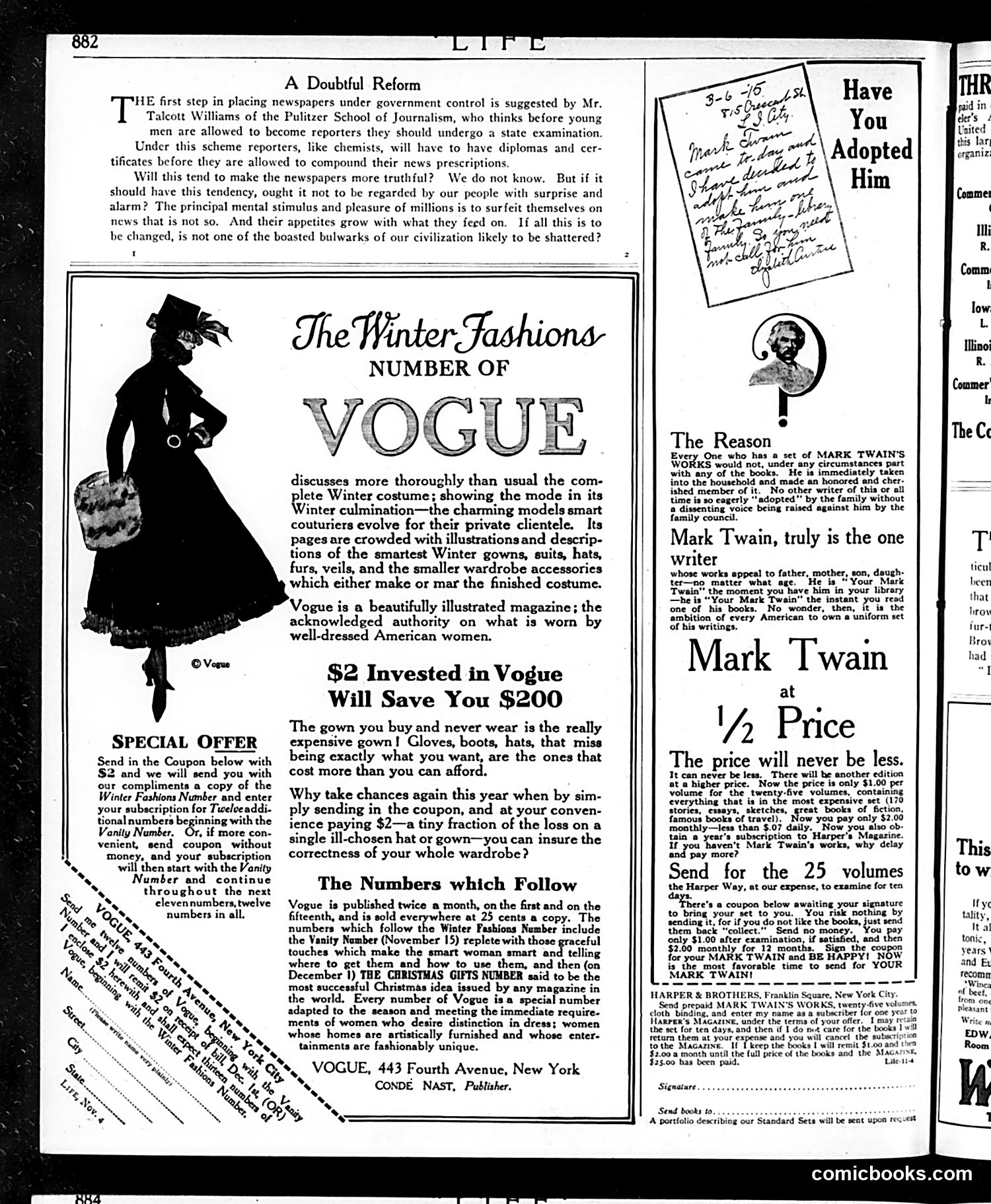
**"A Doubtful Reform"** (top left): This satirical editorial argues *against* requiring journalists to be certified/licensed. The writer sarcastically questions whether making newspapers "more truthful" is actually desirable—suggesting that the public's appetite for sensational, false news is so ingrained in American culture that enforcing truth-telling would undermine a fundamental pleasure citizens expect from their papers. The satire implies newspapers profit from lies and that readers prefer fiction to facts. The rest of the page consists primarily of **advertisements**: a Vogue magazine promotion featuring fashionable winter clothing, and a Mark Twain book collection offer. These are not satirical content but standard period advertising using celebrity endorsement (Twain) and lifestyle appeals typical of early 20th-century magazines.
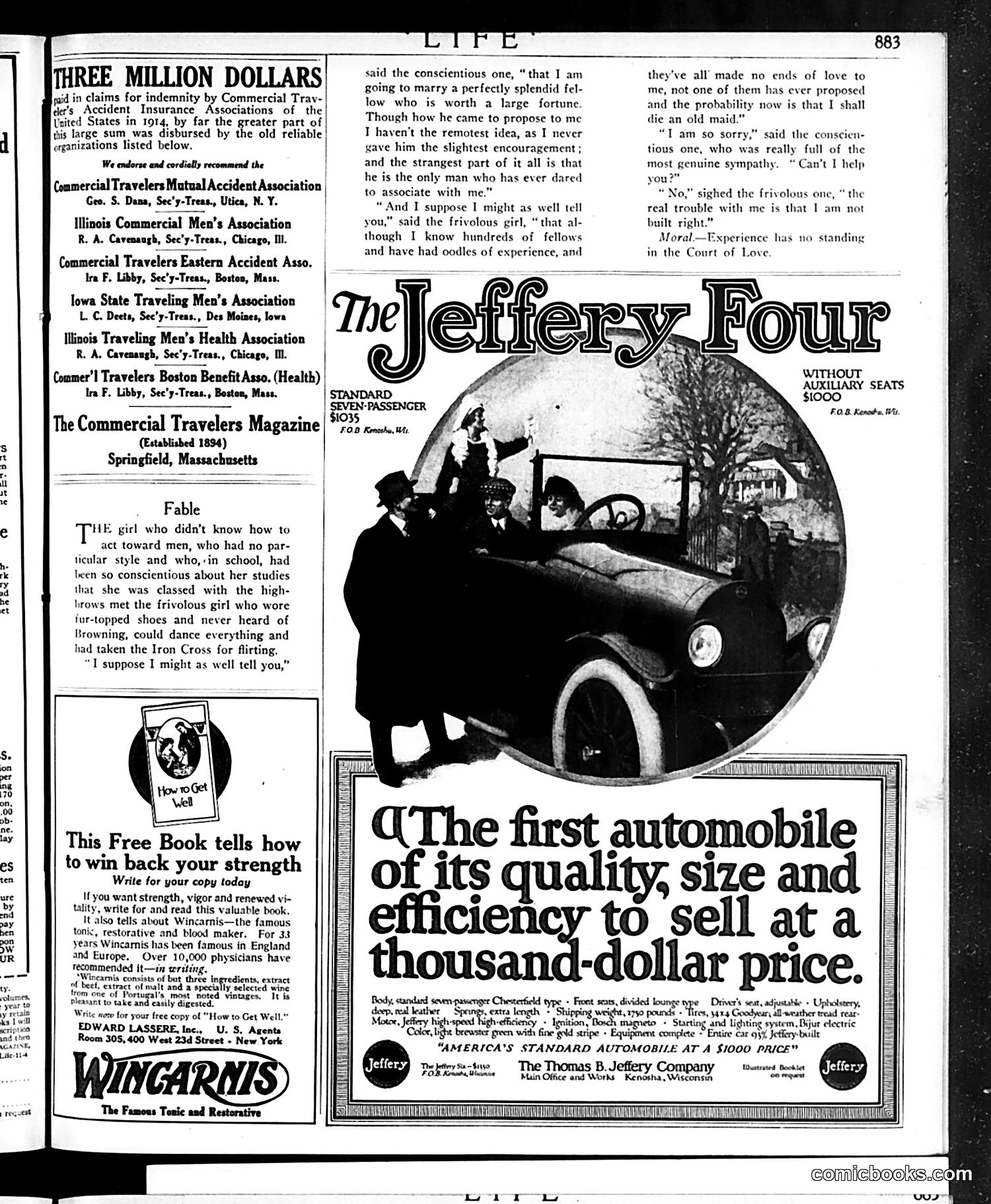
This page is primarily **advertising-focused**, not political satire. The main content includes: **Left side:** A humorous "Fable" contrasting two female archetypes—a conscientious, studious "highbrow" girl versus a frivolous, fashionable girl who dances and flirts. The moral: "Experience has no standing in the Court of Love"—a lighthearted commentary suggesting that social experience doesn't guarantee romantic success, and personality type matters more than behavior. **Right side:** A full-page advertisement for the Jeffery Four automobile, claiming it's "the first automobile of its quality, size and efficiency to sell at a thousand-dollar price." The image shows the car with passengers in early 1910s dress. **Additional ads:** Include insurance associations for traveling salesmen and a "Wincarnis" tonic advertised as a restorative for strength and vigor. The fable reflects period attitudes about gender roles and courtship; the automobile ad represents the era's fascination with affordable motorcar technology.
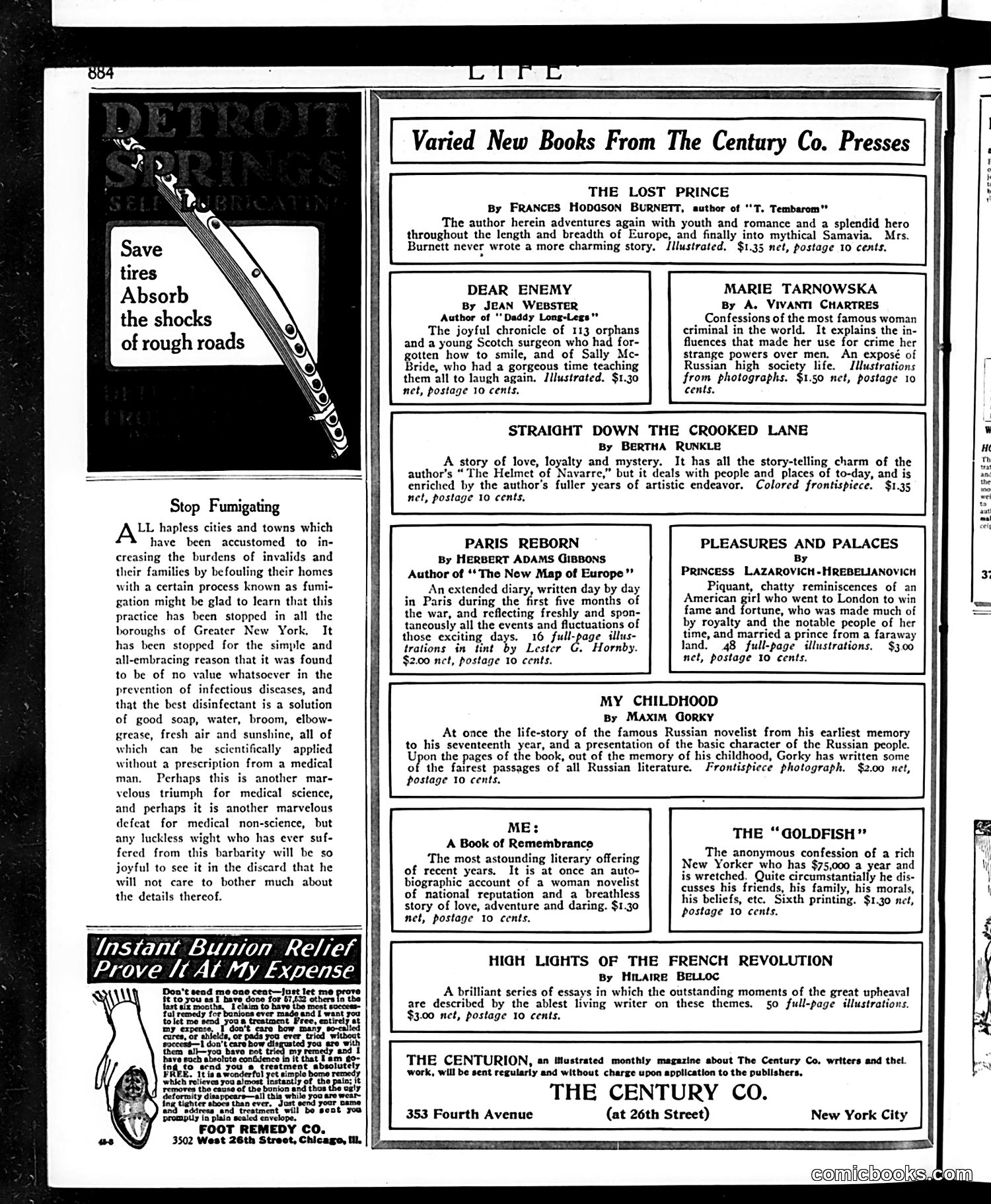
This page is primarily a **book advertisement** from The Century Co. publishers, not political satire. The left sidebar contains two unrelated advertisements: one for car tires and one for a foot remedy. The substantive editorial content is a brief opinion piece titled "Stop Fumigating" criticizing New York City's now-abandoned practice of fumigating homes and neighborhoods to prevent disease. The author argues fumigation was ineffective and that simple cleanliness—soap, water, and fresh air—works better. The tone is gently mocking ("marvelous triumph for medical science, and perhaps it is another marvelous defeat for medical non-science"), suggesting this represents progress in public health policy, though the author admits uncertainty about crediting medical science versus rejecting bad practices. The bulk of the page showcases books from 1910-1915, including works by Frances Hodgson Burnett and Maxim Gorky. No political cartoons appear on this page.
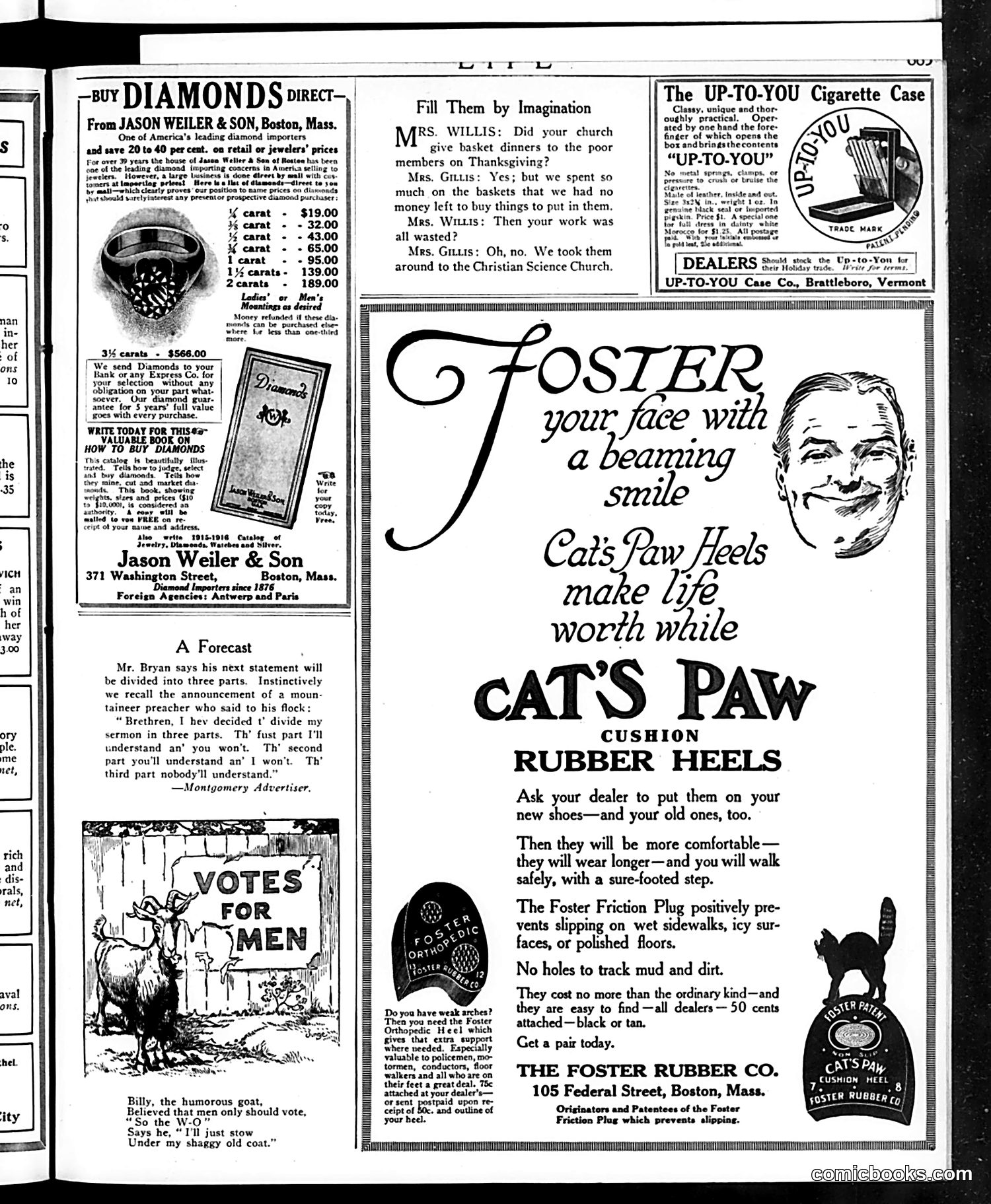
This page features a satirical cartoon about women's suffrage. The illustration shows **Billy the goat** holding a sign reading "VOTES FOR MEN," accompanying a verse that mocks the opposition to women voting. The joke: Billy represents a stubborn, backward-thinking male who believes only men should vote. He plans to hide under women's coats to prevent them from voting—a ridiculous image that satirizes the absurdity of anti-suffrage arguments. The accompanying verse ("I'll just stow / Under my shaggy old coat") emphasizes this foolishness. **Historical context**: This appears from Life magazine's satirical perspective *supporting* women's suffrage by ridiculing those who opposed it. The cartoon equates male-only voting advocates with an animal, suggesting their position is primitive and irrational. The page's surrounding advertisements (diamonds, cigarette cases, rubber heels) are period appropriate but unrelated to the political content.
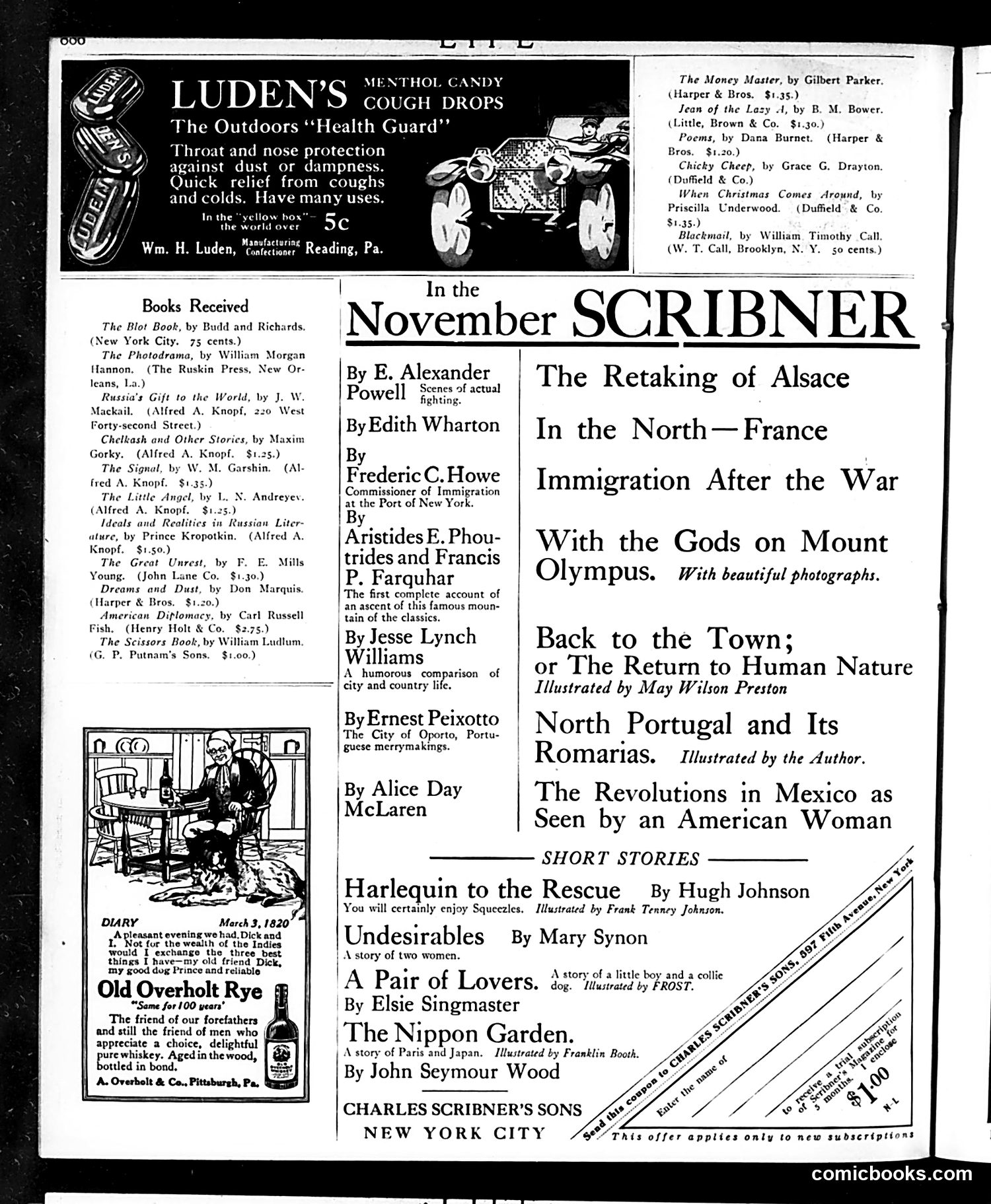
This is primarily a **table of contents/advertisement page** for *Scribner's* magazine's November issue, not a satirical cartoon page. The small illustration in the lower left—labeled "DIARY March 3, 1820"—depicts a man and dog by a fireplace, accompanying an advertisement for **Old Overholt Rye whiskey**. The "diary entry" uses nostalgic Americana to market the liquor, claiming it's been favored "for 100 years" and suggesting it represents timeless American values ("friend of our forefathers"). The page otherwise lists forthcoming *Scribner's* articles addressing post-WWI concerns: Edith Wharton on France, pieces on immigration and Mexican revolution, and travel writing. These reflect contemporary 1919-era anxieties about international conflict and American involvement abroad. The Luden's cough drops advertisement at top uses similar period marketing—emphasizing "health" and universal availability.
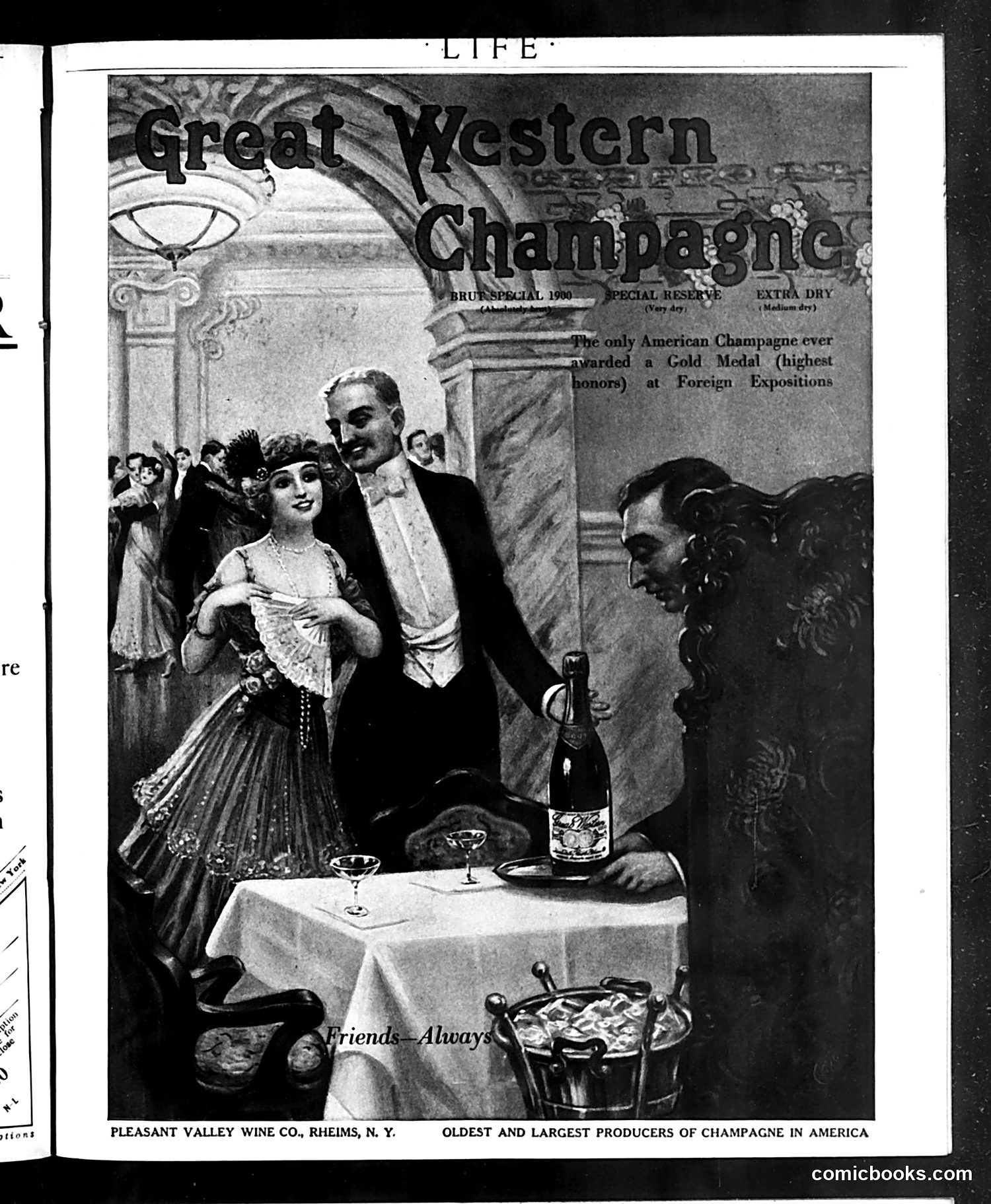
This is a **champagne advertisement**, not a political cartoon. It promotes Great Western Champagne from Pleasant Valley Wine Co. in Rheims, New York. The ad features an elegant social scene with well-dressed figures at what appears to be a formal gathering, emphasizing sophistication and celebration. The tagline "Friends—Always" suggests the product's role in social bonding. The key sales pitch is in the text box: this champagne was "the only American Champagne ever awarded a Gold Medal (highest honor) at Foreign Expositions"—a claim meant to establish American prestige and quality against French competition. The image uses visual glamour and social status to market champagne during what appears to be the pre-Prohibition era, appealing to wealthy consumers' desires for refinement and international recognition.
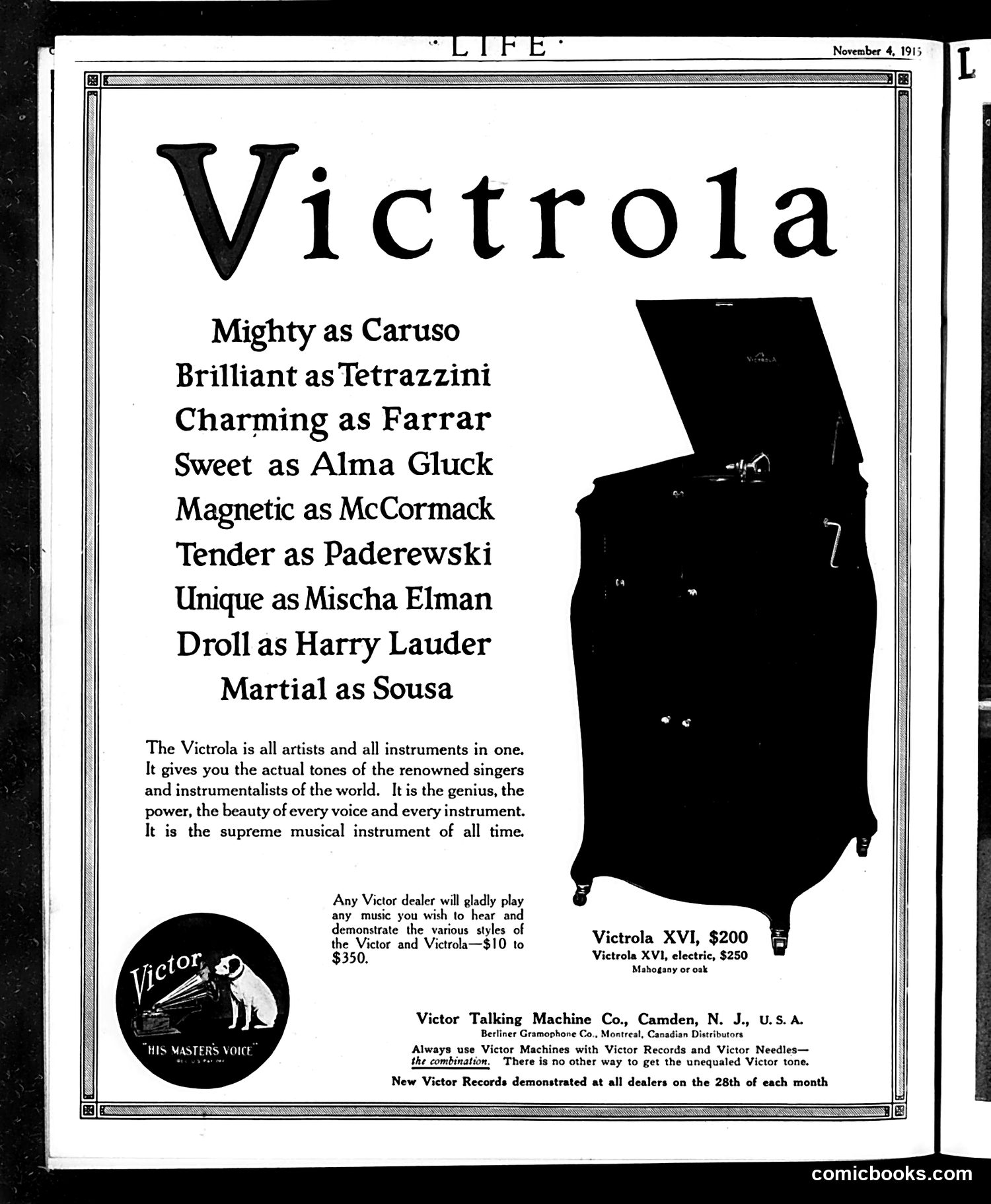
This is primarily a **product advertisement**, not a political cartoon. It promotes the Victrola phonograph by claiming it captures the performances of famous early 20th-century singers and musicians: Caruso (opera tenor), Tetrazzini (soprano), Farrar (soprano), Alma Gluck (soprano), McCormack (tenor), Paderewski (pianist), Mischa Elman (violinist), Harry Lauder (Scottish entertainer), and Sousa (composer/bandleader). The ad's rhetorical strategy compares the machine's quality to these renowned artists—"mighty as Caruso," "brilliant as Tetrazzini," etc.—suggesting the Victrola faithfully reproduces their artistry. The silhouetted product image shows the cabinet-style machine typical of the era. For modern readers: this reflects how phonograph technology was revolutionary, allowing middle-class homes to access world-class performances previously available only to concert-goers.