
Life, 1915-11-04 · page 15 of 56
Life — November 4, 1915 — page 15: what you’re looking at
What you’re looking at
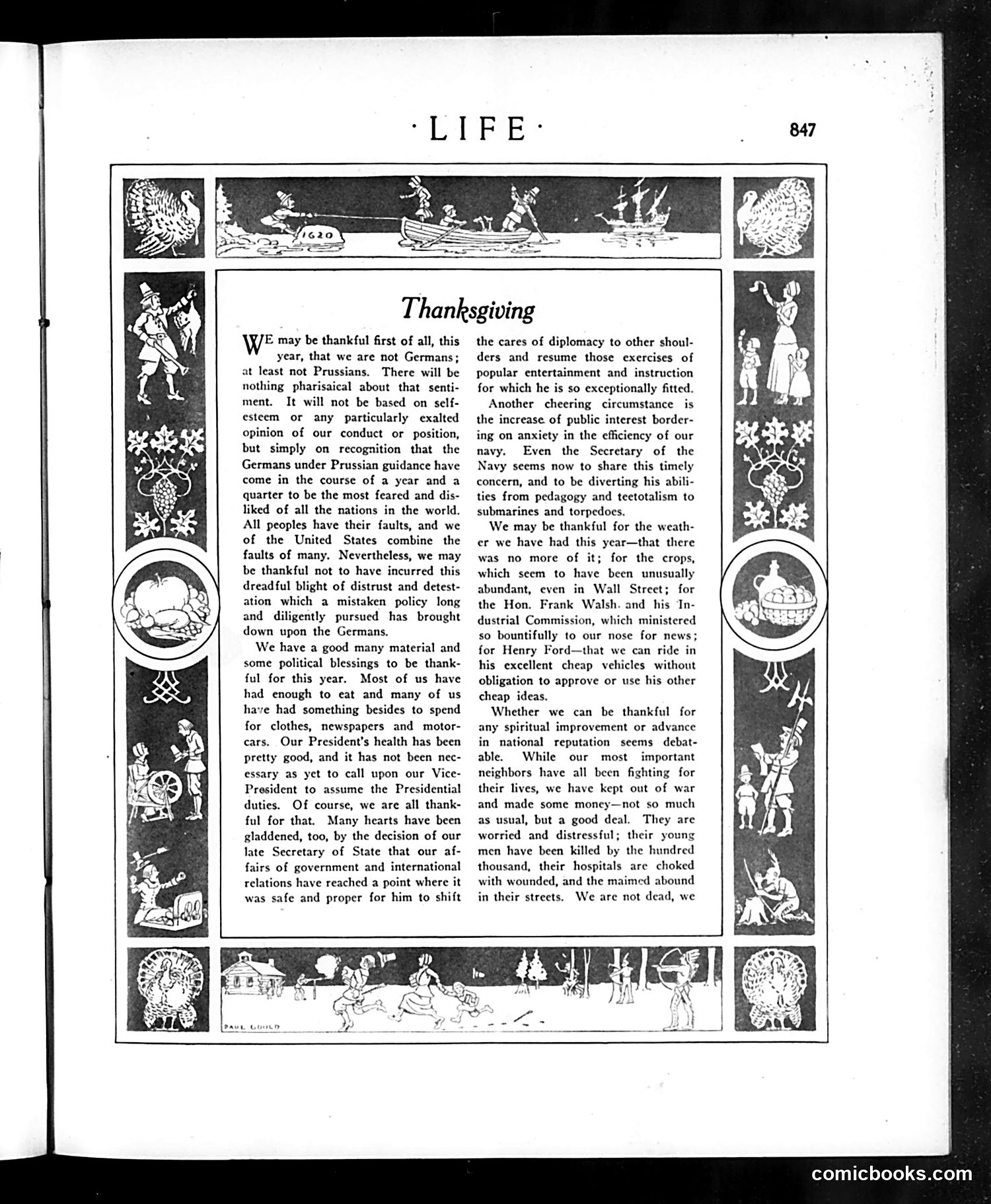
This is an editorial essay titled "Thanksgiving," not a political cartoon. The piece reflects on 1917 America's gratitude despite World War I's ongoing carnage. The text expresses relief that Americans are not Germans or Prussians, praised U.S. leadership (mentioning President Wilson and Secretary of State), and celebrated domestic achievements—notably Henry Ford's affordable automobiles and Frank Walsh's Industrial Commission. The essay acknowledges the war's human cost ("young men have been killed by the hundred thousand") while emphasizing America's relative safety and prosperity. It references anxiety about naval efficiency, suggesting pre-WWI naval readiness concerns. The decorative borders contain period illustrations of Thanksgiving themes, harvest scenes, and domestic life—not satirical commentary, but thematic ornamentation appropriate to the holiday essay.
📄 Transcribed text from this page (OCR, searchable)
Machine-transcribed from the original scan — historical spelling and the odd misread are preserved.
Thanksgiving E may be thankful first of all, this year, that we are not Germans; at least not Prussians. There will be nothing pharisaical about that senti- ment. It will not be based on self- esteem or any particularly exalted opinion of our conduct or position, but simply on recognition that the Germans under Prussian guidance have come in the course of a year and a quarter to be the most feared and dis- liked of all the nations in the world. All peoples have their faults, and we of the United States combine the faults of many. Nevertheless, we may be thankful not to have incurred this dreadful blight of distrust and detest- ation which a mistaken policy long and diligently pursued has brought down upon the Germans, We have a good many material and some political blessings to be thank- ful for this year. Most of us have had enough to eat and many of us have had something besides to spend for clothes, newspapers and motor- cars. Our President's health has been pretty good, and it has not been nec- essary as yet to call upon our Vice- President to assume the Presidential duties. Of course, we are all thank- ful for that. Many hearts have been gladdened, too, by the decision of our late Secretary of State that our af- fairs of government and international relations have reached a point where it was safe and proper for him to shift the cares of diplomacy to other shoul- ders and resume those exercises of popular entertainment and instruction for which he is so exceptionally fitted. Another cheering circumstance is the increase of public interest border- ing on anxiety in the efficiency of our navy. Even the Secretary of the Navy seems now to share this timely concern, and to be diverting his abili- ties from pedagogy and teetotalism to submarines and torpedoes. We may be thankful for the weath- er we have had this year—that there was no more of it; for the crops, which seem to have been unusually abundant, even in Wall Street; for the Hon. Frank Walsh. and his In- dustrial Commission, which ministered so bountifully to our nose for news; for Henry Ford—that we can ride in his excellent cheap vehicles without obligation to approve or use his other cheap ideas. Whether we can be thankful for any spiritual improvement or advance in national reputation seems debat- able. While our most important neighbors have all been fighting for their lives, we have kept out of war and made some moncy—not so much as usual, but a good deal. They are worried and distressful; their young men have been killed by the hundred thousand, their hospitals are choked with wounded, and the maimed abound in their streets. We are not dead, we comicbooks.com