
Life, 1915-11-04 · page 35 of 56
Life — November 4, 1915 — page 35: what you’re looking at
What you’re looking at
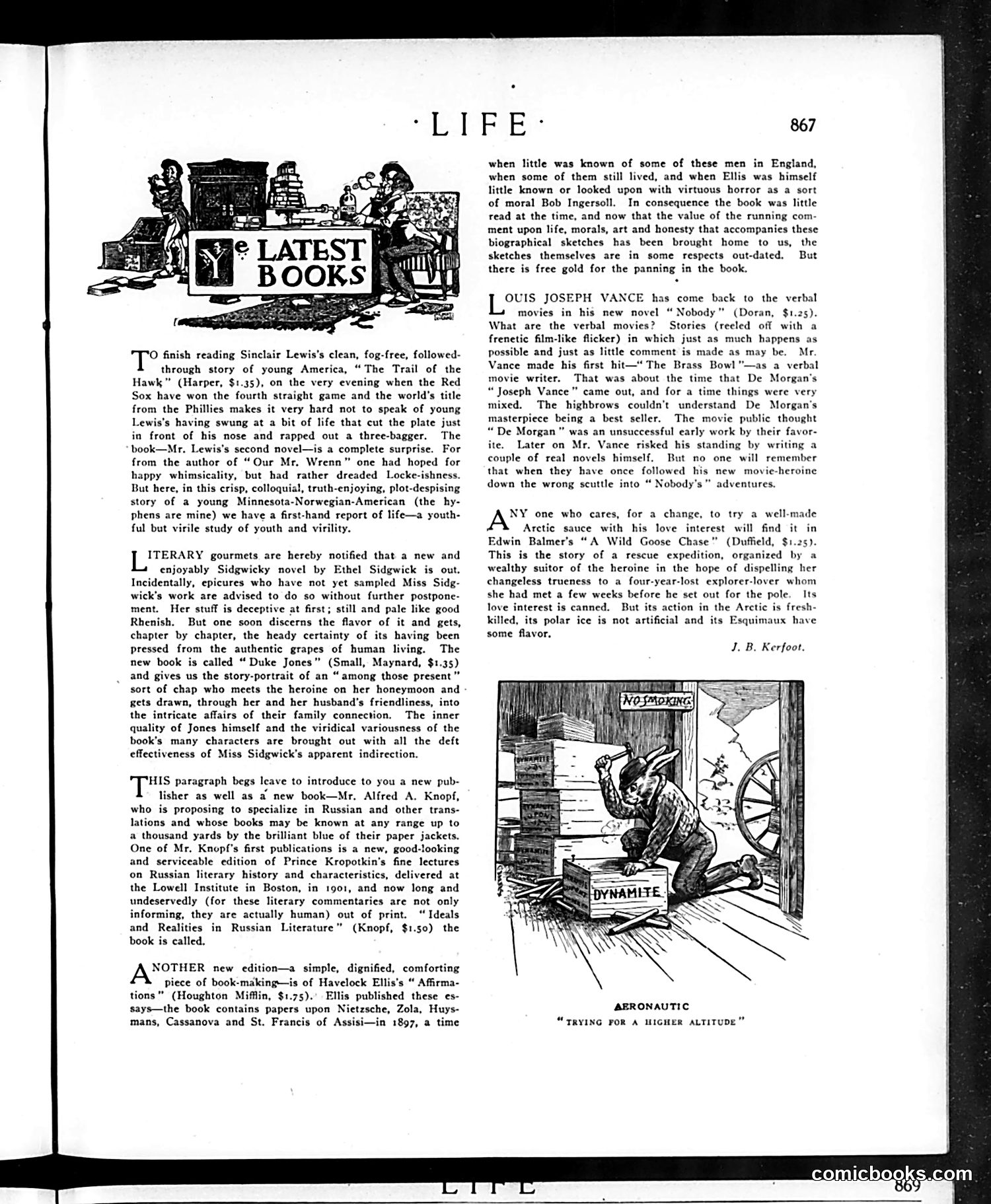
This page is a **book review section** titled "Latest Books," not primarily a political cartoon. The small illustration labeled "Aeronautic: Trying for a Higher Altitude" appears to be a humorous sketch of someone at a desk surrounded by dynamite and "No Smoking" signs—likely satirizing the explosive nature of creative work or literary ambition. The text reviews several new novels and publications, including: - Sinclair Lewis's "The Trail of the Hawk" (praised for authentic American realism) - Ethel Sidgwick's "Duke Jones" - A new publisher, Alfred A. Knopf, specializing in Russian translations - Reprinted editions of Russian literary criticism and Havelock Ellis's essays - Louis Joseph Vance's "Nobody" (described as "verbal movies"—fast-paced fiction) The reviews emphasize **literary quality and authenticity** over commercial appeal, reflecting early 20th-century intellectual tastes. The page documents emerging modernist American literature and serious publishing ventures.
📄 Transcribed text from this page (OCR, searchable)
Machine-transcribed from the original scan — historical spelling and the odd misread are preserved.
*LIFE- 867 ‘O finish reading Sinclair Lewis's clean, fog-free, followed- through story of young America, “The Trail of the Hawk” (Harper, $1.35), on the very evening when the Red Sox have won the fourth straight game and the world’s title from the Phillies makes it very hard not to speak of young Lewis's having swung at a bit of life that cut the plate just in front of his nose and rapped out a three-bagger. The book—Mr. Lewis's second novel—is a complete surprise. For from the author of “Our Mr. Wrenn” one had hoped for happy whimsicality, but had rather dreaded Locke-ishness. But here, in this crisp, colloquial, truth-enjoying, plot-despising story of a young Minnesota-Norwegian-American (the hy- phens are mine) we have a first-hand report of life—a youth- ful but virile study of youth and virility. ITERARY gourmets are hereby notified that a new and enjoyably Sidgwicky novel by Ethel Sidgwick is out. Incidentally, epicures who have not yet sampled Miss Sidg- wick’s work are advised to do so without further postpone- ment. Her stuff is deceptive at first; still and pale like good Rhenish. But one soon discerns the flavor of it and gets, chapter by chapter, the heady certainty of its having been pressed from the authentic grapes of human living. The new book is called “Duke Jones” (Small, Maynard, $1.35) and gives us the story-portrait of an “among those present” sort of chap who meets the heroine on her honeymoon and gets drawn, through her and her husband's friendliness, into the intricate affairs of their family connection. The inner quality of Jones himself and the viridical variousness of the book's many characters are brought out with all the deft effectiveness of Miss Sidgwick’s apparent indirection. 'HIS paragraph begs Icave to introduce to you a new pub- lisher as well as a new book—Mr. Alfred A. Knopf, who is proposing to specialize in Russian and other trans- lations and whose books may be known at any range up to a thousand yards by the brilliant blue of their paper jackets. One of Mr. Knopf’s first publications is a new, good-looking and serviceable edition of Prince Kropotkin’s fine lectures on Russian literary history and characteristics, delivered at the Lowell Institute in Boston, in 1901, and now long and undeservedly (for these literary commentaries are not only informing, they are actually human) out of print. “ Ideals and Realities in Russian Literature” (Knopf, $1.50) the book is called. NOTHER new edition—a simple, dignified, comforting piece of book-making—is of Havelock Ellis’s “ Affirma- tions" (Houghton Mifflin, $1.75).’ Ellis published these es- says—the book contains papers upon Nietzsche, Zola, Huys- mans, Cassanova and St. Francis of Assisi—in 1897, a time when little was known of some of these men in England, when some of them still lived, and when Ellis was himself little known or looked upon with virtuous horror as a sort of moral Bob Ingersoll. In consequence the book was little read at the time, and now that the value of the running com- ment upon life, morals, art and honesty that accompanies these biographical sketches has been brought home to us, the sketches themselves are in some respects out-dated. But there is free gold for the panning in the book. OUIS JOSEPH VANCE has come back to the verbal movies in his new novel “Nobody” (Doran, $1.25). What are the verbal movies? Stories (reeled off with a frenetic film-like flicker) in which just as much happens as possible and just as little comment is made as may be. Mr. Vance made his first hit— The Brass Bowl"—as a verbal movie writer. That was about the time that De Morgan's “ Joseph Vance” came out, and for a time things were very mixed. The highbrows couldn't understand De Morgan's masterpiece being a best seller. The movie public thought “ De Morgan” was an unsuccessful early work by their favor- ite. Later on Mr. Vance risked his standing by writing a couple of real novels himself. But no one will remember that when they have once followed his new movie-heroine down the wrong scuttle into “ Nobody's” adventures. one who cares, for a change, to try a well-made Arctic sauce with his love interest will find it in in Balmer’s “A Wild Goose Chase" (Duffield, $1.25). This is the story of a rescue expedition, organized by a wealthy suitor of the heroine in the hope of dispelling her changeless trueness to a four-year-lost explorer-lover whom she had met a few weeks before he set out for the pole, Its love interest is canned. But action in the Arctic is fresh- killed, its polar ice is not artificial and its Esquimaux have some flavor. J. B. Kerfoot. AERONAUTIC “TRYING FOR A HIGHER ALTITUDE”