
Life, 1915-11-04 · page 21 of 56
Life — November 4, 1915 — page 21: what you’re looking at
What you’re looking at
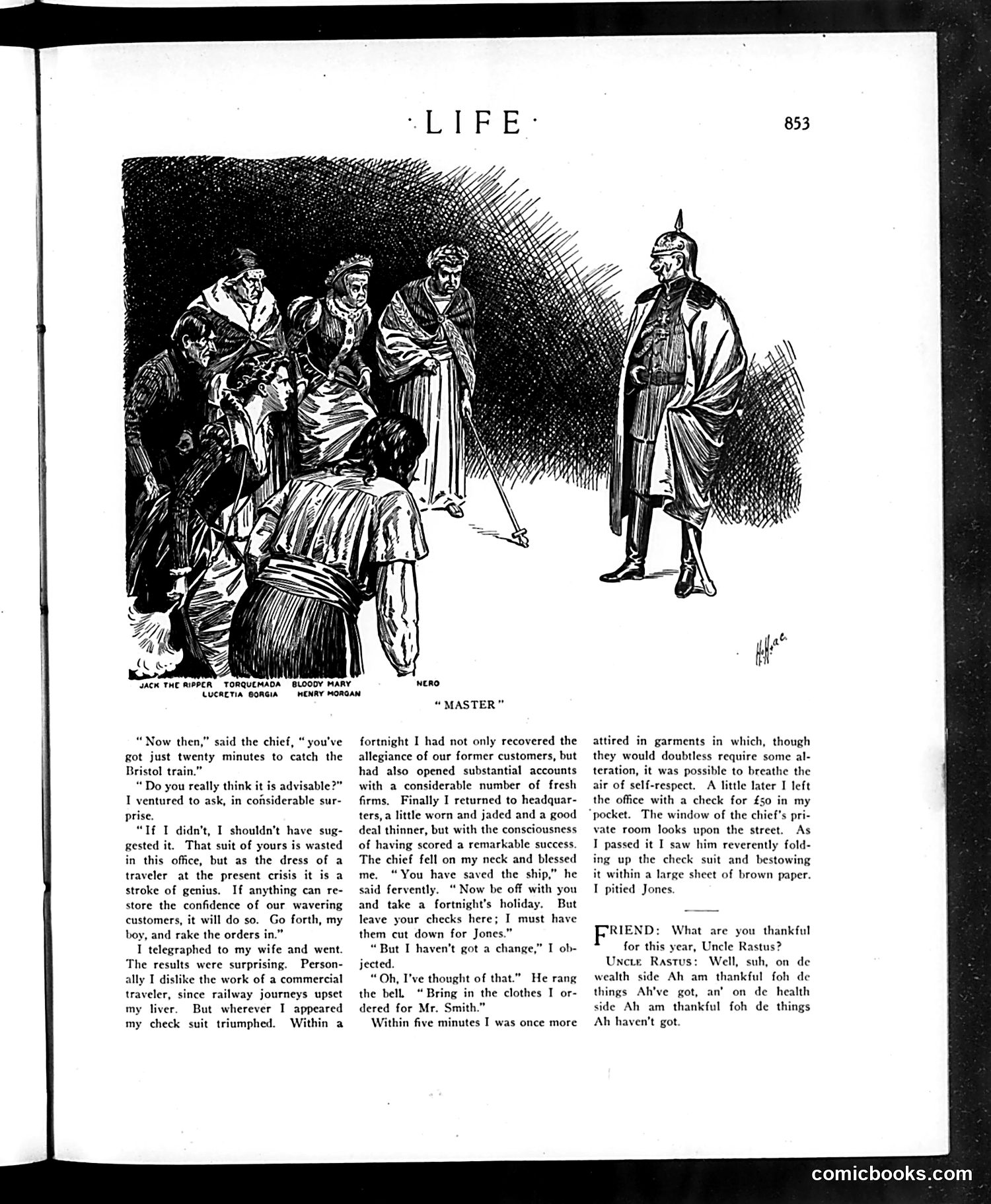
The main illustration satirizes corporate ruthlessness. A commercial traveler's shabby "check suit" mysteriously becomes his greatest asset in winning back customers during an economic crisis. The joke's dark twist: after he succeeds, his boss confiscates the suit to pass down to another employee ("Jones"), reducing the successful salesman back to poverty despite his triumph. The labeled villains—Jack the Ripper, Torquemada, Bloody Mary, Lucretia Borgia, Nero, Henry Morgan—underscore the chief's moral monstrosity: he uses people as disposable tools. The lower section is a separate brief dialogue featuring racist stereotypes common to early 20th-century American humor. "Uncle Rastus" expresses gratitude for material possessions while joking about avoiding illness—harmless by the text's intent, though reflecting deeply offensive minstrelsy conventions. The satire targets exploitative labor practices and corporate indifference to individual welfare—concerns relevant to the publication's era of industrial capitalism.
📄 Transcribed text from this page (OCR, searchable)
Machine-transcribed from the original scan — historical spelling and the odd misread are preserved.
ACK THE RIPPCR TORQUEMADA BLOODY MARY LUCRETIA BORGIA Now then,” said the chief, “ you've got just twenty minutes to catch the Bristol train.” “ Do you really think it is advisable I ventured to ask, in considerable sur- prise. “Tf I didn’t, I shouldn’t have sug- gested it. That suit of yours is wasted in this office, but as the dress of a traveler at the present crisis it is a stroke of genius. If anything can re- store the confidence of our wavering customers, it will do so. Go forth, my boy, and rake the orders in.” I telegraphed to my wife and went. The results were surprising. Person- ally I dislike the work of a commercial traveler, since railway journeys upset my liver. But wherever I appeared my check suit triumphed. Within a NERO “MASTER” HENRY MORGAN fortnight I had not only recovered the allegiance of our former customers, but had also opened substantial accounts with a considerable number of fresh firms. Finally I returned to headquar- ters, a little worn and jaded and a good deal thinner, but with the consciousness of having scored a remarkable success. The chief fell on my neck and blessed me. “You have saved the ship,” he said fervently. “ Now be off with you and take a fortnight’s holiday. But leave your checks here; I must have them cut down for Jones.” “But I haven't got a change,” I ob- jected. “Oh, I've thought of that.” He rang the bell. “Bring in the clothes I or- dered for Mr. Smith.” Within five minutes I was once more attired in garments in which, though they would doubtless require some al- teration, it was possible to breathe the air of self-respect. A little later I left the office with a check for £50 in my “pocket. The window of the chief's pri- vate room looks upon the street. As I passed it I saw him reverently fold- ing up the check suit and bestowing it within a large sheet of brown paper. I pitied Jones. RIEND: What are you thankful for this year, Uncle Rastus? Uncre Rastus: Well, suh, on de wealth side Ah am thankful foh de things Ah've got, an’ on de health side Ah am thankful foh de things Ah haven't got. comicbooks.com