
Life, 1915-11-04 · page 33 of 56
Life — November 4, 1915 — page 33: what you’re looking at
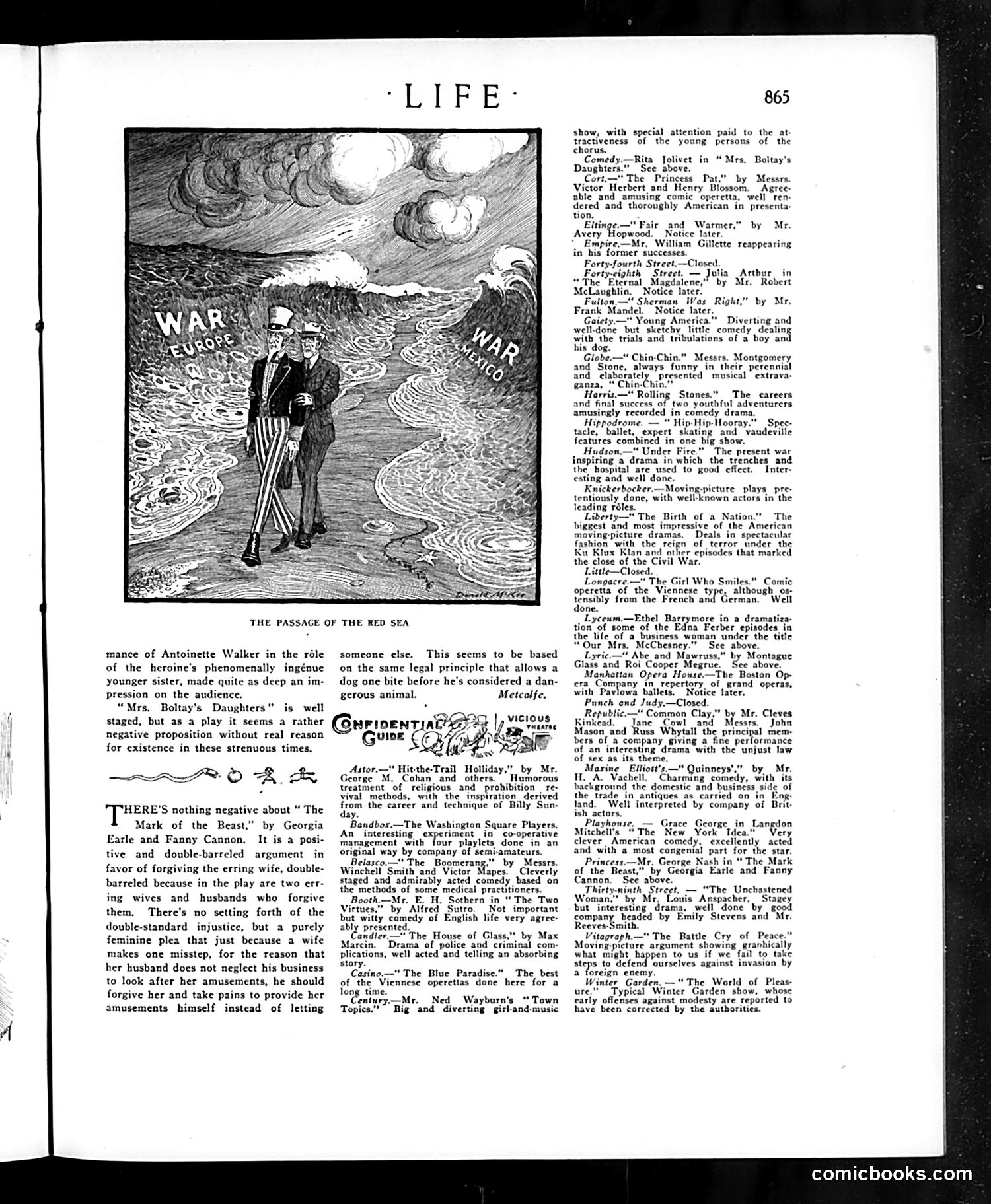
What you’re looking at
This cartoon depicts **Uncle Sam** (identifiable by his characteristic star-spangled outfit and top hat) walking between two labeled storm clouds: "WAR EUROPE" and "WAR CONGO." The swirling, turbulent sky suggests chaos and danger. The title references the Biblical Red Sea parting, implying Uncle Sam is navigating a treacherous path between two conflicts. This appears to be commentary on **American neutrality during World War I** (Europe's war) while also referencing colonial tensions in Africa ("Congo"). The satirical point: America is attempting to remain isolated and uninvolved in international conflicts, miraculously passing through without being drawn into either war—though the ominous sky suggests this precarious balance is fragile and may not hold. The image criticizes or questions America's ability to maintain neutrality amid global turmoil.
📄 Transcribed text from this page (OCR, searchable)
Machine-transcribed from the original scan — historical spelling and the odd misread are preserved.
THE PASSAGE OF THE RED SEA mance of Antoinette Walker in the réle of the heroine’s phenomenally ingénue younger sister, made quite as deep an im- Pression on the audience. “Mrs, Boltay’s Daughters” is well staged, but as a play it seems a rather negative proposition without real reason for existence in these strenuous times. HERE'S nothing negative about “ The Mark of the Beast,” by Georgia Earle and Fanny Cannon, It is a posi- tive and double-barreled argument in favor of forgiving the erring wife, double- barreled because in the play are two err- ing wives and husbands who forgive them, There's no setting forth of the double-standard injustice, but a purely feminine plea that just because a wife makes one misstep, for the reason that her husband does not neglect his business to look after her amusements, he should forgive her and take pains to provide her amusements himself instead of letting someone else. This seems to be based on the same legal principle that allows a dog one bite before he’s considered a dan- gerous animal. Metcalfe. 2, Cree dh | VIDE “roy Be i 4 Dh Boe Sse Astor.—" Hit-the-Trail Holliday,” by Mr. George M. Cohan and others. Humorous treatment of religious and prohibition re- vival methods, with the inspiration derived from the career and technique of Billy Sun- a Bandbor.—The Washington Square Players. ‘An interesting experiment. in’ co-operative management with four playlets done in an original way by company of semi-amateurs. Belasco." The Boomerang.” by Messrs. Winchell Smith and Victor Mapes. Cleverly staged and admirably acted comedy based on the methods of some medical practitioners. Boot Mr. E. H. Sothern in “ The Two Virtues.” by Alfred’ Sutro, Not important but witty comedy of English life very agree- ably presented. ‘andler.—* The House of Glass,” by Max Marcin. rama of police and criminal com- plications, well acted and telling an absorbing “The Blue Paradise.” The best iennese operettas done here for a 3 Ned Wayburn's “Town "Big and diverting girl-and-music vicious ot 865 show, with special attention paid to the at- tractiveness of the young persons of the chorus. Rita Jolivet in “ Mrs, See above. Cort.—" The Princess Pat," by Messrs. Victor Herbert and Henry Blossom. Agree: able and amusing comic operetta, well ren- dered and thoroughly American in presenta- tion. itinge—" Fair and Warmer," by Mr. ry Hopwood. Notice later " Empire.—Mr. William Gillette reappearing in his former successes. Forty-fourth Street.—Closed. Forty-cighth Street, — Julia Arthur in “The Eternal Magdaiene,”” by Mr. Robert McLaughlin. Notice later. Fulton —" Sherman Was Right,” by Mr. Frank Mandel, Notice later. Gaiety—" Young America.” Diverting and well-done but sketchy little comedy dealin; with the trials and tribulations of a boy and his dog. Globe.— Chin-Chin.” Messrs. Montgomery and Stone, always funny in their perennial and elaborately presented musical extrava- ganza, Chin-Chin, Harris —" Rolling Stones.” The careers and final success of two youthful adventurers amusingly recorded in comedy drama. Hippodrome. — “ Hip-Hip- Hooray.” tacle, ballet, Boltay's Spec- ‘expert skating and vaudeville features conibined in one big show. Hudson.—" Under Fire" The present war inspiring a drama in which the trenches and the hospital are used to good effect. Inter- esting and well done. Knickerbocker.—Moving-picture plays_pre- tentiously done, with well-known actors in the leading réles. Liberty—" The Birth of a Nation.” The biggest and most impressive of the American moving-picture dramas. Deals in spectacular fashion with the reign of terror under the Ku Klux Klan and other episodes that marked the close of the Civil War. Little—Closed. Longacre.—" The Girl Who Smiles.” Comic operetta of the Viennese type, although, os: 1 tensibly from the French and German. Well done. Lyceum.—Ethel Barrymore in a dramatiza- tion of some of the Edna Ferber episodes. in the life of a business woman under the title “Our Mrs. McChesney.” See above. Lyric.— Abe and Mawruss,” by Montague Glass and Roi Cooper Megrue. See above, Manhattan Opera House.—The Boston Op- cra Company in repertory of grand operas, with Pavlowa ballets. Notice later. Punch and Judy.—Closed. Reps “Common Clay,” by Mr. Cleves Kinkead. Jane Cowl ‘and Messrs. John Mason and Russ Whytall the principal mem- bers of a company giving a fine performance of an interesting drama with the unjust law of sex as its theme. Merine Elliott’s.—“ Quinneys',"”" by Mr. H. A. Vachell, Charming comedy, with its background the domestic and business side of the trade in antiques as carried on in Eng- land. Well interpreted by company of Brit- ish actors, Playhouse, — Grace George in Langdon Mitchell's “The New York Idea." Very clever American comedy, excellently acted and with a most congenial part for the star. Princess.—Mr. George Nash in “ The Mark of the Beast,” by Georgia Earle and Fanny Cannon. See above. Thirty-ninth Street, — “The Unchastened Woman.” by Mr, Louis Anspacher, | Stagey but interesting drama, well, done by good beaded by Emily Stevens and Mr. Vitagraph.—" The Battle Cry of Peace.” Moving-picture argument showing graphically what might happen to us if we fail to take steps to defend ourselves against invasion by a foreign enemy. Winter Garden. —“ The World of Pleas- ure.""” Typical Winter Garden show, whose carly offenses against modesty are reported to have been corrected by the authorities. comicbooks.com