
Life, 1915-11-04 · page 32 of 56
Life — November 4, 1915 — page 32: what you’re looking at
What you’re looking at
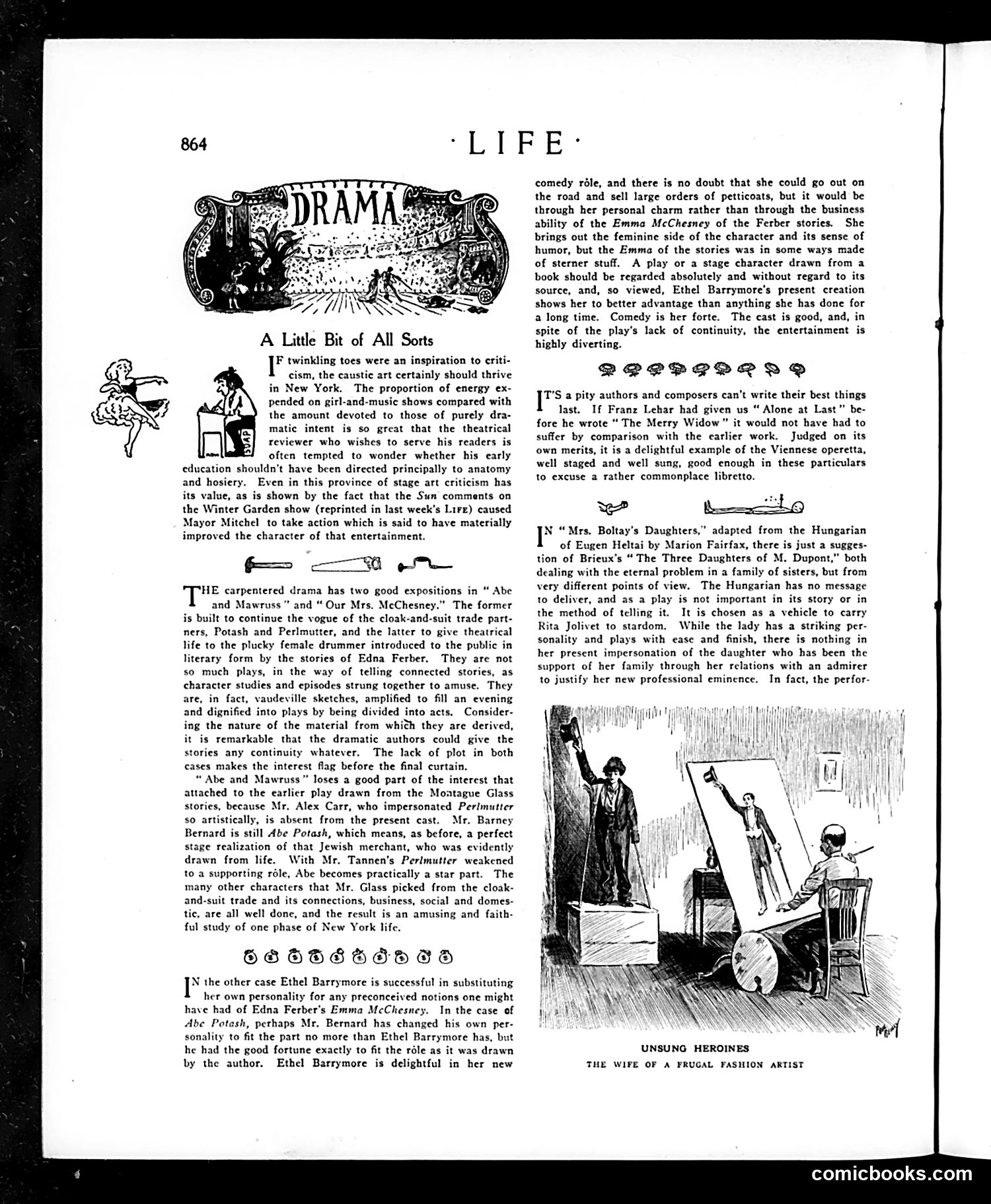
This page reviews three theatrical productions for modern readers unfamiliar with early 1900s Broadway. **"Abe and Mawruss"** and **"Our Mrs. McChesney"** are "carpentered dramas"—plays constructed from existing literary sources (Montague Glass stories and Edna Ferber fiction). The critic notes they're essentially vaudeville sketches padded into full plays rather than traditionally plotted dramas, lacking narrative continuity. **The illustration** (captioned "Unsung Heroines: The Wife of a Frugal Fashion Artist") depicts a woman coordinating workers on what appears to be a fashion or design project—likely satirizing the underappreciated female support systems behind male creative success, a common Life magazine theme. The drama criticism praises actor **Barney Bernard's** performance as the Jewish merchant Abe Potash and **Ethel Barrymore's** charm in the female lead, even while acknowledging the plays' structural weaknesses. The reviewer argues stage characters should be judged independently from their literary sources.
📄 Transcribed text from this page (OCR, searchable)
Machine-transcribed from the original scan — historical spelling and the odd misread are preserved.
“LIFE- A Little Bit of All Sorts F twinkling toes were an inspiration to criti- cism, the caustic art certainly should thrive in New York. The proportion of energy ex- pended on girl-and-music shows compared with the amount devoted to those of purely dra- matic intent is so great that the theatrical reviewer who wishes to serve his readers is often tempted to wonder whether his early education shouldn't have been directed principally to anatomy and hosiery. Even in this province of stage art criticism has its value, as is shown by the fact that the Sun comments on the Winter Garden show (reprinted in last week's Lirz) caused Mayor Mitchel to take action which is said to have materially improved the character of that entertainment. —) aoa TA gM HE carpentered drama has two good expositions in “ Abe and Mawruss” and “ Our Mrs. McChesney.” The former is built to continue the vogue of the cloak-and-suit trade part- ners, Potash and Perlmutter, and the latter to give theatrical life to the plucky female drummer introduced to the public in literary form by the stories of Edna Ferber. They are not so much plays, in the way of telling connected stories, as character studies and episodes strung together to amuse. They are, in fact, vaudeville sketches, amplified to fill an evening and dignified into plays by being divided into acts. Consider- ing the nature of the material from whith they are derived, it is remarkable that the dramatic authors could give the stories any continuity whatever. The lack of plot in both cases makes the interest flag before the final curtain. “Abe and Mawruss” loses a good part of the interest that attached to the earlier play drawn from the Moatague Glass stories, because Mr. Alex Carr, who impersonated Perlmutter so artistically, is absent from the present cast. Mr, Barney Bernard is still Abe Potash, which means, as before, a perfect stage realization of that Jewish merchant, who was evidently drawn from life. With Mr. Tannen’s Perlmutter weakened to a supporting role, Abe becomes practically a star part. The many other characters that Mr. Glass picked from the cloak- and-suit trade and its connections, business, social and domes- tic, are all well done, and the result is an amusing and faith- ful study of one phase of New York life. [ORG MORORGRGROROROMO) N the other case Ethel Barrymore is successful in substituting her own personality for any preconceived notions one might have had of Edna Ferber’s Emma McChesney. In the case of Abe Potash, perhaps Mr. Bernard has changed his own per- sonality to fit the part no more than Ethel Barrymore has, but he had the good fortune exactly to fit the role as it was drawn by the author. Ethel Barrymore is delightful in her new comedy réle, and there is no doubt that she could go out on the road and sell large orders of petticoats, but it would be through her personal charm rather than through the business ability of the Emma McChesney of the Ferber stories. She brings out the feminine side of the character and its sense of humor, but the Emma of the stories was in some ways made of sterner stuff. A play or a stage character drawn from a book should be regarded absolutely and without regard to its source, and, so viewed, Ethel Barrymore's present creation shows her to better advantage than anything she has done for a long time. Comedy is her forte. The cast is good, and, in spite of the play's lack of continuity, the entertainment is highly diverting. Q@PSPRSQRRN T'S a pity authors and composers can’t write their best things last. If Franz Lebar had given us “ Alone at Last” be- fore he wrote “ The Merry Widow” it would not have had to suffer by comparison with the earlier work. Judged on its own merits, it is a delightful example of the Viennese operetta, well staged and well sung, good enough in these particulars to excuse a rather commonplace libretto. Ir “Mrs. Boltay’s Daughters,” adapted from the Hungarian of Eugen Heltai by Marion Fairfax, there is just a sugges- tion of Brieux’s “ The Three Daughters of M. Dupont,” both dealing with the eternal problem in a family of sisters, but from very different points of view. The Hungarian has no message to deliver, and as a play is not important in its story or in the method of telling it. It is chosen as a vehicle to carry Rita Jolivet to stardom. While the lady has a striking per- sonality and plays with ease and finish, there is nothing in her present impersonation of the daughter who has been the support of her family through her relations with an admirer to justify her new professional eminence. In fact, the perfor- UNSUNG HEROINES THE WIFE OF A FRUGAL FASHION ARTIST comicbooks.com