
Life, 1915-11-04 · page 31 of 56
Life — November 4, 1915 — page 31: what you’re looking at
What you’re looking at
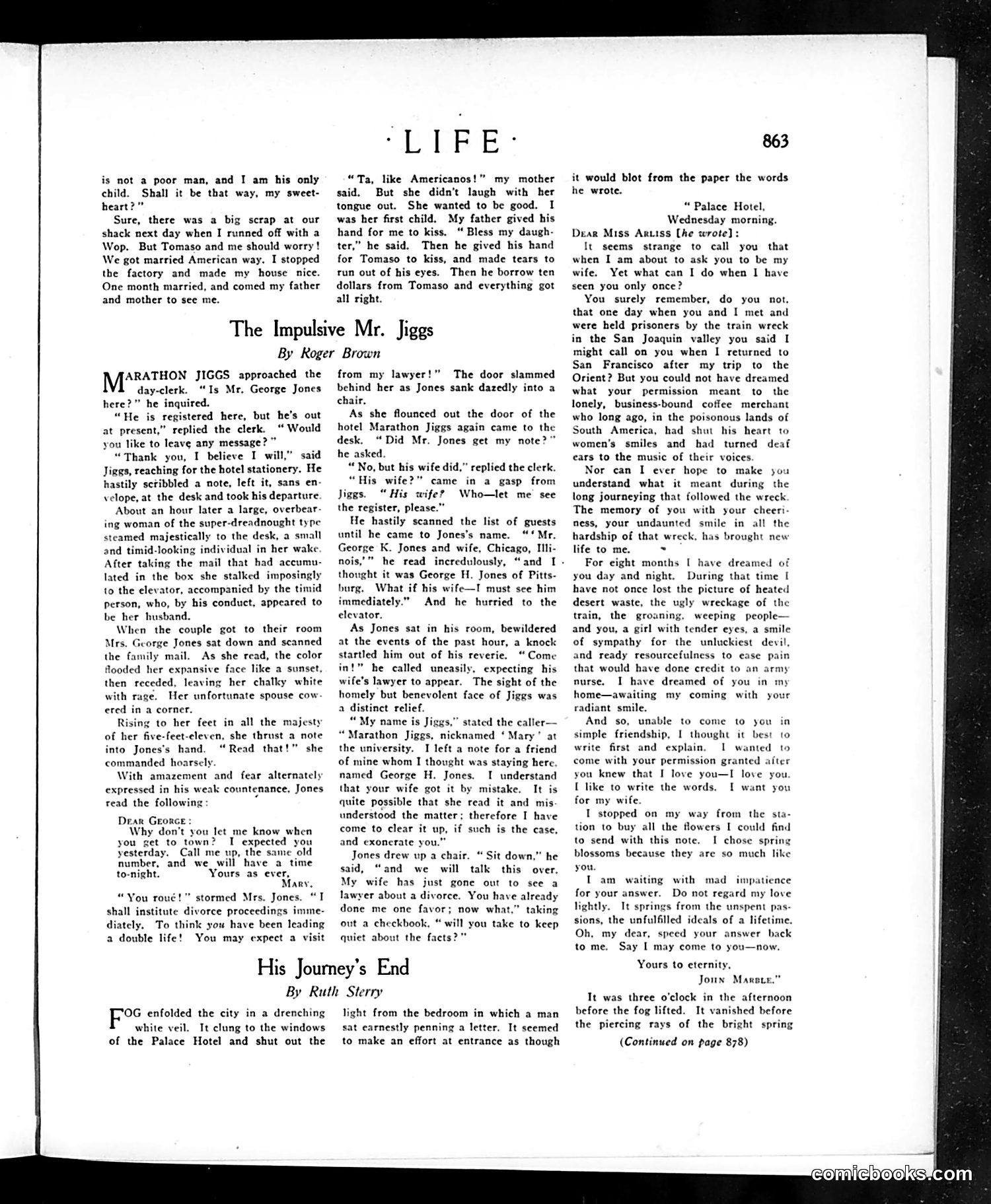
This is a humorous short story about mistaken identity and marital misunderstanding. Marathon Jiggs leaves a casual note at a hotel intended for his university friend George H. Jones, inviting him to "call me up...and we will have a time to-night," signing it "Mary" (his college nickname). However, the note is mistakenly given to George K. Jones and his wife, who interprets it as evidence of her husband's infidelity with a woman named Mary. She threatens divorce immediately. Jiggs discovers his error when the clerk mentions "his wife" received the note, realizes the name confusion, and rushes to explain the innocent mix-up. The satire targets human hasty judgment and the comedy of errors—how a simple mistake, combined with a suspicious mind, nearly destroys a marriage.
📄 Transcribed text from this page (OCR, searchable)
Machine-transcribed from the original scan — historical spelling and the odd misread are preserved.
is not a poor man, and I am his only child. Shall it be that way, my sweet- heart?” Sure, there was a big scrap at our shack next day when I runned off with a Wop. But Tomaso and me should worry! We got married American way. I stopped the factory and made my house nice. One month married, and comed my father and mother to see me. ie ae “Ta, like Americanos!” my mother said. But she didn’t laugh with her tongue out. She wanted to be good. I was her first child. My father gived his hand for me to kiss. “Bless my daugh- ter,” he said. Then he gived his hand for Tomaso to kiss, and made tears to run out of his eyes. Then he borrow ten dollars from Tomaso and everything got all right. The Impulsive Mr. Jiggs By Roger Brown MARATHON JIGGS approached the day-clerk. “Is Mr. George Jones here?” he inquired. “He is registered here, but he’s out at present,” replied the clerk. “ Would you like to leave any message?” “Thank you, I believe I will,” said Jiggs, reaching for the hotel stationery. He hastily scribbled a note, left it, sans en- velope, at the desk and took his departure. About an hour later a large, overbear. ing woman of the super-dreadnought type steamed majestically to the desk, a small and timid-looking individual in her wake After taking the mail that had accumu- lated in the box she stalked imposingly to the elevator, accompanied by the timid person, who, by his conduct, appeared to be her husband. When the couple got to their room Mrs. George Jones sat down and scanned the family mail, As she read, the color flooded her expansive face like a sunset, then receded, leaving her chalky white with rage. Her unfortunate spouse cow- ered in a corner. Rising to her feet in all the majesty of her five-feet-eleven, she thrust a note into Jones’s hand. “Read that!" she commanded hoarse! With amazement and fear alternately expressed in his weak countenance, Jones read the following: Dear Gronce : Why don’t you let me know when you get to town? I expected you yesterday. Call me up, the same old number, and we will have a time to-night. Yours as ever, Mary. “You roué!” stormed Mrs. Jones. “I shall institute divorce proceedings imme- diately. To think you have been leading a double life! You may expect a visit from my lawyer!" The door slammed behind her as Jones sank dazedly into a chair, As she flounced out the door of the hotel Marathon Jiggs again came to the desk. “Did Mr. Jones get my note? he asked. “No, but his wife did,” replied the clerk. “His wife?” came in a gasp from Jiggs. “His wife? Who—let me see the register, please.” He hastily scanned the list of guests until he came to Jones’s name. “‘ Mr. George K. Jones and wife, Chicago, Illi- no’ he read incredulously, “and I - thought it was George H. Jones of Pitt burg. What if his wife—I must see him immediately.” And he hurried to the elevator. As Jones sat in his room, bewildered at the events of the past hour, a knock startled him out of his reverie. “Come in!" he called uneasily, expecting his wife’s lawyer to appear. The sight of the homely but benevolent face of Jiggs was a distinct relief. “My name is Jiggs,” stated the caller— “Marathon Jiggs, nicknamed ‘ Mary’ at the university. I left a note for a friend of mine whom I thought was staying here named George H. Jones. I understand that your wife got it by mistake. It is quite possible that she read it and mis- understood the matter; therefore I have come to clear it up, if such is the case, and exonerate you.” Jones drew up a chair. “ Sit down,” he said, “and we will talk this over. My wife has just gone out to see a lawyer about a divorce. You have already done me one favor; now what,” taking out a checkbook, “ will you take to keep quiet about the facts?" His Journey’s End By Ruth Sterry ‘OG enfolded the city in a drenching white veil. It clung to the windows of the Palace Hotel and shut out the light from the bedroom in which a man sat earnestly penning a letter. It seemed to make an effort at entrance as though 863 it would blot from the paper the words he wrote. “ Palace Hotel, Wednesday morning. Dear Miss Aruiss [he wrote]: It seems strange to call you that when I am about to ask you to be my wife. Yet what can I do when I have seen you only once? You surely remember, do you not. that one day when you and I met and were held prisoners by the train wreck in the San Joaquin valley you said I might call on you when I returned to San Francisco after my trip to the Orient? But you could not have dreamed what your permission meant to the lonely, business-bound coffee merchant who long ago, in the poisonous lands of South America, had shut his heart to women’s smiles and had turned deaf ears to the music of their voices. Nor can I ever hope to make jou understand what it meant during the long journeying that followed the wreck. The memory of you with your cheeri- ness, your undaunted smile in all the hardship of that wreck, has brought new life to me. = For eight months | have dreamed of you day and night. During that time [ have not once lost the picture of heated desert waste, the ugly wreckage of the train, the groaning, weeping people— and you, a girl with tender eyes, a smile of sympathy for the unluckiest devil, and ready resourcefulness to ease pain that would have done credit to an army nurse. I have dreamed of you in my home—awaiting my coming with your radiant smile. And so, unable to come to you in simple friendship, I thought it best to write first and explain. I wanted to come with your permission granted after you knew that I love you—I love you. [ like to write the words. [ want you for my wife. I stopped on my way from the sta- tion to buy all the flowers I could find to send with this note. I chose spring blossoms because they are so much like you. IT am waiting with mad impatience for your answer. Do not regard my love lightly. It springs from the unspent pas- sions, the unfulfilled ideals of a lifetime. Oh, my dear, speed your answer back to me. Say I may come to you—now. Yours to eternity, Joun Maroce.” It was three o'clock in the afternoon before the fog lifted. It vanished before the piercing rays of the bright spring (Continued on page 878)