
Life, 1915-11-04 · page 22 of 56
Life — November 4, 1915 — page 22: what you’re looking at
What you’re looking at
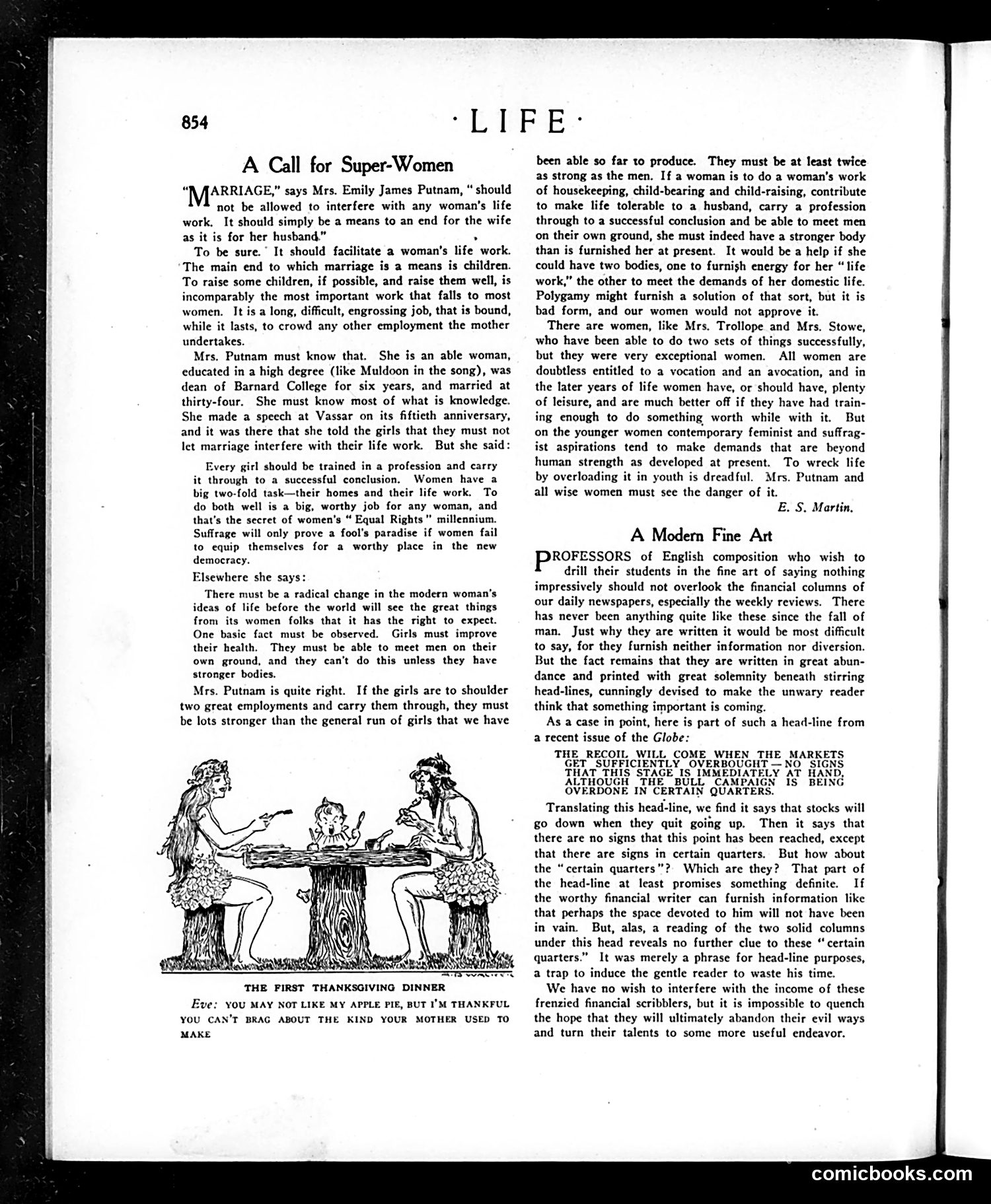
This page presents two distinct pieces of social commentary from early 20th-century America. **"A Call for Super-Women"** critiques Emily James Putnam's argument that women shouldn't let marriage interfere with their careers. The author (E.S. Martin) sarcastically supports her position while exposing its absurdity: women would need to be twice as strong as men to simultaneously manage full-time careers, housekeeping, childbearing, and spousal support. The piece argues such demands are physically impossible and dangerous, invoking examples of exceptional women (Trollope, Stowe) to prove they're rare exceptions, not achievable ideals. The satire targets both feminist aspirations and the physical limitations society placed on women. **"The First Thanksgiving Dinner"** is a cartoon joke about Eve and Adam, with Eve defending her apple pie by noting Adam can't brag about his mother's cooking—since Eve is humanity's only woman. It's a light domestic humor piece playing on the biblical creation narrative. Together, these pieces reflect period anxieties about women's expanding roles during the suffrage era.
📄 Transcribed text from this page (OCR, searchable)
Machine-transcribed from the original scan — historical spelling and the odd misread are preserved.
854 A Call for Super-Women “N A,ARRIAGE,” says Mrs. Emily James Putnam, “ should not be allowed to interfere with any woman’s life work. It should simply be a means to an end for the wife as it is for her husband” , To be sure.’ It should facilitate a woman's life work. The main end to which marriage is a means is children. To raise some children, if possible, and raise them well, is incomparably the most important work that falls to most women. It is a long, difficult, engrossing job, that is bound, while it lasts, to crowd any other employment the mother undertakes. Mrs, Putnam must know that. She is an able woman, educated in a high degree (like Muldoon in the song), was dean of Barnard College for six years, and married at thirty-four. She must know most of what is knowledge. She made a speech at Vassar on its fiftieth anniversary, and it was there that she told the girls that they must not let marriage interfere with their life work. But she said: Every girl should be trained in a profession and carry it through to a successful conclusion. Women have a big two-fold task—their homes and their life work. To do both well is a big, worthy job for any woman, and that's the secret of women’s “ Equal Rights” millennium. Suffrage will only prove a fool's paradise if women fail to equip themselves for a worthy place in the new democracy. Elsewhere she says: There must be a radical change in the modern woman's ideas of life before the world will see the great things from its women folks that it has the right to expect. One basic fact must be observed. Girls must improve their health. They must be able to meet men on their own ground, and they can’t do this unless they have stronger bodies. Mrs. Putnam is quite right. If the girls are to shoulder two great employments and carry them through, they must be lots stronger than the general run of girls that we have THE FIRST THANKSGIVING DINNER Eve: you MAY NOT LIKE MY APPLE PIE, BUT I'M THANKFUL YOU CAN'T BRAG ABOUT THE KIND YOUR MOTHER USED TO MAKE “EE TRRSE- been able so far to produce. They must be at least twice as strong as the men. If a woman is to do a woman's work of housekeeping, child-bearing and child-raising, contribute to make life tolerable to a husband, carry a profession through to a successful conclusion and be able to meet men on their own ground, she must indeed have a stronger body than is furnished her at present. It would be a help if she could have two bodies, one to furnish energy for her “life work,” the other to meet the demands of her domestic life. Polygamy might furnish a solution of that sort, but it is bad form, and our women would not approve it. There are women, like Mrs. Trollope and Mrs. Stowe, who have been able to do two sets of things successfully, but they were very exceptional women. All women are doubtless entitled to a vocation and an avocation, and in the later years of life women have, or should have, plenty of leisure, and are much better off if they have had train- ing enough to do something worth while with it. But on the younger women contemporary feminist and suffrag- ist aspirations tend to make demands that are beyond human strength as developed at present. To wreck life by overloading it in youth is dreadful. Mrs. Putnam and all wise women must see the danger of it. E. S. Martin, A Modern Fine Art PROFEssoRS of English composition who wish to drill their students in the fine art of saying nothing impressively should not overlook the financial columns of our daily newspapers, especially the weekly reviews. There has never been anything quite like these since the fall of man. Just why they are written it would be most difficult to say, for they furnish neither information nor diversion. But the fact remains that they are written in great abun- dance and printed with great solemnity beneath stirring head-lines, cunningly devised to make the unwary reader think that something important is coming. As a case in point, here is part of such a head-line from a recent issue of the Globe: THE RECOIL WILL COME WHEN THE MARKETS GET SUFFICIENTLY OVERBOUGHT — NO SIGNS THAT THIS STAGE IS IMMEDIATELY AT HAND, ALTHOUGH THE BULL CAMPAIGN IS BEING OVERDONE IN CERTAIN QUARTERS. Translating this head-line, we find it says that stocks will go down when they quit going up. Then it says that there are no signs that this point has been reached, except that there are signs in certain quarters. But how about the “certain quarters”? Which are they? That part of the head-line at least promises something definite. If the worthy financial writer can furnish information like that perhaps the space devoted to him will not have been in vain. But, alas, a reading of the two solid columns under this head reveals no further clue to these “certain quarters.” It was merely a phrase for head-line purposes, a trap to induce the gentle reader to waste his time. We have no wish to interfere with the income of these frenzied financial scribblers, but it is impossible to quench the hope that they will ultimately abandon their evil ways and turn their talents to some more useful endeavor. comicbooks.com