
Life, 1915-11-04 · page 24 of 56
Life — November 4, 1915 — page 24: what you’re looking at
What you’re looking at
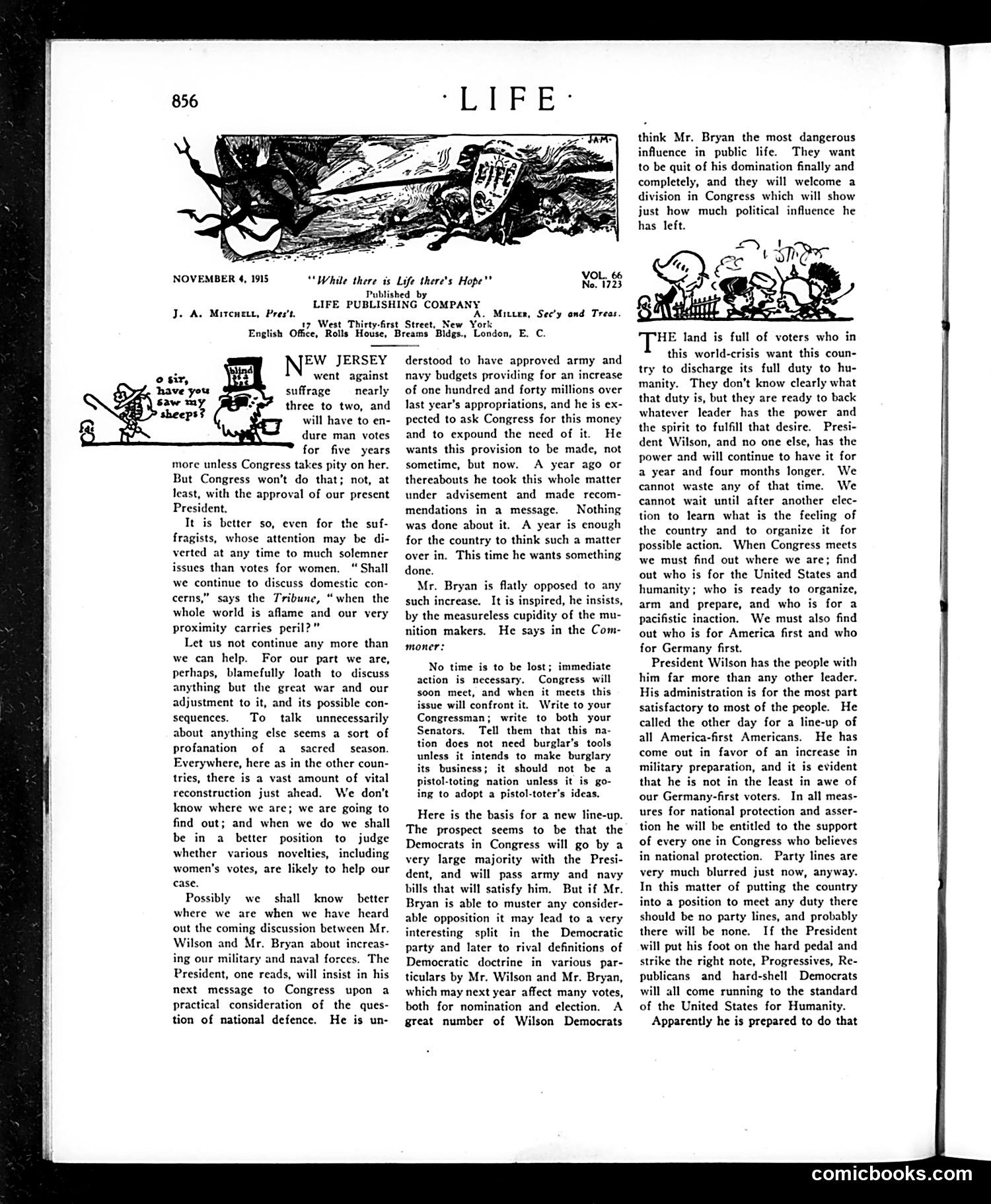
This page contains editorial commentary on a brewing political conflict between President Wilson and William Jennings Bryan over military spending. The text explains that Wilson wants Congress to approve a $140 million increase in army and navy budgets, while Bryan (writing in his publication *The Commoner*) opposes it, viewing the spending as driven by munitions manufacturers' greed. The cartoon at the top appears to depict this conflict, though specific figures are unclear from the image quality. The editorial suggests this disagreement could split the Democratic Party and weaken Bryan's political influence—something many "Wilson Democrats" actually welcomed. The page also dismisses ongoing women's suffrage efforts (New Jersey recently voted against it), arguing such domestic concerns should be postponed during wartime ("the world is aflame").
📄 Transcribed text from this page (OCR, searchable)
Machine-transcribed from the original scan — historical spelling and the odd misread are preserved.
NOVEMBER 4, 1915 “While there is Life there's Hope" VOL. No. 1723 Published by LIFE PUBLISHING COMPANY J. A. Mitcnett, Pres't. 7 West Thirty-first Street, A. Mutszs, Sec'y ond Treas. New Yo: English Office, Rolls House, Breams ‘Bldgs. ‘London, EC. EW JERSEY went against suffrage nearly three to two, and will have to en- dure man votes for five years more unless Congress takes pity on her. But Congress won't do that; not, at least, with the approval of our present President. It is better so, even for the suf- fragists, whose attention may be di- verted at any time to much solemner issues than votes for women. “ Shall we continue to discuss domestic con- cerns,” says the Tribune, “when the whole world is aflame and our very proximity carries peril?” Let us not continue any more than we can help. For our part we are, perhaps, blamefully loath to discuss anything but the great war and our adjustment to it, and its possible con- sequences. To talk unnecessarily about anything else seems a sort of profanation of a sacred season. Everywhere, here as in the other coun- tries, there is a vast amount of vital reconstruction just ahead. We don’t know where we are; we are going to find out; and when we do we shall be in a better position to judge whether various novelties, including women’s votes, are likely to help our case. Possibly we shall know better where we are when we have heard out the coming discussion between Mr. Wilson and Mr. Bryan about increas- ing our military and naval forces. The President, one reads, will insist in his next message to Congress upon a practical consideration of the ques- tion of national defence. He is un- derstood to have approved army and navy budgets providing for an increase of one hundred and forty millions over last year’s appropriations, and he is ex- pected to ask Congress for this money and to expound the need of it. He wants this provision to be made, not sometime, but now. A year ago or thereabouts he took this whole matter under advisement and made recom- mendations in a message. Nothing was done about it. A year is cnough for the country to think such a matter over in. This time he wants something done. Mr. Bryan is flatly opposed to any such increase. It is inspired, he insists, by the measureless cupidity of the mu- nition makers, He says in the Com- moner: No time is to be lost; immediate action is necessary. Congress will soon mect, and when it mects this issue will confront it. Write to your Congressman; write to both your Senators. Tell them that this na- tion does not need burglar’s tools unless it intends to make burglary business; it should not be a ‘ol-toting nation unless it is go- ing to adopt a pistol-toter’s ideas. Here is the basis for a new line-up. The prospect seems to be that the Democrats in Congress will go by a very large majority with the Presi- dent, and will pass army and navy bills that will satisfy him. But if Mr. Bryan is able to muster any consider- able opposition it may lead to a very interesting split in the Democratic party and later to rival definitions of Democratic doctrine in various par- ticulars by Mr. Wilson and Mr. Bryan, which may next year affect many votes, both for nomination and election. A great number of Wilson Democrats think Mr. Bryan the most dangerous influence in public life. They want to be quit of his domination finally and completely, and they will welcome a division in Congress which will show just how much political influence he has left. HE land is full of voters who in this world-crisis want this coun- try to discharge its full duty to hu- manity. They don’t know clearly what that duty is, but they are ready to back whatever leader has the power and the spirit to fulfill that desire. Presi- dent Wilson, and no one else, has the power and will continue to have it for a year and four months longer. We cannot waste any of that time. We cannot wait until after another elec- tion to learn what is the feeling of the country and to organize it for possible action. When Congress meets we must find out where we are; find out who is for the United States and humanity; who is ready to organize, arm and prepare, and who is for a pacifistic inaction. We must also find out who is for America first and who for Germany first. President Wilson has the people with him far more than any other leader. His administration is for the most part satisfactory to most of the people. He called the other day for a line-up of all America-first Americans. He has come out in favor of an increase in military preparation, and it is evident that he is not in the least in awe of our Germany-first voters. In all meas- ures for national protection and asser- tion he will be entitled to the support of every one in Congress who believes in national protection. Party lines are very much blurred just now, anyway. In this matter of putting the country into a position to meet any duty there should be no party lines, and probably there will be none. If the President will put his foot on the hard pedal and strike the right note, Progressives, Re- publicans and hard-shell Democrats will all come running to the standard of the United States for Humanity. Apparently he is prepared to do that comicbooks.com