
Life, 1915-11-04 · page 26 of 56
Life — November 4, 1915 — page 26: what you’re looking at
What you’re looking at
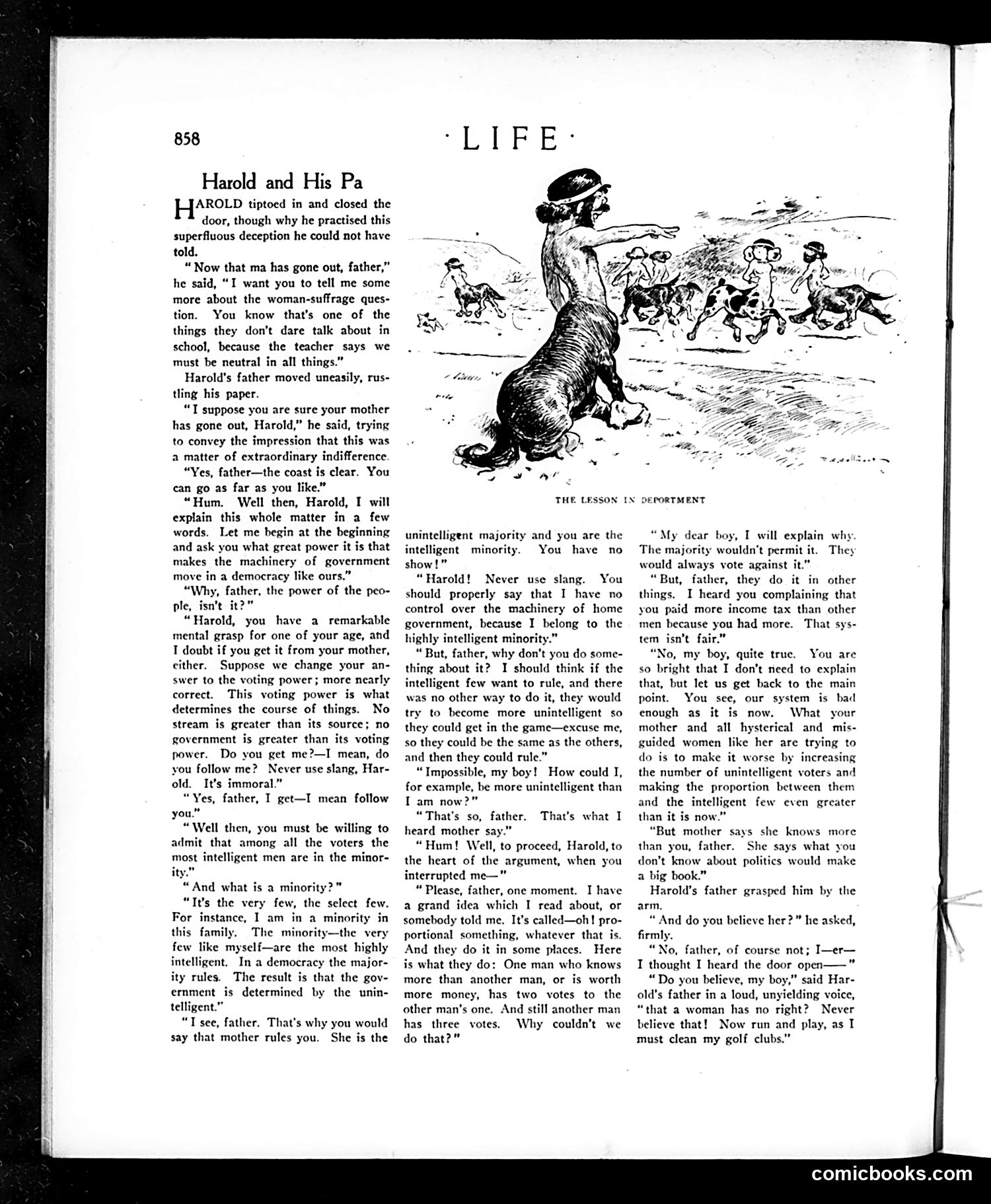
This dialogue satirizes anti-suffrage arguments by exposing their logical absurdity through a child's innocent questions. The father represents the smug male voter who claims women shouldn't vote because they're part of an "unintelligent majority," while he belongs to a superior "intelligent minority." The humor lies in Harold's simple logic: if intelligence should determine voting power, why not adopt a weighted voting system based on education or wealth? This directly undermines the father's position—he's already accepted such inequality in taxation but won't admit the principle applies to women's suffrage. The cartoon attacks the hypocrisy of men like this father who use pseudo-intellectual arguments to maintain political dominance while the illustration shows women actively engaged (supervising children, being capable). The piece ridicules how men invoke "neutrality" and "logic" to avoid discussing women's rights, revealing these as mere excuses for preserving male privilege.
📄 Transcribed text from this page (OCR, searchable)
Machine-transcribed from the original scan — historical spelling and the odd misread are preserved.
858 Harold and His Pa AROLD tiptoed in and closed the door, though why he practised this superfluous deception he could not have told. “ Now that ma has gone out, father,” he said, “I want you to tell me some more about the woman-suffrage ques- tion. You know that’s one of the things they don’t dare talk about in school, because the teacher says we must be neutral in all things.” Harold’s father moved uneasily, rus- tling his paper. “T suppose you are sure your mother has gone out, Harold,” he said, trying to convey the impression that this was a matter of extraordinary indifference. “Yes, father—the coast is clear. You can go as far as you like.” “Hum. Well then, Harold, I will explain this whole matter in a few words. Let me begin at the beginning and ask you what great power it is that makes the machinery of government move in a democracy like ours.” “Why, father, the power of the peo- ple, isn’t it?” “Harold, you have a remarkable mental grasp for one of your age, and I doubt if you get it from your mother, cither. Suppose we change your an- swer to the voting power; more nearly correct. This voting power is what determines the course of things. No stream is greater than its source; no government is greater than its voting power. Do you get me?—I mean, do you follow me? Never use slang, Har- old. It’s immoral.” “Yes, father, I get—I mean follow you.” “Well then, you must be willing to admit that among all the voters the intelligent men are in the minor- And what is a minority?” “It’s the very few, the select few. For instance, I am in a minority in this family, The minority—the very few like myself—are the most highly intelligent. In a democracy the major- ity rules. The result is that the gov- ernment is determined by the unin- telligent.” “T see, father. That's why you would say that mother rules you. She is the THE LESSON IN unintelligent majorit intelligent minority. show!” “Harold! Never use slang. You should properly say that I have no control over the machinery of home government, because I belong to the highly intelligent minority.” “But, father, why don’t you do some- thing about it? I should think if the intelligent few want to rule, and there was no other way to do it, they would try to become more unintelligent so they could get in the game—excuse me, so they could be the same as the others, and then they could rule.” “Impossible, my boy! How could I, for example, be more unintelligent than T am now?” “That's so, father, heard mother say. “Hum! Well, to proceed, Harold, to the heart of the argument, when you interrupted me—" “Please, father, one moment. I have a grand idea which I read about, or somebody told me. It’s called—oh! pro- portional something, whatever that is. And they do it in some places. Here is what they do: One man who knows more than another man, or is worth more money, has two votes to the other man’s one. And still another man has three votes. Why couldn’t we do that?” and you are the You have no That's what I DEPORTMENT “My dear boy, I will explain why. The majority wouldn't permit it. They would always vote against “But, father, they do it in other things. I heard you complaining that you paid more income tax than other men because you had more. That sys- tem isn’t fair.” “No, my boy, quite true. You are so bright that I don’t need to explain that, but let us get back to the main point. You see, our system is bad enough as it is now. What your mother and all hysterical and mis- guided women like her are trying to do is to make it worse by increasing the number of unintelligent voters and making the proportion between them and the intelligent few even greater than it is now.” “But mother says she knows more than you, father. She says what you don’t know about politics would make a big book.” Harold’s father grasped him by the arm. “And do you believe her?” he asked, firmly. “No, father, of course not; I—er— I thought I heard the door open——" “Do you believe, my boy,” said Har- old's father in a loud, unyielding voice, “that a woman has no right? Never believe that! Now run and play, as I must clean my golf clubs, comicbooks.com