
Life, 1915-11-04 · page 18 of 56
Life — November 4, 1915 — page 18: what you’re looking at
What you’re looking at
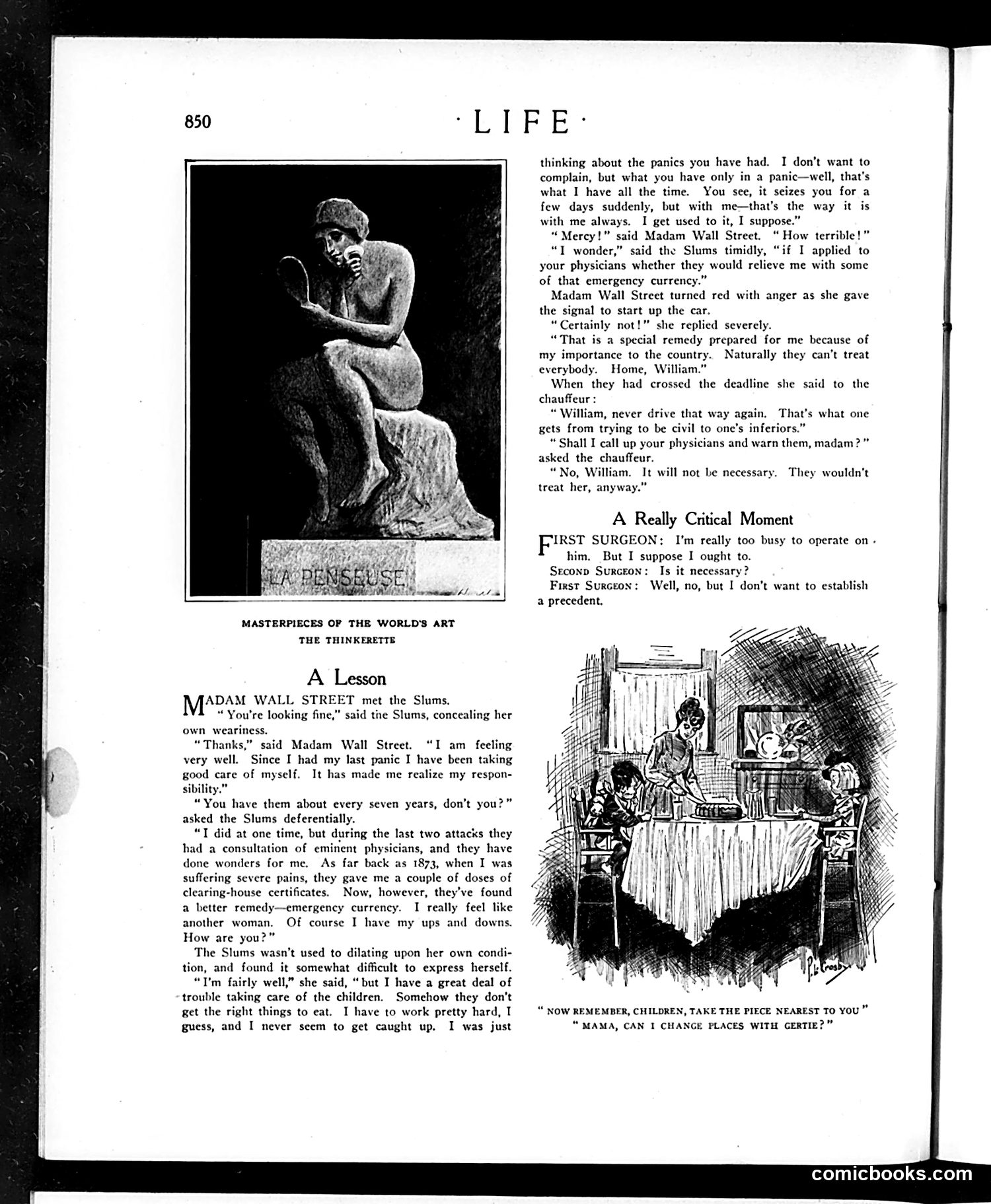
This page satirizes the stark inequality between Wall Street wealth and urban poverty during the early 1900s. "Madam Wall Street" personifies financial elites, while "the Slums" represents the poor. The main dialogue mocks how the wealthy receive special government remedies (emergency currency) during financial panics—occurring regularly since 1873—while the poor receive nothing. When the Slums asks if she might access this same relief, Madam Wall Street angrily refuses, claiming it's reserved for the "important" to the nation. She then instructs her chauffeur never to drive through poor neighborhoods again, calling the poor "inferiors." The secondary cartoon about surgeons suggests a darker parallel: the wealthy get special treatment and precedent-setting care, while others are left to die. The "Thinkerette" statue parodies Rodin's famous sculpture, implying this bitter contemplation of class injustice is the era's defining thought.
📄 Transcribed text from this page (OCR, searchable)
Machine-transcribed from the original scan — historical spelling and the odd misread are preserved.
“LIFE™ thinking about the panics you have had. I don’t want to complain, but what you have only in a panic—well, that's what I have all the time. You see, it seizes you for a few days suddenly, but with me—that’s the way it is with me always. I get used to it, I suppose.” “Mercy!” said Madam Wall Street. “ How terrible!” “T wonder,” said the Slums timidly, “if I applied to your physicians whether they would relieve me with some of that emergency currency.” Madam Wall Street turned red with anger as she gave the signal to start up the car. “Certainly not!” she replied severely. “That is a special remedy prepared for me because of my importance to the country. Naturally they can’t treat everybody. Home, William.” When they had crossed the deadline she said to the chauffeur: “William, never drive that way again. That's what one gets from trying to be civil to one’s inferiors.” “ Shall I call up your physicians and warn them, madam?” asked the chauffeur. “No, William. It will not be necessary. They wouldn't treat her, anyway.” A Really Critical Moment IRST SURGEON: I'm really too busy to operate on - him. But I suppose I ought to. Srconp Surceon: Is it necessary? First Surceo: Well, no, but I don’t want to establish a precedent, MASTERPIECES OF THE WORLD'S ART THE THINKERETTE A Lesson ADAM WALL STREET met the Slums. “You're looking fine,” said the Slums, concealing her own weariness. “Thanks,” said Madam Wall Street. “I am_ feeling very well. Since I had my last panic I have been taking good care of myself. It has made me realize my respon- sibility.’ “You have them about every seven years, don’t you?” asked the Slums deferentially. “T did at one time, but during the last two attacks they had a consultation of eminent physicians, and they have done wonders for me, As far back as 1873, when I was suffering severe pains, they gave me a couple of doses of clearing-house certificates. Now, however, they’ve found a better remedy—emergency currency. I really feel like another woman. Of course I have my ups and downs. How are you?” The Slums wasn’t used to dilating upon her own condi- tion, and found it somewhat difficult to express herself. “I'm fairly well,” she said, “but I have a great deal of trouble taking care of the children. Somehow they don’t get the right things to eat. I have to work pretty hard, T “ NOW REMEMBER, CHILDREN, TAKE THE PIECE NEAREST TO YOU” guess, and I never seem to get caught up. I was just “MAMA, CAN I CHANGE PLACES WITH GERTIE?” comicbooks.com