
Life, 1915-11-04 · page 30 of 56
Life — November 4, 1915 — page 30: what you’re looking at
What you’re looking at
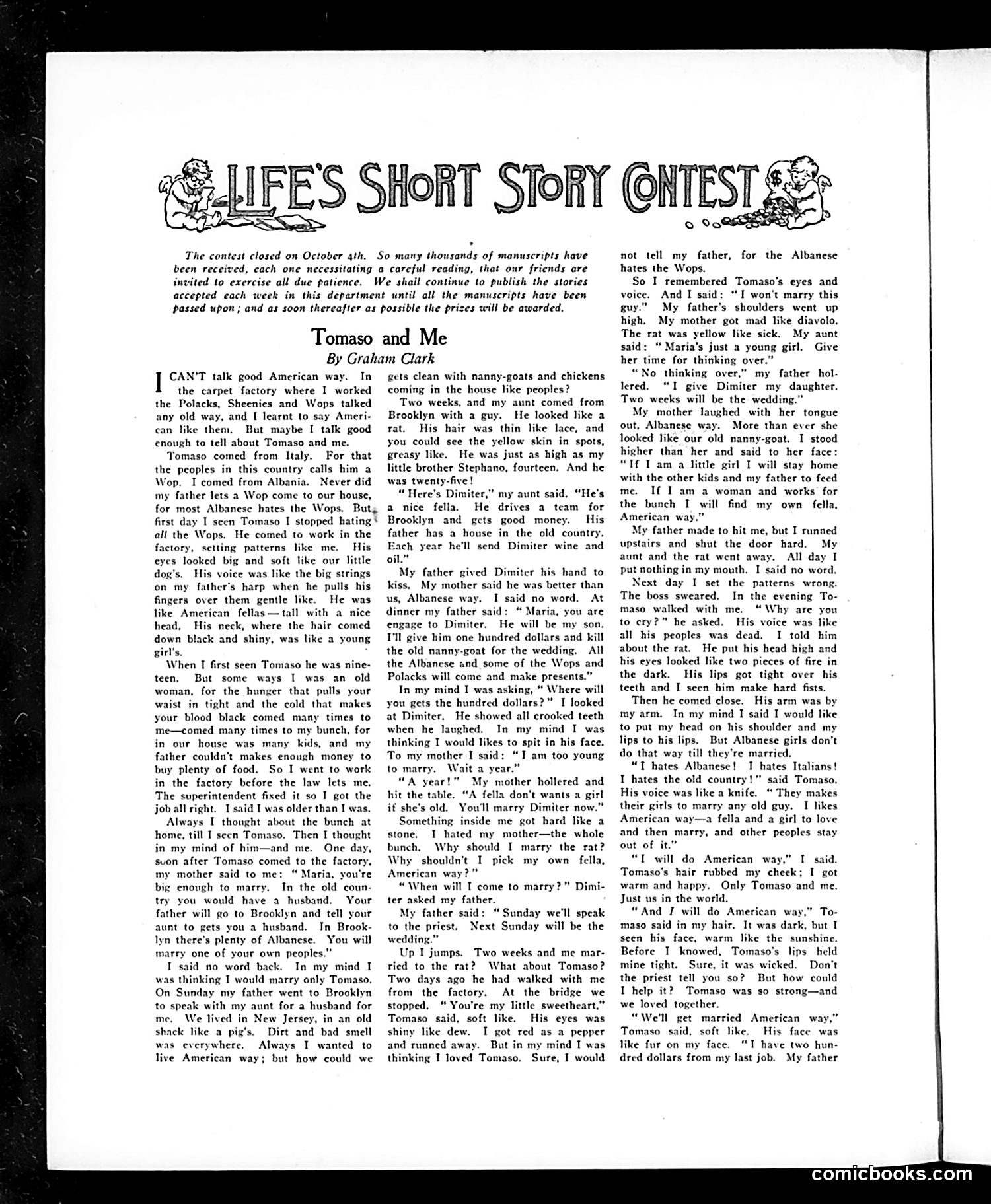
This is a short story submission to Life magazine's 1910s-era contest, not a political cartoon. The piece explores immigrant identity and assimilation through a romantic narrative. **Key context for modern readers:** The story depicts early 20th-century Italian and Albanian immigrant communities in industrial America, specifically factory workers in New Jersey. Period-authentic ethnic slurs ("Wops," "Polacks," "Sheenies") reflect both the narrator's voice and contemporary prejudices against Southern/Eastern European immigrants. **The central conflict:** Maria's Albanian father forbids relationships with Italians ("Wops"), yet she falls for Tomaso, an Italian coworker. Her father arranges her engagement to Dimiter, a fellow Albanian, emphasizing "old country" traditions. Maria wants the "American way"—implying romantic choice and assimilation over arranged marriages and ethnic insularity. **The satire:** The story gently mocks both rigid immigrant traditions and American naiveté, using Maria's broken English and conflicted loyalties to explore how first-generation immigrants navigated competing cultural values.
📄 Transcribed text from this page (OCR, searchable)
Machine-transcribed from the original scan — historical spelling and the odd misread are preserved.
AIFES S HORT STORY @NTEST. The contest closed on October 4th. So many thousands of manuscripts have been received, cach one necessitating a invited to exercise all due patience. accepted each week in this department passed upon ; and as soon thereafter as pi careful reading, that our friends are We shail continue to publish the stories until all the manuscripts have been ossible the prizes will be awarded. Tomaso and Me By Graham Clark CAN'T talk good American way. In the carpet factory where I worked the Polacks, Sheenies and Wops talked any old way, and I learnt to say Ameri- can like them, But maybe I talk good enough to tell about Tomaso and me. Tomaso comed from Italy, For that the peoples in this country calls him a Wop. I comed from Albania. Never did my father lets a Wop come to our house, for most Albanese hates the Wops. Buty first day I seen Tomaso I stopped hating * all the Wops. He comed to work in the factory, setting patterns like me. His eyes looked and soft like our little dog's. His voice was like the big strings on my father’s harp when he pulls his fingers over them gentle like. He was like American fellas—tall with a nice head. His neck, where the hair comed down black and shiny, was like a young girl’ : When I first seen T: so he was nine- teen. But some ways I was an old woman, for the hunger that pulls your waist in tight and the cold that makes your blood black comed many times to me—comed many times to my bunch, for in our house was many kids, and my father couldn't makes enough money to buy plenty of food. So I went to work in the factory before the law lets me. The superintendent fixed it so I got the job all right. I said I was older than I was. Always I thought about the bunch at home, till I seen Tomaso. Then I thought in my id of him—and me. One day, svon after Tomaso comed to the factory, my mother said to me: “ Maria, you're big enough to marry. In the old coun- try you would have a husband. Your father will go to Brooklyn and tell your aunt to gets you a husband. In Brook- lyn there's plenty of Albanese. You will marry one of your own peoples.” T said no word back. In my mind I was thinking I would marry only Tomaso. On Sunday my father went to Brooklyn to speak with my aunt for a husband for We lived in New Jersey, in an old shack like a pij Dirt and bad smell was everywhere. Always I wanted to live American way; but how could we gets clean with nanny-goats and chickens coming in the house like peoples? Two weeks, and my aunt comed from Brooklyn with a guy. He looked like a rat. His hair was thin like lace, and you could see the yellow skin in spots, greasy like. He was just as high as my little brother Stephano, fourteen. And he was twenty-five! “Here's Dimiter,” my aunt said. “He's a nice fella, He drives a team for Brooklyn and gets good money. His father has a house in the old country. ch year he'll send Dimiter wine and oi My father gived Dimiter his hand to kiss, My mother said he was better than us, Albanese way. I s: no word. At dinner my father said: “ Maria, you are engage to Dimiter. He will be my son. I'l give him one hundred dollars and kill the old nanny-goat for the wedding. All the Albanese and some of the Wops and Polacks will come and make presents.” In my mind I was asking, “ Where will you gets the hundred dollars?” I looked at Dimiter. He showed all crooked teeth when he laughed. In my mind I was thinking I would likes to spit in his face. To my mother I said: “I am too young to marry. Wait a year.” “A year!" My mother hollered and hit the table. “A fella don't wants a girl if she’s old. You'll marry Dimiter now.” Something inside me got hard like a stone. I hated my mother—the whole bunch, Why should I marry the rat? Why shouldn't I pick my own fella, American way?" “When will I come to marry?” Dimi- ter asked my father. My father said: “Sunday we'll speak to the priest. Next Sunday will be the wedding.” Up I jumps. Two weeks and me mar- ried to the rat? What about Tomaso? Two days ago he had walked with me from the factory. At the bridge we stopped. “ You're my little sweetheart.” Tomaso said, soft like. His eyes was shiny like dew. I got red as a pepper and runned awa But in my mind I was thinking I loved Tomaso. Sure, I would eccnry not tell my father, for the Albanese hates the Wops. So I remembered Tomaso’s eyes and voice. And I said: “I won't marry this guy.” My father’s shoulders went up high. My mother got mad like diavolo, The rat was yellow like sick. My aunt said: “ Maria's just a young girl. Give her time for thinking over.” “No thinking over,” my father hol- lered. “I give Dimiter my daughter. Two weeks will be the wedding.” My mother laughed with her tongue out, Albanese way. More than ever she looked like our old nanny-goat. I stood higher than her and said to her face: “Tf I am a little girl I will stay home with the other kids and my father to feed me. If I am a woman and works for the bunch I will find my own fella, American way.” My father made to hit me, but I runned upstairs and shut the door hard. My aunt and the rat went away. All day I put nothing in my mouth. I said no word. Next day I set the patterns wrong. The boss sweared. In the evening To- maso walked with me. “Why are you to cry?” he asked. His voice was like all his peoples was dead. I told him about the rat. He put his head high and his eyes looked like two pieces of fire in the dark. His lips got tight over his teeth and I seen him make hard fists. Then he comed close. His arm was by my arm. In my mind I said I would like to put my head on his shoulder and my lips to his lips. But Albanese girls don’t do that way till they're married. “T hates Albanese! I hates Italians! I hates the old country!” said Tomaso. His voice was like a knife. “ They makes their girls to marry any old guy. I likes American way—a fella and a girl to love and then marry, and other peoples stay out of it.” “T will do American way,” I said. Tomaso'’s hair rubbed my cheek; I got warm and happy. Only Tomaso and me. Just us in the world. “And I will do American wa To- maso said in my hair. It was dark, but I seen his face, warm like the sunshine. Before I knowed, Tomaso’s lips held mine tight. Sure, it was wicked. Don't the priest tell you so? But how could I help it? Tomaso was so strong—and we loved together. “We'll get married American way,” Tomaso said, soft like. His face was like fur on my face. “T have two hun- dred dollars from my last job. My father comicbooks.com