
Life, 1915-11-04 · page 4 of 56
Life — November 4, 1915 — page 4: what you’re looking at
What you’re looking at
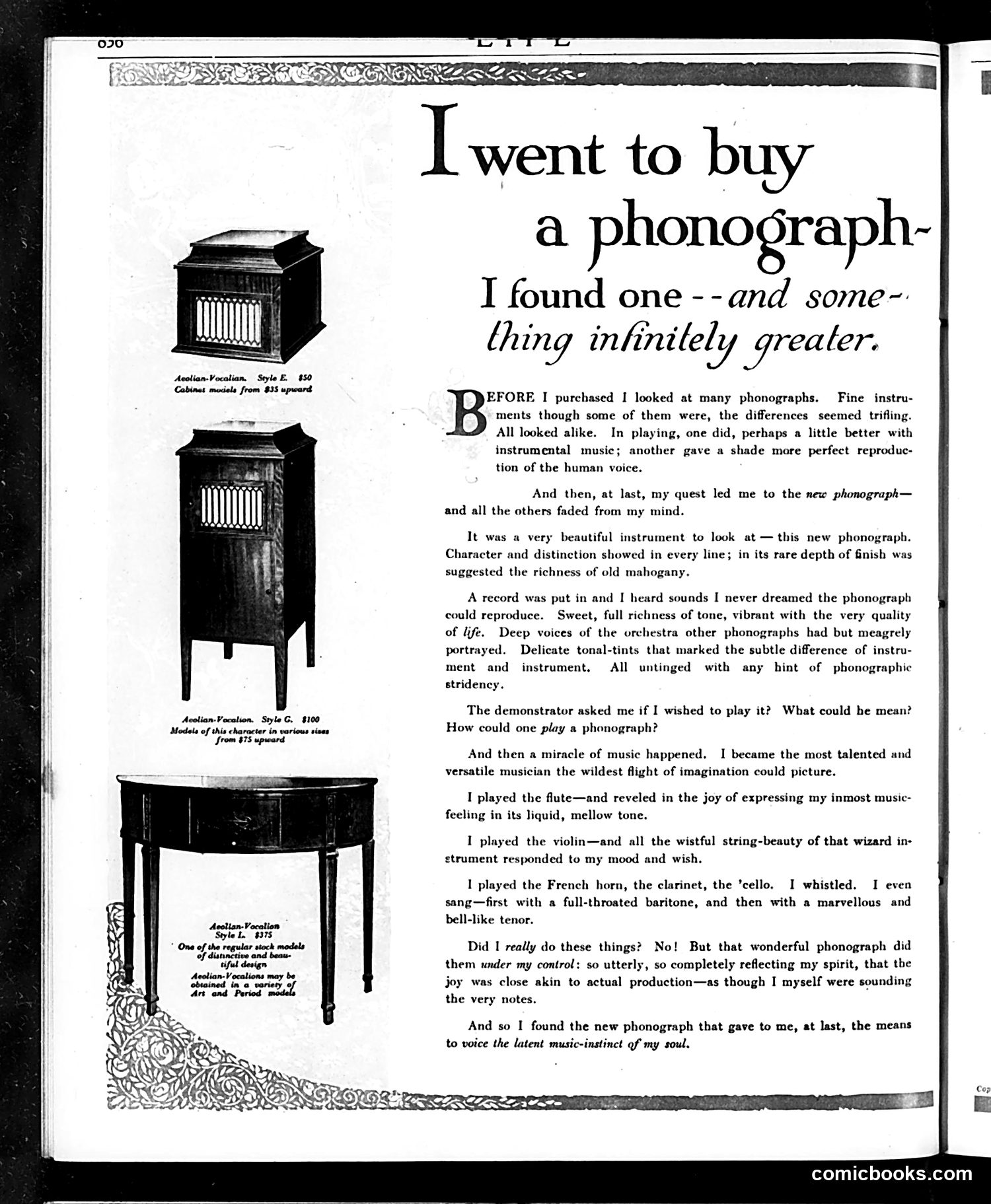
This is **not a political cartoon**, but rather a **phonograph advertisement** disguised as editorial content—a common early 20th-century marketing technique. The piece describes someone who went shopping for a phonograph and discovered one model so superior it made all others irrelevant. The narrative emphasizes the phonograph's ability to reproduce music with such fidelity that the owner could play various instruments (flute, violin, French horn, clarinet, cello) and even sing through it, as if they themselves were performing. The three product images on the left show different **Aeolian-Vocalion phonograph models** at various price points ($150-$175). The advertisement's emotional appeal—claiming the machine "gave voice to the latent music-instinct of my soul"—was typical promotional hyperbole for early audio technology, positioning the phonograph as almost miraculous in capability.
📄 Transcribed text from this page (OCR, searchable)
Machine-transcribed from the original scan — historical spelling and the odd misread are preserved.
went to buy a phonograph- I found one --and some-: thing infinilely greater. Acolian-Vocalian. Style E. $50 er cree er OS re EFORE I purchased I looked at many phonographs. Fine instru- . ments though some of them were, the differences seemed trifling. All looked alike. In playing, one did, perhaps a little better with instrumental music; another gave a shade more perfect reproduc- tion of the human voice. And then, at last, my quest led me to the new phonograph— and all the others faded from my mind. It was a very beautiful instrument to look at — this new phonograph. Character and distinction showed in every line; in its rare depth of finish was suggested the richness of old mahogany. A record was put in and I heard sounds I never dreamed the phonograph could reproduce. Sweet, full richness of tone, vibrant with the very quality of life. Deep voices of the orchestra other phonographs had but meagrely portrayed. Delicate tonal-tints that marked the subtle difference of instru- ment and instrument, All untinged with any hint of phonographic stridency. The demonstrator asked me if I wished to play it? What could he mean? Acolian-Vecalion. Style G. $100 Mists of ih characer 5 enon Gio How could one play a phonograph? from $75 upward And then a miracle of music happened. I became the most talented and versatile musician the wildest flight of imagination could picture. I played the flute—and reveled in the joy of expressing my inmost music- feeling in its liquid, mellow tone. I played the violin—and all the wistful string-beauty of that wizard in- strument responded to my mood and wish. I played the French horn, the clarinet, the ’cello. I whistled. I even sang—first with a full-throated baritone, and then with a marvellous and bell-like tenor. Did I really do these things? No! But that wonderful phonograph did them under my control: so utterly, so completely reflecting my spirit, that the joy was close akin to actual production—as though I myself were sounding the very notes. And so I found the new phonograph that gave to me, at last, the means to voice the latent music-instinct of my soul. comicbooks.com