
A complete issue · 52 pages · 1915
Life — June 17, 1915
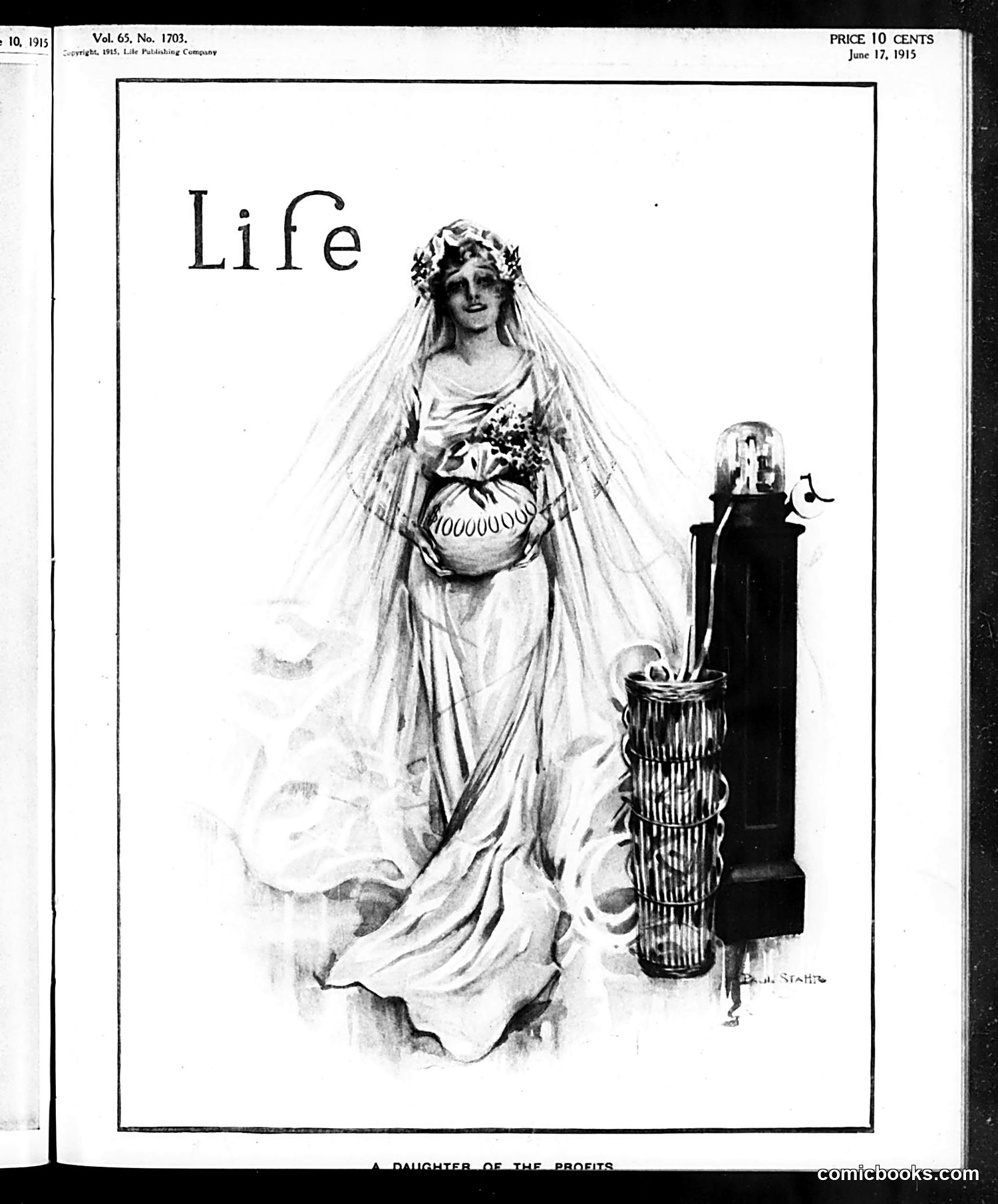
This cover depicts a classical allegorical figure—a veiled woman in flowing robes representing "Life" or perhaps "Liberty"—holding a large vessel or urn. She stands beside an industrial or mechanical apparatus on the right side. The caption reads "A Daughter of the Profits," suggesting satire about wealth generation or capitalism. The image likely critiques how commercial or industrial interests exploit or control abstract ideals. The contrast between the classical, ethereal female figure and the stark mechanical device emphasizes tension between idealism and industrial materialism. Without additional context from the magazine's interior, the specific 1915 reference remains unclear, though it appears to comment on American industrial capitalism during the World War I era.
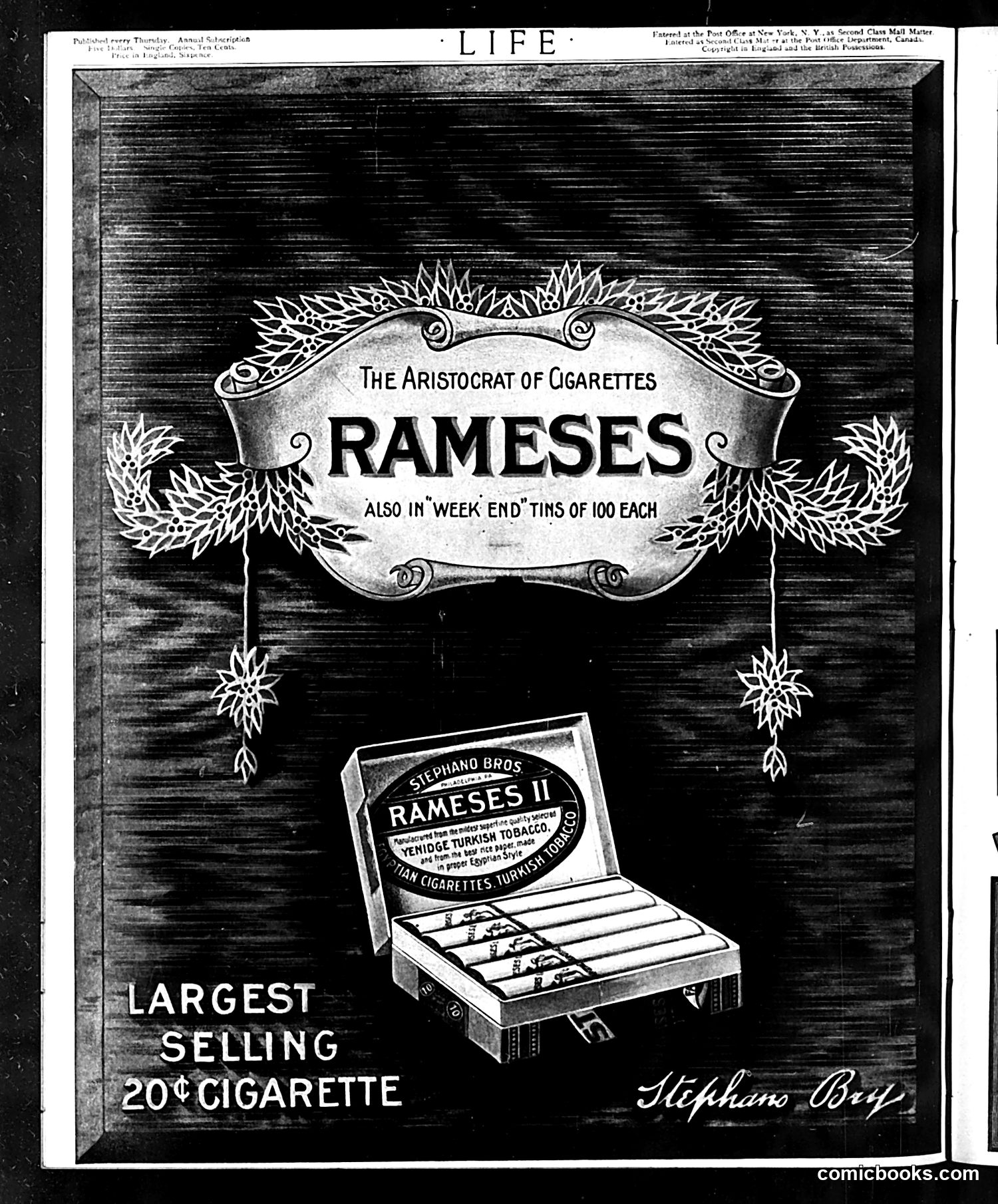
This page is **primarily an advertisement**, not political satire. It promotes Rameses cigarettes by Stephano Bros., marketed as "The Aristocrat of Cigarettes" and describes itself as the "Largest Selling 20¢ Cigarette." The decorative elements—ornate banner, thistle flowers, and an open cigarette box—are purely commercial design meant to convey luxury and prestige. The thistle motif likely references Turkish tobacco, as the box label mentions "Yehidgie Turkish Tobacco" and "Turkish Cigarettes, Turkey Tobacco." There is no political commentary or satire evident on this page. It's a straightforward vintage cigarette advertisement from Life magazine, using period design conventions to market a premium product to early 20th-century readers.
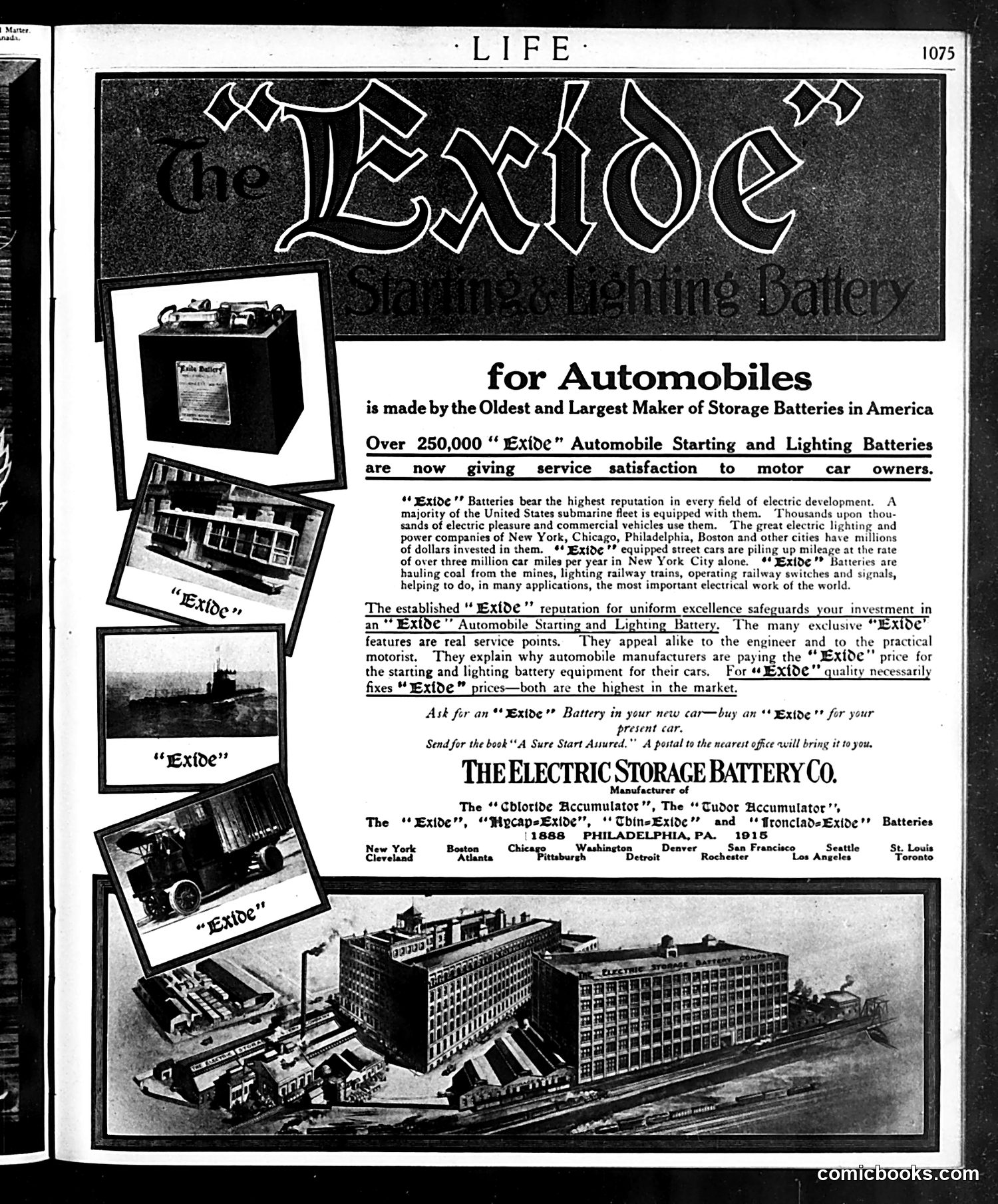
This page is **not a cartoon or satirical content** — it is a straightforward advertisement for "Exide" automobile batteries, published in *Life* magazine (page 1075). The ad promotes Exide as "the Oldest and Largest Maker of Storage Batteries in America," claiming over 250,000 units in service. It highlights uses in submarines, commercial vehicles, and electric lighting for cities like New York and Chicago. The images show the battery product itself, internal battery components, and a photograph of The Electric Storage Battery Company's manufacturing facilities in Philadelphia. This represents early 20th-century automotive advertising emphasizing industrial scale and technological reliability to appeal to both engineers and motorists considering which battery brand to purchase.
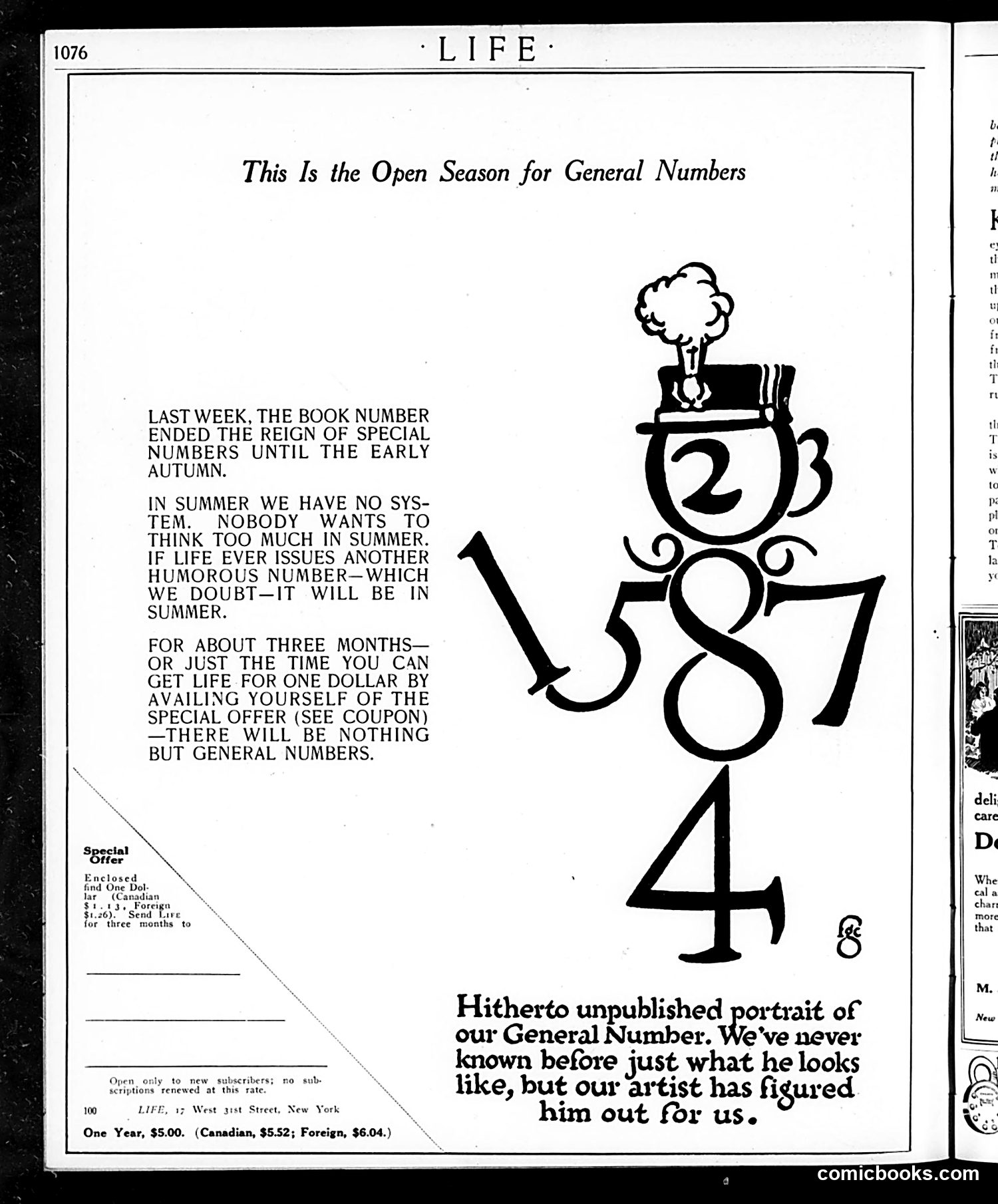
This is a satirical advertisement for a magazine subscription product called "General Numbers." The anthropomorphized numbers 1, 2, 5, 7, 4, and 8 are stacked whimsically, with the "2" wearing a crown or hat. The text jokes that during summer months, Life magazine publishes no regular system—only "General Numbers" issues instead. The copy humorously suggests readers shouldn't overthink summer content. The "hitherto unpublished portrait" caption jokingly presents this illustrated arrangement as finally revealing what their "General Number" looks like, playing on the absurdity of personifying numbered issues. The special offer promises three months of Life for one dollar ($1 foreign) if subscribers use the enclosed coupon. This is primarily a promotional piece exploiting the magazine's summer publishing schedule through humor and whimsy.
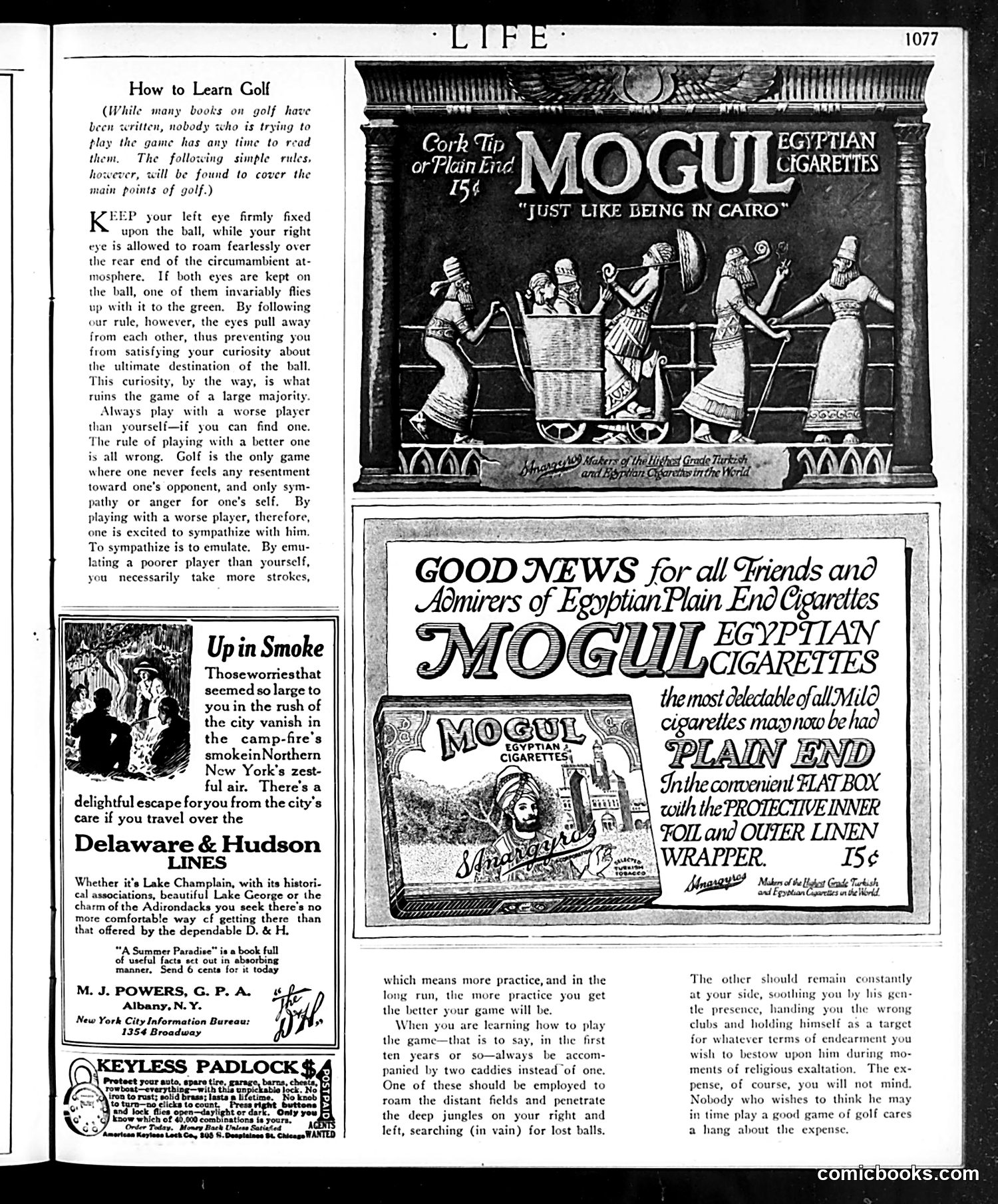
This page is **primarily advertising** with minimal satirical content. The dominant feature is a Mogul Egyptian Cigarettes advertisement depicting an Egyptian-themed scene with people in exotic dress and the tagline "Just Like Being in Cairo." The left side contains a golf instruction article ("How to Learn Golf") with accompanying small ads, including one for the Delaware & Hudson Line railroad promoting the Adirondacks as a vacation destination, and a Keyless Padlock advertisement. The satirical elements are negligible. The Egyptian cigarette ad's exoticized imagery reflects early-20th-century commercial orientalism—marketing cigarettes through fantastical orientalist imagery—but lacks specific political satire. The page functions primarily as commercial messaging rather than social commentary.
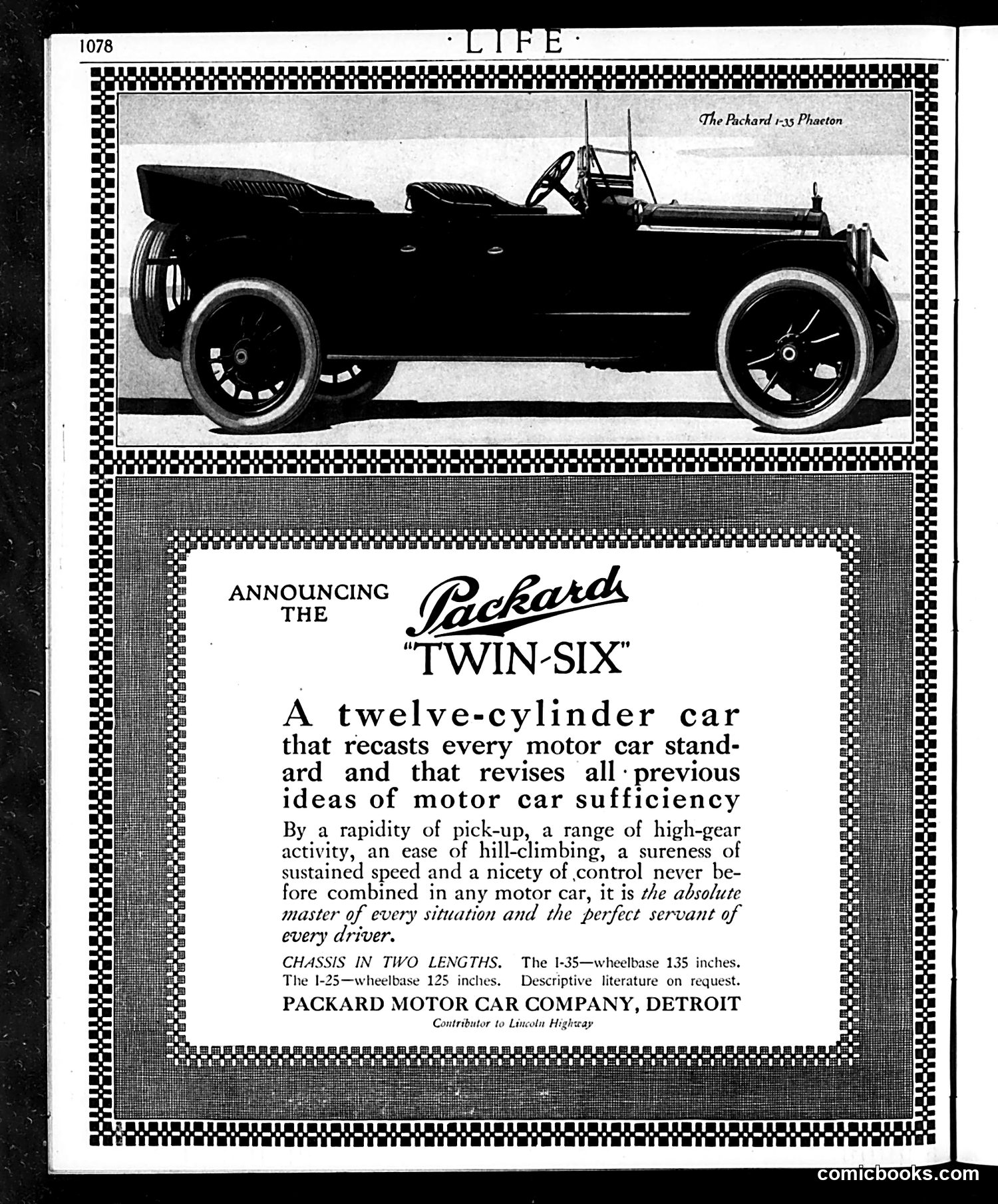
This is not a cartoon or satirical content—it's a **straightforward automobile advertisement** from Life magazine. The page announces the Packard "Twin-Six," a twelve-cylinder luxury car manufactured by the Packard Motor Car Company of Detroit. The image shows a side profile of an open-air roadster. The ad copy emphasizes performance features (acceleration, hill-climbing, sustained speed, control) and positions the vehicle as superior to competing automobiles. Two chassis options are offered with different wheelbases (135 and 125 inches). This represents early automotive advertising, when twelve-cylinder engines were prestigious luxury features. No satire or political commentary is present—it's purely commercial promotion aimed at affluent buyers.
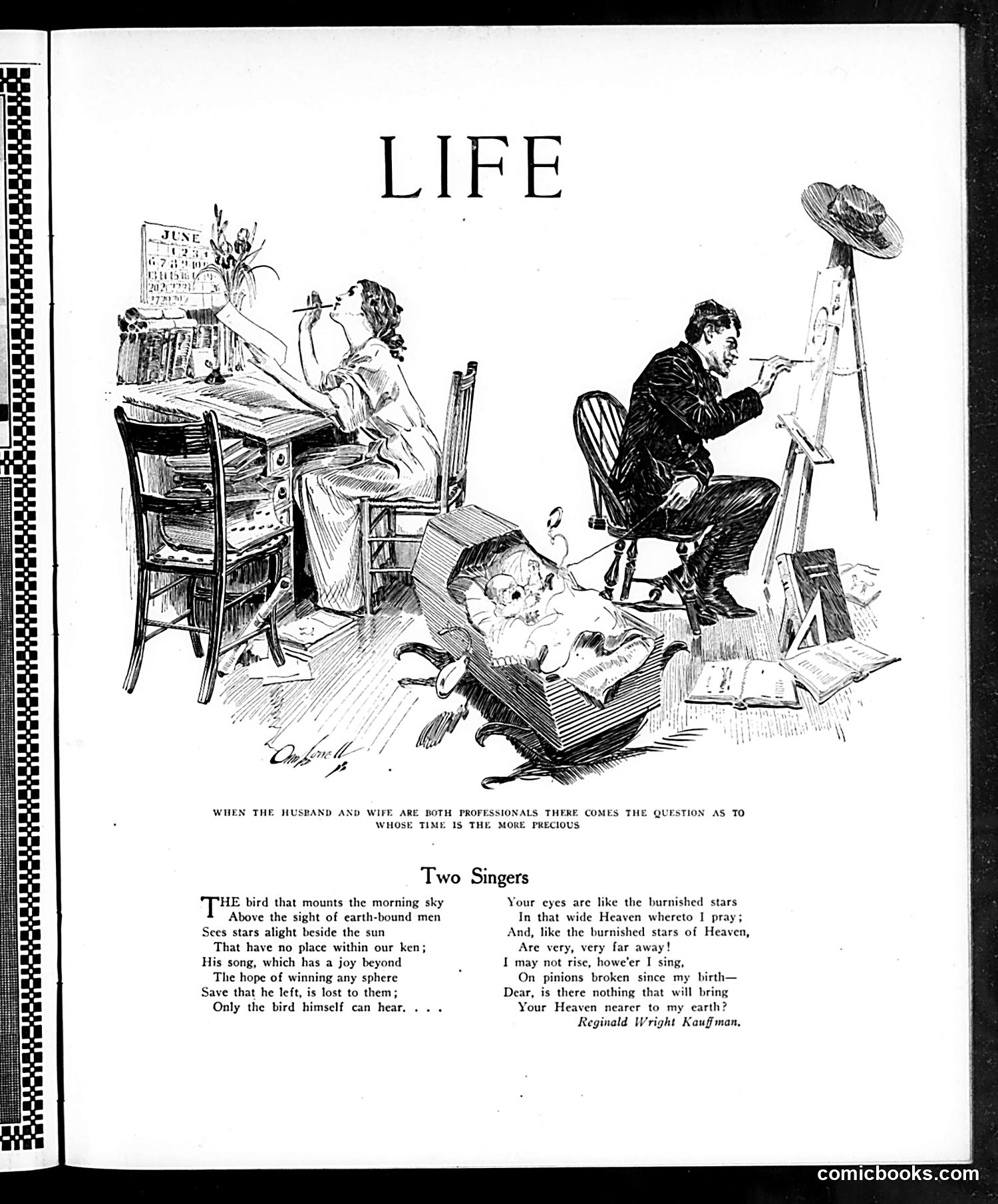
This page satirizes the competing demands on time when both spouses work as professionals. The illustration shows a domestic studio scene with three figures: a woman at a desk (appearing to work on correspondence or administrative tasks), a man at an easel painting, and a baby on the floor playing with papers and books. The caption addresses the central tension: "When the husband and wife are both professionals there comes the question as to whose time is the more precious." The satire suggests that professional pursuits—here represented by artistic and clerical work—conflict with childcare responsibilities. The neglected baby literally underfoot humorously emphasizes how domestic life becomes secondary when both parents prioritize careers. This reflects early 20th-century anxieties about women's professional ambitions and their impact on traditional family roles.
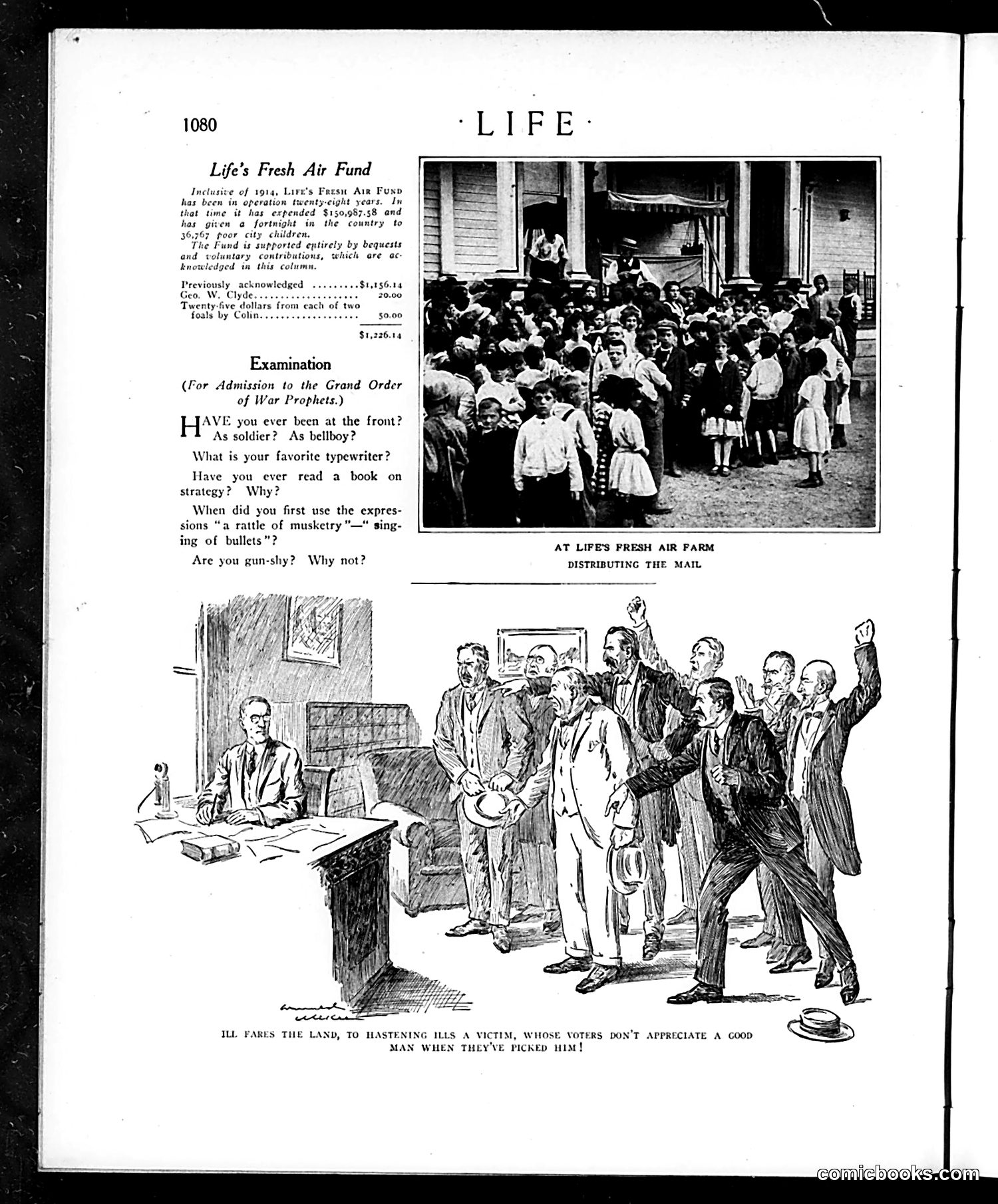
This Life magazine page contains two distinct items: **Upper section:** Information about "Life's Fresh Air Fund," a charitable program providing poor city children with country vacations. The text documents financial contributions. **Lower cartoon:** Titled "Ill Fares the Land, to Hastening His a Victim, Whose Voters Don't Appreciate a Good Man When They've Picked Him!" The sketch depicts a politician (seated, left) being confronted by an angry mob of constituents. The satire critiques voter ingratitude—suggesting citizens fail to properly appreciate elected officials they've chosen. The threatening crowd gestures suggest public dissatisfaction, while the politician appears helpless. This appears to be commentary on political accountability and the fraught relationship between elected officials and their electorate during the early 20th century.
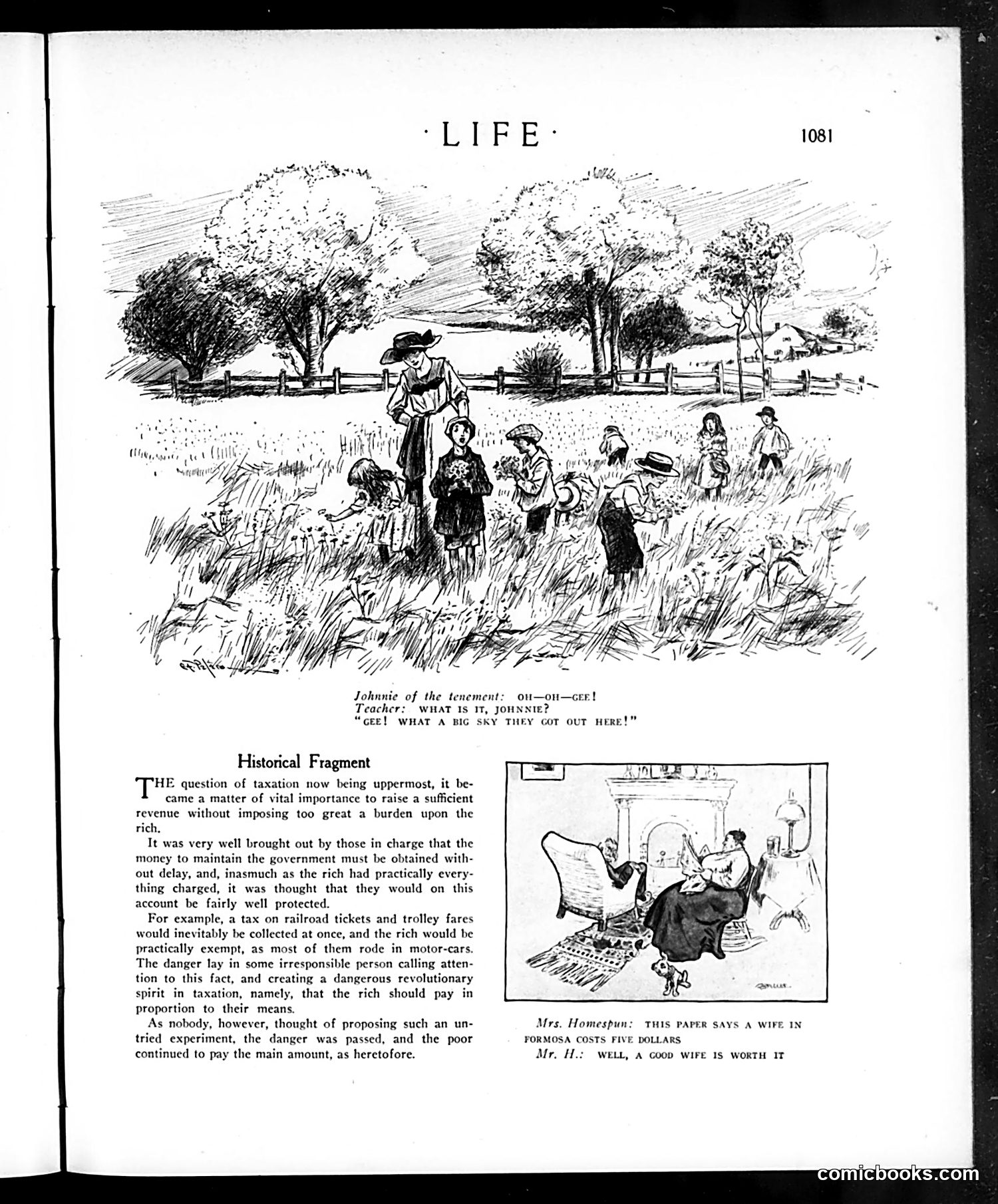
**Top Cartoon:** A teacher leads schoolchildren outdoors, exclaiming about the "big sky." One child (Johnnie) asks "Out—out—ger?" The joke appears to be about rural children's unfamiliarity with outdoor space or unusual speech patterns—likely satirizing either rural dialect or children's mispronunciation. **"Historical Fragment":** This section discusses taxation policy, specifically critiquing proposals to tax the wealthy differently. It argues that collecting taxes from the rich (via railroad tickets, trolley fares) would be efficient and prevent them from evading taxes—a progressive taxation argument. **Bottom Cartoon:** A domestic scene where Mrs. Homespun reads that a wife in Formosa costs five dollars. Mr. H. replies "A good wife is worth it"—a joke about marital value and economic worth.
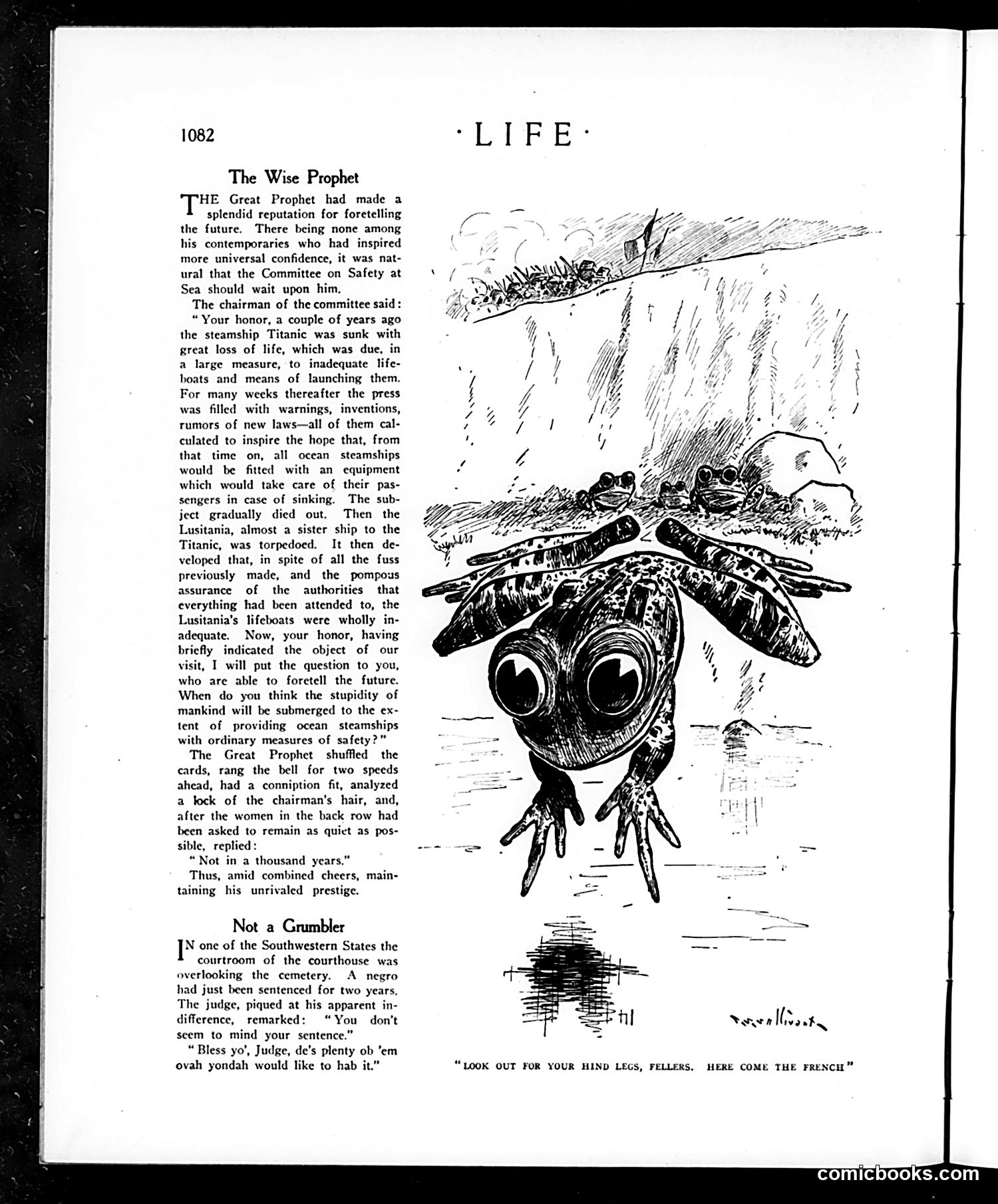
This page contains two satirical pieces: **"The Wise Prophet"** mocks a "Great Prophet" who predicted ocean steamships would need lifeboats and safety equipment after the Titanic disaster (1912). The story implies his predictions were obvious and self-serving, eventually dismissed as his credibility faded. **"Not a Grumbler"** presents a brief anecdote about a Black defendant sentenced to two years in court. The judge remarks the defendant doesn't seem to mind the sentence, to which the defendant responds using dialect: he'd prefer more time if possible. The main cartoon depicts a grotesque creature with large bulging eyes emerging from water, captioned "Look out for your hind legs, fellers. Here come the French." This appears to be anti-French propaganda, likely referencing World War I tensions or immigration concerns.
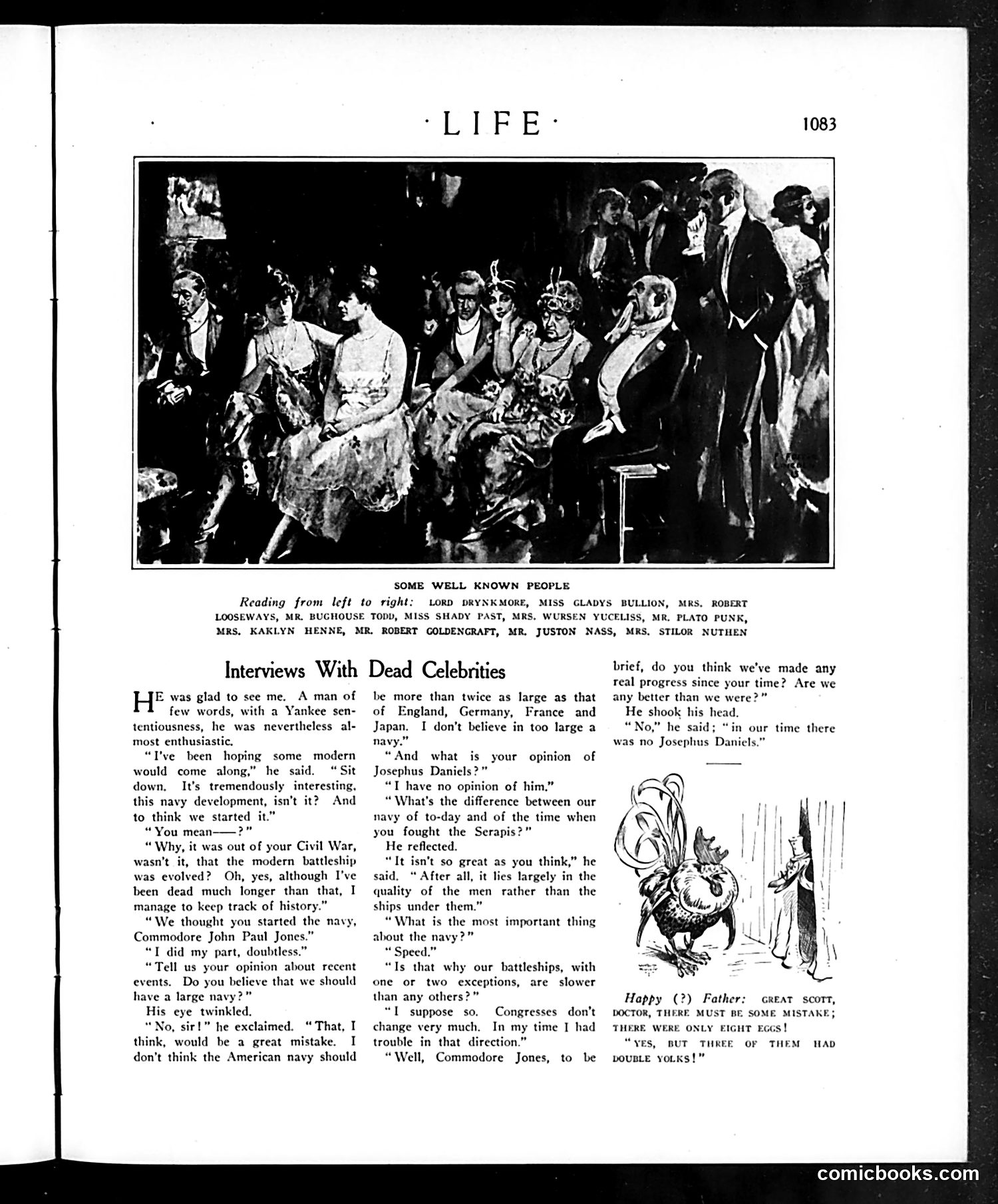
This satirical piece imagines conversations with historical figures—apparently including Commodore John Paul Jones and references to naval history. The main interview discusses the American navy's development, with the "dead celebrity" (shown with a twinkle in his eye) skeptically commenting on modern naval progress. He expresses doubt that the current American navy has improved much since his era, and questions whether a large modern navy is necessary. The accompanying cartoon below depicts a confused father figure ("Great Scott") discovering something unexpected—apparently "eight eggs" when there should have been "double yolks," playing on the phrase "double yolks" as a contemporary expression of surprise or absurdity. The page satirizes both historical naval policy and domestic confusion.
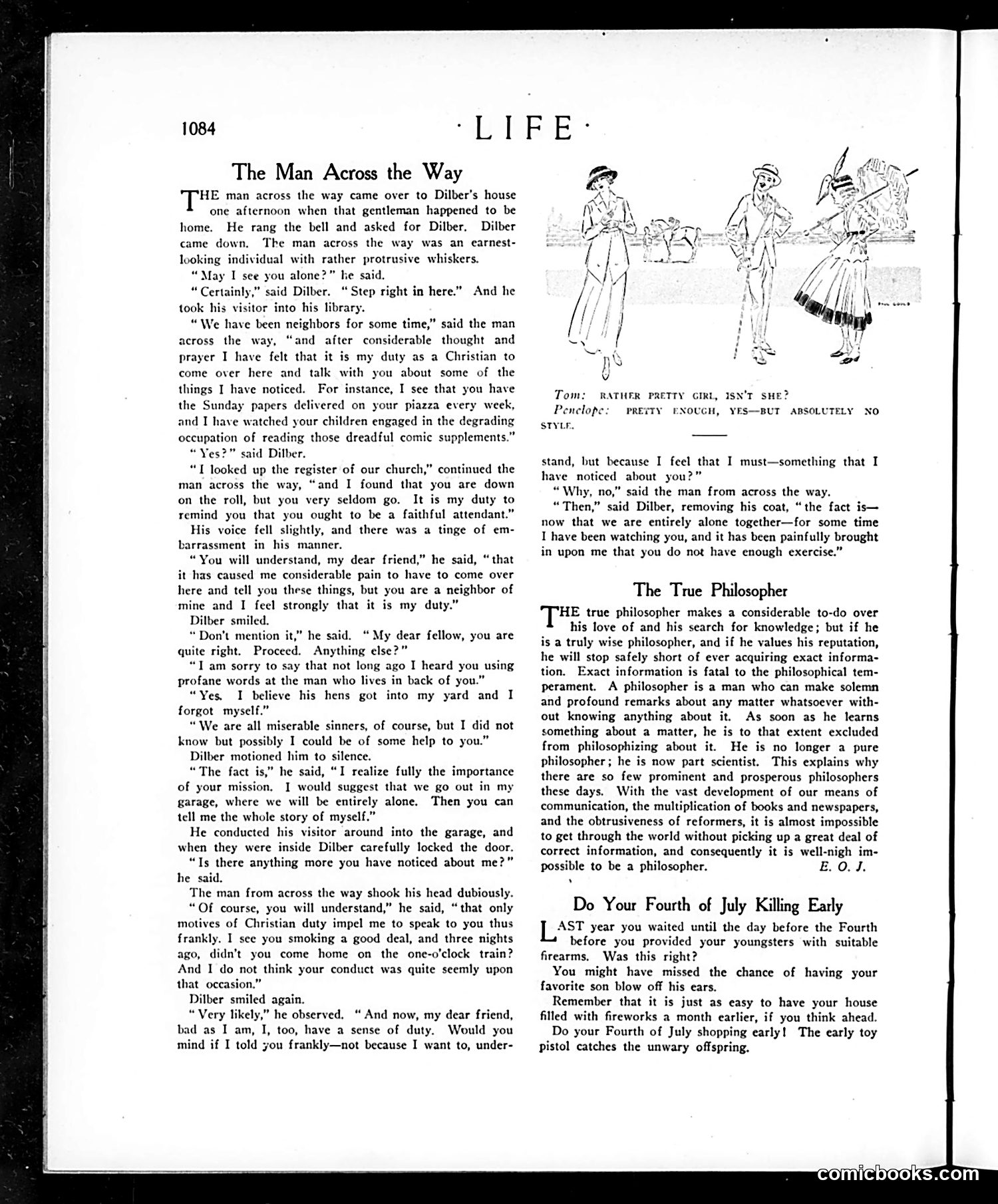
This page contains two separate pieces of satirical content: **"The Man Across the Way"** (left column): A short story about a neighbor who visits to criticize Dilber's family for reading comic supplements and not attending church regularly. The neighbor lectures about Christian duty. The satire targets self-righteous, nosy neighbors who presume moral authority while meddling in others' private lives. **"The True Philosopher"** (right column): A brief essay mocking philosophers who claim expertise while admitting ignorance. It argues that true philosophers avoid making definitive claims, making it "well-nigh impossible to be a philosopher" in modern times. **"Do Your Fourth of July Killing Early"** (bottom right): Advises buying fireworks in advance rather than waiting until July 3rd to avoid accidents. This is straightforward practical safety advice, not satire. The illustration shows fashionable women, apparently unrelated to the text content.
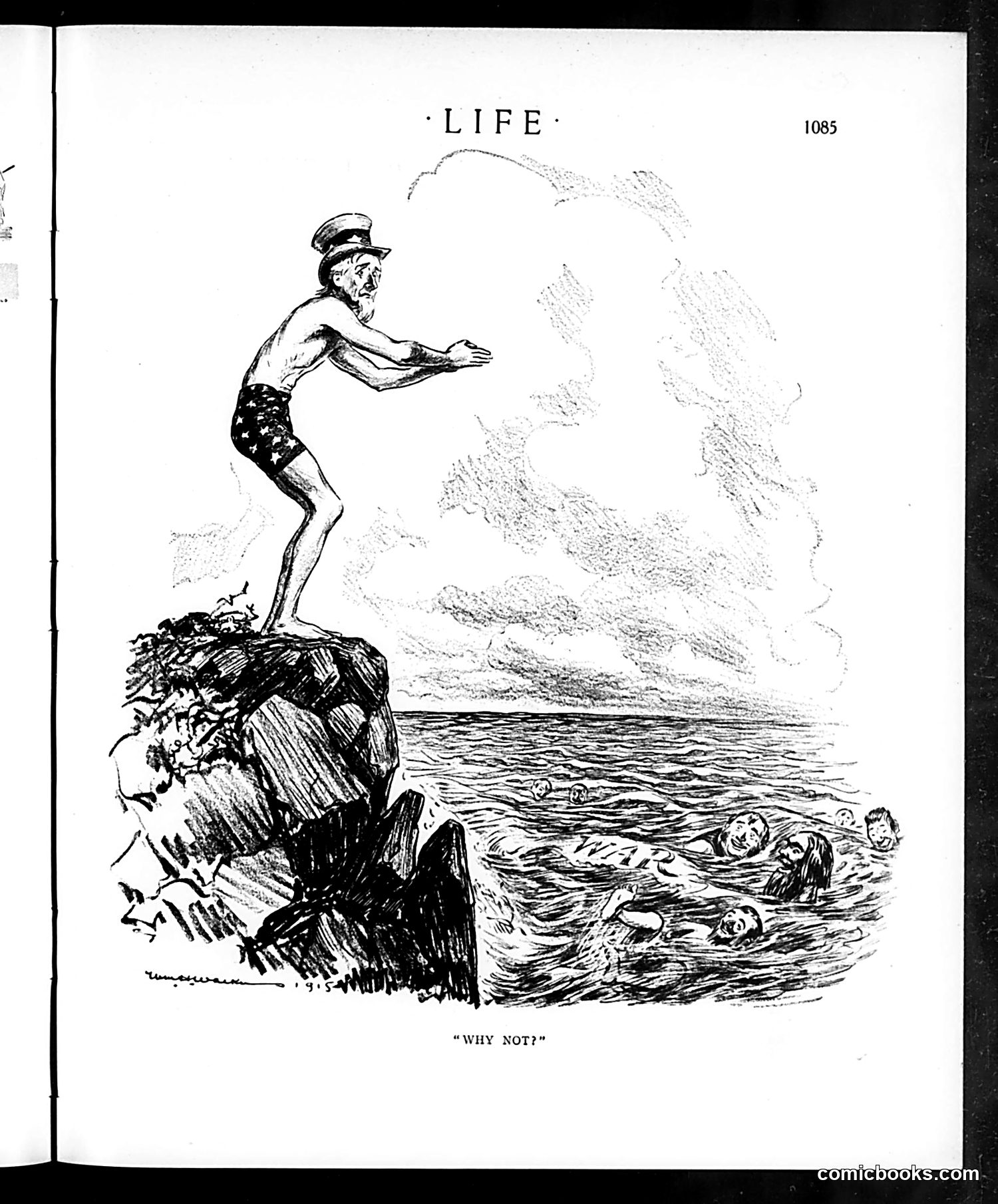
This is a single-panel political cartoon titled "Why Not?" depicting a man in a hat and swimming trunks standing on a rocky outcrop, gesturing invitingly toward the ocean where multiple people are swimming. The cartoon appears to be satirizing either a public health campaign or social policy debate—likely concerning swimming safety, public bathing access, or water recreation during the early 20th century. The figure's rhetorical question "Why Not?" suggests he's promoting something others may resist or question. Without additional context about the specific historical moment, the exact subject remains unclear, though the cartoon's tone suggests gentle mockery of either an enthusiast promoting an activity or resistance to some proposed change in public behavior or policy.
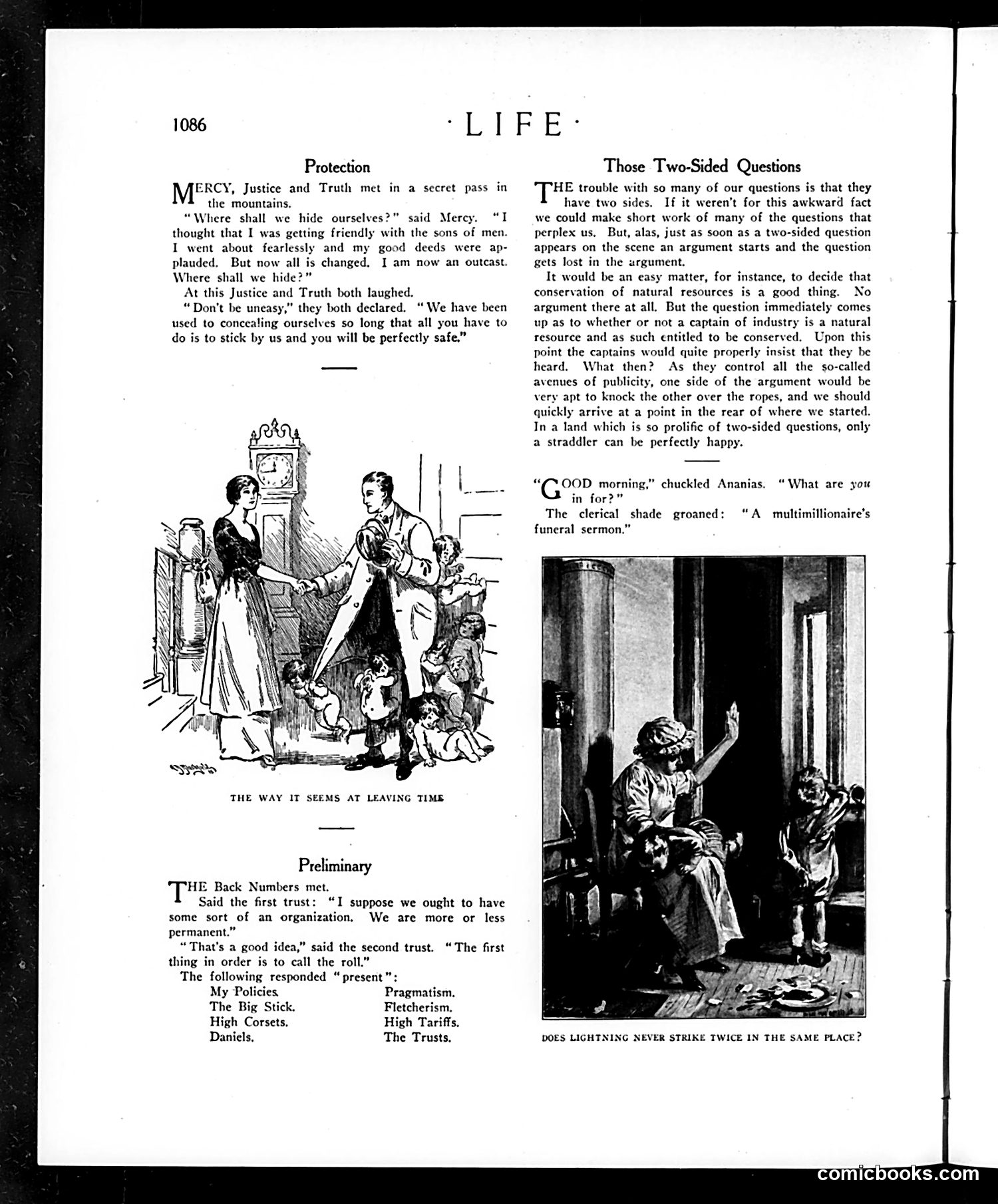
This page contains three distinct satirical pieces: **"Protection"** (top left): A sketch showing two figures labeled Mercy and Justice discussing hiding in mountains. The dialogue suggests they've abandoned their protective roles in society, implying that justice and mercy have become obsolete or compromised in contemporary affairs. **"Those Two-Sided Questions"** (right column): An editorial criticizing how public debates become unproductive when arguments have two equally valid sides. The example given—whether natural resource conservation is good—shows how "avenues of publicity" allow either side to "knock the other over the ropes," making resolution impossible. **"Preliminary"** and **"The Back Numbers"** (bottom): Brief satirical pieces about organizational structure and social commentary, listing items like "Pragmatism," "Fletcherism," and "The Trusts" as response categories. The overall tone critiques institutional failure and rhetorical deadlock in contemporary society.
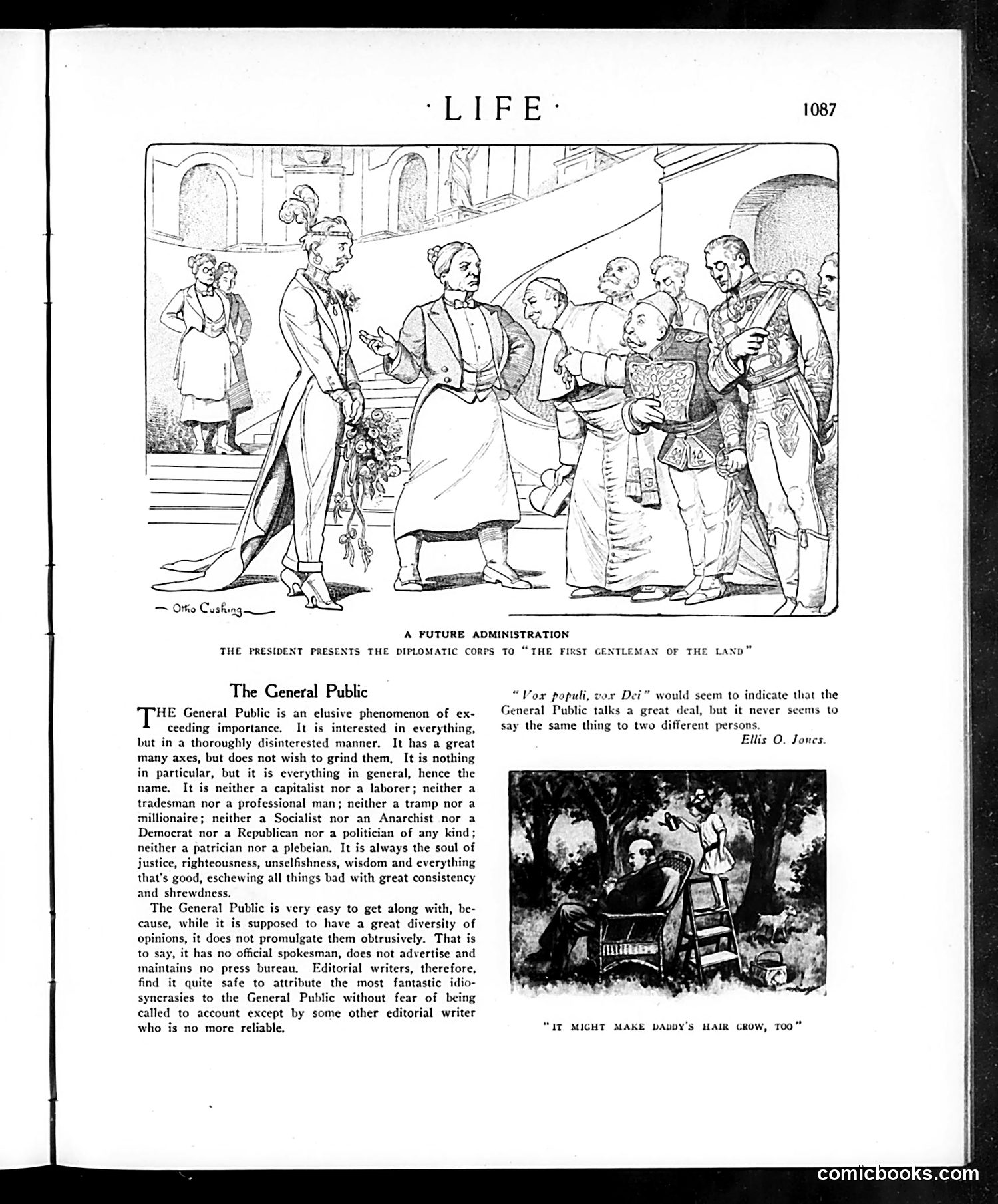
**Top Cartoon:** Titled "A Future Administration," this depicts a President presenting the "Diplomatic Corps" to "The First Gentleman of the Land." The satire appears to mock a hypothetical future administration where women hold diplomatic positions—a radical notion for the era. The "First Gentleman" (husband of a female President) is presented to official dignitaries, inverting traditional gender roles in government. The joke's impact relies on readers finding female political leadership absurd. **Bottom Image:** Captioned "It Might Make Daddy's Hair Grow, Too," this appears to be a domestic humor photograph or illustration, likely commenting on a contemporary product claim or advertisement, though context remains unclear from this page alone.
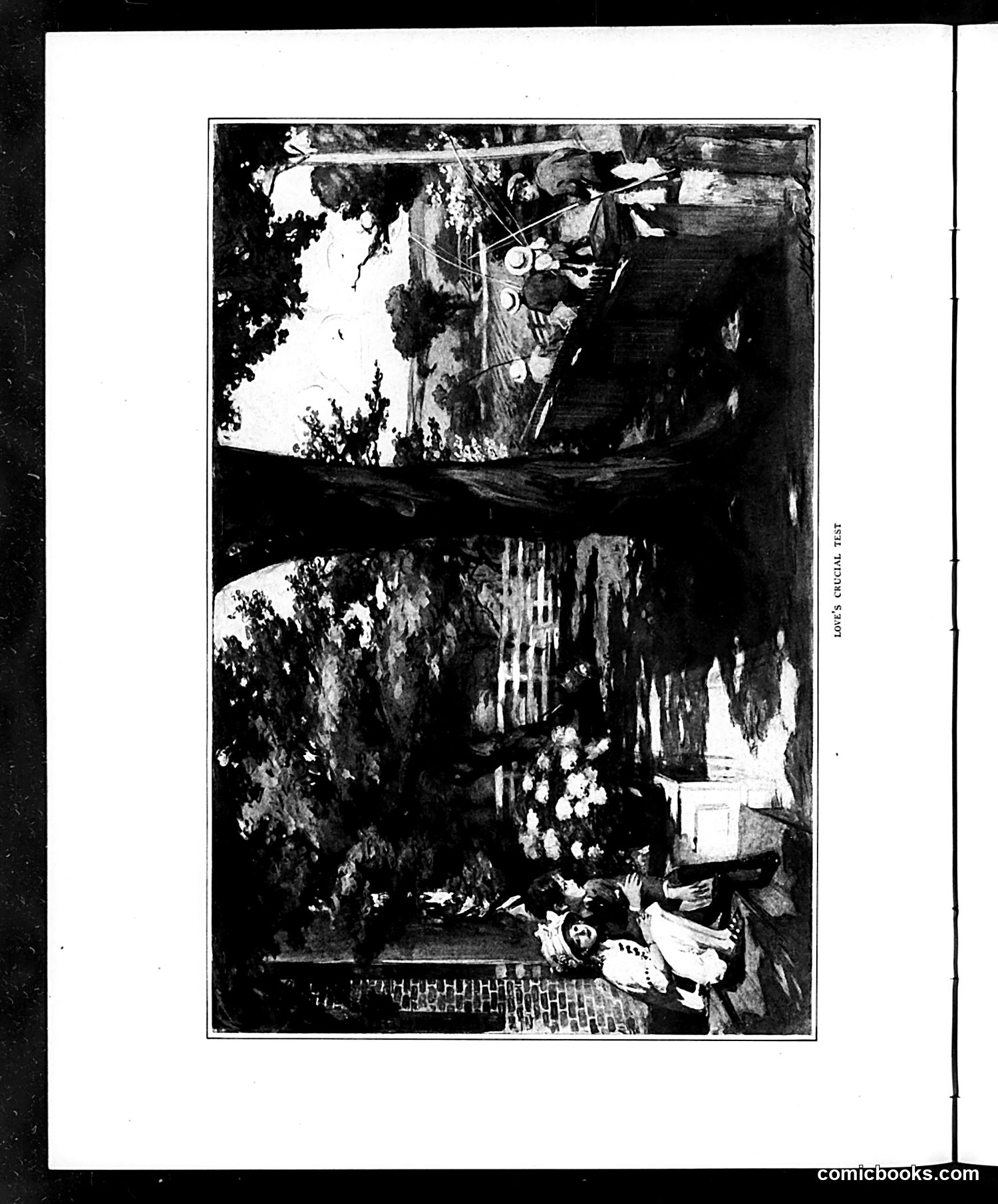
I can see this is a black and white illustration from Life magazine, but the image quality and orientation make it difficult to read clearly. The OCR text provided appears to be corrupted symbols rather than actual readable content. From what's visible in the image, it appears to show a scene with multiple figures in what looks like an interior setting, with foliage or decorative elements visible. However, without legible text or a clear caption, I cannot confidently identify the specific figures, political/social references, or the satirical point being made. To provide an accurate explanation of what this cartoon means to a modern reader, I would need either: a clearer image, the actual caption text, or additional context about which issue of Life this appeared in. I cannot responsibly guess at the content's meaning.
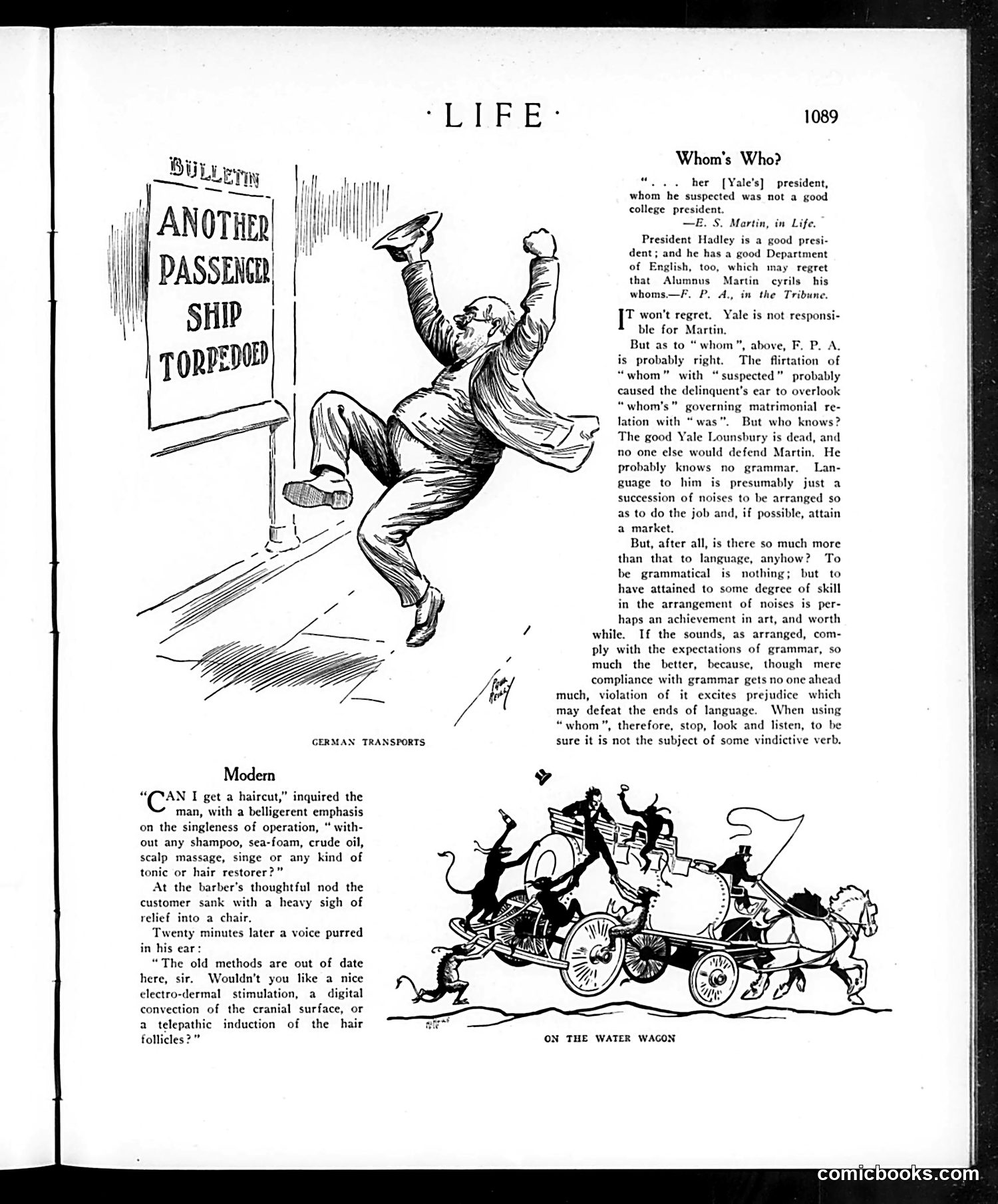
**Top Section - "Whom's Who?"**: This is a grammatical debate among Yale University figures. E.S. Martin (a Life editor) criticized Yale's president's grammar, prompting responses defending President Hadley and the English Department. The piece humorously discusses whether "whom" was correctly used, with contributors acknowledging that while grammatical precision matters aesthetically, strict compliance isn't essential—only that violations don't alienate audiences. It's intellectual satire targeting educated elites' pedantry. **"German Transports"**: The cartoon shows a man triumphantly reading a bulletin of a torpedoed passenger ship, appearing to celebrate German naval attacks. This reflects WWI-era American attitudes toward German U-boat warfare against civilian vessels—likely satirizing either German aggression or American reactions to it. **"Modern"**: A man asks for a simple haircut without extras, but the barber pitches absurd modern treatments ("electro-dermal stimulation," "telepathic induction"). This satirizes commercial over-complication and hard-sell marketing tactics of early 20th-century businesses.
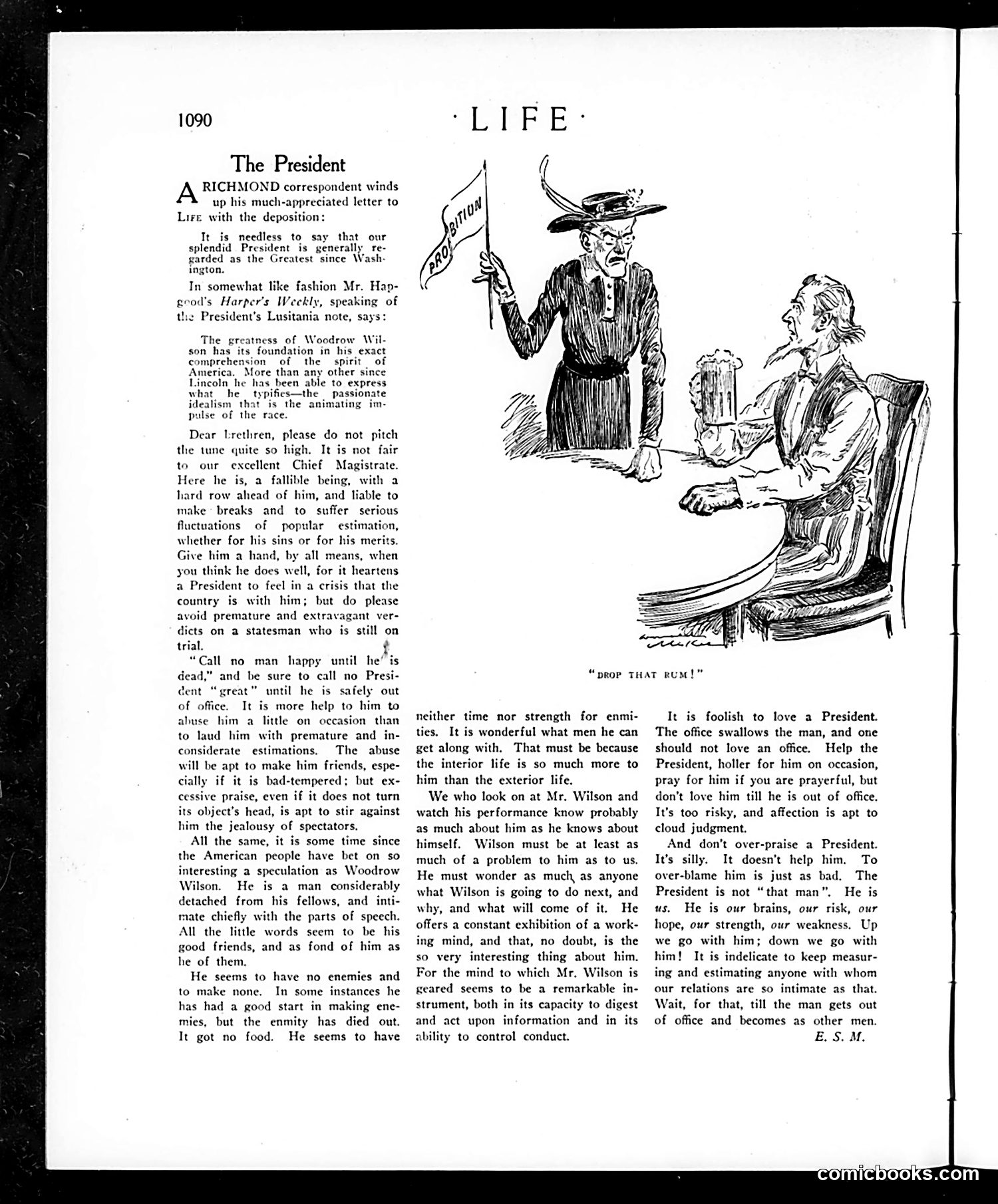
This page satirizes excessive praise of President Woodrow Wilson, likely from around 1915 (referencing his "Lusitania note"). The cartoon depicts a woman (representing Lady Liberty or "America") holding a banner labeled "PATRIOTISM" while addressing a seated man (Wilson), with the caption "DROP THAT RUM!" — suggesting he's intoxicated by flattery. The accompanying editorial mocks Harper's Weekly and other publications for calling Wilson "the Greatest since Washington." The author argues this premature lionizing is counterproductive: praise clouds judgment, makes enemies through jealousy, and prevents Wilson from understanding his actual performance. The piece advocates measured support rather than excessive adulation. The satire's core message: don't deify sitting presidents. Love the office, not the man; judge results only after he leaves office. Wilson, the writer insists, is merely human—flawed and "considerably detached"—not a secular deity.
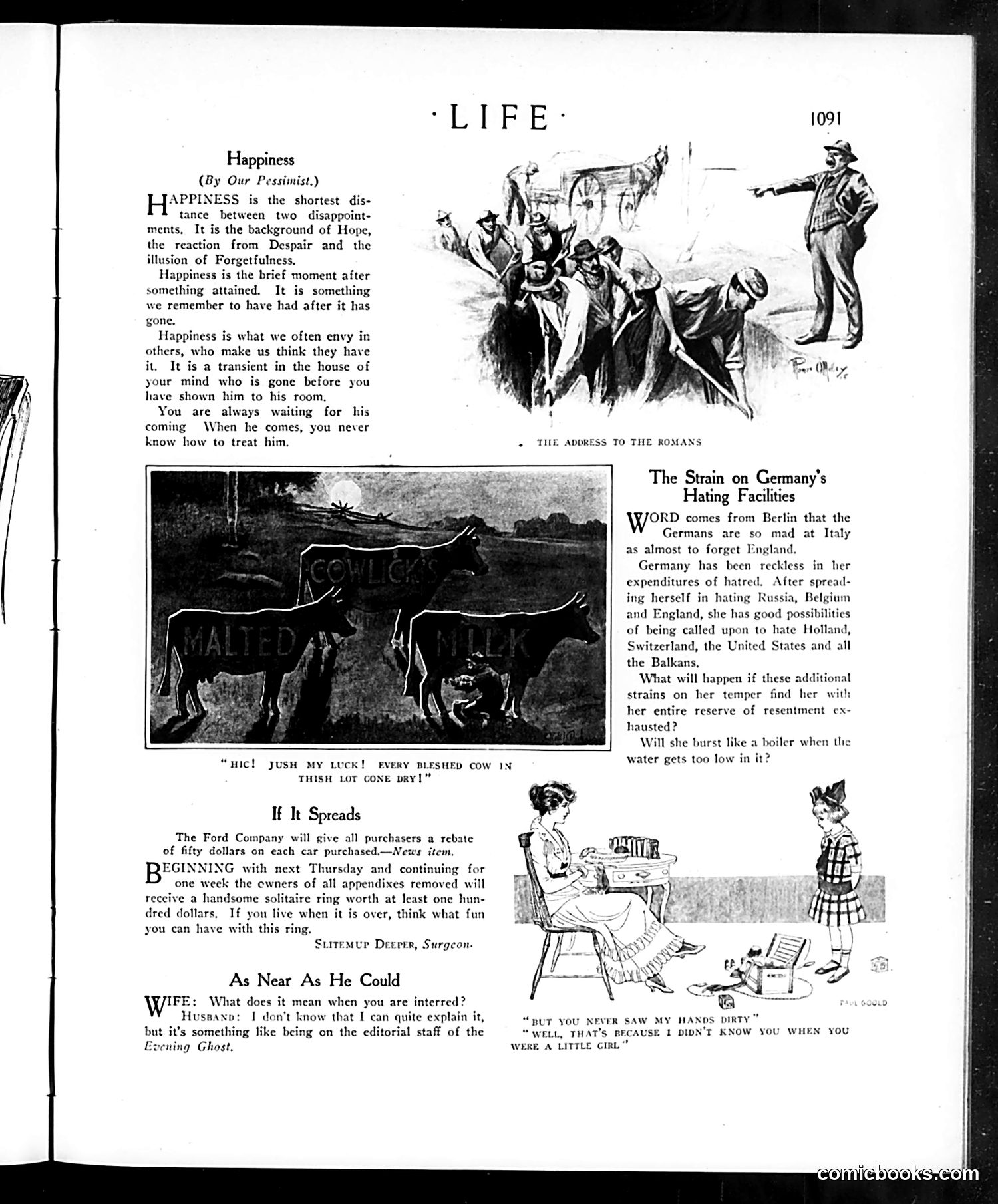
This page contains WWI-era satirical commentary, likely from 1916-1918. **"The Strain on Germany's Hating Facilities"** mocks Germany's extensive enemies during World War I. The piece sarcastically suggests Germany has "spent" its capacity for hatred on Russia, Belgium, and England, and warns it may run out of resentment if forced to hate additional nations (Holland, Switzerland, the U.S., the Balkans). The humor relies on treating hatred as a finite resource, like a boiler that could burst under pressure. This reflects American/Allied perspective ridiculing German aggression. **Other items** include satirical definitions of happiness (pessimistic philosophy), a joke about Ford's $50 rebate extended absurdly to surgical procedures, and domestic humor about marital cleanliness. The illustrations depict period scenes: a soldier addressing civilians, a mother and daughter interaction. The overall tone is characteristic of Life's wartime satirical commentary targeting German militarism and Allied skepticism.
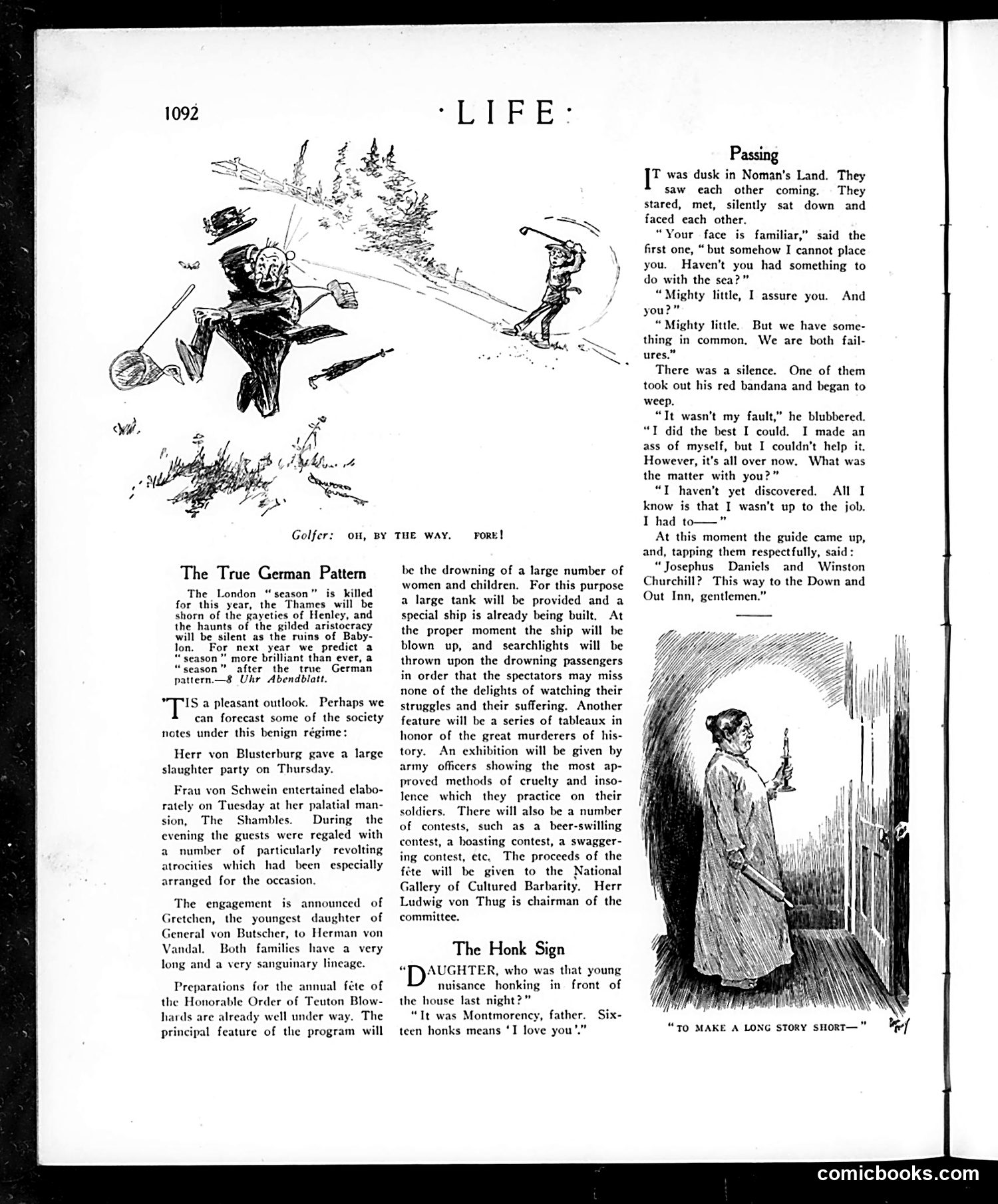
This 1914-era Life magazine page satirizes German militarism and culture through mock "society notes." The text imagines post-war London adopting "German patterns"—replacing genteel aristocratic gatherings with grotesque brutality. Events like "slaughter parties," drowning spectacles of women and children, and exhibitions of military cruelty replace traditional soirées. Names like "von Blusterburg," "von Schwein" (pig), and "von Thug" caricature Germans as inherently barbaric. The small golfer cartoon and accompanying anecdotes appear unrelated filler content. The satire's point: Germans are culturally primitive warmongers whose values—celebrating violence, military domination, and cruelty—represent the opposite of civilized Western society. This reflects pre-WWI Anglo-American attitudes portraying Germany as a threat to European refinement. The exaggeration aims at ridicule through grotesque juxtaposition of formal social conventions with savagery.
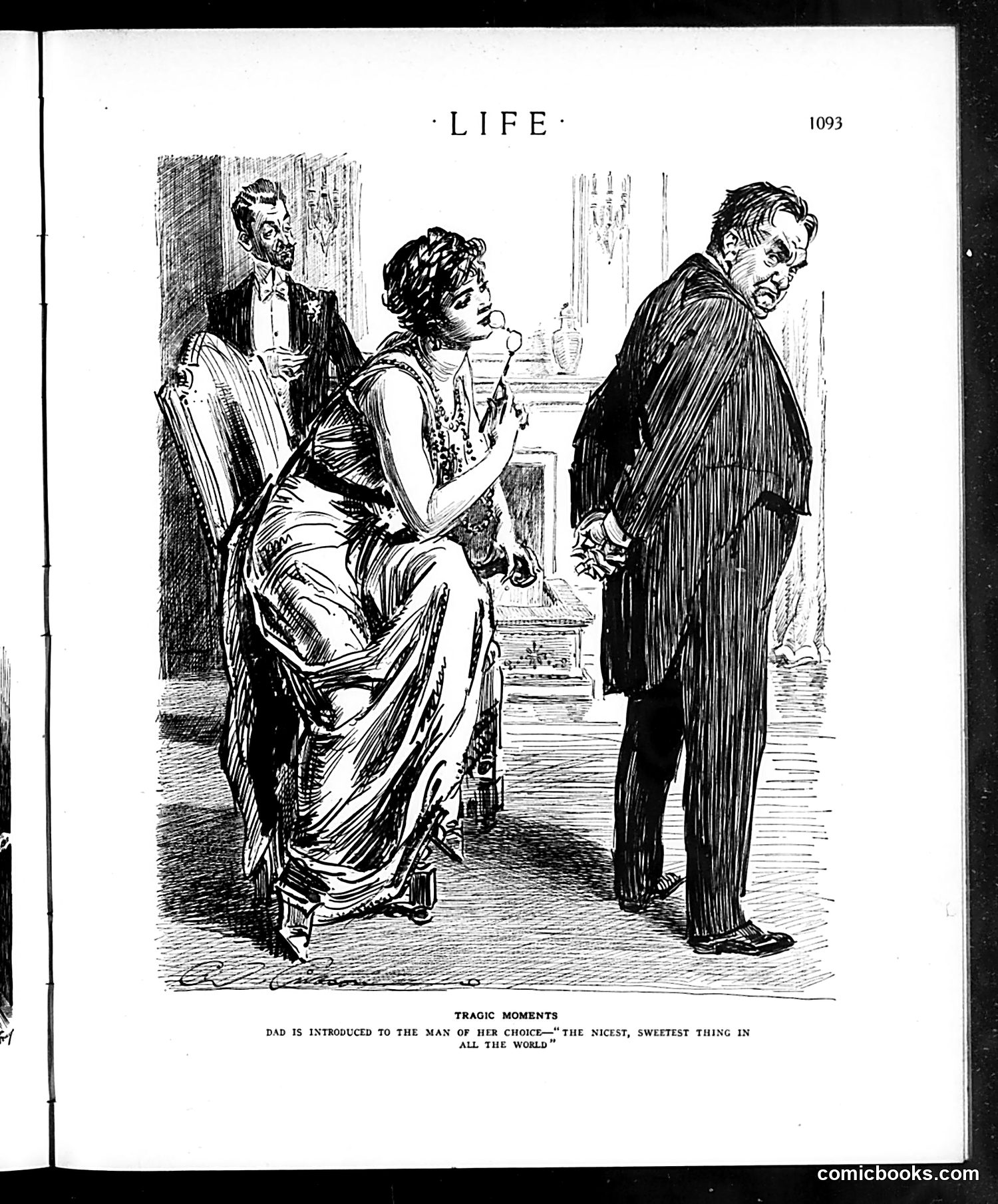
This cartoon depicts a social comedy about introducing a prospective father-in-law. The scene shows a woman seated with a man standing nearby (appearing uncomfortable or awkward), while another man is being introduced to him. The caption suggests the woman's choice of partner is being presented as "the nicest, sweetest thing in all the world." The humor appears to lie in the irony of the situation—the title "Tragic Moments" combined with the awkward body language suggests the introduction is not going as smoothly as the woman's glowing description implies. The man on the right looks distinctly unhappy or disapproving, implying he may not share his daughter's enthusiasm about her choice of partner. This reflects early 20th-century social anxieties about parental approval of romantic matches.
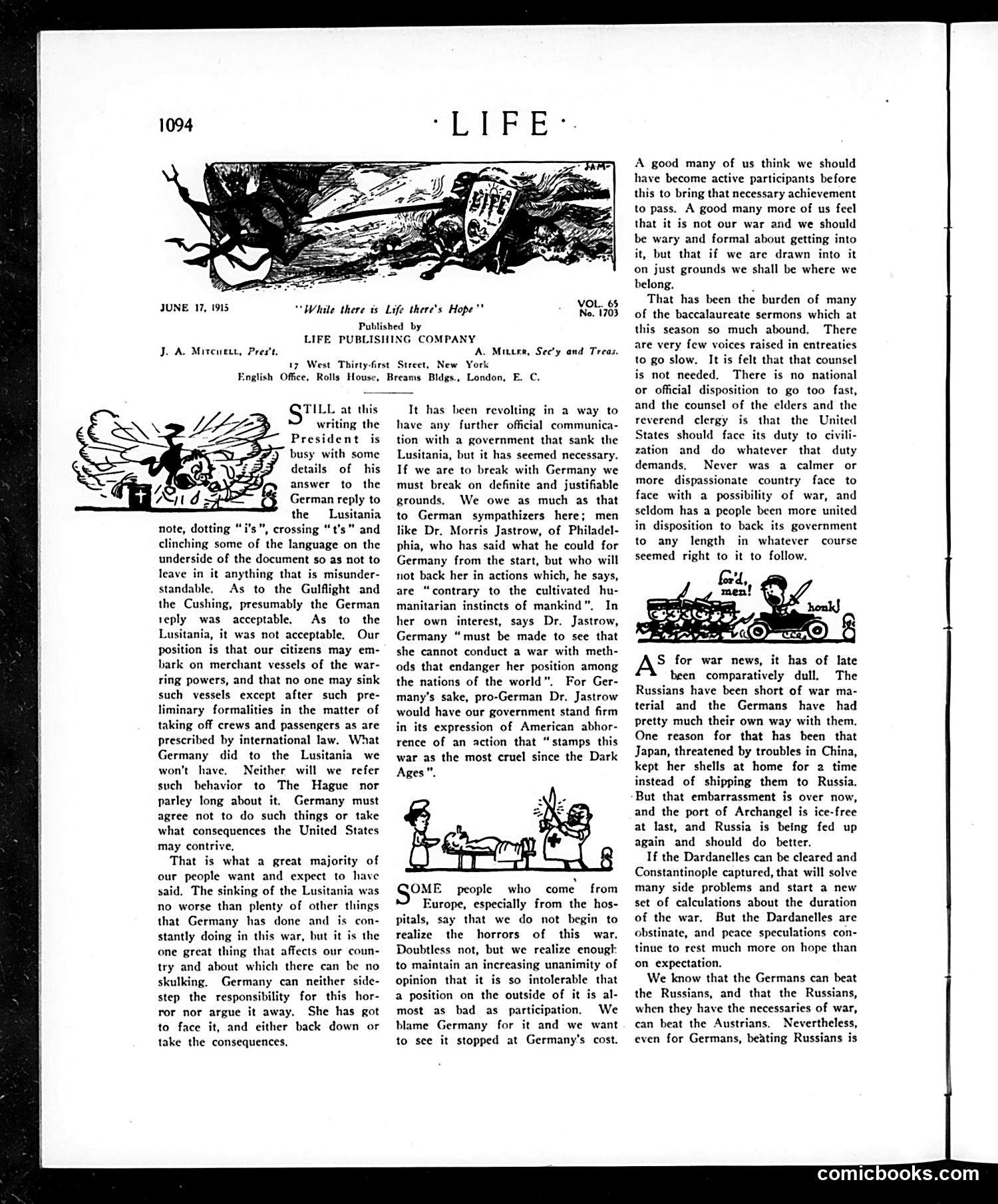
This page addresses the **Lusitania sinking** (May 1915), when a German U-boat torpedoed the British passenger ship, killing nearly 1,200 people including 128 Americans. The editorial argues that President Wilson's diplomatic response is appropriately firm. The author defends negotiating with Germany only to establish clear "justifiable grounds" for potential American intervention—not from moral squeamishness, but to unite American opinion and convince German sympathizers (like the mentioned Dr. Morris Jastrow) that Germany bears responsibility. The cartoon (top left, depicting a corpse) visualizes the human cost of the attack. The piece reflects 1915 American divided sentiment: many felt the war was intolerable yet America shouldn't rush in, but if drawn in "on just grounds," participation would be justified. The tone suggests growing inevitability of U.S. involvement while maintaining diplomatic formality—a position soon overtaken by events (America entered the war in 1917).
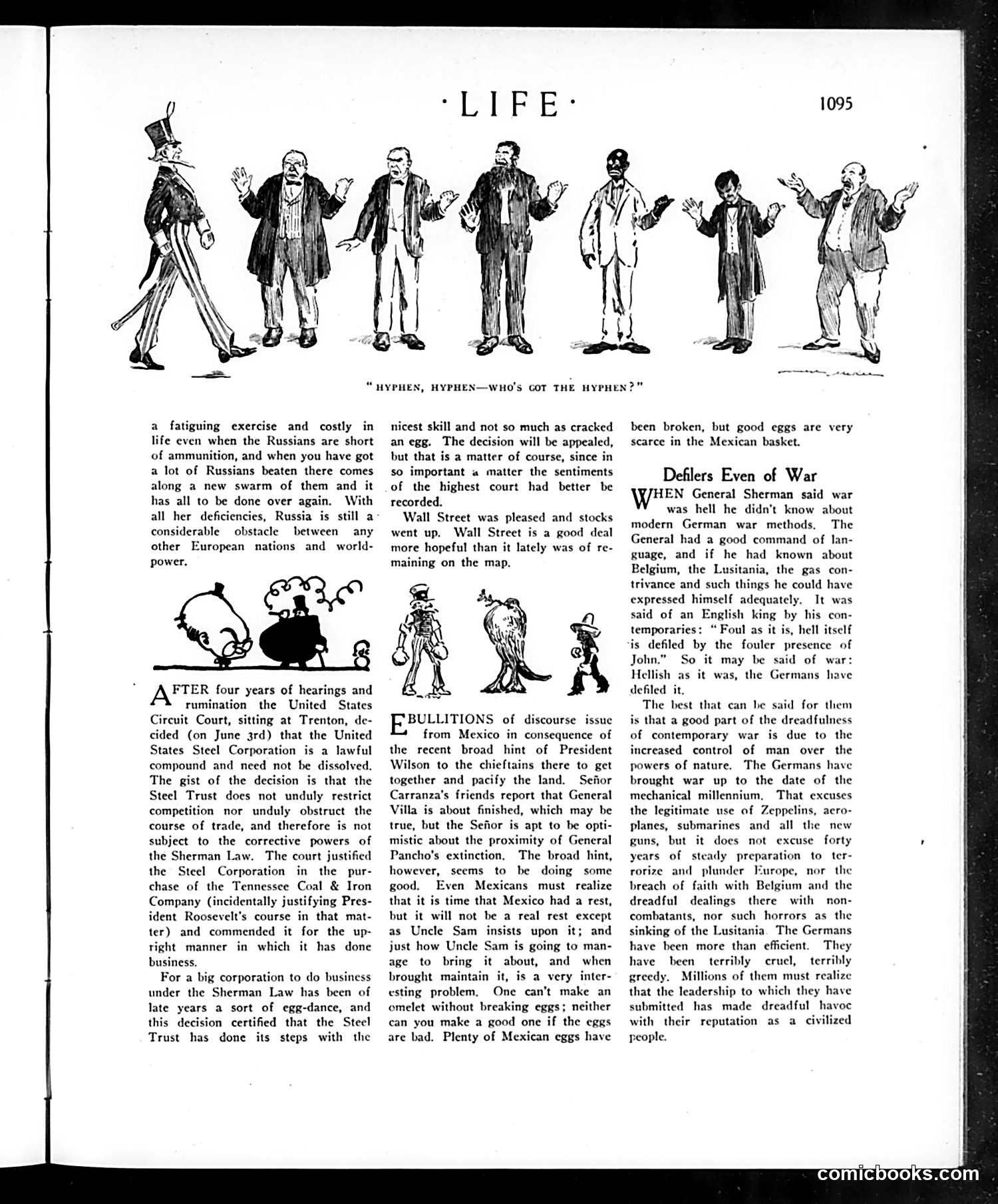
## Top Cartoon: "Hyphen, Hyphen—Who's Got the Hyphen?" The seven caricatured figures represent immigrant or ethnic groups in America during WWI, each gesturing frantically. The "hyphen" refers to identity labels like "German-American" or "Irish-American." The satire mocks the period's heated debate over immigrant loyalties: should Americans with ethnic ties to foreign powers be trusted? The cartoon suggests these groups are desperately claiming or denying hyphenated identities amid wartime suspicion. ## Articles Below **Steel Trust Decision**: Reports a court ruling that the U.S. Steel Corporation isn't a monopoly requiring dissolution—praised as skillfully navigating antitrust law ("egg-dance"). **Mexico/Villa**: Discusses President Wilson's pressure on Mexican factions (Carranza, Villa, Pancho) to achieve peace, using egg-breaking metaphors. **German War Crimes**: Condemns German methods in WWI—Belgium, the Lusitania sinking, poison gas—as exceeding even war's brutality, dwarfing Sherman's "war is hell" statement.
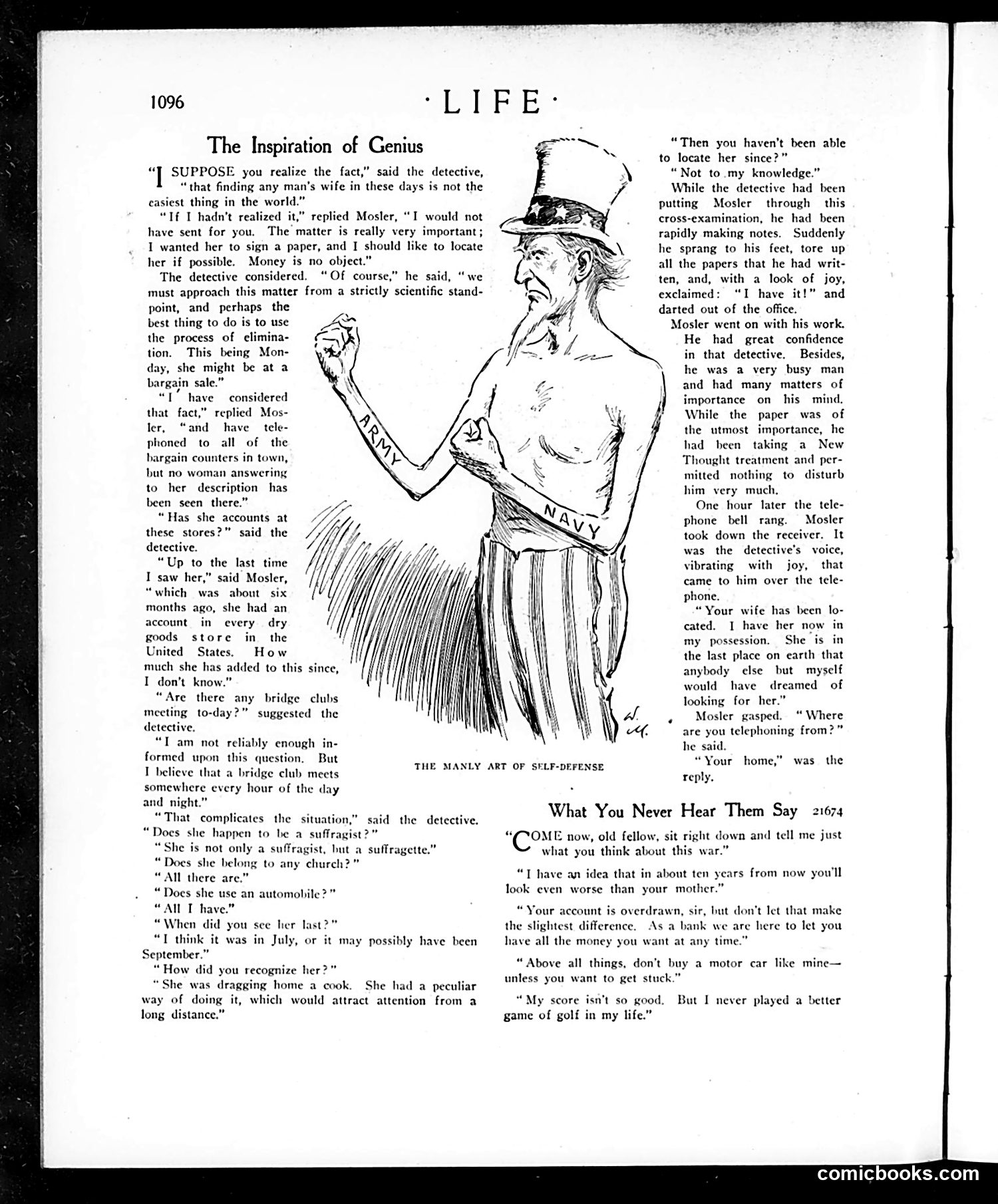
This *Life* magazine page contains two satirical pieces from the early 1900s mocking social conventions of the era. **"The Inspiration of Genius"** (left) ridicules both absent wives and incompetent detectives. The joke: a husband hires a detective to find his wife, who frequents bargain sales, bridge clubs, suffragist meetings, churches, and drives automobiles—essentially depicting the modern woman's busy social life as impossible to track. The detective's "breakthrough" is absurd, suggesting even professional investigators are helpless before female independence. **"What You Never Hear Them Say"** (right) lists sardonic observations—things supposedly never said in polite society. The war reference suggests WWI-era context. The humor derives from social pretense: bankers don't admit they'll lend money freely; golfers don't admit poor scores; people don't honestly criticize others' cars or mothers. Both pieces mock early-20th-century gender dynamics, consumer culture, and social hypocrisy through exaggeration and irony.
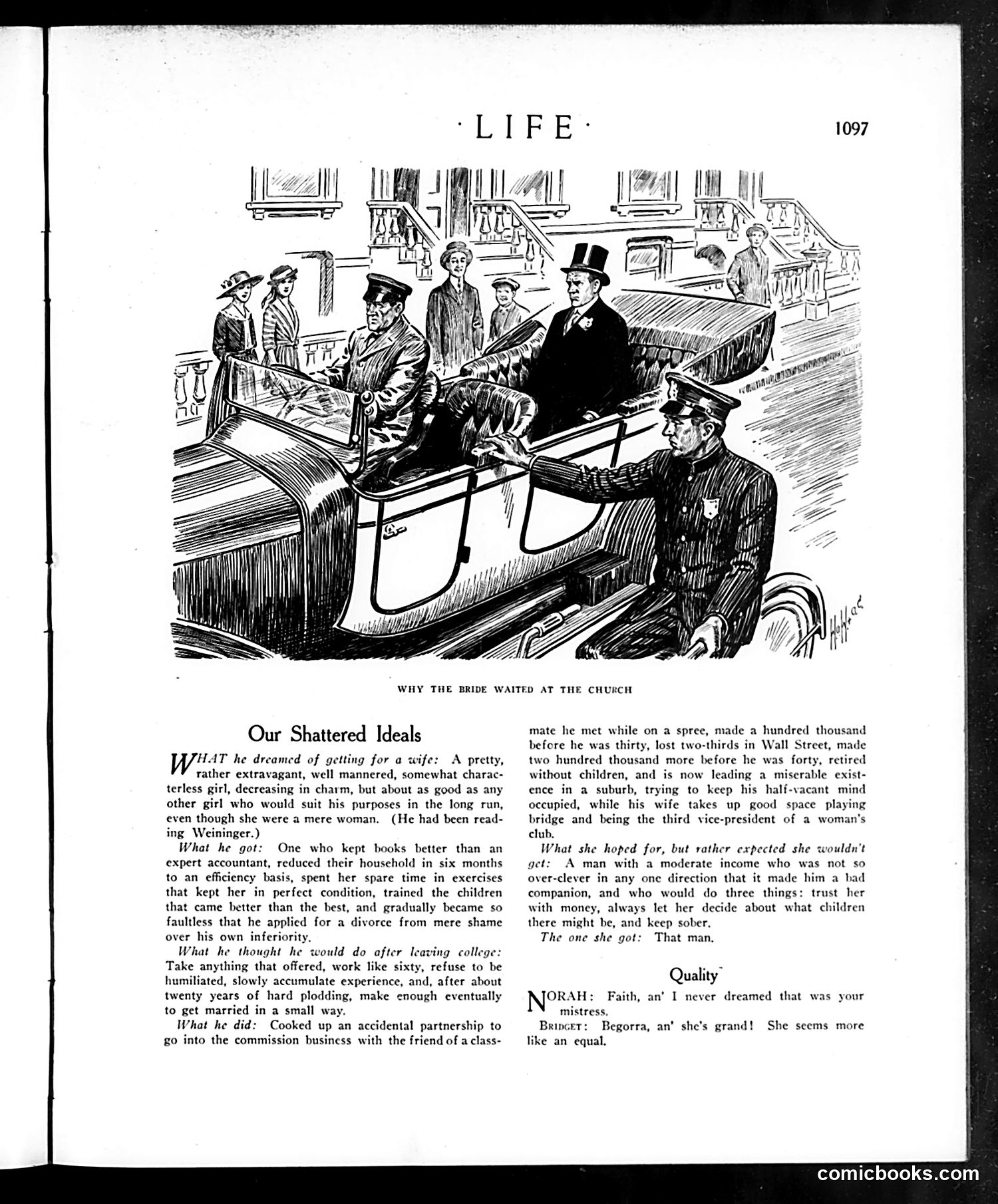
This satirical piece mocks the gap between romantic ideals and married reality. The cartoon titled "Why the Bride Waited at the Church" depicts a bride refusing to proceed with her wedding, illustrated by a carriage scene at what appears to be a church entrance. The text presents four parallel narratives of "shattered ideals"—what husbands and wives expected versus what they actually got in marriage. The satire shows how both partners' expectations proved unrealistic: the man wanted a decorative but competent wife but got an overachieving woman who made him feel inferior; the woman wanted a modest, trustworthy man and actually got exactly that, yet it left her unfulfilled. The dialogue at bottom, featuring Irish characters (indicated by "Begorra" and Irish-inflected speech), appears to comment on class dynamics—a working-class man's surprise that the refined woman is actually the employer's wife, suggesting social mobility tensions. The overall message critiques how modern marriage disappoints both parties: ambition, efficiency, and material success replace romantic connection.
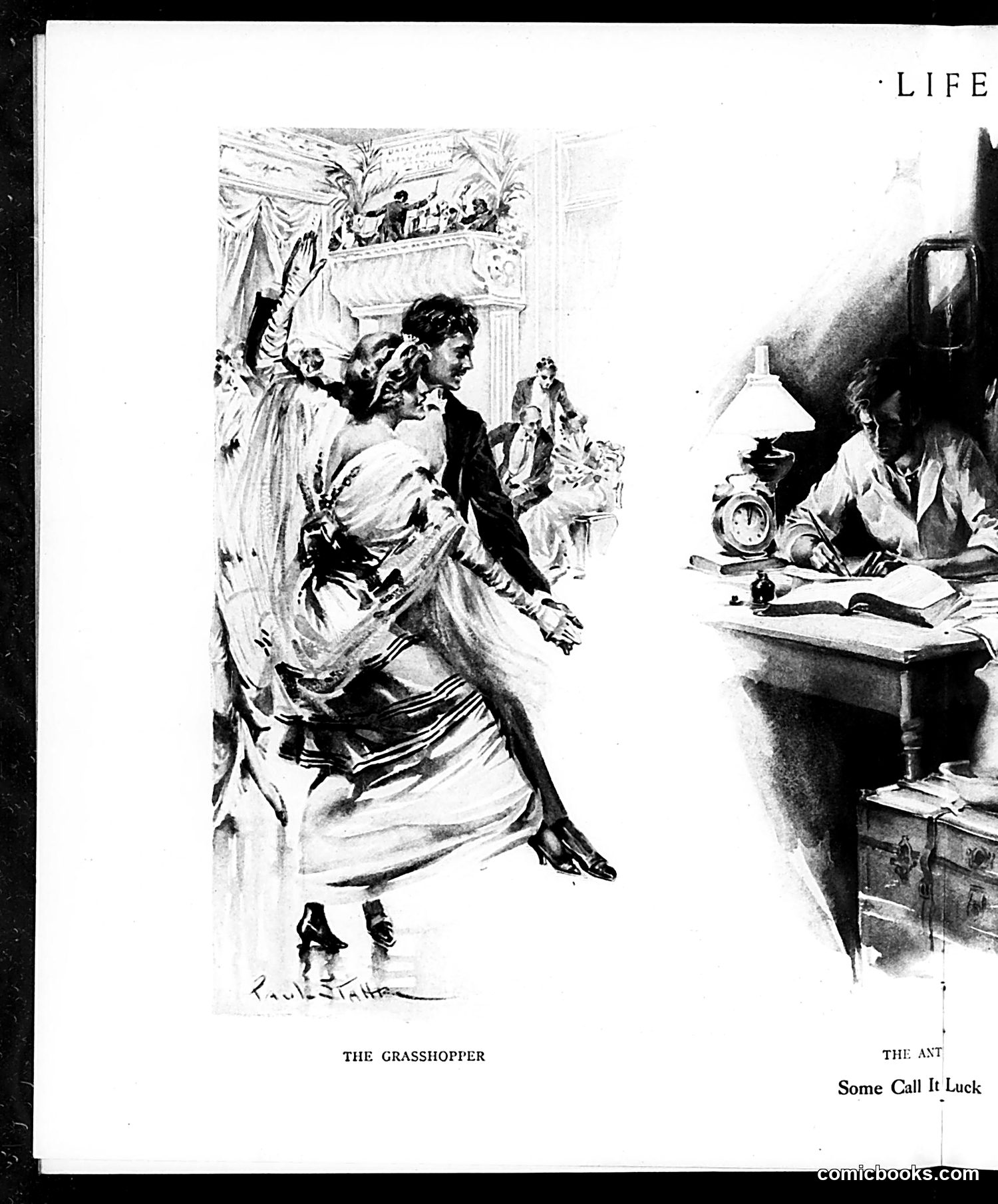
This page presents two contrasting illustrations referencing Aesop's fable "The Ant and the Grasshopper." **Left ("The Grasshopper"):** A well-dressed couple enjoys a lavish party with decorative drapes and balcony spectators—depicting carefree leisure and pleasure-seeking. **Right ("The Ant"):** A figure works diligently at a desk with lamp, clock, and papers—depicting industrious labor and responsibility. The caption "Some Call It Luck" suggests satirical commentary on wealth disparity and life outcomes. The cartoon implies that one person's success versus another's struggle isn't purely merit-based ("luck"), but rather reflects different choices between indulgence and hard work. This reflects early 20th-century American anxieties about class mobility, work ethic, and whether prosperity was earned or fortunate. The fable's moral—industriousness rewarded, idleness punished—is invoked to comment on contemporary social divisions.
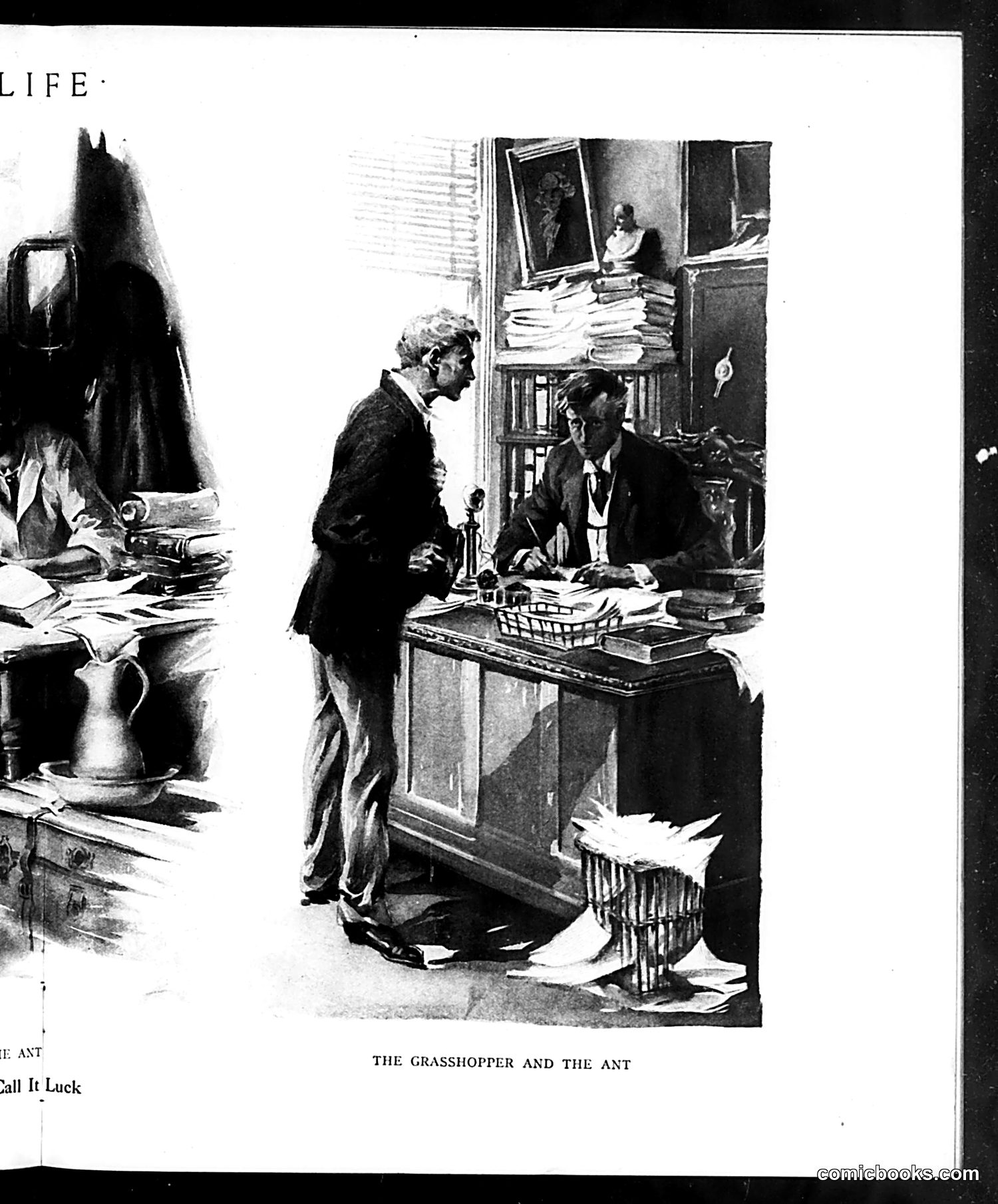
This appears to be an illustration of Aesop's fable rather than contemporary political satire. The image shows two men in an office or shop setting: one (standing, appearing disheveled) represents the "grasshopper"—the improvident character who failed to prepare; the other (seated, more composed) represents the "ant"—the industrious, organized figure. The scene depicts the grasshopper seeking help from the ant after squandering resources through idleness. Papers and books are scattered throughout the cluttered workspace, emphasizing disorganization versus order. The moral lesson—that industry and foresight lead to security while idleness leads to hardship—was a common satirical vehicle in early-20th-century American magazines for commentary on work ethic, financial responsibility, and class differences.
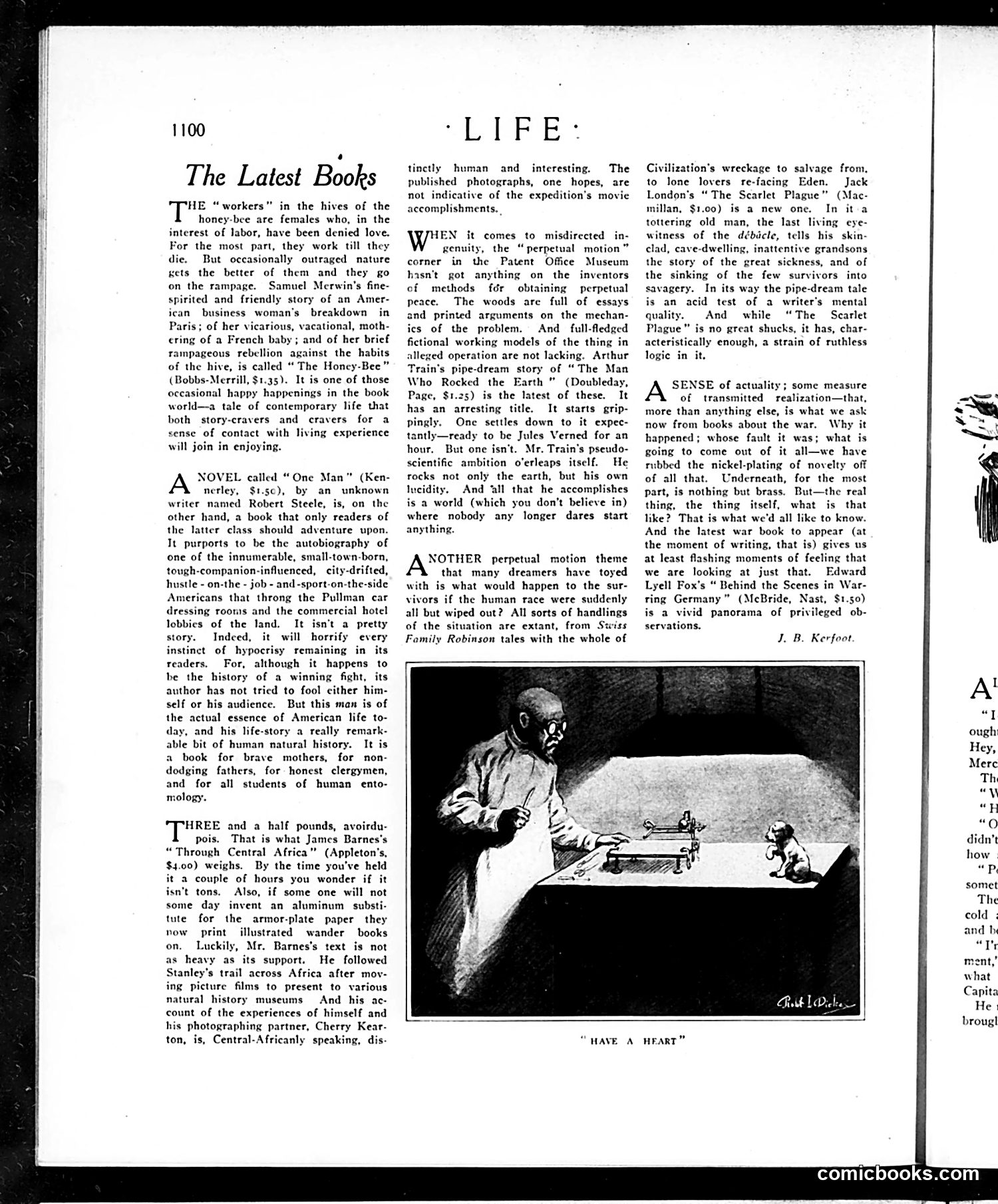
The illustration depicts an elderly man operating what appears to be a mechanical device or machine at a workbench, while a small child watches from the side. The caption reads "HAVE A HEART." **Context and Meaning:** This appears to be social commentary on industrialization and its human cost. The cartoon likely critiques the dehumanizing effects of machinery and factory work—themes central to early 20th-century Progressive Era concerns. The juxtaposition of the child observer suggests commentary on generational impact or the moral implications of mechanization. The phrase "Have a Heart" is an appeal for compassion or humanity, implying the machine-operator (or those promoting industrial progress) lack sympathy for human welfare. This aligns with the page's book reviews discussing labor conditions ("workers" in hives denied love, working until death) and the "actual essence of American life"—harsh industrial realities. The cartoonist (signed, though signature is unclear) uses the mechanical device as a metaphor for cold industrial progress at odds with human needs and dignity.
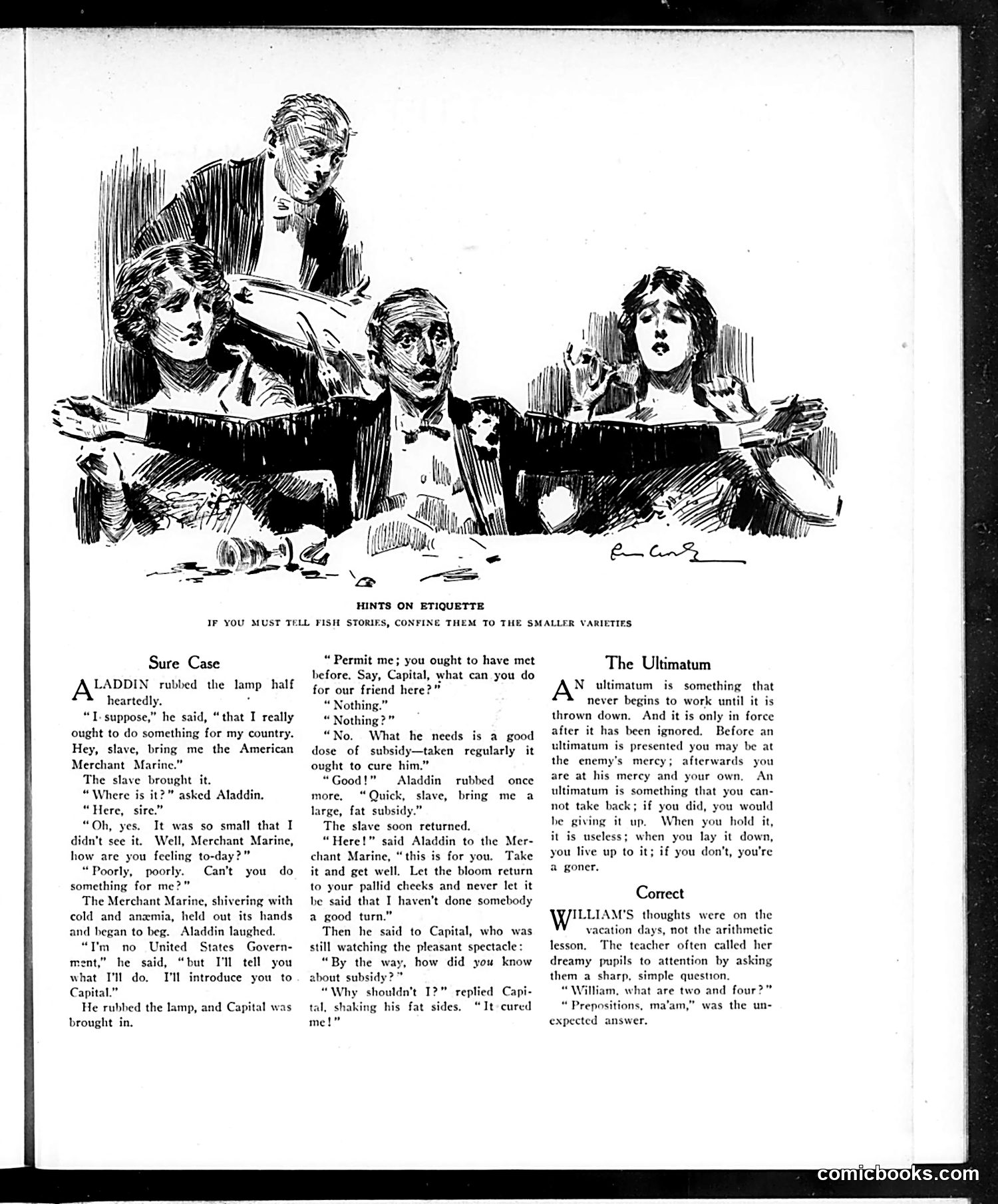
This satirical page uses Aladdin as a vehicle to mock American economic policy, specifically government subsidies to the struggling Merchant Marine industry. **The Main Cartoon** ("Sure Case"): Aladdin represents the government. The "American Merchant Marine"—depicted as sickly and weak—seeks help. Capital (personified as wealthy and well-fed) refuses direct aid but suggests "subsidies" as a cure. When Capital is asked how it knows about subsidies, it reveals the bitter joke: subsidies previously enriched Capital itself at the public's expense. The satire criticizes how government handouts benefit wealthy interests rather than genuinely helping struggling industries. **The Etiquette Header** warns against exaggerating fish stories—a winking reference to the "tall tales" of government economic solutions. **"The Ultimatum" and "Correct"** are separate, lighter humor pieces unrelated to the main political cartoon. The page reflects early 20th-century American debates over protectionist policies and government intervention in business.
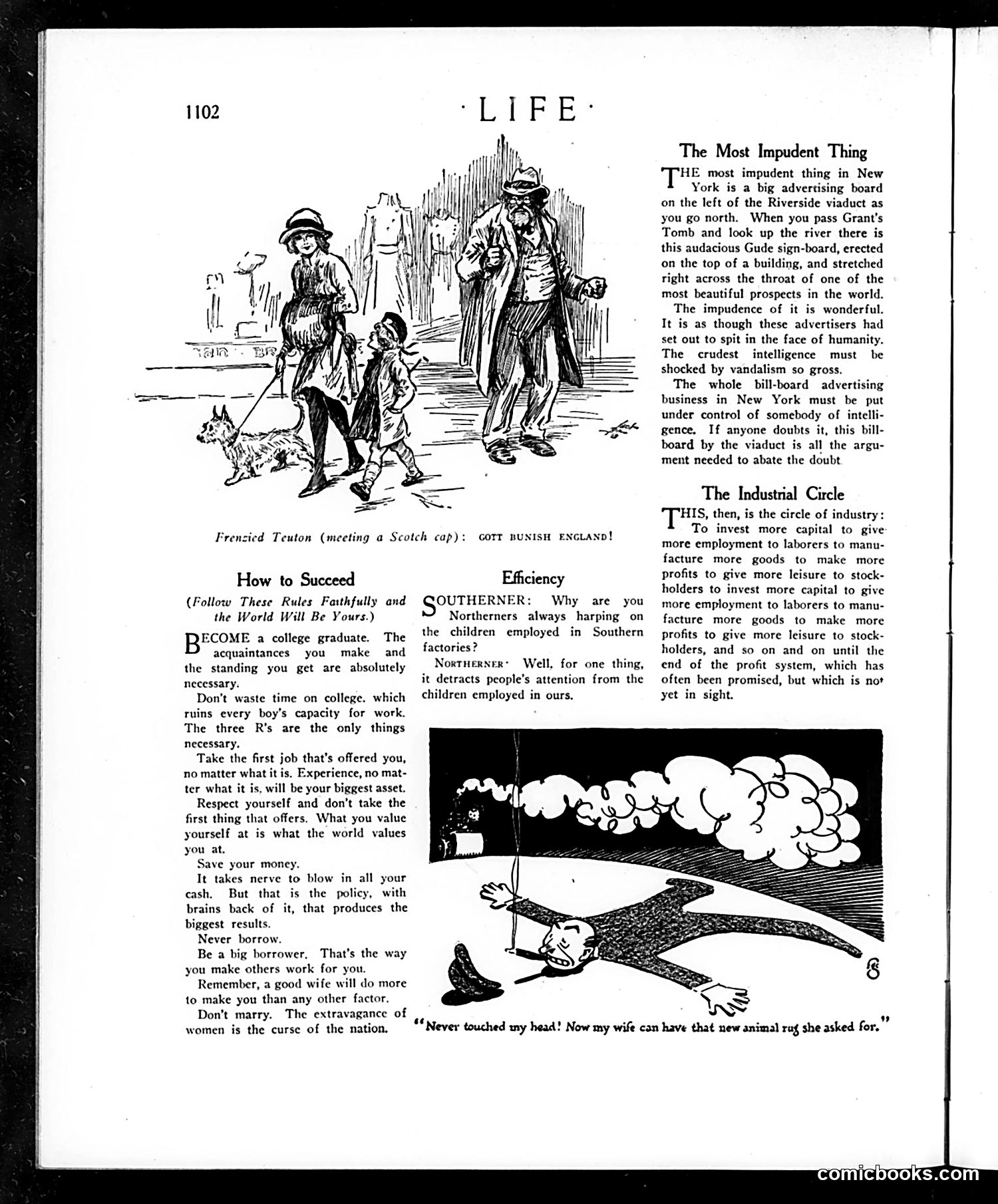
This page contains three satirical pieces critiquing American society circa early 20th century: **"How to Succeed"** presents contradictory advice—deliberately pairing opposite statements (get/don't get a college education; save/borrow money; marry/don't marry)—to mock self-help literature's hollow platitudes. The satire suggests such advice is inherently contradictory and useless. **"Efficiency"** jokes about North-South hypocrisy: when a Southerner defends child labor in Southern factories, the Northerner admits the North employs children too—exposing mutual moral failure rather than genuine concern. **The cartoon caption** "Frenzied Teuton" (German) meeting a Scotsman saying "GOTT BUNISH ENGLAND!" appears to reference World War I tensions, likely mocking German-British antagonism. **"The Industrial Circle"** critiques capitalism's cyclical logic as self-perpetuating and ultimately hollow—capital begets labor begets goods begets profit begets more capital, "until the end of the profit system...which is not yet in sight," suggesting the system never truly fulfills its promises.
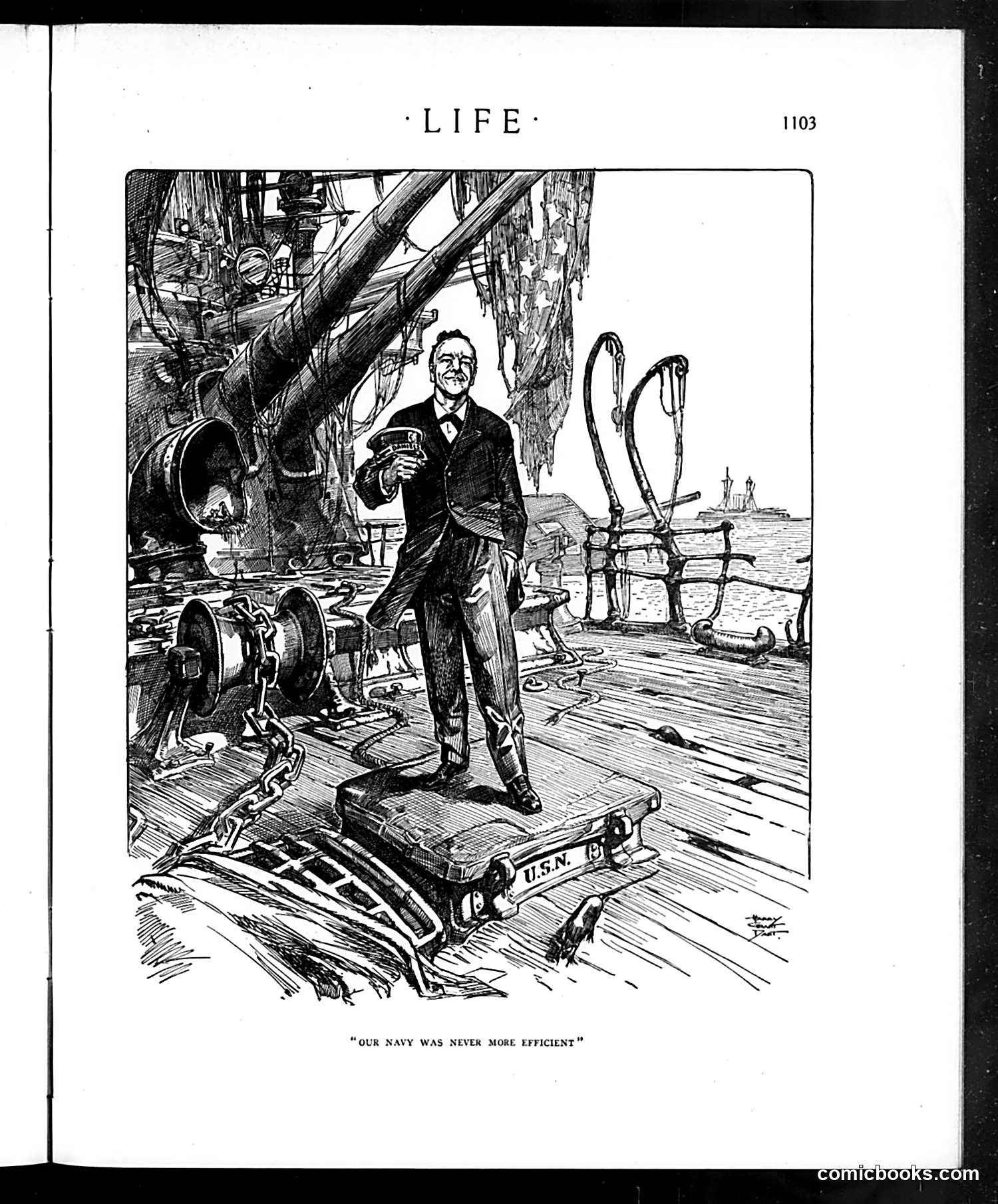
This Life magazine cartoon depicts a well-dressed man standing confidently on a U.S. Navy equipment cart aboard a warship. The caption reads "OUR NAVY WAS NEVER MORE EFFICIENT." The satire appears to work through ironic contrast: the figure's proud demeanor and formal attire seem incongruous with the chaotic naval setting behind him—visible machinery, rigging, and what appears to be a distant warship on the horizon. The joke likely critiques naval administration or leadership during a specific period (the cartoon's style suggests early-to-mid 20th century), suggesting that while officials claim efficiency improvements, operational reality tells a different story. Without additional context about the publication date or specific naval events referenced, the exact target remains unclear, though it appears to mock claims of military modernization or administrative competence.
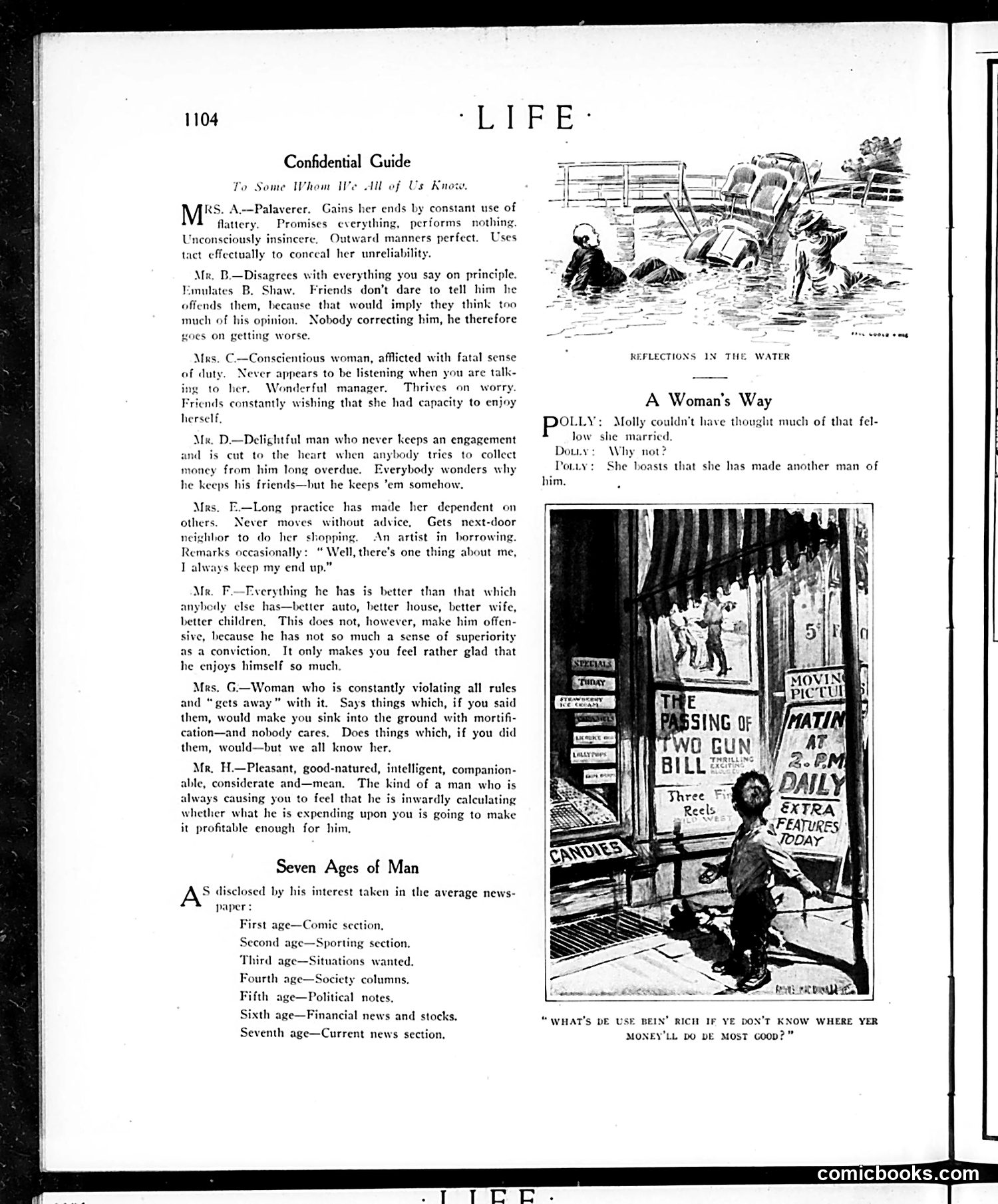
This page contains two distinct pieces of social satire typical of Life's early 20th-century format: **"Confidential Guide"** presents eight character types (Mrs. A through Mr. H) representing common social personalities—the flatterer, contrarian, obsessive-duty woman, unreliable man, dependent borrower, braggart, rule-breaker, and calculating miser. These are broad satirical sketches of recognizable social archetypes meant to entertain through recognition. **"Seven Ages of Man"** cleverly parallels Shakespeare's famous monologue, but instead tracks a man's life through newspaper-reading habits: from comics (youth) through sports, job-hunting, society news, politics, and finance, ending with current events (old age). It's a humorous commentary on how newspapers reflect life stages and priorities. **"A Woman's Way"** presents a brief joke about marriage: a woman boasts she's "made another man" of her husband, implying she's fundamentally changed him—which the conversation frames as evidence she didn't think much of him initially. The street scene cartoon at bottom depicts an impoverished child questioning the value of wealth without knowing how to use it wisely.
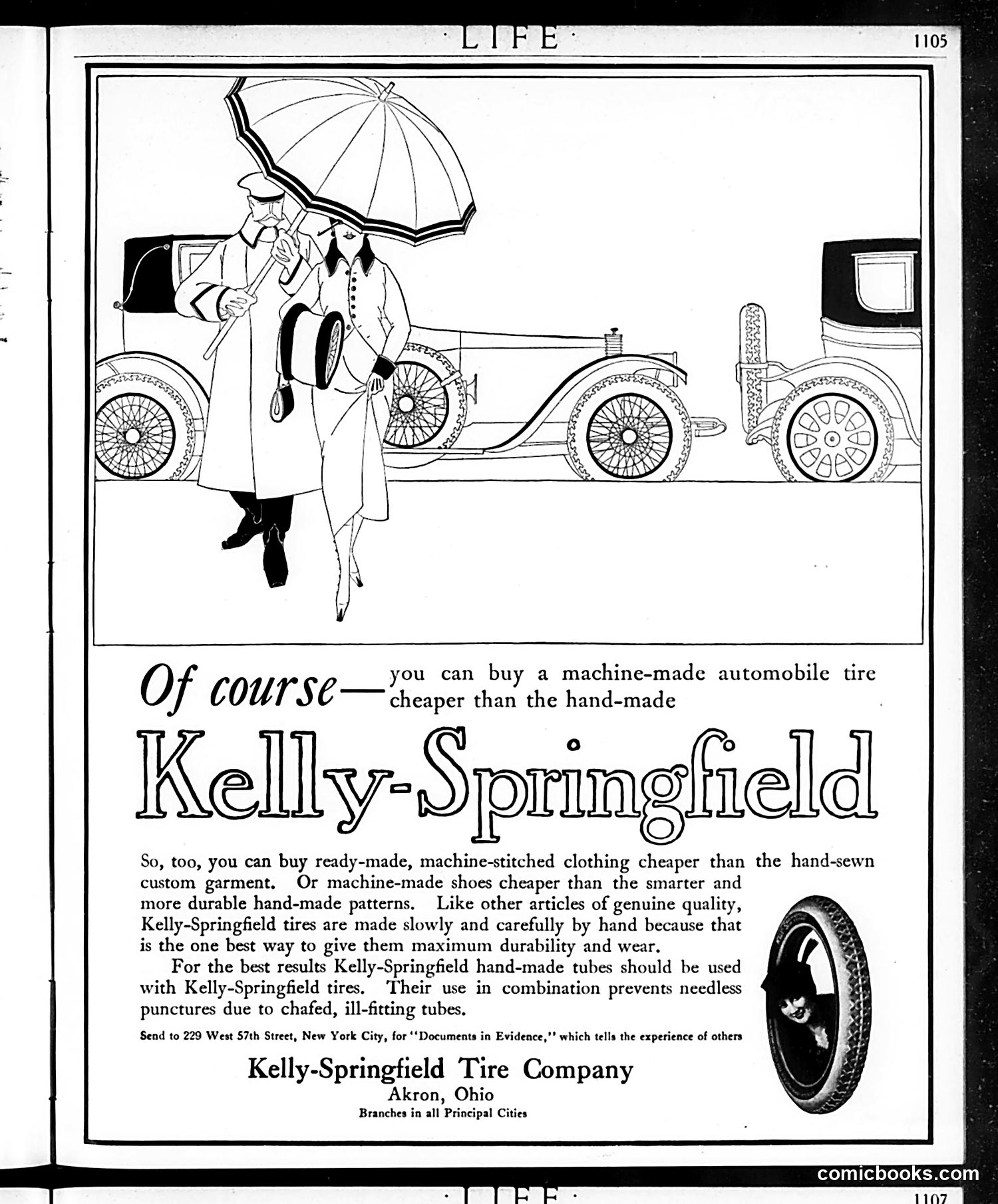
This is a **Kelly-Springfield Tire Company advertisement**, not political satire. The illustration shows a well-dressed man with an umbrella standing before parked automobiles, establishing an upscale consumer context. The ad's argument is paradoxical: it acknowledges that machine-made products (tires, clothing, shoes) are cheaper than hand-made equivalents, *but* claims Kelly-Springfield tires are superior *because* they're hand-made. The copywriter argues that genuine quality requires slow, careful hand-craftsmanship for "maximum durability and wear"—not cost savings. This reflects early 20th-century manufacturing debates: industrial production promised affordability but faced consumer skepticism about quality. The ad positions Kelly-Springfield as offering premium hand-crafted goods despite mass-manufacturing competition, appealing to consumers willing to pay more for durability and reliability.
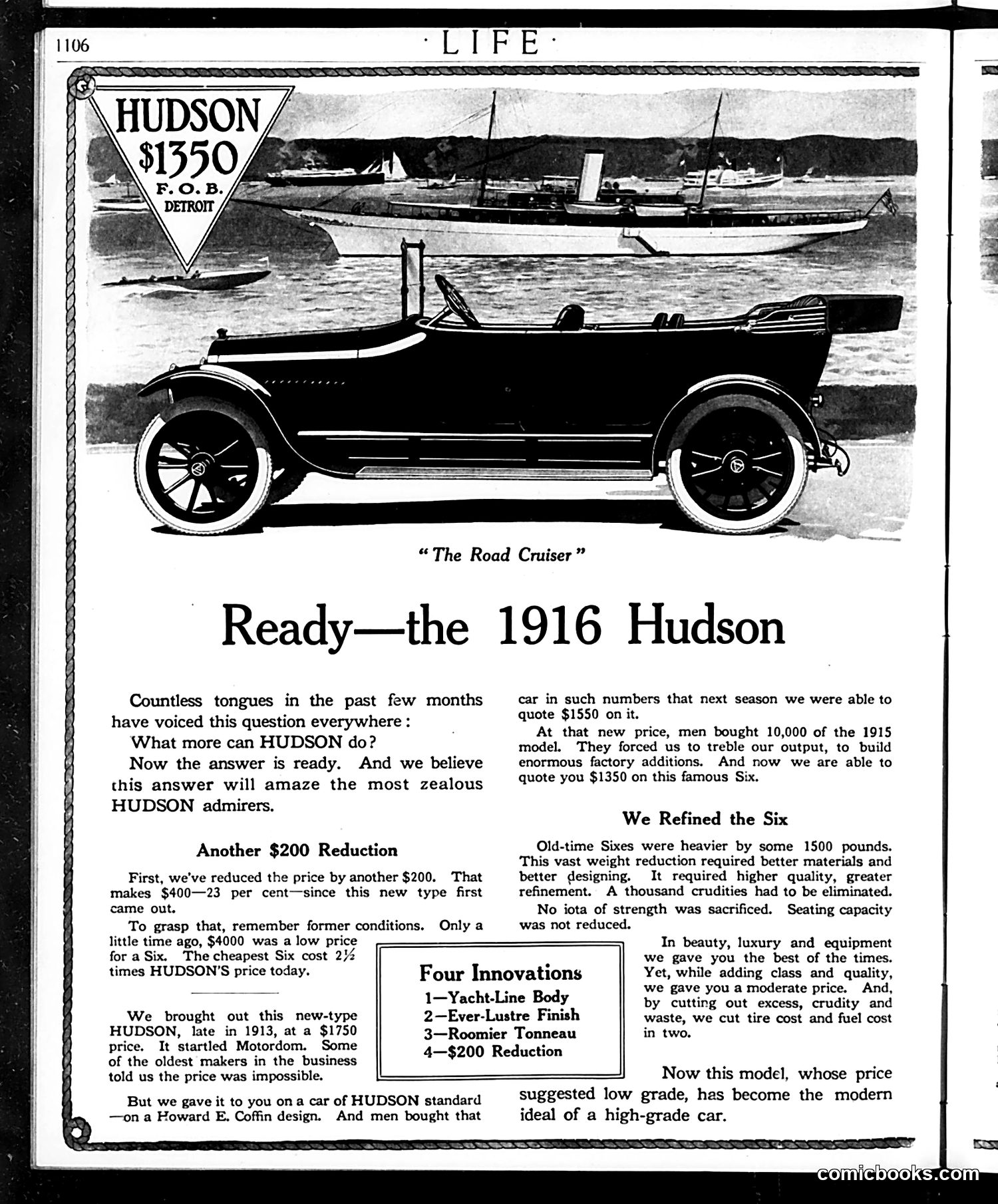
This is **not a cartoon but an automobile advertisement** appearing in Life magazine (circa 1916). It promotes the Hudson motor car, specifically the 1916 model priced at $1,350. The ad emphasizes price reduction and engineering improvements to appeal to middle-class buyers. Key selling points include: - A $200 price cut (making it $400 cheaper since introduction) - Weight reduction of 1,500 pounds without sacrificing strength - Four innovations: yacht-line body, durable finish, spacious interior, and affordability - Attribution to designer Howard E. Coffin as a mark of quality The background image shows boats, positioning the vehicle as suitable for leisure and travel. The ad's rhetorical strategy—"What more can HUDSON do?"—uses question-and-answer format to highlight competitive advantages during the early automobile industry's rapid development. This reflects 1910s consumer culture when cars were transitioning from luxury items to mass-market products.
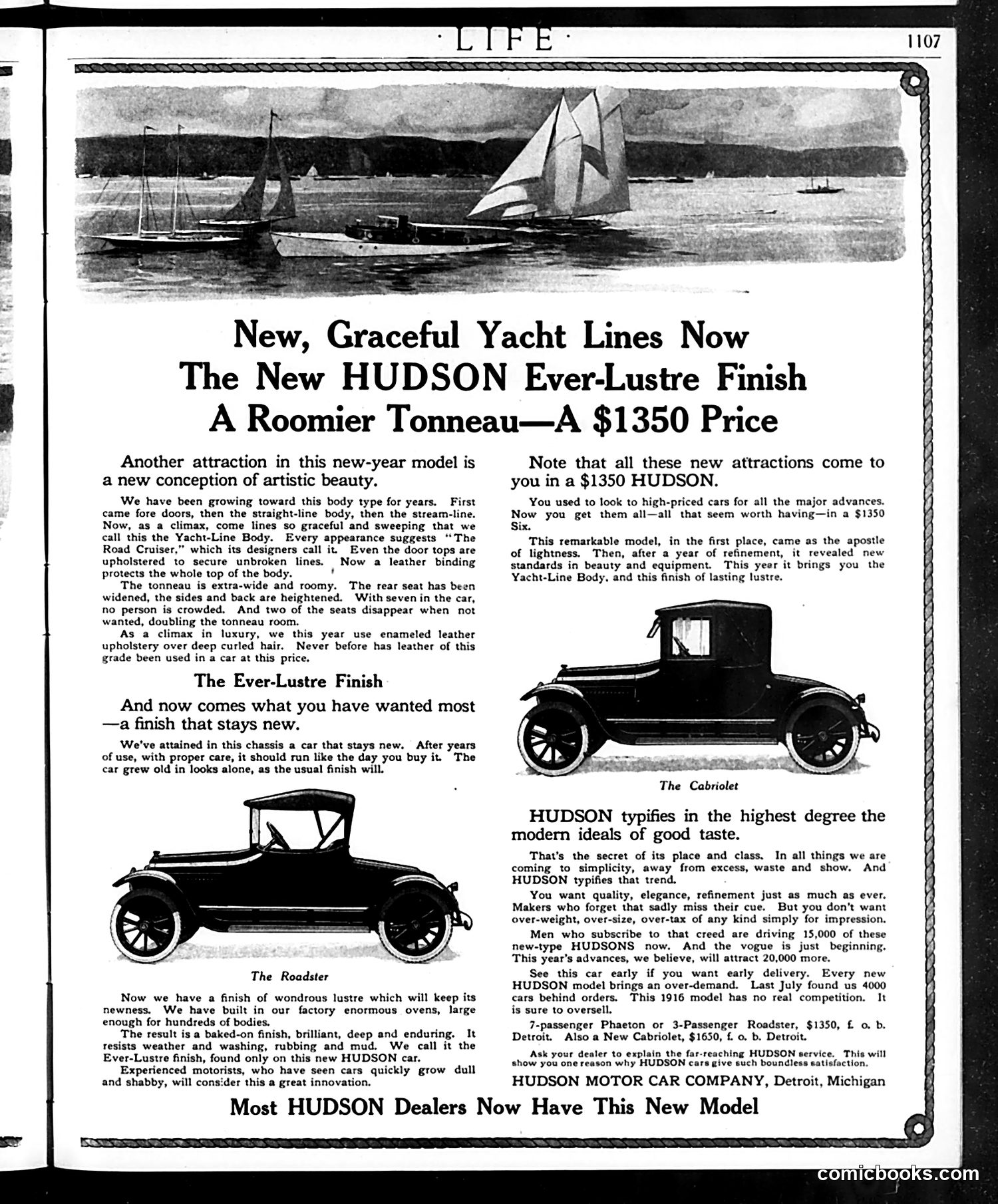
This is **not a political cartoon or satire**—it's a straightforward commercial advertisement for Hudson automobiles from *Life* magazine (page 1107). The page advertises the 1916 Hudson models, emphasizing three main selling points: the new "Yacht-Line Body" design (inspired by yacht aesthetics for a graceful appearance), the innovative "Ever-Lustre Finish" (a durable, baked-on paint that resists weathering), and a competitive $1,350 price point that democratizes luxury features previously found only in expensive cars. The advertisement uses aspirational language typical of the era, comparing the Hudson to high-end vehicles while claiming superior value. Images show two models: the Roadster and Cabriolet. The copy targets "experienced motorists" seeking quality without ostentation—reflecting early 20th-century marketing emphasis on restraint and practicality alongside elegance. This reflects genuine automotive innovation of the period, not satire.
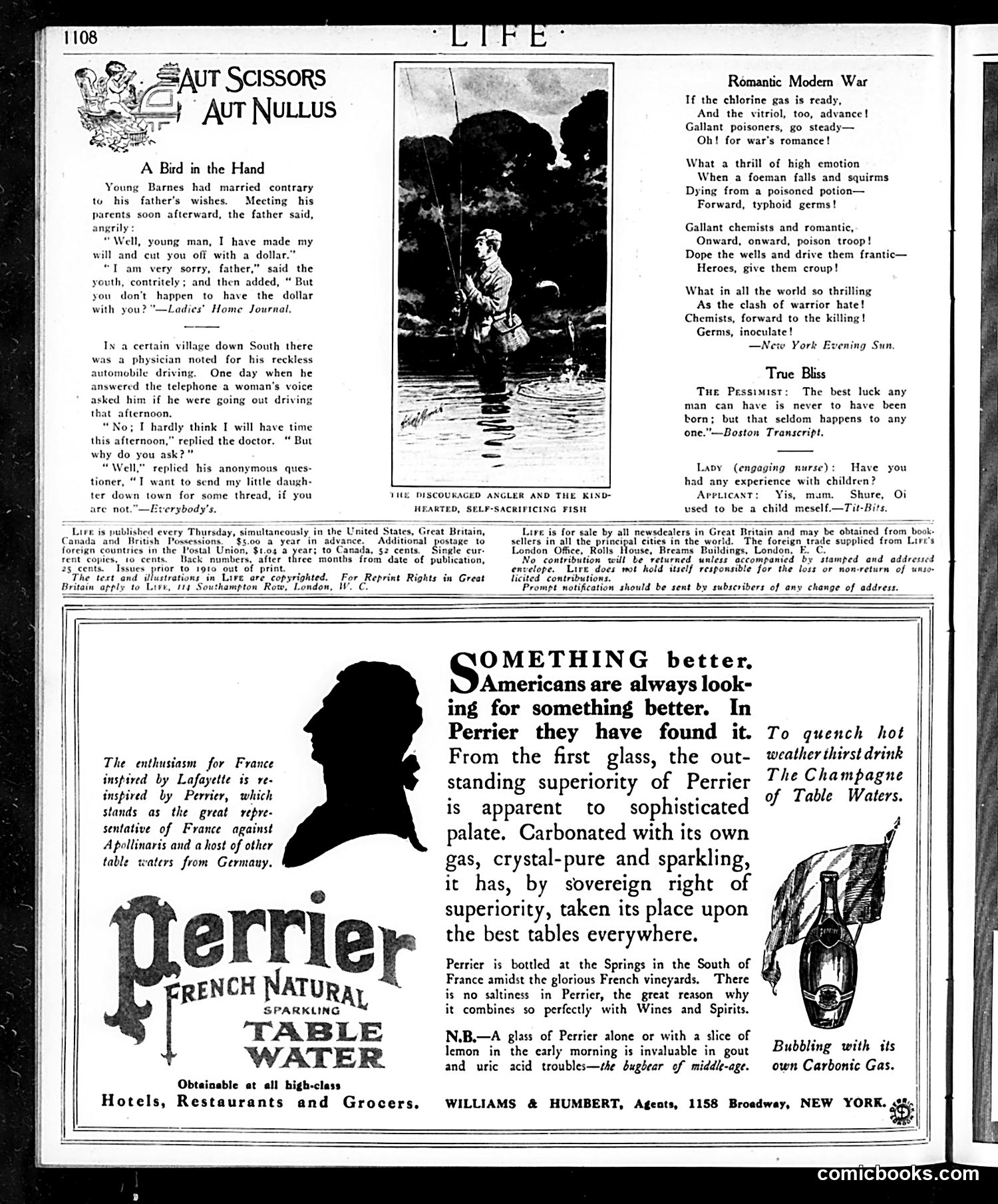
This page contains several satirical pieces typical of Life's style: **"A Bird in the Hand"** presents two humorous anecdotes about people's financial concerns—a son cut off with a dollar asking to borrow it immediately, and a doctor receiving a suspicious phone call. **"Romantic Modern War"** is sharp anti-war satire mocking the mechanization of modern warfare. Published during or near WWI, it sarcastically celebrates poison gas, chemical weapons, and disease as instruments of war, inverting traditional notions of martial honor. The poem condemns modern combat's dehumanizing reliance on chemistry rather than courage. **"True Bliss"** offers cynical observations about luck and child-rearing. **The cartoon** (bottom) depicts a fisherman who has caught a fish but appears reluctant to keep it—representing kindheartedness or self-sacrifice. The **Perrier advertisement** emphasizes French superiority, appealing to American consumer aspirations while subtly promoting French goods over German competitors (referencing "Apollinaris," a German water brand)—reflecting wartime nationalist sentiment.
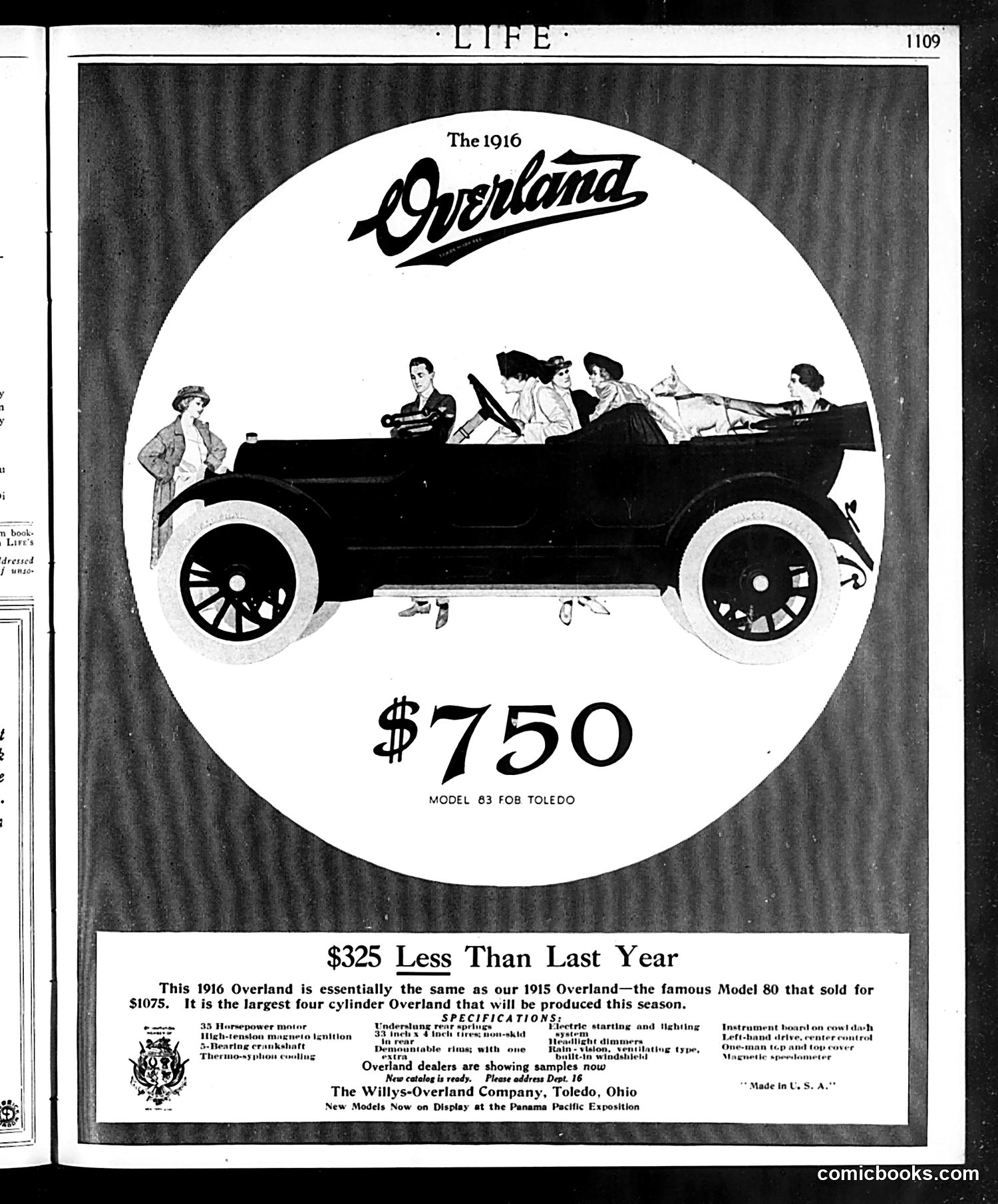
This is **not a political cartoon or satire**—it's a straightforward automobile advertisement from *Life* magazine (1916). The image advertises the Overland Model 63, priced at $750, marketed as "$325 Less Than Last Year." The illustration shows a fashionable group of men and women in an open-air motorcar, depicting the aspirational lifestyle associated with car ownership in the early automotive era. The ad emphasizes that this 1916 model is essentially identical to the previous year's Model 80 (which cost $1,075), highlighting the manufacturer's ability to reduce prices while maintaining quality. Technical specifications are listed, and the ad notes that dealers have samples available and that the car is displayed at the Panama Pacific Exposition. This represents early-20th-century consumer marketing: using stylish imagery and price comparison to appeal to middle-class buyers entering the automobile market.
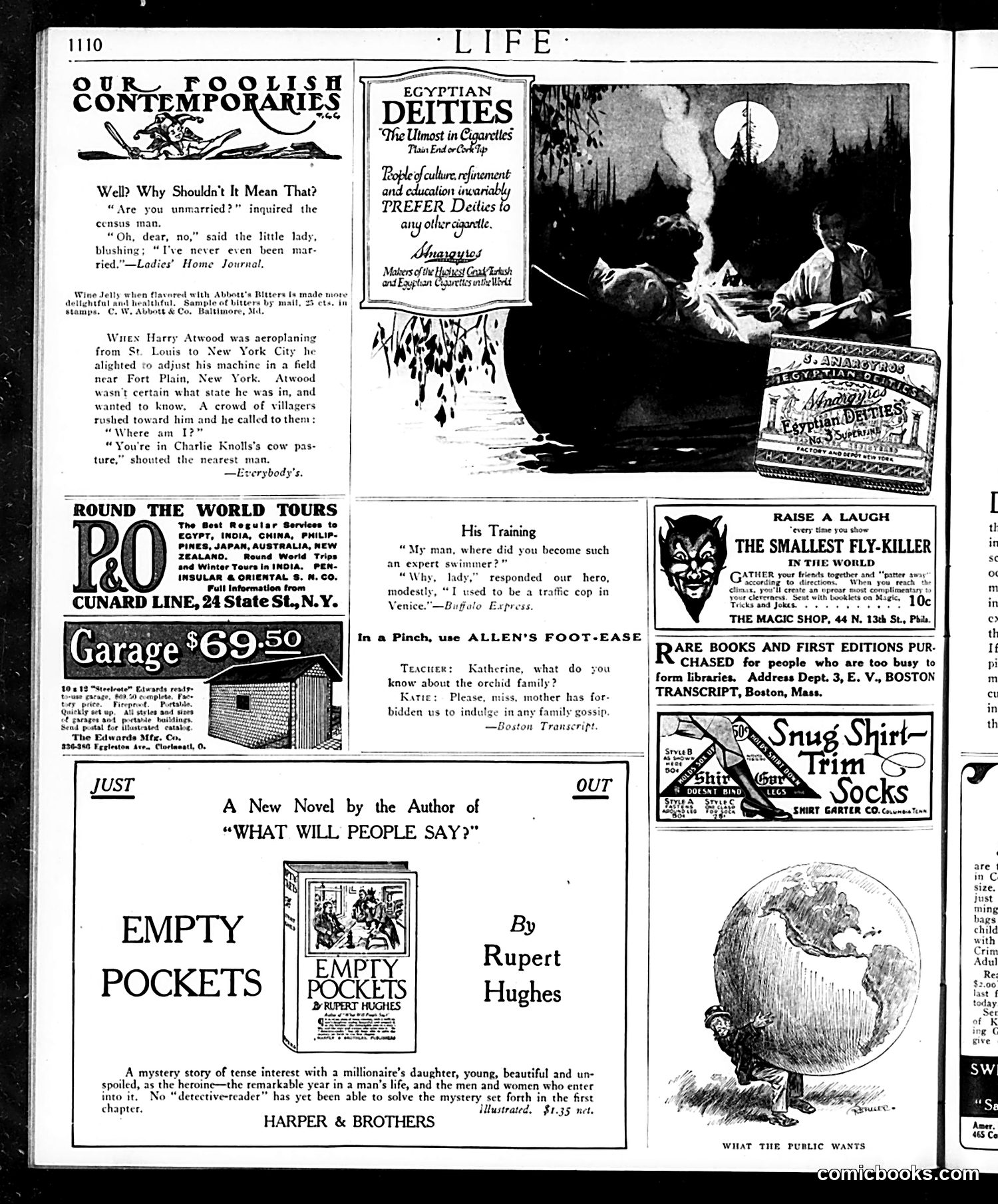
This page from Life magazine (circa early 1900s) is primarily **advertising and book promotion**, with satirical humor sections. The main "foolish contemporaries" section contains three brief jokes mocking everyday absurdities: 1. **Census confusion**: A woman tells the census-taker she's never been married while being unmarried—wordplay on the phrase "married life." 2. **Aviation confusion**: Aviator Harry Atwood, landing near Fort Plain, New York, asks villagers his location. They respond by naming a local farm owner's cow pasture, not the state—satirizing rural imprecision. 3. **Swimming expertise**: A woman asks a man about his swimming skills; he claims experience as a "traffic cop in Venice"—likely referencing Venice's canals humorously. The page contains numerous product advertisements (Egyptian Deities cigarettes, Allen's Foot-Ease, Snug Shirt-Trim Socks) and announces a new novel "Empty Pockets" by Rupert Hughes. These jokes reflect gentle, turn-of-century American humor mocking urban-rural cultural gaps and everyday confusion.
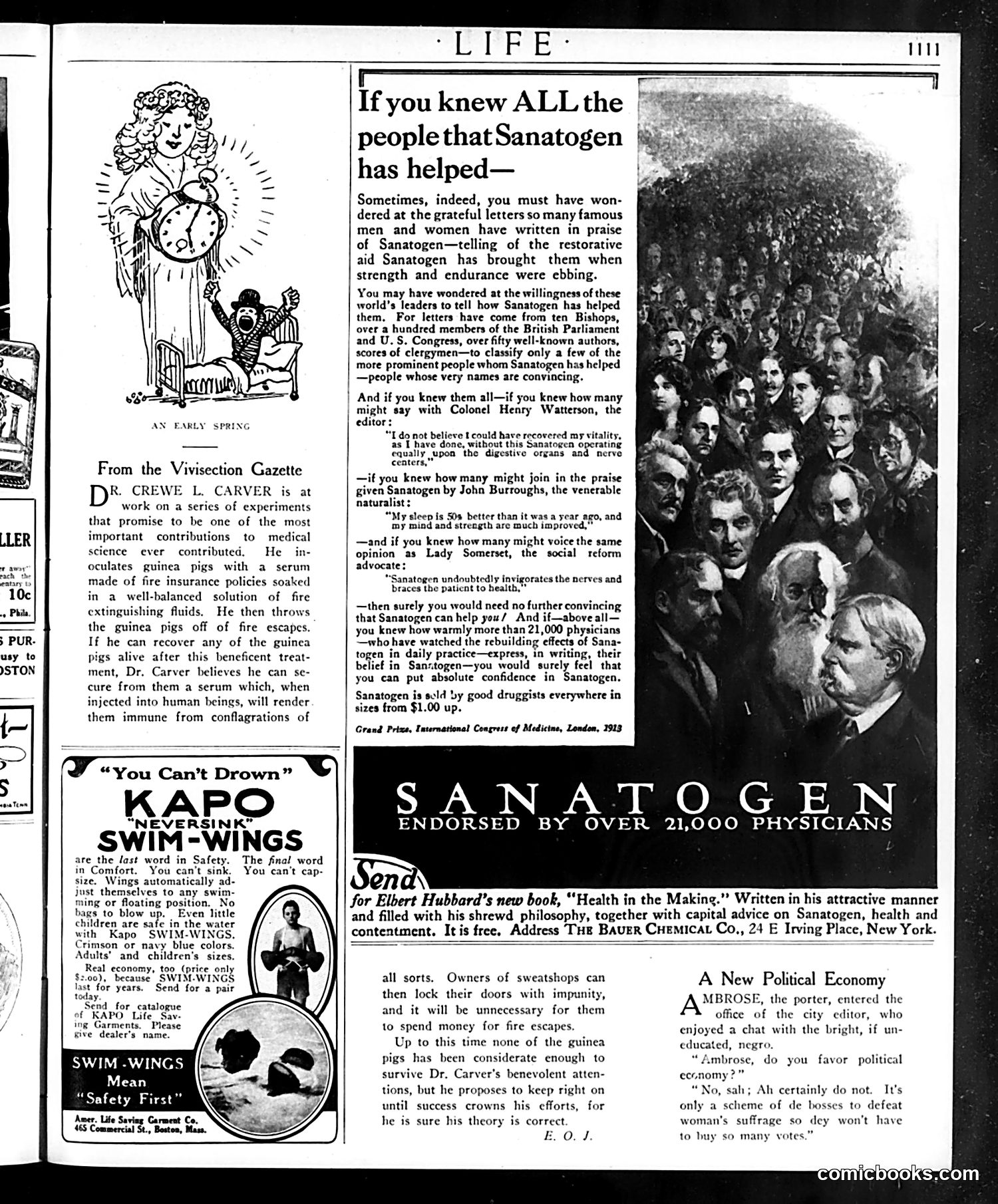
This page contains early 20th-century advertisements and satirical content. **The "Vivisection Gazette" Cartoon** (left): A dark satire mocking medical experimentation. It describes Dr. Crewe L. Carver injecting guinea pigs with fire insurance policies dissolved in fire-extinguishing fluid, then throwing them off fire escapes to test immunity. The joke is absurdist—combining insurance (financial protection) with actual fire safety in ridiculous ways. The final paragraph's real target: sweatshop owners who could use this "cure" to justify locking fire escape doors, making worker deaths acceptable if they were "immune." **The Sanatogen Advertisement** (center-right): A patent medicine ad claiming 21,000 physicians endorse this tonic for "strength and endurance." It lists famous endorsers (bishops, congressmen, authors). Modern readers should know: these were unregulated products making broad health claims; such testimonials were common and often unreliable marketing tactics. **The Kapo Swim-Wings Ad** (lower left): Promotes water safety devices for children. The page reflects an era of dubious medical claims and industrial negligence regarding worker safety.
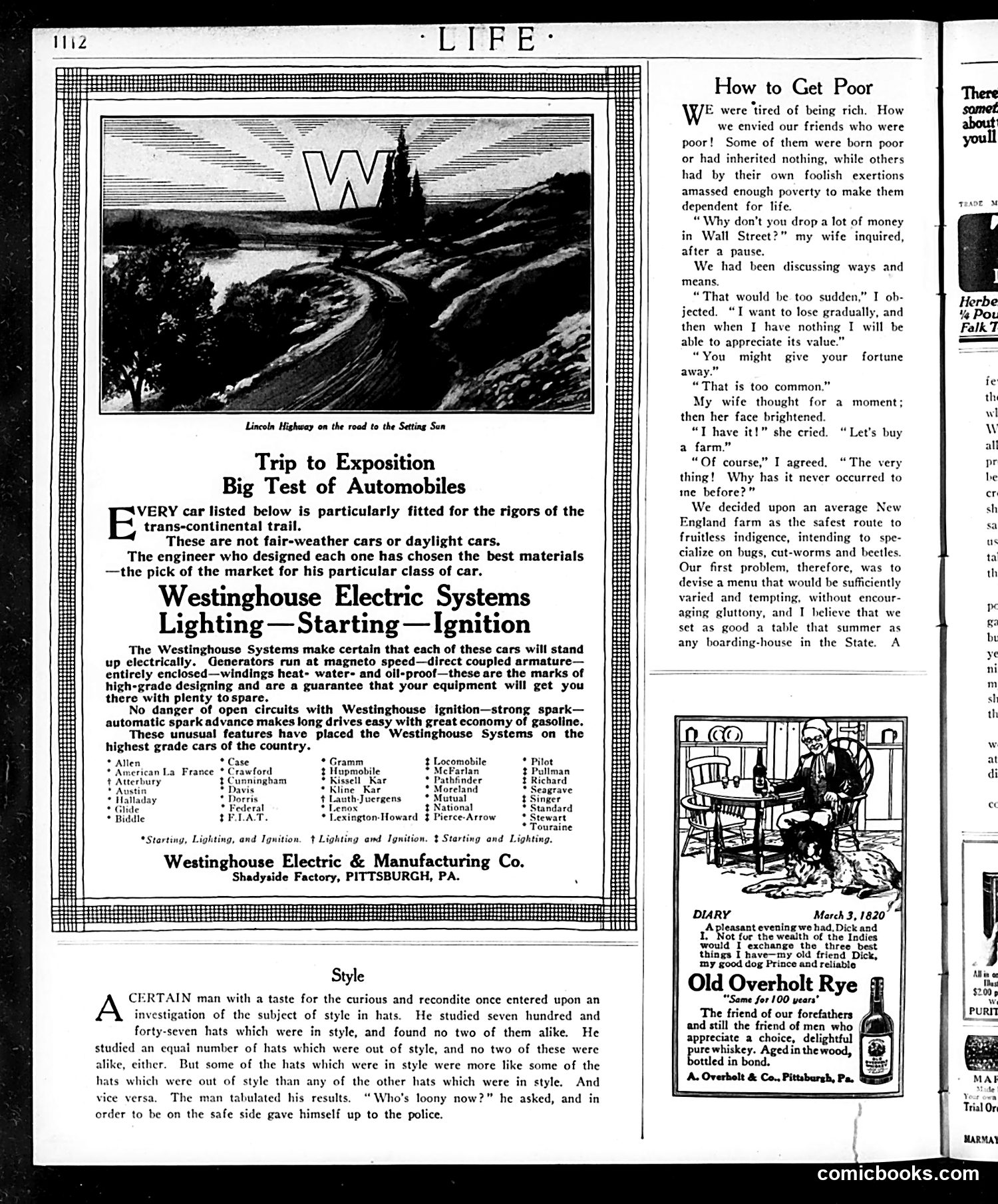
This page mixes advertising with satirical humor typical of Life magazine. The main content comprises: **Advertisements:** A large Westinghouse Electric ad promotes automobile electrical systems for cross-country travel, listing major car manufacturers. Below is an Old Overholt Rye whiskey ad. **Satire:** Two pieces mock American society: 1. A hat-style commentary ridicules fashion absurdity—a man studies 747 "in-style" and 747 "out-of-style" hats, finding no two alike in either category, yet some in-style hats resemble some out-of-style ones. The paradox—that fashion categories are meaningless—drives him to madness. 2. "How to Get Poor" satirizes wealthy Americans' romanticization of poverty. A rich couple envies poor friends and schemes to lose their fortune by buying a New England farm, hoping to go broke farming bugs and beetles. The joke critiques both wealth-worship and naive wealthy people's misunderstanding of actual poverty's hardships.
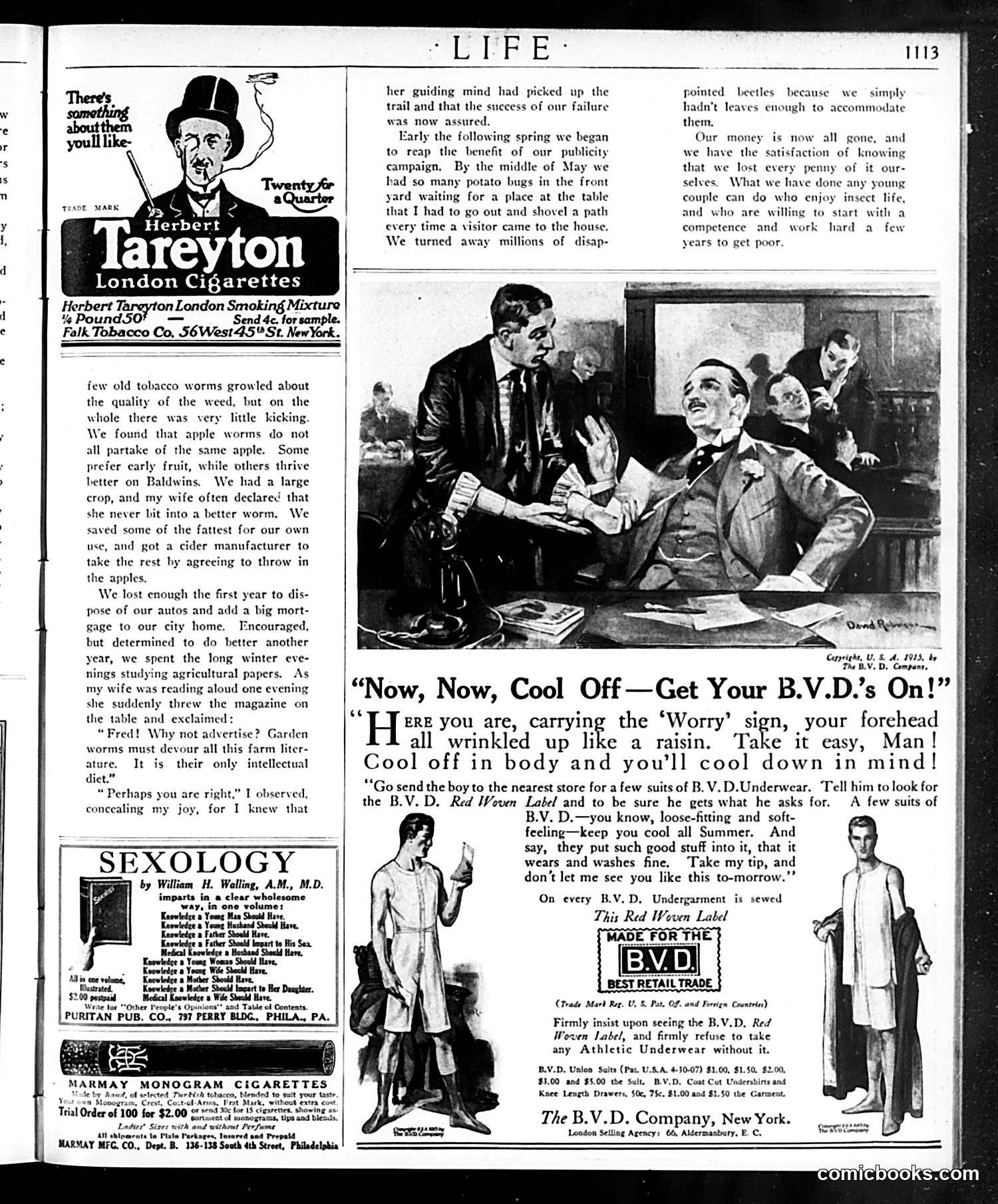
This page contains **primarily advertisements** rather than political cartoons. The main content includes: 1. **Tareyton London Cigarettes ad** (top left): A gentlemanly figure in a top hat—typical early 20th-century advertising imagery emphasizing sophistication and refinement. 2. **B.V.D. Underwear ad** (center-right): A domestic comedy scene depicting a worried, stressed man being advised by another to cool off by wearing B.V.D. brand underwear. The ad uses humor suggesting mental anxiety can be relieved through physical comfort—a humorous sales pitch playing on gender anxiety about appearing "worried" or disheveled. 3. **Sexology book ad** (left): Medical/educational content typical of the era. 4. **Harlem Monogram Cigarettes** (bottom): Another tobacco product advertisement. The page reflects **1915 consumer culture** emphasizing brand loyalty and lifestyle messaging rather than political satire. The B.V.D. ad uses mild social humor rather than sharp political commentary.
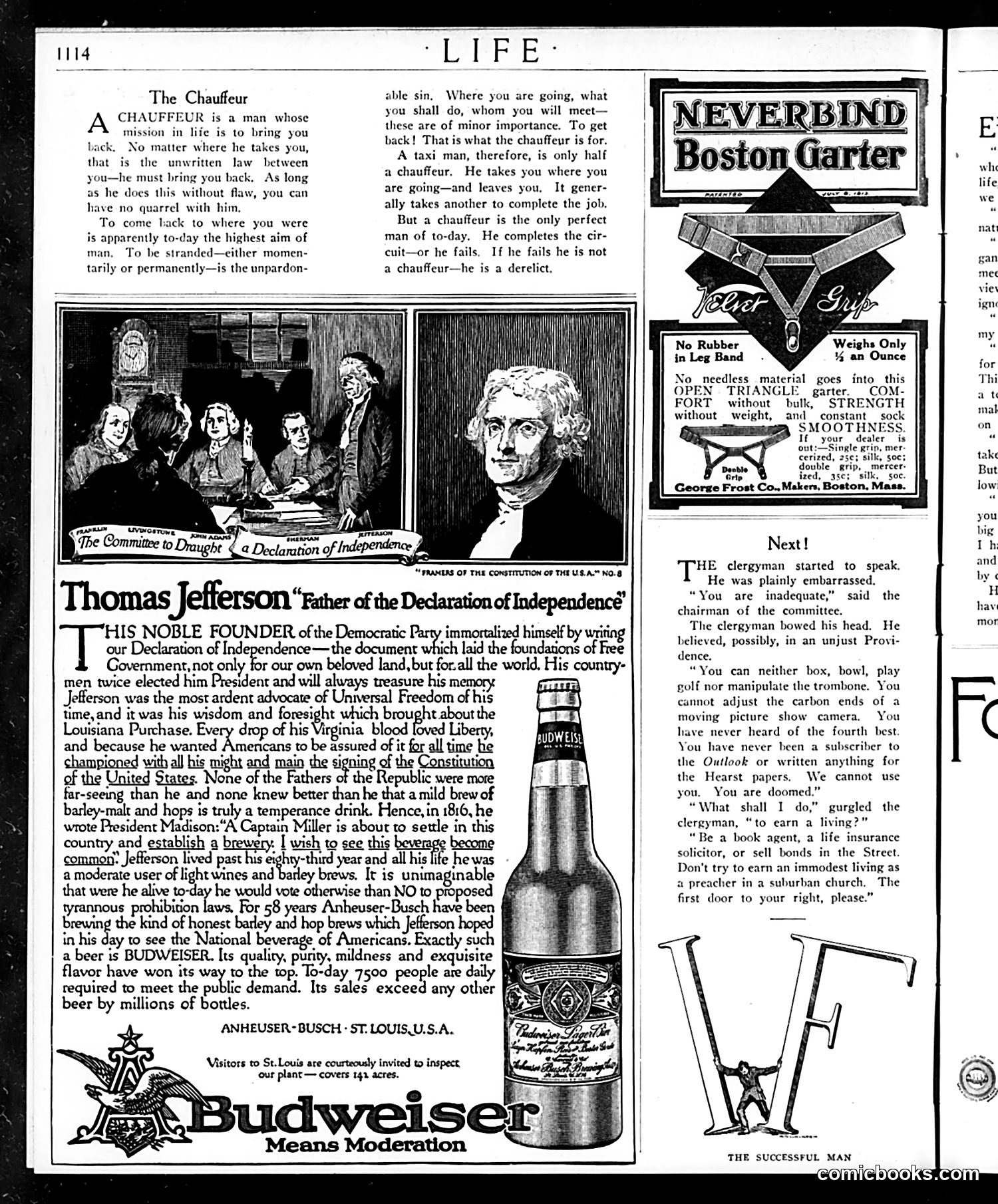
This page contains three distinct pieces of satirical content: **"The Chauffeur"** (top left): A humorous essay defining the modern chauffeur as the "only perfect man of to-day"—someone who must reliably return passengers to their starting point, completing the "circuit." It's gentle social satire about the new automobile age and servant expectations. **Thomas Jefferson/Budweiser Advertisement** (center-left): A striking example of misleading historical propaganda. The ad cynically appropriates Jefferson's legacy to argue he would have opposed Prohibition, claiming he advocated "moderate" beer consumption. The text falsely attributes a brewery-supporting quote to Jefferson and misrepresents his temperance views—a deliberate distortion designed to influence contemporary Prohibition debates. **"Next!"** (right): A satirical dialogue mocking clergy inadequacy. A committee chairman condemns a clergyman for lacking modern skills (boxing, golf, trombone, photography expertise, magazine subscriptions) and suggests he instead sell insurance or bonds—biting social commentary on how materialistic, secular values had displaced religious authority in American society.
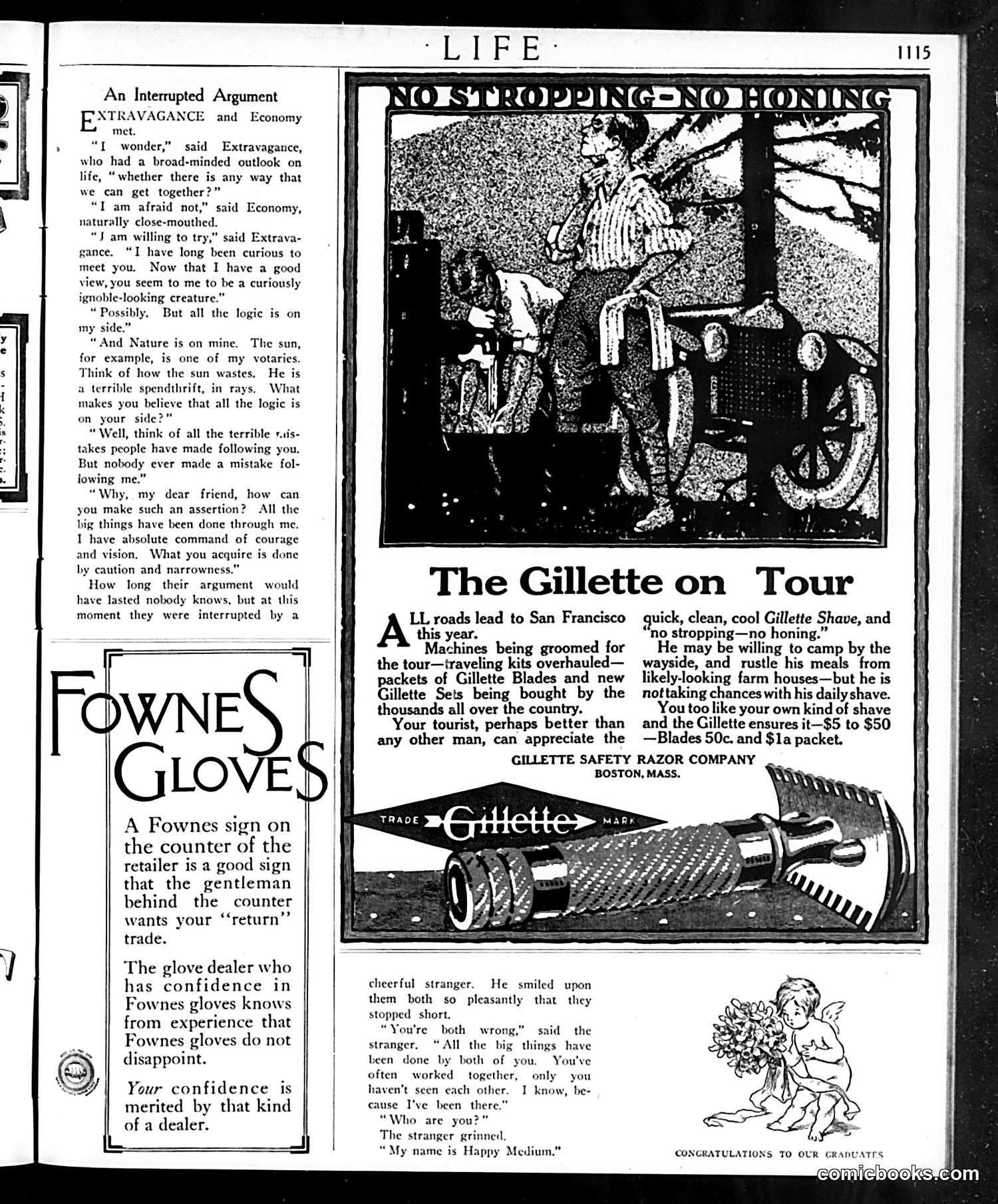
This page contains a philosophical allegory titled "An Interrupted Argument" between personified concepts: **Extravagance** and **Economy**. The two debate whether they can coexist, with Economy claiming logic supports restraint, while Extravagance argues that nature and great achievements require spending. Their heated argument is interrupted by a mysterious stranger who identifies himself as "Happy Medium"—suggesting the satirical point that **balance between frugality and spending is the ideal solution**. The page also advertises **Fownes Gloves** and a **Gillette Safety Razor**, both marketed as reliable products for travelers heading to San Francisco. These ads reinforce the "happy medium" theme: quality goods worth investing in. The satire likely reflects post-WWI American tensions between wartime austerity and peacetime consumption, suggesting neither extreme serves society well.
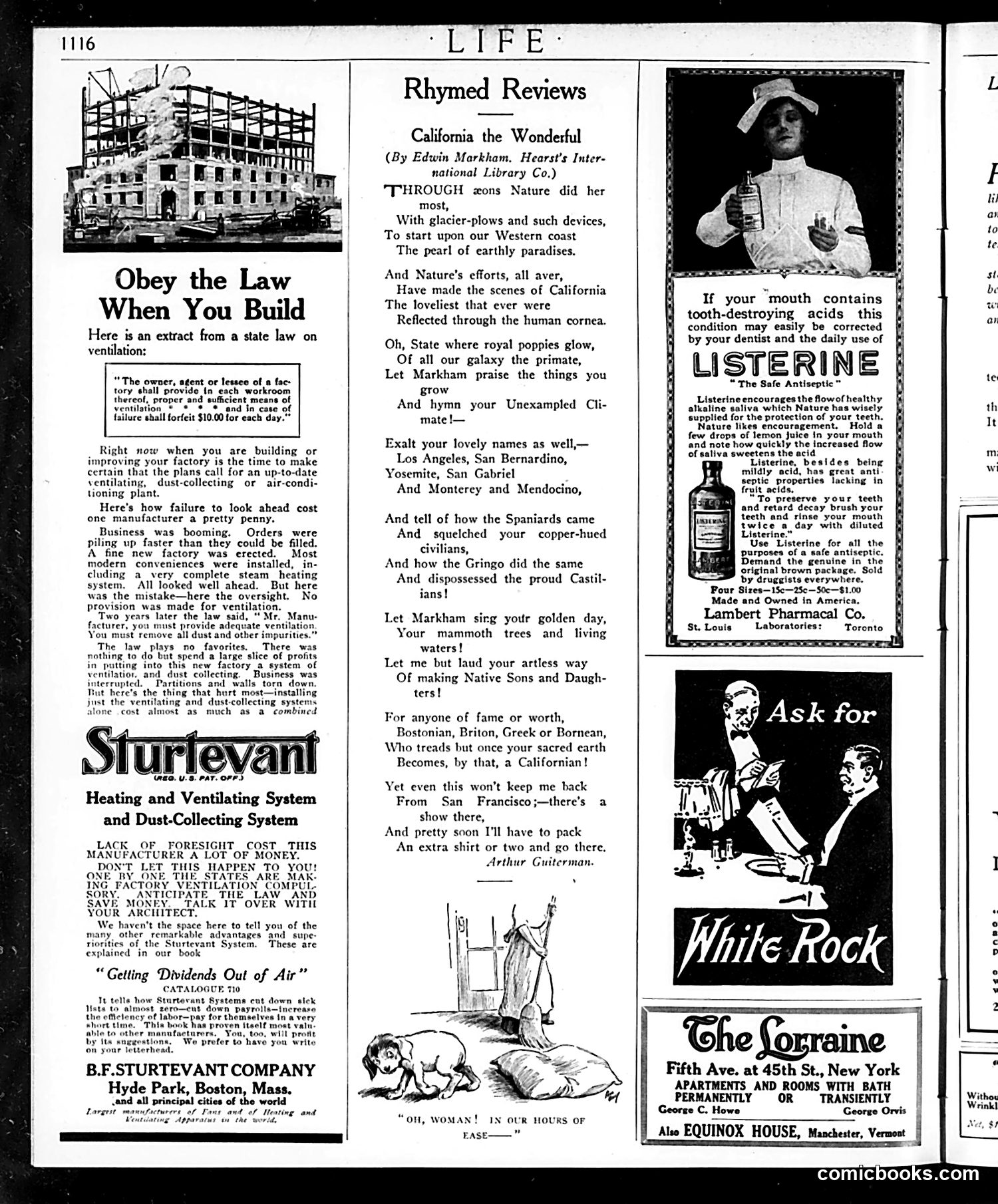
This page mixes advertising with editorial content, primarily promoting industrial ventilation systems and consumer products. **Main Editorial Content:** A cautionary article about building-code compliance advocates that factory owners install proper ventilation systems *before* legal requirements force expensive retrofitting. It uses a real anecdote of a manufacturer who ignored ventilation, then faced costly mid-operation installation after the law changed. The Sturtevant Company's ventilation system is promoted as the forward-thinking solution. **"Rhymed Reviews":** Arthur Guiterman parodies Edwin Markham's reverent poem "California the Wonderful." Guiterman's satire celebrates California's natural beauty while sardonically mocking the state's tendency to mythologize itself and create instant "Californians" from newcomers. The closing joke—that even this won't stop him from visiting San Francisco for "a show"—suggests California's mystique doesn't match reality. **Advertisements:** Include Listerine (claiming to neutralize mouth acids), White Rock beverage, and lodging services. The page reflects 1920s progressive concerns with industrial safety regulation and consumer skepticism toward inflated regional boosterism.
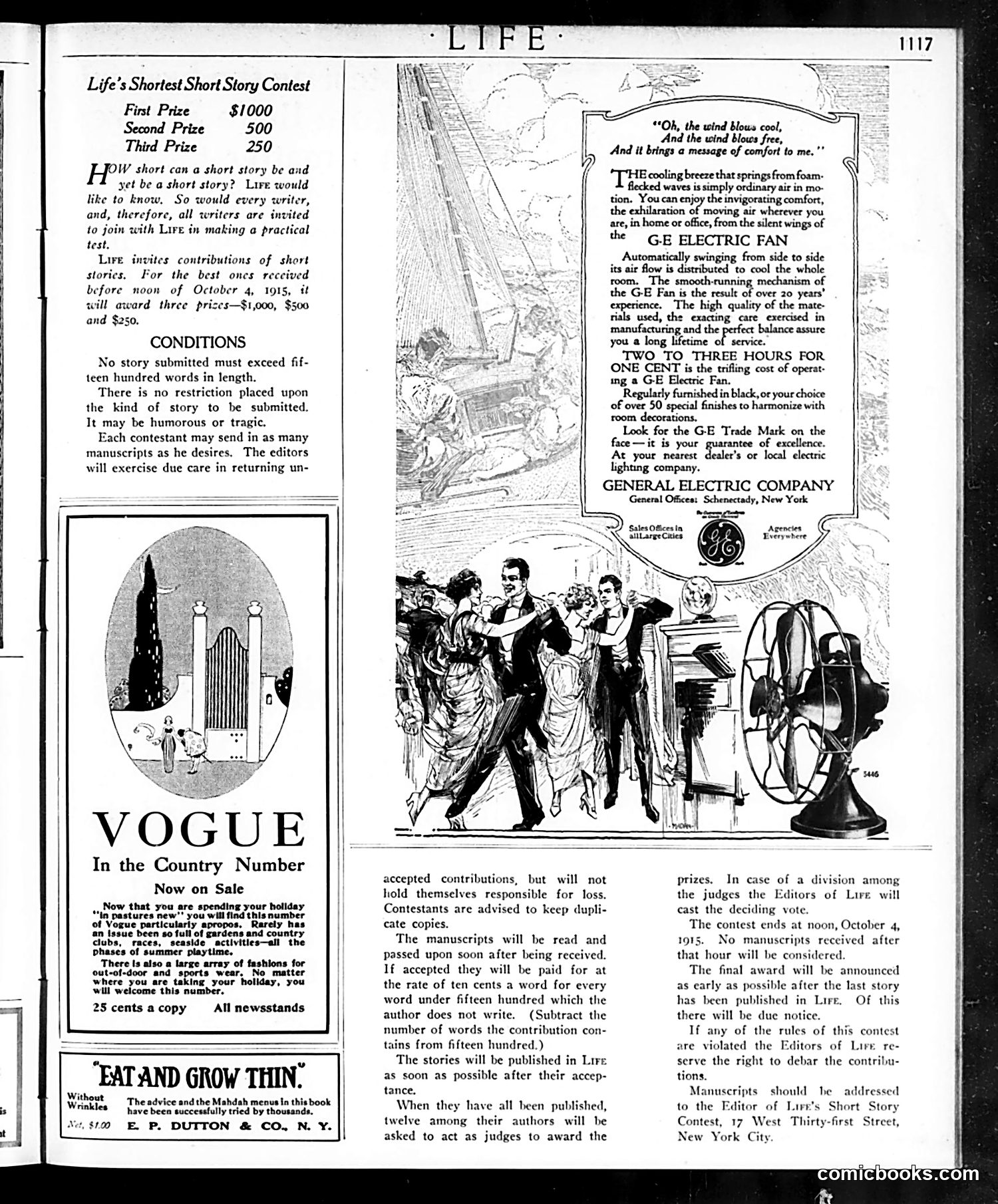
This page is primarily **advertising and contest announcement**, not political satire. The main content announces **Life's Shortest Short Story Contest**, offering $1,000 for the winning entry—a practical test of how brief a story can be while remaining a story. The contest accepts submissions up to 1,500 words, with payment at ten cents per word for accepted stories. The page includes two advertisements unrelated to the contest: 1. **Vogue's "Country Number"** promotes a fashion and leisure magazine issue focused on summer vacation activities and outdoor wear. 2. **General Electric Electric Fan** advertisement depicts well-dressed people enjoying cooling breezes, emphasizing the fan's efficiency and affordability (operating cost: one to three hours for one cent). There is also an advertisement for a diet book titled **"Eat and Grow Thin."** None of these contain political commentary or satirical cartoons requiring historical context beyond understanding that these were typical consumer products and leisure interests of 1915 middle-to-upper-class Americans.
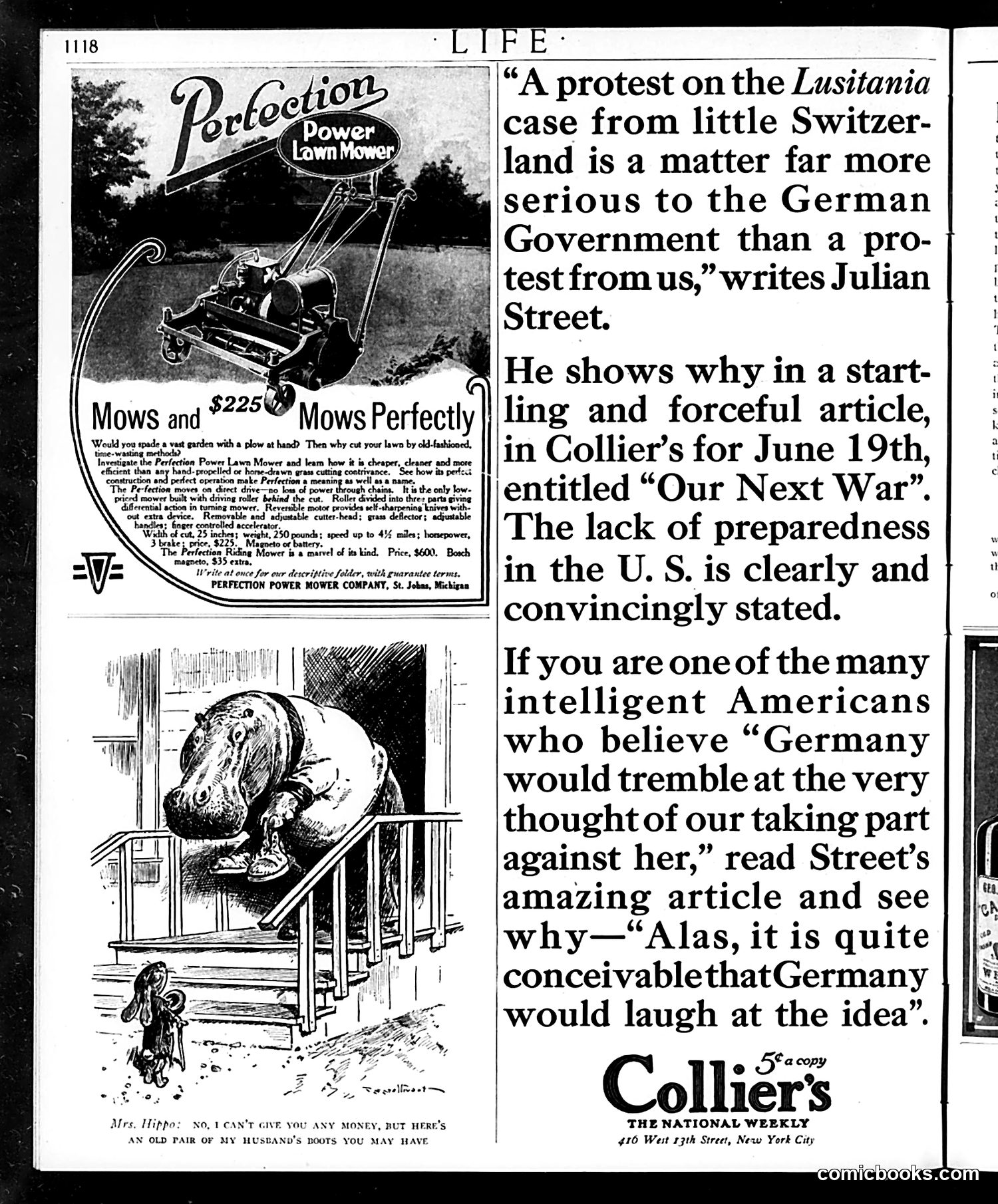
This page mixes advertising with editorial promotion. The **Perfection Power Lawn Mower ad** is straightforward product marketing ($225 price tag). The **cartoon** (lower left) depicts "Mrs. Hippo"—a woman depicted as a hippopotamus—offering her husband's old boots as charity, saying she has no money. This is Depression-era satire about economic hardship and marital dynamics, with the animal caricature suggesting either foolishness or desperation. The **right side** promotes Julian Street's article "Our Next War" in Collier's magazine, referencing the **Lusitania sinking** (a German U-boat attack on a passenger ship in 1915). Street argues that Switzerland's diplomatic protest matters more to Germany than American protests, implying the U.S. lacks military power to be taken seriously. The article warns of American unpreparedness for potential war with Germany—clearly written during WWI tensions when American entry was debated. The page targets readers anxious about military strength and international respect.
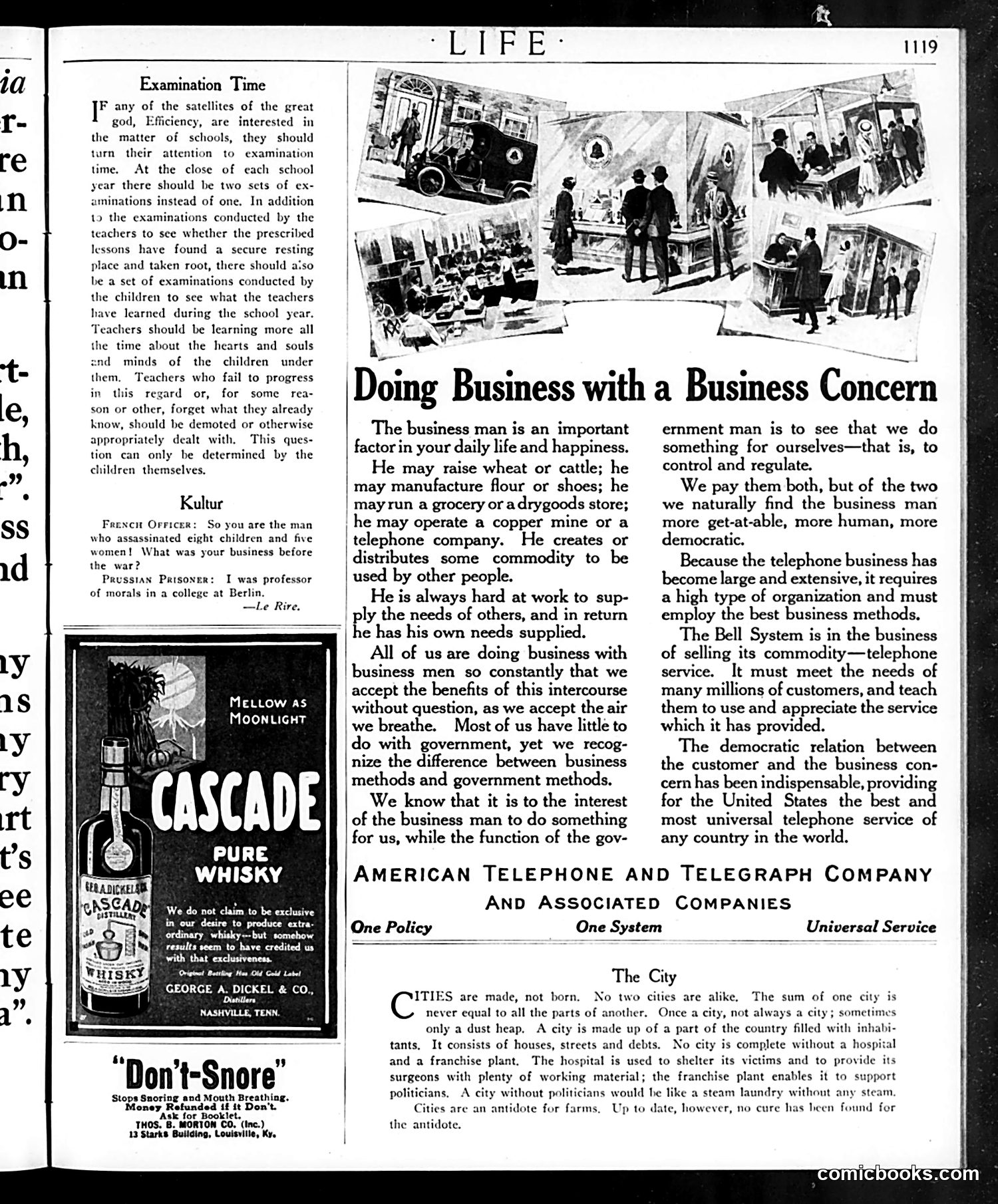
This page combines editorial commentary with advertising. The main content includes: **"Examination Time"** argues students should examine teachers' progress, not just vice versa—a progressive-era critique of educational accountability. **"Kultur"** is a dark joke referencing World War I. A French officer interrogates a German prisoner who claims to be a professor of morals. The satire: Germany's militarism and atrocities are presented as contradicting its claims to moral authority. This reflects post-WWI attitudes toward German culpability. **"Doing Business with a Business Concern"** is a Bell Telephone advertisement disguised as editorial commentary. It argues businesses are more democratic and responsive than government because profit incentives make them serve customers better. This pro-corporate messaging was typical of 1920s American publications. **Advertisements** for Cascade Whisky and "Don't-Snore" products occupy the lower portion—standard magazine filler. The page reflects early 20th-century American confidence in business efficiency and lingering anti-German sentiment from WWI.
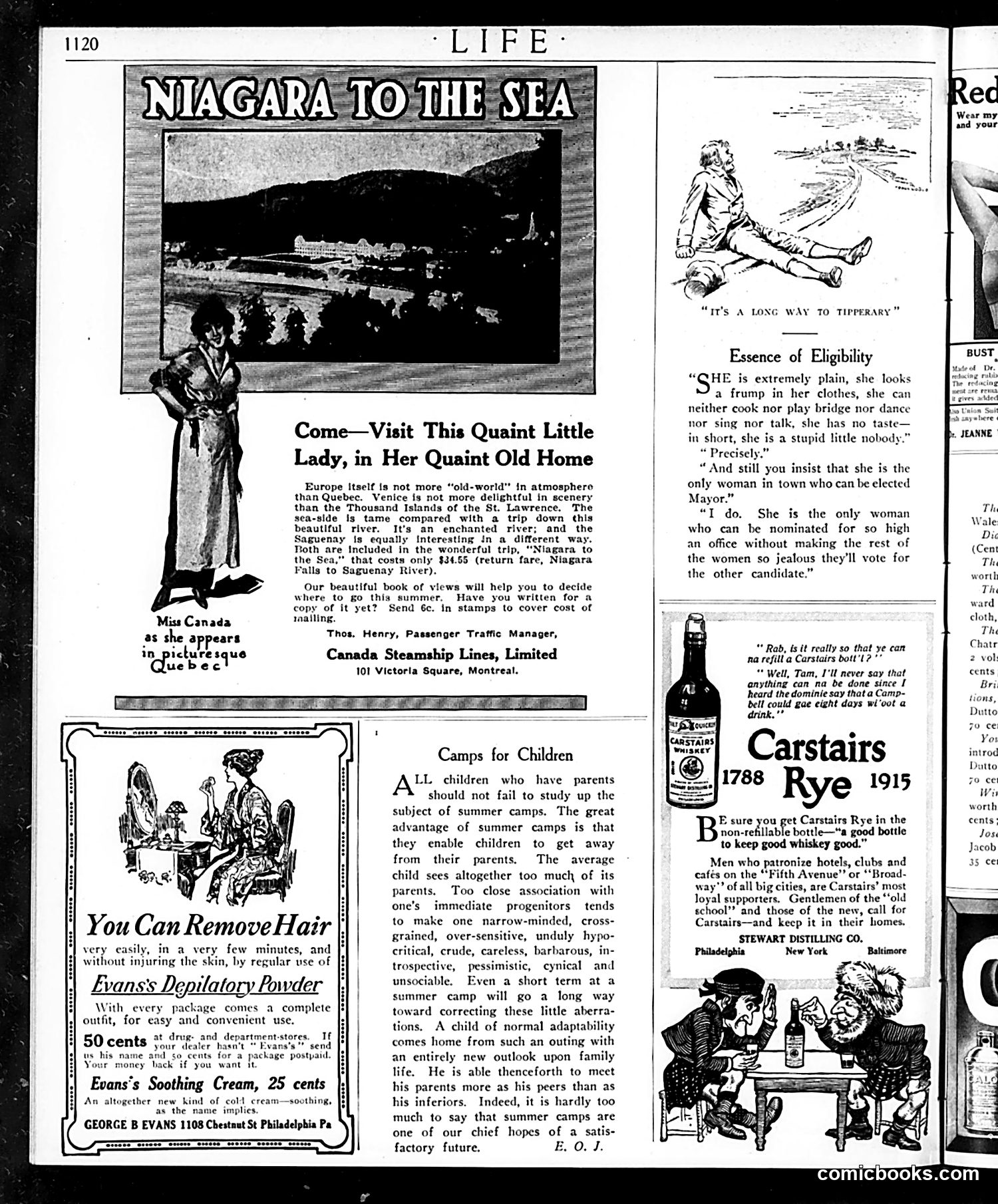
This page contains multiple advertisements and satirical pieces typical of early 20th-century Life magazine. **Main Advertisement:** "Niagara to the Sea" promotes Canadian Steamship Lines, featuring "Miss Canada" as a romanticized figure representing Quebec's picturesque appeal to tourists. **Satirical Content:** - A piece on summer camps sarcastically argues children should be *separated* from their parents, claiming parental proximity makes children "narrow-minded, cross-grained, barbarous" and that camps will improve parent-child relationships by making offspring see parents "as his peers rather than his inferiors." This is gentle social satire about generational tensions. - A political joke about women's suffrage: a plainly unattractive woman is the "only" eligible female mayoral candidate *because* her unattractiveness won't threaten other women's jealousy enough to vote against her. This reflects early anxieties about women entering politics. **Other Ads:** Hair removal powder, whiskey, and cold cream round out the commercial content—typical period advertising emphasizing appearance and propriety. The page reflects 1910s-era attitudes toward gender, family, tourism, and beauty standards.
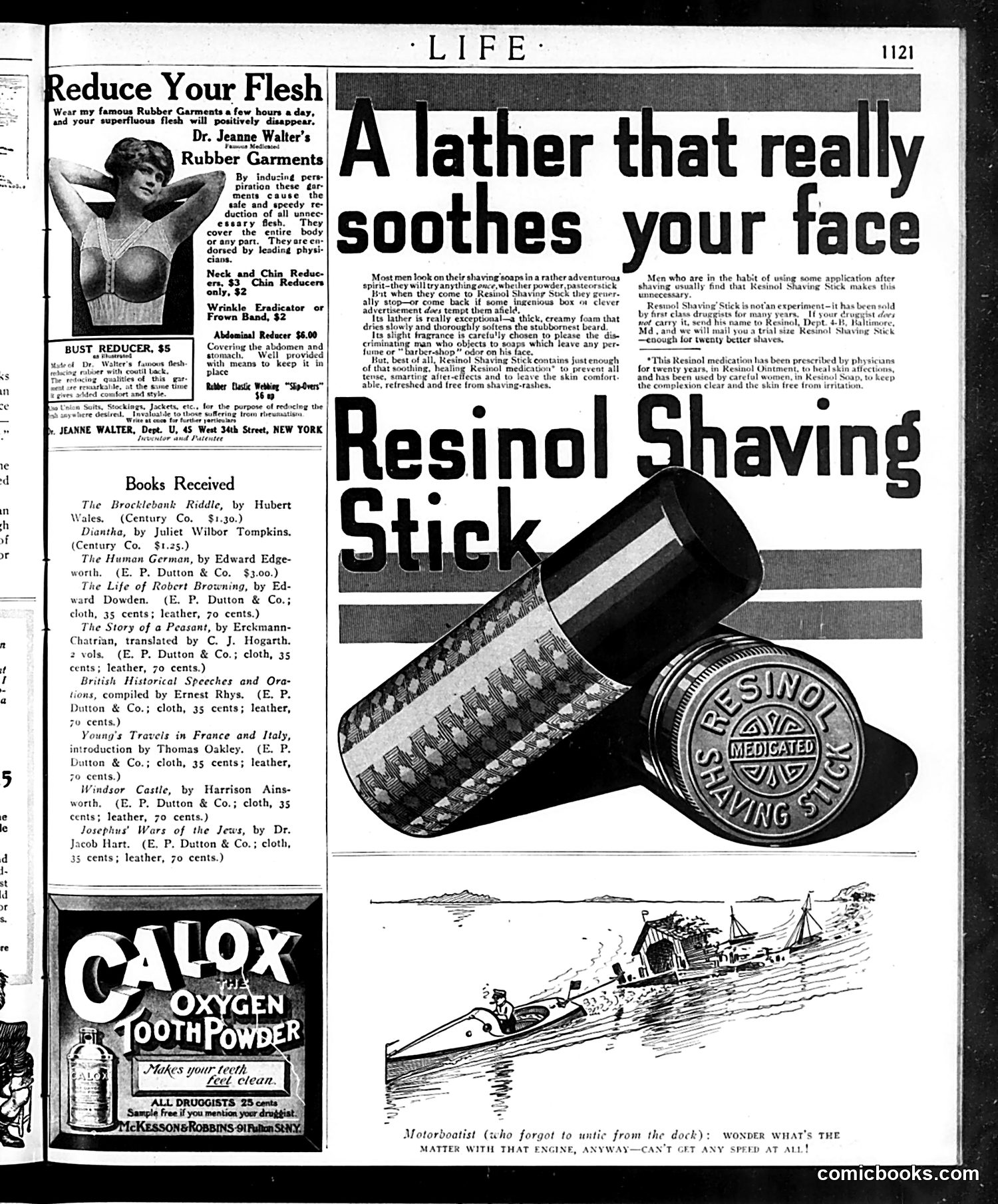
This is a **commercial advertising page** from Life magazine, not a political cartoon. The page consists primarily of product advertisements for body-modification and grooming items popular in the early 20th century. **Key advertisements:** - **Dr. Jeanne Walter's Rubber Garments**: Corset-like devices claiming to reduce flesh through perspiration—reflecting era obsessions with reducing body size through restrictive wear - **Resinol Shaving Stick**: A medicinal shaving product emphasizing soothing properties and "healing" benefits - **Calox Oxygen Toothpowder**: A teeth-cleaning product The small cartoon at bottom shows a motorboatist unable to start his engine—a humorous non-sequitur unrelated to the advertisements. **Social context**: These ads reveal early-1900s consumer culture obsessed with body modification, medical pseudo-science, and the marketing of "solutions" to perceived physical flaws—particularly weight and appearance. The prominence of such ads reflects contemporary beauty standards and aggressive advertising practices of the period.
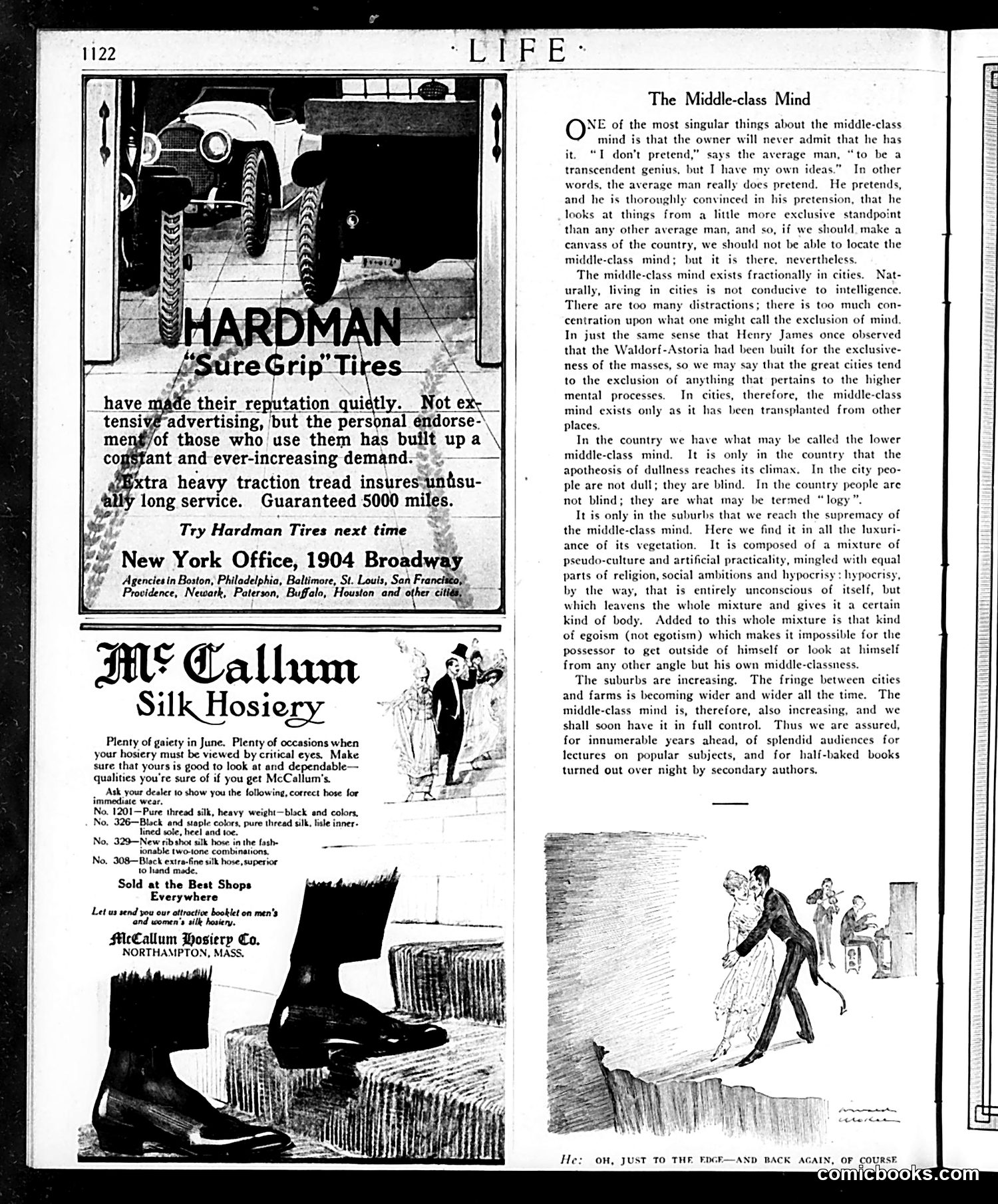
This page is primarily **advertising** (Hardman tires, McCallum hosiery) alongside a substantial **satirical essay** titled "The Middle-class Mind." The essay attacks suburban middle-class pretension. The author argues that middle-class people deny having a "middle-class mind" while being thoroughly convinced of their own intellectual superiority—a contradiction he finds laughable. The satire targets **suburban culture specifically**, claiming it represents the "supremacy of the middle-class mind" as a toxic mixture of pseudo-culture, artificial propriety, religion, social climbing, and unconscious hypocrisy. The author warns that suburban expansion means this mediocre mentality will soon dominate American thought and culture. The accompanying cartoon (bottom) shows a man slipping or stumbling at a cliff's edge—likely illustrating the essay's critique of suburban pretension and self-delusion. This reflects early 20th-century *Life* magazine's role as intellectual satire targeting American bourgeois values.
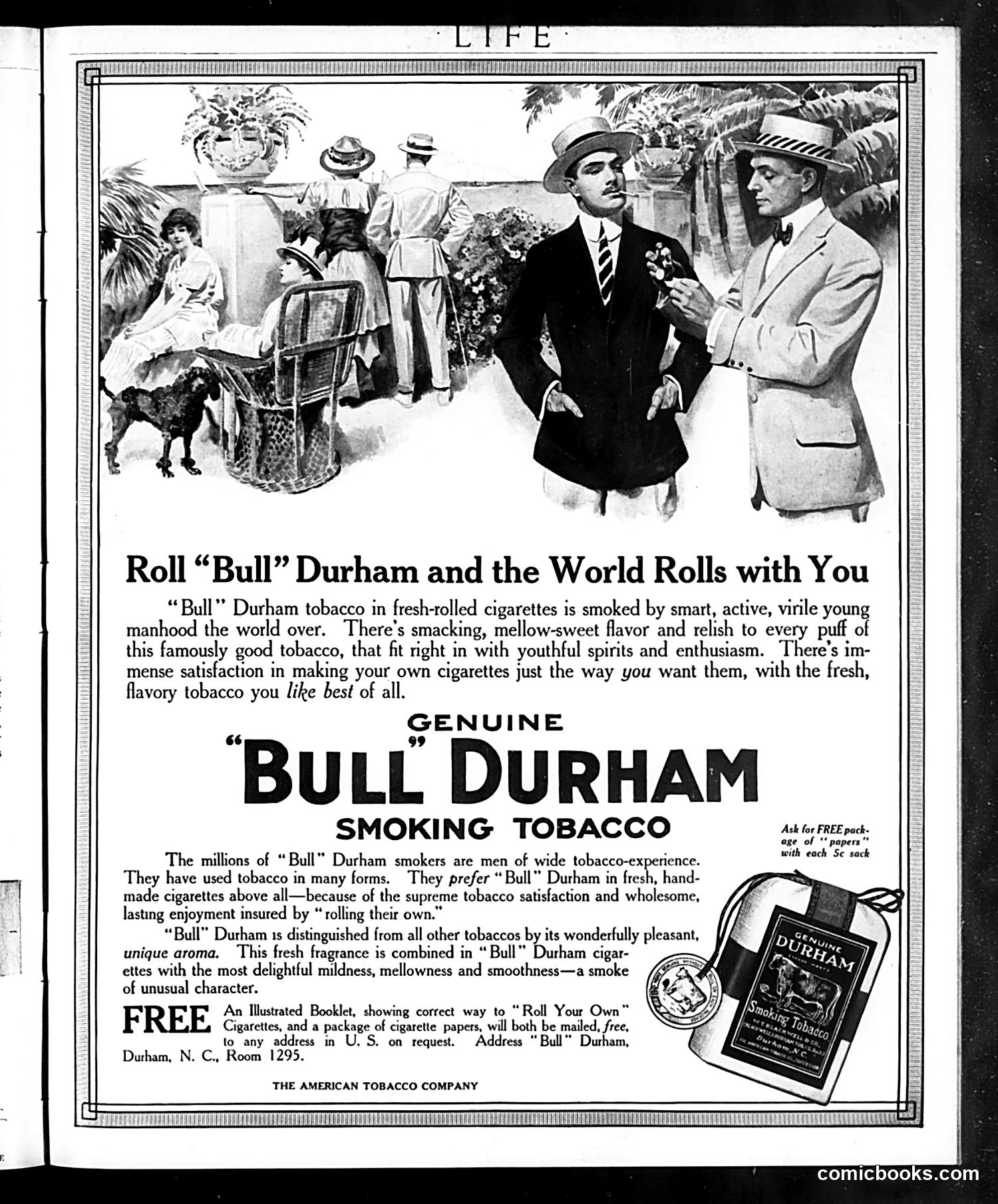
This is a **full-page tobacco advertisement**, not satire or political commentary. It promotes "Bull Durham" smoking tobacco, manufactured by American Tobacco Company. The illustration depicts an elegant social scene—likely a garden party or upscale gathering—where well-dressed men in suits and hats are portrayed as sophisticated and successful. The ad's appeal centers on **masculinity and self-sufficiency**: the product's main selling point is that smokers can "roll their own" cigarettes from loose tobacco, positioning this as an activity for "smart, active, virile young manhood." The copy emphasizes the tobacco's "unique aroma," freshness, and superior quality compared to factory-made cigarettes. A free booklet showing proper rolling technique and complimentary cigarette papers are offered as incentives. **Modern context**: This reflects early 20th-century marketing that associated tobacco use with status, independence, and youthful vigor—tactics now recognized as predatory advertising.
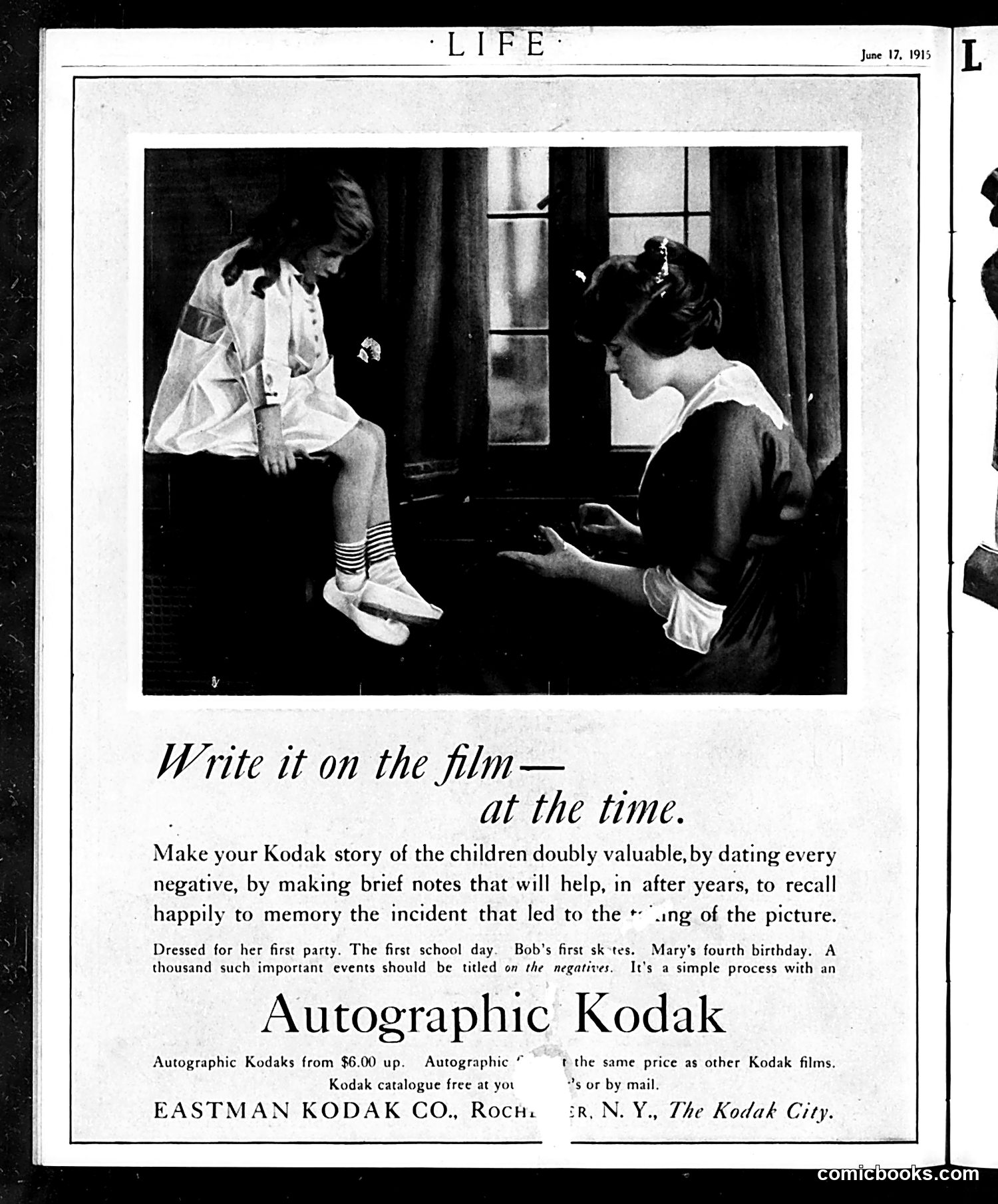
This is a **Kodak advertisement**, not political satire. The page promotes the "Autographic Kodak" camera, a 1914 innovation allowing users to write directly on film negatives. The image shows a woman helping a young child write notes on a photographic negative. The advertisement's pitch targets parents: date and annotate your family photographs so that years later you'll remember the context of each image—your child's first party, first school day, birthday, etc. The social context: this represents an early marketing appeal to **domestic sentimentality and family memory-keeping** as consumer benefits. Photography was becoming accessible to middle-class households, and Kodak positioned their product as essential for preserving family narratives. For modern readers: the ad reflects how consumer companies have long marketed products by appealing to emotional memory and family values—a strategy still used in advertising today.