
Life, 1915-06-17 · page 18 of 52
Life — June 17, 1915 — page 18: what you’re looking at
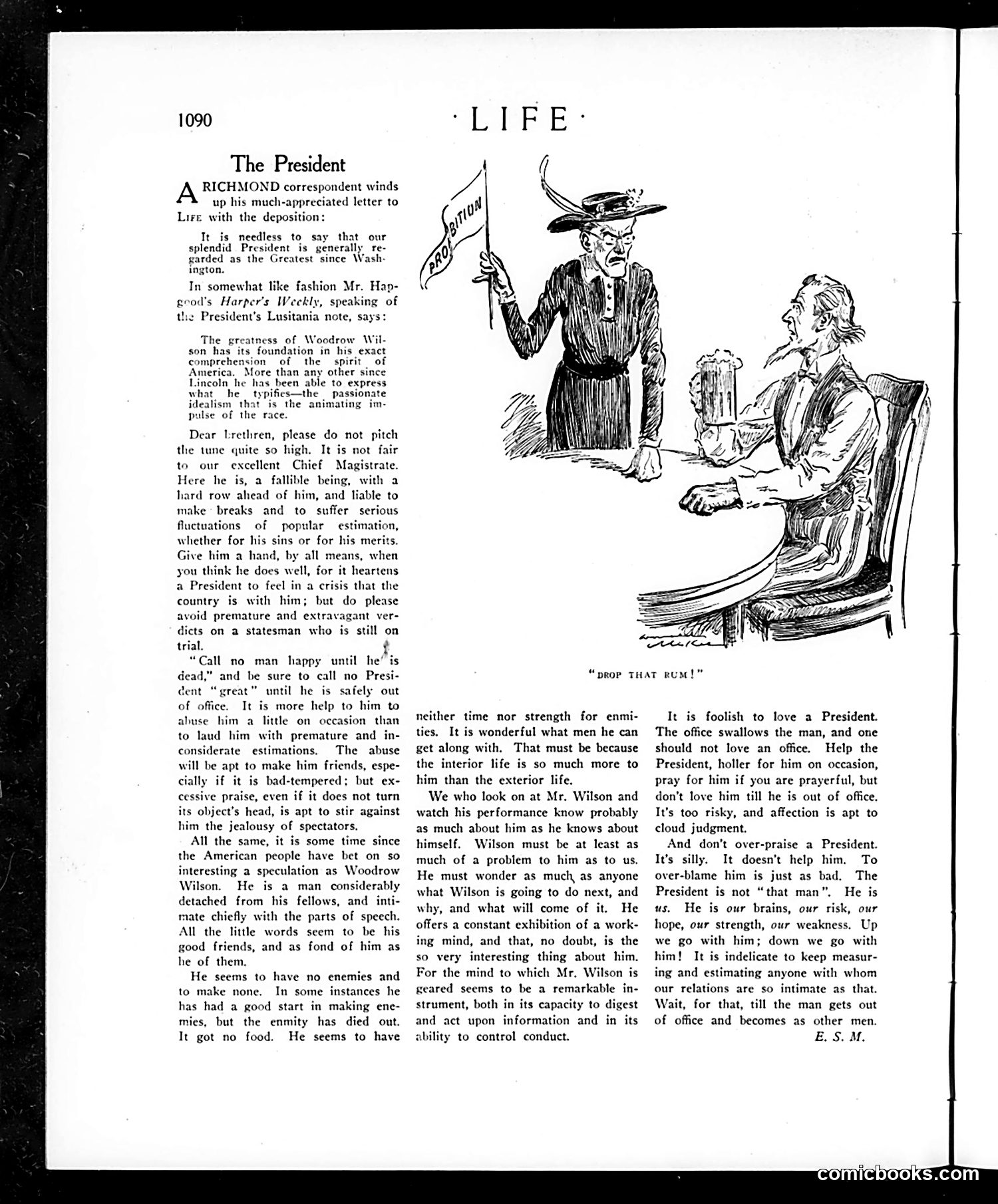
What you’re looking at
This page satirizes excessive praise of President Woodrow Wilson, likely from around 1915 (referencing his "Lusitania note"). The cartoon depicts a woman (representing Lady Liberty or "America") holding a banner labeled "PATRIOTISM" while addressing a seated man (Wilson), with the caption "DROP THAT RUM!" — suggesting he's intoxicated by flattery. The accompanying editorial mocks Harper's Weekly and other publications for calling Wilson "the Greatest since Washington." The author argues this premature lionizing is counterproductive: praise clouds judgment, makes enemies through jealousy, and prevents Wilson from understanding his actual performance. The piece advocates measured support rather than excessive adulation. The satire's core message: don't deify sitting presidents. Love the office, not the man; judge results only after he leaves office. Wilson, the writer insists, is merely human—flawed and "considerably detached"—not a secular deity.
📄 Transcribed text from this page (OCR, searchable)
Machine-transcribed from the original scan — historical spelling and the odd misread are preserved.
1090 The President RICHMOND correspondent winds up his much-appreciated letter to Live with the deposition: Tt is needless to say that our splendid President is generally re- garded as the Greatest since Wash- ington. In somewhat like fashion Mr. Hap- god's Harper's Weekly, speaking of the President’s Lusitania note, says: The greatness of Woodrow Wil- son has its foundation in his exact comprehension of the spirit of America, More than any other since Lincoln he has been able to express what he | typifies—the i idealism that is the animating pulse of the race. Dear brethren, please do not pitch the tune quite so high, It is not fair to our excellent Chief Magistrate. Here he is, a fallible being, with a hard row ahead of him, and liable to make breaks and to suffer serious fluctuations of popular estimation, whether for his sins or for his merits. Give him a hand, by all means, when you think he does well, for it heartens a President to feel in a crisis that the country is with him; but do please avoid premature and extravagant ver- dicts on a statesman who is still on trial. “Call no man happy until he’ is dead,” and be sure to call no Presi- cent “great” until he is safely out of office. It is more help to him to abuse him a little on occasion than to laud him with premature and in- considerate estimations. The abuse will be apt to make him friends, espe- cially if it is bad-tempered; but ex- cessive praise, even if it does not turn its object's head, is apt to stir against him the jealousy of spectators. All the same, it is some time since the American people have bet on so interesting a speculation as Woodrow Wilson. He is a man_ considerably detached from his fellows, and inti- mate chiefly with the parts of speech. All the little words seem to be his good friends, and as fond of him as he of them. He seems to have no enemies and to make none. In some instances he has had a good start in making ene- mies, but the enmity has died out. It got no food. He seems to have “prop THAT RUM!” neither time nor strength for enmi- ties, It is wonderful what men he can get along with. That must be because the interior life is so much more to him than the exterior life. We who look on at Mr. Wilson and watch his performance know probably as much about him as he knows about himself. Wilson must be at least as much of a problem to him as to us. He must wonder as much as anyone what Wilson is going to do next, and why, and what will come of it. He offers a constant exhibition of a work- ing mind, and that, no doubt, is the so very interesting thing about him. For the mind to which Mr. Wilson is geared seems to be a remarkable in- strument, both in its capacity to digest and act upon information and in its ability to control conduct. It is foolish to love a President. The office swallows the man, and one should not love an office. Help the President, holler for him on occasion, pray for him if you are prayerful, but don’t love him till he is out of office. It’s too risky, and affection is apt to cloud judgment. And don’t over-praise a President. It's silly. It doesn’t help him. To over-blame him is just as bad. The President is not “that man”. He is us. He is our brains, our risk, our hope, our strength, our weakness. Up we go with him; down we go with him! It is indelicate to keep measur- ing and estimating anyone with whom our relations are so intimate as that. Wait, for that, till the man gets out of office and becomes as other men. E. S. M.