
Life, 1915-06-17 · page 17 of 52
Life — June 17, 1915 — page 17: what you’re looking at
What you’re looking at
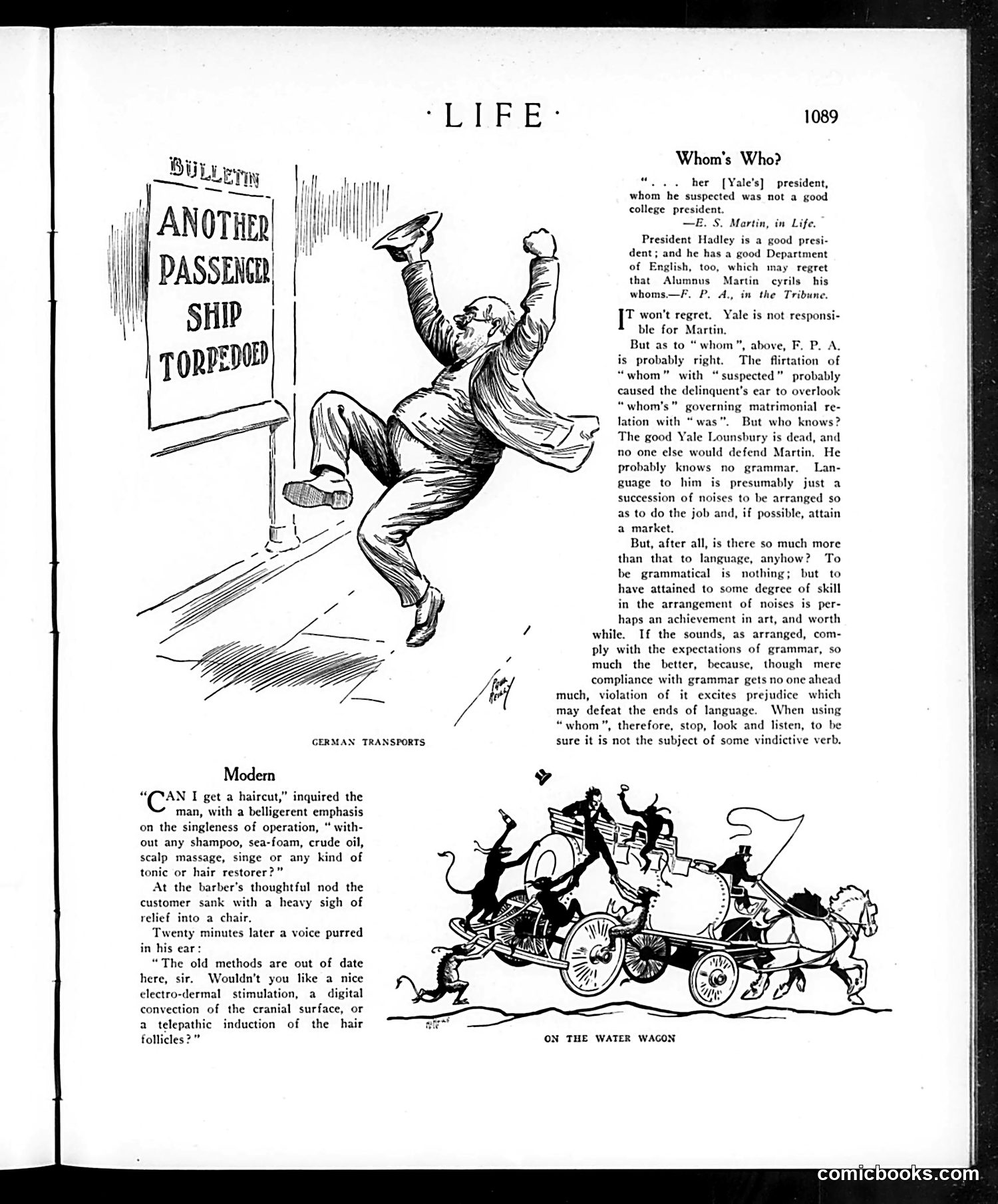
**Top Section - "Whom's Who?"**: This is a grammatical debate among Yale University figures. E.S. Martin (a Life editor) criticized Yale's president's grammar, prompting responses defending President Hadley and the English Department. The piece humorously discusses whether "whom" was correctly used, with contributors acknowledging that while grammatical precision matters aesthetically, strict compliance isn't essential—only that violations don't alienate audiences. It's intellectual satire targeting educated elites' pedantry. **"German Transports"**: The cartoon shows a man triumphantly reading a bulletin of a torpedoed passenger ship, appearing to celebrate German naval attacks. This reflects WWI-era American attitudes toward German U-boat warfare against civilian vessels—likely satirizing either German aggression or American reactions to it. **"Modern"**: A man asks for a simple haircut without extras, but the barber pitches absurd modern treatments ("electro-dermal stimulation," "telepathic induction"). This satirizes commercial over-complication and hard-sell marketing tactics of early 20th-century businesses.
📄 Transcribed text from this page (OCR, searchable)
Machine-transcribed from the original scan — historical spelling and the odd misread are preserved.
Whom's Who? ++. her [Yale's] president, whom he suspected was not a good college president. E. S. Martin, in Life. President Hadley is a good presi- dent; and he has a good Department of English, too, which may regret | } that Alumnus Martin cyrils his whoms.—F. P, A., in the Tribune. T won't regret. Yale is not responsi- ble for Martin. But as to “whom”, above, F. P. A. is probably right. The flirtation of “whom” with “suspected” probably caused the delinquent’s ear to overlook “whom's” governing matrimonial re- lation with “was”. But who knows? The good Yale Lounsbury is dead, and no one else would defend Martin, He probably knows no grammar. Lan- guage to him is presumably just a succession of noises to be arranged so as to do the job and, if possible, attain a market. But, after all, is there so much more than that to language, anyhow? To be grammatical is nothing; but to have attained to some degree of skill in the arrangement of noises is per- haps an achievement in art, and worth while. If the sounds, as arranged, com- ply with the expectations of grammar, so much the better, because, though mere compliance with grammar gets no one ahead much, violation of it excites prejudice which may defeat the ends of language. When using “whom”, therefore, stop, look and listen, to be GERMAN TRANSPORTS sure it is not the subject of some vindictive verb. Modern “(CAN I get a haircut,” inquired the man, with a belligerent emphasis on the singleness of operation, “ with- out any shampoo, sea-foam, crude oil, scalp massage, singe or any kind of tonic or hair restorer?” At the barber's thoughtful nod the customer sank with a heavy sigh of relief into a chair, Twenty minutes later a voice purred in his ear: “The old methods are out of date here, sir. Wouldn’t you like a nice electro-dermal stimulation, a digital convection of the cranial surface, or a telepathic induction of the hair follicles?” ON THE WATER WAGON