
Life, 1915-06-17 · page 22 of 52
Life — June 17, 1915 — page 22: what you’re looking at
What you’re looking at
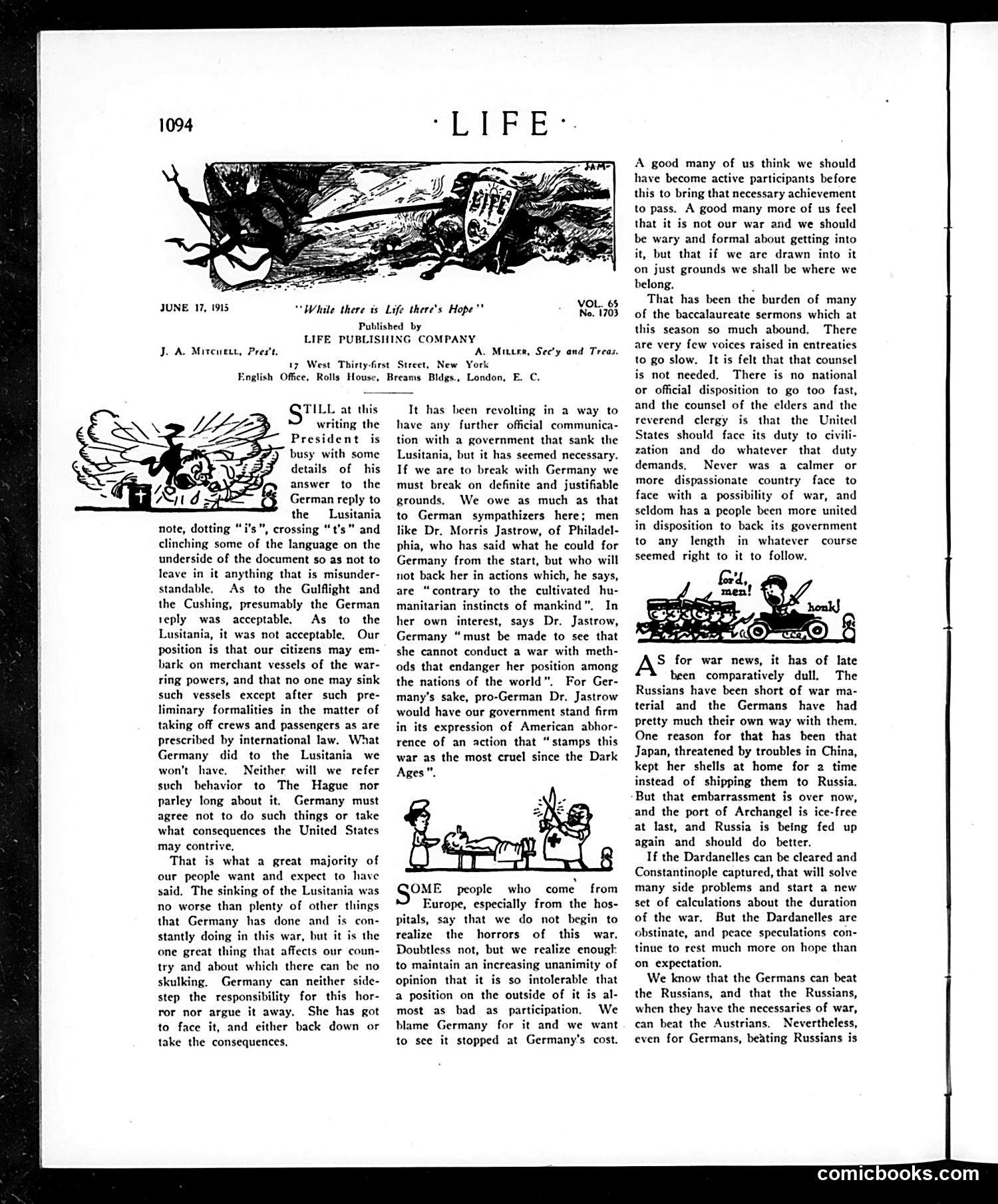
This page addresses the **Lusitania sinking** (May 1915), when a German U-boat torpedoed the British passenger ship, killing nearly 1,200 people including 128 Americans. The editorial argues that President Wilson's diplomatic response is appropriately firm. The author defends negotiating with Germany only to establish clear "justifiable grounds" for potential American intervention—not from moral squeamishness, but to unite American opinion and convince German sympathizers (like the mentioned Dr. Morris Jastrow) that Germany bears responsibility. The cartoon (top left, depicting a corpse) visualizes the human cost of the attack. The piece reflects 1915 American divided sentiment: many felt the war was intolerable yet America shouldn't rush in, but if drawn in "on just grounds," participation would be justified. The tone suggests growing inevitability of U.S. involvement while maintaining diplomatic formality—a position soon overtaken by events (America entered the war in 1917).
📄 Transcribed text from this page (OCR, searchable)
Machine-transcribed from the original scan — historical spelling and the odd misread are preserved.
JUNE 17, 1915 "While there is Life there's Hope" No. 1703 Published by LIFE PUBLISHING COMPANY J. A. Mircuent, Pres't. 17 West Thirty: English Office, Rolls Hou: TILL at this writing the President is busy with some details of his answer to the German reply to the Lusitania , crossing “t's” and note, dotting “i’s clinching some of the language on the underside of the document so as not to leave in it anything that is misunder- standable. As to the Gulflight and the Cushing, presumably the German reply was acceptable. As to the Lusitania, it was not acceptable. Our position is that our citizens may em- bark on merchant vessels of the war- ring powers, and that no one may sink such vessels except after such pre- liminary formalities in the matter of taking off crews and passengers as are prescribed by international law. What Germany did to the Lusitania we won't have. Neither will we refer such behavior to The Hague nor parley long about it. Germany must agree not to do such things or take what consequences the United States may contrive, That is what a great majority of our people want and expect to have said, The sinking of the Lusitania was no worse than plenty of other things that Germany has done and is con- stantly doing in this war, but it is the one great thing that affects our coun- try and about which there can be no skulking. Germany can neither side- step the responsibility for this hor- ror nor argue it away, She has got to face it, and either back down or take the consequences, A. Mutter, Sec’y and Treas. Street, New York Breams Bldgs., London, E. C. Tt has been revolting in a way to have any further official communi tion with a government that sank the Lusitania, but it has seemed necessary. If we are to break with Germany we must break on definite and justifiable grounds. We owe as much as that to German sympathizers here; men like Dr. Morris Jastrow, of Philadel- phia, who has said what he could for Germany from the start, but who will not back her in actions which, he says, are “contrary to the cultivated hu- manitarian instincts of mankind”. In her own interest, says Dr. Jastrow, Germany “must be made to see that she cannot conduct a war with meth- ods that endanger her position among the nations of the world". For Ger- many’s sake, pro-German Dr. Jastrow would have our government stand firm in its expression of American abhor- rence of an action that “stamps this war as the most cruel since the Dark Ages”. OME people who come from Europe, especially from the hos- pitals, say that we do not begin to realize the horrors of this war. Doubtless not, but we realize enough to maintain an increasing unanimity of opinion that it is so intolerable that a position on the outside of it is al- most as bad as participation. We blame Germany for it and we want to sce it stopped at Germany’s cost. A good many of us think we should have become active participants before this to bring that necessary achievement to pass. A good many more of us feel that it is not our war and we should be wary and formal about getting into it, but that if we are drawn into it on just grounds we shall be where we belong. . That has been the burden of many of the baccalaureate sermons which at this season so much abound. There are very few voices raised in entreaties to go slow. It is felt that that counsel is not needed, There is no national or official disposition to go too fast, and the counsel of the elders and the reverend clergy is that the United States should face its duty to civili- zation and do whatever that duty demands, Never was a calmer or more dispassionate country face to face with a possibility of war, and seldom has a people been more united in disposition to back its government to any length in whatever course seemed right to it to follow. S for war news, it has of late been comparatively dull, The Russians have been short of war ma- terial and the Germans have had pretty much their own way with them, One reason for that has been that Japan, threatened by troubles in China, kept her shells at home for 2 time instead of shipping them to Russia. But that embarrassment is over now, and the port of Archangel is ice-free at last, and Russia is being fed up again and should do better. If the Dardanelles can be cleared and Constantinople captured, that will solve many side problems and start a new set of calculations about the duration of the war. But the Dardanelles are obstinate, and peace speculations con- tinue to rest much more on hope than on expectation. We know that the Germans can beat the Russians, and that the Russians, when they have the necessaries of war, can beat the Austrians. Nevertheless, even for Germans, beating Russians is comicbooks.com