
Life, 1915-06-17 · page 28 of 52
Life — June 17, 1915 — page 28: what you’re looking at
What you’re looking at
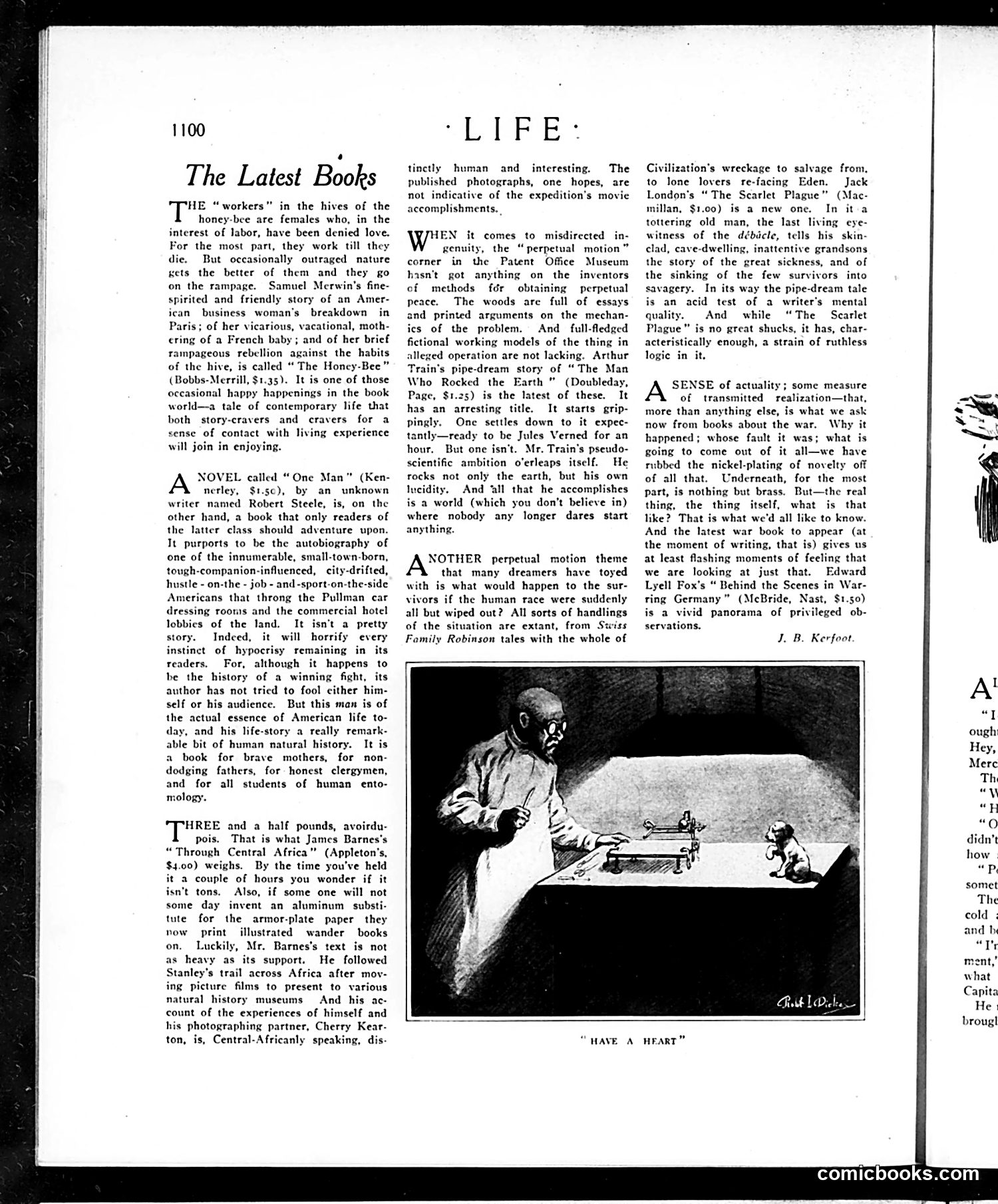
The illustration depicts an elderly man operating what appears to be a mechanical device or machine at a workbench, while a small child watches from the side. The caption reads "HAVE A HEART." **Context and Meaning:** This appears to be social commentary on industrialization and its human cost. The cartoon likely critiques the dehumanizing effects of machinery and factory work—themes central to early 20th-century Progressive Era concerns. The juxtaposition of the child observer suggests commentary on generational impact or the moral implications of mechanization. The phrase "Have a Heart" is an appeal for compassion or humanity, implying the machine-operator (or those promoting industrial progress) lack sympathy for human welfare. This aligns with the page's book reviews discussing labor conditions ("workers" in hives denied love, working until death) and the "actual essence of American life"—harsh industrial realities. The cartoonist (signed, though signature is unclear) uses the mechanical device as a metaphor for cold industrial progress at odds with human needs and dignity.
📄 Transcribed text from this page (OCR, searchable)
Machine-transcribed from the original scan — historical spelling and the odd misread are preserved.
1100 The Latest Books HE “ workers" in the hives of the honey-bee are females who, in the interest of labor, have been denied love. For the most part, they work till they die, But occasionally outraged nature kets the better of them and they go on the rampage. Samuel Merwin’s fine- spirited and friendly story of an Amer- in business woman's breakdown in Paris; of her vicarious, vacational, moth- ering of a French baby ; and of her brief rampageous rebellion against the habits of the hive, is called “ The Honcy-Bee” (Bobbs-Merrill, $1.35). It is one of those occasional happy happenings in the book world—a tale of contemporary life that both story-cravers and cravers for a sense of contact with living experience will join in enjoying. NOVEL called “One Man” (Ken- nerley, $1.5¢), by an unknown writer named Robert Steele, is, on the other hand, a book that only readers of the latter class should adventure upon. It purports to be the autobiography of one of the innumerable, small-town-born, tough-companion-influenced, city-drifted, hustle - on-the - job - and-sport-on-the-side Americans that throng the Pullman car dressing rooms and the commercial hotel lobbies of the land. It isn't a pretty story. Indeed, it will horrify every instinct of hypocrisy remaining in its readers. For, although it happens to be the history of a winning fight, its author has not tried to fool cither him- self or his audience. But this man is of the actual essence of American life to- day, and his life-story a really remark able bit of human natural history. It is a book for brave mothers, for non- dodging fathers, for honest clergymen, and for all students of human ento- mology. HREE and a half pounds, avoirdu- pois. That is what James Barnes's Through Central Africa” (Appleton’s, $4.00) weighs. By the time you've held it a couple of hours you wonder if it isn’t tons, Also, if some one will not some day invent an aluminum substi- tute for the armor-plate paper they now print illustrated wander books on. Luckily, Mr. Barnes's text is not as heavy as its support. He followed Stanley's trail across Africa after mov- ing picture films to present to various natural history museums And his ac- count of the experiences of himself and his photographing partner, Cherry Kear- ton, is, Central-Africanly speaking, dis- UE, HE' Et tinetly human and interesting. The published photographs, one hopes, are not indicative of the expedition’s movie accomplishments. wv" N it comes to misdirected in: genuity, the “perpetual motion corner in the Patent Office Museum hasn't got anything on the inventors of methods fdr obtaining perpetual peace. The woods are full of essays and printed arguments on the mechan- ics of the problem. And full-fledged fictional working models of the thing in alleged operation are not lacking. Arthur ain's pipe-dream story of “The Man Who Rocked the Earth " (Doubleday, Page, $1.25) is the latest of these. It has an arresting title. It starts grip- pingly. One settles down to it expec- tantly—ready to be Jules Verned for an hour, But one isn't. Mr. Train's pseudo- scientific ambition o’erleaps itself. He rocks not only the earth, but his own lucidity. And ‘all that he accomplishes is a world (which you don't believe in) where nobody any longer dares start anything. NOTHER perpetual motion theme that many dreamers have toyed with is what would happen to the sur- vivors if the human race were suddenly all but wiped out? All sorts of handlings of the situation are extant, from Swiss Family Robinson tales with the whole of Civilization’s wreckage to salvage from, to lone lovers re-facing Eden. Jack London's “The Scarlet Plague” (Mac- millan, $1.00) is a new one. In it a tottering old man, the last living eye- witness of the débdcle, tells his skin- clad, cave-dwelling, inattentive grandsons the story of the great sickness, and of the sinking of the few survivors into savagery. In its way the pipe-dream tale is an acid test of a writer's mental quality. And while “The Scarlet Plague” is no great shucks, it has, char- acteristically enough, a strain of ruthless logic in it. SENSE of actuality; some measure of transmitted realization—that, more than anything else, is what we ask now from books about the war, Why it happened; whose fault it was; what is going to come out of it all—we have rubbed the nickel-plating of novelty off of all that. Underneath, for the most part, is nothing but brass. But—the real thing, the thing itself, what is that like? That is what we'd all like to know. And the latest war book to appear (at the moment of writing, that is) gives us at least flashing moments of feeling that we are looking at just that. Edward Lyell Fox's “ Behind the Scenes in War- ring Germany” (McBride, Nast, $1.50) is a vivid panorama of privileged ob- servations. J.B. Kerfoot “HAVE A HEART” A ay ough’ Hey, Merc Th “v “H “O didn't how oP somet The cold and Ih a ment,’ what Capita He | brougl comicbooks.com