
Life, 1915-06-17 · page 32 of 52
Life — June 17, 1915 — page 32: what you’re looking at
What you’re looking at
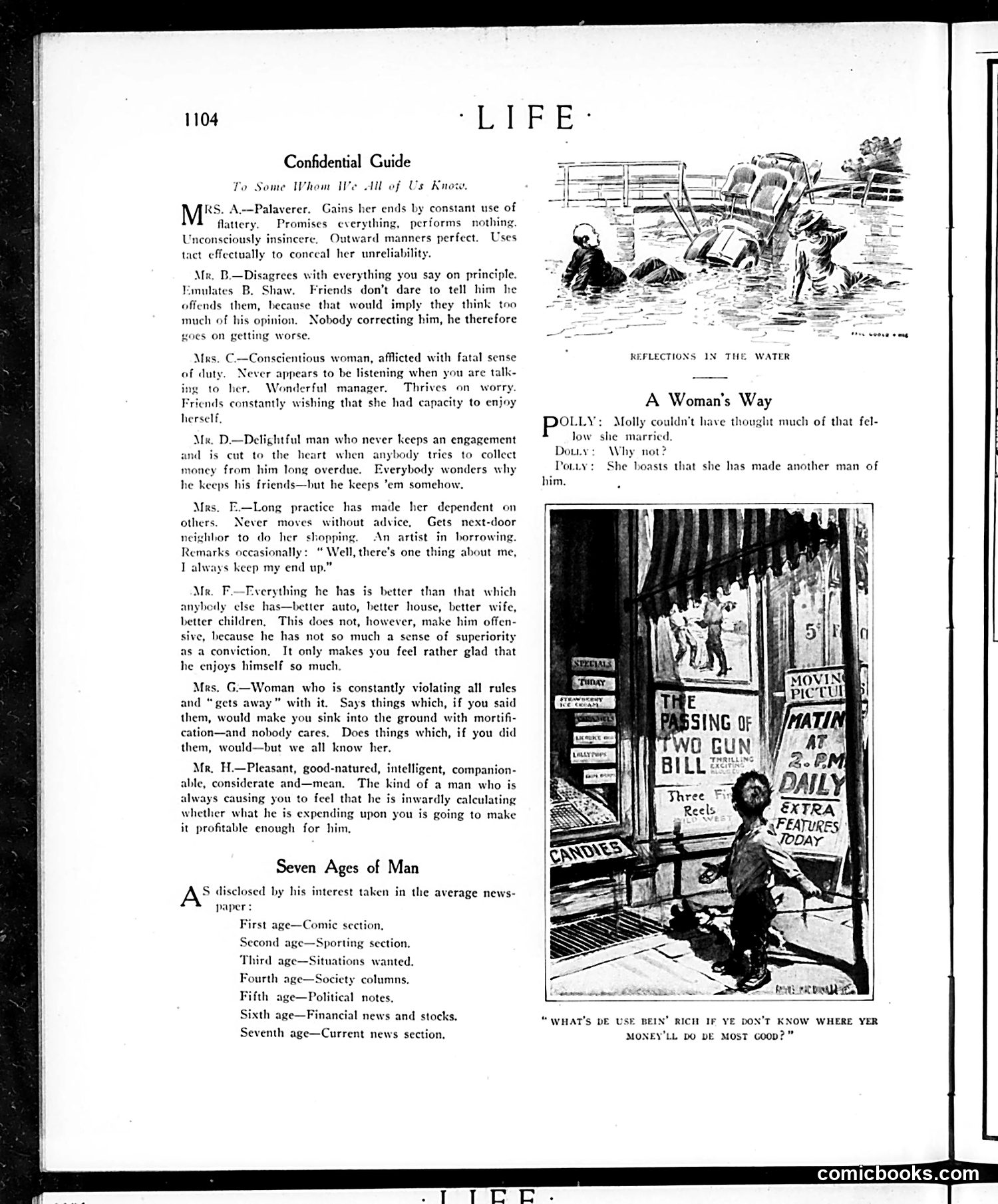
This page contains two distinct pieces of social satire typical of Life's early 20th-century format: **"Confidential Guide"** presents eight character types (Mrs. A through Mr. H) representing common social personalities—the flatterer, contrarian, obsessive-duty woman, unreliable man, dependent borrower, braggart, rule-breaker, and calculating miser. These are broad satirical sketches of recognizable social archetypes meant to entertain through recognition. **"Seven Ages of Man"** cleverly parallels Shakespeare's famous monologue, but instead tracks a man's life through newspaper-reading habits: from comics (youth) through sports, job-hunting, society news, politics, and finance, ending with current events (old age). It's a humorous commentary on how newspapers reflect life stages and priorities. **"A Woman's Way"** presents a brief joke about marriage: a woman boasts she's "made another man" of her husband, implying she's fundamentally changed him—which the conversation frames as evidence she didn't think much of him initially. The street scene cartoon at bottom depicts an impoverished child questioning the value of wealth without knowing how to use it wisely.
📄 Transcribed text from this page (OCR, searchable)
Machine-transcribed from the original scan — historical spelling and the odd misread are preserved.
Confidential Guide To Some Whom We All of Us Know. . A.—Palaverer. Gains her ends by constant use of flattery. Promises everything, performs nothing. Unconsciously insincere, Outward manners perfect. Uses tact effectually to conceal her unreliability. Mr, B.—Disagrees with everything you say on principle. Emulates B. Shaw. Friends don’t dare to tell him he offends them, because that would imply they think too much of his opinion. Nobody correcting him, he therefore Koes on getting worse. Mrs. C.—Conscientious woman, afflicted with fatal sense of duty, Never appears to be listening when you are talk- ing to her. Wonderful manager. Thrives on worry. Friends constantly wishing that she had capacity to enjoy herself, Mx. D.—Delightful man who never keeps an engagement and is cut to the heart when anybody tries to collect money from him long overdue. Everybody wonders why he keeps his friends—but he keeps ’em somehow. Mrs, Long practice has made her dependent on others. ver moves without advice, Gets next-door neighbor to do her shopping. An artist in borrowing Remarks occasionally: “ Well, there's one thing about me, I always keep my end up.” Me. F.—Everything he has is better than that which anybedy else has—better auto, better house, better wife, better children, This does not, however, make him offen- sive, because he has not so much a sense of superiority as a conviction, It only makes you feel rather glad that he enjoys himself so much. Mrs. G.—Woman who is constantly violating all rules and “gets away” with it. Says things which, if you said them, would make you sink into the ground with mortifi- cation—and nobody cares. Does things which, if you did them, would—but we all know her. Mr. H.—Pleasant, good-natured, intelligent, companion- able, considerate and—mean. The kind of a man who is always causing you to fcel that he is inwardly calculating whether what he is expending upon you is going to make it profitable enough for him. Seven Ages of Man AS disclosed by his interest taken in the average news- paper irst age—Comic section, Second age—Sporting section. Third age—Situations wanted. Fourth age—Society columns, Fifth age—Political notes, Sixth age—Financial news and stocks. Seventh age—Current news section, REFLECTIONS 1N THE WATER A Woman's Way OLLY: Molly couldn't have thought much of that fel- low she married, Douy: Why not? Ponty: She boasts that she has made another man of him. “WHAT'S DE USE BEIN’ RICH IF YE DON'T KNOW WHERE YER MONEY'LL DO DE Most Goop?” comicbooks.com