
Life, 1915-06-17 · page 12 of 52
Life — June 17, 1915 — page 12: what you’re looking at
What you’re looking at
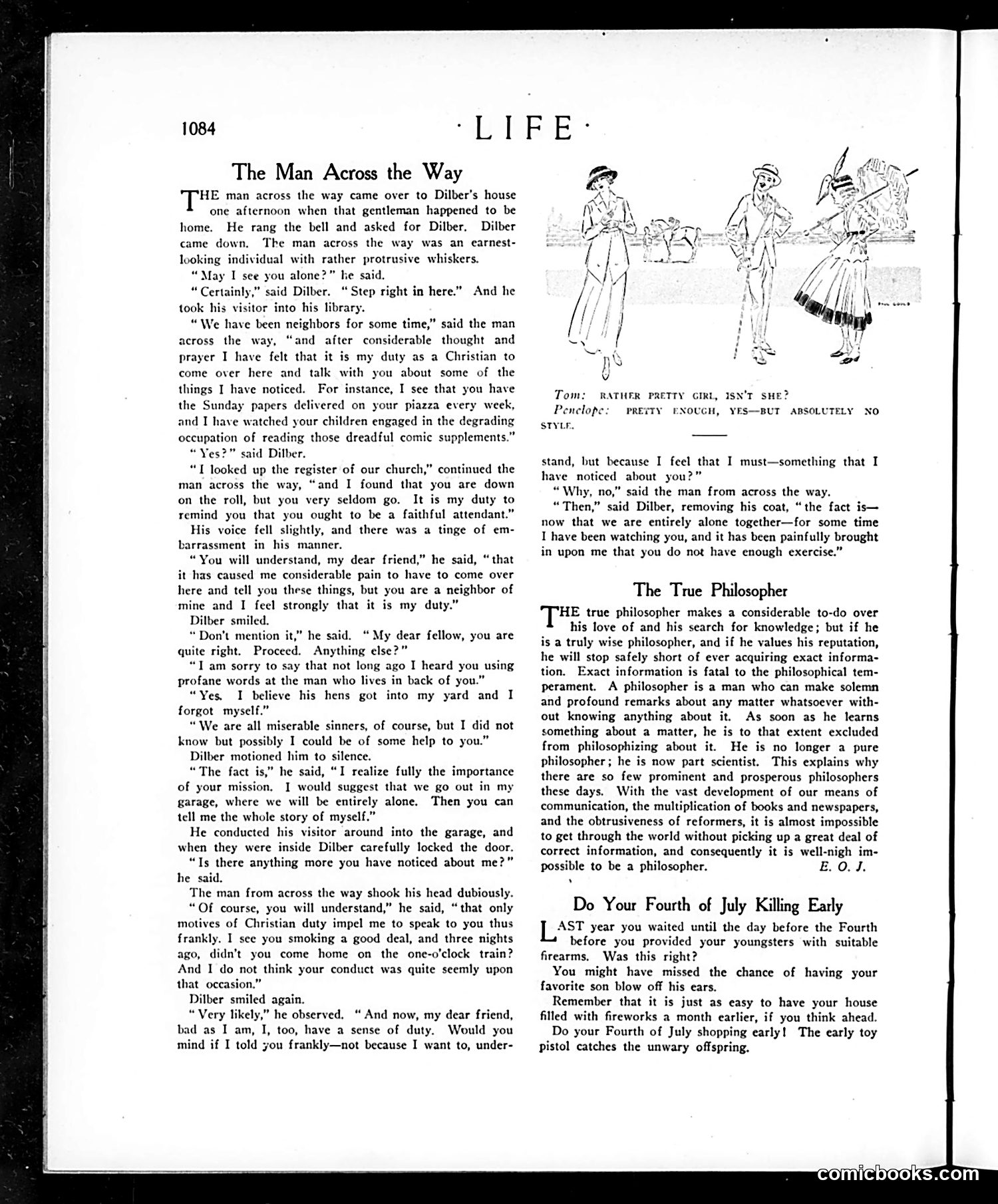
This page contains two separate pieces of satirical content: **"The Man Across the Way"** (left column): A short story about a neighbor who visits to criticize Dilber's family for reading comic supplements and not attending church regularly. The neighbor lectures about Christian duty. The satire targets self-righteous, nosy neighbors who presume moral authority while meddling in others' private lives. **"The True Philosopher"** (right column): A brief essay mocking philosophers who claim expertise while admitting ignorance. It argues that true philosophers avoid making definitive claims, making it "well-nigh impossible to be a philosopher" in modern times. **"Do Your Fourth of July Killing Early"** (bottom right): Advises buying fireworks in advance rather than waiting until July 3rd to avoid accidents. This is straightforward practical safety advice, not satire. The illustration shows fashionable women, apparently unrelated to the text content.
📄 Transcribed text from this page (OCR, searchable)
Machine-transcribed from the original scan — historical spelling and the odd misread are preserved.
“DEAE * The Man Across the Way HE man across the way came over to Dilber’s house one afternoon when that gentleman happened to be He rang the bell and asked for Dilber. Dilber came down, The man across the way was an earnest- looking individual with rather protrusive whiskers. “May I see you alone?” ke said. “Certainly,” said Dilber. “Step right in here.” And he took his visitor into his library. “We have been neighbors for some time,” said the man across the way, “and after considerable thought and prayer I have felt that it is my duty as a Christian to come over here and talk with you about some of the things I have noticed. For instance, I see that you have the Sunday papers delivered on your piazza every week, and I have watched your children engaged in the degrading occupation of reading those dreadful comic supplements.” “Yes?” said Dilber, “TI looked up the register of our church,” continued the man across the way, “and I found that you are down on the roll, but you very seldom go. It is my duty to remind you that you ought to be a faithful attendant.” His voice fell slightly, and there was a tinge of em- barrassment in his manner. “You will understand, my dear friend,” he said, “that it has caused me considerable pain to have to come over here and tell you these things, but you are a neighbor of mine and I feel strongly that it is my duty.” Dilber smiled. “Don’t mention it,” he said. “ My dear fellow, you are quite right. Proceed. Anything else?” “Tam sorry to say that not long ago I heard you using profane words at the man who lives in back of you.” “Yes, I believe his hens got into my yard and I forgot myself.” “We are all miserable sinners, of course, but I did not know but possibly I could be of some help to you.” Dilber motioned him to silence. Phe fact is,” he said, “I realize fully the importance of your mission. I would suggest that we go out in my garage, where we will be entirely alone. Then you can tell me the whole story of myself.” He conducted his visitor around into the garage, and when they were inside Dilber carefully locked the door. “Ts there anything more you have noticed about me?” he said. The man from across the way shook his head dubiously. “Of course, you will understand,” he said, “that only motives of Christian duty impel me to speak to you thus frankly. I see you smoking a good deal, and three nights ago, didn’t you come home on the one-o'clock train? And I do not think your conduct was quite seemly upon that occasion.” Dilber smiled again. “Very likely,” he observed, “ And now, my dear friend, bad as I am, I, too, have a sense of duty. Would you mind if I told you frankly—not because I want to, under- home. Tom: RATHER PRETTY GIRL, ISN'T SHE? Penelope: PRETTY ENOUGH, YES—BUT ABSOLUTELY NO STYLF. stand, but because I feel that I must—something that I have noticed about you?” “Why, no,” said the man from across the way. “Then,” said Dilber, removing his coat, “the fact is— now that we are entirely alone together—for some time I have been watching you, and it has been painfully brought in upon me that you do not have enough exercise.” The True Philosopher 'HE true philosopher makes a considerable to-do over his love of and his search for knowledge; but if he is a truly wise philosopher, and if he values his reputation, he will stop safely short of ever acquiring exact informa- tion. Exact information is fatal to the philosophical tem- perament. A philosopher is a man who can make solemn and profound remarks about any matter whatsoever with- out knowing anything about it. As soon as he learns something about a matter, he is to that extent excluded from philosophizing about it. He is no longer a pure philosopher; he is now part scientist. This explains why there are so few prominent and prosperous philosophers these days. With the vast development of our means of communication, the multiplication of books and newspapers, and the obtrusiveness of reformers, it is almost impossible to get through the world without picking up a great deal of correct information, and consequently it is well-nigh im- possible to be a philosopher. E.0. J. Do Your Fourth of July Killing Early L‘‘st year you waited until the day before the Fourth before you provided your youngsters with suitable firearms, Was this right? You might have missed the chance of having your favorite son blow off his ears. Remember that it is just as easy to have your house filled with fireworks a month earlier, if you think ahead. Do your Fourth of July shopping early! The early toy pistol catches the unwary offspring.