
Life, 1915-06-17 · page 25 of 52
Life — June 17, 1915 — page 25: what you’re looking at
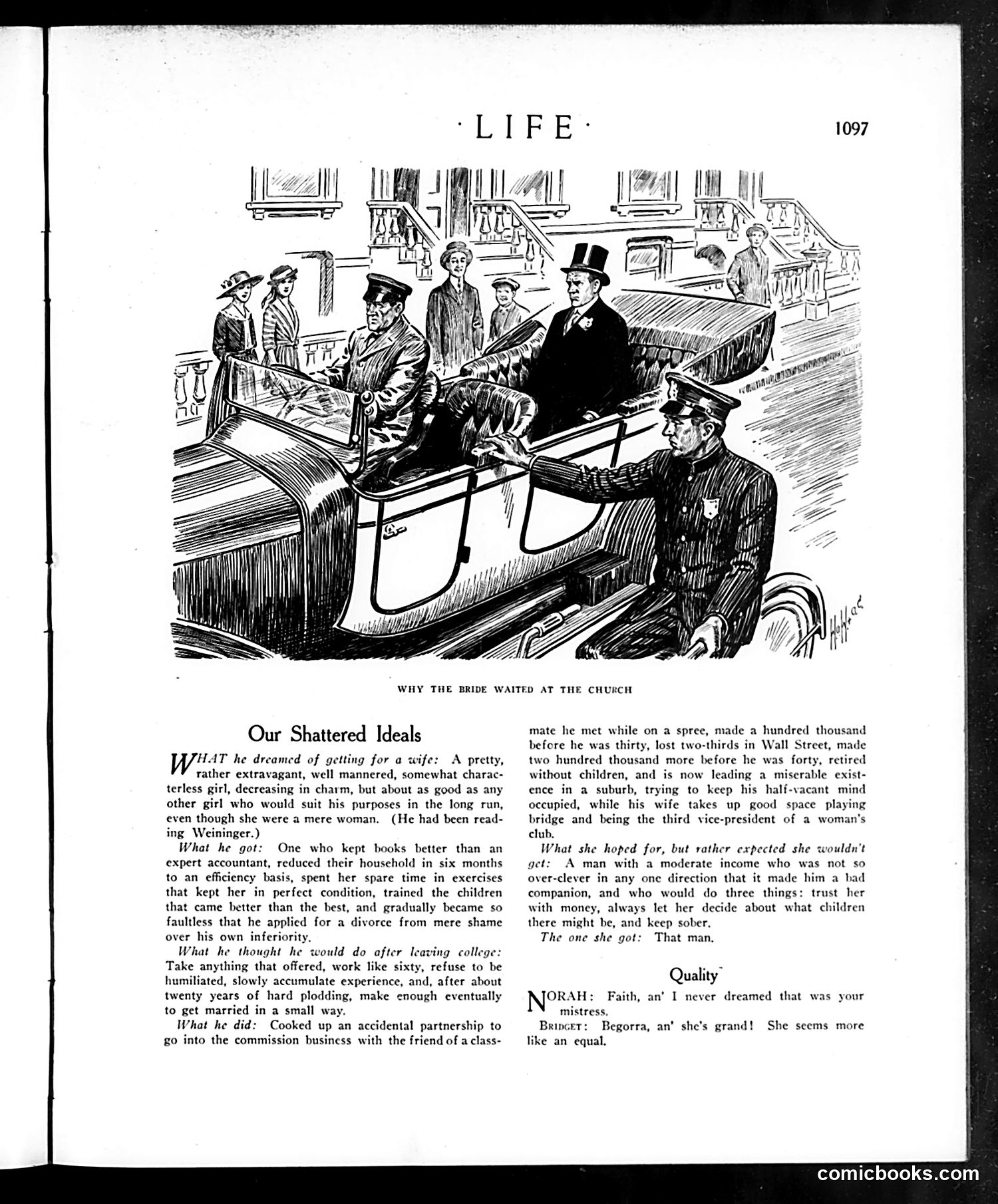
What you’re looking at
This satirical piece mocks the gap between romantic ideals and married reality. The cartoon titled "Why the Bride Waited at the Church" depicts a bride refusing to proceed with her wedding, illustrated by a carriage scene at what appears to be a church entrance. The text presents four parallel narratives of "shattered ideals"—what husbands and wives expected versus what they actually got in marriage. The satire shows how both partners' expectations proved unrealistic: the man wanted a decorative but competent wife but got an overachieving woman who made him feel inferior; the woman wanted a modest, trustworthy man and actually got exactly that, yet it left her unfulfilled. The dialogue at bottom, featuring Irish characters (indicated by "Begorra" and Irish-inflected speech), appears to comment on class dynamics—a working-class man's surprise that the refined woman is actually the employer's wife, suggesting social mobility tensions. The overall message critiques how modern marriage disappoints both parties: ambition, efficiency, and material success replace romantic connection.
📄 Transcribed text from this page (OCR, searchable)
Machine-transcribed from the original scan — historical spelling and the odd misread are preserved.
WHY THE BRIDE WAITED AT THE CHURCH Our Shattered Ideals HAT he dreamed of getting for a wife: A pretty, rather extravagant, well mannered, somewhat charac- terless girl, decreasing in charm, but about as good as any other girl who would suit his purposes in the long run, even though she were a mere woman. (He had been read- ing Weininger.) What he got: One who kept books better than an expert accountant, reduced their household in six months to an efficiency basis, spent her spare time in exercises that kept her in perfect condition, trained the children that came better than the best, and gradually became so faultless that he applied for a divorce from mere shame over his own inferiority, What he thought he would do after leaving college: Take anything that offered, work like sixty, refuse to be humiliated, slowly accumulate experience, and, after about twenty years of hard plodding, make enough eventually to get married in a small way. What he did: Cooked up an accidental partnership to go into the commission business with the friend of a class- mate he met while on a spree, made a hundred thousand before he was thirty, lost two-thirds in Wall Street, made two hundred thousand more before he was forty, retired without children, and is now leading a miserable exist- ence in a suburb, trying to keep his half-vacant mind occupied, while his wife takes up good space playing bridge and being the third vice-president of a woman's club. What she hoped for, but rather expected she wouldn't get: A man with a moderate income who was not so over-clever in any one direction that it made him a bad companion, and who would do three things: trust her with money, always let her decide about what children there might be, and keep sober, The one she got: That man, Quality” ORAH: = Faith, an’ I never dreamed that was your mistress, Brincet: Begorra, an’ she’s grand! like an equal, She seems more comicbooks.com