
A complete issue · 40 pages · 1915
Life — January 28, 1915
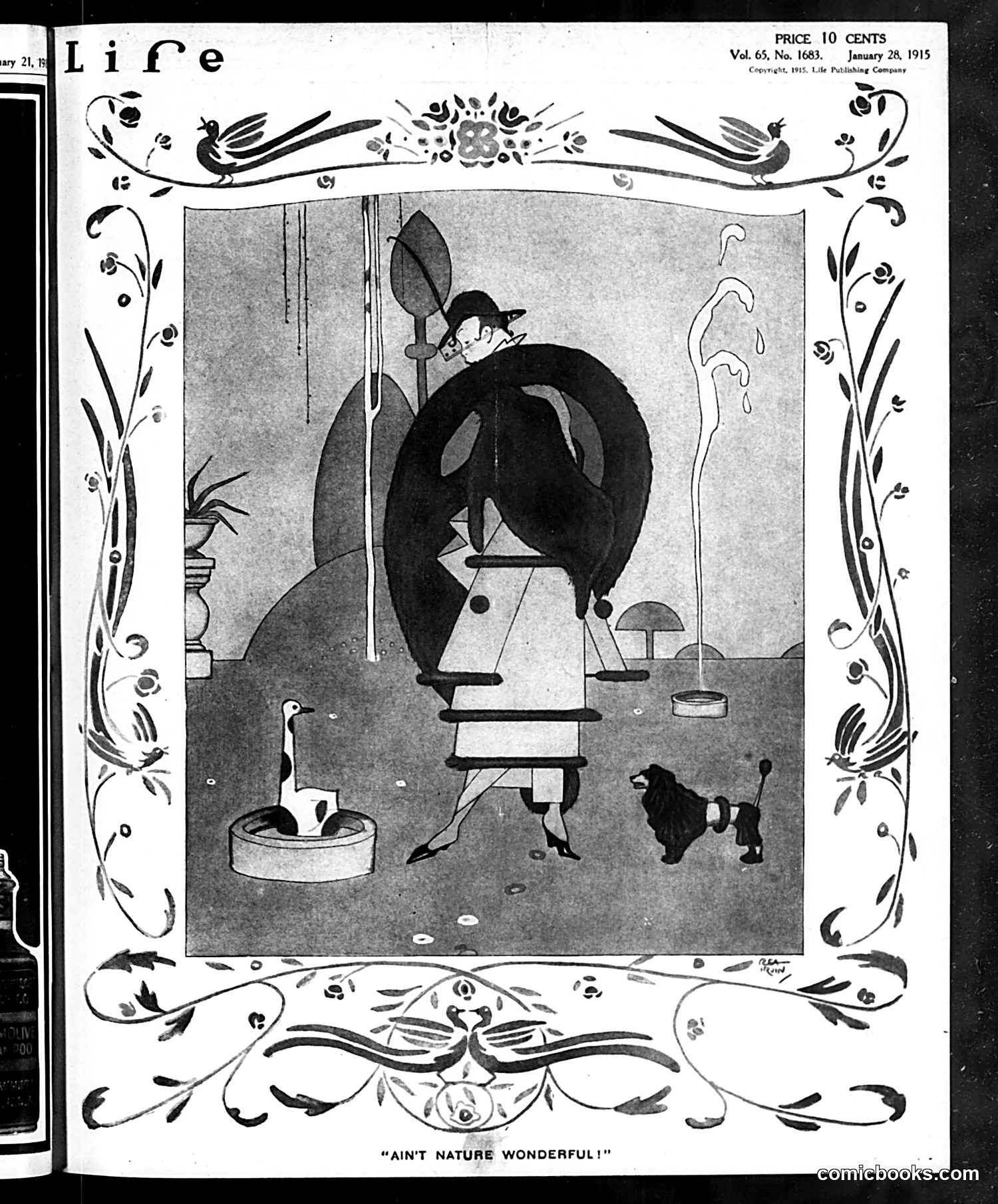
This 1915 *Life* magazine cartoon depicts a person in black clothing tending to an enormous, grotesque plant with large leaf-like appendages. The figure wears a hat and appears to be a gardener or botanist carefully cultivating this unnatural specimen. A small dog observes nearby. The caption "Ain't Nature Wonderful!" employs irony—the monstrous plant is clearly artificial or grotesquely engineered, not natural at all. This likely satirizes either scientific experimentation gone awry, the artificiality of heavily processed products marketed as "natural," or perhaps industrial agriculture's transformation of nature. The ornate Art Nouveau border frames this commentary on the contradiction between claims of naturalness and the reality of human intervention in the natural world.
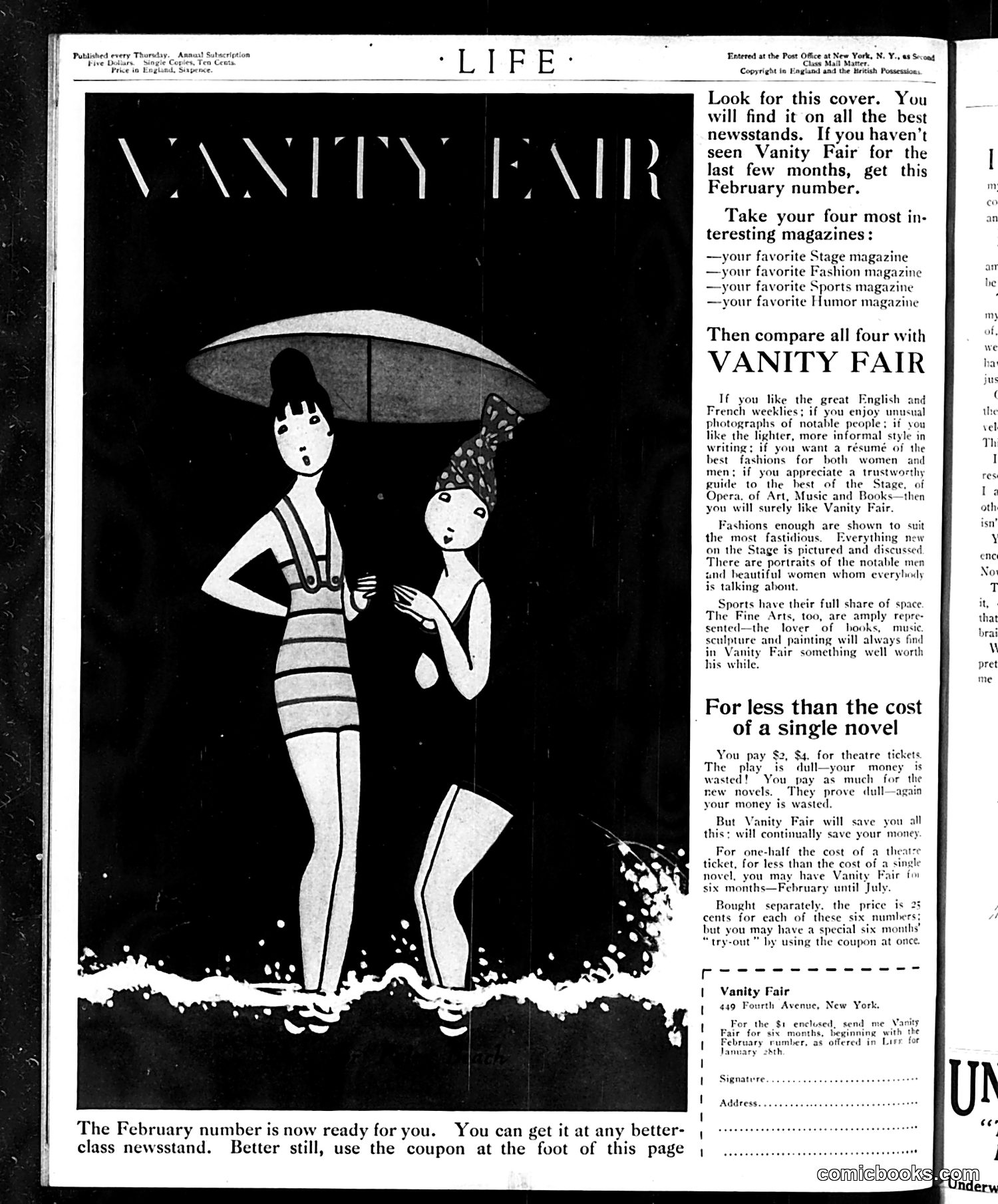
This page is primarily **advertising for Vanity Fair magazine**, not political satire. The left side features an Art Deco illustration of two stylishly dressed women with an umbrella in the rain—typical 1920s fashion imagery emphasizing elegance and modernity. The advertisement's pitch emphasizes Vanity Fair's superiority over competitors by claiming it offers superior coverage of stage, fashion, sports, and humor compared to four other magazines combined. It highlights the magazine's focus on "notable people" and "beautiful women" alongside cultural content. The pricing comparison (less than a novel's cost for a six-month subscription) and coupon at bottom are standard period advertising tactics. This is essentially a **lifestyle magazine promotion** targeting affluent readers interested in entertainment, fashion, and arts—not political commentary.
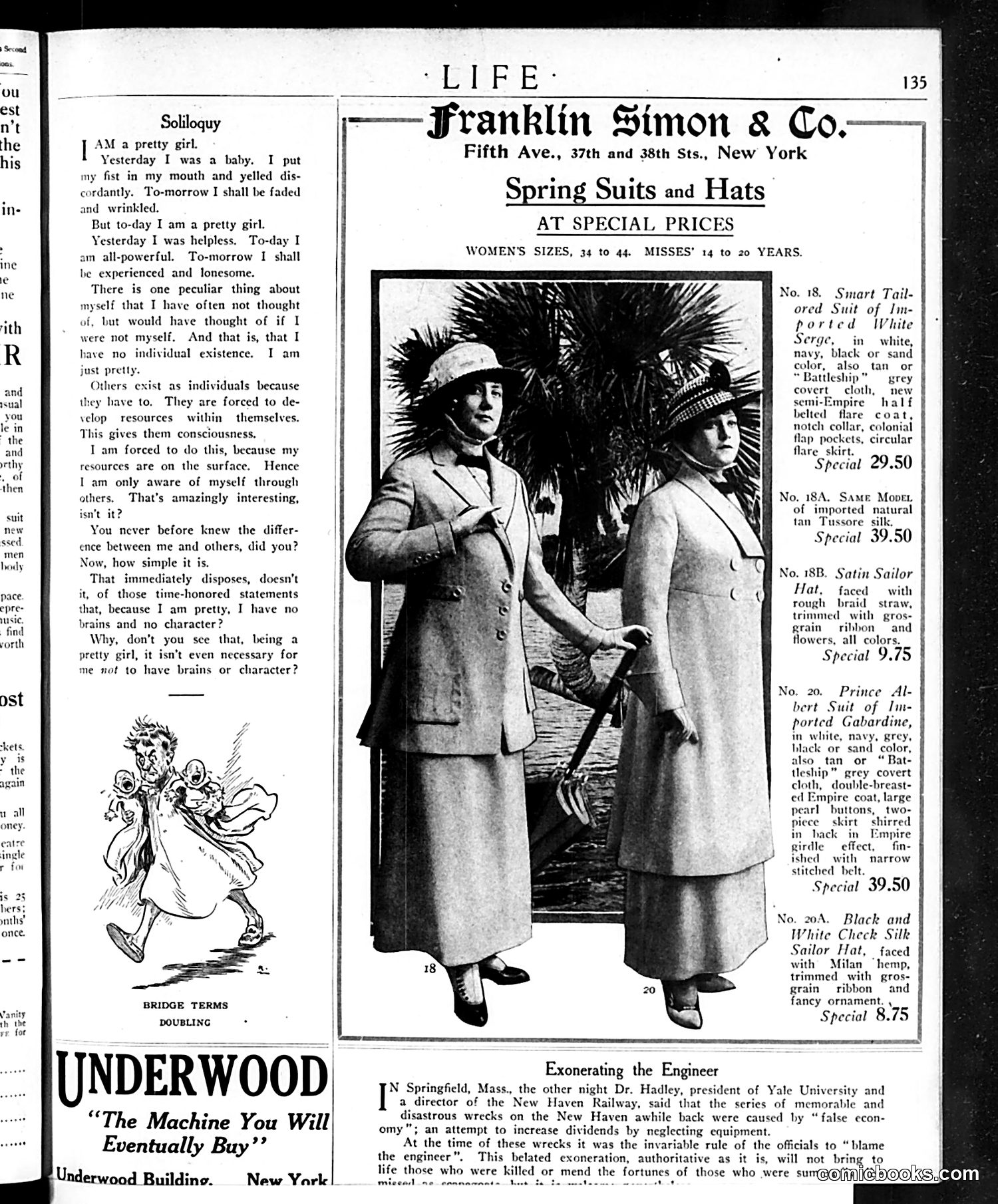
This page is primarily **advertising and light editorial content** rather than political satire. The left column contains a "Soliloquy" essay by a woman reflecting on her individuality and self-awareness—a piece about personal identity and consciousness, not political commentary. Below that is a small cartoon illustrating "Bridge Terms: Doubling," a bridge card game instruction, with a whimsical figure. The main content is a **Franklin Simon & Co. advertisement** showcasing spring suits and hats for women, with two models wearing tailored suits and fashionable hats typical of the 1920s era. The lower article, "Exonerating the Engineer," discusses a Yale University president's comments about railroad wreck investigations—appearing to be straightforward news rather than satire. This page reflects Life's mix of advertising, fashion, and commentary rather than concentrated political satire.
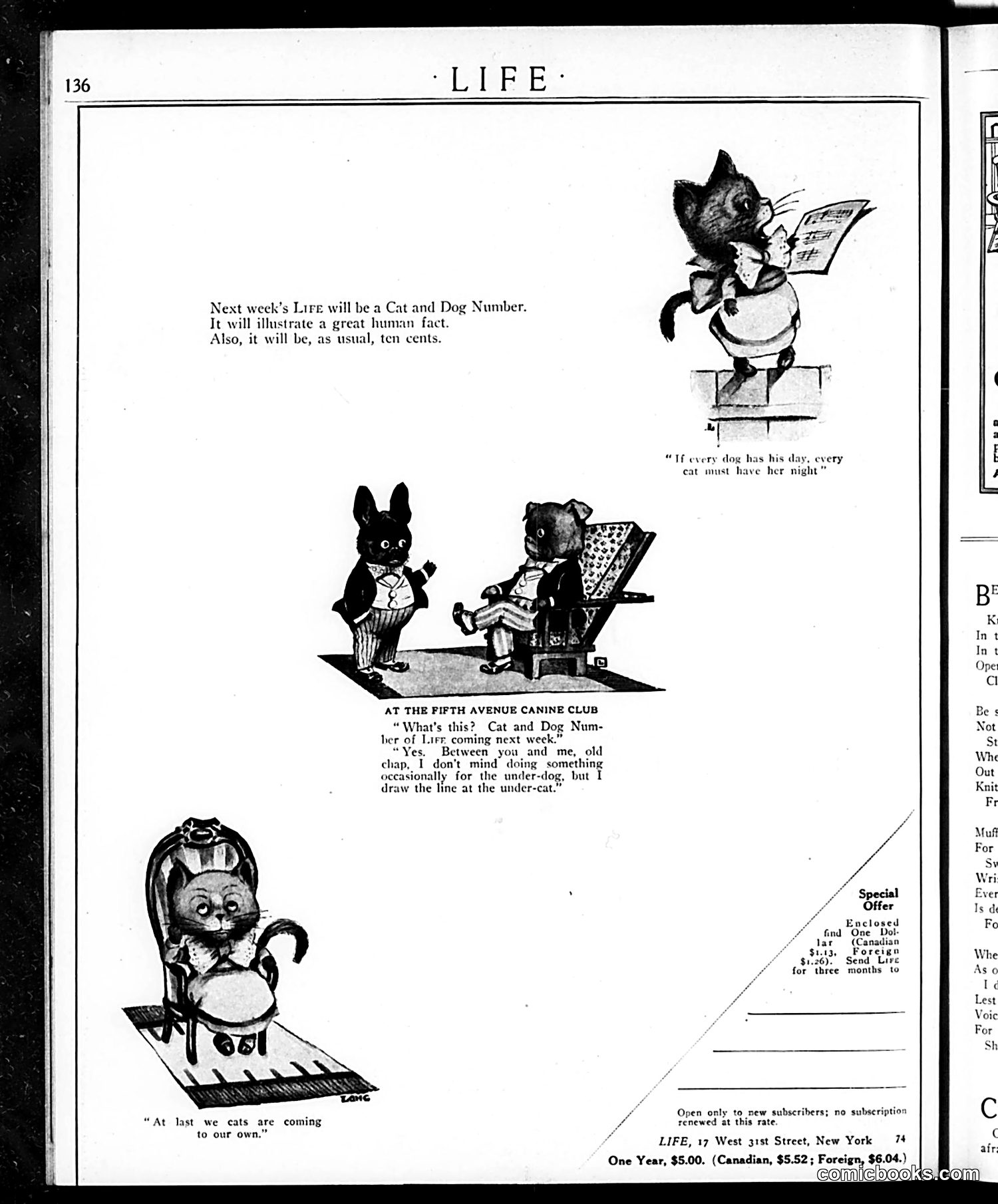
This page consists primarily of **lighthearted animal humor** rather than political satire. The content advertises next week's "Cat and Dog Number" of *Life* magazine. The three cartoon illustrations anthropomorphize cats and dogs in human situations: 1. **Top right**: A cat reading sheet music, captioned "If every dog has his day, every cat must have her night" — a playful gender-based joke inverting the common saying. 2. **Center**: Two animals at the "Fifth Avenue Canine Club," discussing the upcoming issue. 3. **Bottom left**: A cat at a piano, captioned "At last we cats are coming to our own" — suggesting cats' cultural ascendancy. The humor relies on pet stereotypes and domestic animal personification rather than political commentary. This appears to be **pure entertainment content** marketed to middle-class readers.
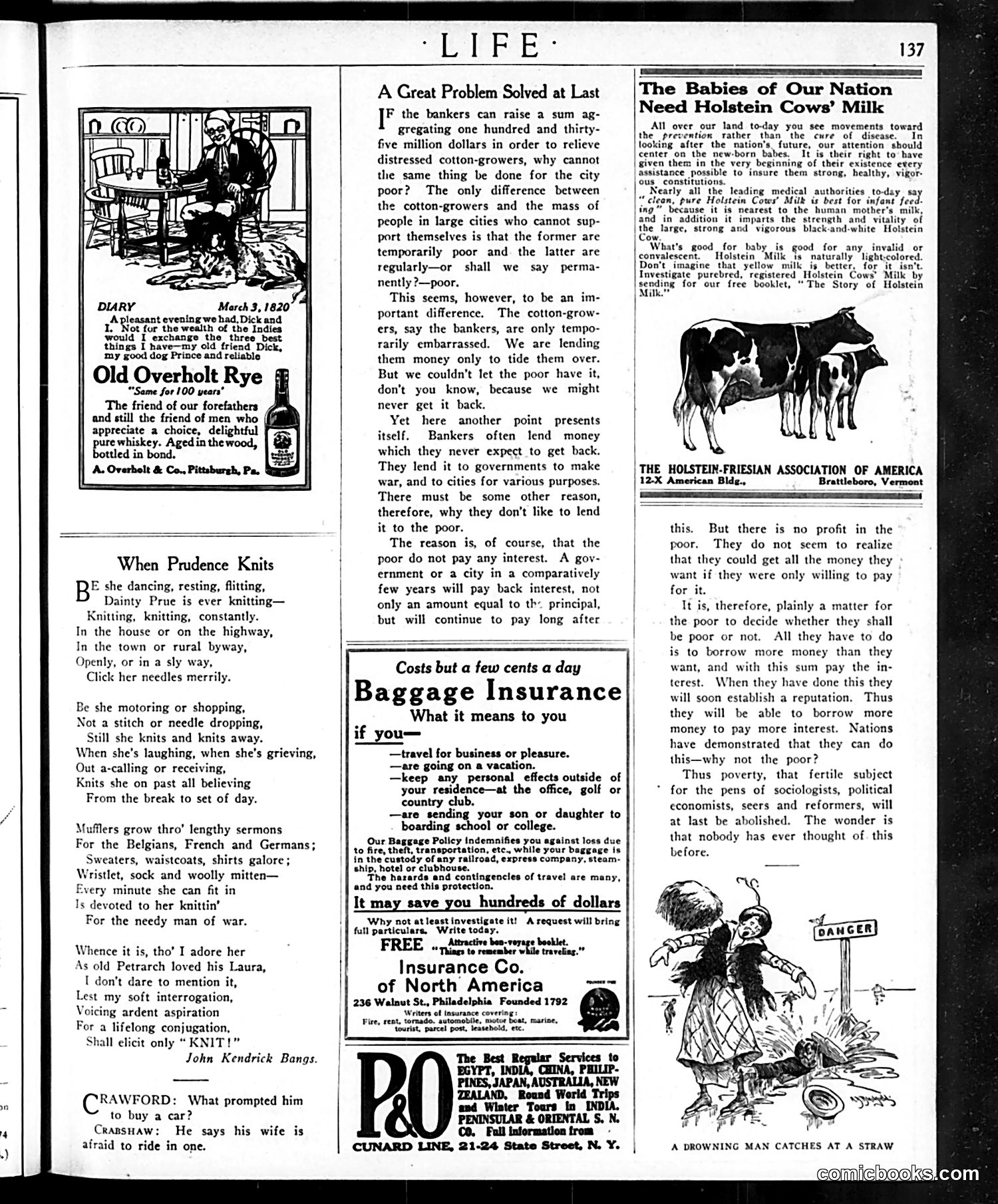
This page is primarily **advertising and light humor** rather than political satire. The main cartoon shows two men in an office discussing banking policy. The text debates whether banks should lend money to poor urban residents versus temporarily embarrassed cotton farmers. The satire suggests **class hypocrisy**: bankers justify lending to farmers as temporary hardship while refusing poor city-dwellers the same consideration, though both may be equally unable to repay. Other content includes: - A poem "When Prudence Knits" celebrating women's wartime knitting efforts - An insurance company advertisement - A brief joke about a man afraid to ride in a car - A drowning safety illustration The page reflects **1910s-1920s concerns** about poverty, banking practices, and women's wartime domestic contributions, though most space is devoted to commercial advertising.
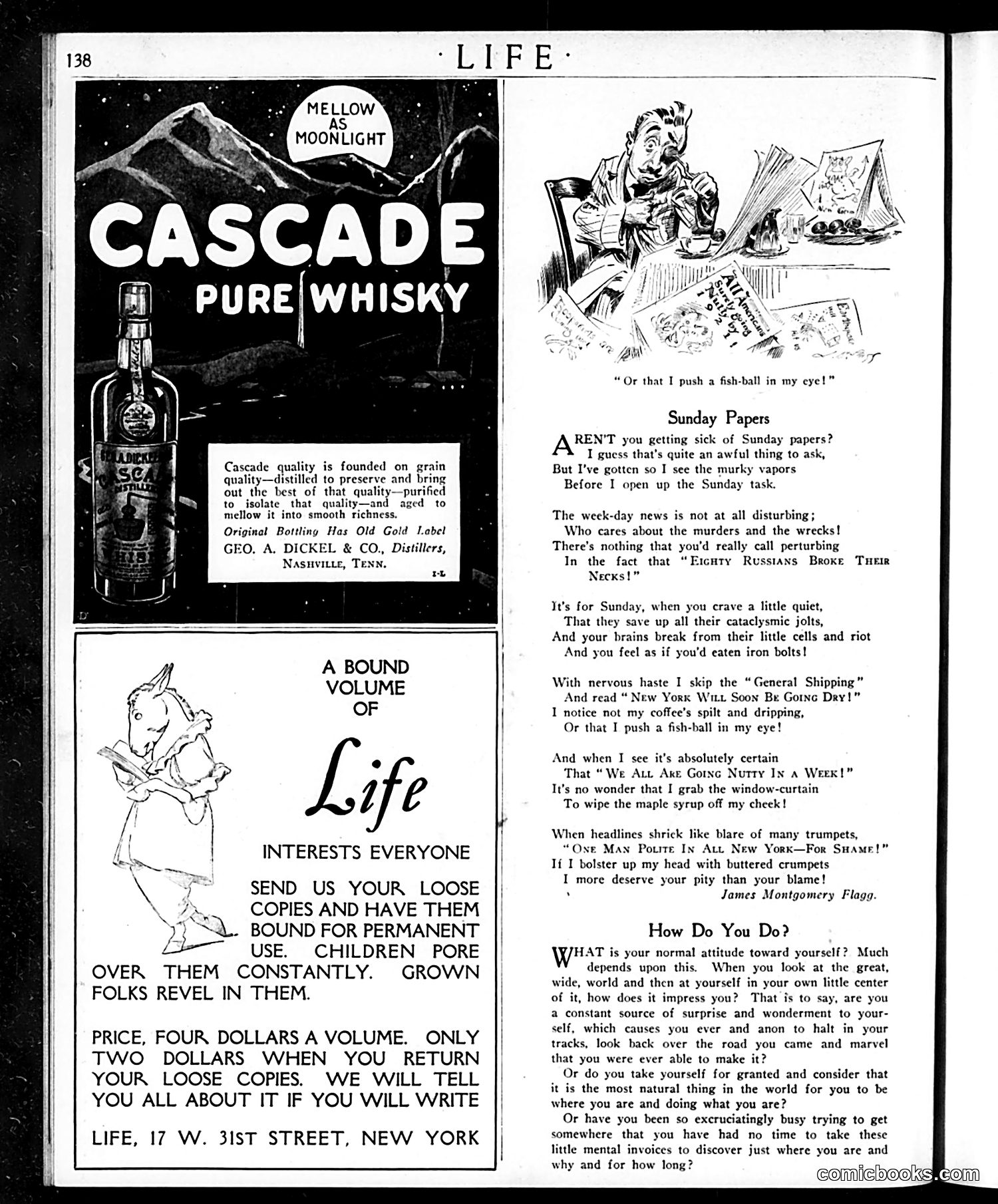
This page contains primarily **advertisements and editorial content** rather than political cartoons. The main advertisement promotes **Cascade Pure Whisky**, featuring a moonlit mountain scene and emphasizing the product's quality and aging process. The distillery is located in Nashville, Tennessee. Below that is a **Life magazine subscription advertisement** offering to bind loose copies into volumes for $4, with $2 credited toward subscription when copies are returned. The right side contains a poem titled **"Sunday Papers"** by James Montgomery Flagg, satirizing readers' frustration with sensationalist headlines in Sunday newspapers. The opening illustration shows a man overwhelmed by papers, complaining about dramatic news coverage ("Eight Russians Broke Their Necks!"). The satire mocks how Sunday papers prioritize shocking, trivial stories over meaningful reporting. A separate feature, "How Do You Do?", appears to be a self-reflective advice column.
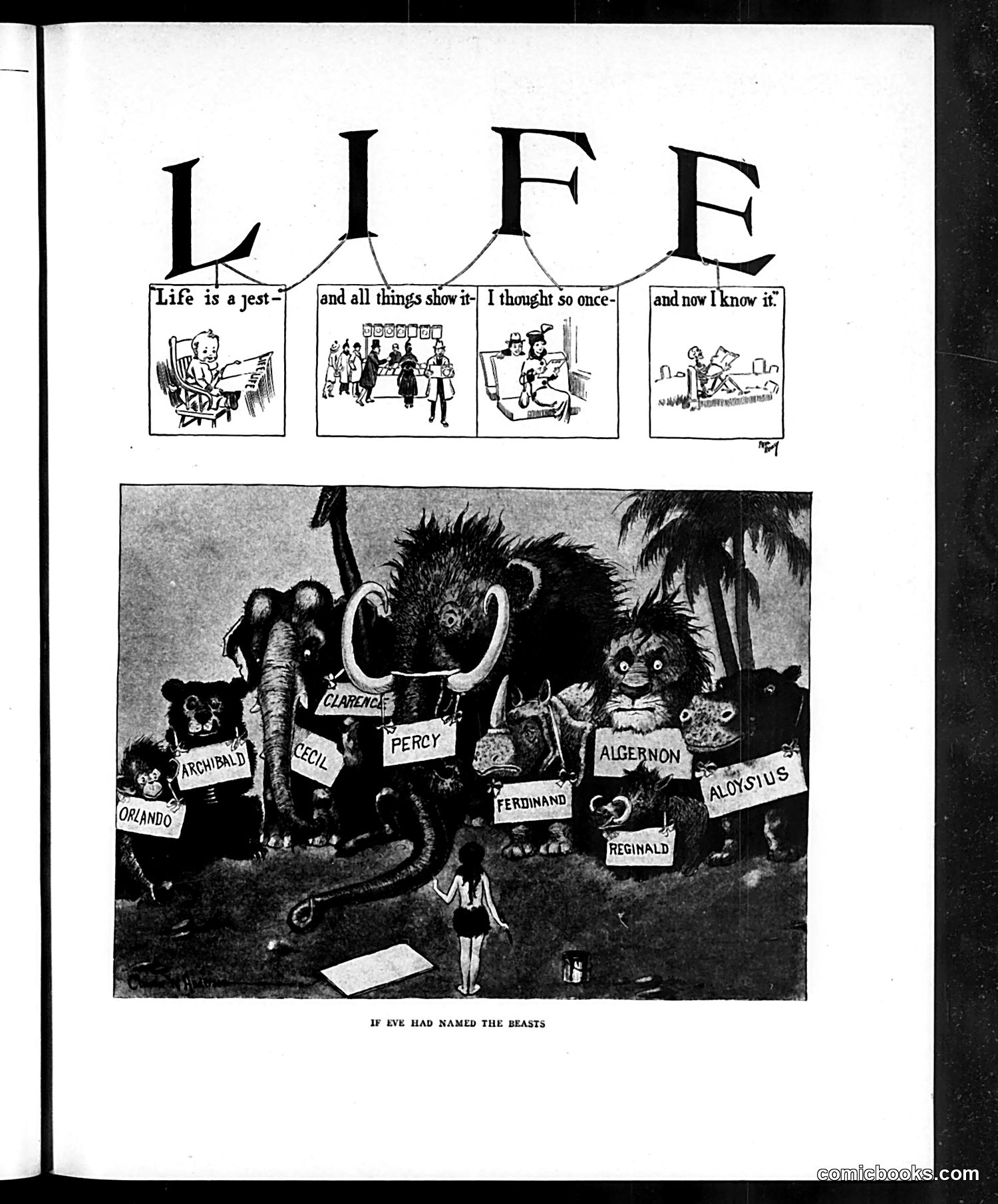
**Top Section:** A four-panel comic titled "LIFE" presents a philosophical progression: "Life is a jest—and all things show it—I thought so once—and now I know it." The panels show a figure moving from casual observation to direct experience of life's absurdities. **Bottom Section:** Titled "IF EVE HAD NAMED THE BEASTS," this satirical illustration depicts a woman (Eve) naming various animals labeled with male names: Orlando, Archibald, Cecil, Clarence, Percy, Ferdinand, Algernon, Aloysius, and Reginald. The satire mocks overly refined, aristocratic male names by suggesting they belong to animals rather than proper gentlemen—a jab at affected naming conventions and pretentious masculinity among upper-class society of the era.
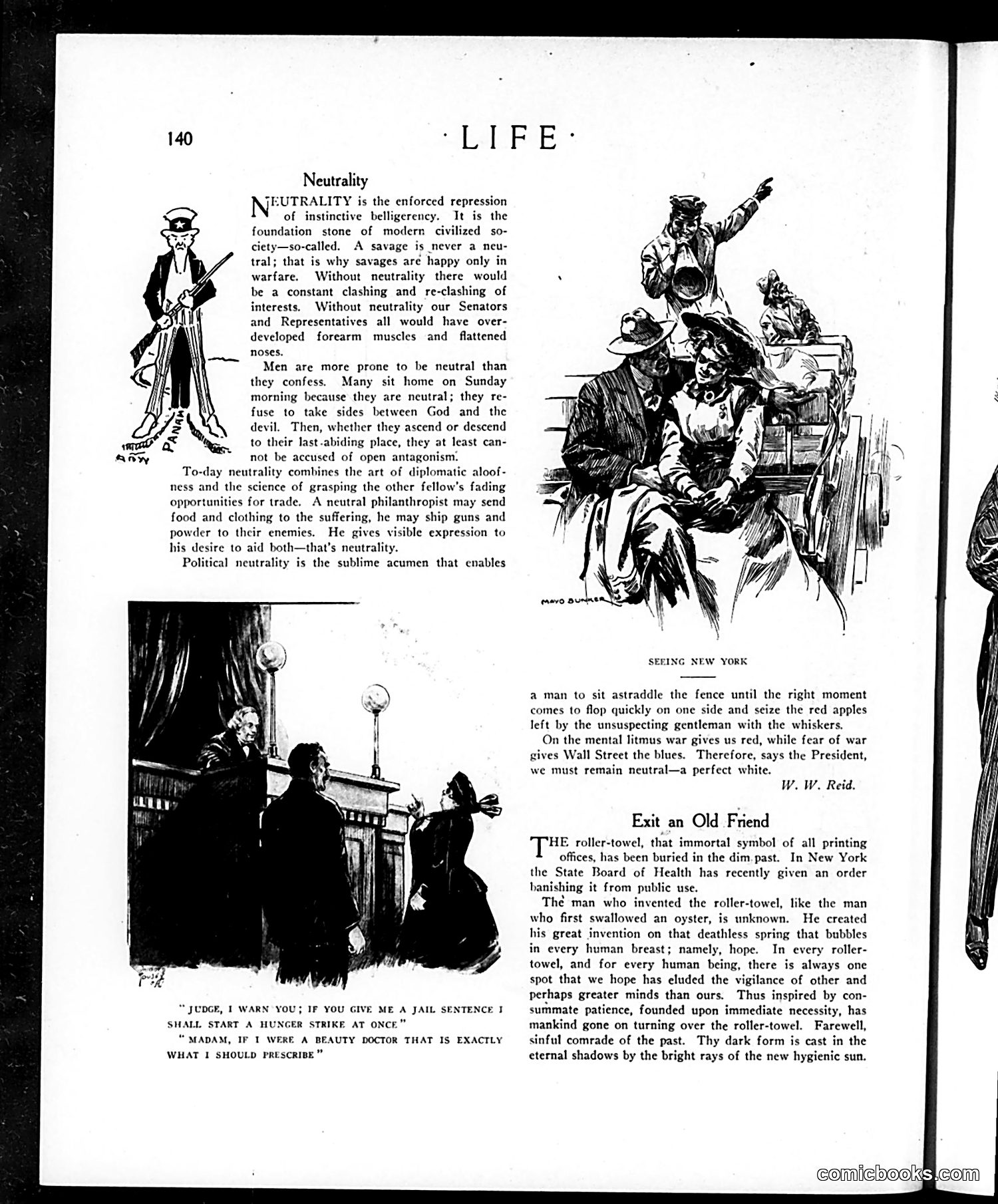
This page satirizes **neutrality** during wartime (likely WWI era, given references to Wall Street and fear of war). The top article mocks American claims of neutrality, arguing that true neutrality is impossible—neutrals still profit from war through trade and finance. The cartoon titled "SEEING NEW YORK" depicts a wealthy gentleman smugly sitting with companions, apparently representing how the rich exploit war opportunities while professing neutrality. The lower cartoon shows a street scene with a caption about jail sentences and hunger strikes, likely referencing labor unrest or political activism—suggesting the government's harsh treatment of dissidents contradicts claims of neutral, democratic principles. The "Exit an Old Friend" section discusses New York banning roller-towels for hygiene reasons, presented as progress replacing outdated practices—a metaphor for abandoning false neutrality.
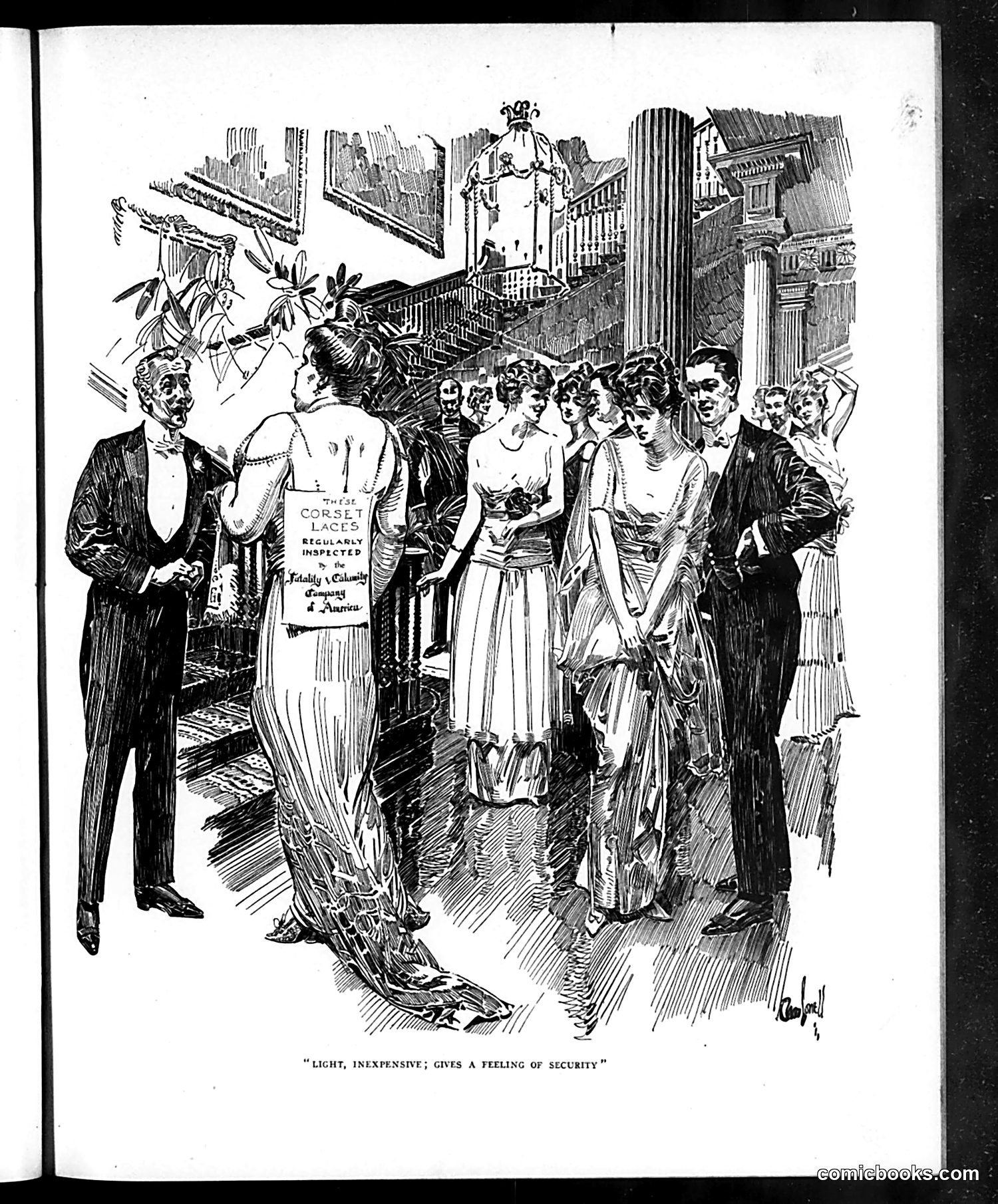
This illustration depicts a formal social gathering—likely a ball or reception in an elegant classical interior. The caption reads "LIGHT, INEXPENSIVE; GIVES A FEELING OF SECURITY." The satire appears to target women's fashion and social anxieties of the era. One woman's back is prominently labeled with text advertising "CORSET LACES / REGULARLY INSPECTED" from what appears to be a company name (partially visible). The joke likely mocks both the advertising culture infiltrating high society and women's reliance on corsetry for both physical support and social confidence. The caption's reference to "security" is ironic—the elaborate undergarments provide only psychological reassurance, not actual protection. The cartoon satirizes how commercial products marketed as essential create false sense of comfort among the wealthy elite at formal events.
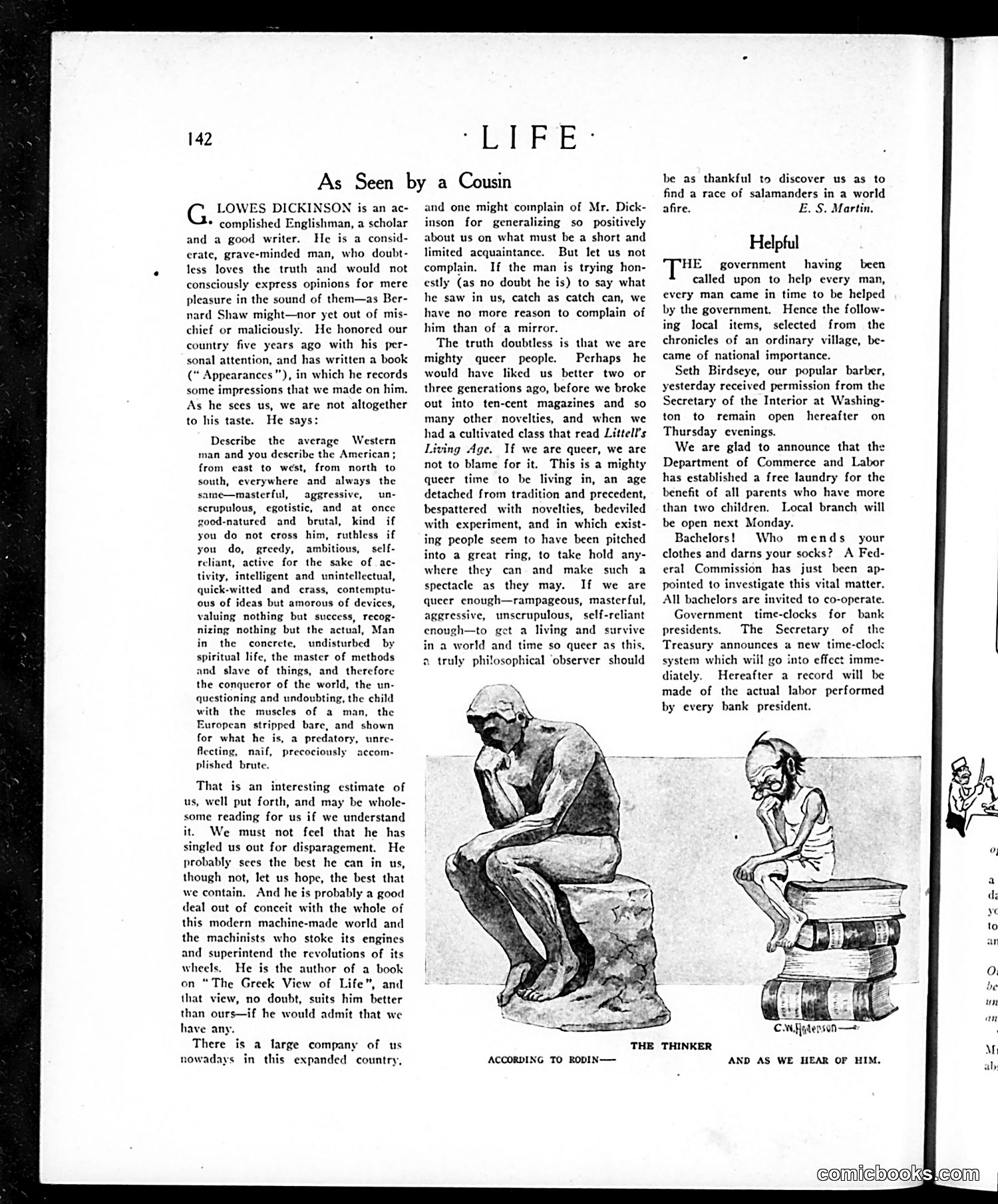
This page features two illustrations captioned "According to Rodin—The Thinker" and "And as We Hear of Him," presenting a satirical contrast between artistic idealism and modern reality. The left image reproduces Rodin's famous sculpture of a contemplative nude male figure. The right image shows a man sitting on stacked books in a similar pose but clothed and appearing comical rather than noble. The satire critiques the gap between romantic artistic visions of intellectual life and actual modern existence. The accompanying essay discusses American character, quoting Lowes Dickinson's observations about American society as "queer," materialistic, and spiritually shallow—implying that contemporary Americans cannot achieve the philosophical depth represented by Rodin's idealized thinker.
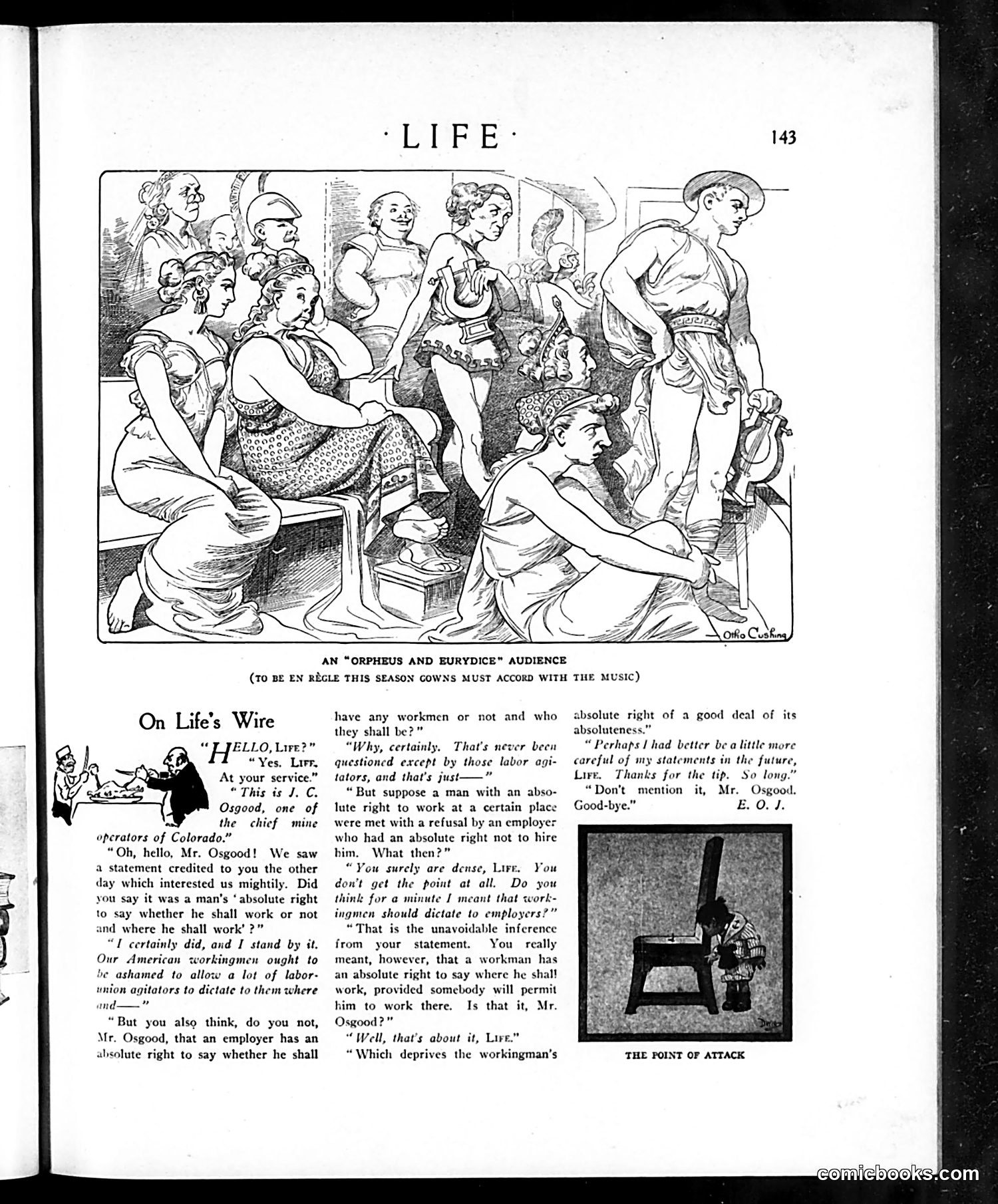
The top illustration is labeled "An 'Orpheus and Eurydice' Audience" with a note that "gowns must accord with the music"—a satirical jab at opera-goers' pretentiousness about formal dress codes. The main article, "On Life's Wire," features a debate between "Life" (the magazine personified) and "J.C. Osgood" about labor rights. The discussion centers on whether employers have an "absolute right" to dictate where workers can work, and whether workers should have collective bargaining power through unions. Osgood argues employers control hiring; Life counters that workers deserve say in their working conditions. This reflects early 20th-century labor disputes over union organizing and workers' rights—a contentious political issue of the era.
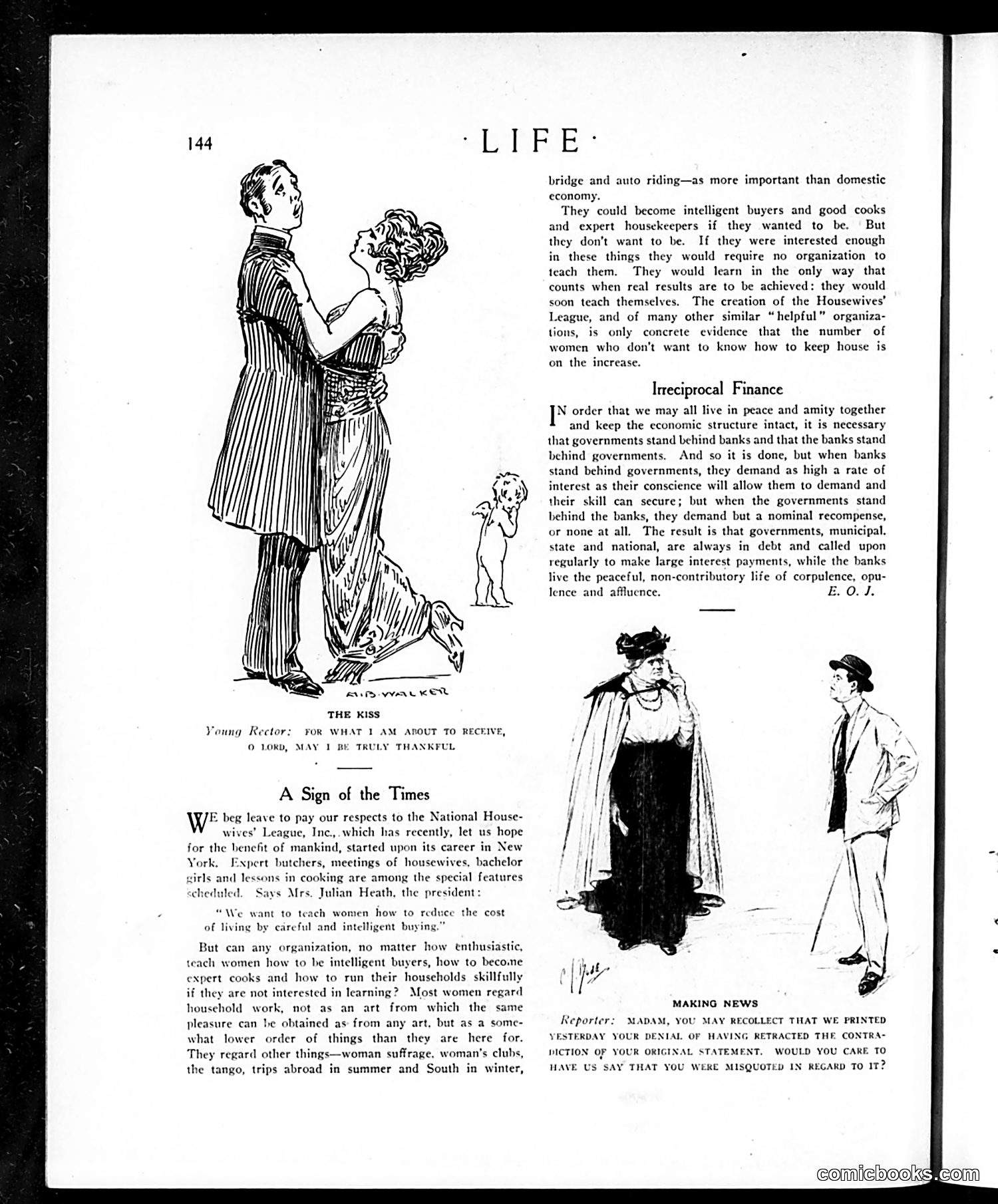
This Life magazine page satirizes early 20th-century debates about women's education and domestic roles. **"The Kiss"** (top illustration by W.A. Walker) depicts a young rector receiving a kiss, captioned as payment for a future "transfiguration"—likely mocking both religious authority and romantic entanglement. **"A Sign of the Times"** discusses the National Housewives' League, which Mrs. Julian Heath founded to teach women "intelligent buying" and household efficiency. The text sarcastically questions whether women truly want such education, suggesting most prefer leisure activities (clubs, travel, the tango) over domestic work. The satire critiques both women who avoid housekeeping and reformers pushing domestic "expertise." **"Making News"** (bottom) shows a reporter confronting a woman about a retracted statement—commentary on modern journalism and public discourse.
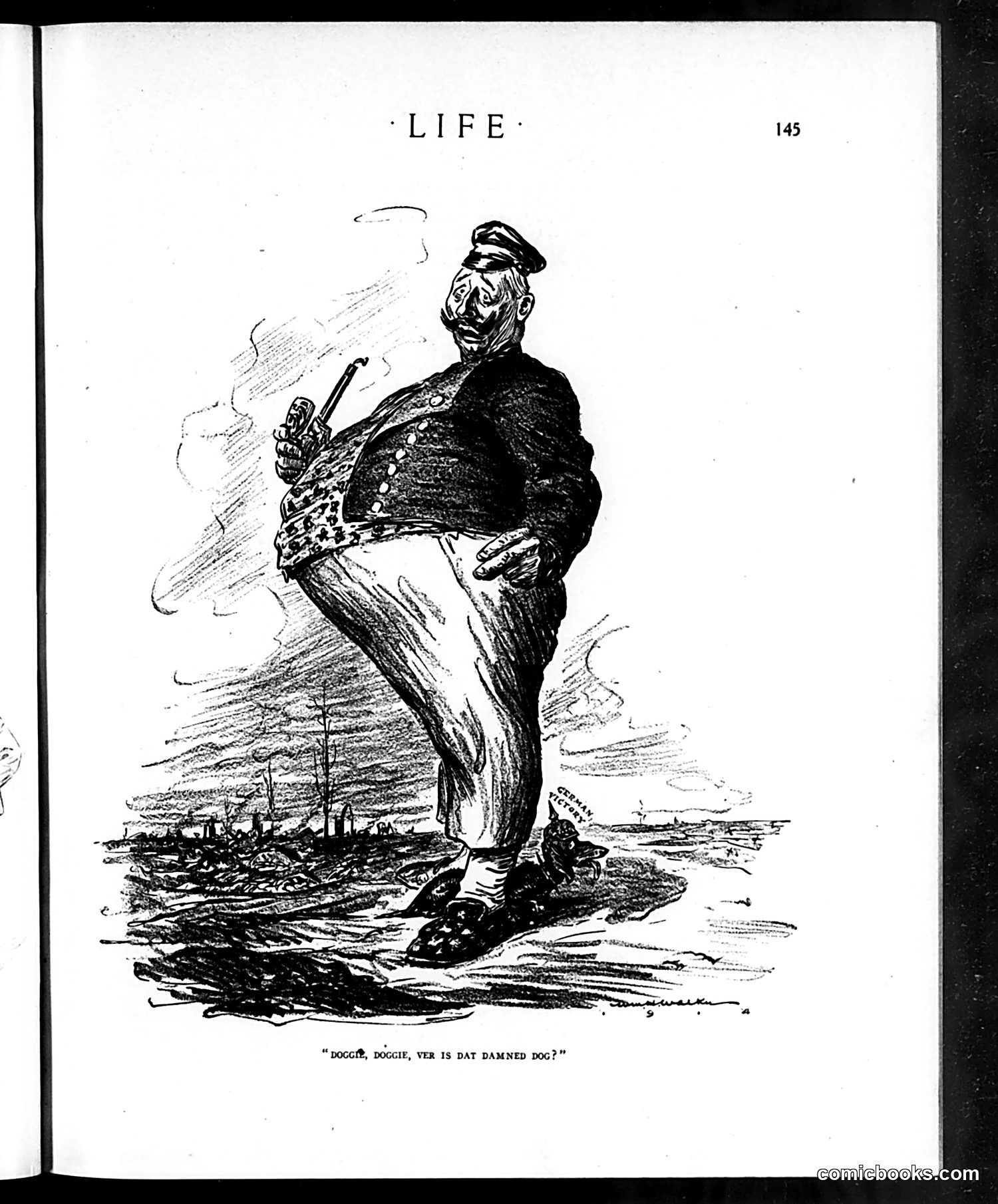
This satirical cartoon depicts a rotund military or political figure in formal dress with decorative buttons, standing in a barren landscape. The caption reads: "DOGGER, DOGGIE, VER IS DAT DAMNED DOG?" The caricature uses exaggerated physical features—the bulbous body and facial features—typical of early 20th-century satirical art. The figure appears to be searching for something, suggested by the questioning caption with a Germanic accent ("ver" instead of "where," "dat" for "that"). Without additional context or byline visible, the specific historical reference remains unclear. The accent suggests commentary on a German or Germanic figure, possibly related to military or political events of the era. The dog reference may be metaphorical for a lost advantage, ally, or failed initiative, but the exact meaning requires knowledge of contemporary events from this *Life* magazine issue.
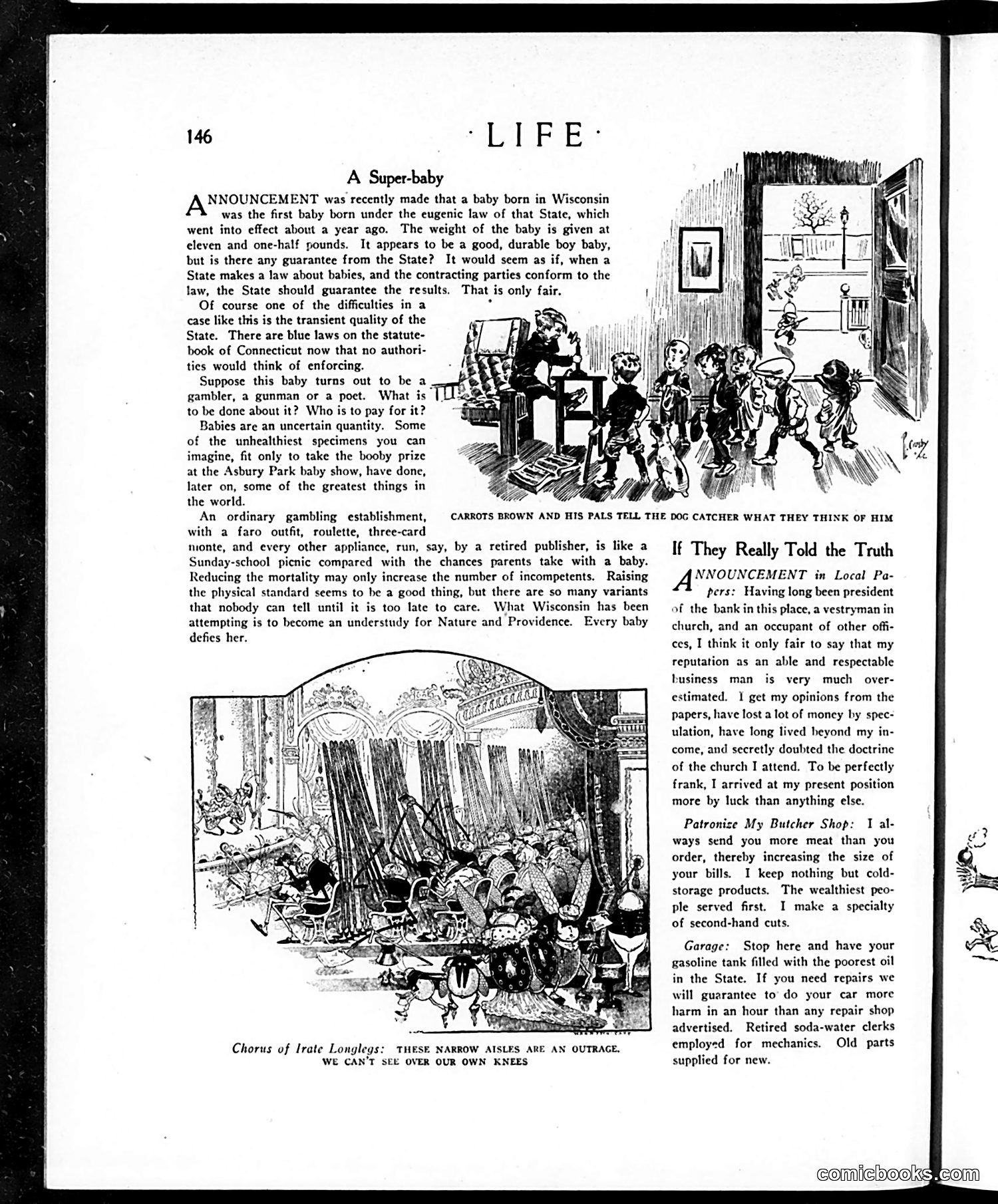
This page contains two distinct satirical pieces: **"A Super-baby"** (top): Critiques Wisconsin's eugenic baby law (enacted ~1 year prior) requiring babies meet weight standards. The satire questions the state's overreach: if it guarantees results, should it also guarantee compensation if the baby fails to meet standards? The piece mockingly compares raising children to gambling, suggesting the state cannot control all variables affecting child development. **"If They Really Told the Truth"** (bottom): Features fake testimonials from local businesses—a churchman, butcher, and garage owner—satirizing self-serving advertisements. Each "honestly" admits to unethical practices: inflating bills, selling poor-quality products, and using outdated mechanics. The humor lies in exposing how actual businesses operate versus their promotional claims.
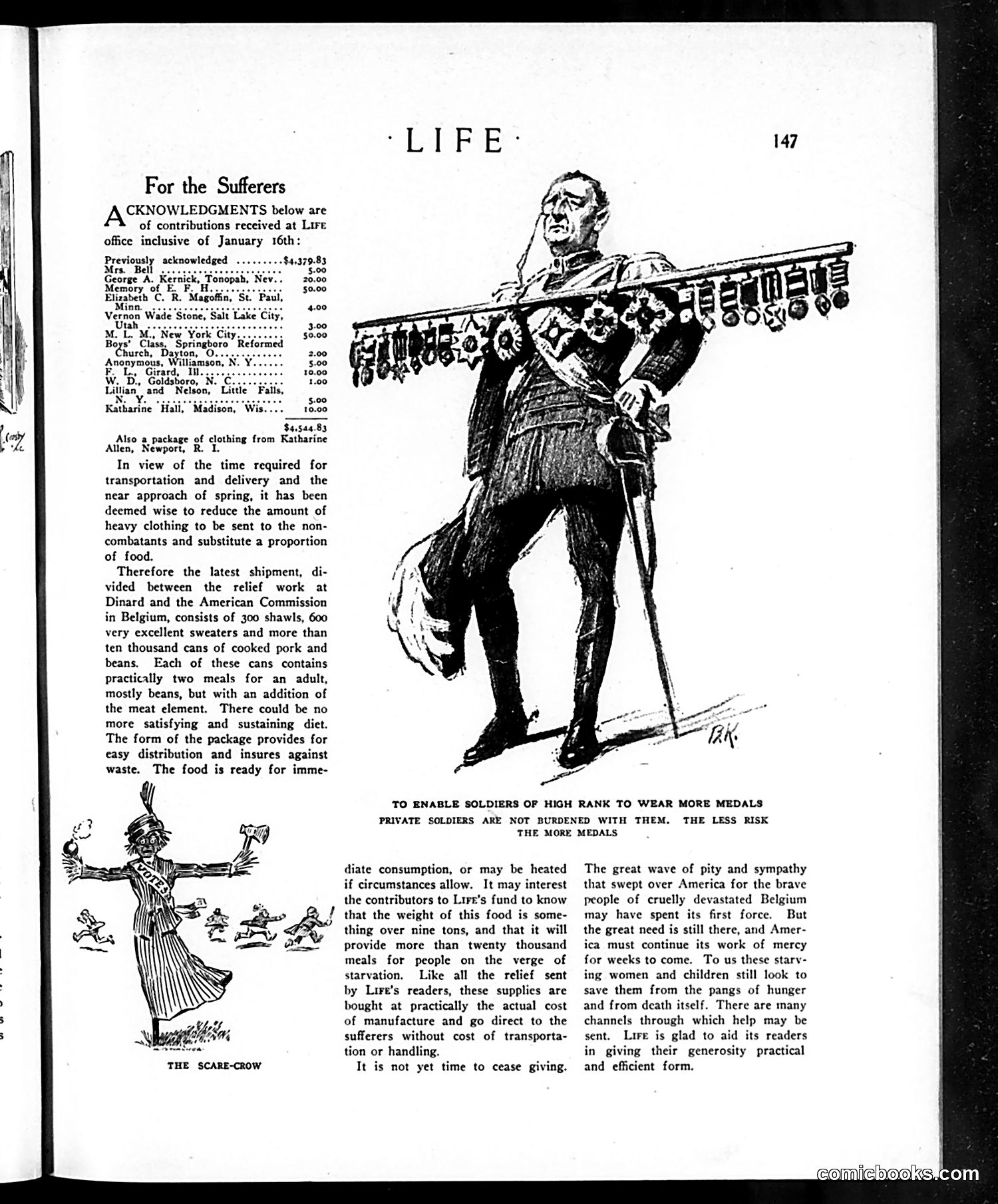
This page documents **Life magazine's relief fund for Belgian civilians** suffering during World War I. The text reports contributions totaling $4,544.83 received for food and clothing aid to non-combatants in Belgium and the Dinard region (likely French territory affected by the war). The main cartoon depicts a **heavily decorated military officer** laden with medals, accompanied by a caption mocking military hierarchy: officers accumulate medals while "private soldiers are not burdened with them." This satirizes the disparity in honors between ranks—a pointed critique that high-ranking officers receive disproportionate recognition despite lower-ranked soldiers bearing greater risk. The smaller "Scare-Crow" illustration (left) is unclear in context but appears decorative or commentary on fear-mongering. The page emphasizes that Life's readers' contributions provide practical relief: 10,000+ cans of pork and beans totaling nine tons, feeding 20,000+ meals to starving Belgians. The appeal urges continued American charitable giving, as "the great need is still there."
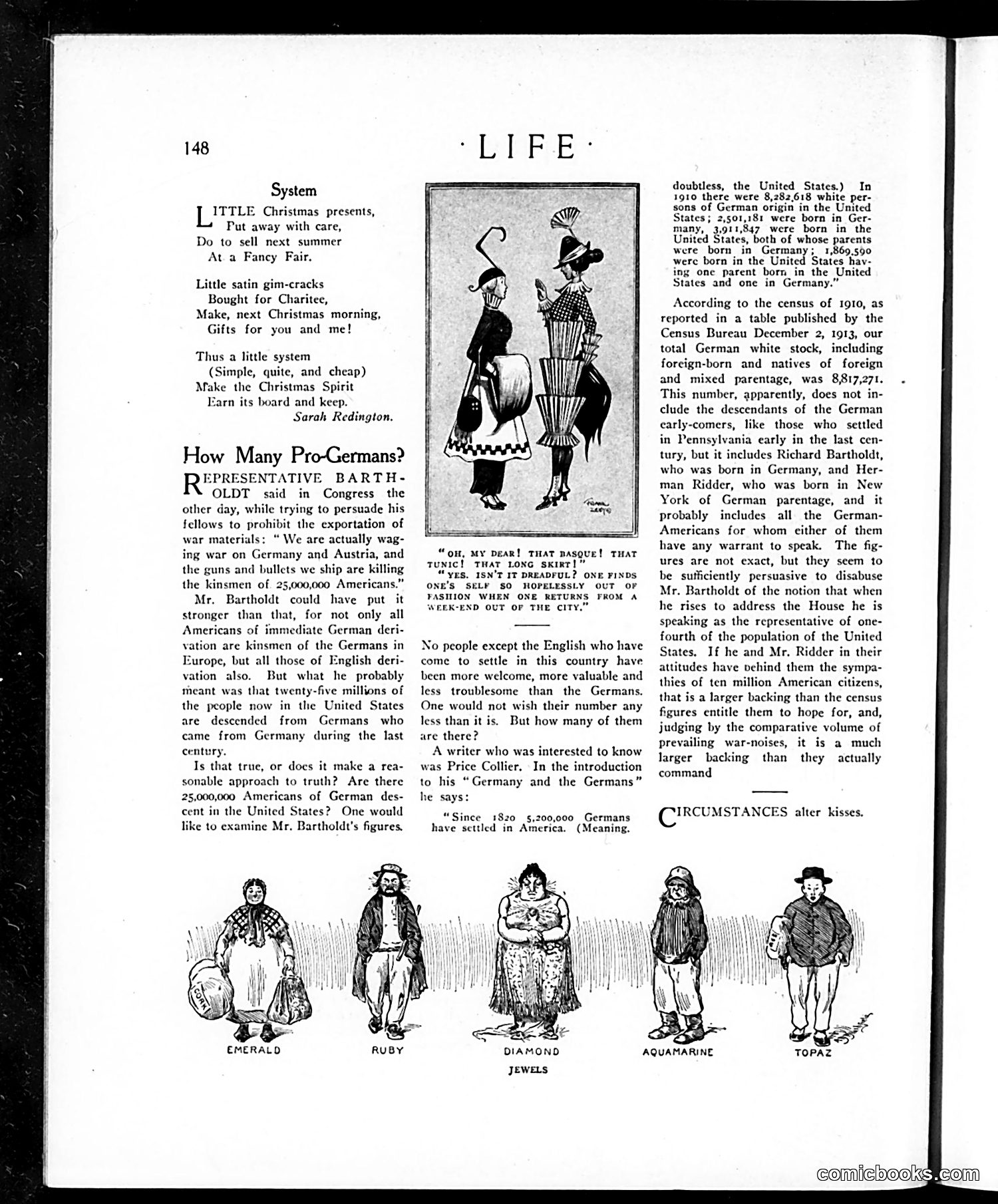
This page addresses **German-American loyalty during World War I**, a contentious issue in 1910s America. **Main Article:** "How Many Pro-Germans?" challenges Representative Bartholdt's claim that 25 million Americans of German descent oppose war material exports to Allied powers. The author uses census data to deflate this figure, arguing that approximately 8.8 million German-Americans exist—a significant but minority population. The point: German-Americans' political influence is overstated; they don't represent "one-fourth of the population." **The Cartoon:** The bottom illustration shows five figures labeled with gemstone names (Emerald, Ruby, Diamond, Aquamarine, Topaz)—likely caricatured ethnic stereotypes used to represent different immigrant groups. The humor is unclear without identifying who these represent. **Context:** During WWI, German-Americans faced suspicion of disloyalty. This article defends them against exaggerated claims while simultaneously questioning their political power—essentially arguing they're numerous but not dangerously influential.
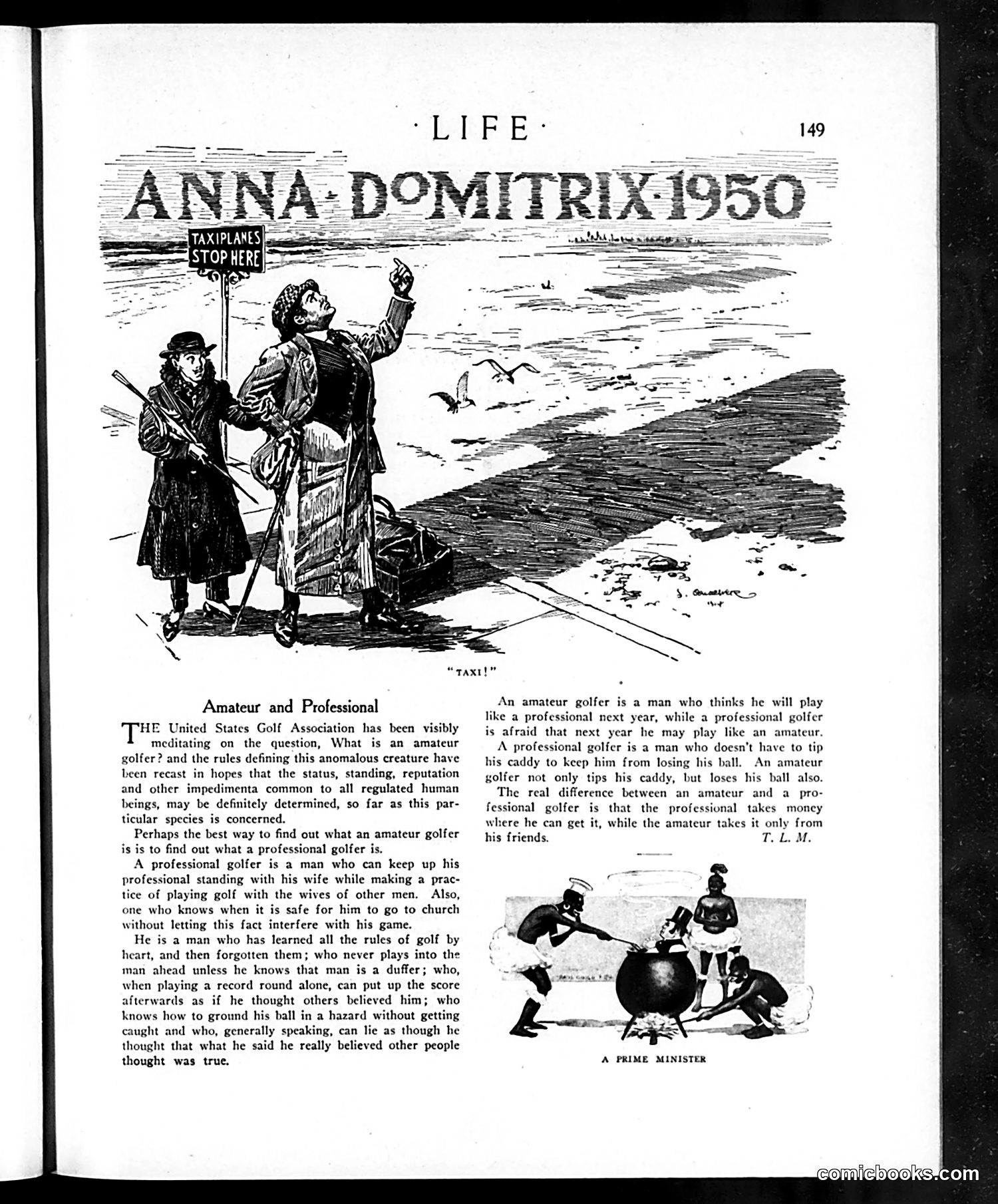
This satirical piece contrasts amateur and professional golfers through humorous definitions. The top cartoon shows a taxi driver pointing skyward at an airplane labeled "ANNA DOMITRIX 1950"—likely referencing a contemporary figure or scandal, though the specific reference is unclear today. The main text offers tongue-in-cheek definitions of professional golfers as men who juggle their marriages while flirting with other women's wives, who lie about their scores, and who rationalize their rule-breaking. The amateur, by contrast, is optimistic but financially exploited—tipping caddies and losing balls. The satire mocks golf culture's moral flexibility and the pretense surrounding amateur status. The bottom illustration labeled "A Prime Minister" (unclear connection) shows figures in conversation. Overall, the piece uses golf as a vehicle to critique masculine hypocrisy, infidelity, and financial dishonesty among upper-class leisure pursuits.
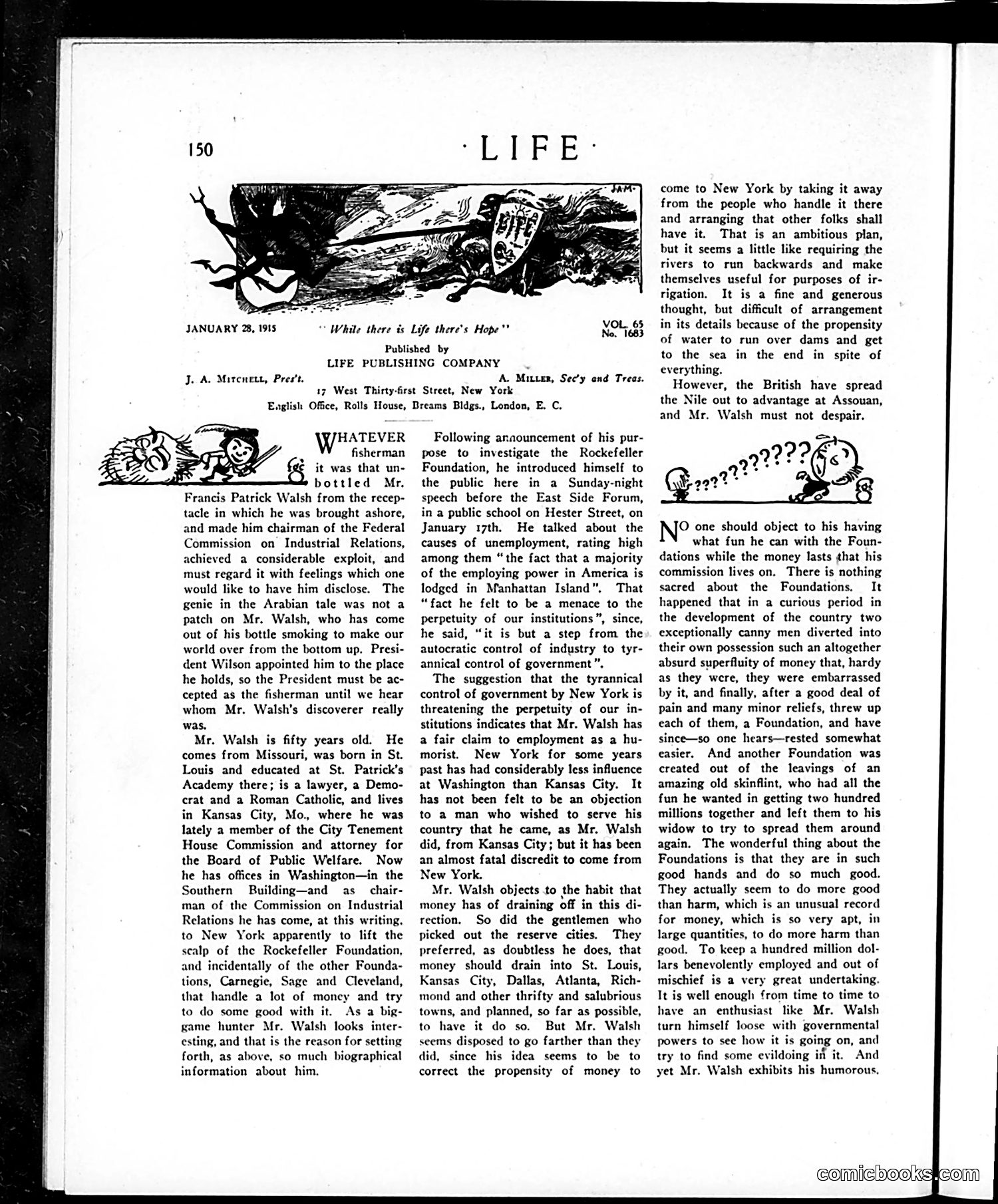
This article satirizes **Francis Patrick Walsh**, appointed by President Wilson to chair the Federal Commission on Industrial Relations. Walsh, a Kansas City lawyer, has announced plans to investigate major philanthropic foundations (Rockefeller, Carnegie, Sage, Cleveland) and spoke publicly about concentrating wealth and power threatening American democracy. Life's satire targets Walsh's ambitions as naive and contradictory. The magazine mocks his claim that Manhattan's concentrated wealth endangers institutions—noting New York actually has *less* influence in Washington than Kansas City. More pointedly, Life ridicules his scheme to redistribute foundation money away from New York as absurdly futile: "like requiring the rivers to run backwards." The piece portrays Walsh as earnest but humorously delusional, a "big-game hunter" pursuing foundations with crusading zeal while proposing economically impractical solutions to genuine unemployment and inequality problems.
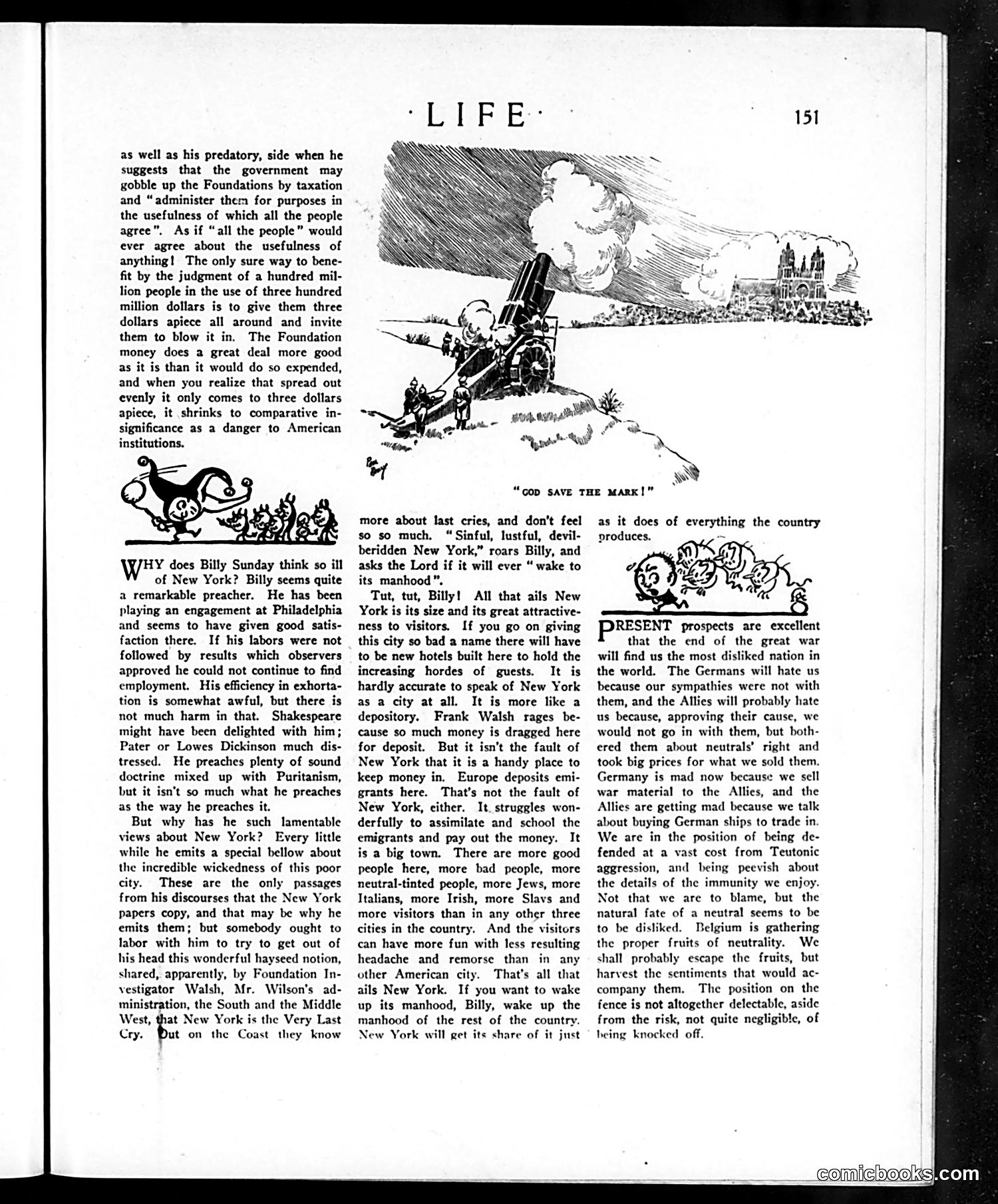
This page contains two satirical pieces attacking prominent figures and attitudes of the era (appears to be WWI period, given references to "the great war"). **The main cartoon** depicts a cannon labeled "GOD SAVE THE MARK!" aimed at a European cathedral, satirizing American military/financial intervention in European affairs. **The text critiques Billy Sunday**, a famous evangelist preacher, for his repeated condemnations of New York City as sinful and wicked. The author argues Sunday's attacks are unfair—New York's "wickedness" is merely a byproduct of its size and role as a major commercial/immigration hub. The piece defends the city as performing admirably in assimilating immigrants and managing capital flow, suggesting critics like Sunday (and Foundation Investigator Frank Walsh, apparently) unfairly scapegoat New York rather than addressing nationwide moral failings. **The closing section** predicts America will be disliked globally after WWI—by Germans for supporting the Allies, and by the Allies for not fully committing to their cause—satirizing American diplomatic neutrality and hesitation. The page exemplifies Life's role as a vehicle for sophisticated political commentary mocking public figures and conventional pieties.
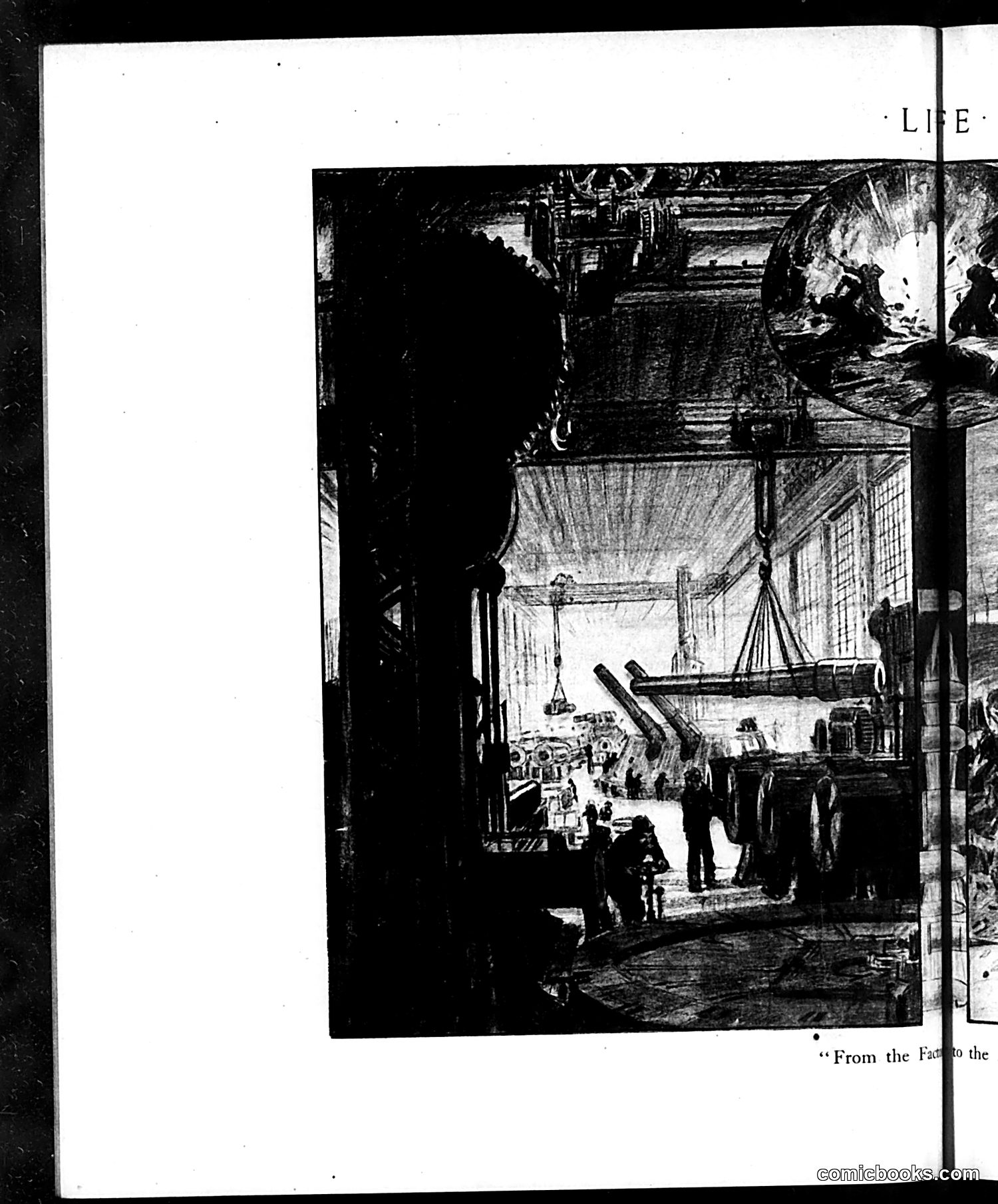
This page from *Life* magazine shows an industrial or maritime scene viewed through a dark silhouetted archway or doorway. The image depicts workers at what appears to be a shipyard or factory, with a vessel visible and various laborers engaged in work activities. The partial caption reads "From the Fac[tory] to the..." Without the complete caption or additional context visible on the page, the specific satirical point is unclear. The composition—viewing industrial labor through shadow—may be commentary on working conditions, industrialization, or labor practices of the era, but the exact target of satire and what the phrase continues to say cannot be determined from what's legible here. The image itself is realistic rather than caricatured.
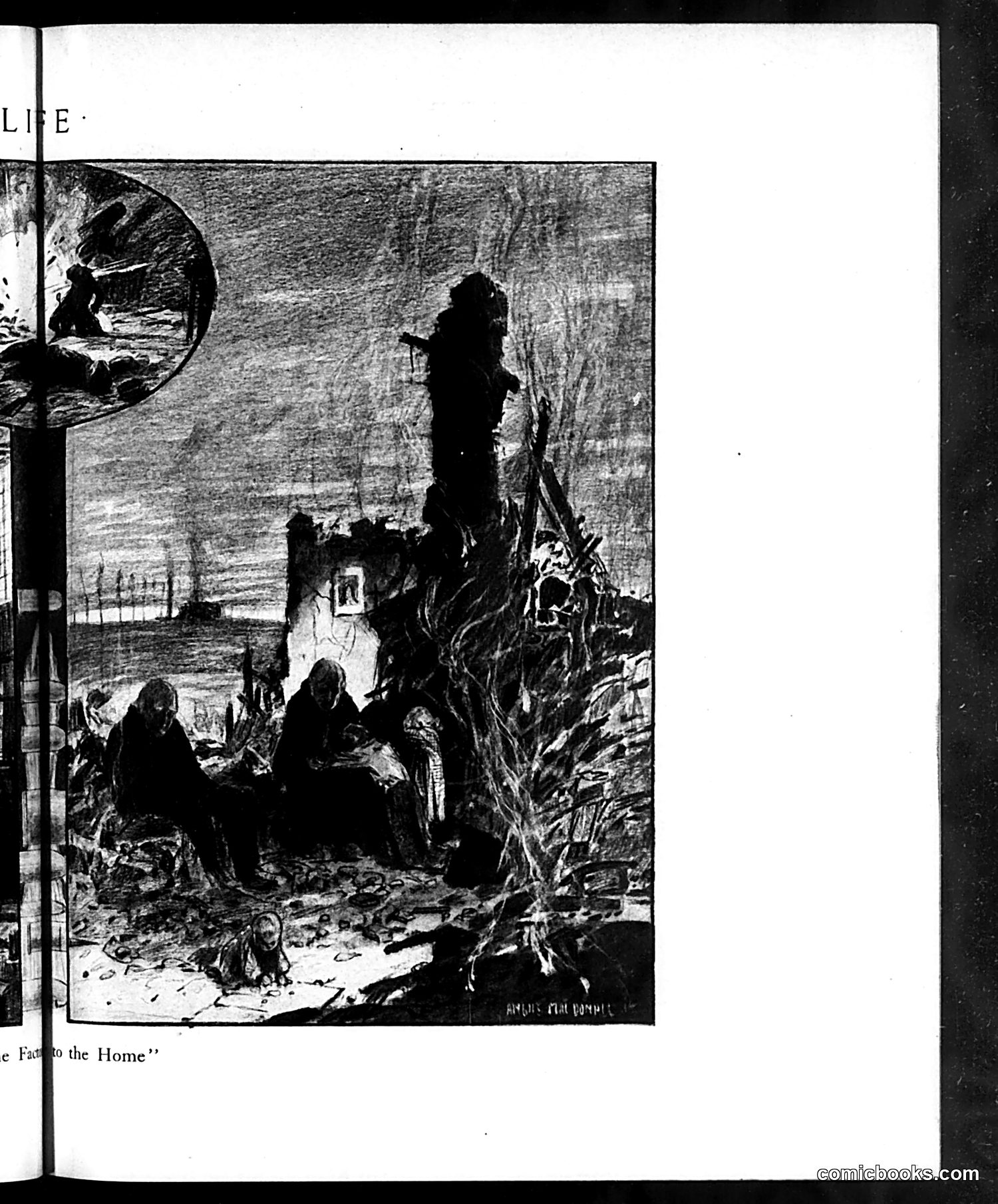
This appears to be a dramatic illustration titled "The Face to the Home" (partially visible at bottom). The image depicts a desolate, war-torn landscape with ruins of a building, bare twisted trees, and several figures huddled in the foreground. A full moon illuminates the scene in an inset circle. The composition suggests a commentary on the devastation of war and its impact on civilian populations and domestic life. The destroyed architecture, barren landscape, and displaced figures evoke themes of loss, displacement, and the human cost of conflict. Without clearer context or date information, the specific historical conflict referenced remains unclear, though the artistic style suggests early-to-mid 20th century origin. The caption's reference to "home" emphasizes the irony of warfare destroying the domestic spaces it supposedly protects.
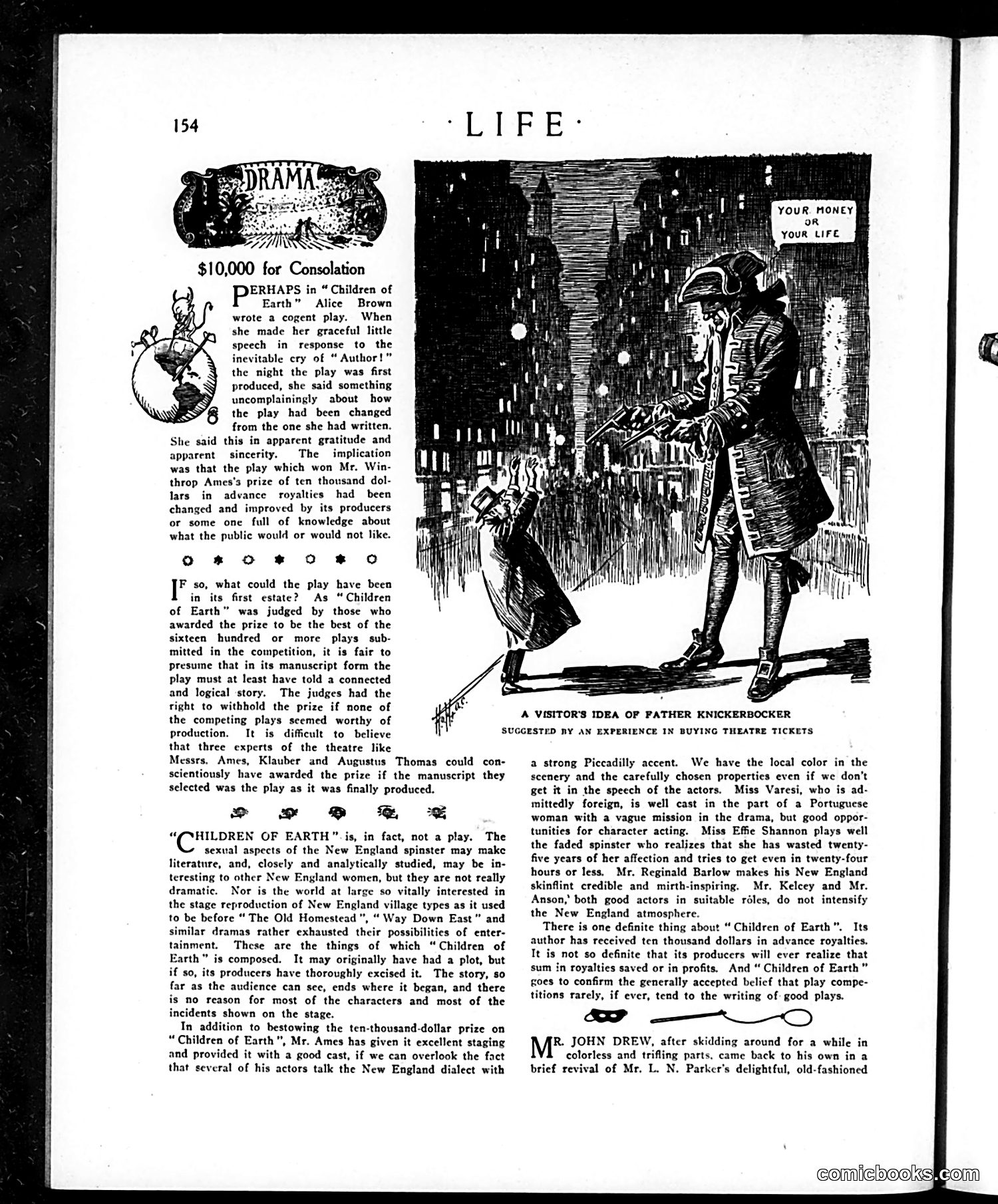
This page contains two distinct satirical pieces: **Left column ("$10,000 for Consolation"):** A theater critic reviews *Children of Earth* by Alice Brown, which won a $10,000 prize from producer Winthrop Ames. The satire attacks the play itself—claiming it lacks genuine plot, dramatic structure, or narrative logic. The critic sarcastically suggests the prize-winning manuscript must have been superior to the produced version, implying producers ruined it. The piece concludes that despite excellent staging and casting, the play remains fundamentally undramatic, dealing only with "sexual aspects of the New England spinster." The satire mocks both the play competition system and theatrical judgment. **Right cartoon:** Titled "A Visitor's Idea of Father Knickerbocker," it depicts a well-dressed man (Father Knickerbocker, a personification of New York City) robbing a woman at knifepoint while she clutches a theater ticket. The caption suggests this reflects "an experience in buying theatre tickets"—satirizing exorbitant Broadway ticket prices as highway robbery.
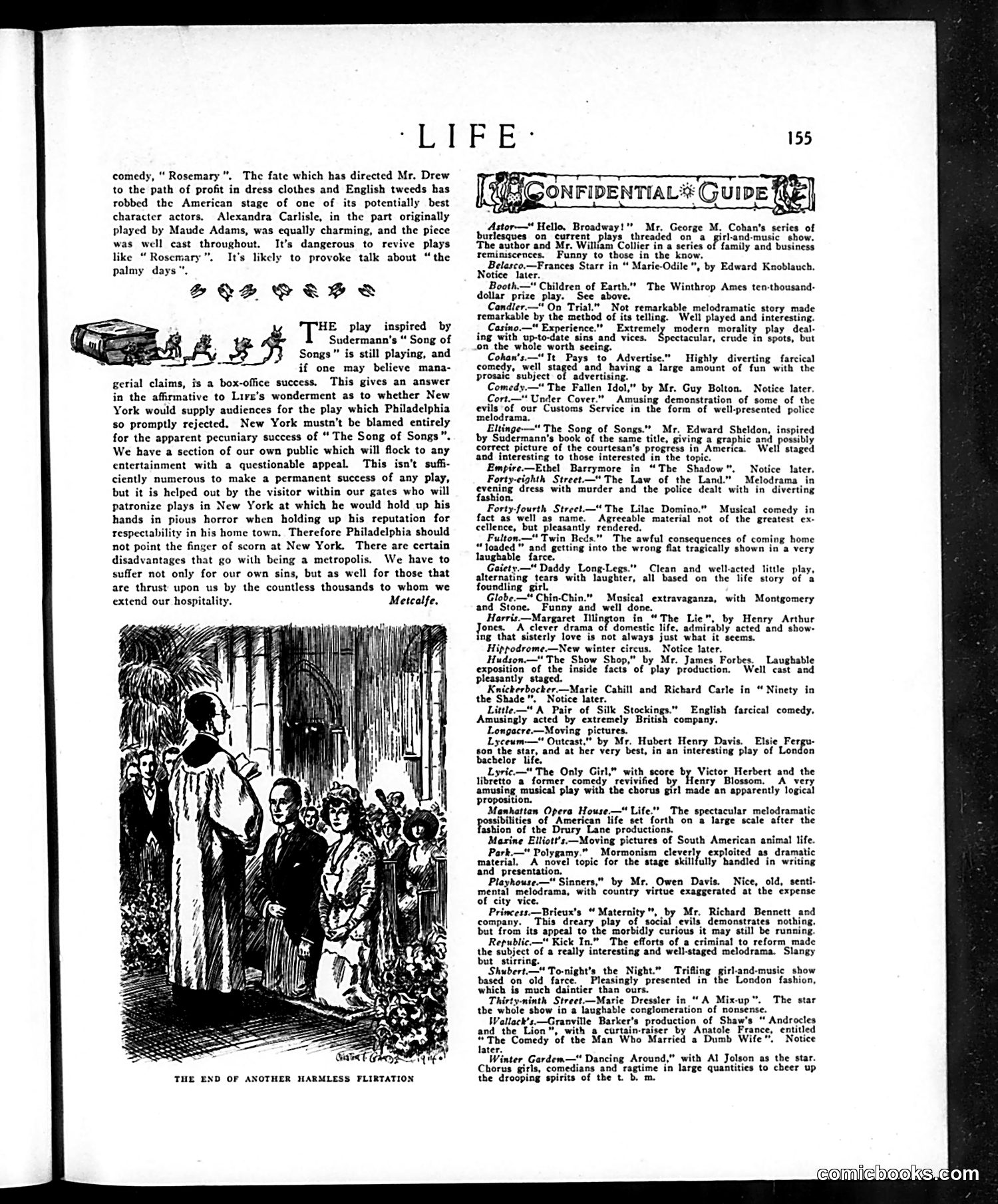
This page contains theatrical reviews and a political cartoon titled "The End of Another Harmless Flirtation." The cartoon depicts a well-dressed man (appears to be a wealthy gentleman or politician) exiting through a doorway while a woman in modest dress remains behind, observed by onlookers. The scene suggests a clandestine affair or improper relationship ending. The satire likely critiques hypocrisy among the upper classes—the man can exit respectably into society while the woman faces social consequences. The title's irony suggests such "flirtations" were routine among the privileged yet treated as scandalous when exposed. The page's main content is a "Confidential Guide" to Broadway theaters, reviewing current plays including *The Song of Songs*, *Experience*, and *Chin-Chin*. The reviews discuss theatrical merit and moral content, reflecting early 1900s concerns about propriety in entertainment—the very hypocrisy the cartoon satirizes.
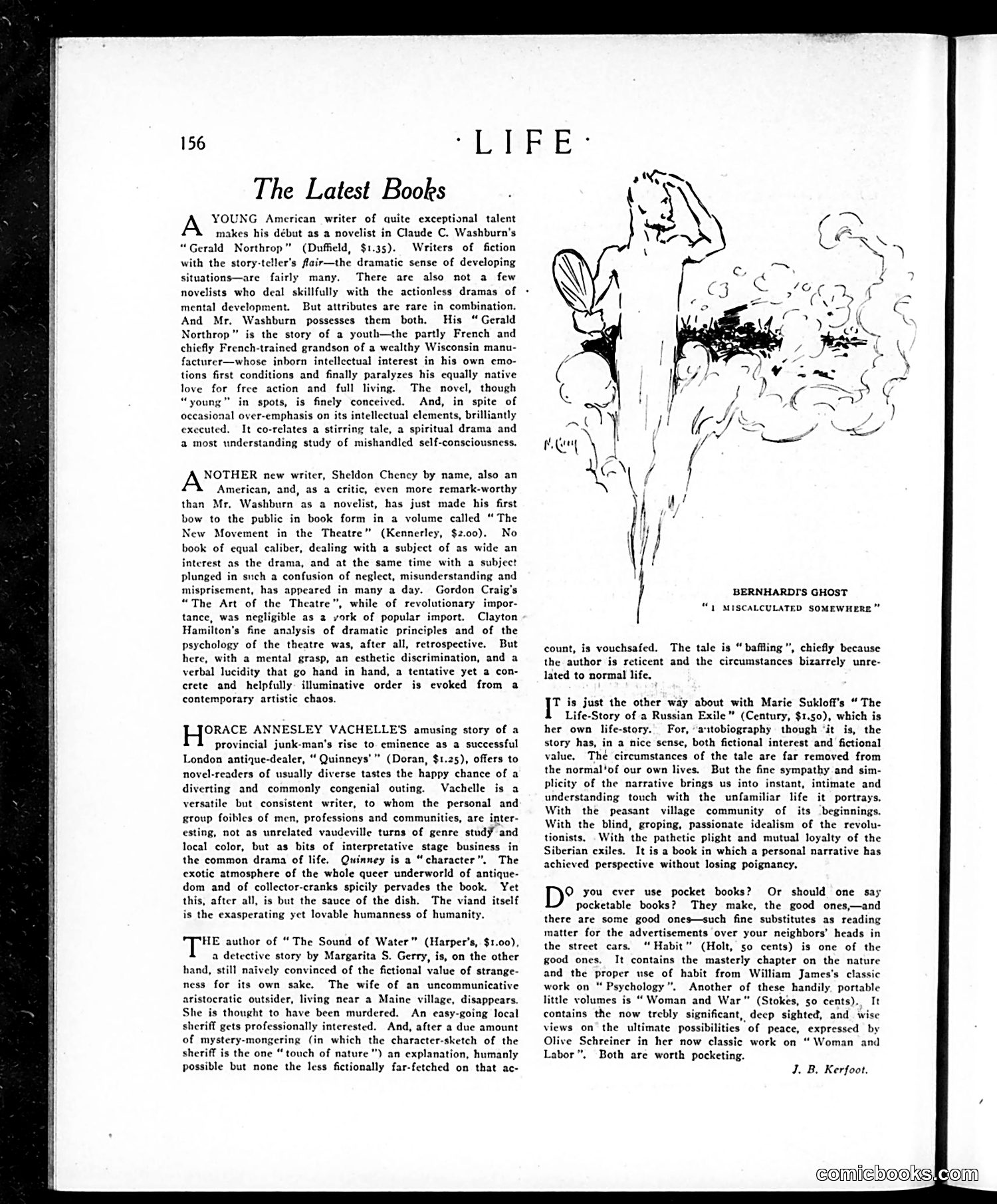
This is a straightforward literary review section from *Life* magazine, not primarily satirical. The page discusses several new novels and books from the early 20th century. The small cartoon titled "Bernhardt's Ghost" appears in the upper right—a sketchy drawing of a woman's face with the caption "I miscalculated somewhere." This likely references Sarah Bernhardt, the famous French actress who died in 1923. The joke seems to suggest Bernhardt, observing from beyond, reflects ruefully on some miscalculation during her life or career—though without more context, the specific reference remains unclear. The bulk of the page reviews books by American and British authors, praising writers like Claude C. Washburn and Sheldon Cheney for their literary merit, while critiquing others like Margarita S. Gerry for relying on artificial "strangeness" rather than genuine character development.
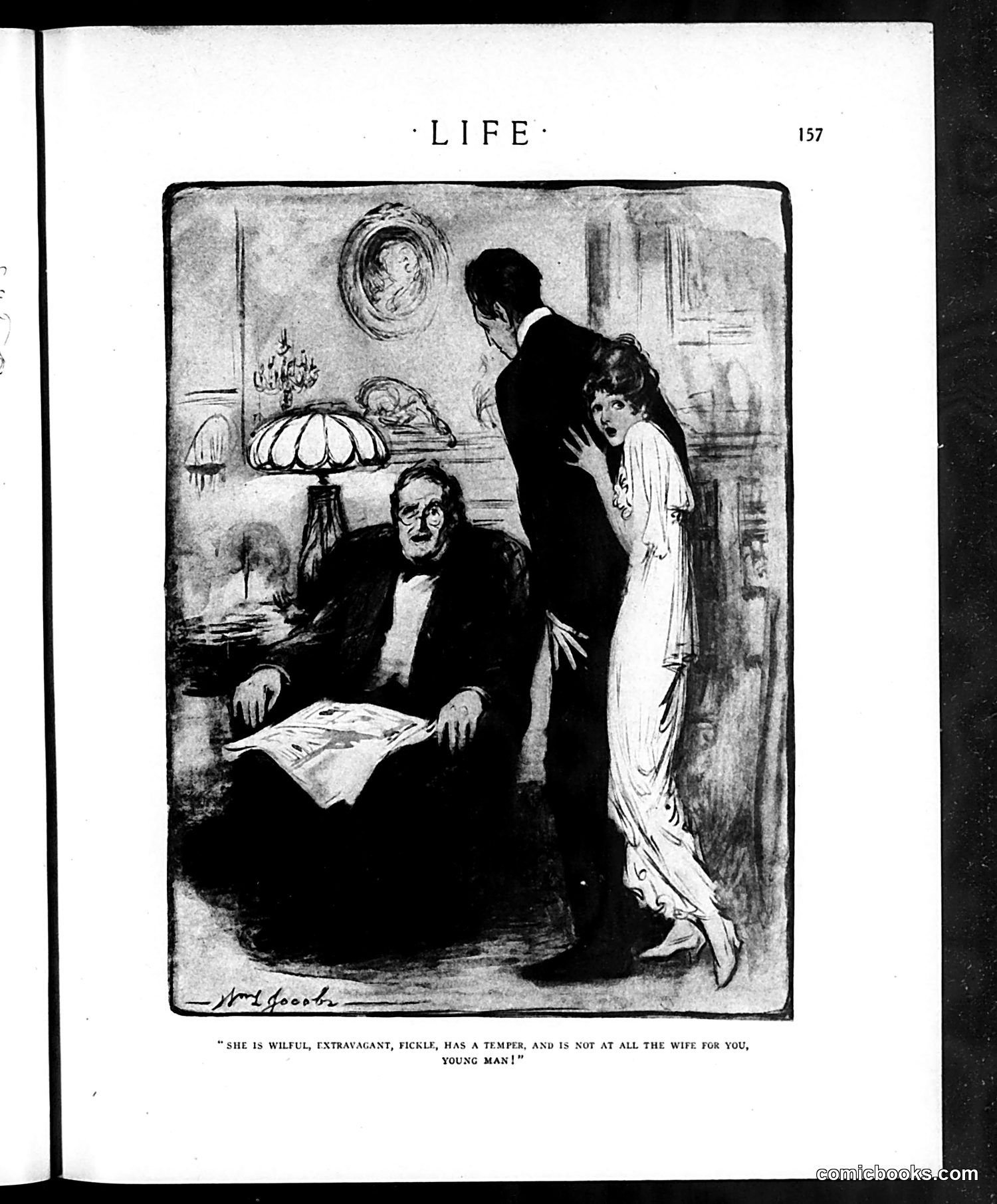
This cartoon depicts a domestic scene where an older man (seated, holding papers) warns a young man about a woman in a white dress, listing her character flaws: willful, extravagant, fickle, and temperamental—declaring she's unsuitable as a wife. The satire likely mocks Victorian-era courtship rituals and patriarchal control over marriage. The "older gentleman" figure appears to be either the woman's father or a senior male advisor, asserting authority to judge women's worthiness as wives based on conformity to feminine ideals. The cartoon's humor lies in the irony: these "flaws" (independence, financial autonomy, emotional expression) were precisely what made women threatening to traditional male authority. The piece satirizes how society policed women's behavior while pretending concern for the young man's welfare.
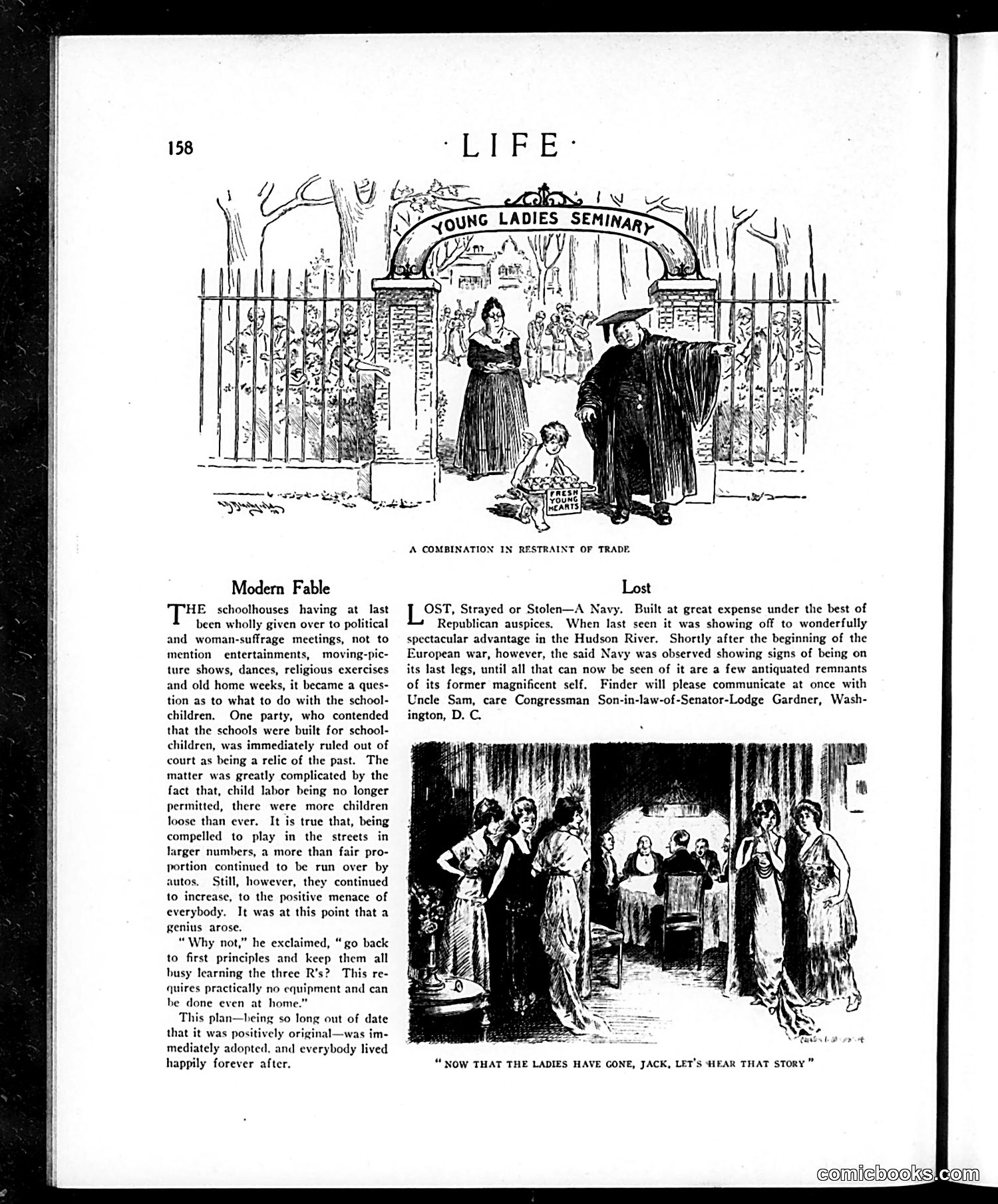
This page contains two distinct satirical pieces: **"Modern Fable"** mocks progressive education reforms. Schools have been appropriated for political meetings and women's suffrage events, leaving nowhere for children. The genius "solution"—returning to basic education (the "three R's") at home—is presented as absurdly novel, when it's actually outdated common sense. The satire targets the displacement of education's primary purpose by activist agendas. **"A Combination in Restraint of Trade"** is a lost-and-found advertisement satirizing the U.S. Navy's apparent decline. Built under Republican administration, the Navy was once impressive but has deteriorated during the European War (WWI). The finder should contact "Congressman Son-in-law-of-Senator-Lodge Gardner," mocking political nepotism and suggesting the Navy's weakness reflects government incompetence. The top cartoon showing the "Young Ladies Seminary" depicts schools converted away from education—visually reinforcing the fable's critique.
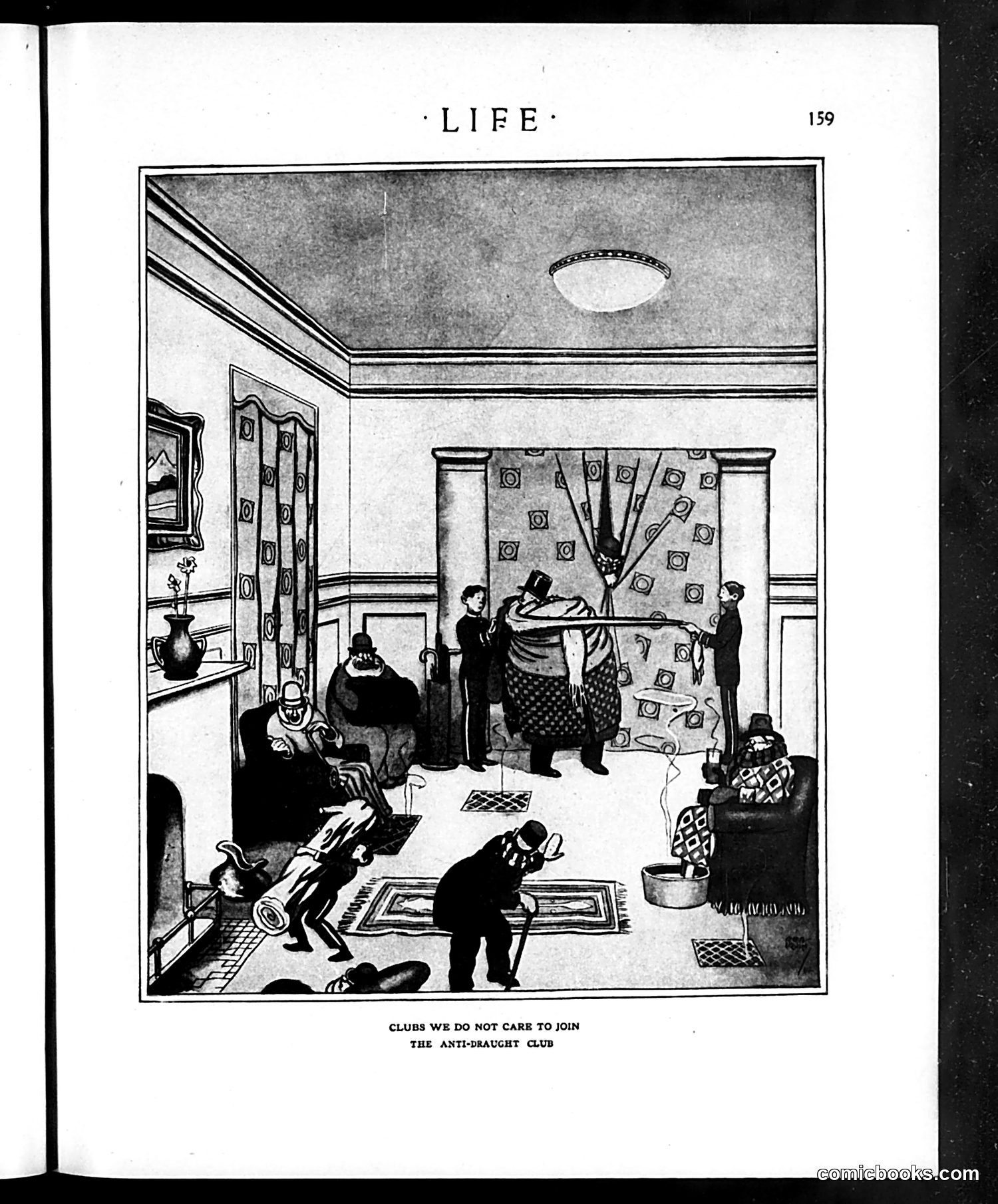
This satirical cartoon from *Life* magazine depicts an "Anti-Draught Club"—a social gathering where members actively oppose drafts (air currents). The scene shows elegantly dressed people in a formal interior room struggling comically against an invisible draft: some are holding onto furniture, others are bracing themselves, and figures appear to be fighting the wind effects. The humor likely references Prohibition-era concerns or general anxieties about "draughts" (literally cold air from windows/doors), but more probably satirizes ridiculous or overcautious social clubs and their obsessive memberships. The ornate setting and formal dress emphasize how absurd people appear when fixating on trivial concerns while acting with exaggerated seriousness. This mocks both clubroom culture and unnecessary worry about minor inconveniences.
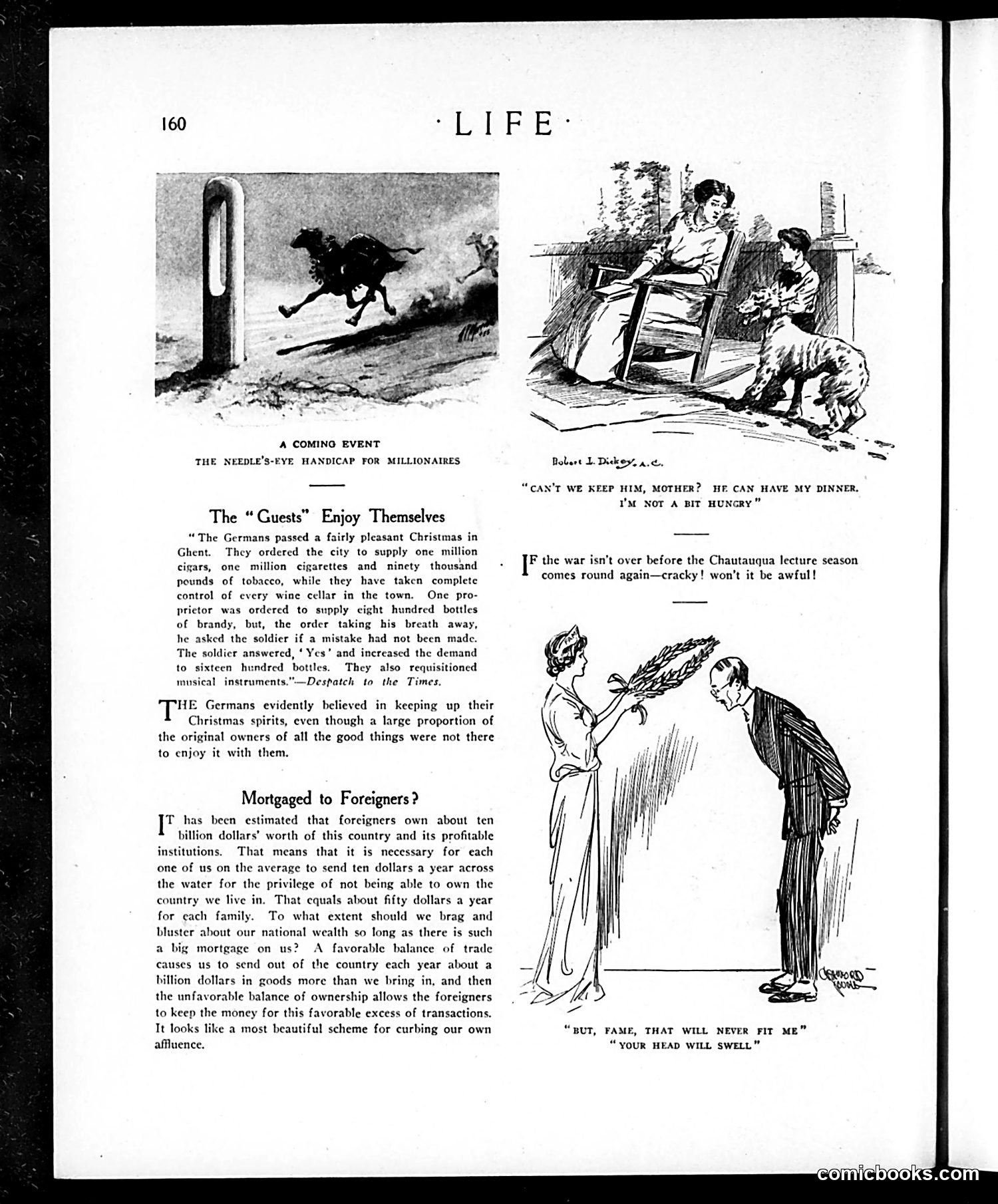
This page contains three distinct satirical commentaries on World War I-era America: **"The Guests Enjoy Themselves"** mocks German occupation forces in Ghent, Belgium, who requisitioned massive quantities of luxury goods (cigars, wine, brandy) while displacing local owners. The satire highlights the absurdity of military excess during wartime. **"Mortgaged to Foreigners?"** critiques American economic dependence on foreign investment. The argument warns that despite boasting about national wealth, America owes approximately $10 billion to foreign investors, necessitating annual payments that undermine claims of prosperity. **The cartoon illustrations** include a domestic scene where a child offers dinner to a guest, and a woman trying on an ill-fitting hat while a man suggests her "head will swell"—likely satirizing vanity or inflated self-importance. The page overall reflects wartime anxieties about American economic vulnerability and questions whether pre-war confidence in national affluence remains justified given foreign financial control.
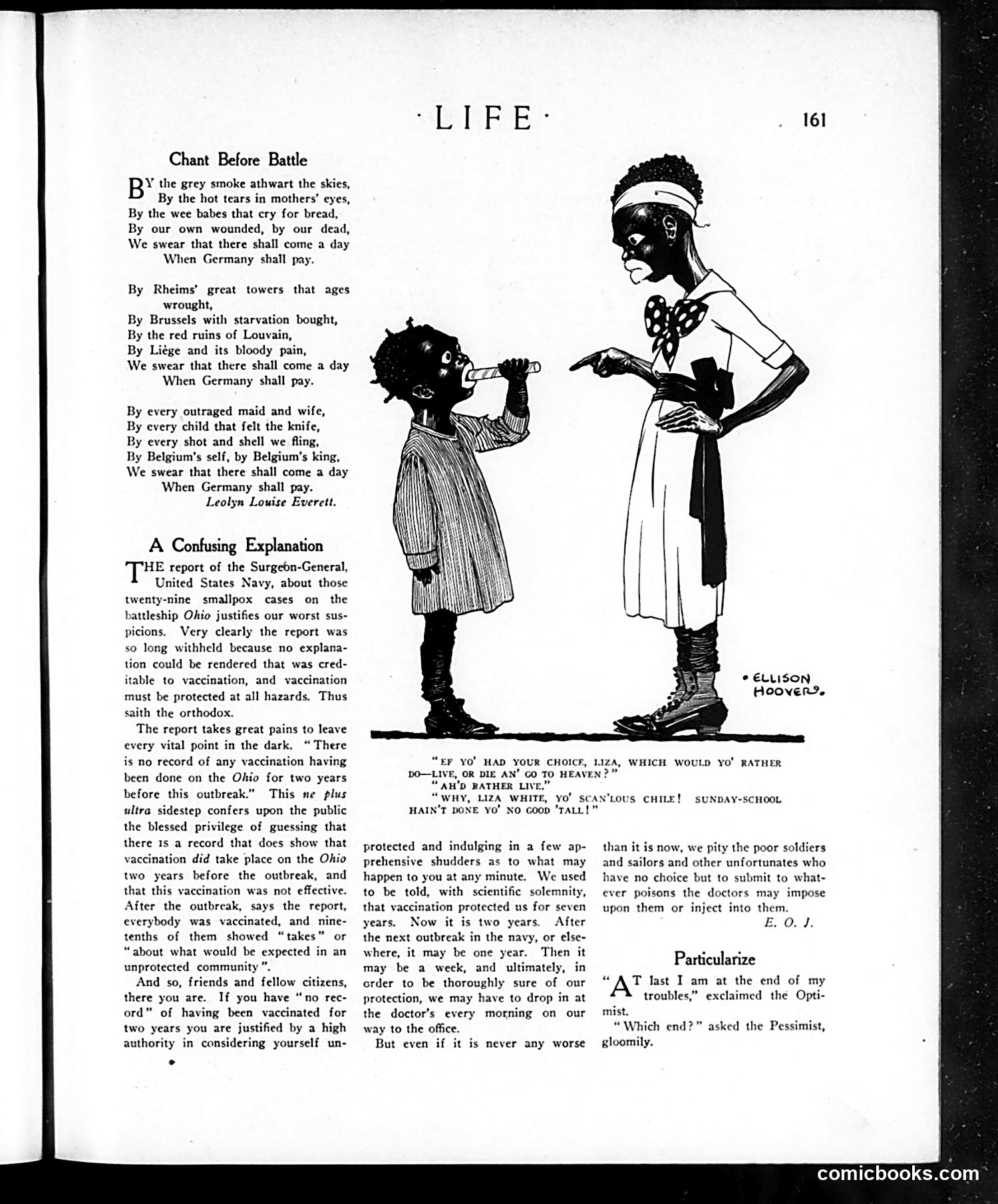
This page contains WWI-era satirical content from *Life* magazine (circa 1914-1918): **"Chant Before Battle"** is a patriotic war poem by Leolyn Louise Everett invoking German atrocities—the destruction of Belgian cities (Rheims, Brussels, Louvain, Liège)—as motivation for Allied victory. It references real wartime destruction used for propaganda. **"A Confusing Explanation"** critiques the U.S. Navy's report on a smallpox outbreak aboard the USS *Ohio*. The satire attacks official obfuscation: the report claims "no record" of prior vaccination, yet implies vaccination occurred but failed. The author mocks how authorities protect vaccination's credibility through circular logic and vague language, suggesting mandatory vaccination without clear evidence of effectiveness. **The cartoon** by Ellison Hoover depicts a Black woman and child in a satirical "choice" dialogue, using period dialect stereotypes common to *Life*'s humor. **"Particularize"** is a brief joke about optimism versus pessimism—wordplay on "end of troubles." The vaccination critique reflects genuine early-20th-century skepticism about medical mandates during wartime.
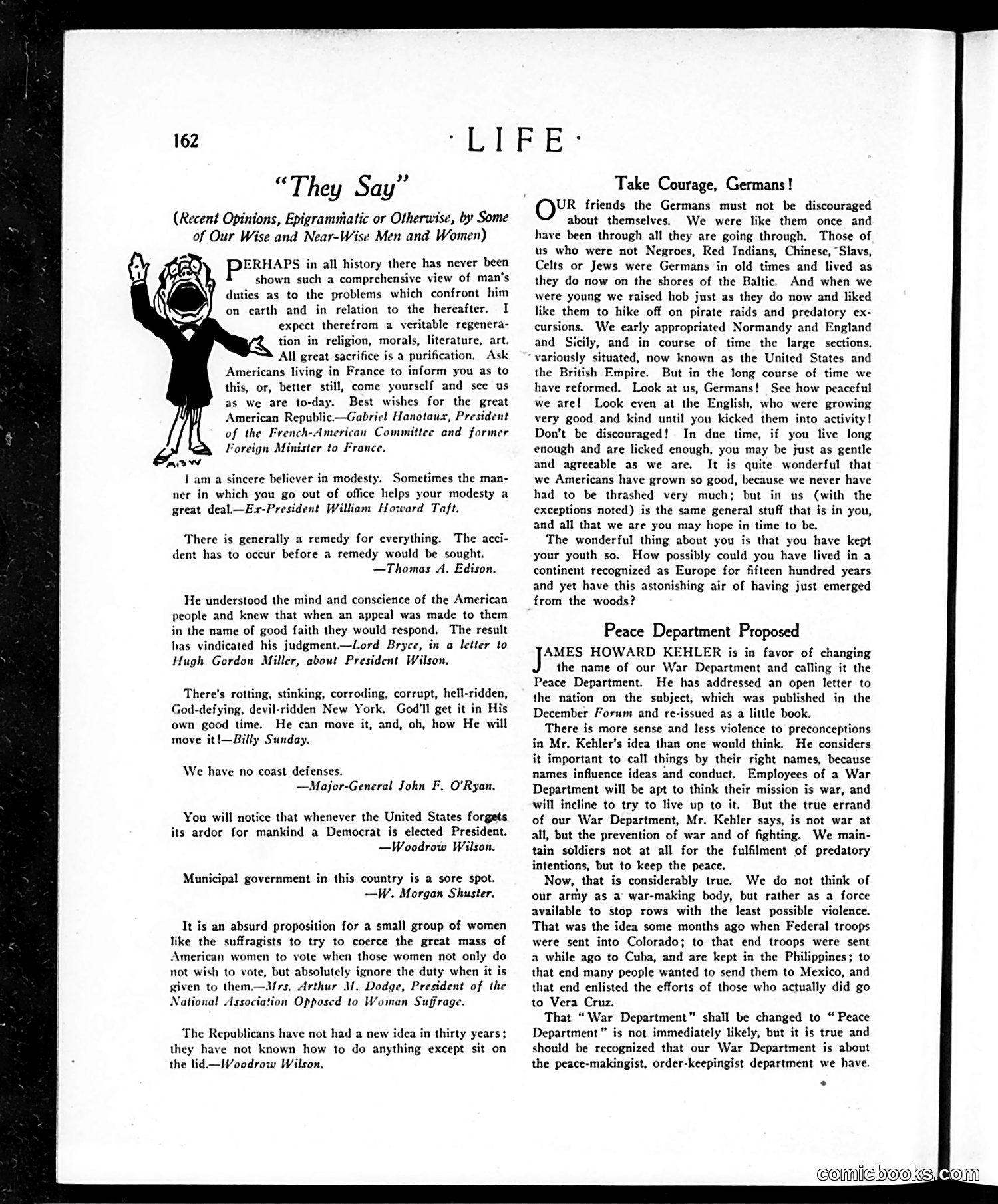
This page from *Life* magazine presents a satirical column titled "They Say," featuring quotes from prominent figures, followed by a longer editorial piece titled "Take Courage, Germans!" **The Cartoon/Illustration:** The left side shows a caricatured figure (appears to be representing an American) speaking to readers—likely meant to embody the magazine's satirical voice. **Political Context:** The quotes mock various American politicians and public figures of the era (references to President Wilson, ex-President Taft, and Billy Sunday suggest early 20th century). The satire targets their contradictions and pomposity. **"Take Courage, Germans!" Section:** This is the key satirical piece. It's written with heavy irony, comparing Germany's current militarism to America's own colonial/expansionist past ("pirate raids," appropriation of territories). The piece sarcastically suggests Germans shouldn't be discouraged by their defeats in WWI, since Americans also engaged in similar aggressive expansion and "reformed" over time. The satire criticizes American hypocrisy—lecturing Germany about morality while ignoring America's own imperial history.
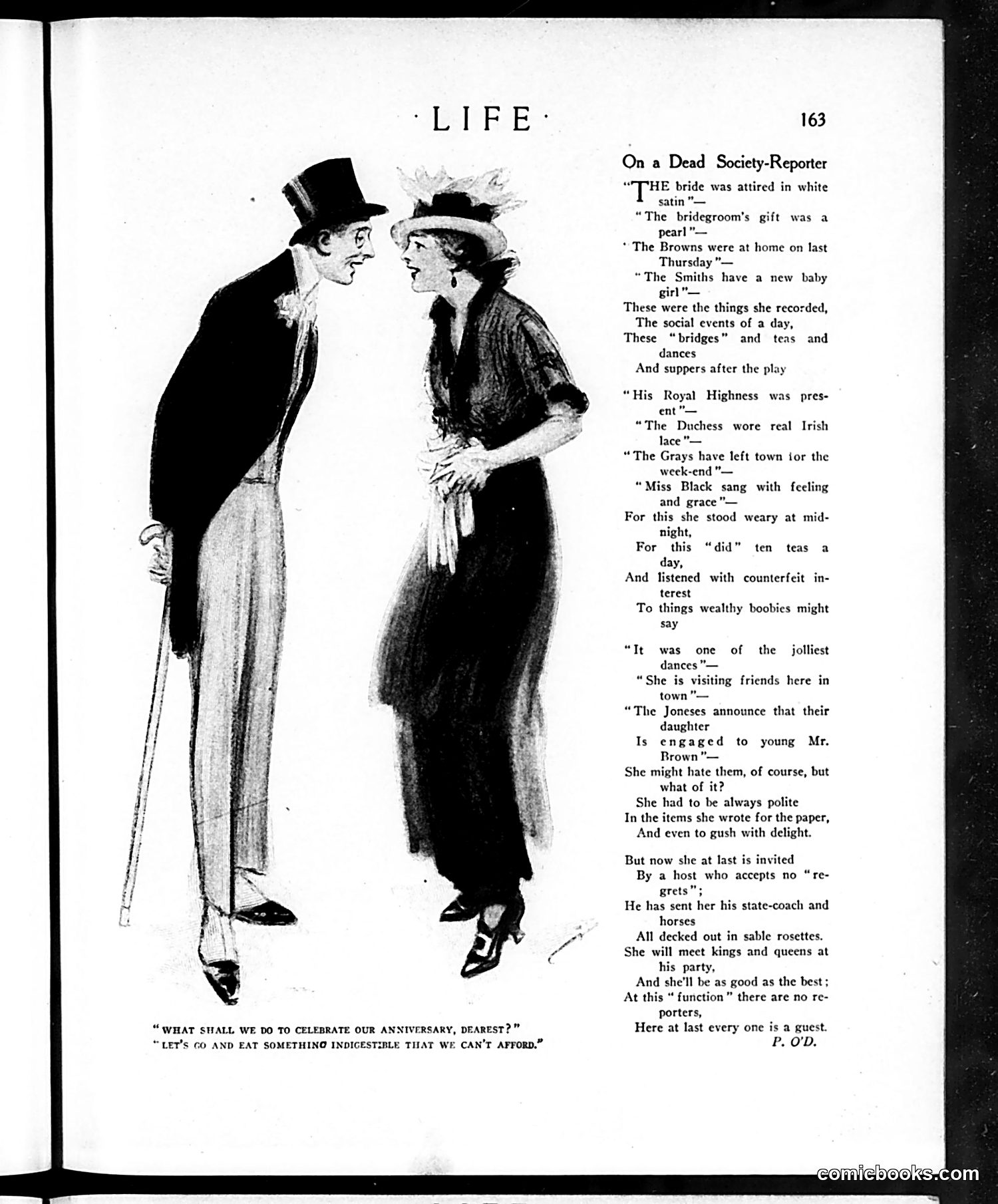
This page satirizes a society-page newspaper reporter—a woman assigned to cover high-society events. The cartoon illustration shows a couple discussing their anniversary celebration with ironic understatement: they'll eat something expensive they can't afford. The poem mocks the reporter's exhausting job: attending ten teas daily, recording mundane details (weddings, births, social gatherings) with forced enthusiasm while secretly despising the wealthy subjects she covers. She must "gush with delight" about "boobies" and their trivial lives, maintaining constant politeness despite fatigue and contempt. The satire's cruel irony: finally invited to an exclusive party where she's a *guest* rather than *reporter*, she achieves what she desired—acceptance among the elite—but only by being excluded from her actual role. She's welcomed into society precisely by being silenced, unable to report on it. The piece critiques both the superficiality of high society and the subservient position of society-page journalists.
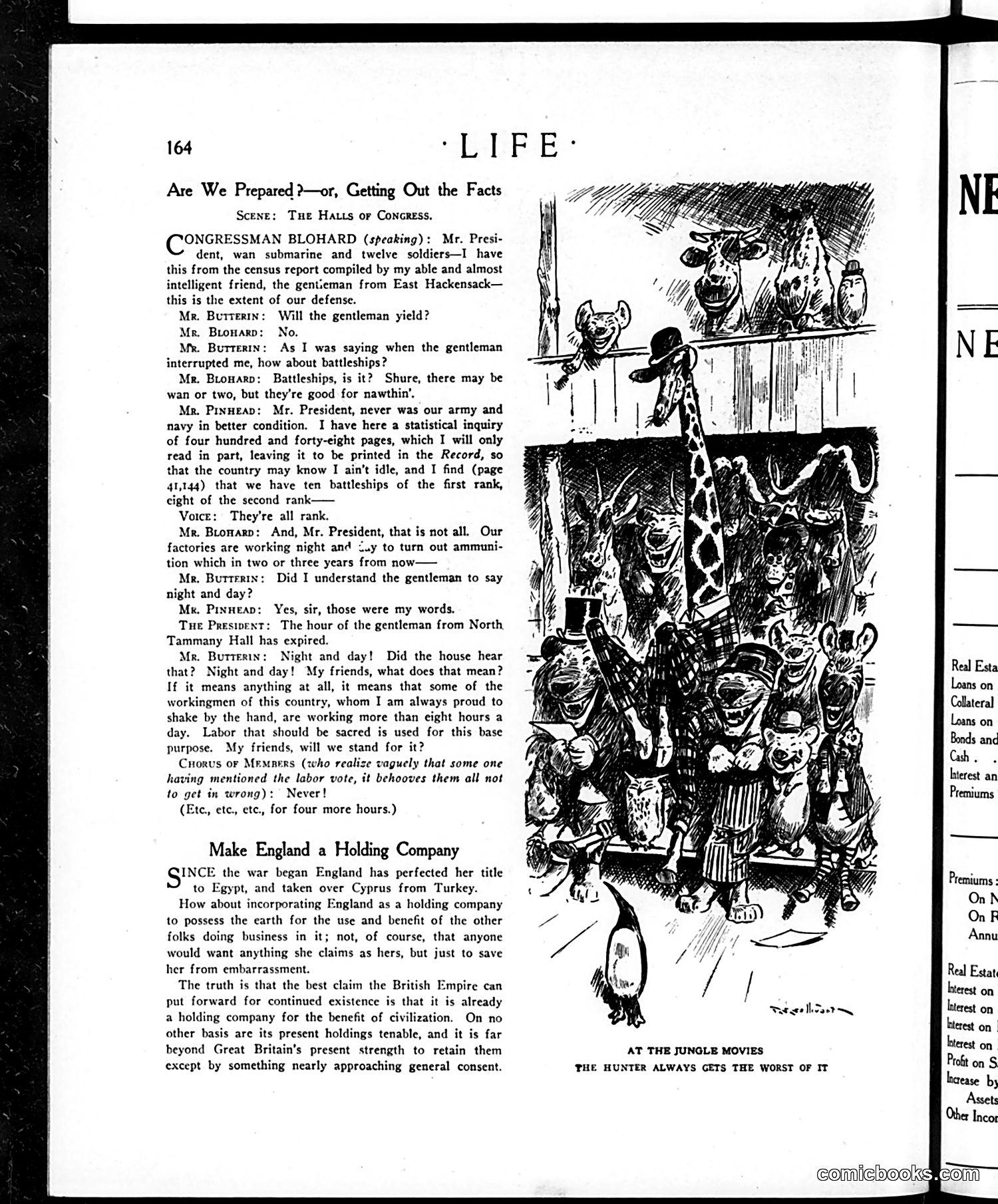
This page contains two satirical pieces from *Life* magazine (likely WWI-era, based on submarine and battleship references). **Top section: Congressional debate satire.** Politicians exchange absurd claims about military preparedness—one congressman claims only "wan submarine and twelve soldiers" exist, another boasts of ten battleships while admitting factories will need "two or three years" to produce ammunition. When a third congressman mentions factories working "night and day," another immediately seizes on this to accuse the government of forcing workers beyond eight-hour shifts, rousing colleagues to oppose it. The satire mocks Congress for simultaneously bragging about military strength while being more concerned with labor politics than actual defense. **Bottom section: "Make England a Holding Company."** This proposes incorporating Britain as a business entity to justify its imperial holdings (Egypt, Cyprus, etc.). The satire suggests Britain's only legitimate claim to its empire is "civilization," not conquest—and that maintaining these territories requires public consent rather than force. **Right image:** "At the Jungle Movies—The Hunter Always Gets the Worst of It" shows the hunter apparently losing to jungle animals in a slapstick scenario.
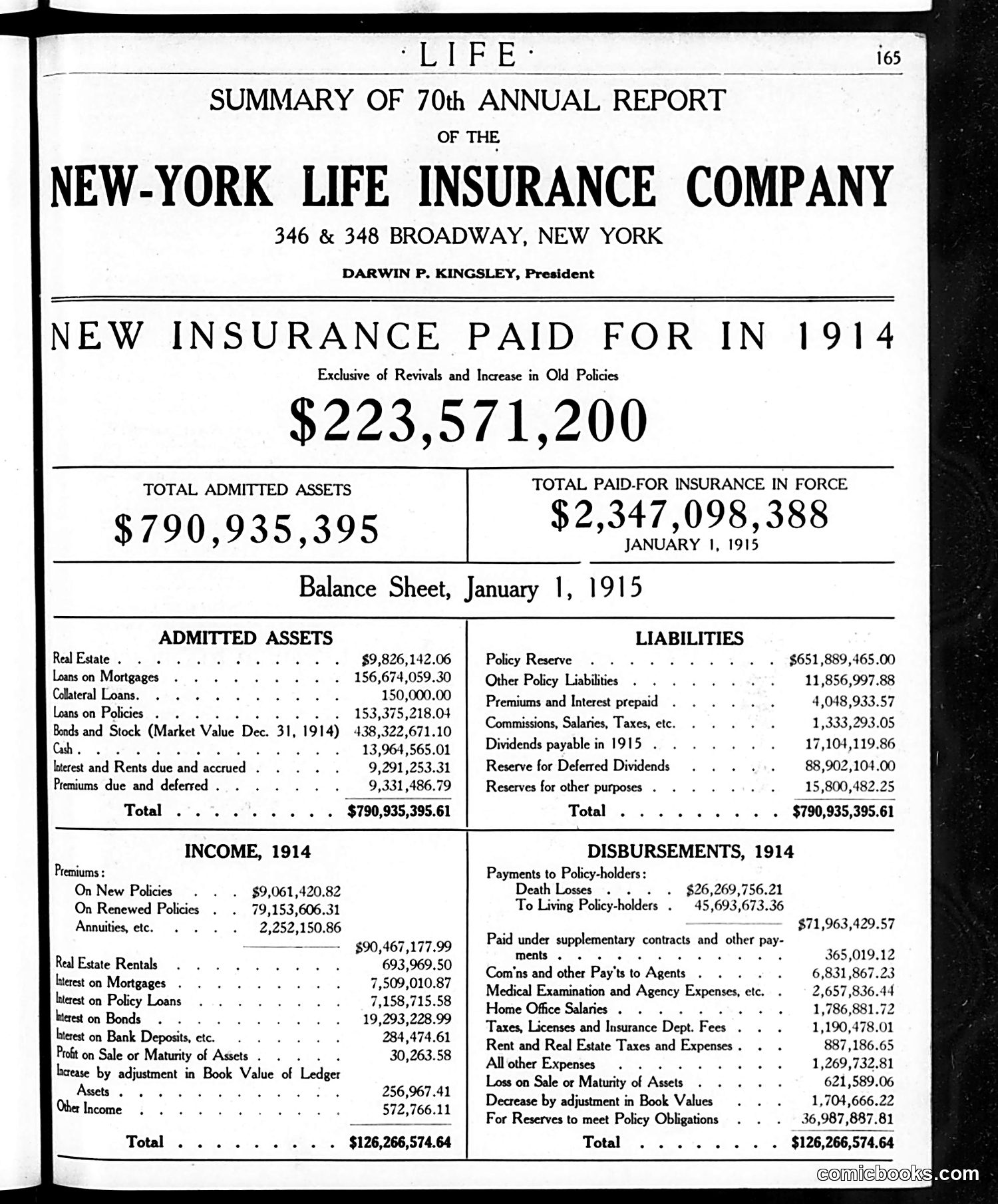
This is a financial document, not a satirical cartoon page. It's a summary of the New York Life Insurance Company's 70th annual report, presented to readers of *Life* magazine in 1915. The page displays balance sheets, assets, liabilities, income, and disbursements for the company as of January 1, 1915. It shows Darwin P. Kingsley as president and reports $223.5 million in new insurance paid for in 1914, with total assets of $790.9 million. While *Life* was primarily a satirical magazine known for political cartoons, this particular page appears to be paid advertising or a corporate financial statement inserted into the publication—common practice in early 20th-century magazines. There is no visible satirical content, caricature, or joke on this page.
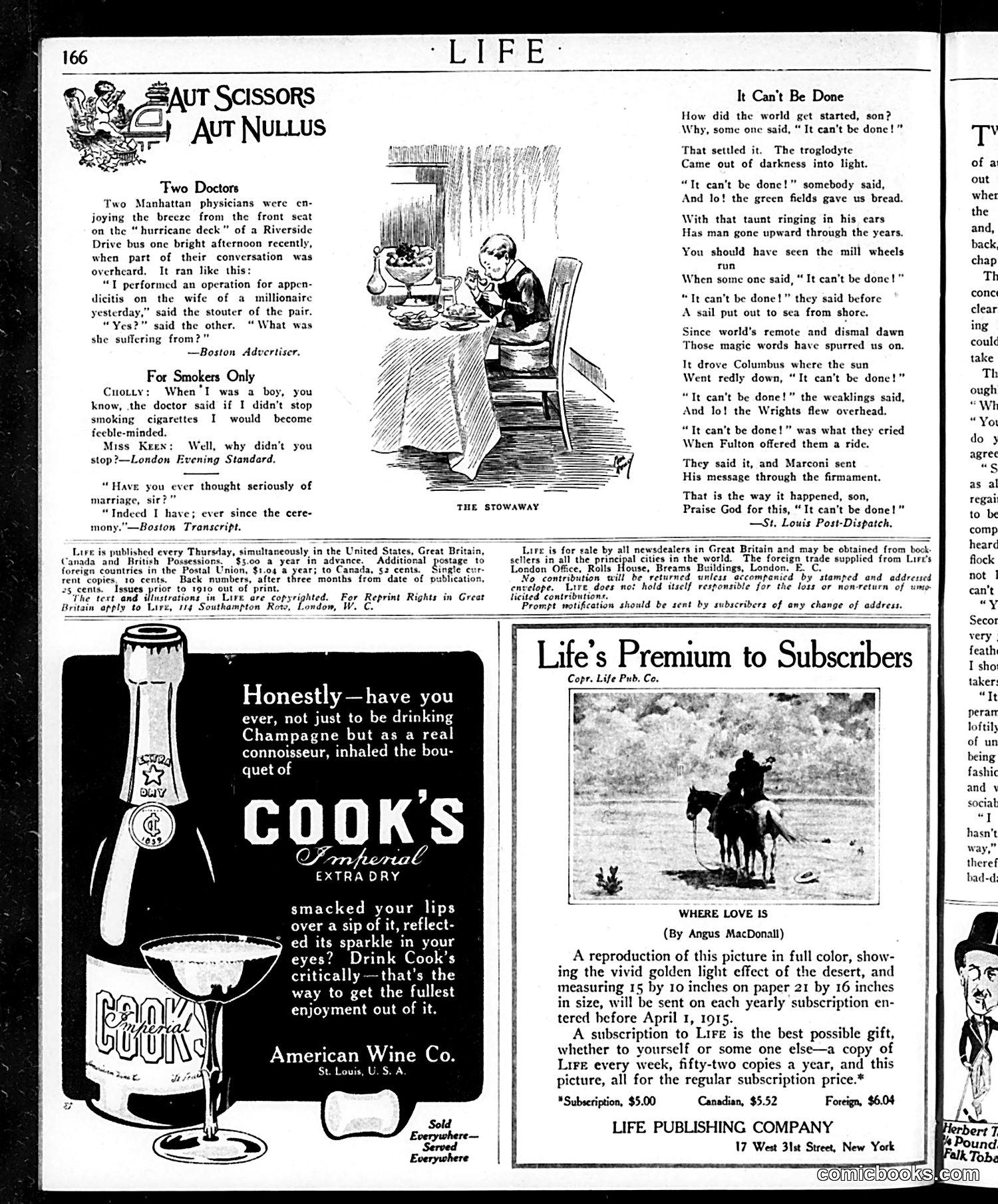
This page contains several satirical humor pieces typical of early 20th-century Life magazine: **"Two Doctors"** mocks physicians' pretension—one boasts of operating on a millionaire's wife, but the punchline reveals she suffered from nothing serious, exposing both professional pomposity and hypochondria among the wealthy. **"For Smokers Only"** presents two brief jokes: one about a doctor's smoking warning (the man ignored it, implying he became feeble-minded anyway), and another about marriage being a lifelong serious concern—mild domestic humor. **"The Stowaway"** (illustration) shows a child hiding/stowed aboard, though context is minimal. **"It Can't Be Done"** is an inspirational poem celebrating how people overcome defeatist attitudes, citing Columbus, the Wright Brothers, and Fulton as examples—typical Progressive-era boosterism. The page is largely **advertising** (Cook's Champagne, Life subscriptions with art premium) mixed with light social satire. The humor relies on familiar situations (doctors, marriage, smoking) rather than topical politics.
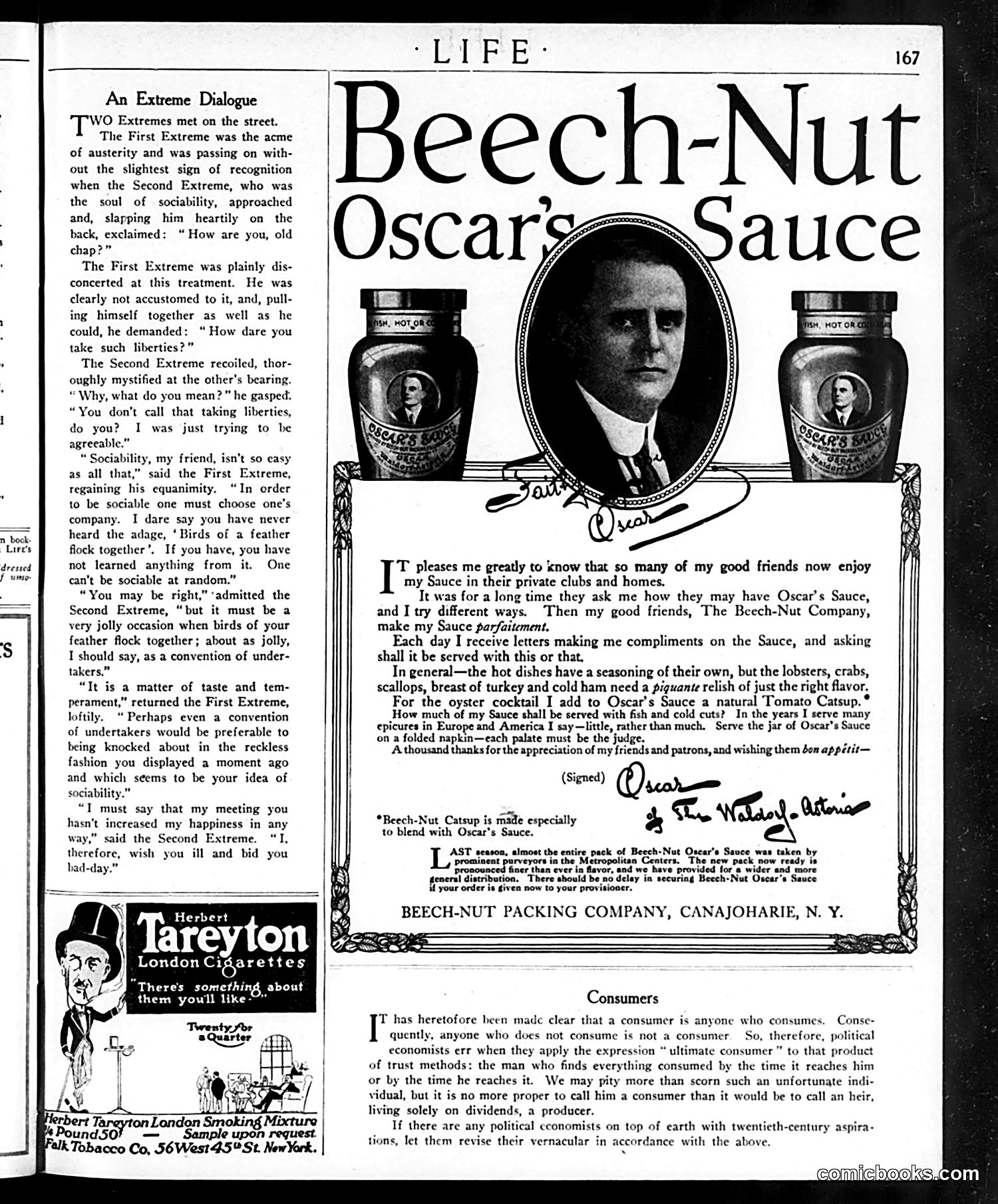
This page contains two distinct pieces: **Left side - "An Extreme Dialogue"**: A satirical sketch mocking rigid social class distinctions. Two men meet on the street—one austere and standoffish, the other jovial and friendly. The first man rejects the second's casual greeting as an unwelcome liberty, insisting sociability requires choosing one's company carefully ("birds of a feather flock together"). The joke targets snobbish elitism: the austere man's rigid propriety makes him so unpleasant that even a chance meeting with him diminishes happiness. The undertakers' convention joke emphasizes how joyless such uptight people are. **Right side - Oscar's Sauce advertisement**: Features a testimonial from someone named Oscar (appears to be a celebrity chef or restaurateur), promoting Beech-Nut's packaging of his sauce. He describes how friends request it for home use. **Bottom - "Consumers" article fragment**: Begins defining "consumer" in economic terms, criticizing how the wealthy consume goods before they reach ordinary people. The page exemplifies Life's satirical commentary on class, pretension, and social behavior.
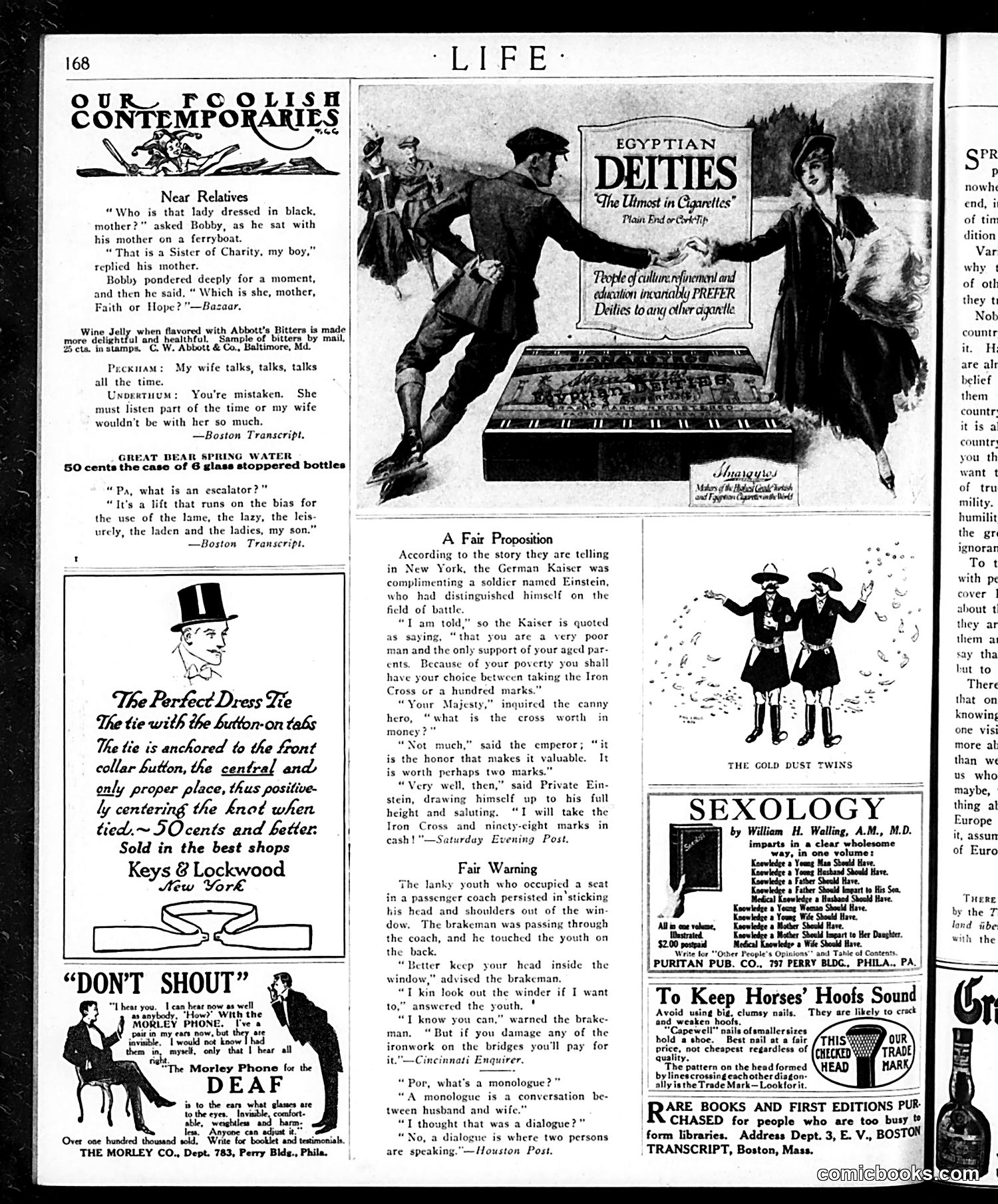
This page contains several distinct satirical pieces and advertisements from *Life* magazine. The main cartoon, "A Fair Proposition," mocks German Kaiser Wilhelm II through a supposedly true anecdote: a poor soldier named Einstein is offered either the Iron Cross or money. When told the Cross is worthless except for honor, Einstein shrewdly chooses the money plus ninety-eight marks instead—satirizing the Kaiser's empty flattery and the soldier's practical common sense. The humor targets Prussian militarism and the hollow nature of medals versus actual material reward. Other brief humorous dialogues joke about marriage, escalators, and monologues in typical early-20th-century fashion. The page is otherwise dominated by period advertisements for dress ties, bitters, water, and books on sexology—typical of *Life's* mixed editorial-advertising format from this era.
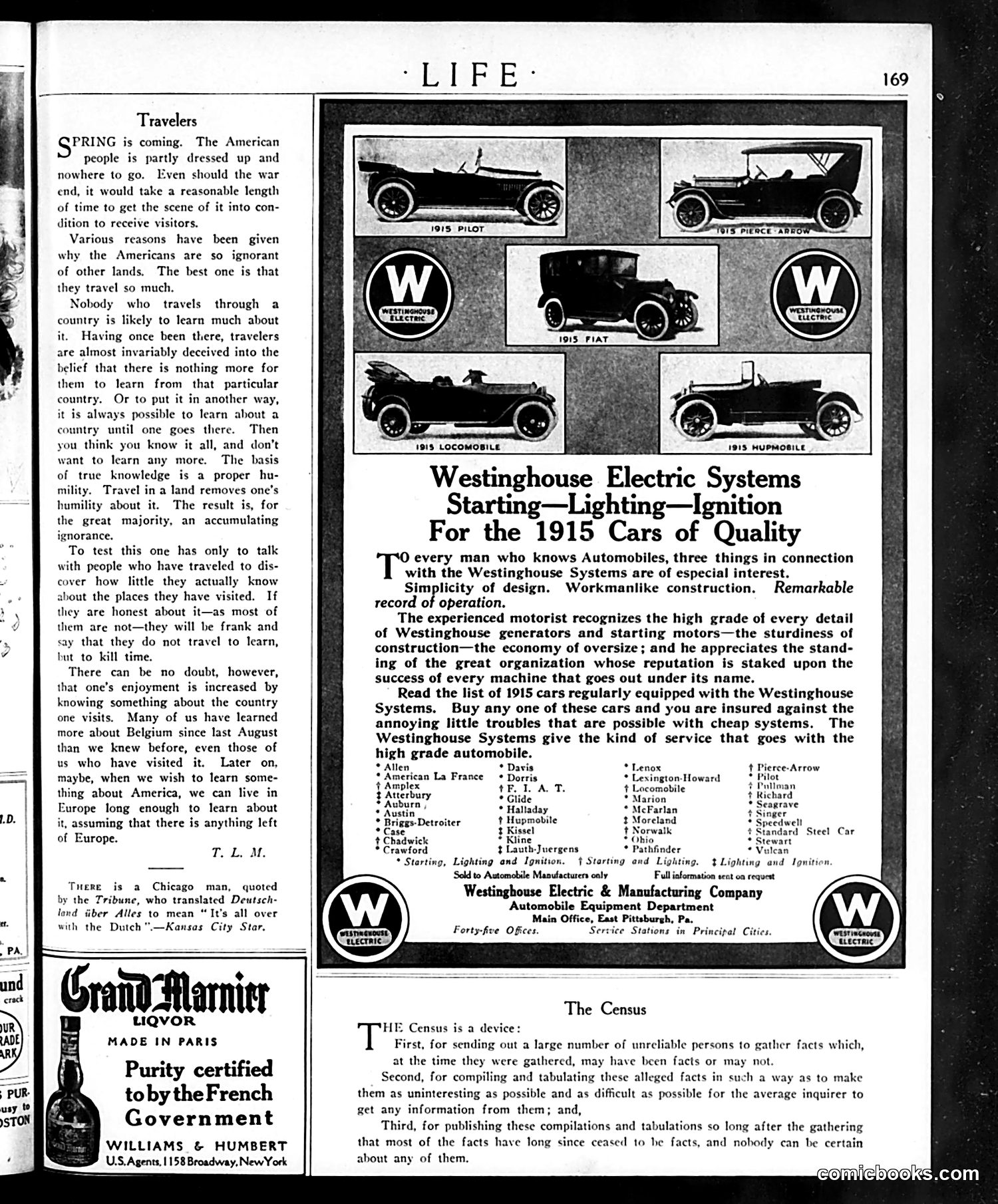
This page contains three distinct sections: **"Travelers" Essay (Left):** A satirical column by T.L.M. criticizing American tourists. The author argues that traveling *prevents* true knowledge—tourists visit places, assume they've learned everything, and refuse further study. The irony: Americans travel extensively yet remain ignorant. A secondary joke references a Chicago man's mistranslation of the German national anthem "Deutschland Über Alles" as "It's all over with the Dutch," playing on World War I tensions (the U.S. remained officially neutral until 1917, but anti-German sentiment was rising). **Westinghouse Advertisement (Center):** A straightforward car equipment ad listing 1915 automobile manufacturers, emphasizing electrical systems' reliability. **"The Census" (Bottom):** A brief, incomplete satirical piece (text cuts off) mocking the Census Bureau as inefficient—sending "unreliable persons" to gather facts that become outdated and useless by publication. The page primarily showcases Life magazine's satirical voice about American ignorance and institutional inefficiency, framed around pre-WWI anxieties.
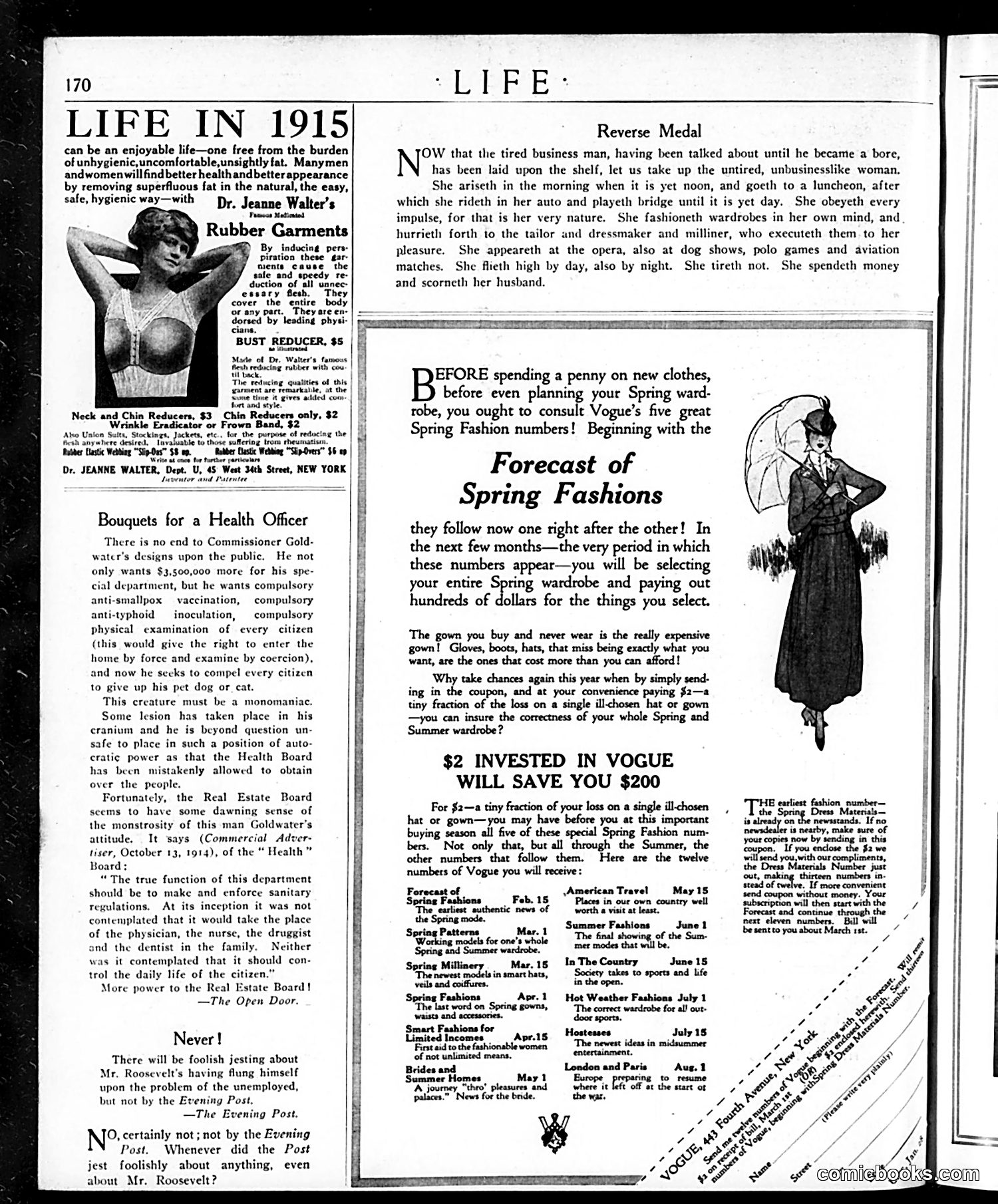
This page mixes advertising with satirical commentary typical of Life magazine's format. **The advertisements** promote Dr. Jeanne Walter's rubber garments for weight reduction—corsets and wraps claiming to reduce flesh through perspiration. This reflects early-1900s attitudes toward women's bodies and the lucrative "reducing" industry. **The satirical articles** critique 1915 society: 1. "Bouquets for a Health Officer" attacks Commissioner Goldwater's expansive public health powers, calling him a "monomaniac" for seeking mandatory vaccinations and home inspections. It satirizes government overreach in citizens' private lives. 2. "Reverse Medal" mocks the leisured wealthy woman—contrasting her with the "tired business man" (previously satirized). She spends recklessly on fashion, attends constant social events (opera, polo, dog shows), and "scorneth her husband." It's satirical social commentary on idle wealth and female consumer excess. The Vogue fashion advertisement promises that $2 invested in their magazine will save $200 on clothing mistakes—capitalist logic applied to fashion advice.
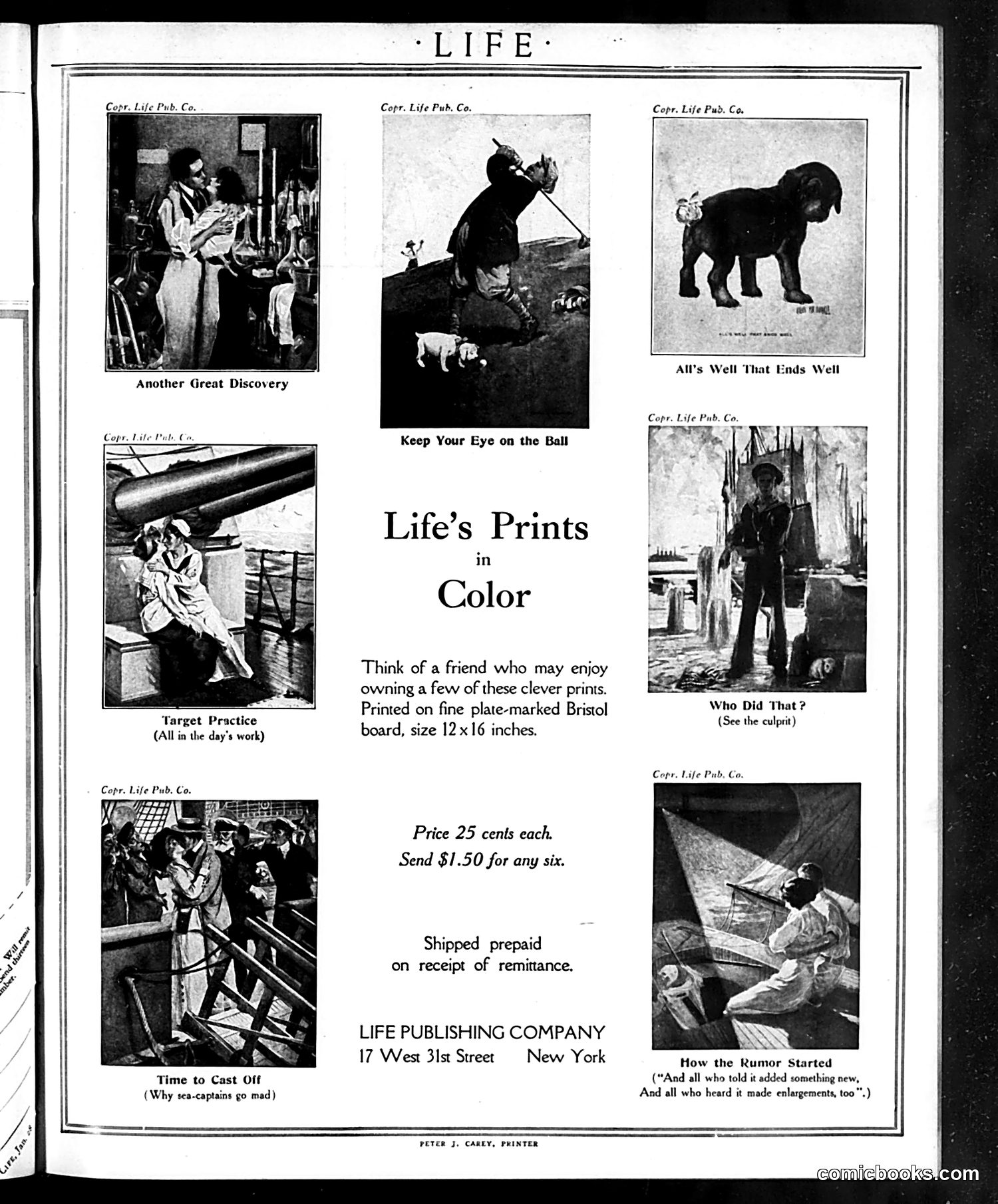
This is a product advertisement page for Life Publishing Company, selling hand-colored prints rather than political satire. The page displays six humorous illustrated prints available for purchase at 25 cents each. The prints depict everyday comedic scenarios: a medical discovery, a man looking through a telescope, a large dog, target practice shooting, a sea captain casting off his ship, and rumor-spreading. Each carries a clever caption playing on common expressions or social observations—"All's Well That Ends Well," "Keep Your Eye on the Ball," "Why Sea-captains Go Mad," etc. The humor relies on visual gags and wordplay accessible to early 20th-century audiences. There are no identifiable political figures or specific current events referenced. This is purely domestic, lighthearted entertainment merchandise, marketed to readers who might gift these prints to friends. The advertising emphasizes their quality (fine Bristol board, hand-colored) and affordability.
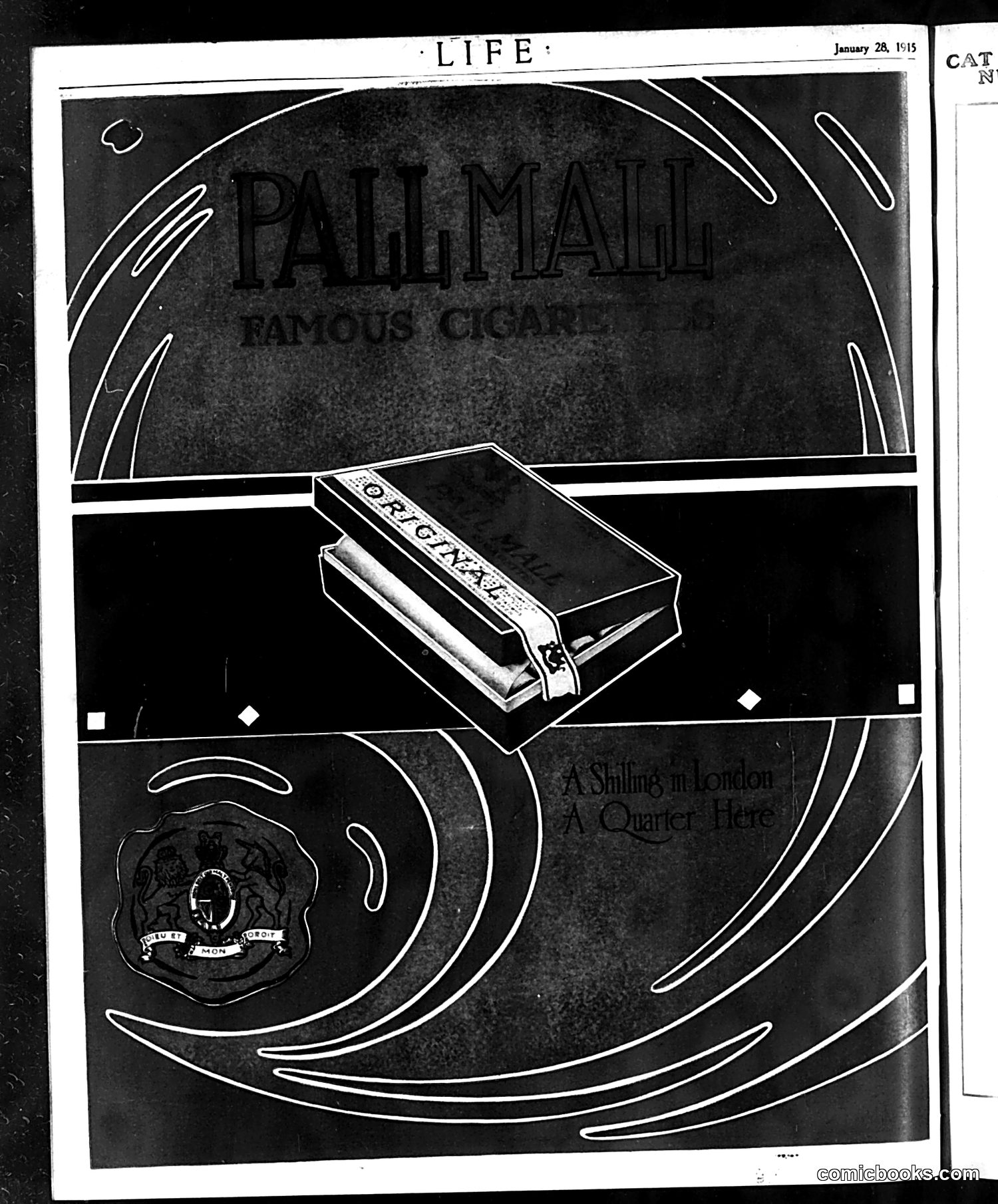
This is a **cigarette advertisement** from Life magazine (January 28, 1915), not a political cartoon. It promotes Pall Mall "Famous Cigaret[tes]" with pricing text reading "A Shilling in London / A Quarter Here." The ad uses Art Deco styling with geometric line work and displays a pack of Pall Mall cigarettes prominently in the center. A heraldic crest or coat of arms appears in the lower section, likely suggesting the product's British origin or prestige. The pricing comparison is the advertisement's key message: a Pall Mall costs one shilling in London but only a quarter (25 cents) in America, positioning it as an affordable luxury import for American consumers during the early twentieth century.